Criminal Justice 2011
Class Name,
Instructor Name
Date, Semester
© 2012 by Pearson Higher Education, Inc
Upper Saddle River, New Jersey 07458 • All Rights Reserved
NEWS MAKERS
PSYCHOPATHS
•Embodiment of evil
•Wicked acts of bad people
•Percent of the population
•25 percent of jail and prison inmates
•Serial homicide and sadistic sexual assault
2
© 2012 by Pearson Higher Education, Inc
Upper Saddle River, New Jersey 07458 • All Rights Reserved
VIRTUE AND VICE
• Virtue and Character
• Character trait
• Moral behavior
• Immoral behavior
3
© 2012 by Pearson Higher Education, Inc
Upper Saddle River, New Jersey 07458 • All Rights Reserved
VIRTUE, CHARACTER, AND BEHAVIOR
TRAITS
• MORAL VIRTUES
• MORAL VICES
4
© 2012 by Pearson Higher Education, Inc
Upper Saddle River, New Jersey 07458 • All Rights Reserved
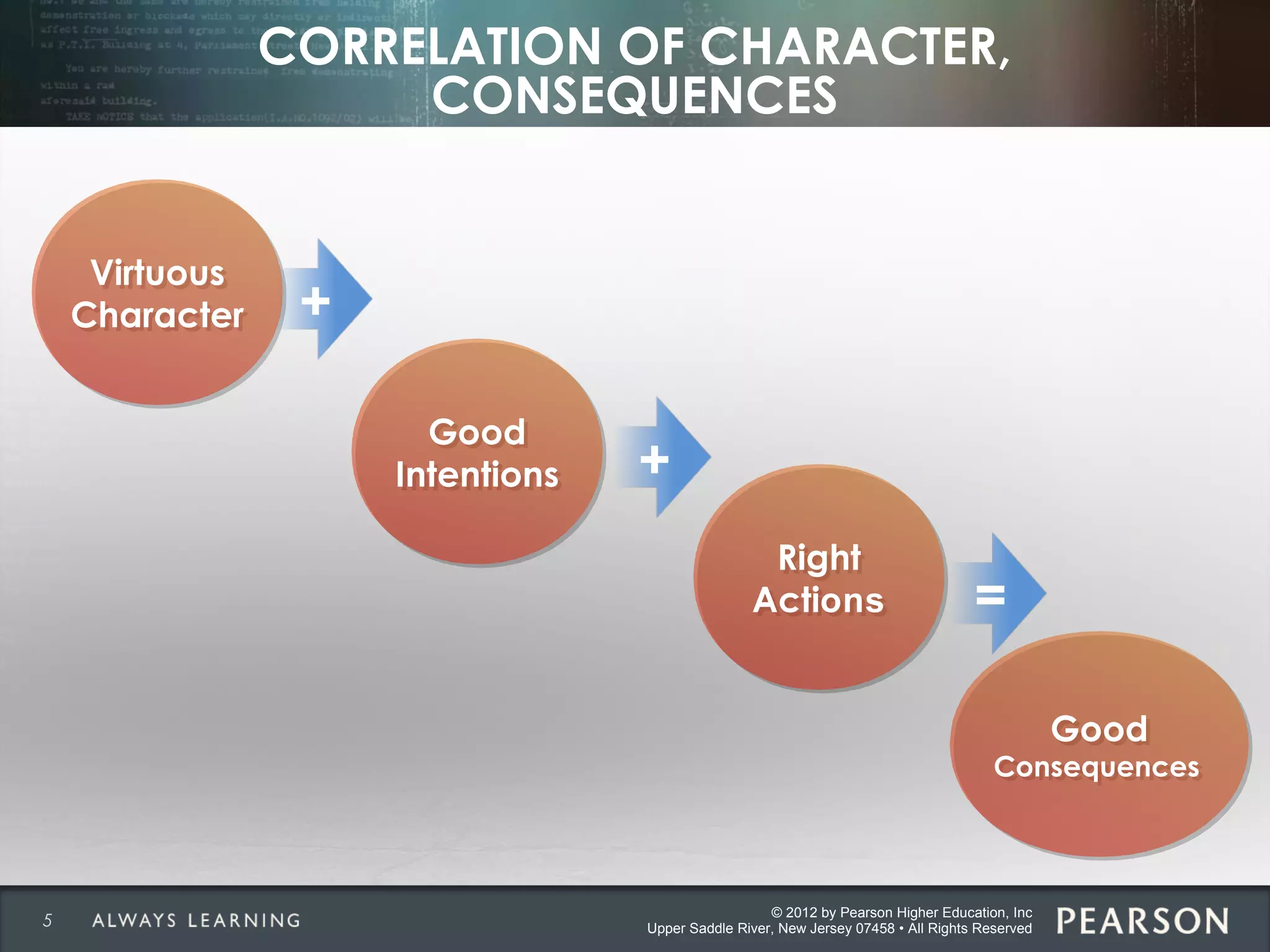
CORRELATION OF CHARACTER,
CONSEQUENCES
5
Good
Consequences
Good
Consequences
Right
Actions
Right
Actions
+
Good
Intentions
Good
Intentions
+
Virtuous
Character
Virtuous
Character
=
© 2012 by Pearson Higher Education, Inc
Upper Saddle River, New Jersey 07458 • All Rights Reserved
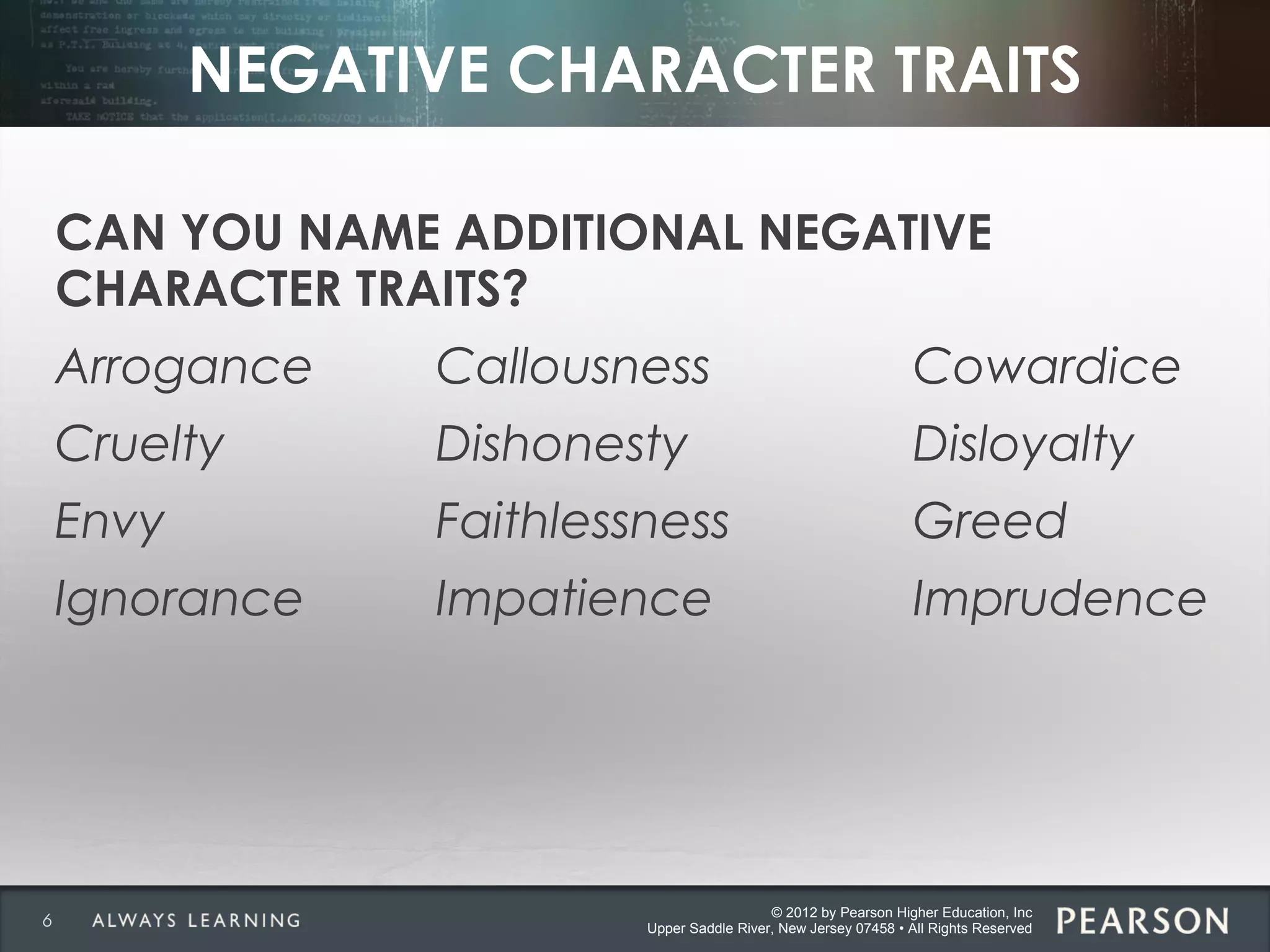
NEGATIVE CHARACTER TRAITS
CAN YOU NAME ADDITIONAL NEGATIVE
CHARACTER TRAITS?
Arrogance Callousness Cowardice
Cruelty Dishonesty Disloyalty
Envy Faithlessness Greed
Ignorance Impatience Imprudence
6
© 2012 by Pearson Higher Education, Inc
Upper Saddle River, New Jersey 07458 • All Rights Reserved
VIRTUE AND HUMAN FLOURISHING
• Human Flourishing
• Differences
• Similarities
7
© 2012 by Pearson Higher Education, Inc
Upper Saddle River, New Jersey 07458 • All Rights Reserved
SIMILARITIES
• BIOGENIC NEEDS
• COOPERATION - social beings
• CONNECTEDNESS - associations
8
© 2012 by Pearson Higher Education, Inc
Upper Saddle River, New Jersey 07458 • All Rights Reserved
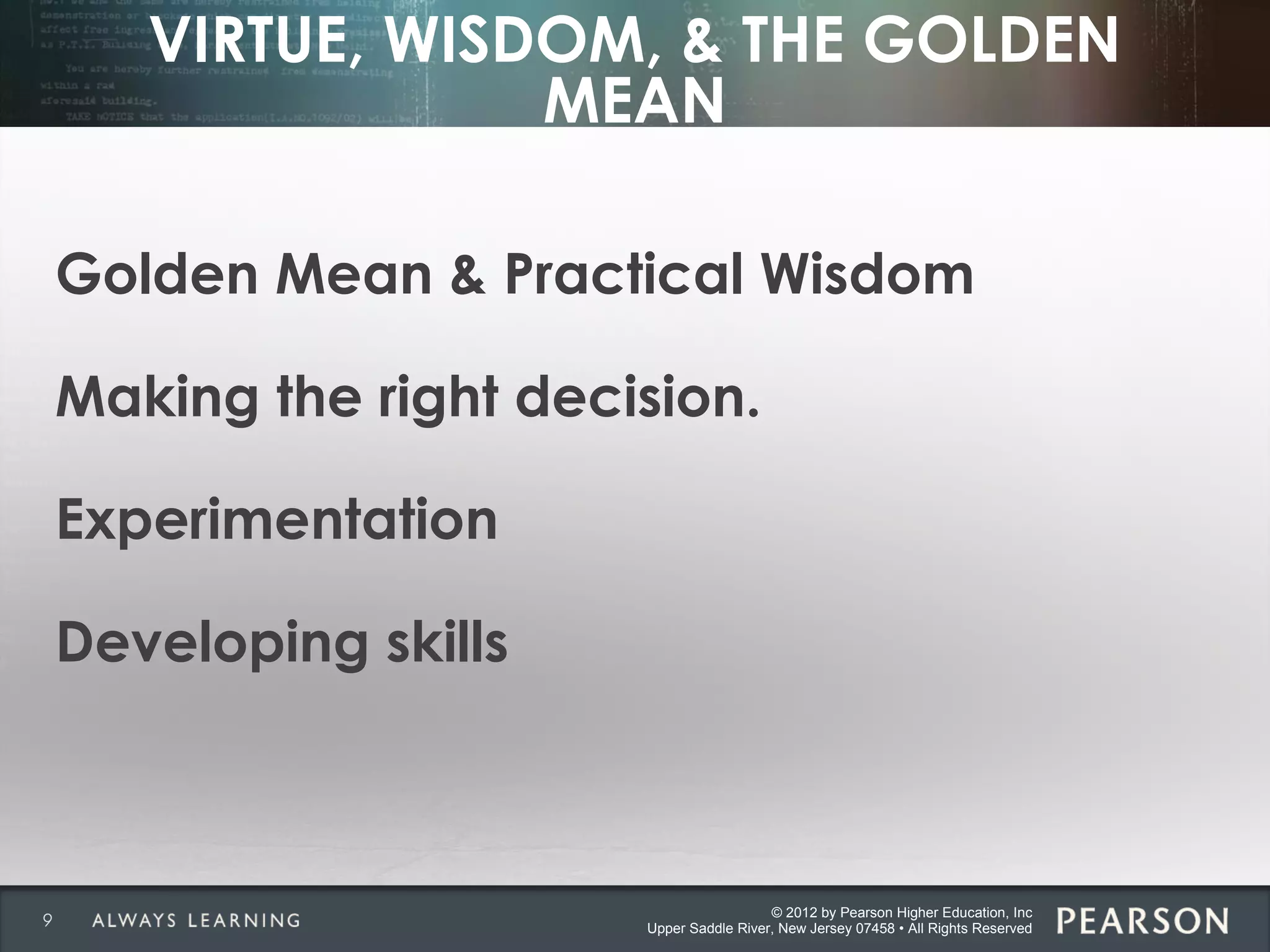
VIRTUE, WISDOM, & THE GOLDEN
MEAN
Golden Mean & Practical Wisdom
Making the right decision.
Experimentation
Developing skills
9
© 2012 by Pearson Higher Education, Inc
Upper Saddle River, New Jersey 07458 • All Rights Reserved
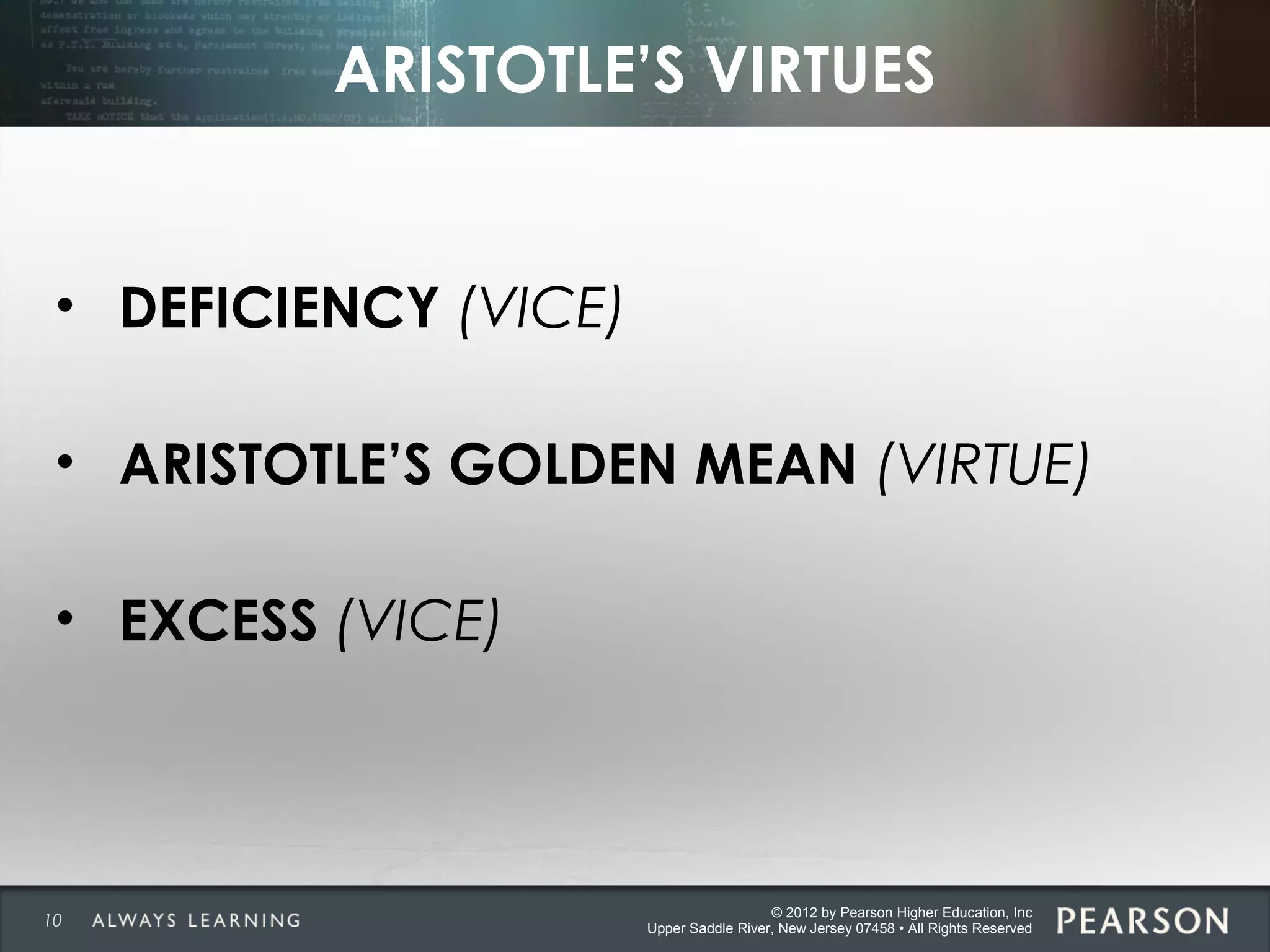
ARISTOTLE’S VIRTUES
• DEFICIENCY (VICE)
• ARISTOTLE’S GOLDEN MEAN (VIRTUE)
• EXCESS (VICE)
10
© 2012 by Pearson Higher Education, Inc
Upper Saddle River, New Jersey 07458 • All Rights Reserved
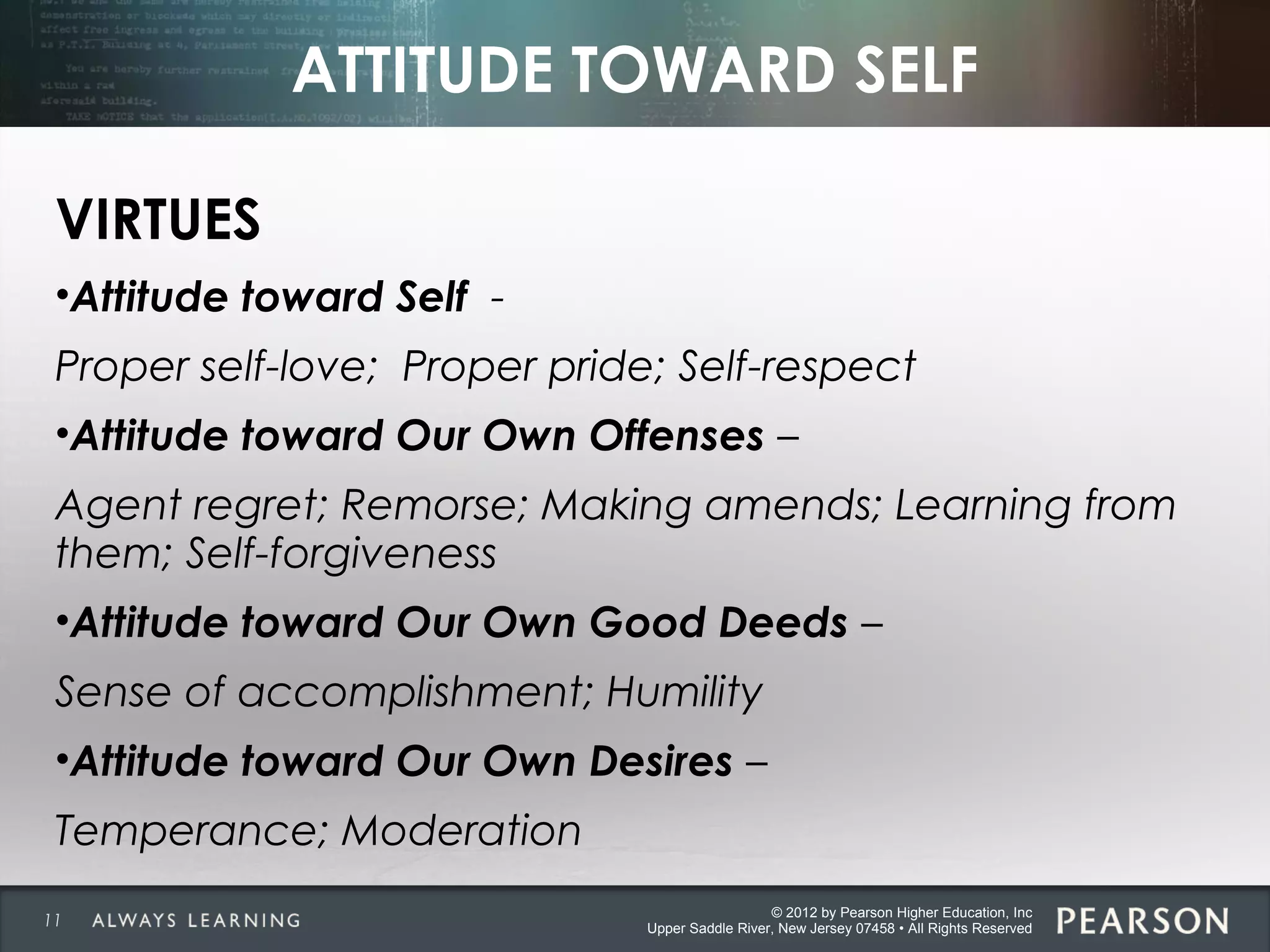
ATTITUDE TOWARD SELF
VIRTUES
•Attitude toward Self -
Proper self-love; Proper pride; Self-respect
•Attitude toward Our Own Offenses –
Agent regret; Remorse; Making amends; Learning from
them; Self-forgiveness
•Attitude toward Our Own Good Deeds –
Sense of accomplishment; Humility
•Attitude toward Our Own Desires –
Temperance; Moderation
11
© 2012 by Pearson Higher Education, Inc
Upper Saddle River, New Jersey 07458 • All Rights Reserved
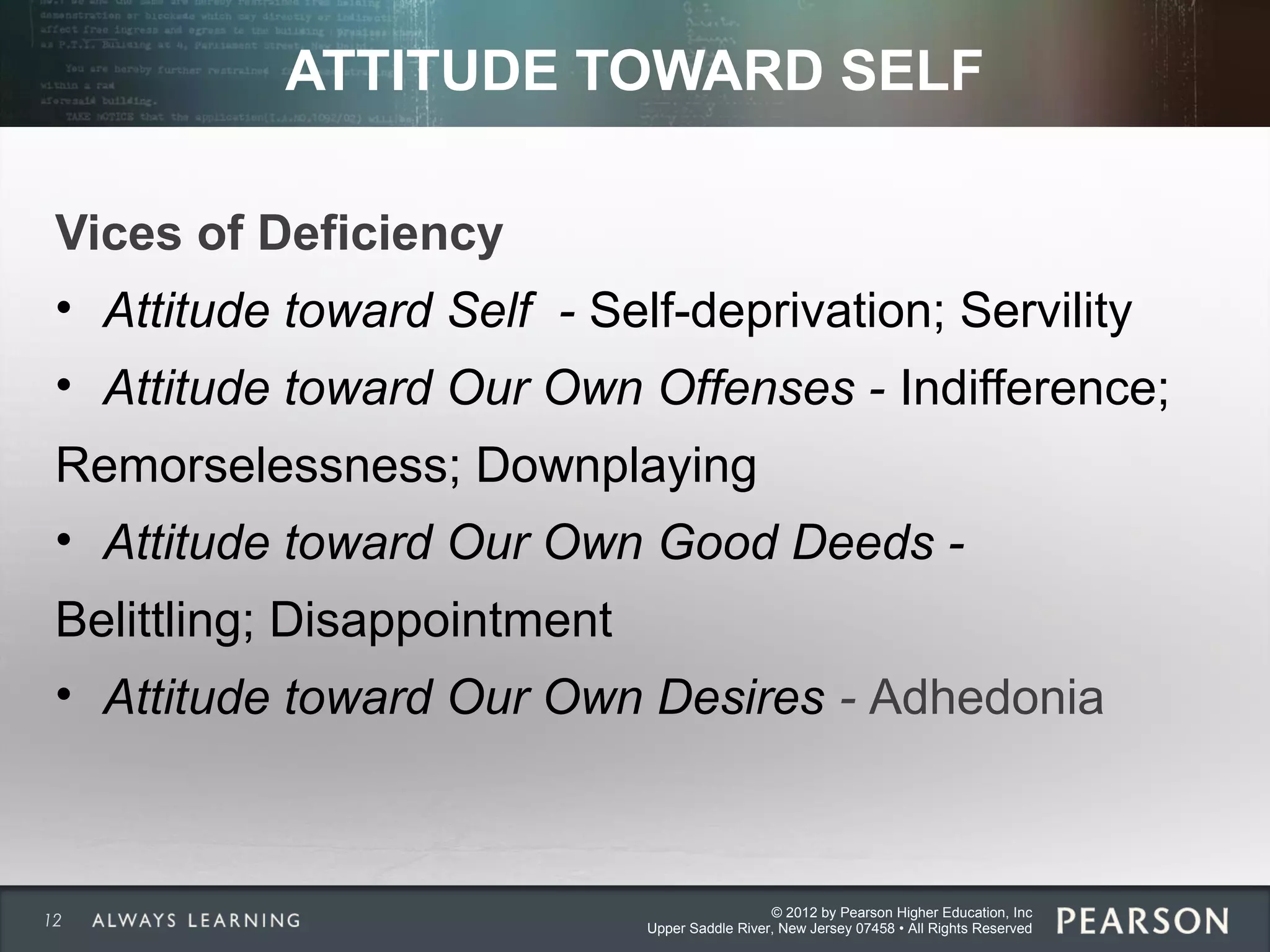
ATTITUDE TOWARD SELF
Vices of Deficiency
• Attitude toward Self - Self-deprivation; Servility
• Attitude toward Our Own Offenses - Indifference;
Remorselessness; Downplaying
• Attitude toward Our Own Good Deeds -
Belittling; Disappointment
• Attitude toward Our Own Desires - Adhedonia
12
© 2012 by Pearson Higher Education, Inc
Upper Saddle River, New Jersey 07458 • All Rights Reserved
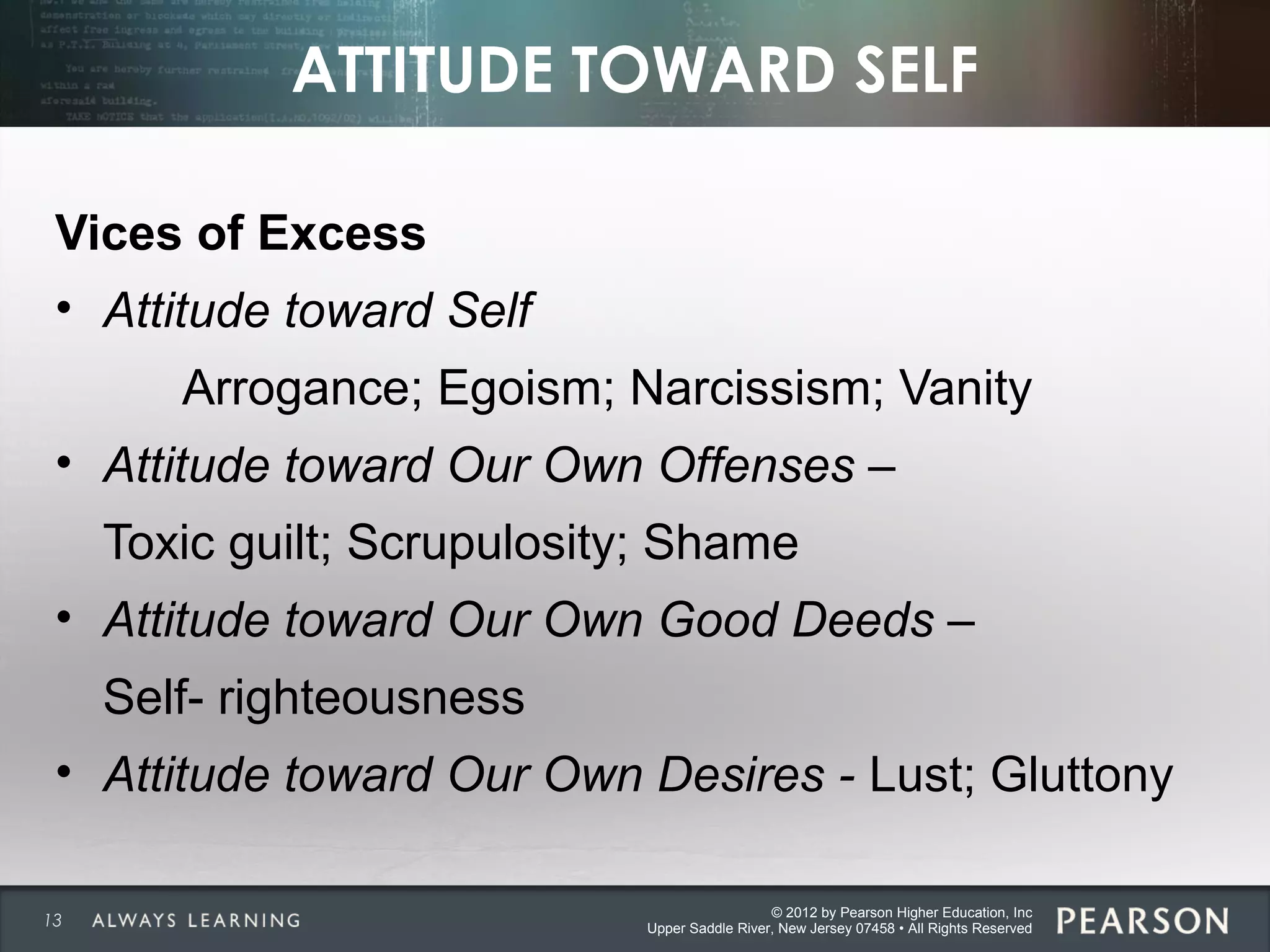
ATTITUDE TOWARD SELF
Vices of Excess
• Attitude toward Self
Arrogance; Egoism; Narcissism; Vanity
• Attitude toward Our Own Offenses –
Toxic guilt; Scrupulosity; Shame
• Attitude toward Our Own Good Deeds –
Self- righteousness
• Attitude toward Our Own Desires - Lust; Gluttony
13
© 2012 by Pearson Higher Education, Inc
Upper Saddle River, New Jersey 07458 • All Rights Reserved
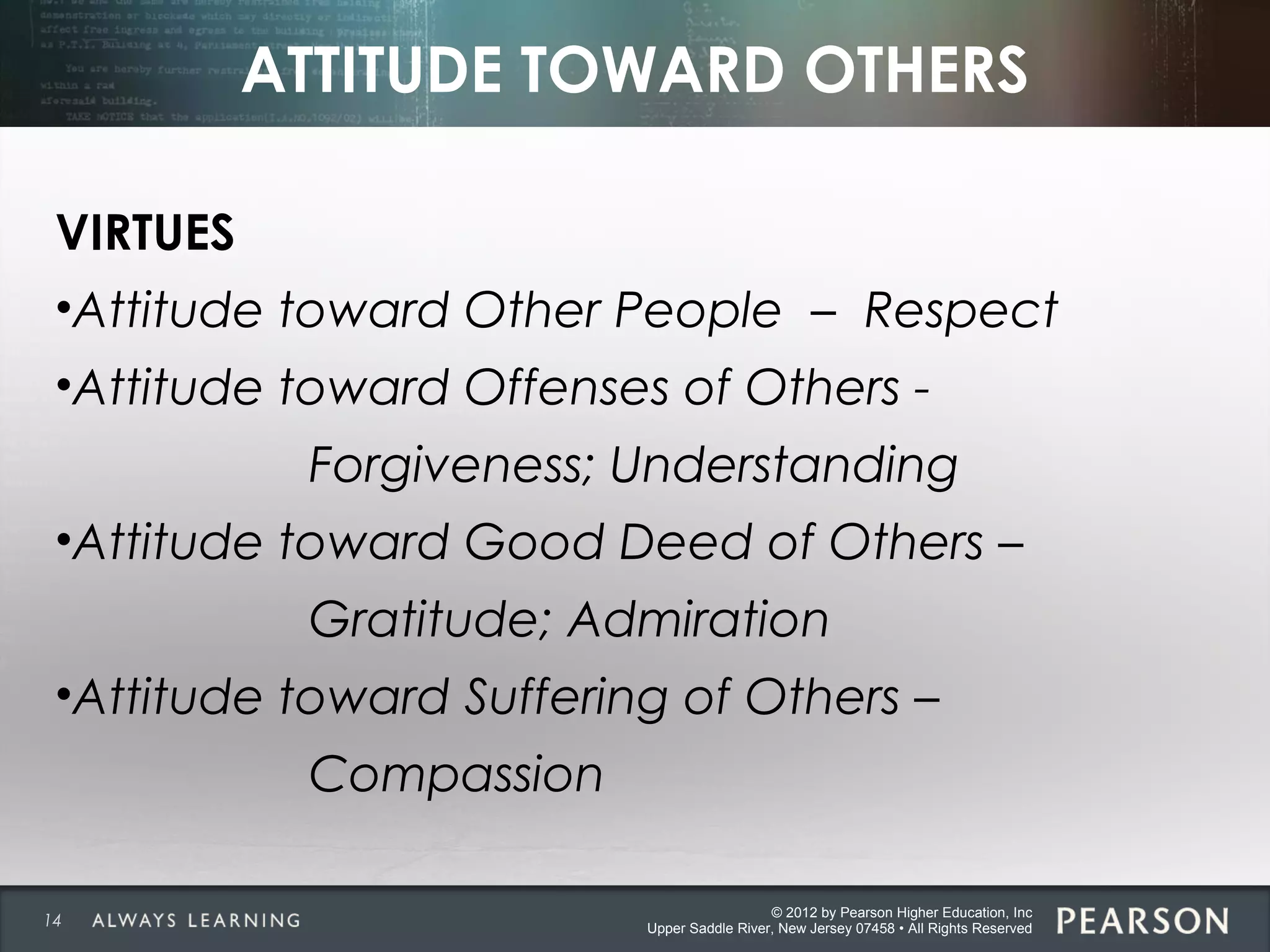
ATTITUDE TOWARD OTHERS
VIRTUES
•Attitude toward Other People – Respect
•Attitude toward Offenses of Others -
Forgiveness; Understanding
•Attitude toward Good Deed of Others –
Gratitude; Admiration
•Attitude toward Suffering of Others –
Compassion
14
© 2012 by Pearson Higher Education, Inc
Upper Saddle River, New Jersey 07458 • All Rights Reserved
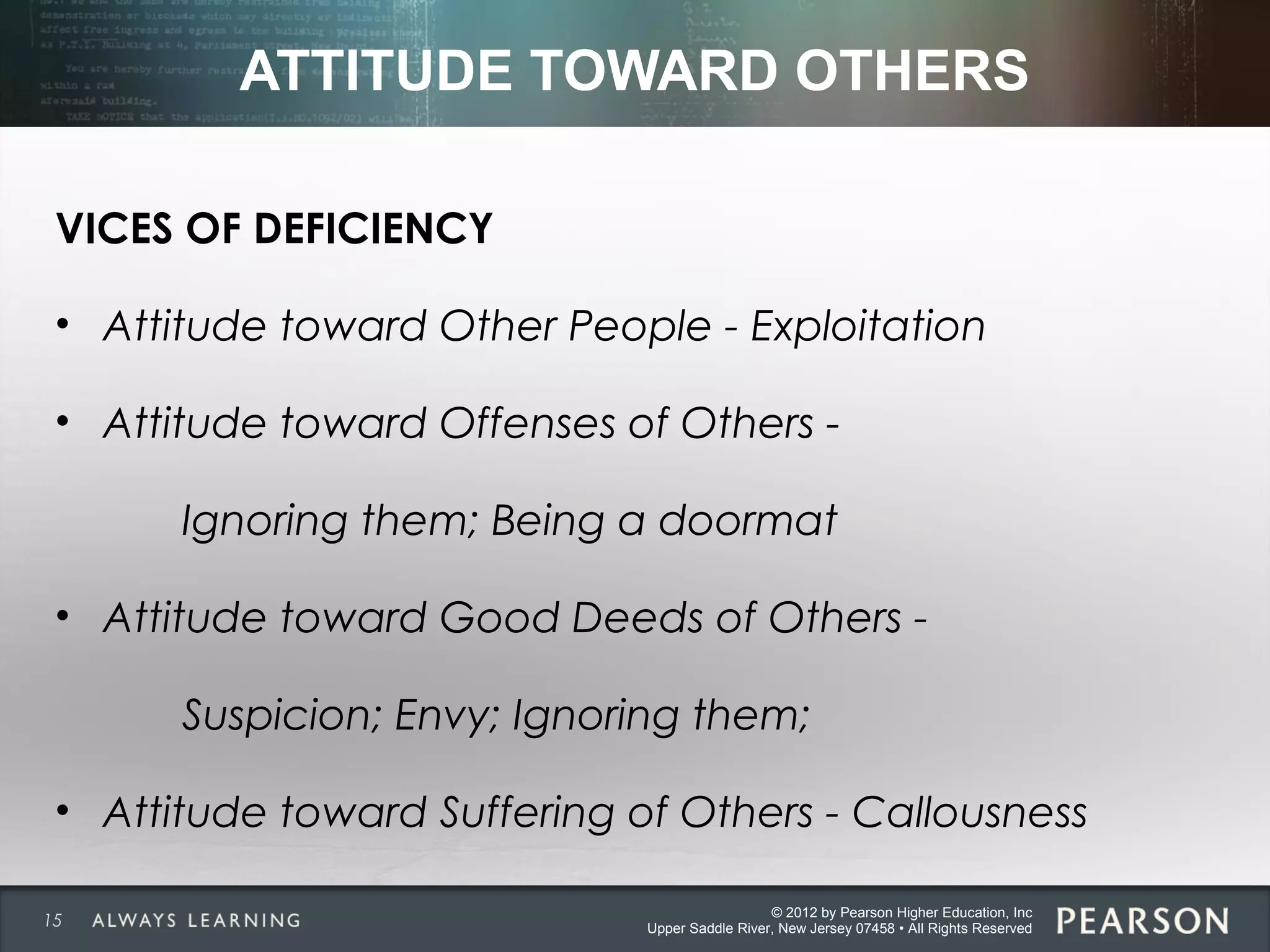
ATTITUDE TOWARD OTHERS
VICES OF DEFICIENCY
• Attitude toward Other People - Exploitation
• Attitude toward Offenses of Others -
Ignoring them; Being a doormat
• Attitude toward Good Deeds of Others -
Suspicion; Envy; Ignoring them;
• Attitude toward Suffering of Others - Callousness
15
© 2012 by Pearson Higher Education, Inc
Upper Saddle River, New Jersey 07458 • All Rights Reserved
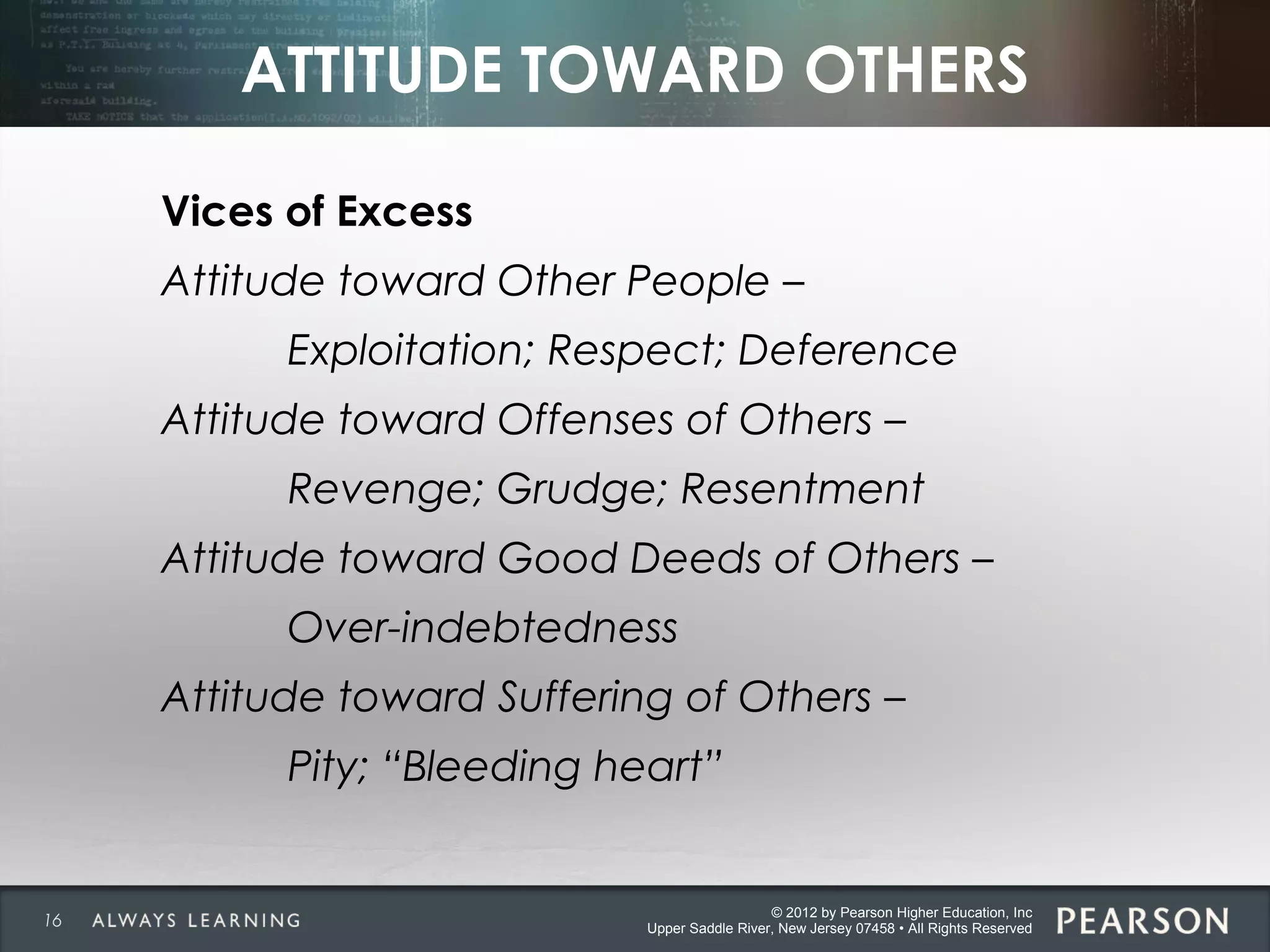
ATTITUDE TOWARD OTHERS
Vices of Excess
Attitude toward Other People –
Exploitation; Respect; Deference
Attitude toward Offenses of Others –
Revenge; Grudge; Resentment
Attitude toward Good Deeds of Others –
Over-indebtedness
Attitude toward Suffering of Others –
Pity; “Bleeding heart”
16
© 2012 by Pearson Higher Education, Inc
Upper Saddle River, New Jersey 07458 • All Rights Reserved
CRITICAL VIRTUES IN CRIMINAL
JUSTICE
• Honesty
• Justice
• Wisdom/Knowledge
• Responsibility/Accountability
• Temperance
17
© 2012 by Pearson Higher Education, Inc
Upper Saddle River, New Jersey 07458 • All Rights Reserved
RESTORATIVE JUSTICE
Victim-Offender Reconciliation
Programs (VORP)
18
© 2012 by Pearson Higher Education, Inc
Upper Saddle River, New Jersey 07458 • All Rights Reserved
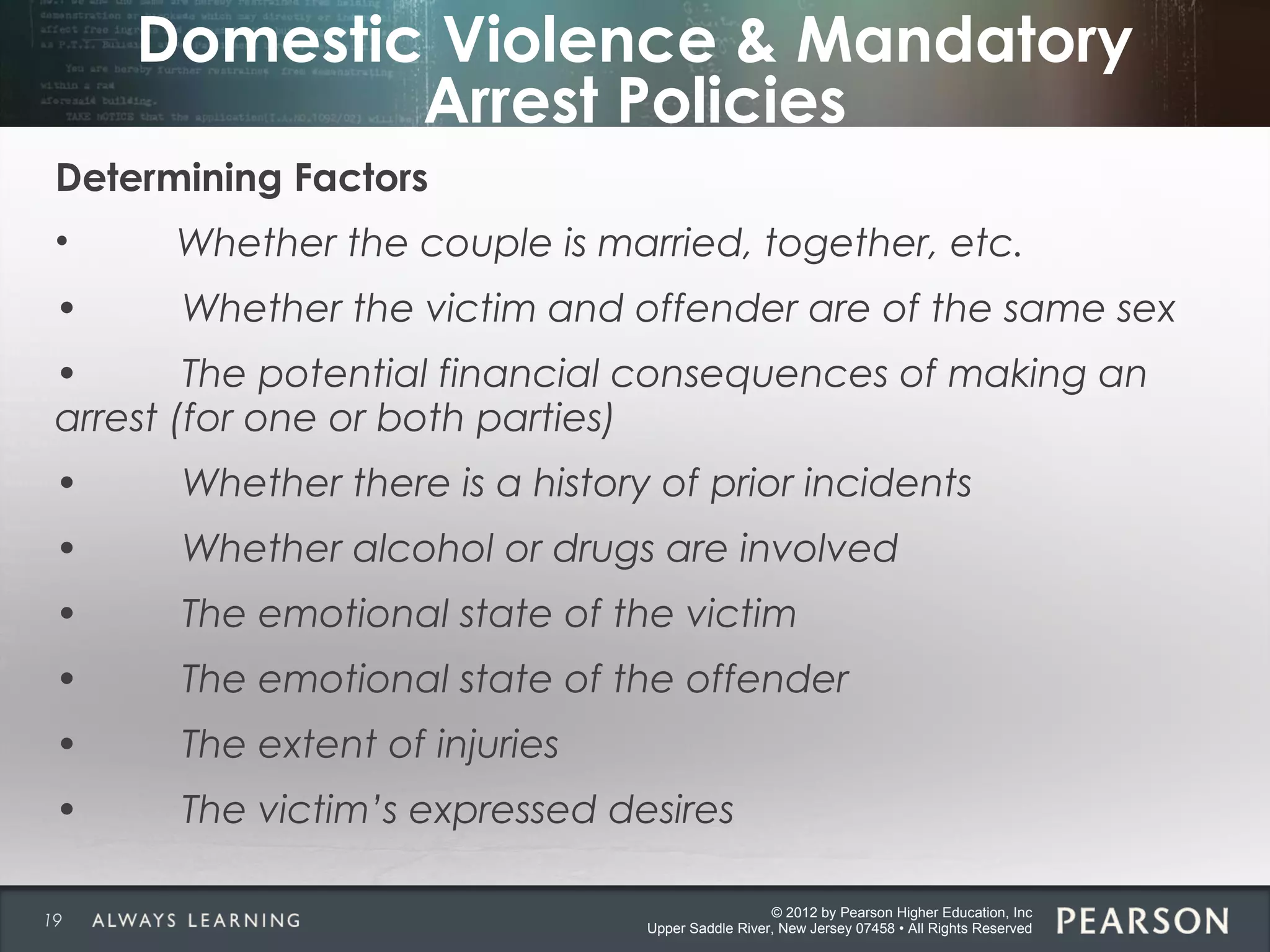
Domestic Violence & Mandatory
Arrest Policies
Determining Factors
• Whether the couple is married, together, etc.
• Whether the victim and offender are of the same sex
• The potential financial consequences of making an
arrest (for one or both parties)
• Whether there is a history of prior incidents
• Whether alcohol or drugs are involved
• The emotional state of the victim
• The emotional state of the offender
• The extent of injuries
• The victim’s expressed desires
19

p305_pp10

  • 1.
    Criminal Justice 2011 ClassName, Instructor Name Date, Semester
  • 2.
    © 2012 byPearson Higher Education, Inc Upper Saddle River, New Jersey 07458 • All Rights Reserved NEWS MAKERS PSYCHOPATHS •Embodiment of evil •Wicked acts of bad people •Percent of the population •25 percent of jail and prison inmates •Serial homicide and sadistic sexual assault 2
  • 3.
    © 2012 byPearson Higher Education, Inc Upper Saddle River, New Jersey 07458 • All Rights Reserved VIRTUE AND VICE • Virtue and Character • Character trait • Moral behavior • Immoral behavior 3
  • 4.
    © 2012 byPearson Higher Education, Inc Upper Saddle River, New Jersey 07458 • All Rights Reserved VIRTUE, CHARACTER, AND BEHAVIOR TRAITS • MORAL VIRTUES • MORAL VICES 4
  • 5.
    © 2012 byPearson Higher Education, Inc Upper Saddle River, New Jersey 07458 • All Rights Reserved CORRELATION OF CHARACTER, CONSEQUENCES 5 Good Consequences Good Consequences Right Actions Right Actions + Good Intentions Good Intentions + Virtuous Character Virtuous Character =
  • 6.
    © 2012 byPearson Higher Education, Inc Upper Saddle River, New Jersey 07458 • All Rights Reserved NEGATIVE CHARACTER TRAITS CAN YOU NAME ADDITIONAL NEGATIVE CHARACTER TRAITS? Arrogance Callousness Cowardice Cruelty Dishonesty Disloyalty Envy Faithlessness Greed Ignorance Impatience Imprudence 6
  • 7.
    © 2012 byPearson Higher Education, Inc Upper Saddle River, New Jersey 07458 • All Rights Reserved VIRTUE AND HUMAN FLOURISHING • Human Flourishing • Differences • Similarities 7
  • 8.
    © 2012 byPearson Higher Education, Inc Upper Saddle River, New Jersey 07458 • All Rights Reserved SIMILARITIES • BIOGENIC NEEDS • COOPERATION - social beings • CONNECTEDNESS - associations 8
  • 9.
    © 2012 byPearson Higher Education, Inc Upper Saddle River, New Jersey 07458 • All Rights Reserved VIRTUE, WISDOM, & THE GOLDEN MEAN Golden Mean & Practical Wisdom Making the right decision. Experimentation Developing skills 9
  • 10.
    © 2012 byPearson Higher Education, Inc Upper Saddle River, New Jersey 07458 • All Rights Reserved ARISTOTLE’S VIRTUES • DEFICIENCY (VICE) • ARISTOTLE’S GOLDEN MEAN (VIRTUE) • EXCESS (VICE) 10
  • 11.
    © 2012 byPearson Higher Education, Inc Upper Saddle River, New Jersey 07458 • All Rights Reserved ATTITUDE TOWARD SELF VIRTUES •Attitude toward Self - Proper self-love; Proper pride; Self-respect •Attitude toward Our Own Offenses – Agent regret; Remorse; Making amends; Learning from them; Self-forgiveness •Attitude toward Our Own Good Deeds – Sense of accomplishment; Humility •Attitude toward Our Own Desires – Temperance; Moderation 11
  • 12.
    © 2012 byPearson Higher Education, Inc Upper Saddle River, New Jersey 07458 • All Rights Reserved ATTITUDE TOWARD SELF Vices of Deficiency • Attitude toward Self - Self-deprivation; Servility • Attitude toward Our Own Offenses - Indifference; Remorselessness; Downplaying • Attitude toward Our Own Good Deeds - Belittling; Disappointment • Attitude toward Our Own Desires - Adhedonia 12
  • 13.
    © 2012 byPearson Higher Education, Inc Upper Saddle River, New Jersey 07458 • All Rights Reserved ATTITUDE TOWARD SELF Vices of Excess • Attitude toward Self Arrogance; Egoism; Narcissism; Vanity • Attitude toward Our Own Offenses – Toxic guilt; Scrupulosity; Shame • Attitude toward Our Own Good Deeds – Self- righteousness • Attitude toward Our Own Desires - Lust; Gluttony 13
  • 14.
    © 2012 byPearson Higher Education, Inc Upper Saddle River, New Jersey 07458 • All Rights Reserved ATTITUDE TOWARD OTHERS VIRTUES •Attitude toward Other People – Respect •Attitude toward Offenses of Others - Forgiveness; Understanding •Attitude toward Good Deed of Others – Gratitude; Admiration •Attitude toward Suffering of Others – Compassion 14
  • 15.
    © 2012 byPearson Higher Education, Inc Upper Saddle River, New Jersey 07458 • All Rights Reserved ATTITUDE TOWARD OTHERS VICES OF DEFICIENCY • Attitude toward Other People - Exploitation • Attitude toward Offenses of Others - Ignoring them; Being a doormat • Attitude toward Good Deeds of Others - Suspicion; Envy; Ignoring them; • Attitude toward Suffering of Others - Callousness 15
  • 16.
    © 2012 byPearson Higher Education, Inc Upper Saddle River, New Jersey 07458 • All Rights Reserved ATTITUDE TOWARD OTHERS Vices of Excess Attitude toward Other People – Exploitation; Respect; Deference Attitude toward Offenses of Others – Revenge; Grudge; Resentment Attitude toward Good Deeds of Others – Over-indebtedness Attitude toward Suffering of Others – Pity; “Bleeding heart” 16
  • 17.
    © 2012 byPearson Higher Education, Inc Upper Saddle River, New Jersey 07458 • All Rights Reserved CRITICAL VIRTUES IN CRIMINAL JUSTICE • Honesty • Justice • Wisdom/Knowledge • Responsibility/Accountability • Temperance 17
  • 18.
    © 2012 byPearson Higher Education, Inc Upper Saddle River, New Jersey 07458 • All Rights Reserved RESTORATIVE JUSTICE Victim-Offender Reconciliation Programs (VORP) 18
  • 19.
    © 2012 byPearson Higher Education, Inc Upper Saddle River, New Jersey 07458 • All Rights Reserved Domestic Violence & Mandatory Arrest Policies Determining Factors • Whether the couple is married, together, etc. • Whether the victim and offender are of the same sex • The potential financial consequences of making an arrest (for one or both parties) • Whether there is a history of prior incidents • Whether alcohol or drugs are involved • The emotional state of the victim • The emotional state of the offender • The extent of injuries • The victim’s expressed desires 19

Editor's Notes

  • #3 Lecture Notes: P. 188 However, there is at least one important parallel between our moral evaluations of the heinous crimes of some psychopathic offenders and far more common instances of schoolyard bullying, callous property offending, or manipulative heartbreaking. In both kinds of cases, we tend not only to negatively assess the action, but also the person engaging in that action. We say not that the bully is a good person who made a poor choice or didn’t fully consider the consequences of his actions; rather, we are more apt to assume that the bully is a certain type of person —one with enduring personality characteristics that lead to him to consistently demonstrate selfish behavior patterns, disregard for the welfare of others, and so forth. For most, there is an important relationship between evil deeds and evil persons. Our discussion of normative ethics, then, must account not only for actions and consequences, but also for types of people.
  • #4 Lecture Notes: p. 189. A character trait is “a tendency to behave in certain ways in certain circumstances.” Character traits can dispose us toward moral or immoral behaviors; they can encourage us to be honest, responsible, and considerate of the needs and interests of others, or incline us to be dishonest, deceptive, fraudulent, irresponsible, or indifferent to or harmful toward others. What is important about character traits is not only that they define us as people, but that they dispose us to act in certain ways when we encounter certain types of situations. Character traits can dispose us toward moral or immoral behaviors; they can encourage us to be honest, responsible, and considerate of the needs and interests of others, or incline us to be dishonest, deceptive, fraudulent, irresponsible, or indifferent to or harmful toward others. What is important about character traits is not only that they define us as people, but that they dispose us to act in certain ways when we encounter certain types of situations.
  • #5 Lecture Notes: P. 190 Moral virtues are traits of character that dispose a person to act in a moral fashion, while moral vices are traits of character that dispose a person to act in an indifferent or harmful fashion. P. 191: as a function of personality; rather, virtue is something that, through regular practice, one comes to and continues to embody.
  • #7 Lecture Notes: p. 192 Ingratitude Insincerity Intolerance Irascibility Irresponsibility Jealousy Laziness Manipulativeness Mercilessness Prejudice Promiscuity Rudeness Selfishness Servility Shamelessness Tactlessness Unreliability Untrustworthiness
  • #8 Lecture Notes: Aristotle was interested in offering a generalized portrait of human well-being, happiness, and flourishing that applies to all people . Aristotle believed that all human beings are similar in certain respects. It is not differences between people that tell us something about human happiness and flourishing; rather, it is the similarities that we share that can help us to understand what it means to be well, flourish, and be happy.
  • #9 Lecture Notes: Pp. 198-199. What we might call biogenic needs are those linked with the maintenance of life. These include such universally necessary and desired goods as food, housing, clothing, clean air, adequate medical care, and exercise and physical recreation. COOPERATION - having basic biological needs fulfilled does not make for the “good life” in the sense in which Aristotle discussed it. This is because human beings also share another universal feature—in addition to being biological entities, we are also social beings . Our nature as human beings demands that we live in communities, cooperating with and depending upon one another—not merely for survival, but also to be well, happy, and flourish. Human beings, like many other species of beings, are social animals. In other words, we are not best suited for solitary lives independent of other human beings. CONNECTEDNESS. People experience their deepest and most enduring joys, in association with their peers, friends, & family.
  • #10 Lecture Notes: P. 200. Virtue requires experimentation. It requires us to engage in life. Persons of practical wisdom “have developed skills to make the right decision at the right moment and to act efficiently on those decisions.” A courageous act is one that a person of practical wisdom deems to be courageous at a given moment in a given situation.
  • #11 Lecture Notes: ARISTOTLE’S GOLDEN MEAN VIRTUES Courage Temperance Liberality Magnificence Proper pride Gentleness Friendliness Righteous indignation Truthfulness Wittiness Modesty Deficiency (Vice) Excess (Vice) Cowardice Foolhardiness Inhibition Overindulgence/intemperance Miserliness Prodigality/extravagance Shabbiness Bad taste/vulgarity Lack of ambition Ambitiousness Poor-spiritedness Irascibility Peevishness Obsequiousness/flattery Maliciousness Envy Sarcasm Boastfulness Boorishness Buffoonery Shamelessness Shamefacedness
  • #17 Lecture Notes: P. 202. The Unity of Virtue: Finally, even though it is common to discuss the virtues as though they were individual traits, Aristotle reminds us that virtue is better regarded as an “ overarching quality of goodness or excellence that gives unity and integrity to a person’s character. ” We can think of virtuous people as those who serve as examples to follow - as role models for moral behavior. They are people who can be “counted on to act in a manner that benefits others” and who show a “willingness to perform supererogatory actions— going beyond what is required by everyday morality.” Rather than a collection of personality traits, virtue is best thought of as a unifying concept. A “good person” is virtuous in the sense of having a more global disposition to act in ways that benefit herself or himself and others.
  • #18 Lecture Notes: Honesty • Law enforcement officers “ … shall be accurate, complete, and truthful in all matters. (IACP); • Lawyers “ shall not … engage in conduct involving dishonesty, fraud, deceit, or misrepresentation ” and “ shall not … use or participate in the use of any form of public communication Justice • “ Corrections leadership . . . must ensure that employees are treated with righteous standards of fairness and justice . . . ” (American Correctional Association, “Declaration of Principles”). Wisdom/Knowledge • “ Corrections must be committed to pursuing a continual search for new knowledge . . . ” (ACA) • “ A lawyer is aided in attaining and maintaining his competence by keeping abreast if current legal literature and developments, participating in continuing legal education programs . . . and by utilizing other means. ” (ABA). Responsibility/Accountability • “ Accountability is a keystone of sounds corrections practice; therefore, all those engaged in corrections activity should be held responsible for their actions and behavior. ” (ACA); • “ Officers shall accept responsibility for their actions without attempting to conceal, divert, or mitigate their true culpability . . . ” (IACP). Temperance • “ A lawyer . . . should be temperate and dignified, and he should refrain from all illegal and morally reprehensible conduct. ” (ACA).
  • #19 Lecture Notes: P . 202. One of the widely used restorative justice programs is the Victim-Offender Reconciliation Programs (VORP). It bring offenders and victims together to promote a healthy interaction between them. Under the guidance of a trained mediator, victims have the opportunity to explain the harm that was caused by the offender and the ways in which the criminal event has affected their lives. The offender, in turn, has an opportunity to explain motivations to the victim. Victim-Offender Reconciliation Programs, and other restorative justice programs such as family group conferencing and victim-offender panels seek to re-involve the victim and the community in a legal process that has lost sight of them. Justice requires that victims, offenders, and communities be healed, and that all involved parties are offered an opportunity to participate in the healing or restorative process. Doing so repairs the harm caused, and arguably does much more for the prevention of future offending than traditional models of criminal justice.