Introduction

Majorca is an island of the Mediterranean sea. It is the biggest
in the Balearic Islands. Precisely, its name comes from this
fact, Majorca means the biggest.

It has got an area of 3620 square kilometres and in 2007 the
population was 814275 inhabitants. The population density is
214,87 inhabitant per square kilometre.
Municipalities
Majorca has got 53
municipalities. The most
important is Palma, capital of
Majorca, followed by
Manacor, Inca, Llucmajor
and Calvià. We can also
point out Pollença and Sóller
for its history. The biggest
are Llucmajor, Manacor,
Palma and Felanitx. The
smallest are Buger, Lloseta,
Estellencs and Consell
Orography

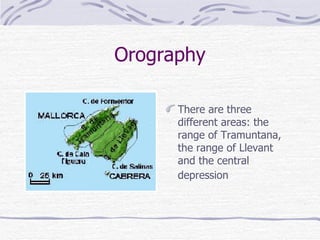
      There are three
      different areas: the
      range of Tramuntana,
      the range of Llevant
      and the central
      depression
Orography
The range of Tramuntana is
90 km long. There we can
find the tallest mountains in
Majorca: the Puig Major
(1445m), the Massanella
(1340m), the Ofre (1090m),
the “Es Teix”(1064m), and
the Galatzó (1026m). The
coasts of the range make
breathtaking cliffs which
in some places reach
400 metres.

                  Puig Major- the tallest mountain in Majorca
Climate

Majorca has got a mediterranean climate. This climate is mild. Its main
characteristics are the following: dry summers, showers are concentrated
in autumn and spring. The average temperature is 17ºC.
Vegetation
      Majorca’s vegetation is
      related to the following:
      climate (species are
      conditioned), the fact of
      being four islands (the
      process of evolution is
      different and it gives
      way to autoctonous
      species) and human
      being.
      Main vegetation is pine
      wood, holm, oak wood
      and scrubs.
Economy
     For     many      centuries   the
     economy of the island was
     based on agriculture and cattle
     raising.
     Industry has developed mainly
     in Palma, Manacor (furniture
     and pearls) and the villages
     which form the Raiguer region
     (leather and glass industry).
     From the sixties onwards
     tourism has been the motor of
     the     island    and    is  also
     responsible for demography,
     social,        economic      and
     enviromental changes which
     have taken place.
Majorca: area and
                inhabitants


Mallorca is made up of 53 municipalities. The archipielago of
Cabrera belongs to the municipality of Palma.
Regions:
A region is made up of some municipalities which share some
physical, enviromental and economic features.
Region of “Es Pla”
The Region of “Es Pla”-
It    is   formed     by
municipalities situated
in the centre of the
island and the bay of
Alcudia.
Palma is a region itself
together     with    the
Archipielago of Cabrera.
Region of Migjorn- Llevant
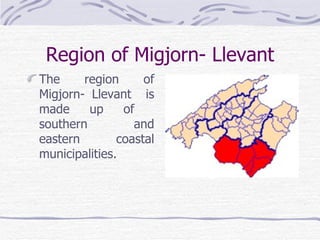
The     region      of
Migjorn- Llevant is
made     up     of
southern          and
eastern        coastal
municipalities.
Region of Tramuntana
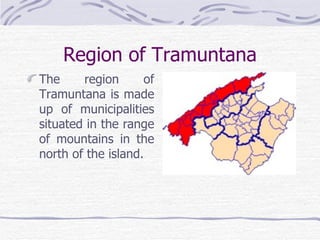
The     region      of
Tramuntana is made
up of municipalities
situated in the range
of mountains in the
north of the island.
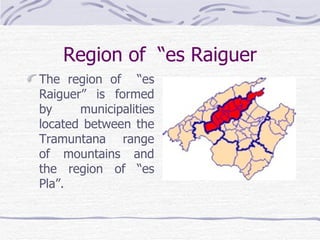
Region of “es Raiguer
The region of “es
Raiguer” is formed
by     municipalities
located between the
Tramuntana range
of mountains and
the region of “es
Pla”.
The migratory movement


The first migration waves to arrive in the Balearics were in late
seventies. They came from the Spanish provinces. However, at present
migration comes from the European countries, Africa, Central and South
America.
Migration is very enriching for destination countries because it
contributes to a new and different social life and traditions. Also, it
makes for the economic development.

On the other hand, the destination country should provide with health
system, schooling and social security.
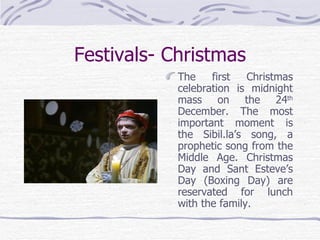
Festivals- Christmas
            The    first   Christmas
            celebration is midnight
            mass on the 24th
            December. The most
            important moment is
            the Sibil.la’s song, a
            prophetic song from the
            Middle Age. Christmas
            Day and Sant Esteve’s
            Day (Boxing Day) are
            reservated for lunch
            with the family.
Festivals- Sant Antoni
The festival starts on the
evening of the 16th January
when many bonfires are lighted.
People gather around the
bonfires scattered in the village
and grill “sobrassada”, other
typical sausages and pork
meat . This constitutes their
supper together with wine.
Devils    dance    around     the
bonfires and typical songs
“glosses” are sung.
On the 17th parades take place.
The floats are mostly scenes
from rural areas, and devils.
Pets are taken to church to be
blessed.
Festivals- Sant Antoni
             The festivity of Sant
             Sant Antoni Abad takes
             place on the 17th
             January. It is mostly
             celebrated      in     the
             villages.
             The most well-known
             festivals are those in
             Sa Pobla, Artà, Pollença
             , Muro i Manacor.
Festivals- The Moor and the Christian


On the 2nd August, day of the “Mare de Déu dels Àngels”, the saint
patron of Pollença. We commemorate the victory of the Christian on the
Moor Dragut, who on the night of 30th May 1550 attacked the village of
Pollença. The legend tells that Joan Mas (Christian) invocated the “Mare
de Déu dels Àngels” and she helped them to beat a much better army
made up of 1500 men
Festivals- The Moor and the Christian


The celebration starts the night before, with a big party in the streets and
squares of Pollença and lasts until the morning of day two, when at five
in the morning, the music band starts to play music along the streets.
Each year the inhabitants of Pollença act out what happened during the
Christian-Moor battle. The main roles documented go back to 1860 and
are chosen by popular voting the first week of July.
The Moor and the Christian- Pollença
Festivals- La Beateta

The Beata festival takes place in Santa Margalida the first weekend of
September. It is the most typical parade in Majorca. Its origin still
remains unknown.

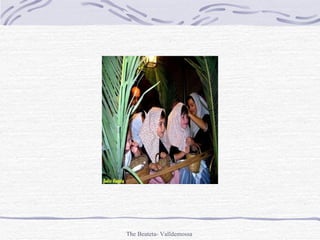
The Beata festival is also celebrated in Valldemossa on the 28th July. In
the parade there is always a Valldemossa born six year old girl and three
three year old angels followed by people singing “la Beateta” (a popular
song).
The Beateta- Valldemossa

P point majorca

  • 1.
    Introduction Majorca is anisland of the Mediterranean sea. It is the biggest in the Balearic Islands. Precisely, its name comes from this fact, Majorca means the biggest. It has got an area of 3620 square kilometres and in 2007 the population was 814275 inhabitants. The population density is 214,87 inhabitant per square kilometre.
  • 3.
    Municipalities Majorca has got53 municipalities. The most important is Palma, capital of Majorca, followed by Manacor, Inca, Llucmajor and Calvià. We can also point out Pollença and Sóller for its history. The biggest are Llucmajor, Manacor, Palma and Felanitx. The smallest are Buger, Lloseta, Estellencs and Consell
  • 4.
    Orography There are three different areas: the range of Tramuntana, the range of Llevant and the central depression
  • 5.
    Orography The range ofTramuntana is 90 km long. There we can find the tallest mountains in Majorca: the Puig Major (1445m), the Massanella (1340m), the Ofre (1090m), the “Es Teix”(1064m), and the Galatzó (1026m). The coasts of the range make breathtaking cliffs which in some places reach 400 metres. Puig Major- the tallest mountain in Majorca
  • 6.
    Climate Majorca has gota mediterranean climate. This climate is mild. Its main characteristics are the following: dry summers, showers are concentrated in autumn and spring. The average temperature is 17ºC.
  • 7.
    Vegetation Majorca’s vegetation is related to the following: climate (species are conditioned), the fact of being four islands (the process of evolution is different and it gives way to autoctonous species) and human being. Main vegetation is pine wood, holm, oak wood and scrubs.
  • 8.
    Economy For many centuries the economy of the island was based on agriculture and cattle raising. Industry has developed mainly in Palma, Manacor (furniture and pearls) and the villages which form the Raiguer region (leather and glass industry). From the sixties onwards tourism has been the motor of the island and is also responsible for demography, social, economic and enviromental changes which have taken place.
  • 9.
    Majorca: area and inhabitants Mallorca is made up of 53 municipalities. The archipielago of Cabrera belongs to the municipality of Palma. Regions: A region is made up of some municipalities which share some physical, enviromental and economic features.
  • 10.
    Region of “EsPla” The Region of “Es Pla”- It is formed by municipalities situated in the centre of the island and the bay of Alcudia. Palma is a region itself together with the Archipielago of Cabrera.
  • 11.
    Region of Migjorn-Llevant The region of Migjorn- Llevant is made up of southern and eastern coastal municipalities.
  • 12.
    Region of Tramuntana The region of Tramuntana is made up of municipalities situated in the range of mountains in the north of the island.
  • 13.
    Region of “esRaiguer The region of “es Raiguer” is formed by municipalities located between the Tramuntana range of mountains and the region of “es Pla”.
  • 14.
    The migratory movement Thefirst migration waves to arrive in the Balearics were in late seventies. They came from the Spanish provinces. However, at present migration comes from the European countries, Africa, Central and South America. Migration is very enriching for destination countries because it contributes to a new and different social life and traditions. Also, it makes for the economic development. On the other hand, the destination country should provide with health system, schooling and social security.
  • 15.
    Festivals- Christmas The first Christmas celebration is midnight mass on the 24th December. The most important moment is the Sibil.la’s song, a prophetic song from the Middle Age. Christmas Day and Sant Esteve’s Day (Boxing Day) are reservated for lunch with the family.
  • 16.
    Festivals- Sant Antoni Thefestival starts on the evening of the 16th January when many bonfires are lighted. People gather around the bonfires scattered in the village and grill “sobrassada”, other typical sausages and pork meat . This constitutes their supper together with wine. Devils dance around the bonfires and typical songs “glosses” are sung. On the 17th parades take place. The floats are mostly scenes from rural areas, and devils. Pets are taken to church to be blessed.
  • 17.
    Festivals- Sant Antoni The festivity of Sant Sant Antoni Abad takes place on the 17th January. It is mostly celebrated in the villages. The most well-known festivals are those in Sa Pobla, Artà, Pollença , Muro i Manacor.
  • 18.
    Festivals- The Moorand the Christian On the 2nd August, day of the “Mare de Déu dels Àngels”, the saint patron of Pollença. We commemorate the victory of the Christian on the Moor Dragut, who on the night of 30th May 1550 attacked the village of Pollença. The legend tells that Joan Mas (Christian) invocated the “Mare de Déu dels Àngels” and she helped them to beat a much better army made up of 1500 men
  • 19.
    Festivals- The Moorand the Christian The celebration starts the night before, with a big party in the streets and squares of Pollença and lasts until the morning of day two, when at five in the morning, the music band starts to play music along the streets. Each year the inhabitants of Pollença act out what happened during the Christian-Moor battle. The main roles documented go back to 1860 and are chosen by popular voting the first week of July.
  • 20.
    The Moor andthe Christian- Pollença
  • 21.
    Festivals- La Beateta TheBeata festival takes place in Santa Margalida the first weekend of September. It is the most typical parade in Majorca. Its origin still remains unknown. The Beata festival is also celebrated in Valldemossa on the 28th July. In the parade there is always a Valldemossa born six year old girl and three three year old angels followed by people singing “la Beateta” (a popular song).
  • 22.