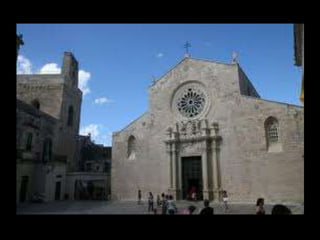
PUGLIA
Recipes
• http://cucina.corriere.it/ricette/salento/34/ca
  rne-cavallo-pignatta_9da41d36-1af6-11df-
  af4a-00144f02aabe.shtml
Some facts
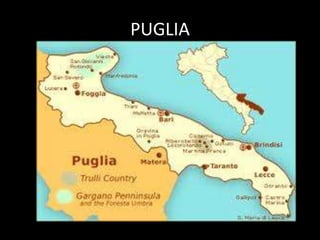
• Apulia is a region in Southern Italy bordering
  the Adriatic Sea in the east, the Ionian Sea to
  the southeast, and the Strait of Otranto and
  Gulf of Taranto in the south.
• Its most southern portion is known as
  Salento.
• The region comprises 19,345 square
  kilometers (7,469 sq mi).
• Its population is about 4.1 million.
The Geography
Apulia is a very dry region. Its few rivers are torrential
and are to be found on the Tavoliere delle Puglie at the
foot of the Gargano promontory.
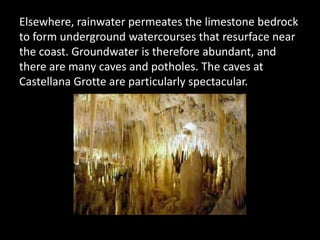
Elsewhere, rainwater permeates the limestone bedrock
to form underground watercourses that resurface near
the coast. Groundwater is therefore abundant, and
there are many caves and potholes. The caves at
Castellana Grotte are particularly spectacular.
Some History
• Apulia is one of the richest regions in Italy in
  terms of archaeological findings.
• It was first settled by Illyric peoples, the most
  well known of whom were the Messapii
Mycenaean Greeks colonized the area.
In the 8th century BC, the Ancient Greeks
expanded until reaching the area of Taranto and
Salento in Magna Graecia.
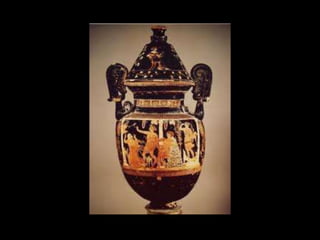
In the 5th and 4th centuries BC, the Greek settlement
at Taras produced a distinctive style of pottery (Apulian
                     vase painting).
Apulia was an important
area for the ancient
Romans, who conquered it
during the course of wars
against the Samnites and
against Pyrrhus in the 4th
and 3rd centuries BC but
also suffered a crushing
defeat here in the battle of
Cannae against Hannibal.
However, after the Carthaginians left the
region, the Romans captured the ports of
Brindisi and Taranto, and established dominion
over the region.

During the Imperial age Apulia was a flourishing
area for production of grain and oil, becoming
the most important exporter to the Eastern
provinces.
After the fall of Rome, Apulia was held successively by
the Goths, the Lombards and, from the 6th century
onwards, the Byzantines. Bari became the capital of a
province that extended to modern Basilicata
Apulia remained under the Byzantine authority, until
the 11th century, when the Normans conquered it with
                    relative ease.
From the late 12th to early 13th centuries, Apulia was a
       favorite residence of the Hohenstaufen
            emperors, notably Frederick II
Frederic II
Under the Angevine and Crown of
Aragon/Spanish dominations Apulia became
largely dominated by a small number of
powerful landowners (Baroni).
In 1734 there were the battle of Bitonto, a
Spanish victory over Austrian forces.
The coast was occupied at times by the Turks
and by the Venetians.
The French also controlled the region in 1806–
15, resulting in the abolition of feudalism and
the reformation of the justice system.
In 1861, with the fall of Two
Sicilies, the region joined Italy.
Mamma, li turchi!
• On July 28, 1480, an Ottoman fleet of 128
  ships arrived near the city of Otranto.
• On July 29 the garrison and the citizens
  retreated to the citadel, the Castle of Otranto.
• On 11 August this was taken by the invaders.
According to Christian
historiography
Archbishop       Stefano
Agricoli and others
were killed in the
cathedral.
Bishop          Stephen
Pendinelli and the
garrison
commander,         count
Francesco Zurlo, were
sawn in two alive.
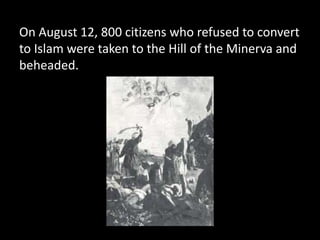
On August 12, 800 citizens who refused to convert
to Islam were taken to the Hill of the Minerva and
beheaded.
Some of the remains of the 800 martyrs are
    today stored in Otranto cathedral
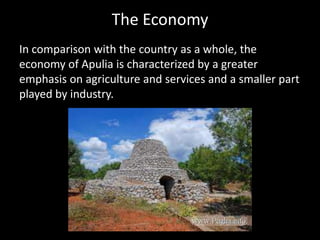
The Economy
In comparison with the country as a whole, the
economy of Apulia is characterized by a greater
emphasis on agriculture and services and a smaller part
played by industry.
In the last 20 years the industrial base of the region's
economy has changed radically. Alongside highly
capital-intensive large-scale a network of small and
medium-sized firms has gradually expanded, and these
now provide approximately 70% of the jobs in the
region.
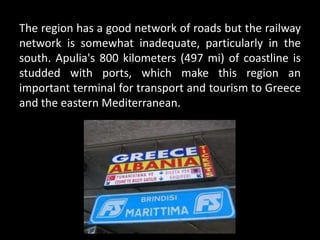
The region has a good network of roads but the railway
network is somewhat inadequate, particularly in the
south. Apulia's 800 kilometers (497 mi) of coastline is
studded with ports, which make this region an
important terminal for transport and tourism to Greece
and the eastern Mediterranean.
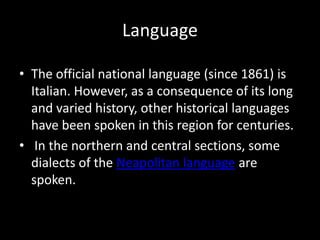
Language

• The official national language (since 1861) is
  Italian. However, as a consequence of its long
  and varied history, other historical languages
  have been spoken in this region for centuries.
• In the northern and central sections, some
  dialects of the Neapolitan language are
  spoken.
• In the southern part of the region, dialects of the
  Sicilian language called Tarantino and Salentino
  are spoken.
• In isolated pockets of the Southern part of
  Salento, a Greek dialect called Griko, is spoken by
  just a few thousand people.
• A rare dialect of the Franco-Provençal language
  called Faetar is spoken in two isolated towns in
  the Province of Foggia.
• In a couple of villages, the Arbëreshë dialect of
  the Albanian language has been spoken by a very
  small community since a wave of refugees settled
  there in the 15th century.
Some Music

• http://www.youtube.com/watch?v=YdVaHCCxHMw
• http://www.youtube.com/watch?v=LsTQM4t76r8&feat
  ure=related
• http://www.youtube.com/watch?v=ummRkOP7lBQ&fe
  ature=related
• http://www.youtube.com/watch?v=r3hfQnuWgAI
• http://www.youtube.com/watch?v=ZtCQXJwN96o
• http://www.youtube.com/watch?v=eUJkbbuh_84&feat
  ure=related

Week 5

  • 1.
  • 2.
    Recipes • http://cucina.corriere.it/ricette/salento/34/ca rne-cavallo-pignatta_9da41d36-1af6-11df- af4a-00144f02aabe.shtml
  • 3.
    Some facts • Apuliais a region in Southern Italy bordering the Adriatic Sea in the east, the Ionian Sea to the southeast, and the Strait of Otranto and Gulf of Taranto in the south. • Its most southern portion is known as Salento. • The region comprises 19,345 square kilometers (7,469 sq mi). • Its population is about 4.1 million.
  • 4.
  • 5.
    Apulia is avery dry region. Its few rivers are torrential and are to be found on the Tavoliere delle Puglie at the foot of the Gargano promontory.
  • 6.
    Elsewhere, rainwater permeatesthe limestone bedrock to form underground watercourses that resurface near the coast. Groundwater is therefore abundant, and there are many caves and potholes. The caves at Castellana Grotte are particularly spectacular.
  • 7.
    Some History • Apuliais one of the richest regions in Italy in terms of archaeological findings. • It was first settled by Illyric peoples, the most well known of whom were the Messapii
  • 8.
  • 9.
    In the 8thcentury BC, the Ancient Greeks expanded until reaching the area of Taranto and Salento in Magna Graecia.
  • 10.
    In the 5thand 4th centuries BC, the Greek settlement at Taras produced a distinctive style of pottery (Apulian vase painting).
  • 14.
    Apulia was animportant area for the ancient Romans, who conquered it during the course of wars against the Samnites and against Pyrrhus in the 4th and 3rd centuries BC but also suffered a crushing defeat here in the battle of Cannae against Hannibal.
  • 15.
    However, after theCarthaginians left the region, the Romans captured the ports of Brindisi and Taranto, and established dominion over the region. During the Imperial age Apulia was a flourishing area for production of grain and oil, becoming the most important exporter to the Eastern provinces.
  • 19.
    After the fallof Rome, Apulia was held successively by the Goths, the Lombards and, from the 6th century onwards, the Byzantines. Bari became the capital of a province that extended to modern Basilicata
  • 20.
    Apulia remained underthe Byzantine authority, until the 11th century, when the Normans conquered it with relative ease.
  • 21.
    From the late12th to early 13th centuries, Apulia was a favorite residence of the Hohenstaufen emperors, notably Frederick II
  • 22.
  • 23.
    Under the Angevineand Crown of Aragon/Spanish dominations Apulia became largely dominated by a small number of powerful landowners (Baroni). In 1734 there were the battle of Bitonto, a Spanish victory over Austrian forces. The coast was occupied at times by the Turks and by the Venetians. The French also controlled the region in 1806– 15, resulting in the abolition of feudalism and the reformation of the justice system.
  • 24.
    In 1861, withthe fall of Two Sicilies, the region joined Italy.
  • 25.
  • 26.
    • On July28, 1480, an Ottoman fleet of 128 ships arrived near the city of Otranto. • On July 29 the garrison and the citizens retreated to the citadel, the Castle of Otranto. • On 11 August this was taken by the invaders.
  • 29.
    According to Christian historiography Archbishop Stefano Agricoli and others were killed in the cathedral. Bishop Stephen Pendinelli and the garrison commander, count Francesco Zurlo, were sawn in two alive.
  • 30.
    On August 12,800 citizens who refused to convert to Islam were taken to the Hill of the Minerva and beheaded.
  • 31.
    Some of theremains of the 800 martyrs are today stored in Otranto cathedral
  • 34.
    The Economy In comparisonwith the country as a whole, the economy of Apulia is characterized by a greater emphasis on agriculture and services and a smaller part played by industry.
  • 35.
    In the last20 years the industrial base of the region's economy has changed radically. Alongside highly capital-intensive large-scale a network of small and medium-sized firms has gradually expanded, and these now provide approximately 70% of the jobs in the region.
  • 36.
    The region hasa good network of roads but the railway network is somewhat inadequate, particularly in the south. Apulia's 800 kilometers (497 mi) of coastline is studded with ports, which make this region an important terminal for transport and tourism to Greece and the eastern Mediterranean.
  • 37.
    Language • The officialnational language (since 1861) is Italian. However, as a consequence of its long and varied history, other historical languages have been spoken in this region for centuries. • In the northern and central sections, some dialects of the Neapolitan language are spoken.
  • 39.
    • In thesouthern part of the region, dialects of the Sicilian language called Tarantino and Salentino are spoken. • In isolated pockets of the Southern part of Salento, a Greek dialect called Griko, is spoken by just a few thousand people. • A rare dialect of the Franco-Provençal language called Faetar is spoken in two isolated towns in the Province of Foggia. • In a couple of villages, the Arbëreshë dialect of the Albanian language has been spoken by a very small community since a wave of refugees settled there in the 15th century.
  • 49.
    Some Music • http://www.youtube.com/watch?v=YdVaHCCxHMw •http://www.youtube.com/watch?v=LsTQM4t76r8&feat ure=related • http://www.youtube.com/watch?v=ummRkOP7lBQ&fe ature=related • http://www.youtube.com/watch?v=r3hfQnuWgAI • http://www.youtube.com/watch?v=ZtCQXJwN96o • http://www.youtube.com/watch?v=eUJkbbuh_84&feat ure=related