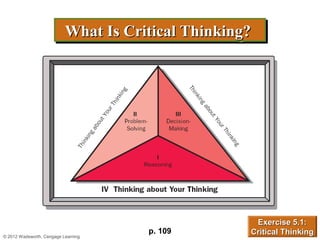
What Is Critical Thinking?
                           What Is Critical Thinking?


                                                     Exercise 5.1:
                                      p. 109        Critical Thinking
© 2012 Wadsworth, Cengage Learning
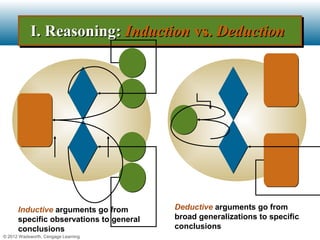
I. Reasoning: Induction vs. Deduction
            I. Reasoning: Induction vs. Deduction


      Inductive arguments go from        Deductive arguments go from
      specific observations to general   broad generalizations to specific
      conclusions                        conclusions
© 2012 Wadsworth, Cengage Learning
I. Reasoning : Relevance and Adequacy
          I. Reasoning : Relevance and Adequacy

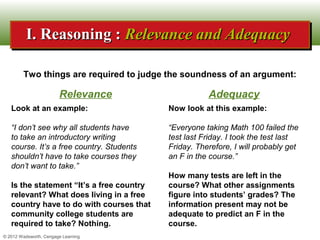
        Two things are required to judge the soundness of an argument:

                        Relevance                     Adequacy
   Look at an example:                     Now look at this example:

   “I don’t see why all students have      “Everyone taking Math 100 failed the
   to take an introductory writing         test last Friday. I took the test last
   course. It’s a free country. Students   Friday. Therefore, I will probably get
   shouldn’t have to take courses they     an F in the course.”
   don’t want to take.”
                                           How many tests are left in the
   Is the statement “It’s a free country   course? What other assignments
   relevant? What does living in a free    figure into students’ grades? The
   country have to do with courses that    information present may not be
   community college students are          adequate to predict an F in the
   required to take? Nothing.              course.
© 2012 Wadsworth, Cengage Learning
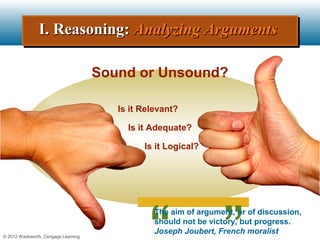
I. Reasoning: Analyzing Arguments
               I. Reasoning: Analyzing Arguments

                                     Sound or Unsound?

                                        Is it Relevant?

                                          Is it Adequate?

                                              Is it Logical?


                                                 The aim of argument, or of discussion,
                                                 should not be victory, but progress.
                                                 Joseph Joubert, French moralist
© 2012 Wadsworth, Cengage Learning
I. Reasoning: Assessing Assumptions
             I. Reasoning: Assessing Assumptions
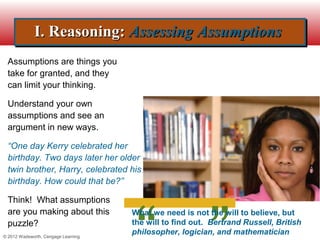
  Assumptions are things you
  take for granted, and they
  can limit your thinking.

  Understand your own
  assumptions and see an
  argument in new ways.

  “One day Kerry celebrated her
  birthday. Two days later her older
  twin brother, Harry, celebrated his
  birthday. How could that be?”

  Think! What assumptions
  are you making about this          What we need is not the will to believe, but
  puzzle?                            the will to find out. Bertrand Russell, British
© 2012 Wadsworth, Cengage Learning
                                     philosopher, logician, and mathematician
I. Reasoning: Considering Claims
                  I. Reasoning: Considering Claims

      Generally speaking, be wary of claims that:
       are supported by unidentified sources
        (“Experts claim . . . ”).
       are made by a person or company who stands to gain
        (“Brought to you by the makers of . . .”).
       come from a a single person claiming his experience as
        the norm (“I tried it and it worked for me!”).
       use a bandwagon appeal (“Everybody’s doing it.”).
       mislead with statistics (“over half” when it’s really only
        50.5 percent).
© 2012 Wadsworth, Cengage Learning
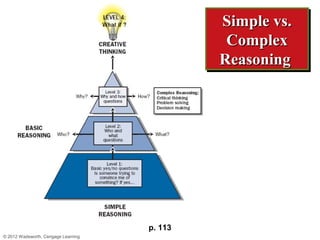
Simple vs.
                                              Simple vs.
                                               Complex
                                               Complex
                                              Reasoning
                                              Reasoning


                                     p. 113
© 2012 Wadsworth, Cengage Learning

P art one reasoning

  • 1.
    What Is CriticalThinking? What Is Critical Thinking? Exercise 5.1: p. 109 Critical Thinking © 2012 Wadsworth, Cengage Learning
  • 2.
    I. Reasoning: Inductionvs. Deduction I. Reasoning: Induction vs. Deduction Inductive arguments go from Deductive arguments go from specific observations to general broad generalizations to specific conclusions conclusions © 2012 Wadsworth, Cengage Learning
  • 3.
    I. Reasoning :Relevance and Adequacy I. Reasoning : Relevance and Adequacy Two things are required to judge the soundness of an argument: Relevance Adequacy Look at an example: Now look at this example: “I don’t see why all students have “Everyone taking Math 100 failed the to take an introductory writing test last Friday. I took the test last course. It’s a free country. Students Friday. Therefore, I will probably get shouldn’t have to take courses they an F in the course.” don’t want to take.” How many tests are left in the Is the statement “It’s a free country course? What other assignments relevant? What does living in a free figure into students’ grades? The country have to do with courses that information present may not be community college students are adequate to predict an F in the required to take? Nothing. course. © 2012 Wadsworth, Cengage Learning
  • 4.
    I. Reasoning: AnalyzingArguments I. Reasoning: Analyzing Arguments Sound or Unsound? Is it Relevant? Is it Adequate? Is it Logical? The aim of argument, or of discussion, should not be victory, but progress. Joseph Joubert, French moralist © 2012 Wadsworth, Cengage Learning
  • 5.
    I. Reasoning: AssessingAssumptions I. Reasoning: Assessing Assumptions Assumptions are things you take for granted, and they can limit your thinking. Understand your own assumptions and see an argument in new ways. “One day Kerry celebrated her birthday. Two days later her older twin brother, Harry, celebrated his birthday. How could that be?” Think! What assumptions are you making about this What we need is not the will to believe, but puzzle? the will to find out. Bertrand Russell, British © 2012 Wadsworth, Cengage Learning philosopher, logician, and mathematician
  • 6.
    I. Reasoning: ConsideringClaims I. Reasoning: Considering Claims Generally speaking, be wary of claims that:  are supported by unidentified sources (“Experts claim . . . ”).  are made by a person or company who stands to gain (“Brought to you by the makers of . . .”).  come from a a single person claiming his experience as the norm (“I tried it and it worked for me!”).  use a bandwagon appeal (“Everybody’s doing it.”).  mislead with statistics (“over half” when it’s really only 50.5 percent). © 2012 Wadsworth, Cengage Learning
  • 7.
    Simple vs. Simple vs. Complex Complex Reasoning Reasoning p. 113 © 2012 Wadsworth, Cengage Learning