Overview of Operatorsin Java
This presentation explores the essential operators in Java, detailing their various types and applications. By understanding these operators,
programmers can effectively manipulate data and manage the flow of their Java applications. The goal is to provide a clear insight into the
interaction of operators with data, enhancing the overall programming experience.
2.
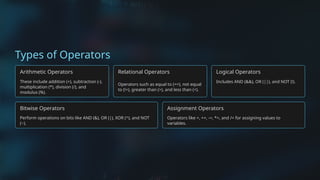
Types of Operators
ArithmeticOperators
These include addition (+), subtraction (-),
multiplication (*), division (/), and
modulus (%).
Bitwise Operators
Perform operations on bits like AND (&), OR (|), XOR (^), and NOT
(~).
Relational Operators
Operators such as equal to (==), not equal
to (!=), greater than (>), and less than (<).
Assignment Operators
Operators like =, +=, -=, *=, and /= for assigning values to
variables.
Logical Operators
Includes AND (&&), OR (||), and NOT (!).
3.
Conditional Operators Overview
TernaryOperator
A shorthand for if-else, evaluates a
condition.
Switch Statement
Utilizes equality operator for multiple value
matching.
1
2
Short-circuit Evaluation
Stops evaluation once the outcome is
determined.
3
4.
Unary Operators
Unary Plusand Minus
The unary plus (+) does not change the
value, while the unary minus (-) negates the
value.
Increment and Decrement
The increment (++) and decrement (--)
operators change a variable's value by one.
Logical Complement Operator
The NOT operator (!) negates a boolean
value, reversing its state.
5.
Operator Precedence and
Associativity
OperatorPrecedence
Java follows a specific order of operations for accurate computations.
Associativity Rules
Operators can have left-to-right or right-to-left associativity.
Parentheses for Clarity
Using parentheses enhances readability and ensures desired order of operations.
6.
Practical Examples
Basic Calculations
Operatorscan be implemented for
simple arithmetic calculations. For
instance, calculating the area of a
rectangle can be achieved using
multiplication and assignment
operators.
1
2 Comparison Scenarios
Relational operators aid in comparing user
input against predefined values,
facilitating conditional flows such as
whether a user is eligible based on age.
3
Loop Control
Logical operators play a vital role in
controlling loop execution. Combining
conditions in while or for loops allows for
dynamic and robust program behavior.
7.
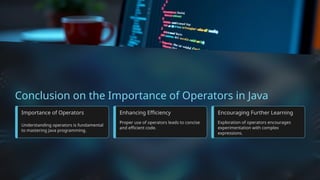
Conclusion on theImportance of Operators in Java
Importance of Operators
Understanding operators is fundamental
to mastering Java programming.
Enhancing Efficiency
Proper use of operators leads to concise
and efficient code.
Encouraging Further Learning
Exploration of operators encourages
experimentation with complex
expressions.