Contact Email Design Copyright 1994-2013 © OxfordCambridge.OrgBusiness Skills (This picture: Trinity College, Cambridge)
Contact Email Design Copyright 1994-2013 © OxfordCambridge.OrgBusiness Skills (This picture: Harcourt Hill, West Oxford)
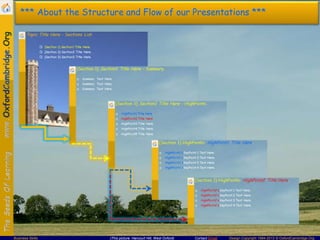
*** About the Structure and Flow of our Presentations ***
Contact Email Design Copyright 1994-2013 © OxfordCambridge.OrgBusiness Skills (This picture: Trinity College, Cambridge)
Basic Business Math
Introductory concepts @ OxfordCambridge.Org all for free and free for all.
The information gathered here is under KeyPoints format and may be use:
- Either to give the reader an overview before deciding for a full scale study of the topic.
- Or act as a study guide for learners in expanding their knowledge on that given topic.
Some recommendations, perhaps:
- Identify each KeyPoint on which you feel a need to expand your knowledge,
- Choose a good book or academic magazine and info from the Internet.
- And then work towards gaining that knowledge, at your own pace.
Please enjoy!
Contact Email Design Copyright 1994-2013 © OxfordCambridge.OrgBusiness Skills (This picture: Harcourt Hill, West Oxford)
Basic Business Math – Summary.
☺ To answer questions of business math, you will review crucial
terms, basic mathematical concepts, and how to apply
concepts to the business environment.
☺ A basic understanding of decimals and percentages is key to
any businessperson, whether tallying costs for warehouse
supplies or estimating resource allocation.
☺ Therefore learn to use decimals, addition, subtraction,
multiplication, and division; and to solve problems involving
percentages.
☺ Also, knowledge of ratios and averages is indispensable in
the business world.
Contact Email Design Copyright 1994-2013 © OxfordCambridge.OrgBusiness Skills (This picture: Trinity College, Cambridge)
Basic Business Math - Aim of publication.
 To bring some introductory concepts to the
reader or the learner who are interested apply
basic math skills to business.
Contact Email Design Copyright 1994-2013 © OxfordCambridge.OrgBusiness Skills (This picture: Harcourt Hill, West Oxford)
Basic Business Math - Learning Objectives.
☺ After developing the KeyPoints outlined in this publication, you
should mainly be able to:
 recognize the value of using and rounding whole numbers to
estimate in business applications.
 choose the necessary operation to solve a problem using
fractions.
 convert a business problem into an equation.
 solve a problem in a hypothetical business situation.
 calculate base, given portion and rate.
 express ratios as decimal numbers and percentages.
 determine the correct ratio and convert it to percentage.
 solve a problem determining a simple average.
Contact Email Design Copyright 1994-2013 © OxfordCambridge.OrgBusiness Skills (This picture: Trinity College, Cambridge)
Basic Business Math - Sections List.
 (Section 1) Whole Numbers, Fractions, and Equations.
 (Section 2) Decimals and Percents.
 (Section 3) Ratios and Averages.
Contact Email Design Copyright 1994-2013 © OxfordCambridge.OrgBusiness Skills (This picture: Harcourt Hill, West Oxford)
(Section 1) Whole Numbers, Fractions, and Equations – Summary.
☺ What are whole numbers and how are they estimated?
☺ How are fractions used in mathematical operations?
☺ How do you find the unknown variable to solve an equation?
☺ To answer such questions of business math like these, you
will review crucial terms, basic mathematical concepts, and
apply concepts to a business environment.
Contact Email Design Copyright 1994-2013 © OxfordCambridge.OrgBusiness Skills (This picture: Trinity College, Cambridge)
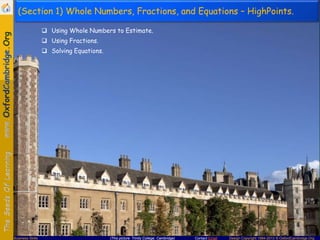
(Section 1) Whole Numbers, Fractions, and Equations – HighPoints.
 Using Whole Numbers to Estimate.
 Using Fractions.
 Solving Equations.
Contact Email Design Copyright 1994-2013 © OxfordCambridge.OrgBusiness Skills (This picture: Harcourt Hill, West Oxford)
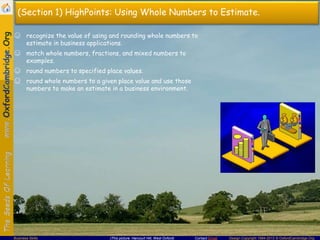
(Section 1) HighPoints: Using Whole Numbers to Estimate.
☺ recognize the value of using and rounding whole numbers to
estimate in business applications.
☺ match whole numbers, fractions, and mixed numbers to
examples.
☺ round numbers to specified place values.
☺ round whole numbers to a given place value and use those
numbers to make an estimate in a business environment.
Contact Email Design Copyright 1994-2013 © OxfordCambridge.OrgBusiness Skills (This picture: Harcourt Hill, West Oxford)
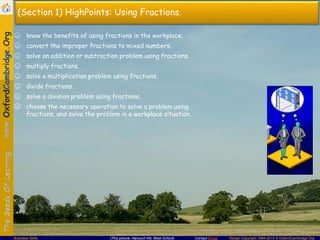
(Section 1) HighPoints: Using Fractions.
☺ know the benefits of using fractions in the workplace.
☺ convert the improper fractions to mixed numbers.
☺ solve an addition or subtraction problem using fractions.
☺ multiply fractions.
☺ solve a multiplication problem using fractions.
☺ divide fractions.
☺ solve a division problem using fractions.
☺ choose the necessary operation to solve a problem using
fractions, and solve the problem in a workplace situation.
Contact Email Design Copyright 1994-2013 © OxfordCambridge.OrgBusiness Skills (This picture: Harcourt Hill, West Oxford)
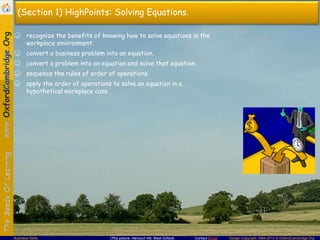
(Section 1) HighPoints: Solving Equations.
☺ recognize the benefits of knowing how to solve equations in the
workplace environment.
☺ convert a business problem into an equation.
☺ convert a problem into an equation and solve that equation.
☺ sequence the rules of order of operations.
☺ apply the order of operations to solve an equation in a
hypothetical workplace case.
Contact Email Design Copyright 1994-2013 © OxfordCambridge.OrgBusiness Skills (This picture: Harcourt Hill, West Oxford)
(Section 2) Decimals and Percents – Summary.
☺ A basic understanding of decimals and percentages is key to a
businessperson, whether tallying costs for warehouse supplies
or estimating resource allocation.
☺ The KeyPoints that follow are to instruct the learner in the
following manner:
 how to use decimals, including addition, subtraction,
multiplication, and division;
 how to solve problems involving percentages to determine
portions, a rate, a whole unit, and increases and decreases;
 how to apply these operations in business settings.
Contact Email Design Copyright 1994-2013 © OxfordCambridge.OrgBusiness Skills (This picture: Trinity College, Cambridge)
(Section 2) Decimals and Percents – HighPoints.
 Using Decimals.
 Using Percents.
Contact Email Design Copyright 1994-2013 © OxfordCambridge.OrgBusiness Skills (This picture: Harcourt Hill, West Oxford)
(Section 2) HighPoints: Using Decimals.
☺ recognize the importance of understanding decimals in the
workplace.
☺ match various digits in a decimal number with their appropriate
place values.
☺ add and subtract decimals.
☺ add or subtract decimals to solve a problem in a hypothetical
business situation.
☺ multiply decimals.
☺ multiply decimals to solve a problem in a business environment.
☺ divide decimals.
☺ divide decimals to solve a problem in a hypothetical business
situation.
Contact Email Design Copyright 1994-2013 © OxfordCambridge.OrgBusiness Skills (This picture: Harcourt Hill, West Oxford)
(Section 2) HighPoints: Using Percents.
☺ value the benefit of knowing how to work with percents.
☺ compare partial quantities of a whole unit using simple
percentages.
☺ calculate portion, given rate and base.
☺ calculate portion in a hypothetical business situation.
☺ calculate rate, given portion and base.
☺ calculate the percent of one number compared to another in
a business situation.
☺ calculate base, given por tion and rate.
☺ calculate the base in a hypothetical business scenario, given
portion and rate.
Contact Email Design Copyright 1994-2013 © OxfordCambridge.OrgBusiness Skills (This picture: Harcourt Hill, West Oxford)
(Section 3) Ratios and Averages – Summary.
☺ Whether tracking profitability or portraying the rate of
inventory consumption, knowledge of ratios and averages is
indispensable in the business world.
☺ Using real cases scenarios, learn to explain the concepts of
ratio, proportion;
☺ And also how to compare different kinds of numbers; and
discusses simple, weighted, and moving averages.
Contact Email Design Copyright 1994-2013 © OxfordCambridge.OrgBusiness Skills (This picture: Trinity College, Cambridge)
(Section 3) Ratios and Averages – HighPoints
 Using Ratios.
 Using Averages.
Contact Email Design Copyright 1994-2013 © OxfordCambridge.OrgBusiness Skills (This picture: Harcourt Hill, West Oxford)
(Section 3) HighPoints: Using Ratios.
☺ recognize the benefits of using ratios in the workplace.
☺ reduce ratios to their simplest forms.
☺ express ratios as decimal numbers and percentages.
☺ determine the correct ratio and convert it to a decimal or
percentage.
☺ solve for the missing variable in a pure math problem.
☺ solve for an unknown quantity in two business scenarios given an
equality between two ratios.
☺ solve rate problems using the appropriate method.
☺ solve for the missing variable in rate problems, given
hypothetical business situations..
Contact Email Design Copyright 1994-2013 © OxfordCambridge.OrgBusiness Skills (This picture: Harcourt Hill, West Oxford)
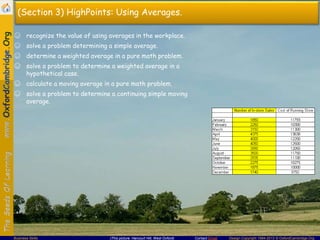
(Section 3) HighPoints: Using Averages.
☺ recognize the value of using averages in the workplace.
☺ solve a problem determining a simple average.
☺ determine a weighted average in a pure math problem.
☺ solve a problem to determine a weighted average in a
hypothetical case.
☺ calculate a moving average in a pure math problem.
☺ solve a problem to determine a continuing simple moving
average.
Contact Email Design Copyright 1994-2013 © OxfordCambridge.OrgBusiness Skills (This picture: Harcourt Hill, West Oxford)
Basic Business Math – Conclusion.
☺ At this point you should be able to be familiar with the
following:
 rounding numbers to specified place values.
 using fractions in the workplace.
 solving equations in a workplace environment.
 understanding decimals in the workplace.
 knowing how to work with percents.
 calculating portion, given rate and base.
 missing variable in a pure math problem.
 using ratios in the workplace.
 determining a simple average.
 moving average in a pure math problem.
Contact Email Design Copyright 1994-2013 © OxfordCambridge.OrgBusiness Skills (This picture: Harcourt Hill, West Oxford)
Contact Email Design Copyright 1994-2013 © OxfordCambridge.OrgBusiness Skills (This picture: Trinity College, Cambridge)
Thank you for your interest!
Contact Email Design Copyright 1994-2013 © OxfordCambridge.OrgBusiness Skills (This picture: Trinity College, Cambridge)
We shall always be on SlideShare!

Basicbusinessmath 131221044224-phpapp01

  • 1.
    Contact Email DesignCopyright 1994-2013 © OxfordCambridge.OrgBusiness Skills (This picture: Trinity College, Cambridge)
  • 2.
    Contact Email DesignCopyright 1994-2013 © OxfordCambridge.OrgBusiness Skills (This picture: Trinity College, Cambridge)
  • 3.
    Contact Email DesignCopyright 1994-2013 © OxfordCambridge.OrgBusiness Skills (This picture: Harcourt Hill, West Oxford) *** About the Structure and Flow of our Presentations ***
  • 4.
    Contact Email DesignCopyright 1994-2013 © OxfordCambridge.OrgBusiness Skills (This picture: Trinity College, Cambridge) Basic Business Math Introductory concepts @ OxfordCambridge.Org all for free and free for all. The information gathered here is under KeyPoints format and may be use: - Either to give the reader an overview before deciding for a full scale study of the topic. - Or act as a study guide for learners in expanding their knowledge on that given topic. Some recommendations, perhaps: - Identify each KeyPoint on which you feel a need to expand your knowledge, - Choose a good book or academic magazine and info from the Internet. - And then work towards gaining that knowledge, at your own pace. Please enjoy!
  • 5.
    Contact Email DesignCopyright 1994-2013 © OxfordCambridge.OrgBusiness Skills (This picture: Harcourt Hill, West Oxford) Basic Business Math – Summary. ☺ To answer questions of business math, you will review crucial terms, basic mathematical concepts, and how to apply concepts to the business environment. ☺ A basic understanding of decimals and percentages is key to any businessperson, whether tallying costs for warehouse supplies or estimating resource allocation. ☺ Therefore learn to use decimals, addition, subtraction, multiplication, and division; and to solve problems involving percentages. ☺ Also, knowledge of ratios and averages is indispensable in the business world.
  • 6.
    Contact Email DesignCopyright 1994-2013 © OxfordCambridge.OrgBusiness Skills (This picture: Trinity College, Cambridge) Basic Business Math - Aim of publication.  To bring some introductory concepts to the reader or the learner who are interested apply basic math skills to business.
  • 7.
    Contact Email DesignCopyright 1994-2013 © OxfordCambridge.OrgBusiness Skills (This picture: Harcourt Hill, West Oxford) Basic Business Math - Learning Objectives. ☺ After developing the KeyPoints outlined in this publication, you should mainly be able to:  recognize the value of using and rounding whole numbers to estimate in business applications.  choose the necessary operation to solve a problem using fractions.  convert a business problem into an equation.  solve a problem in a hypothetical business situation.  calculate base, given portion and rate.  express ratios as decimal numbers and percentages.  determine the correct ratio and convert it to percentage.  solve a problem determining a simple average.
  • 8.
    Contact Email DesignCopyright 1994-2013 © OxfordCambridge.OrgBusiness Skills (This picture: Trinity College, Cambridge) Basic Business Math - Sections List.  (Section 1) Whole Numbers, Fractions, and Equations.  (Section 2) Decimals and Percents.  (Section 3) Ratios and Averages.
  • 9.
    Contact Email DesignCopyright 1994-2013 © OxfordCambridge.OrgBusiness Skills (This picture: Harcourt Hill, West Oxford) (Section 1) Whole Numbers, Fractions, and Equations – Summary. ☺ What are whole numbers and how are they estimated? ☺ How are fractions used in mathematical operations? ☺ How do you find the unknown variable to solve an equation? ☺ To answer such questions of business math like these, you will review crucial terms, basic mathematical concepts, and apply concepts to a business environment.
  • 10.
    Contact Email DesignCopyright 1994-2013 © OxfordCambridge.OrgBusiness Skills (This picture: Trinity College, Cambridge) (Section 1) Whole Numbers, Fractions, and Equations – HighPoints.  Using Whole Numbers to Estimate.  Using Fractions.  Solving Equations.
  • 11.
    Contact Email DesignCopyright 1994-2013 © OxfordCambridge.OrgBusiness Skills (This picture: Harcourt Hill, West Oxford) (Section 1) HighPoints: Using Whole Numbers to Estimate. ☺ recognize the value of using and rounding whole numbers to estimate in business applications. ☺ match whole numbers, fractions, and mixed numbers to examples. ☺ round numbers to specified place values. ☺ round whole numbers to a given place value and use those numbers to make an estimate in a business environment.
  • 12.
    Contact Email DesignCopyright 1994-2013 © OxfordCambridge.OrgBusiness Skills (This picture: Harcourt Hill, West Oxford) (Section 1) HighPoints: Using Fractions. ☺ know the benefits of using fractions in the workplace. ☺ convert the improper fractions to mixed numbers. ☺ solve an addition or subtraction problem using fractions. ☺ multiply fractions. ☺ solve a multiplication problem using fractions. ☺ divide fractions. ☺ solve a division problem using fractions. ☺ choose the necessary operation to solve a problem using fractions, and solve the problem in a workplace situation.
  • 13.
    Contact Email DesignCopyright 1994-2013 © OxfordCambridge.OrgBusiness Skills (This picture: Harcourt Hill, West Oxford) (Section 1) HighPoints: Solving Equations. ☺ recognize the benefits of knowing how to solve equations in the workplace environment. ☺ convert a business problem into an equation. ☺ convert a problem into an equation and solve that equation. ☺ sequence the rules of order of operations. ☺ apply the order of operations to solve an equation in a hypothetical workplace case.
  • 14.
    Contact Email DesignCopyright 1994-2013 © OxfordCambridge.OrgBusiness Skills (This picture: Harcourt Hill, West Oxford) (Section 2) Decimals and Percents – Summary. ☺ A basic understanding of decimals and percentages is key to a businessperson, whether tallying costs for warehouse supplies or estimating resource allocation. ☺ The KeyPoints that follow are to instruct the learner in the following manner:  how to use decimals, including addition, subtraction, multiplication, and division;  how to solve problems involving percentages to determine portions, a rate, a whole unit, and increases and decreases;  how to apply these operations in business settings.
  • 15.
    Contact Email DesignCopyright 1994-2013 © OxfordCambridge.OrgBusiness Skills (This picture: Trinity College, Cambridge) (Section 2) Decimals and Percents – HighPoints.  Using Decimals.  Using Percents.
  • 16.
    Contact Email DesignCopyright 1994-2013 © OxfordCambridge.OrgBusiness Skills (This picture: Harcourt Hill, West Oxford) (Section 2) HighPoints: Using Decimals. ☺ recognize the importance of understanding decimals in the workplace. ☺ match various digits in a decimal number with their appropriate place values. ☺ add and subtract decimals. ☺ add or subtract decimals to solve a problem in a hypothetical business situation. ☺ multiply decimals. ☺ multiply decimals to solve a problem in a business environment. ☺ divide decimals. ☺ divide decimals to solve a problem in a hypothetical business situation.
  • 17.
    Contact Email DesignCopyright 1994-2013 © OxfordCambridge.OrgBusiness Skills (This picture: Harcourt Hill, West Oxford) (Section 2) HighPoints: Using Percents. ☺ value the benefit of knowing how to work with percents. ☺ compare partial quantities of a whole unit using simple percentages. ☺ calculate portion, given rate and base. ☺ calculate portion in a hypothetical business situation. ☺ calculate rate, given portion and base. ☺ calculate the percent of one number compared to another in a business situation. ☺ calculate base, given por tion and rate. ☺ calculate the base in a hypothetical business scenario, given portion and rate.
  • 18.
    Contact Email DesignCopyright 1994-2013 © OxfordCambridge.OrgBusiness Skills (This picture: Harcourt Hill, West Oxford) (Section 3) Ratios and Averages – Summary. ☺ Whether tracking profitability or portraying the rate of inventory consumption, knowledge of ratios and averages is indispensable in the business world. ☺ Using real cases scenarios, learn to explain the concepts of ratio, proportion; ☺ And also how to compare different kinds of numbers; and discusses simple, weighted, and moving averages.
  • 19.
    Contact Email DesignCopyright 1994-2013 © OxfordCambridge.OrgBusiness Skills (This picture: Trinity College, Cambridge) (Section 3) Ratios and Averages – HighPoints  Using Ratios.  Using Averages.
  • 20.
    Contact Email DesignCopyright 1994-2013 © OxfordCambridge.OrgBusiness Skills (This picture: Harcourt Hill, West Oxford) (Section 3) HighPoints: Using Ratios. ☺ recognize the benefits of using ratios in the workplace. ☺ reduce ratios to their simplest forms. ☺ express ratios as decimal numbers and percentages. ☺ determine the correct ratio and convert it to a decimal or percentage. ☺ solve for the missing variable in a pure math problem. ☺ solve for an unknown quantity in two business scenarios given an equality between two ratios. ☺ solve rate problems using the appropriate method. ☺ solve for the missing variable in rate problems, given hypothetical business situations..
  • 21.
    Contact Email DesignCopyright 1994-2013 © OxfordCambridge.OrgBusiness Skills (This picture: Harcourt Hill, West Oxford) (Section 3) HighPoints: Using Averages. ☺ recognize the value of using averages in the workplace. ☺ solve a problem determining a simple average. ☺ determine a weighted average in a pure math problem. ☺ solve a problem to determine a weighted average in a hypothetical case. ☺ calculate a moving average in a pure math problem. ☺ solve a problem to determine a continuing simple moving average.
  • 22.
    Contact Email DesignCopyright 1994-2013 © OxfordCambridge.OrgBusiness Skills (This picture: Harcourt Hill, West Oxford) Basic Business Math – Conclusion. ☺ At this point you should be able to be familiar with the following:  rounding numbers to specified place values.  using fractions in the workplace.  solving equations in a workplace environment.  understanding decimals in the workplace.  knowing how to work with percents.  calculating portion, given rate and base.  missing variable in a pure math problem.  using ratios in the workplace.  determining a simple average.  moving average in a pure math problem.
  • 23.
    Contact Email DesignCopyright 1994-2013 © OxfordCambridge.OrgBusiness Skills (This picture: Harcourt Hill, West Oxford)
  • 24.
    Contact Email DesignCopyright 1994-2013 © OxfordCambridge.OrgBusiness Skills (This picture: Trinity College, Cambridge) Thank you for your interest!
  • 25.
    Contact Email DesignCopyright 1994-2013 © OxfordCambridge.OrgBusiness Skills (This picture: Trinity College, Cambridge) We shall always be on SlideShare!

Editor's Notes