Missions:
overcoming barriers
to the fulfillment of
the Great Commission
                   2.005, David Rogers
The Great Commission
(Matthew 28:18-20)

  Jesus came to them and said: I have been given all
  authority in heaven and on earth!
  Go to the people of all nations and make them my
  disciples. Baptize them in the name of the Father,
  the Son, and the Holy Spirit.
  And teach them to do everything I have told you. I
  will be with you always, even until the end of the
  world.
In order to make disciples of the people of
all nations...


     …it is necessary to overcome
     7 barriers.
Barrier #1

              The
        geographic
             barrier
“Go to the people...”


 You must go where the people
 are.
“Then you will tell everyone about me
in Jerusalem, in all Judea, in Samaria,
and everywhere in the world.”
Acts 1.8
“The Lord’s followers who had been
scattered went from place to place,
telling the good news.”
Acts 8.4
Some will have to intentionally
go from places where there is a
relatively high percent of
believers to places where there
is a relatively low percent of
believers.
Missionary = Apostle = Sent One
 “While they were worshiping the Lord and going
 without eating, the Holy Spirit told them,
 ‘Appoint Barnabas and Saul to do the work for
 which I have chosen them.’ Everyone prayed and
 went without eating for a while longer. Next,
 they placed their hands on Barnabas and Saul to
 show that they had been appointed to do the
 work. Then everyone sent them on their way.”
 Acts 13.2-3
Barrier #2

               The
             language
              barrier
“In the past God spoke to our forefathers
through the prophets at many times and in
various ways, but in these last days he has
spoken to us by his Son, whom he appointed
heir of all things, and through whom he made
the universe.”
Hebrews 1.1-2
“each one heard them speaking in his own
language.”
Acts 2.6
“As the soldiers were about to take Paul into
the barracks, he asked the commander,
‘May I say something to you?’
‘Do you speak Greek?’ he replied.”

Acts 21.37
“Brothers and fathers, listen now to my
defense. When they heard him speak to
them in Aramaic, they became very quiet.”

Acts 22.1-2
Barrier #3

              The
             cultural
              barrier
“Though I am free and belong to no man, I make
myself a slave to everyone, to win as many as possible.
To the Jews I became like a Jew, to win the Jews. To
those under the law I became like one under the law
(though I myself am not under the law), so as to win
those under the law. To those not having the law I
became like one not having the law (though I am not
free from God's law but am under Christ’s law), so as
to win those not having the law. To the weak I became
weak, to win the weak. I have become all things to all
men so that by all possible means I might save some.”
1 Corinthians 9.19-22
Normally, those who come from
the same cultural context as those
who are going to receive the
message will be more effective at
communicating the message in a
culturally relevant manner than
those who come from another
cultural context.
However, there are situations in
which there are not yet enough
evangelists and disciplers from
the local cultural context to
effectively reach everyone.
In these situations, the most
effective evangelists and
disciplers (even though they come
from outside of the cultural
context) will usually be those who
best adapt to the cultural context.
In any case, in order to reach a
greater effectiveness in the
communication of the gospel, it is
necessary to always transfer the
main responsibility of
communicating the gospel to those
who come from the same cultural
context as much as possible, and as
soon as possible.
Barrier #4

             The
             social
             barrier
You must win the trust of
     the people.
Trust is won by way of 4 main
things...

 1. Friendship

 2. Good works

 3. A life testimony consistent with your
 spoken testimony

 4. The communion of the church
Friendship...


“People don’t care how much you know,
until they know how much you care.”
Good works…

“For we do not preach ourselves, but
Jesus Christ as Lord, and ourselves as
your servants for Jesus’ sake.”
2 Corinthians 4.5
Life testimony…
“Rather, we have renounced secret and
shameful ways; we do not use deception, nor
do we distort the word of God. On the
contrary, by setting forth the truth plainly we
commend ourselves to every man’s
conscience in the sight of God.”

2 Corinthians 4.2
The communion of the church…
“…that all of them may be one, Father, just as you are in me
and I am in you. May they also be in us so that the world may
believe that you have sent me.”

John 17.21

“We proclaim to you what we have seen and heard, so that you
also may have fellowship with us. And our fellowship is with
the Father and with his Son, Jesus Christ… But if we walk in
the light, as he is in the light, we have fellowship with one
another.”

1 John 1.3, 7
Barrier #5

              The
         spiritual
             barrier
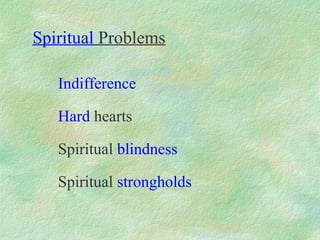
Spiritual Problems

   Indifference

   Hard hearts

   Spiritual blindness

   Spiritual strongholds
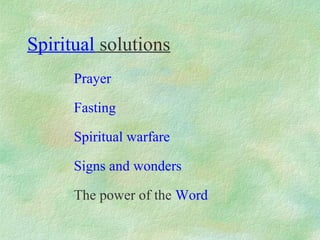
Spiritual solutions
      Prayer

      Fasting

      Spiritual warfare

      Signs and wonders

      The power of the Word
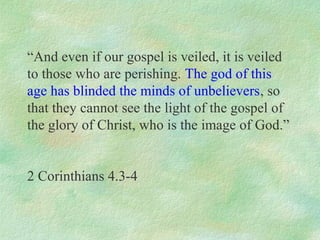
“And even if our gospel is veiled, it is veiled
to those who are perishing. The god of this
age has blinded the minds of unbelievers, so
that they cannot see the light of the gospel of
the glory of Christ, who is the image of God.”


2 Corinthians 4.3-4
“…I will rescue you from your own
people and from the Gentiles. I am
sending you to them to open their eyes
and turn them from darkness to light, and
from the power of Satan to God, so that
they may receive forgiveness of sins and
a place among those who are sanctified
by faith in me.”
Acts 26.17-18
“The weapons we fight with are not the
weapons of the world. On the contrary,
they have divine power to demolish
strongholds. We demolish arguments
and every pretension that sets itself up
against the knowledge of God, and we
take captive every thought to make it
obedient to Christ.”
2 Corinthians 10.4-5
“Now, Lord, consider their threats and
enable your servants to speak your word
with great boldness. Stretch out your
hand to heal and perform miraculous
signs and wonders through the name of
your holy servant Jesus.”

Acts 4:29-30
“But if an unbeliever or someone who
does not understand comes in while
everybody is prophesying, he will be
convinced by all that he is a sinner and
will be judged by all, and the secrets of
his heart will be laid bare. So he will fall
down and worship God, exclaiming, ‘God
is really among you!’”

1 Corinthians 14.24-25
“But this kind does not go out
except by prayer and fasting.”

Matthew 17.21
Barrier #6

              The
    communication
             barrier
You must communicate the
message of the gospel.
“God was pleased through the foolishness
of what was preached to save those who
believe.”
1 Corinthians 1.21

“How, then, can they call on the one they
have not believed in? And how can they
believe in the one of whom they have not
heard? And how can they hear without
someone preaching to them?”
Romans 10.14
You must communicate the
message in a way that is
understandable.
“But the one who received the seed that fell on
good soil is the man who hears the word and
understands it. He produces a crop, yielding a
hundred, sixty or thirty times what was sown.”

Matthew 13.23
You must communicate clearly...
  The message of reconciliation
    more so than how to get to heaven, the gospel is
   about how to mend our broken relationship with our
   Heavenly Father
  The message of grace
    a “gospel” that leaves room for trusting in good
   works is not an authentic gospel
  The message of repentance
    the prerequisite for receiving the gift of grace is a
   sincerely repentant heart
According to the Great Commission,
the work of making disciples is
made up not only of “baptizing them
in the name of the Father, of the Son,
and of the Holy Spirit,” but also of
“teaching them to obey everything
that Jesus has commanded us.”
“If we ever have to choose
between how much Bible is
understood or how much Bible is
obeyed, my prejudice is in favor
of obeyed truth.”

    Carl George, The Coming Church
    Revolution
This task of “post-conversion
discipleship” normally is best
carried out in the context of a
local church, with a personalized
methodology, either one-on-one
or in small groups.
If we are able to overcome
these first 6 barriers, almost
certainly, we will have at least
made some disciples.

 But...
…the Great Commission will still not have been
fulfilled.


In order to do this, there is
one more barrier that must
be overcome...
Barrier #7

              The
             logistic
             barrier
We must have a strategy of
multiplication.
Multiplying disciples,
multiplying disciple-makers.
“But he said, ‘I must preach the good news of
the kingdom of God to the other towns also,
because that is why I was sent.’”
Luke 4.43

“This went on for two years, so that all the
Jews and Greeks who lived in the province of
Asia heard the word of the Lord.”

Acts 19.10
Multiplication models...
    Cell churches
      the “G-12” model
      the “5 x 5” model

    “Simple” churches or house churches

    “Pioneer Evangelism”
The key...

   Training, mobilizing, and
 multiplying evangelists, disciplers,
 and “lay” leaders
“The main limiting factor in the
part of the harvest that
corresponds to the church, is,
very probably, the lack of trained
leaders.”
       Carl George, The Coming Church
       Revolution
“Learn to develop cell-group
leaders. That is the most
important single thing that you
need to do as a leader of a
church.”
     Carl George, The Coming Church
     Revolution
“No church can reach everyone on its
own. Therefore, it will be necessary to
multiply the amount of available units
to serve a greater quantity of
demographic segments and different
communities within a general
population.”

      Carl George, The Coming Church
      Revolution
“The secret of the expansion of the Christian
movement is the mobilization of more
workers. The key is not just new churches, but
also new units. It is a model based on
harvesters. The more units there are, the more
harvesters there will be who can be effective.
The best way, then, of preparing for a greater
harvest is training more leaders who will be
able to care for people.”

        Carl George, The Coming Church
        Revolution
There will never be enough
“pastors,” “missionaries,” or
“full-time workers” to reach all
the people that need to be
evangelized and discipled.
Also, many times, the most
effective evangelists and
disciplers are those who work side
by side with non-believers and
have more natural opportunities to
win their trust.
However, it is not sufficient to
train “lay people” to evangelize
and disciple, without giving them
specific structures to put into
practice the training they receive.
The problem with many
missionary models...

    They focus on overcoming one or
  some of the barriers to the fulfillment of
  the Great Commission to the exclusion
  or near exclusion of the rest.
For example...
 “Good works” ministries that do not
 emphasize the need to verbally
 communicate the gospel
 “Evangelistic” ministries that do not
 emphasize the need to win the trust of the
 people by way of “good works”
 Ministries that underestimate the
 importance of prayer and spiritual warfare
It doesn’t make much sense...


   To pray without evangelizing

But neither does it make sense...


  To evangelize without praying
Many times we cannot make any
significant progress towards the
goal of making disciples among
all the nations as long as there are
still some of these barriers left to
overcome.
At times, some barriers must be
overcome in a certain order.
For example...

    It doesn’t make much sense to try to
  win someone’s friendship, if you don’t
  speak their language.

    Neither does it make much sense to try
  to communicate the gospel with
  someone who doesn’t trust you as a
  person.
In some places and contexts,
overcoming some of these
barriers will take on a higher
priority at a given time than
overcoming others.
For example...
    In a postmodern context, overcoming
  the trust barrier will be a very important
  priority.

    In a so-called “harvest field” context,
  giving immediate attention to the
  communication of the gospel will take
  higher priority.
Although efforts to overcome
each and every one of the 7
barriers are important and have
their place, it can sometimes be a
bad stewardship of resources, and
even counterproductive, to work
too much on certain barriers
outside of their proper order.
This is one of the main problems,
for example, with many short-
term projects. They focus on
overcoming only one of the
barriers independently of a
broader strategy for addressing
all of the barriers in their
appropriate time and order.
In one way or another, the job of the
missionary strategist is to analyze the
situation at hand in order to determine
what are the main barriers that are
standing in the way of the fulfillment
of the Great Commission in a given
context and time, and propose adequate
strategies for overcoming those
particular barriers.

Overcoming barriers

  • 1.
    Missions: overcoming barriers to thefulfillment of the Great Commission 2.005, David Rogers
  • 2.
    The Great Commission (Matthew28:18-20) Jesus came to them and said: I have been given all authority in heaven and on earth! Go to the people of all nations and make them my disciples. Baptize them in the name of the Father, the Son, and the Holy Spirit. And teach them to do everything I have told you. I will be with you always, even until the end of the world.
  • 3.
    In order tomake disciples of the people of all nations... …it is necessary to overcome 7 barriers.
  • 4.
    Barrier #1 The geographic barrier
  • 5.
    “Go to thepeople...” You must go where the people are.
  • 6.
    “Then you willtell everyone about me in Jerusalem, in all Judea, in Samaria, and everywhere in the world.” Acts 1.8 “The Lord’s followers who had been scattered went from place to place, telling the good news.” Acts 8.4
  • 7.
    Some will haveto intentionally go from places where there is a relatively high percent of believers to places where there is a relatively low percent of believers.
  • 8.
    Missionary = Apostle= Sent One “While they were worshiping the Lord and going without eating, the Holy Spirit told them, ‘Appoint Barnabas and Saul to do the work for which I have chosen them.’ Everyone prayed and went without eating for a while longer. Next, they placed their hands on Barnabas and Saul to show that they had been appointed to do the work. Then everyone sent them on their way.” Acts 13.2-3
  • 9.
    Barrier #2 The language barrier
  • 10.
    “In the pastGod spoke to our forefathers through the prophets at many times and in various ways, but in these last days he has spoken to us by his Son, whom he appointed heir of all things, and through whom he made the universe.” Hebrews 1.1-2 “each one heard them speaking in his own language.” Acts 2.6
  • 11.
    “As the soldierswere about to take Paul into the barracks, he asked the commander, ‘May I say something to you?’ ‘Do you speak Greek?’ he replied.” Acts 21.37 “Brothers and fathers, listen now to my defense. When they heard him speak to them in Aramaic, they became very quiet.” Acts 22.1-2
  • 12.
    Barrier #3 The cultural barrier
  • 13.
    “Though I amfree and belong to no man, I make myself a slave to everyone, to win as many as possible. To the Jews I became like a Jew, to win the Jews. To those under the law I became like one under the law (though I myself am not under the law), so as to win those under the law. To those not having the law I became like one not having the law (though I am not free from God's law but am under Christ’s law), so as to win those not having the law. To the weak I became weak, to win the weak. I have become all things to all men so that by all possible means I might save some.” 1 Corinthians 9.19-22
  • 14.
    Normally, those whocome from the same cultural context as those who are going to receive the message will be more effective at communicating the message in a culturally relevant manner than those who come from another cultural context.
  • 15.
    However, there aresituations in which there are not yet enough evangelists and disciplers from the local cultural context to effectively reach everyone.
  • 16.
    In these situations,the most effective evangelists and disciplers (even though they come from outside of the cultural context) will usually be those who best adapt to the cultural context.
  • 17.
    In any case,in order to reach a greater effectiveness in the communication of the gospel, it is necessary to always transfer the main responsibility of communicating the gospel to those who come from the same cultural context as much as possible, and as soon as possible.
  • 18.
    Barrier #4 The social barrier
  • 19.
    You must winthe trust of the people.
  • 20.
    Trust is wonby way of 4 main things... 1. Friendship 2. Good works 3. A life testimony consistent with your spoken testimony 4. The communion of the church
  • 21.
    Friendship... “People don’t carehow much you know, until they know how much you care.”
  • 22.
    Good works… “For wedo not preach ourselves, but Jesus Christ as Lord, and ourselves as your servants for Jesus’ sake.” 2 Corinthians 4.5
  • 23.
    Life testimony… “Rather, wehave renounced secret and shameful ways; we do not use deception, nor do we distort the word of God. On the contrary, by setting forth the truth plainly we commend ourselves to every man’s conscience in the sight of God.” 2 Corinthians 4.2
  • 24.
    The communion ofthe church… “…that all of them may be one, Father, just as you are in me and I am in you. May they also be in us so that the world may believe that you have sent me.” John 17.21 “We proclaim to you what we have seen and heard, so that you also may have fellowship with us. And our fellowship is with the Father and with his Son, Jesus Christ… But if we walk in the light, as he is in the light, we have fellowship with one another.” 1 John 1.3, 7
  • 25.
    Barrier #5 The spiritual barrier
  • 26.
    Spiritual Problems Indifference Hard hearts Spiritual blindness Spiritual strongholds
  • 27.
    Spiritual solutions Prayer Fasting Spiritual warfare Signs and wonders The power of the Word
  • 28.
    “And even ifour gospel is veiled, it is veiled to those who are perishing. The god of this age has blinded the minds of unbelievers, so that they cannot see the light of the gospel of the glory of Christ, who is the image of God.” 2 Corinthians 4.3-4
  • 29.
    “…I will rescueyou from your own people and from the Gentiles. I am sending you to them to open their eyes and turn them from darkness to light, and from the power of Satan to God, so that they may receive forgiveness of sins and a place among those who are sanctified by faith in me.” Acts 26.17-18
  • 30.
    “The weapons wefight with are not the weapons of the world. On the contrary, they have divine power to demolish strongholds. We demolish arguments and every pretension that sets itself up against the knowledge of God, and we take captive every thought to make it obedient to Christ.” 2 Corinthians 10.4-5
  • 31.
    “Now, Lord, considertheir threats and enable your servants to speak your word with great boldness. Stretch out your hand to heal and perform miraculous signs and wonders through the name of your holy servant Jesus.” Acts 4:29-30
  • 32.
    “But if anunbeliever or someone who does not understand comes in while everybody is prophesying, he will be convinced by all that he is a sinner and will be judged by all, and the secrets of his heart will be laid bare. So he will fall down and worship God, exclaiming, ‘God is really among you!’” 1 Corinthians 14.24-25
  • 33.
    “But this kinddoes not go out except by prayer and fasting.” Matthew 17.21
  • 34.
    Barrier #6 The communication barrier
  • 35.
    You must communicatethe message of the gospel.
  • 36.
    “God was pleasedthrough the foolishness of what was preached to save those who believe.” 1 Corinthians 1.21 “How, then, can they call on the one they have not believed in? And how can they believe in the one of whom they have not heard? And how can they hear without someone preaching to them?” Romans 10.14
  • 37.
    You must communicatethe message in a way that is understandable. “But the one who received the seed that fell on good soil is the man who hears the word and understands it. He produces a crop, yielding a hundred, sixty or thirty times what was sown.” Matthew 13.23
  • 38.
    You must communicateclearly... The message of reconciliation more so than how to get to heaven, the gospel is about how to mend our broken relationship with our Heavenly Father The message of grace a “gospel” that leaves room for trusting in good works is not an authentic gospel The message of repentance the prerequisite for receiving the gift of grace is a sincerely repentant heart
  • 39.
    According to theGreat Commission, the work of making disciples is made up not only of “baptizing them in the name of the Father, of the Son, and of the Holy Spirit,” but also of “teaching them to obey everything that Jesus has commanded us.”
  • 40.
    “If we everhave to choose between how much Bible is understood or how much Bible is obeyed, my prejudice is in favor of obeyed truth.” Carl George, The Coming Church Revolution
  • 41.
    This task of“post-conversion discipleship” normally is best carried out in the context of a local church, with a personalized methodology, either one-on-one or in small groups.
  • 42.
    If we areable to overcome these first 6 barriers, almost certainly, we will have at least made some disciples. But...
  • 43.
    …the Great Commissionwill still not have been fulfilled. In order to do this, there is one more barrier that must be overcome...
  • 44.
    Barrier #7 The logistic barrier
  • 45.
    We must havea strategy of multiplication.
  • 46.
  • 47.
    “But he said,‘I must preach the good news of the kingdom of God to the other towns also, because that is why I was sent.’” Luke 4.43 “This went on for two years, so that all the Jews and Greeks who lived in the province of Asia heard the word of the Lord.” Acts 19.10
  • 48.
    Multiplication models... Cell churches the “G-12” model the “5 x 5” model “Simple” churches or house churches “Pioneer Evangelism”
  • 49.
    The key... Training, mobilizing, and multiplying evangelists, disciplers, and “lay” leaders
  • 50.
    “The main limitingfactor in the part of the harvest that corresponds to the church, is, very probably, the lack of trained leaders.” Carl George, The Coming Church Revolution
  • 51.
    “Learn to developcell-group leaders. That is the most important single thing that you need to do as a leader of a church.” Carl George, The Coming Church Revolution
  • 52.
    “No church canreach everyone on its own. Therefore, it will be necessary to multiply the amount of available units to serve a greater quantity of demographic segments and different communities within a general population.” Carl George, The Coming Church Revolution
  • 53.
    “The secret ofthe expansion of the Christian movement is the mobilization of more workers. The key is not just new churches, but also new units. It is a model based on harvesters. The more units there are, the more harvesters there will be who can be effective. The best way, then, of preparing for a greater harvest is training more leaders who will be able to care for people.” Carl George, The Coming Church Revolution
  • 54.
    There will neverbe enough “pastors,” “missionaries,” or “full-time workers” to reach all the people that need to be evangelized and discipled.
  • 55.
    Also, many times,the most effective evangelists and disciplers are those who work side by side with non-believers and have more natural opportunities to win their trust.
  • 56.
    However, it isnot sufficient to train “lay people” to evangelize and disciple, without giving them specific structures to put into practice the training they receive.
  • 57.
    The problem withmany missionary models... They focus on overcoming one or some of the barriers to the fulfillment of the Great Commission to the exclusion or near exclusion of the rest.
  • 58.
    For example... “Goodworks” ministries that do not emphasize the need to verbally communicate the gospel “Evangelistic” ministries that do not emphasize the need to win the trust of the people by way of “good works” Ministries that underestimate the importance of prayer and spiritual warfare
  • 59.
    It doesn’t makemuch sense... To pray without evangelizing But neither does it make sense... To evangelize without praying
  • 60.
    Many times wecannot make any significant progress towards the goal of making disciples among all the nations as long as there are still some of these barriers left to overcome.
  • 61.
    At times, somebarriers must be overcome in a certain order.
  • 62.
    For example... It doesn’t make much sense to try to win someone’s friendship, if you don’t speak their language. Neither does it make much sense to try to communicate the gospel with someone who doesn’t trust you as a person.
  • 63.
    In some placesand contexts, overcoming some of these barriers will take on a higher priority at a given time than overcoming others.
  • 64.
    For example... In a postmodern context, overcoming the trust barrier will be a very important priority. In a so-called “harvest field” context, giving immediate attention to the communication of the gospel will take higher priority.
  • 65.
    Although efforts toovercome each and every one of the 7 barriers are important and have their place, it can sometimes be a bad stewardship of resources, and even counterproductive, to work too much on certain barriers outside of their proper order.
  • 66.
    This is oneof the main problems, for example, with many short- term projects. They focus on overcoming only one of the barriers independently of a broader strategy for addressing all of the barriers in their appropriate time and order.
  • 67.
    In one wayor another, the job of the missionary strategist is to analyze the situation at hand in order to determine what are the main barriers that are standing in the way of the fulfillment of the Great Commission in a given context and time, and propose adequate strategies for overcoming those particular barriers.