OVER FITTING
UNDERFITTING
BIAS VARIANCE TRADE OFF
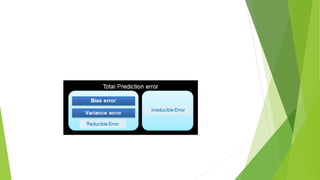
What is bias?
 Bias is the difference between the average prediction of our model and the
correct value which we are trying to predict. Model with high bias pays very
little attention to the training data and oversimplifies the model. It always
leads to high error on training and test data.
overfitting
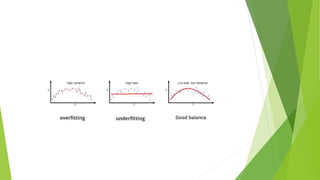
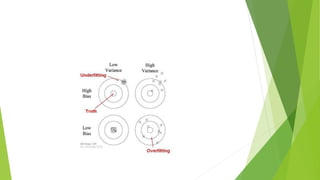
 In supervised learning, overfitting happens when our model captures the
noise along with the underlying pattern in data. It happens when we train our
model a lot over noisy dataset. These models have low bias and high variance.
These models are very complex like Decision trees which are prone to
overfitting.
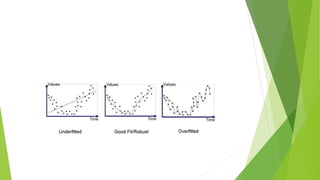
 When a mode is built using so many predictors that it captures noise along
with the underlying pattern then it tries to fit the model too closely to the
training data leaving very less scope for generalizability. This phenomenon is
known as Overfitting.
 Low bias error, High variance error
 This is a case of complex representation of a simpler reality
 Example- Decision tress are prome to Overfitting
underfitting
 In supervised learning, underfitting happens when a model unable to capture
the underlying pattern of the data. These models usually have high bias and
low variance. It happens when we have very less amount of data to build an
accurate model or when we try to build a linear model with a nonlinear data.
Also, these kind of models are very simple to capture the complex patterns in
data like Linear and logistic regression.
 UNDERFITTING
 When a model is unable to capture the essence of the training data properly
because of low number of parameters then this phenomenon is known as
Underfitting.
 High bias error, Low variance error
 This can also happen in the cases where we have very less amount of data to
build an accurate model.
 This situation can also arise if we try to build linear model with non-linear
data.
 Example- Linear regression and logistic regression models might face this
Why is Bias Variance Tradeoff?
 If our model is too simple and has very few parameters then it may have high
bias and low variance. On the other hand if our model has large number of
parameters then it’s going to have high variance and low bias. So we need to
find the right/good balance without overfitting and underfitting the data.
 This tradeoff in complexity is why there is a tradeoff between bias and
variance. An algorithm can’t be more complex and less complex at the same
time.
OVER FITTING UNDERFITTING.pptx

OVER FITTING UNDERFITTING.pptx

  • 1.
  • 2.
    What is bias? Bias is the difference between the average prediction of our model and the correct value which we are trying to predict. Model with high bias pays very little attention to the training data and oversimplifies the model. It always leads to high error on training and test data.
  • 3.
    overfitting  In supervisedlearning, overfitting happens when our model captures the noise along with the underlying pattern in data. It happens when we train our model a lot over noisy dataset. These models have low bias and high variance. These models are very complex like Decision trees which are prone to overfitting.
  • 4.
     When amode is built using so many predictors that it captures noise along with the underlying pattern then it tries to fit the model too closely to the training data leaving very less scope for generalizability. This phenomenon is known as Overfitting.  Low bias error, High variance error  This is a case of complex representation of a simpler reality  Example- Decision tress are prome to Overfitting
  • 5.
    underfitting  In supervisedlearning, underfitting happens when a model unable to capture the underlying pattern of the data. These models usually have high bias and low variance. It happens when we have very less amount of data to build an accurate model or when we try to build a linear model with a nonlinear data. Also, these kind of models are very simple to capture the complex patterns in data like Linear and logistic regression.
  • 6.
     UNDERFITTING  Whena model is unable to capture the essence of the training data properly because of low number of parameters then this phenomenon is known as Underfitting.  High bias error, Low variance error  This can also happen in the cases where we have very less amount of data to build an accurate model.  This situation can also arise if we try to build linear model with non-linear data.  Example- Linear regression and logistic regression models might face this
  • 10.
    Why is BiasVariance Tradeoff?  If our model is too simple and has very few parameters then it may have high bias and low variance. On the other hand if our model has large number of parameters then it’s going to have high variance and low bias. So we need to find the right/good balance without overfitting and underfitting the data.  This tradeoff in complexity is why there is a tradeoff between bias and variance. An algorithm can’t be more complex and less complex at the same time.