Using The Performance Management Framework Gerald Power Service Transformation Manager Delivery and Transformation Group
Opening Assumptions That you  do  already measure:  Call volumes.  Call durations.  Wait/pickup times.  Contact centre costs.  Basic HR data on staff turnover and absence.
Opening Assumptions That you  may  already investigate:  Why people call you.  Who these people are.  Whether you meet their needs.
Opening Assumptions That you  want to use this information  to achieve: Better service .   Better Insight.  Better efficiency.  Overall a better ‘business’.
Avoidable Contact Avoidable contact is defined in the 2007 Service Transformation Agreement as:  ‘Contact that adds no value to the outcome. It includes contact that is nugatory, duplicative or caused by failures in business processes.’   Its could be put even more simply as:  ‘ Contact which is a waste of time for the customer or the Service Provider’
How important is Avoidable Contact It can have a massive resource cost in terms of providing ever more contact and back office services.  It can have a massive impact on an organisations reputation and create a chain reaction effect as it causes your organisation to ‘gridlock’.  It can create a ‘toxic’ environment for your staff.  It really annoys your customers.
Reducing Avoidable Contact Measuring avoidable contact is only the first step on the journey to understanding and eliminating it.  In principle its all very obvious and essentially business process and customer service improvement.  Central Government is committed to reducing its avoidable contact by 50% by April 2011.  Local Government is committed to identifying its avoidable contact levels for all services and via all channels by March 2009.
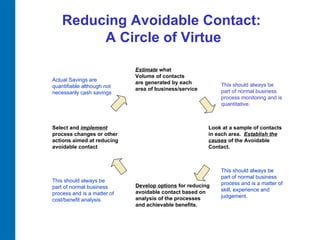
Reducing Avoidable Contact:  A Circle of Virtue Estimate  what Volume of contacts are generated by each area of business/service Look at a sample of contacts in each area.  Establish the causes  of the Avoidable Contact.  Develop options  for reducing avoidable contact based on analysis of the processes and achievable benefits.  Select and  implement  process changes or other actions aimed at reducing avoidable contact  Actual Savings are quantifiable although not necessarily cash savings This should always be part of normal business process monitoring and is quantitative.   This should always be part of normal business process and is a matter of skill, experience and judgement.  This should always be part of normal business process and is a matter of cost/benefit analysis.
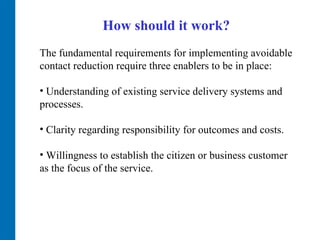
How should it work? The fundamental requirements for implementing avoidable contact reduction require three enablers to be in place:  Understanding of existing service delivery systems and processes.  Clarity regarding responsibility for outcomes and costs.  Willingness to establish the citizen or business customer as the focus of the service.
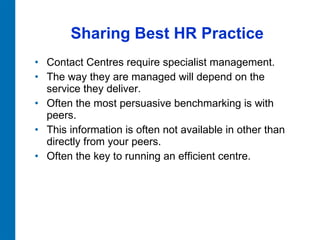
Sharing Best HR Practice Contact Centres require specialist management.  The way they are managed will depend on the service they deliver.  Often the most persuasive benchmarking is with peers.  This information is often not available in other than directly from your peers.  Often the key to running an efficient centre.
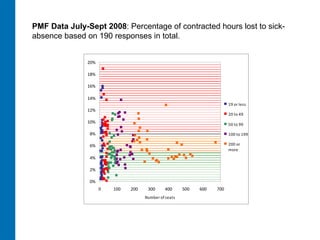
PMF Data July-Sept 2008 : Percentage of contracted hours lost to sick-absence based on 190 responses in total.  Size of Contact Centre [Personnel] % Hours Lost to Sickness
PMF Data July-Sept 2008 : Percentage of contracted hours lost to sick-absence based on 190 responses in total.
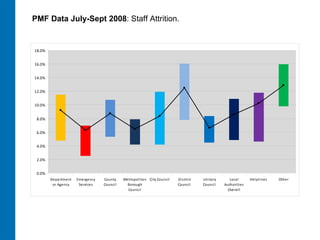
PMF Data July-Sept 2008 : Staff Attrition.
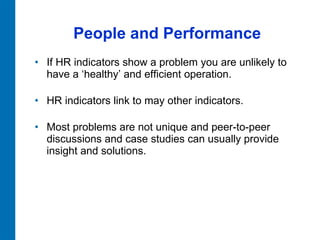
People and Performance If HR indicators show a problem you are unlikely to have a ‘healthy’ and efficient operation.  HR indicators link to may other indicators.  Most problems are not unique and peer-to-peer  discussions and case studies can usually provide insight and solutions.
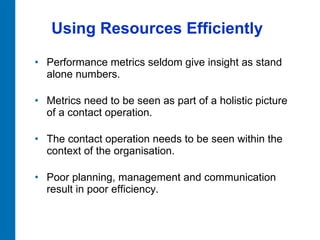
Using Resources Efficiently Performance metrics seldom give insight as stand alone numbers.  Metrics need to be seen as part of a holistic picture of a contact operation.  The contact operation needs to be seen within the context of the organisation.  Poor planning, management and communication result in poor efficiency.
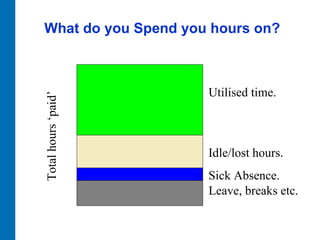
What do you Spend you hours on? Total hours ‘paid’ Leave, breaks etc. Sick Absence. Utilised time. Idle/lost hours.
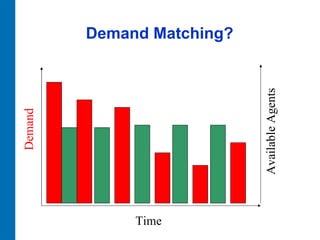
Demand Matching? Demand Time Available Agents
Some Useful LINKS…… I&DEA Guidance on NI14 http://www.idea.gov.uk/idk/core/page.do?pageId=8507853   Community of Practice [Requires registration]  http://www.communities.idea.gov.uk/login.do   Cabinet Office Service Reform http:// www.cabinetoffice.gov.uk/public_service_reform.aspx   Customer Journey Mapping [ Scroll to Publications] http://www.cabinetoffice.gov.uk/public_service_reform/delivery_council/workplan.aspx   Customer Service Excellence http://www.cse.cabinetoffice.gov.uk/homeCSE.do   I&DEA Guidance on NI14 http://www.idea.gov.uk/idk/core/page.do?pageId=8507853   Community of Practice [Requires registration]  http://www.communities.idea.gov.uk/login.do   Cabinet Office Service Reform http:// www.cabinetoffice.gov.uk/public_service_reform.aspx   Customer Journey Mapping [ Scroll to Publications] http://www.cabinetoffice.gov.uk/public_service_reform/delivery_council/workplan.aspx   Customer Service Excellence http://www.cse.cabinetoffice.gov.uk/homeCSE.do

09 03 10 N Housing Trusts

  • 1.
    Using The PerformanceManagement Framework Gerald Power Service Transformation Manager Delivery and Transformation Group
  • 2.
    Opening Assumptions Thatyou do already measure: Call volumes. Call durations. Wait/pickup times. Contact centre costs. Basic HR data on staff turnover and absence.
  • 3.
    Opening Assumptions Thatyou may already investigate: Why people call you. Who these people are. Whether you meet their needs.
  • 4.
    Opening Assumptions Thatyou want to use this information to achieve: Better service . Better Insight. Better efficiency. Overall a better ‘business’.
  • 5.
    Avoidable Contact Avoidablecontact is defined in the 2007 Service Transformation Agreement as: ‘Contact that adds no value to the outcome. It includes contact that is nugatory, duplicative or caused by failures in business processes.’ Its could be put even more simply as: ‘ Contact which is a waste of time for the customer or the Service Provider’
  • 6.
    How important isAvoidable Contact It can have a massive resource cost in terms of providing ever more contact and back office services. It can have a massive impact on an organisations reputation and create a chain reaction effect as it causes your organisation to ‘gridlock’. It can create a ‘toxic’ environment for your staff. It really annoys your customers.
  • 7.
    Reducing Avoidable ContactMeasuring avoidable contact is only the first step on the journey to understanding and eliminating it. In principle its all very obvious and essentially business process and customer service improvement. Central Government is committed to reducing its avoidable contact by 50% by April 2011. Local Government is committed to identifying its avoidable contact levels for all services and via all channels by March 2009.
  • 8.
    Reducing Avoidable Contact: A Circle of Virtue Estimate what Volume of contacts are generated by each area of business/service Look at a sample of contacts in each area. Establish the causes of the Avoidable Contact. Develop options for reducing avoidable contact based on analysis of the processes and achievable benefits. Select and implement process changes or other actions aimed at reducing avoidable contact Actual Savings are quantifiable although not necessarily cash savings This should always be part of normal business process monitoring and is quantitative. This should always be part of normal business process and is a matter of skill, experience and judgement. This should always be part of normal business process and is a matter of cost/benefit analysis.
  • 9.
    How should itwork? The fundamental requirements for implementing avoidable contact reduction require three enablers to be in place: Understanding of existing service delivery systems and processes. Clarity regarding responsibility for outcomes and costs. Willingness to establish the citizen or business customer as the focus of the service.
  • 10.
    Sharing Best HRPractice Contact Centres require specialist management. The way they are managed will depend on the service they deliver. Often the most persuasive benchmarking is with peers. This information is often not available in other than directly from your peers. Often the key to running an efficient centre.
  • 11.
    PMF Data July-Sept2008 : Percentage of contracted hours lost to sick-absence based on 190 responses in total. Size of Contact Centre [Personnel] % Hours Lost to Sickness
  • 12.
    PMF Data July-Sept2008 : Percentage of contracted hours lost to sick-absence based on 190 responses in total.
  • 13.
    PMF Data July-Sept2008 : Staff Attrition.
  • 14.
    People and PerformanceIf HR indicators show a problem you are unlikely to have a ‘healthy’ and efficient operation. HR indicators link to may other indicators. Most problems are not unique and peer-to-peer discussions and case studies can usually provide insight and solutions.
  • 15.
    Using Resources EfficientlyPerformance metrics seldom give insight as stand alone numbers. Metrics need to be seen as part of a holistic picture of a contact operation. The contact operation needs to be seen within the context of the organisation. Poor planning, management and communication result in poor efficiency.
  • 16.
    What do youSpend you hours on? Total hours ‘paid’ Leave, breaks etc. Sick Absence. Utilised time. Idle/lost hours.
  • 17.
    Demand Matching? DemandTime Available Agents
  • 18.
    Some Useful LINKS……I&DEA Guidance on NI14 http://www.idea.gov.uk/idk/core/page.do?pageId=8507853 Community of Practice [Requires registration] http://www.communities.idea.gov.uk/login.do Cabinet Office Service Reform http:// www.cabinetoffice.gov.uk/public_service_reform.aspx Customer Journey Mapping [ Scroll to Publications] http://www.cabinetoffice.gov.uk/public_service_reform/delivery_council/workplan.aspx Customer Service Excellence http://www.cse.cabinetoffice.gov.uk/homeCSE.do I&DEA Guidance on NI14 http://www.idea.gov.uk/idk/core/page.do?pageId=8507853 Community of Practice [Requires registration] http://www.communities.idea.gov.uk/login.do Cabinet Office Service Reform http:// www.cabinetoffice.gov.uk/public_service_reform.aspx Customer Journey Mapping [ Scroll to Publications] http://www.cabinetoffice.gov.uk/public_service_reform/delivery_council/workplan.aspx Customer Service Excellence http://www.cse.cabinetoffice.gov.uk/homeCSE.do