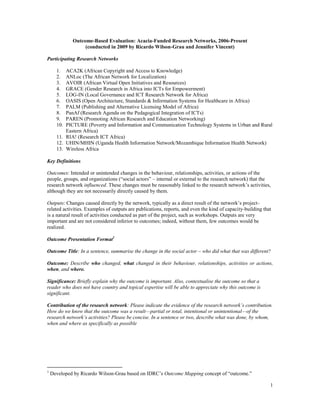
Outcome-Based Evaluation: Acacia-Funded Research Networks, 2006-Present
                  (conducted in 2009 by Ricardo Wilson-Grau and Jennifer Vincent)

Participating Research Networks

      1.  ACA2K (African Copyright and Access to Knowledge)
      2.  ANLoc (The African Network for Localization)
      3.  AVOIR (African Virtual Open Initiatives and Resources)
      4.  GRACE (Gender Research in Africa into ICTs for Empowerment)
      5.  LOG-IN (Local Governance and ICT Research Network for Africa)
      6.  OASIS (Open Architecture, Standards & Information Systems for Healthcare in Africa)
      7.  PALM (Publishing and Alternative Licensing Model of Africa)
      8.  PanAf (Research Agenda on the Pedagogical Integration of ICTs)
      9.  PAREN (Promoting African Research and Education Networking)
      10. PICTURE (Poverty and Information and Communication Technology Systems in Urban and Rural
          Eastern Africa)
      11. RIA! (Research ICT Africa)
      12. UHIN/MHIN (Uganda Health Information Network/Mozambique Information Health Network)
      13. Wireless Africa

Key Definitions

Outcomes: Intended or unintended changes in the behaviour, relationships, activities, or actions of the
people, groups, and organizations (“social actors” – internal or external to the research network) that the
research network influenced. These changes must be reasonably linked to the research network’s activities,
although they are not necessarily directly caused by them.

Outputs: Changes caused directly by the network, typically as a direct result of the network’s project-
related activities. Examples of outputs are publications, reports, and even the kind of capacity-building that
is a natural result of activities conducted as part of the project, such as workshops. Outputs are very
important and are not considered inferior to outcomes; indeed, without them, few outcomes would be
realized.

Outcome Presentation Format1

Outcome Title: In a sentence, summarise the change in the social actor – who did what that was different?

Outcome: Describe who changed, what changed in their behaviour, relationships, activities or actions,
when, and where.

Significance: Briefly explain why the outcome is important. Also, contextualise the outcome so that a
reader who does not have country and topical expertise will be able to appreciate why this outcome is
significant.

Contribution of the research network: Please indicate the evidence of the research network’s contribution.
How do we know that the outcome was a result—partial or total, intentional or unintentional—of the
research network’s activities? Please be concise. In a sentence or two, describe what was done, by whom,
when and where as specifically as possible


1
    Developed by Ricardo Wilson-Grau based on IDRC’s Outcome Mapping concept of “outcome.”

                                                                                                             1
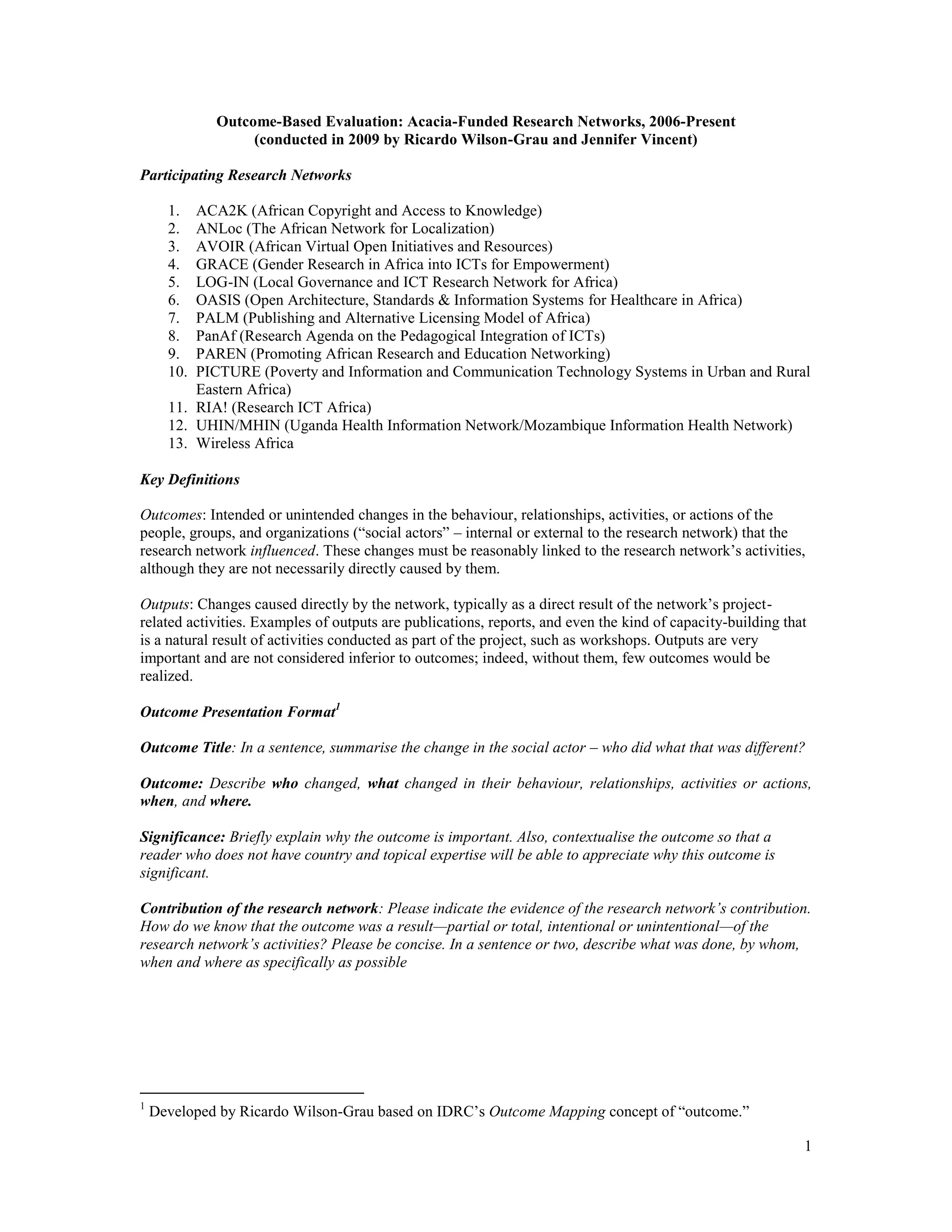
Outcome Presentation Format Continued…

Classification: Please indicate which of the following dimensions of Acacia’s overall objectives the
outcome contributes to (or in the case of a negative outcome, detracts from), bearing in mind that IDRC
recognizes that not every project/network will make a significant contribution to (or undermine) all of these
objectives. (Please select as many as you feel apply by marking an ―X‖ or highlighting):

Fostering on-going, robust policy dialogue among:
         ICT4D researchers
         Policy-makers
         Other key policy-related bodies.
Catalyzing thriving regional research networks that:
         Strengthen weak institutions through mentoring relationships
         Serve as fora for knowledge diffusion
         Are a vehicle for parallel funding activities
Increasing research capacity in ICT4D through:
         Improved research methodologies and practices
         Increased numbers of ICT4D researchers
         More research institutions with a specific ICT4D focus
Stimulating social and technical innovation in ICTs, including:
         Mobile telephony
         Wireless broadband
         Alternative, innovative telecom and IT policy models for Africa
         Alternative intellectual property regimes
        Fostering social innovation, broadly defined as dealing with improving the welfare of individuals
        and community through employment, consumption or participation, its expressed purpose being to
        provide solutions for individual and community problems.
Contributing to a formal body of knowledge in ICT4D as evidenced by research findings being:
         Cited and/or published in peer-reviewed, third-party publications (i.e., not by IDRC or the
         research networks).
        Incorporated into university curricula.
Applying meaningful gender analysis:
         Contribution to a more sophisticated understanding of women’s access and usage of ICTs in
         Africa
       Reduction in the magnitude and evolution of the observed gender gap
    Changing gender relations in:
         Access and patterns of use
         ICT literacy
         Education and skills
         ICT employment.


                                                                                                            2

Outcome Format

  • 1.
    Outcome-Based Evaluation: Acacia-FundedResearch Networks, 2006-Present (conducted in 2009 by Ricardo Wilson-Grau and Jennifer Vincent) Participating Research Networks 1. ACA2K (African Copyright and Access to Knowledge) 2. ANLoc (The African Network for Localization) 3. AVOIR (African Virtual Open Initiatives and Resources) 4. GRACE (Gender Research in Africa into ICTs for Empowerment) 5. LOG-IN (Local Governance and ICT Research Network for Africa) 6. OASIS (Open Architecture, Standards & Information Systems for Healthcare in Africa) 7. PALM (Publishing and Alternative Licensing Model of Africa) 8. PanAf (Research Agenda on the Pedagogical Integration of ICTs) 9. PAREN (Promoting African Research and Education Networking) 10. PICTURE (Poverty and Information and Communication Technology Systems in Urban and Rural Eastern Africa) 11. RIA! (Research ICT Africa) 12. UHIN/MHIN (Uganda Health Information Network/Mozambique Information Health Network) 13. Wireless Africa Key Definitions Outcomes: Intended or unintended changes in the behaviour, relationships, activities, or actions of the people, groups, and organizations (“social actors” – internal or external to the research network) that the research network influenced. These changes must be reasonably linked to the research network’s activities, although they are not necessarily directly caused by them. Outputs: Changes caused directly by the network, typically as a direct result of the network’s project- related activities. Examples of outputs are publications, reports, and even the kind of capacity-building that is a natural result of activities conducted as part of the project, such as workshops. Outputs are very important and are not considered inferior to outcomes; indeed, without them, few outcomes would be realized. Outcome Presentation Format1 Outcome Title: In a sentence, summarise the change in the social actor – who did what that was different? Outcome: Describe who changed, what changed in their behaviour, relationships, activities or actions, when, and where. Significance: Briefly explain why the outcome is important. Also, contextualise the outcome so that a reader who does not have country and topical expertise will be able to appreciate why this outcome is significant. Contribution of the research network: Please indicate the evidence of the research network’s contribution. How do we know that the outcome was a result—partial or total, intentional or unintentional—of the research network’s activities? Please be concise. In a sentence or two, describe what was done, by whom, when and where as specifically as possible 1 Developed by Ricardo Wilson-Grau based on IDRC’s Outcome Mapping concept of “outcome.” 1
  • 2.
    Outcome Presentation FormatContinued… Classification: Please indicate which of the following dimensions of Acacia’s overall objectives the outcome contributes to (or in the case of a negative outcome, detracts from), bearing in mind that IDRC recognizes that not every project/network will make a significant contribution to (or undermine) all of these objectives. (Please select as many as you feel apply by marking an ―X‖ or highlighting): Fostering on-going, robust policy dialogue among: ICT4D researchers Policy-makers Other key policy-related bodies. Catalyzing thriving regional research networks that: Strengthen weak institutions through mentoring relationships Serve as fora for knowledge diffusion Are a vehicle for parallel funding activities Increasing research capacity in ICT4D through: Improved research methodologies and practices Increased numbers of ICT4D researchers More research institutions with a specific ICT4D focus Stimulating social and technical innovation in ICTs, including: Mobile telephony Wireless broadband Alternative, innovative telecom and IT policy models for Africa Alternative intellectual property regimes Fostering social innovation, broadly defined as dealing with improving the welfare of individuals and community through employment, consumption or participation, its expressed purpose being to provide solutions for individual and community problems. Contributing to a formal body of knowledge in ICT4D as evidenced by research findings being: Cited and/or published in peer-reviewed, third-party publications (i.e., not by IDRC or the research networks). Incorporated into university curricula. Applying meaningful gender analysis: Contribution to a more sophisticated understanding of women’s access and usage of ICTs in Africa Reduction in the magnitude and evolution of the observed gender gap Changing gender relations in: Access and patterns of use ICT literacy Education and skills ICT employment. 2