OUTSOURCING HR
MS.SUNITA
FACULTY IN ENGLISH &MBA(HR)
GIACR COLLEGE
DEFINATION
• Outsourcing is defined as a management
pattern that consists of contracting out a
particular in-house business process or
processes to an external provider or providers.
• While these processes are purchased from said
providers, the ultimate responsibility for the
processes still rests with the purchasing
company
Outsourcing
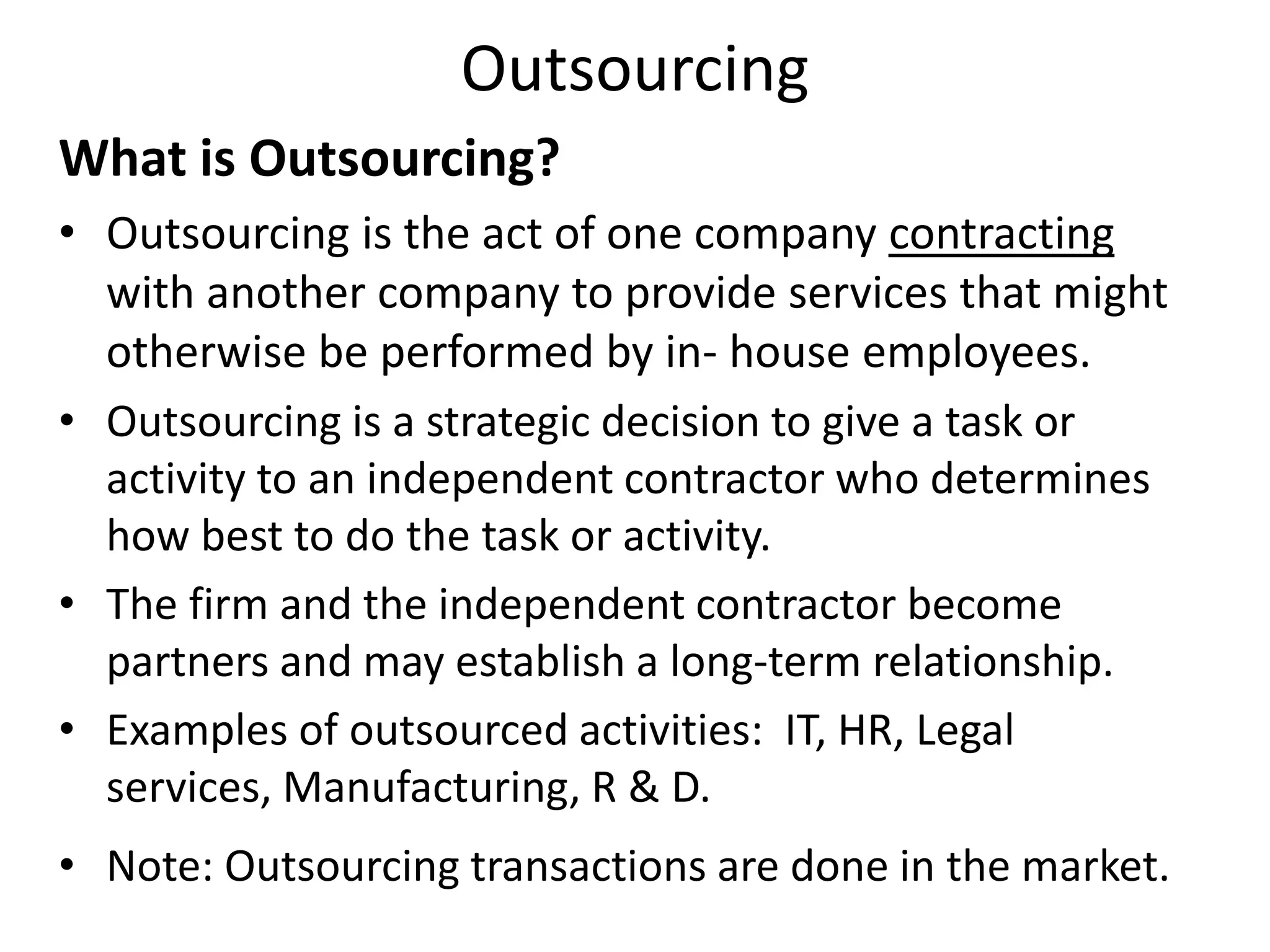
What is Outsourcing?
• Outsourcing is the act of one company contracting
with another company to provide services that might
otherwise be performed by in- house employees.
• Outsourcing is a strategic decision to give a task or
activity to an independent contractor who determines
how best to do the task or activity.
• The firm and the independent contractor become
partners and may establish a long-term relationship.
• Examples of outsourced activities: IT, HR, Legal
services, Manufacturing, R & D.
• Note: Outsourcing transactions are done in the market.
Cont..
• Outsourcing is an option that's being explored
by an increasing number of companies for
reasons that include increased efficiency and
cost savings. The precise services that are
earmarked (allocated) for outsourcing will
depend on the company and/or the outsourcing
options available in that particular market
Which functions/sub-systems
to outsource
• Recruitment – preliminary screening and short listing
• Training – Trg. Needs identification, content
development, delivery, logistics, third party evaluation
• Performance management - on line – automation
• Compensation – pay roll and compensation surveys
• Safety -- inspections
• welfare – transport, security, catering
• Labour contract – contract employees doing the job
which was earlier done by regular employees
• Which function not to outsource
– Decision making in each of the sub functions
– Leading change and transforming the organization
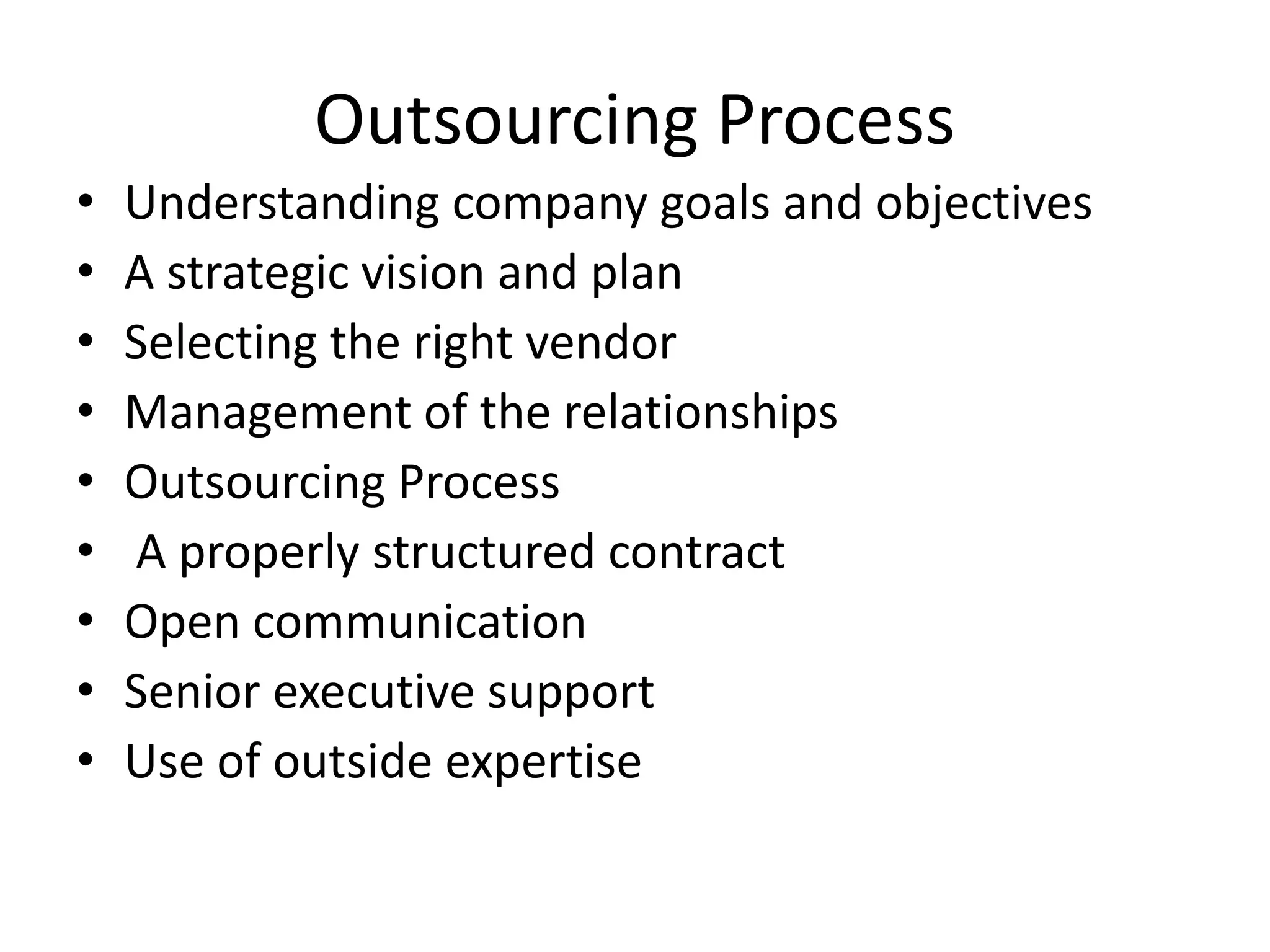
Outsourcing Process
• Understanding company goals and objectives
• A strategic vision and plan
• Selecting the right vendor
• Management of the relationships
• Outsourcing Process
• A properly structured contract
• Open communication
• Senior executive support
• Use of outside expertise
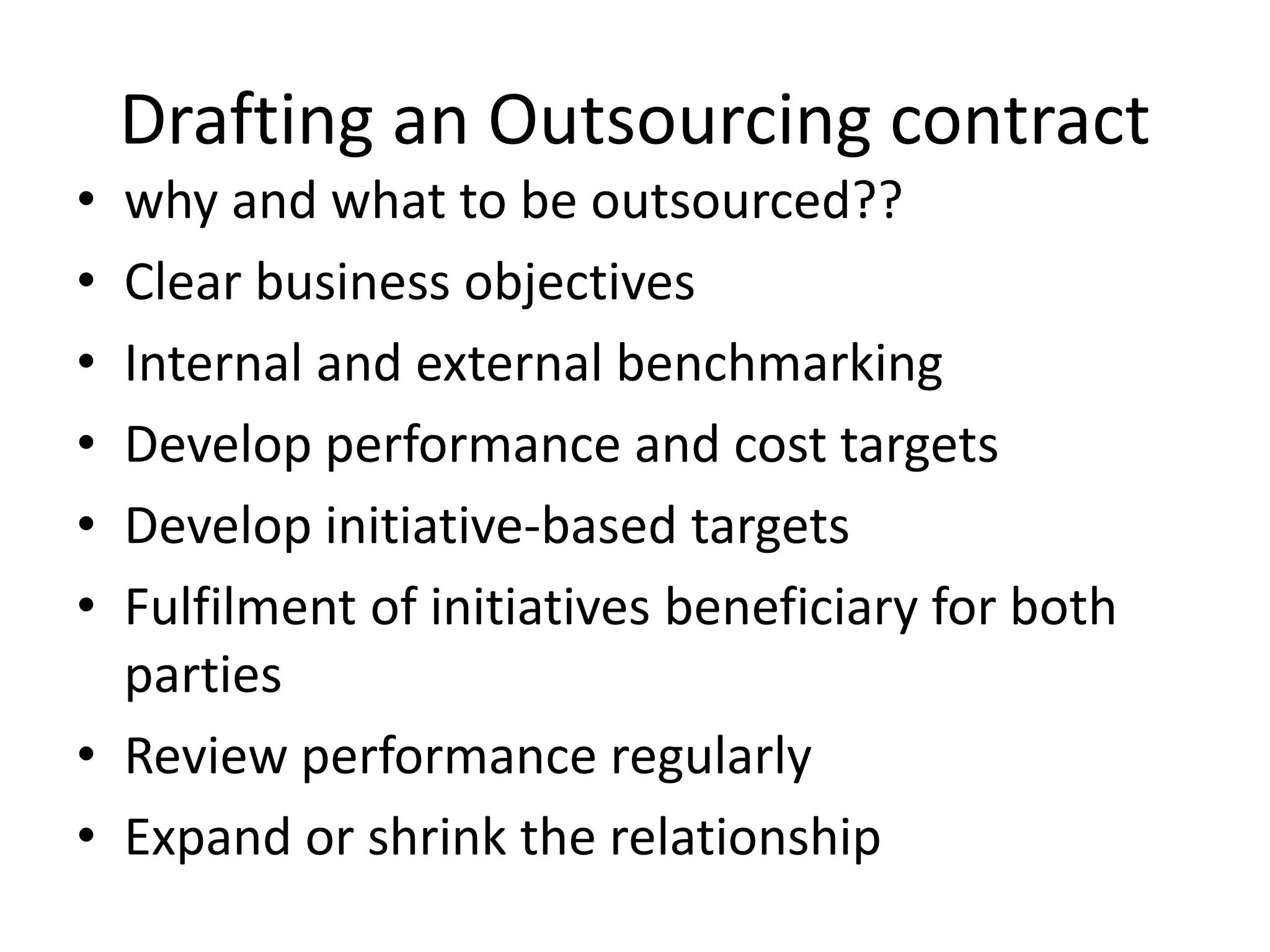
Drafting an Outsourcing contract
• why and what to be outsourced??
• Clear business objectives
• Internal and external benchmarking
• Develop performance and cost targets
• Develop initiative-based targets
• Fulfilment of initiatives beneficiary for both
parties
• Review performance regularly
• Expand or shrink the relationship
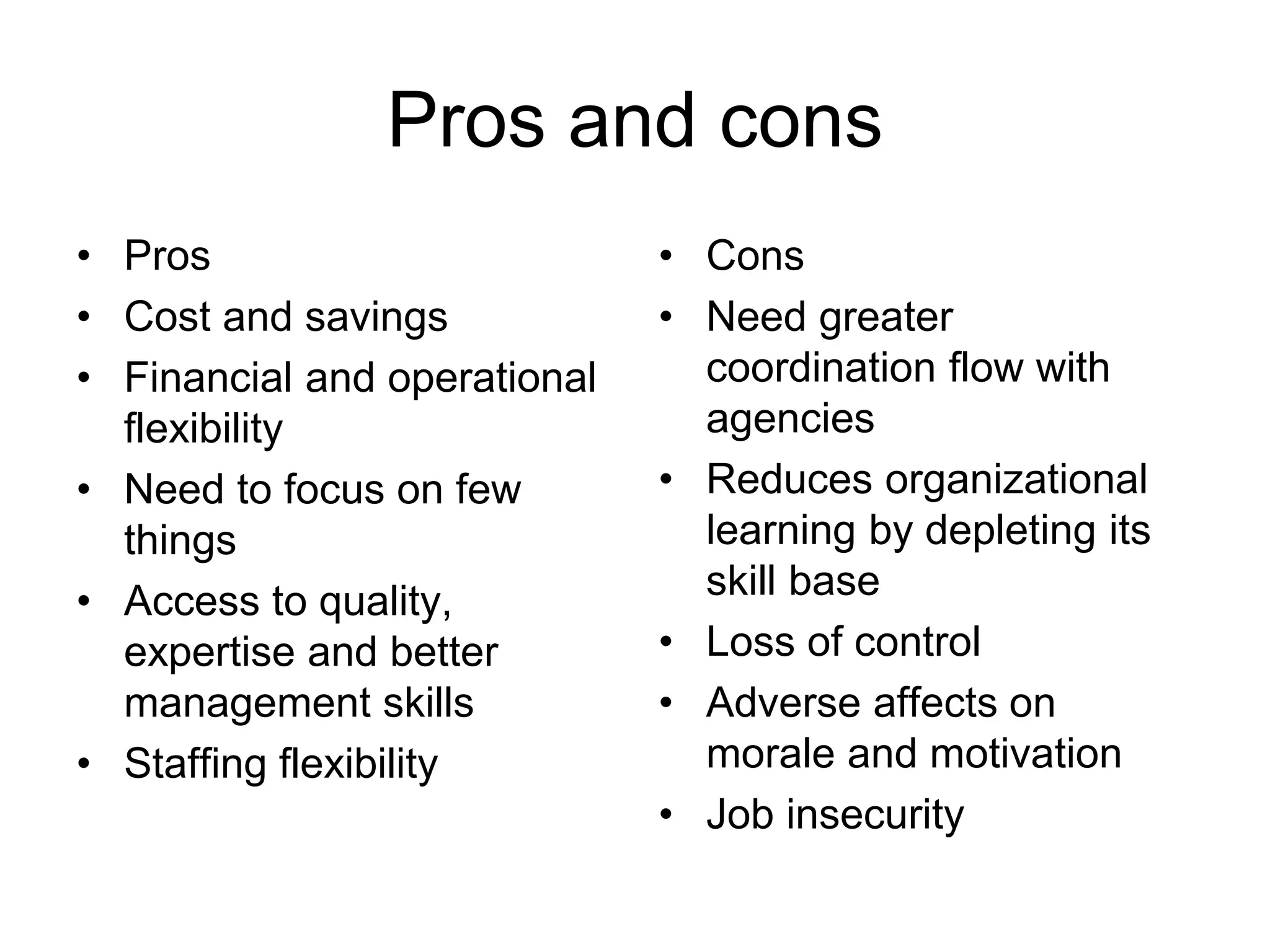
Pros and cons
• Pros
• Cost and savings
• Financial and operational
flexibility
• Need to focus on few
things
• Access to quality,
expertise and better
management skills
• Staffing flexibility
• Cons
• Need greater
coordination flow with
agencies
• Reduces organizational
learning by depleting its
skill base
• Loss of control
• Adverse affects on
morale and motivation
• Job insecurity
What are outsourced and what to kept
in-house?
Six-step process shows the process:
Step One:
Identify Key HR Initiatives
• First, it’s important for HR to Define HR’s
strategic role of the company.
• Then write up some good old-fashioned job
responsibilities for HR.
Step Two:
Consider Which Functions can be outsourced
• Any roles HR is currently managing that fall outside
of the sweet spot THAT IS identified should be
considered for outsourcing.
• There are good outsourcing firms that efficiently
handle activities like relocation, temporary staffing,
background checks, and drug screening.
• Even a critical function like regulatory compliance
should be considered for outsourcing. HR
compliance requires constant attention to stay up
to date on the latest regulations and legal
decisions.
• While these processes are very important to the
operation of the company, they do not drive the
strategic mission of the organization
Step Three
Create a Team of Internal and External
Specialists:
• A company that enlists outside specialists to
supplement on-staff talent is cultivating a strong
team of HR professionals. In this era of lean
management, most HR departments are not
going to be able to have an on-staff expert to
manage every HR issue.
Step Four
Find a Trusted Partner – or Partners
• One can maintain control of important HR functions
and help HR become a more efficient and effective
player, but can be if a good trusted partners are
there.
• Compare benefits, the associated costs and
approaches of different firms. Conduct background
checks to ensure the outsourcing firm’s reputation is
solid. Be sure the firm is accredited by the Better
Business Bureau, and talk to other companies that
have used the firm.
• Read all proposals carefully. Make sure you
understand the value you will receive in doing
business with a particular vendor
Step Five:
Explore a Plug-and-Play Solution
• One outsourcing option that works for some
companies is to contract with a group purchasing
organization (GPO).
• A GPO provides access to qualified, pre-negotiated
contracts with staffing firms, managed service
providers and others. This arrangement can be a
convenient, efficient and cost-effective one-stop shop
for a range of HR outsourced services.
• Companies avoid the time and effort required for
negotiating and managing multiple contracts. The GPO
vets the best suppliers, leverages relationships to
secure competitive contracts, and helps a company
secure the resources it needs.
Step Six:
Consider a Complete Outsourcing of HR
• For certain companies, it may make sense to consider a
professional employer organization (PEO).
• A PEO takes over all of a company’s HR functions by
literally hiring the company's employees and becoming
their employer of record for tax and insurance
purposes. The practice is known as co-employment or
joint employment.
• Through a PEO, the employees of small businesses gain
access to employee benefits such as: 401(k) plans;
health, dental, life, and other insurance; dependent
care, and other benefits typically provided by large
companies.
• According to the National Association of Professional
Employer Organizations (NAPEO), approximately
250,000 businesses use PEOs
Here are the HR functions that are
most commonly outsourced:
• High-volume recruiting
• Temporary staffing
• Background checks and drug screening
• Relocation
• Payroll
• Benefits administration
• Coaching
• Creating/updating employee handbooks and policy manuals
• Compensation program development/implementation
• Writing and updating affirmative action plans
• Providing sexual harassment training
• Independent contractor compliance
.
These HR initiatives tend to stay in-house
• Employee relations
• Compensation design and delivery
• Talent development
• Capital strategy planning
• Succession planning
• HR strategy
• Performance management
• Organization development
• Recruiting
• HR department management
• Outsourcing some, or even all, HR functions is a proven and
widely practiced concept among companies of all sizes.
Outsourcing enables a company to focus on HR activities
with the most strategic value while saving money and
benefiting from the specialized expertise of outside firms
• "Reason for Outsourcing
• 26 percent – Save money
• 23 percent – Focus on strategy
• 22 percent – Improve compliance
• 18 percent – Improve accuracy
• 18 percent – Lack experience in house
• 18 percent – Take advantage of technological
advances
• 17 percent – Offer services we otherwise coul
not
• 15 percent – Focus on core business
• 5 percent – Other
• 47 percent – Do not outsource
Functions Outsourced
• 84 percent - 401 (k) administration
• 84 percent – Employee assistance/counseling
• 74 percent – Retirement planning help
• 73 percent – Pension administration
• 72 percent – Temporary staffing
• 68 percent – Background checks
• 57 percent – Training and management development programs
• 54 percent – Executive development and coaching
• 53 percent – Health care benefits administration
• 49 percent – Employee benefit administration
• 49 percent – Payroll
• 46 percent – Risk management
• 44 percent – Executive staffing
• 41 percent – Employee relocation
• 40 percent – HRIS selection, training implementation
• 32 percent – Recruitment
• 17 percent – Executive compensation and incentive plans
• 15 percent – Policy writing
• 14 percent – Administration of compensation/incentive plans
• 11 percent - Wage and salary administration"
•

Out sourcing hr

  • 1.
    OUTSOURCING HR MS.SUNITA FACULTY INENGLISH &MBA(HR) GIACR COLLEGE
  • 2.
    DEFINATION • Outsourcing isdefined as a management pattern that consists of contracting out a particular in-house business process or processes to an external provider or providers. • While these processes are purchased from said providers, the ultimate responsibility for the processes still rests with the purchasing company
  • 3.
    Outsourcing What is Outsourcing? •Outsourcing is the act of one company contracting with another company to provide services that might otherwise be performed by in- house employees. • Outsourcing is a strategic decision to give a task or activity to an independent contractor who determines how best to do the task or activity. • The firm and the independent contractor become partners and may establish a long-term relationship. • Examples of outsourced activities: IT, HR, Legal services, Manufacturing, R & D. • Note: Outsourcing transactions are done in the market.
  • 4.
    Cont.. • Outsourcing isan option that's being explored by an increasing number of companies for reasons that include increased efficiency and cost savings. The precise services that are earmarked (allocated) for outsourcing will depend on the company and/or the outsourcing options available in that particular market
  • 5.
    Which functions/sub-systems to outsource •Recruitment – preliminary screening and short listing • Training – Trg. Needs identification, content development, delivery, logistics, third party evaluation • Performance management - on line – automation • Compensation – pay roll and compensation surveys • Safety -- inspections • welfare – transport, security, catering • Labour contract – contract employees doing the job which was earlier done by regular employees • Which function not to outsource – Decision making in each of the sub functions – Leading change and transforming the organization
  • 6.
    Outsourcing Process • Understandingcompany goals and objectives • A strategic vision and plan • Selecting the right vendor • Management of the relationships • Outsourcing Process • A properly structured contract • Open communication • Senior executive support • Use of outside expertise
  • 7.
    Drafting an Outsourcingcontract • why and what to be outsourced?? • Clear business objectives • Internal and external benchmarking • Develop performance and cost targets • Develop initiative-based targets • Fulfilment of initiatives beneficiary for both parties • Review performance regularly • Expand or shrink the relationship
  • 8.
    Pros and cons •Pros • Cost and savings • Financial and operational flexibility • Need to focus on few things • Access to quality, expertise and better management skills • Staffing flexibility • Cons • Need greater coordination flow with agencies • Reduces organizational learning by depleting its skill base • Loss of control • Adverse affects on morale and motivation • Job insecurity
  • 9.
    What are outsourcedand what to kept in-house? Six-step process shows the process: Step One: Identify Key HR Initiatives • First, it’s important for HR to Define HR’s strategic role of the company. • Then write up some good old-fashioned job responsibilities for HR.
  • 10.
    Step Two: Consider WhichFunctions can be outsourced • Any roles HR is currently managing that fall outside of the sweet spot THAT IS identified should be considered for outsourcing. • There are good outsourcing firms that efficiently handle activities like relocation, temporary staffing, background checks, and drug screening. • Even a critical function like regulatory compliance should be considered for outsourcing. HR compliance requires constant attention to stay up to date on the latest regulations and legal decisions. • While these processes are very important to the operation of the company, they do not drive the strategic mission of the organization
  • 11.
    Step Three Create aTeam of Internal and External Specialists: • A company that enlists outside specialists to supplement on-staff talent is cultivating a strong team of HR professionals. In this era of lean management, most HR departments are not going to be able to have an on-staff expert to manage every HR issue.
  • 12.
    Step Four Find aTrusted Partner – or Partners • One can maintain control of important HR functions and help HR become a more efficient and effective player, but can be if a good trusted partners are there. • Compare benefits, the associated costs and approaches of different firms. Conduct background checks to ensure the outsourcing firm’s reputation is solid. Be sure the firm is accredited by the Better Business Bureau, and talk to other companies that have used the firm. • Read all proposals carefully. Make sure you understand the value you will receive in doing business with a particular vendor
  • 13.
    Step Five: Explore aPlug-and-Play Solution • One outsourcing option that works for some companies is to contract with a group purchasing organization (GPO). • A GPO provides access to qualified, pre-negotiated contracts with staffing firms, managed service providers and others. This arrangement can be a convenient, efficient and cost-effective one-stop shop for a range of HR outsourced services. • Companies avoid the time and effort required for negotiating and managing multiple contracts. The GPO vets the best suppliers, leverages relationships to secure competitive contracts, and helps a company secure the resources it needs.
  • 14.
    Step Six: Consider aComplete Outsourcing of HR • For certain companies, it may make sense to consider a professional employer organization (PEO). • A PEO takes over all of a company’s HR functions by literally hiring the company's employees and becoming their employer of record for tax and insurance purposes. The practice is known as co-employment or joint employment. • Through a PEO, the employees of small businesses gain access to employee benefits such as: 401(k) plans; health, dental, life, and other insurance; dependent care, and other benefits typically provided by large companies. • According to the National Association of Professional Employer Organizations (NAPEO), approximately 250,000 businesses use PEOs
  • 15.
    Here are theHR functions that are most commonly outsourced: • High-volume recruiting • Temporary staffing • Background checks and drug screening • Relocation • Payroll • Benefits administration • Coaching • Creating/updating employee handbooks and policy manuals • Compensation program development/implementation • Writing and updating affirmative action plans • Providing sexual harassment training • Independent contractor compliance .
  • 16.
    These HR initiativestend to stay in-house • Employee relations • Compensation design and delivery • Talent development • Capital strategy planning • Succession planning • HR strategy • Performance management • Organization development • Recruiting • HR department management • Outsourcing some, or even all, HR functions is a proven and widely practiced concept among companies of all sizes. Outsourcing enables a company to focus on HR activities with the most strategic value while saving money and benefiting from the specialized expertise of outside firms
  • 17.
    • "Reason forOutsourcing • 26 percent – Save money • 23 percent – Focus on strategy • 22 percent – Improve compliance • 18 percent – Improve accuracy • 18 percent – Lack experience in house • 18 percent – Take advantage of technological advances • 17 percent – Offer services we otherwise coul not • 15 percent – Focus on core business • 5 percent – Other • 47 percent – Do not outsource
  • 18.
    Functions Outsourced • 84percent - 401 (k) administration • 84 percent – Employee assistance/counseling • 74 percent – Retirement planning help • 73 percent – Pension administration • 72 percent – Temporary staffing • 68 percent – Background checks • 57 percent – Training and management development programs • 54 percent – Executive development and coaching • 53 percent – Health care benefits administration • 49 percent – Employee benefit administration • 49 percent – Payroll • 46 percent – Risk management • 44 percent – Executive staffing • 41 percent – Employee relocation • 40 percent – HRIS selection, training implementation • 32 percent – Recruitment • 17 percent – Executive compensation and incentive plans • 15 percent – Policy writing • 14 percent – Administration of compensation/incentive plans • 11 percent - Wage and salary administration" •