Homelessness & Health in Canada: Whose Fault ? What Solutions Dr. James Frankish,  Professor, Director & Senior Scholar Centre for Population Health Promotion Research, UBC Board Member, Lookout Shelter Society 3X MacDonald’s Employee-of-the-Month Partners in Community Heath Research-Training Program
Current Projects Training-Related Research & Activities Research Training Program in Community Partnership Research Homelessness & Poverty-Related Research Supportive Housing for Persons with Serious Mental Illness  & Addictions Inner-City Inclusivity, Olympics & Health Rural-Urban Migration, Homelessness & Health Services/Status Health Professionals’ Attitudes toward Homeless Persons Use of Health & Social Services by Homeless Persons Health Literacy, & Literacy & Health Research Health Literacy in School Children   Health Literacy in Street-Involved Youth He alth-System Reform & Marginalized Groups Health Regions & Nonmedical Determinants of Health Children Living with HIV/Aids Adolescents' Concepts of Depression & Related Help-Seeking Measuring the Health of Communities Community Coalitions & the 2010 Games Measuring Community Capacity
Homelessness in Canada Obtaining basic shelter has become a daily struggle & it is widely recognized that the problem is getting worse Homelessness is associated with poorer health status as indicated by early mortality & numerous negative health outcomes such as substance abuse, mental illness, infectious diseases, & difficulty accessing health services At a national level, however, these disparities in health status are poorly described & documented.  Further investigation is required  to clearly understand the  complex interactions between these factors &  homelessness. 4 Homeless Youth Sleeping at 4 th  & Balsam 7:30 AM, November 28, 2007, Zero Celsius.
Summary of the Homeless Qualities GVRD homelessness has grown, Vancouver up 171% (2002) 52% on street, 48% in shelters, increase (238%) in street 30% of homeless are Aboriginal > 600 reported being homeless for more than a year 30 % welfare, 11% disability, 23% no income, 14% employed, 5% dumpster diving or binning, 5% illegal income 40% reported a health condition, 35% reported two or more.  48% report addiction (39% in 2002) 33% have co-morbidity of addiction and mental illness 23% reported mental illness, 21% reported physical disability. Reasons: 44% low $$, 25% health/addictions, 22% housing cost, 16% abuse/conflict, 13% evicted, 8% moving, stranded From City of Vancouver, GVRD & SPARC reports
Youth Homeless in BC Aboriginal youth up from 36% to 57% 1/3 female, 1/10 males were as gay, lesbian or bi 40% had spent time in government care 35% were still attending school 1/3 had a legal job 75% were current smokers 30% exposed to alcohol or marijuana before teens 3X > physically/sexually abused  36% had been sexually exploited 60% had  >  1mental or emotional health concern Outreach workers were identified as most helpful Job training and shelter were the most needed services McCreary Society 2007.
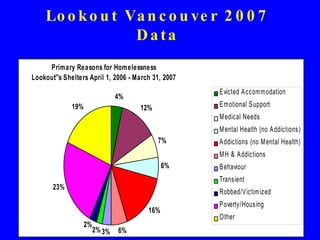
Lookout Vancouver 2007 Data
Homeless Shelter Users & Mental Illness Services Research in 6 BC cities and 29 locations.  510 shelter users with valid PHN Aged from 16-79 years with an average age of 40 29% female and 71% male. No gender differences in age distribution 58% on some form of income assistance and/or disability payments 12% were on the BC MSP for less than one year 89% were not employed, 57% were single MSP: 100% paid (114,705 = 70%), total MSP claims 163,339 2 most claimed fee items were methadone therapy and general office visits. Annual counselling & psychotherapy grew 16X from 1994 to 2004 30% claimed MSP payments for some significant psychiatric disorder Cost of prescriptions per person ranged from a low of no cost to $92,114.37 Twenty persons had prescription costs totalling more $50,000
Strategy # 1:   Changing Public Discourse on Homelessness
Health Inequities Offer a Priority Focus for Policy, Practice & Research Health inequities are unfair. Inequities affect everyone. Conditions that lead to, or result from inequalities are bad for all. Inequities are avoidable to the extent that they stem from policies or human behaviour. Interventions to reduce inequities are cost effective. Inequality erodes social cohesion and impedes productivity and economic growth.  Kawachi 1999
Which Health Inequities Are Acceptable ?
A Continuum of Absurdities Government is  Totally Responsible  for Addressing Homelessness There is  No Role  for  Goverment in Addressing Homelessness What is the  Preferred Future  for Government’s Role in Addressing Homelessness
Lay Canadians’ Views on Homelessness Government policies have caused some people to become poor. Strongly or Somewhat agree 73.4% Most people are poor because they grew up in a poor family.  56.3% Most people are poor because of unequal opportunities in society. 59.1% Have you ever had close friends or family who were living on low incomes? 64.4% Have you read or obtained information or learned about poverty from reading newspapers, listening to the radio, or watching television? 92.2% Do you think there is a link between poverty-health? Yes 90.6% - No 9.4% Reutter et al. 2005. Lay understandings of effects of poverty: a Canadian perspective. H ealth & Social Care in Community  13 (6), 514.
Vancouver Mayor’s Poll What should the City’s priority, 25% homelessness  (top item).  Another 17% - affordable housing. Most important legacy of 2010? - homelessness (32%) ,  programs to improve life for less fortunate (23%) What are the most important issues in Vancouver? – addiction (75%), homelessness (74%). 01/07.
UBC Study of News Discourse  on Homelessness N = 192 Newspapers Articles in the Lower Mainland Since Expo 1986 Information  (Source, Date, Title, Author, Length, Placement) Nature of Homelessness ( see as  Social, Legal, Health, Moral or Economic) Problem Attribution of Responsibility for   Existence/Growth  of Homelessness (intrapersonal, interpersonal, organizational, societal) factors Attribution of Responsibility for Solutions  for  Addressing Homelessness Interventions  Identified Address Homelessness
Media Attitudes Toward the Homeless Front Page o r Front of Later Section 28 % Overall, article describes the nature of the current homelessness problem as : Largely Societal  - 49 % ,  Balanced  -  3 8 % ,  Largely Personal  -  7% ,  A spect of the nature of homelessness are mentioned in the article : Economic Problem 56% Social Problem  44% Health Problem   36% Legal Problem 25%  Moral Problem 24%  F actors identified as contributing to the  growth of homelessness : Intrapersonal  – 32% Organizational  – 31%  Societal  –   21% Interpersonal  –  15%
Media Attitudes Toward the Homeless I dentified problems associated with homelessness :   Decreased aesthetics (bad image) for the community  –  29% Decreased quality-life in the community  –  22% Drug addiction  –  18% Health care  costs  –  9% Increase in crime  –  7% Inappropriate use of health/social services  –  6%  Decline in safety  –  4%  Increased violence  –  3% Changes in infectious diseases  –  2% R esponsibility for addressing homelessness : Solely Personal  -  0% Largely Personal  - . 6% Balanced  -  23.4 % Largely Societal  -  62.9% Solely Societal  -  13%
Media Attitudes Toward the Homeless Grou ps/agencies identified as responsibl e  for addressing homelessness : Municipal Government  –  29% Provincial/Territorial Government  – 27% Federal Government  – 17% Non-Profit Sector  –  9% Regi onal Government  –  8% Health Region or Authority  –  5%
Attitudes Toward the Homeless I nterventions identified in  more than 10% of  article s  as relevant to addressing homelessness : Housing Policy  -  63.2% ,  Housing  +  Support Services  -  51.1% Welfare/social assistance/disability  -  42.9% Alcohol/drug treatment  -  36.8% Non-Market Housing  -  35.2 % Mental health services  -  34.6% Social support strategies  -  23.1% Poverty reduction policy  -  15.9% Public education & awareness  -  15.4% Food bank/food security  -  13.7% Job skills & counselling  -  13.2% Advocacy 12.1% ,  Law enforcement  -  11%
Message # 1 There is a huge/need opportunity to engage Canadians in a public conversation on homelessness, its causes and solutions. See Media Advocacy & Public Health or News for a Change: An Advocate's Guide to Working with the Media. L. Wallack.
Strategy # 2  Using Housing to Build ‘Non-Medical’  Intersectoral Collaboration
Non-Medical Determinants of Health Income & Social Status Social Support Networks  Education  Employment & Working Conditions Social Environments Physical Environment  Personal Health Practices Healthy Child Development   Culture Gender (From Health Canada – Excludes  Health Services & Biology /Genetics)
Current “Health-Sector” Action on  Health Canada’s  Non-Medical  Determinants Frankish  et al.  Addressing the Non-medical Determinants of Health: A Survey of Canada's Health Regions Canadian Journal of Public Health. Ottawa: 2007 98, 1; p. 41 Determinant of Health Programs/Core Funding No Action Healthy Child Development 54% 12% Personal Health Practices 48% 09% Physical Environment 33% 16% Social Support 31% 18% Education 24% 26% Social Environments 21% 27% Culture   21% 27% Employment/Work Conditions 18% 26% Gender 18% 32% Income & Social Status 17% 32%
Key Actions - Report on Housing for Persons with Mental Illness & Addiction Supported housing (housing with on- or off-site support) Housing First (permanent, independent without time limits for treatment) Multidisciplinary treatment teams (ACT, intensive case management) Low Barrier Housing (transitional, congregate housing, no requirements) Harm reduction facilities  Integrated mental health and addiction services New affordable housing (subsidize land, waive fees, taxes, rent supplements) Preserve existing affordable housing (no net loss) Homeless services information system Regional and provincial distribution of services Fast-track to Income Assistance for homeless people Discharge policies and practices Provincial Mental Health and Addictions strategy I Patterson, Somers, Shiell, McIntosh,  Frankish  2007.  Housing  &  Support for Adults with Severe Addictions and/or Mental Illness in BC , CARMHA.
Message # 2 There is a huge/need opportunity to conduct a pan-ministerial  review of health disparities with a view to creating binding, national equity targets. See  Tackling Health Inequalities  – 2002 Cross-Cutting Review, UK. Homeless Vancouver 1920
Strategy # 3   Linking Homelessness & Employment Training
Marginalized Groups, Employment & Independent Living HRSDC is a world leader in employment, job training and social re-integration initiatives. Universities are investing heavily in  community-service-learning  and the next generation of decision leaders are looking for opportunities for learning and engagement with marginalized populations. There is parallel, emerging evidence that  at-risk  and  street-engaged youth  can be usefully engaged in ‘ independent-living-initiatives ’.
Health Professionals’  Attitudes Toward the Homeless Female :  58.%   Male   4 2 % H omeless people are victims of circumstance  –  Agree 53 % Homeless people have the right to basic health care.   Agree 100% Homelessness is a major problem in our society.   Agree 86% H ealth  $$$  should be directed to poor / homeless.   Neutral or disagree 45% I feel overwhelmed by complexity of problems  of the  homeless.   Agree 56% I believe social justice is an important part of health care.   Agree 88% C aring for homeless is not financially viable for a career.   Neutral or Agree 53% My knowledge regarding the problem of homelessness is adequate.   Disagree 55% I  believe I  can provide care for the homeless effectively.   Disagree 45% I feel it is important to provide care to all socioeconomic groups.  Agree 97% Most poor have adequate access to care through the public system.   Disagree 57%
Youth Wellness Project Partnership between UBC and the community Involves CHIUS, Vancouver Youth Visions Coalition, and PCHR Research-Training Program Provides health literacy/health education modules to ‘street-involved’ youth Topics include nutrition, substance use/harm reduction, pregnancy/childcare, suicide prevention Foundation for a ‘ social-enterprise’  Lay Health Ambassadors team that would work with VCH and community health nurses.
Message # 3 There is a huge/need opportunity  to engage youth and young adults in initiatives that would simultaneously build community-service-learning, and  strengthen life skills and quality-of-life in vulnerable persons.
Strategy # 4   Creating Infrastructure & “ Accountability ”
Need for Local  Infrastructure  & “ Accountability ”   We want more “e vidence-based policy & practice”  but we need more “ policy & practice-based evidence”. We need to create and strengthen the ‘ capacity ’ of community organizations to measure and track meaningful outcomes. We need to measure fewer things, more rigorously. Universities/colleges offer an extant ‘ infrastructure’ & expertise  that could work with community groups (shelters, neighbourhood houses)
Message # 4 There is a huge/need opportunity  to build a national housing strategy  and  a‘ locally-embedded’  network of “ population-health-implementation centres.
Four  Defining  Pillars of Success Creation of a ‘ Healthy Cities Investment’  (i.e., endowment from property-transfer taxes) “ Donation” of public space (i.e., empty, schools)  Creation & evaluation of innovative support services, programs, resources for vulnerable persons, families and communities Evaluation/research grants and contracts, and leveraging of additional public and private sector funds.
A Population Health Implementation Centre Home to social enterprise activities Social re-integration, employment and  job training Community-Service Learning projects Mental health, addiction , legal  & housing  outreach services Possible medical /d ental outreach services Activities related to food security and nutrition Health 101, literacy and health, and  health literacy work Health education, and arts activities  (community theatre) Research, training & capacity-building  around NMDH Conduct & evaluation of demonstration  projects Resources shared/adapted across Canada
What We Need to Succeed  in Addressing Homelessness Public support & political will Targeted resources & resourced targets Supportive binding, legislation Policy & practice ‘champions’ A supportive philosophy A cultural & policy framework Organizational/governance infrastructure Trained staff/improved education Remuneration of services/personnel Evidence-based practice based on practice-based evidence
Contact Information Dr. Jim Frankish, Senior Scholar, Michael Smith Foundation Director, Centre for Population Health Promotion Research Rm 425, Library Processing Centre 2206 East Mall Vancouver BC V6T 1Z3 604-822-9205, 822-9210,  [email_address] Personal Website: jimfrankish.com Partners in Community Health Research www.pchr.net

Jim's Homelessness Presentation

  • 1.
    Homelessness & Healthin Canada: Whose Fault ? What Solutions Dr. James Frankish, Professor, Director & Senior Scholar Centre for Population Health Promotion Research, UBC Board Member, Lookout Shelter Society 3X MacDonald’s Employee-of-the-Month Partners in Community Heath Research-Training Program
  • 2.
    Current Projects Training-RelatedResearch & Activities Research Training Program in Community Partnership Research Homelessness & Poverty-Related Research Supportive Housing for Persons with Serious Mental Illness & Addictions Inner-City Inclusivity, Olympics & Health Rural-Urban Migration, Homelessness & Health Services/Status Health Professionals’ Attitudes toward Homeless Persons Use of Health & Social Services by Homeless Persons Health Literacy, & Literacy & Health Research Health Literacy in School Children Health Literacy in Street-Involved Youth He alth-System Reform & Marginalized Groups Health Regions & Nonmedical Determinants of Health Children Living with HIV/Aids Adolescents' Concepts of Depression & Related Help-Seeking Measuring the Health of Communities Community Coalitions & the 2010 Games Measuring Community Capacity
  • 3.
    Homelessness in CanadaObtaining basic shelter has become a daily struggle & it is widely recognized that the problem is getting worse Homelessness is associated with poorer health status as indicated by early mortality & numerous negative health outcomes such as substance abuse, mental illness, infectious diseases, & difficulty accessing health services At a national level, however, these disparities in health status are poorly described & documented. Further investigation is required to clearly understand the complex interactions between these factors & homelessness. 4 Homeless Youth Sleeping at 4 th & Balsam 7:30 AM, November 28, 2007, Zero Celsius.
  • 4.
    Summary of theHomeless Qualities GVRD homelessness has grown, Vancouver up 171% (2002) 52% on street, 48% in shelters, increase (238%) in street 30% of homeless are Aboriginal > 600 reported being homeless for more than a year 30 % welfare, 11% disability, 23% no income, 14% employed, 5% dumpster diving or binning, 5% illegal income 40% reported a health condition, 35% reported two or more. 48% report addiction (39% in 2002) 33% have co-morbidity of addiction and mental illness 23% reported mental illness, 21% reported physical disability. Reasons: 44% low $$, 25% health/addictions, 22% housing cost, 16% abuse/conflict, 13% evicted, 8% moving, stranded From City of Vancouver, GVRD & SPARC reports
  • 5.
    Youth Homeless inBC Aboriginal youth up from 36% to 57% 1/3 female, 1/10 males were as gay, lesbian or bi 40% had spent time in government care 35% were still attending school 1/3 had a legal job 75% were current smokers 30% exposed to alcohol or marijuana before teens 3X > physically/sexually abused 36% had been sexually exploited 60% had > 1mental or emotional health concern Outreach workers were identified as most helpful Job training and shelter were the most needed services McCreary Society 2007.
  • 6.
  • 7.
    Homeless Shelter Users& Mental Illness Services Research in 6 BC cities and 29 locations. 510 shelter users with valid PHN Aged from 16-79 years with an average age of 40 29% female and 71% male. No gender differences in age distribution 58% on some form of income assistance and/or disability payments 12% were on the BC MSP for less than one year 89% were not employed, 57% were single MSP: 100% paid (114,705 = 70%), total MSP claims 163,339 2 most claimed fee items were methadone therapy and general office visits. Annual counselling & psychotherapy grew 16X from 1994 to 2004 30% claimed MSP payments for some significant psychiatric disorder Cost of prescriptions per person ranged from a low of no cost to $92,114.37 Twenty persons had prescription costs totalling more $50,000
  • 8.
    Strategy # 1: Changing Public Discourse on Homelessness
  • 9.
    Health Inequities Offera Priority Focus for Policy, Practice & Research Health inequities are unfair. Inequities affect everyone. Conditions that lead to, or result from inequalities are bad for all. Inequities are avoidable to the extent that they stem from policies or human behaviour. Interventions to reduce inequities are cost effective. Inequality erodes social cohesion and impedes productivity and economic growth. Kawachi 1999
  • 10.
    Which Health InequitiesAre Acceptable ?
  • 11.
    A Continuum ofAbsurdities Government is Totally Responsible for Addressing Homelessness There is No Role for Goverment in Addressing Homelessness What is the Preferred Future for Government’s Role in Addressing Homelessness
  • 12.
    Lay Canadians’ Viewson Homelessness Government policies have caused some people to become poor. Strongly or Somewhat agree 73.4% Most people are poor because they grew up in a poor family. 56.3% Most people are poor because of unequal opportunities in society. 59.1% Have you ever had close friends or family who were living on low incomes? 64.4% Have you read or obtained information or learned about poverty from reading newspapers, listening to the radio, or watching television? 92.2% Do you think there is a link between poverty-health? Yes 90.6% - No 9.4% Reutter et al. 2005. Lay understandings of effects of poverty: a Canadian perspective. H ealth & Social Care in Community  13 (6), 514.
  • 13.
    Vancouver Mayor’s PollWhat should the City’s priority, 25% homelessness (top item). Another 17% - affordable housing. Most important legacy of 2010? - homelessness (32%) , programs to improve life for less fortunate (23%) What are the most important issues in Vancouver? – addiction (75%), homelessness (74%). 01/07.
  • 14.
    UBC Study ofNews Discourse on Homelessness N = 192 Newspapers Articles in the Lower Mainland Since Expo 1986 Information (Source, Date, Title, Author, Length, Placement) Nature of Homelessness ( see as Social, Legal, Health, Moral or Economic) Problem Attribution of Responsibility for Existence/Growth of Homelessness (intrapersonal, interpersonal, organizational, societal) factors Attribution of Responsibility for Solutions for Addressing Homelessness Interventions Identified Address Homelessness
  • 15.
    Media Attitudes Towardthe Homeless Front Page o r Front of Later Section 28 % Overall, article describes the nature of the current homelessness problem as : Largely Societal - 49 % , Balanced - 3 8 % , Largely Personal - 7% , A spect of the nature of homelessness are mentioned in the article : Economic Problem 56% Social Problem 44% Health Problem 36% Legal Problem 25% Moral Problem 24% F actors identified as contributing to the growth of homelessness : Intrapersonal – 32% Organizational – 31% Societal – 21% Interpersonal – 15%
  • 16.
    Media Attitudes Towardthe Homeless I dentified problems associated with homelessness : Decreased aesthetics (bad image) for the community – 29% Decreased quality-life in the community – 22% Drug addiction – 18% Health care costs – 9% Increase in crime – 7% Inappropriate use of health/social services – 6% Decline in safety – 4% Increased violence – 3% Changes in infectious diseases – 2% R esponsibility for addressing homelessness : Solely Personal - 0% Largely Personal - . 6% Balanced - 23.4 % Largely Societal - 62.9% Solely Societal - 13%
  • 17.
    Media Attitudes Towardthe Homeless Grou ps/agencies identified as responsibl e for addressing homelessness : Municipal Government – 29% Provincial/Territorial Government – 27% Federal Government – 17% Non-Profit Sector – 9% Regi onal Government – 8% Health Region or Authority – 5%
  • 18.
    Attitudes Toward theHomeless I nterventions identified in more than 10% of article s as relevant to addressing homelessness : Housing Policy - 63.2% , Housing + Support Services - 51.1% Welfare/social assistance/disability - 42.9% Alcohol/drug treatment - 36.8% Non-Market Housing - 35.2 % Mental health services - 34.6% Social support strategies - 23.1% Poverty reduction policy - 15.9% Public education & awareness - 15.4% Food bank/food security - 13.7% Job skills & counselling - 13.2% Advocacy 12.1% , Law enforcement - 11%
  • 19.
    Message # 1There is a huge/need opportunity to engage Canadians in a public conversation on homelessness, its causes and solutions. See Media Advocacy & Public Health or News for a Change: An Advocate's Guide to Working with the Media. L. Wallack.
  • 20.
    Strategy # 2 Using Housing to Build ‘Non-Medical’ Intersectoral Collaboration
  • 21.
    Non-Medical Determinants ofHealth Income & Social Status Social Support Networks Education  Employment & Working Conditions Social Environments Physical Environment  Personal Health Practices Healthy Child Development   Culture Gender (From Health Canada – Excludes Health Services & Biology /Genetics)
  • 22.
    Current “Health-Sector” Actionon Health Canada’s Non-Medical Determinants Frankish et al. Addressing the Non-medical Determinants of Health: A Survey of Canada's Health Regions Canadian Journal of Public Health. Ottawa: 2007 98, 1; p. 41 Determinant of Health Programs/Core Funding No Action Healthy Child Development 54% 12% Personal Health Practices 48% 09% Physical Environment 33% 16% Social Support 31% 18% Education 24% 26% Social Environments 21% 27% Culture 21% 27% Employment/Work Conditions 18% 26% Gender 18% 32% Income & Social Status 17% 32%
  • 23.
    Key Actions -Report on Housing for Persons with Mental Illness & Addiction Supported housing (housing with on- or off-site support) Housing First (permanent, independent without time limits for treatment) Multidisciplinary treatment teams (ACT, intensive case management) Low Barrier Housing (transitional, congregate housing, no requirements) Harm reduction facilities Integrated mental health and addiction services New affordable housing (subsidize land, waive fees, taxes, rent supplements) Preserve existing affordable housing (no net loss) Homeless services information system Regional and provincial distribution of services Fast-track to Income Assistance for homeless people Discharge policies and practices Provincial Mental Health and Addictions strategy I Patterson, Somers, Shiell, McIntosh, Frankish 2007. Housing & Support for Adults with Severe Addictions and/or Mental Illness in BC , CARMHA.
  • 24.
    Message # 2There is a huge/need opportunity to conduct a pan-ministerial review of health disparities with a view to creating binding, national equity targets. See Tackling Health Inequalities – 2002 Cross-Cutting Review, UK. Homeless Vancouver 1920
  • 25.
    Strategy # 3 Linking Homelessness & Employment Training
  • 26.
    Marginalized Groups, Employment& Independent Living HRSDC is a world leader in employment, job training and social re-integration initiatives. Universities are investing heavily in community-service-learning and the next generation of decision leaders are looking for opportunities for learning and engagement with marginalized populations. There is parallel, emerging evidence that at-risk and street-engaged youth can be usefully engaged in ‘ independent-living-initiatives ’.
  • 27.
    Health Professionals’ Attitudes Toward the Homeless Female : 58.% Male 4 2 % H omeless people are victims of circumstance – Agree 53 % Homeless people have the right to basic health care. Agree 100% Homelessness is a major problem in our society. Agree 86% H ealth $$$ should be directed to poor / homeless. Neutral or disagree 45% I feel overwhelmed by complexity of problems of the homeless. Agree 56% I believe social justice is an important part of health care. Agree 88% C aring for homeless is not financially viable for a career. Neutral or Agree 53% My knowledge regarding the problem of homelessness is adequate. Disagree 55% I believe I can provide care for the homeless effectively. Disagree 45% I feel it is important to provide care to all socioeconomic groups. Agree 97% Most poor have adequate access to care through the public system. Disagree 57%
  • 28.
    Health Professionals’ Attitudes Toward the Homeless Female : 58.% Male 4 2 % H omeless people are victims of circumstance – Agree 53 % Homeless people have the right to basic health care. Agree 100% Homelessness is a major problem in our society. Agree 86% H ealth $$$ should be directed to poor / homeless. Neutral or disagree 45% I feel overwhelmed by complexity of problems of the homeless. Agree 56% I believe social justice is an important part of health care. Agree 88% C aring for homeless is not financially viable for a career. Neutral or Agree 53% My knowledge regarding the problem of homelessness is adequate. Disagree 55% I believe I can provide care for the homeless effectively. Disagree 45% I feel it is important to provide care to all socioeconomic groups. Agree 97% Most poor have adequate access to care through the public system. Disagree 57%
  • 29.
    Youth Wellness ProjectPartnership between UBC and the community Involves CHIUS, Vancouver Youth Visions Coalition, and PCHR Research-Training Program Provides health literacy/health education modules to ‘street-involved’ youth Topics include nutrition, substance use/harm reduction, pregnancy/childcare, suicide prevention Foundation for a ‘ social-enterprise’ Lay Health Ambassadors team that would work with VCH and community health nurses.
  • 30.
    Message # 3There is a huge/need opportunity to engage youth and young adults in initiatives that would simultaneously build community-service-learning, and strengthen life skills and quality-of-life in vulnerable persons.
  • 31.
    Strategy # 4 Creating Infrastructure & “ Accountability ”
  • 32.
    Need for Local Infrastructure & “ Accountability ” We want more “e vidence-based policy & practice” but we need more “ policy & practice-based evidence”. We need to create and strengthen the ‘ capacity ’ of community organizations to measure and track meaningful outcomes. We need to measure fewer things, more rigorously. Universities/colleges offer an extant ‘ infrastructure’ & expertise that could work with community groups (shelters, neighbourhood houses)
  • 33.
    Message # 4There is a huge/need opportunity to build a national housing strategy and a‘ locally-embedded’ network of “ population-health-implementation centres.
  • 34.
    Four Defining Pillars of Success Creation of a ‘ Healthy Cities Investment’ (i.e., endowment from property-transfer taxes) “ Donation” of public space (i.e., empty, schools) Creation & evaluation of innovative support services, programs, resources for vulnerable persons, families and communities Evaluation/research grants and contracts, and leveraging of additional public and private sector funds.
  • 35.
    A Population HealthImplementation Centre Home to social enterprise activities Social re-integration, employment and job training Community-Service Learning projects Mental health, addiction , legal & housing outreach services Possible medical /d ental outreach services Activities related to food security and nutrition Health 101, literacy and health, and health literacy work Health education, and arts activities (community theatre) Research, training & capacity-building around NMDH Conduct & evaluation of demonstration projects Resources shared/adapted across Canada
  • 36.
    What We Needto Succeed in Addressing Homelessness Public support & political will Targeted resources & resourced targets Supportive binding, legislation Policy & practice ‘champions’ A supportive philosophy A cultural & policy framework Organizational/governance infrastructure Trained staff/improved education Remuneration of services/personnel Evidence-based practice based on practice-based evidence
  • 37.
    Contact Information Dr.Jim Frankish, Senior Scholar, Michael Smith Foundation Director, Centre for Population Health Promotion Research Rm 425, Library Processing Centre 2206 East Mall Vancouver BC V6T 1Z3 604-822-9205, 822-9210, [email_address] Personal Website: jimfrankish.com Partners in Community Health Research www.pchr.net