Quality Education for a Healthier Scotland
Pharmacy
OSTEOPOROSIS
An overview of the condition and its treatment
Quality Education for a Healthier Scotland
Pharmacy
Bone
• 206 bones in the human skeleton
• Provide support, anchorage for muscles and protection for organs eg ribs
• Bone is a storage area for calcium and phosphorous salts and has an important
role in blood formation
• Before birth the skeleton is made of cartilage most of which is gradually replaced
by bone via a process called ossification.
• Bones of the human skeleton can be divided into long bone and flat bones
• Long bones are tubular and weight bearing and are made of a dense outer layer
of compact (cortical) bone and central region (medulla) made up of trabecular
(spongy) bone
• Trabecular bone makes up most of the short, flat and irregular shaped bones
and the epiphyses (ends) of the long bones
• It is much lighter than cortical bone and has a good strength to weight ratio
Quality Education for a Healthier Scotland
Pharmacy
Bone
• Trabecular bone is more susceptible to the effects of
osteoporosis
• Most osteoporotic fractures occur where there are
high levels of trabecular bone eg the vertebrae, the
neck of femur (hip) and the wrist
Quality Education for a Healthier Scotland
Pharmacy
Osteoporosis Pathogenesis
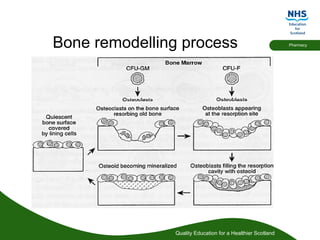
• Bone is constantly re-modelled and repaired due to
damage caused by daily use
• Osteoclasts “cut” into old bone (resorption) and
osteoblasts fill with organic matrix which becomes
mineralised (bone formation or ossification)
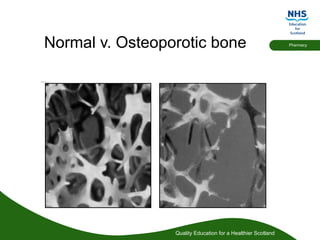
• In osteoporosis the net rate of bone resorption
exceed rate of bone formation- normally matched.
• Results in a decrease in bone mass and quality
Quality Education for a Healthier Scotland
Pharmacy
Bone tissue cells
• Basically three
• Osteoclasts- large multi-nuclear cells which release
enzymes and acids that digest protein and mineral
components of bone (resorption)
• Osteoblasts- bone builders, synthesize and secrete
collagen and other components to create a matrix
which is laid down in the bone. They initiate
calcification of the matrix and hence bone formation
• Osteocytes- mature bone cells (osteoblasts encased
in matrix secretions) responsible for exchange of
waste and nutrients.
Quality Education for a Healthier Scotland
Pharmacy
Bone remodelling process
Quality Education for a Healthier Scotland
Pharmacy
Definition
•Osteoporosis is a progressive systemic skeletal
disease characterised by low bone mass and micro-
architectural deterioration of bone tissue with a
consequent increase in bone fragility and susceptibility
to fracture.
•World Health Organisation (1994)
•Osteoporosis is a chronic disease that has late clinical
consequences and has been referred to as a silent
epidemic because there are no associated signs or
symptoms before fracture.
Quality Education for a Healthier Scotland
Pharmacy
Normal v. Osteoporotic bone
Quality Education for a Healthier Scotland
Pharmacy
Osteoporosis Incidence
•UK incidence is 3 million (probably much more)
•Causes 310,000 fractures per year- including
60,000 hip, 50,000 wrist and 120,000 vertebral
•One in 3 women and one in 12 men over 50 will
sustain an osteoporotic fracture in their lifetime
Quality Education for a Healthier Scotland
Pharmacy
Risk factors for Osteoporosis
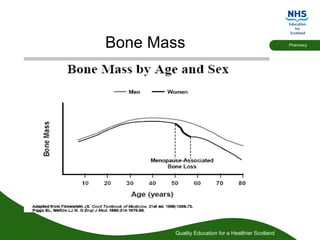
• Age- bone mineral density (BMD) decreases with age
• Hormones- lower levels of oestrogen after menopause accelerate bone
loss due to increased activity of osetoclasts.
• Premature menopause or hysterectomy causes earlier acceleration of
bone loss. Likewise surgical or chemical castration in men
• Gender- women are at increased risk of osteoporosis as they start out
with smaller bones and bone mass compared to men
• Genetic factors- family history of osteoporotic fracture, especially hip
fracture, increases risk
Quality Education for a Healthier Scotland
Pharmacy
Secondary causes of
osteoporosis
• Long term corticosteroid use ie 5mg or more prednisolone daily for 3
months or more
• Aromatase inhibitor treatment
• Hyperparathyroidism
• Hyperthyroidism
• Coeliac disease, malabsorption syndromes, inflammatory bowel
disease,IBS
• Anorexia
• Renal disease
• Rheumatoid arthritis
• Other drugs- PPI’S, SSRI’s, Anti-epileptics
Quality Education for a Healthier Scotland
Pharmacy
Modifiable risk factors
• Smoking- BMD lower in smokers
• Alcohol- BMD lower in alcoholics
• Weight- low BMI i.e. <19 is an indicator of low BMD
• Vitamin D and Calcium- vitamin D required for calcium absorption from
intestines, re-absorption from the kidneys and control of parathyroid hormone
• Vitamin D levels and Calcium intake reduced in old age due to reduced
exposure to sunlight and changes in the epidermis and poor diet.
• Exercise- weight bearing exercise increases BMD and prolonged bed rest
decreases BMD
Quality Education for a Healthier Scotland
Pharmacy
Bone Mass
Quality Education for a Healthier Scotland
Pharmacy
Diagnosis of osteoporosis
• Bone mineral density is main measure for diagnosis
• BMD measured by using Dual Energy X-ray Absorptiometry (DEXA)
scan
• Measurements usually made at lumbar spine and hip
• Usually reported as T scores and Z scores
• T score is the number of standard deviations from the peak bone mass
of young adults of the same sex
• Z score is the number of standard deviations from the average bone
mass of people of same age and sex
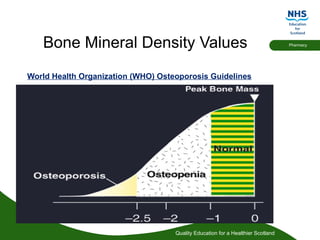
• T score between -1 and -2.5 indicates osteopenia
• T score -2.5 or less indicates osteoporosis
• T score -2.5 with a fracture is established osteoporosis
Quality Education for a Healthier Scotland
Pharmacy
Bone Mineral Density Values
World Health Organization (WHO) Osteoporosis Guidelines
Quality Education for a Healthier Scotland
Pharmacy
DEXA scan results
Quality Education for a Healthier Scotland
Pharmacy
Criteria for referral for DEXA scan
(NHS Glasgow & Clyde)
• Over 50 yrs with a fragility fracture at any site (not attributable
to a RTA or a fall from above head height)
• Steroid exposure of at least 5mg prednisolone per day (or
equivalent) for at least 3 months
• Over 60 yrs and menopause under 45 yrs
• Over 60 yrs and acquired kyphosis
• Over 60 yrs and significant self-reported height loss
• Over 60 yrs and family history of 1st
degree relative with
fracture
• Over 60 yrs and family history of 1st
degree relative with
kyphosis
• Over 60 yrs and family history of 1st
degree relative with
DEXA confirmed osteoporosis
Quality Education for a Healthier Scotland
Pharmacy
Treatment of Osteoporosis
Bisphosphonates
• First line treatment for primary and secondary prevention of
osteoporotic fractures
• Reduce bone resorption by inhibiting action of osteoclasts
• Available orally as daily or weekly tablet, or as a yearly
injection
• Daily and weekly- alendronate, risedronate
• Yearly IV- zoledronate infusion
Quality Education for a Healthier Scotland
Pharmacy
Bisphosphonates cont.
• Oral bisphosphonates have complicated dosage
regimes and poor bioavailability
• Strong evidence to support their use
• Alendronate usually first choice due to cost
• GI Side effects are fairly common with oral
bisphosphonates
• Recent concerns regarding osteonecrosis of the jaw
and atypical stress fractures
Quality Education for a Healthier Scotland
Pharmacy
Treatment of Osteoporosis-
Strontium
• Claims to increase BMD by reducing bone resorption and increasing
bone formation by its action on osetoclasts and osteoblasts
• Available as a powder for reconstitution and taken daily usually bedtime
• Avoidance of food required 2 hours before and after administration
• GI side effects of nausea and diarrhoea but usually transient
• Possible slight increase in risk of venous thromboembolism (VTE)
Quality Education for a Healthier Scotland
Pharmacy
Treatment of Osteoporosis-
others
• Raloxifene- selective oestrogen receptor modulator (SERM) which
selectively binds to oestrogen receptors on bone.
• Reduces incidence of vertebral fractures but no effect on non-vertebral
or hip fractures. Carries risk of VTE.
• Teriparatide- a fragment of recombinant human parathyroid hormone.
High levels of parathyroid hormone usually cause bone resorption but
pulsed doses cause formation. Daily injection. Reduces vertebral and
non-vertebral fractures but not hip. Expensive and usually initiated by
specialists.
• Calcitonin- hormone produced by thyroid gland. Given as a nasal spray
of synthetic calcitonin. Reduces risk of vertebral fracture only.
• Calcium and Vitamin D3- has an important role on bone formation and
remodelling. Calcium is required for bone mineralization and vitamin D
keeps parathyroid hormone secretion under control
Quality Education for a Healthier Scotland
Pharmacy
Newer Treatment
• Denosumab- a human monoclonal antibody to the activator of receptors
on osteoclasts resulting in a reduction in their development and
activity and resultant increases in BMD
• Reduces risk of vertebral, non-vertebral and hip fractures
• Given as a twice yearly s/c injection for 36 months
Quality Education for a Healthier Scotland
Pharmacy
These medicines increase bone
mineral density and reduce
fractures
Why should you consider a patient with
osteopenia or osteoporosis for the
Chronic Medication Service?
Quality Education for a Healthier Scotland
Pharmacy
The Problem- Poor Adherence
• Patients stop taking Anti-osteoporotic medicines (do
not persist)
• Patients take them irregularly or incorrectly (do not
comply)
• Persistence and Compliance = Adherence
Quality Education for a Healthier Scotland
Pharmacy
Why patients stop taking
• Studies have shown that after 1 year 1 in 3 patients
have stopped taking their Bisphosphonate (other
studies as high as 1 in 2)
• Poor understanding of the condition and its treatment
• Long term treatment
• Bisphosphonates (especially) have difficult dosage
regimes
• Texture/taste of Calcium & Vitamin D3
• Side-effects
Quality Education for a Healthier Scotland
Pharmacy
Correct dosage regime
• Bisphosphonates (alendronate, risedronate….)
must be taken in the morning on an empty stomach
and at least 1/2 hour before breakfast
• Must be taken with a large glass of tap water
• Must sit upright after taking ie don’t go back to bed!
• No tea, coffee, juice or other medicines for at least
half an hour (do not take calcium and vit D3 for 4
hours)
• Strontium (Protelos) no food & calcium 2 hours
before and 2 hours after (bedtime is best)
• Please see individual drug SPC’s
Quality Education for a Healthier Scotland
Pharmacy
What’s the problem if not taken
correctly?
• Bisphosphonates:
• If taken CORRECTLY only 0.64% to 0.39% is
absorbed- enough for them to work!
• If overnight fast/ avoidance of food is not followed
absorption is practically ZERO!
• If taken with tea, coffee, juice.. Absorption reduced by
60%!
• Oesophageal irritation/ ulceration if insufficient water
taken with tablet or lie down after taking
• Strontium: 25% absorption if taken correctly, 60%-
70% reduction if not
Quality Education for a Healthier Scotland
Pharmacy
Compliance Aids
• Patients or carers must be able to identify a
bisphosphonate in a compliance aid!
• Leave Calcium & Vitamin D3 to later in the
day eg lunchtime and teatime
Quality Education for a Healthier Scotland
Pharmacy
Falls
The most effective way to minimise osteoporotic fragility
fractures is to…….
STOP PEOPLE FALLING!!!!
If your Health Board has a Falls Prevention Programme
consider referral for your osteoporosis patients who
have suffered falls

osteoporosis pathogenesis and management.

  • 1.
    Quality Education fora Healthier Scotland Pharmacy OSTEOPOROSIS An overview of the condition and its treatment
  • 2.
    Quality Education fora Healthier Scotland Pharmacy Bone • 206 bones in the human skeleton • Provide support, anchorage for muscles and protection for organs eg ribs • Bone is a storage area for calcium and phosphorous salts and has an important role in blood formation • Before birth the skeleton is made of cartilage most of which is gradually replaced by bone via a process called ossification. • Bones of the human skeleton can be divided into long bone and flat bones • Long bones are tubular and weight bearing and are made of a dense outer layer of compact (cortical) bone and central region (medulla) made up of trabecular (spongy) bone • Trabecular bone makes up most of the short, flat and irregular shaped bones and the epiphyses (ends) of the long bones • It is much lighter than cortical bone and has a good strength to weight ratio
  • 3.
    Quality Education fora Healthier Scotland Pharmacy Bone • Trabecular bone is more susceptible to the effects of osteoporosis • Most osteoporotic fractures occur where there are high levels of trabecular bone eg the vertebrae, the neck of femur (hip) and the wrist
  • 4.
    Quality Education fora Healthier Scotland Pharmacy Osteoporosis Pathogenesis • Bone is constantly re-modelled and repaired due to damage caused by daily use • Osteoclasts “cut” into old bone (resorption) and osteoblasts fill with organic matrix which becomes mineralised (bone formation or ossification) • In osteoporosis the net rate of bone resorption exceed rate of bone formation- normally matched. • Results in a decrease in bone mass and quality
  • 5.
    Quality Education fora Healthier Scotland Pharmacy Bone tissue cells • Basically three • Osteoclasts- large multi-nuclear cells which release enzymes and acids that digest protein and mineral components of bone (resorption) • Osteoblasts- bone builders, synthesize and secrete collagen and other components to create a matrix which is laid down in the bone. They initiate calcification of the matrix and hence bone formation • Osteocytes- mature bone cells (osteoblasts encased in matrix secretions) responsible for exchange of waste and nutrients.
  • 6.
    Quality Education fora Healthier Scotland Pharmacy Bone remodelling process
  • 7.
    Quality Education fora Healthier Scotland Pharmacy Definition •Osteoporosis is a progressive systemic skeletal disease characterised by low bone mass and micro- architectural deterioration of bone tissue with a consequent increase in bone fragility and susceptibility to fracture. •World Health Organisation (1994) •Osteoporosis is a chronic disease that has late clinical consequences and has been referred to as a silent epidemic because there are no associated signs or symptoms before fracture.
  • 8.
    Quality Education fora Healthier Scotland Pharmacy Normal v. Osteoporotic bone
  • 9.
    Quality Education fora Healthier Scotland Pharmacy Osteoporosis Incidence •UK incidence is 3 million (probably much more) •Causes 310,000 fractures per year- including 60,000 hip, 50,000 wrist and 120,000 vertebral •One in 3 women and one in 12 men over 50 will sustain an osteoporotic fracture in their lifetime
  • 10.
    Quality Education fora Healthier Scotland Pharmacy Risk factors for Osteoporosis • Age- bone mineral density (BMD) decreases with age • Hormones- lower levels of oestrogen after menopause accelerate bone loss due to increased activity of osetoclasts. • Premature menopause or hysterectomy causes earlier acceleration of bone loss. Likewise surgical or chemical castration in men • Gender- women are at increased risk of osteoporosis as they start out with smaller bones and bone mass compared to men • Genetic factors- family history of osteoporotic fracture, especially hip fracture, increases risk
  • 11.
    Quality Education fora Healthier Scotland Pharmacy Secondary causes of osteoporosis • Long term corticosteroid use ie 5mg or more prednisolone daily for 3 months or more • Aromatase inhibitor treatment • Hyperparathyroidism • Hyperthyroidism • Coeliac disease, malabsorption syndromes, inflammatory bowel disease,IBS • Anorexia • Renal disease • Rheumatoid arthritis • Other drugs- PPI’S, SSRI’s, Anti-epileptics
  • 12.
    Quality Education fora Healthier Scotland Pharmacy Modifiable risk factors • Smoking- BMD lower in smokers • Alcohol- BMD lower in alcoholics • Weight- low BMI i.e. <19 is an indicator of low BMD • Vitamin D and Calcium- vitamin D required for calcium absorption from intestines, re-absorption from the kidneys and control of parathyroid hormone • Vitamin D levels and Calcium intake reduced in old age due to reduced exposure to sunlight and changes in the epidermis and poor diet. • Exercise- weight bearing exercise increases BMD and prolonged bed rest decreases BMD
  • 13.
    Quality Education fora Healthier Scotland Pharmacy Bone Mass
  • 14.
    Quality Education fora Healthier Scotland Pharmacy Diagnosis of osteoporosis • Bone mineral density is main measure for diagnosis • BMD measured by using Dual Energy X-ray Absorptiometry (DEXA) scan • Measurements usually made at lumbar spine and hip • Usually reported as T scores and Z scores • T score is the number of standard deviations from the peak bone mass of young adults of the same sex • Z score is the number of standard deviations from the average bone mass of people of same age and sex • T score between -1 and -2.5 indicates osteopenia • T score -2.5 or less indicates osteoporosis • T score -2.5 with a fracture is established osteoporosis
  • 15.
    Quality Education fora Healthier Scotland Pharmacy Bone Mineral Density Values World Health Organization (WHO) Osteoporosis Guidelines
  • 16.
    Quality Education fora Healthier Scotland Pharmacy DEXA scan results
  • 17.
    Quality Education fora Healthier Scotland Pharmacy Criteria for referral for DEXA scan (NHS Glasgow & Clyde) • Over 50 yrs with a fragility fracture at any site (not attributable to a RTA or a fall from above head height) • Steroid exposure of at least 5mg prednisolone per day (or equivalent) for at least 3 months • Over 60 yrs and menopause under 45 yrs • Over 60 yrs and acquired kyphosis • Over 60 yrs and significant self-reported height loss • Over 60 yrs and family history of 1st degree relative with fracture • Over 60 yrs and family history of 1st degree relative with kyphosis • Over 60 yrs and family history of 1st degree relative with DEXA confirmed osteoporosis
  • 18.
    Quality Education fora Healthier Scotland Pharmacy Treatment of Osteoporosis Bisphosphonates • First line treatment for primary and secondary prevention of osteoporotic fractures • Reduce bone resorption by inhibiting action of osteoclasts • Available orally as daily or weekly tablet, or as a yearly injection • Daily and weekly- alendronate, risedronate • Yearly IV- zoledronate infusion
  • 19.
    Quality Education fora Healthier Scotland Pharmacy Bisphosphonates cont. • Oral bisphosphonates have complicated dosage regimes and poor bioavailability • Strong evidence to support their use • Alendronate usually first choice due to cost • GI Side effects are fairly common with oral bisphosphonates • Recent concerns regarding osteonecrosis of the jaw and atypical stress fractures
  • 20.
    Quality Education fora Healthier Scotland Pharmacy Treatment of Osteoporosis- Strontium • Claims to increase BMD by reducing bone resorption and increasing bone formation by its action on osetoclasts and osteoblasts • Available as a powder for reconstitution and taken daily usually bedtime • Avoidance of food required 2 hours before and after administration • GI side effects of nausea and diarrhoea but usually transient • Possible slight increase in risk of venous thromboembolism (VTE)
  • 21.
    Quality Education fora Healthier Scotland Pharmacy Treatment of Osteoporosis- others • Raloxifene- selective oestrogen receptor modulator (SERM) which selectively binds to oestrogen receptors on bone. • Reduces incidence of vertebral fractures but no effect on non-vertebral or hip fractures. Carries risk of VTE. • Teriparatide- a fragment of recombinant human parathyroid hormone. High levels of parathyroid hormone usually cause bone resorption but pulsed doses cause formation. Daily injection. Reduces vertebral and non-vertebral fractures but not hip. Expensive and usually initiated by specialists. • Calcitonin- hormone produced by thyroid gland. Given as a nasal spray of synthetic calcitonin. Reduces risk of vertebral fracture only. • Calcium and Vitamin D3- has an important role on bone formation and remodelling. Calcium is required for bone mineralization and vitamin D keeps parathyroid hormone secretion under control
  • 22.
    Quality Education fora Healthier Scotland Pharmacy Newer Treatment • Denosumab- a human monoclonal antibody to the activator of receptors on osteoclasts resulting in a reduction in their development and activity and resultant increases in BMD • Reduces risk of vertebral, non-vertebral and hip fractures • Given as a twice yearly s/c injection for 36 months
  • 23.
    Quality Education fora Healthier Scotland Pharmacy These medicines increase bone mineral density and reduce fractures Why should you consider a patient with osteopenia or osteoporosis for the Chronic Medication Service?
  • 24.
    Quality Education fora Healthier Scotland Pharmacy The Problem- Poor Adherence • Patients stop taking Anti-osteoporotic medicines (do not persist) • Patients take them irregularly or incorrectly (do not comply) • Persistence and Compliance = Adherence
  • 25.
    Quality Education fora Healthier Scotland Pharmacy Why patients stop taking • Studies have shown that after 1 year 1 in 3 patients have stopped taking their Bisphosphonate (other studies as high as 1 in 2) • Poor understanding of the condition and its treatment • Long term treatment • Bisphosphonates (especially) have difficult dosage regimes • Texture/taste of Calcium & Vitamin D3 • Side-effects
  • 26.
    Quality Education fora Healthier Scotland Pharmacy Correct dosage regime • Bisphosphonates (alendronate, risedronate….) must be taken in the morning on an empty stomach and at least 1/2 hour before breakfast • Must be taken with a large glass of tap water • Must sit upright after taking ie don’t go back to bed! • No tea, coffee, juice or other medicines for at least half an hour (do not take calcium and vit D3 for 4 hours) • Strontium (Protelos) no food & calcium 2 hours before and 2 hours after (bedtime is best) • Please see individual drug SPC’s
  • 27.
    Quality Education fora Healthier Scotland Pharmacy What’s the problem if not taken correctly? • Bisphosphonates: • If taken CORRECTLY only 0.64% to 0.39% is absorbed- enough for them to work! • If overnight fast/ avoidance of food is not followed absorption is practically ZERO! • If taken with tea, coffee, juice.. Absorption reduced by 60%! • Oesophageal irritation/ ulceration if insufficient water taken with tablet or lie down after taking • Strontium: 25% absorption if taken correctly, 60%- 70% reduction if not
  • 28.
    Quality Education fora Healthier Scotland Pharmacy Compliance Aids • Patients or carers must be able to identify a bisphosphonate in a compliance aid! • Leave Calcium & Vitamin D3 to later in the day eg lunchtime and teatime
  • 29.
    Quality Education fora Healthier Scotland Pharmacy Falls The most effective way to minimise osteoporotic fragility fractures is to……. STOP PEOPLE FALLING!!!! If your Health Board has a Falls Prevention Programme consider referral for your osteoporosis patients who have suffered falls

Editor's Notes

  • #7 The aim of this presentation is to update pharmacists on the current management of stroke and to explore the ways in which we can deliver pharmaceutical care for this patient group
  • #14 Think FAST - Chest Heart and Stroke Scotland (CHSS) charity campaign launched Sept 2007 produced posters, cards and leaflets with this message You may have seen posters like these at bus stops for example
  • #17  F face facial paresis Arm arm drift Speech abnormal speech Test - requires an assessment of three specific symptoms of stroke Simple accurate diagnostic tool anyone can do to improve speed and accuracy of diagnosis in patients with suspected stroke If a person has failed any of these, it is crucial to call 999. Stroke is a medical emergency and by calling 999 you can help someone reach hospital quickly and receive the early treatment they need. Prompt action can prevent further damage to the brain and help someone make a full recovery. Delay can result in death or major long-term disabilities, such as paralysis, severe memory loss and communication problems. 2nd key message – Think FAST
  • #18 Shorter, snappier defn from CHSS Ischaemic stroke Haemorrhagic stroke Brain attack – like a heart attack for myocardial infarction – medical emergency = 3rd key message
  • #19 These are other terms you may hear – all are treated with same medicines 10% risk of stroke within 7 days of TIA There are a number of scales that measure extent of disability post stroke that help define these terms that I will mention later in relation to care issues