FOLLOW US
Computer Networks
LECTURE -1
OSI Reference Model
Mr. Abdul Rais
Assistant Professor, CSE-AIML
LIET, Hyderabad
FOLLOW US
LORDS INSTITUTE OF ENGINEERING & TECHNOLOGY
(AUTONOMOUS)
www.lords.ac.in
FOLLOW US
Lords Institute of Engineering & Technology
www.lords.ac.in
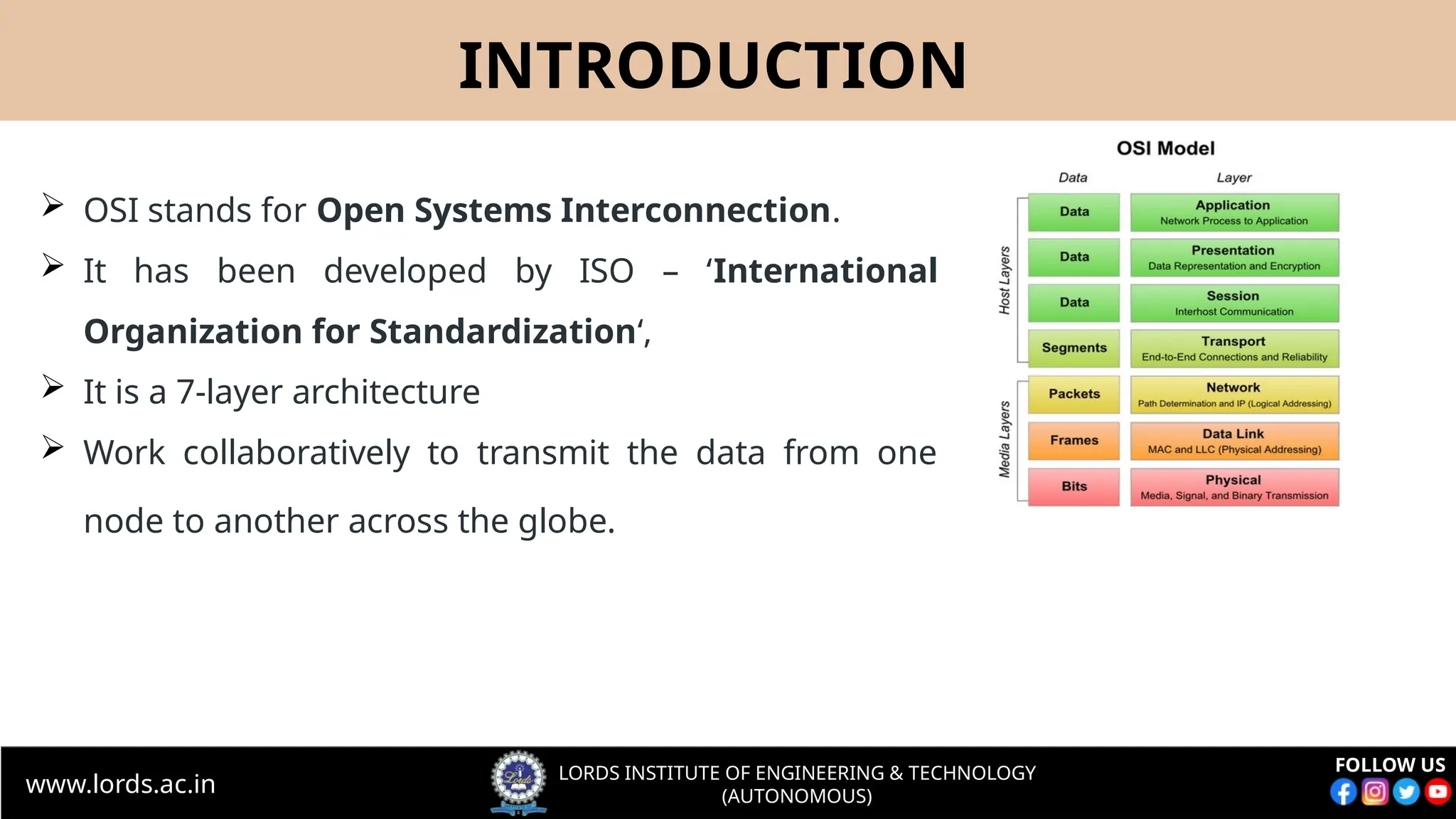
 OSI stands for Open Systems Interconnection.
 It has been developed by ISO – ‘International
Organization for Standardization‘,
 It is a 7-layer architecture
 Work collaboratively to transmit the data from one
node to another across the globe.
INTRODUCTION
www.lords.ac.in Lords Institute of Engineering & Technology
FOLLOW US
LORDS INSTITUTE OF ENGINEERING & TECHNOLOGY
(AUTONOMOUS)
www.lords.ac.in
FOLLOW US
Lords Institute of Engineering & Technology
www.lords.ac.in
 Developed by the International Standards Organization (ISO) as a first step
toward international standardization of the protocols used in the various
layers.
 The model is so called because it deals with connecting open systems-that is,
systems that are open for communication with other systems.
INTRODUCTION
www.lords.ac.in Lords Institute of Engineering & Technology
FOLLOW US
LORDS INSTITUTE OF ENGINEERING & TECHNOLOGY
(AUTONOMOUS)
www.lords.ac.in
FOLLOW US
Lords Institute of Engineering & Technology
www.lords.ac.in
LAYERED ARCHITECTURE
www.lords.ac.in Lords Institute of Engineering & Technology
FOLLOW US
LORDS INSTITUTE OF ENGINEERING & TECHNOLOGY
(AUTONOMOUS)
www.lords.ac.in
FOLLOW US
Lords Institute of Engineering & Technology
www.lords.ac.in
APPLICATION LAYER
www.lords.ac.in Lords Institute of Engineering & Technology
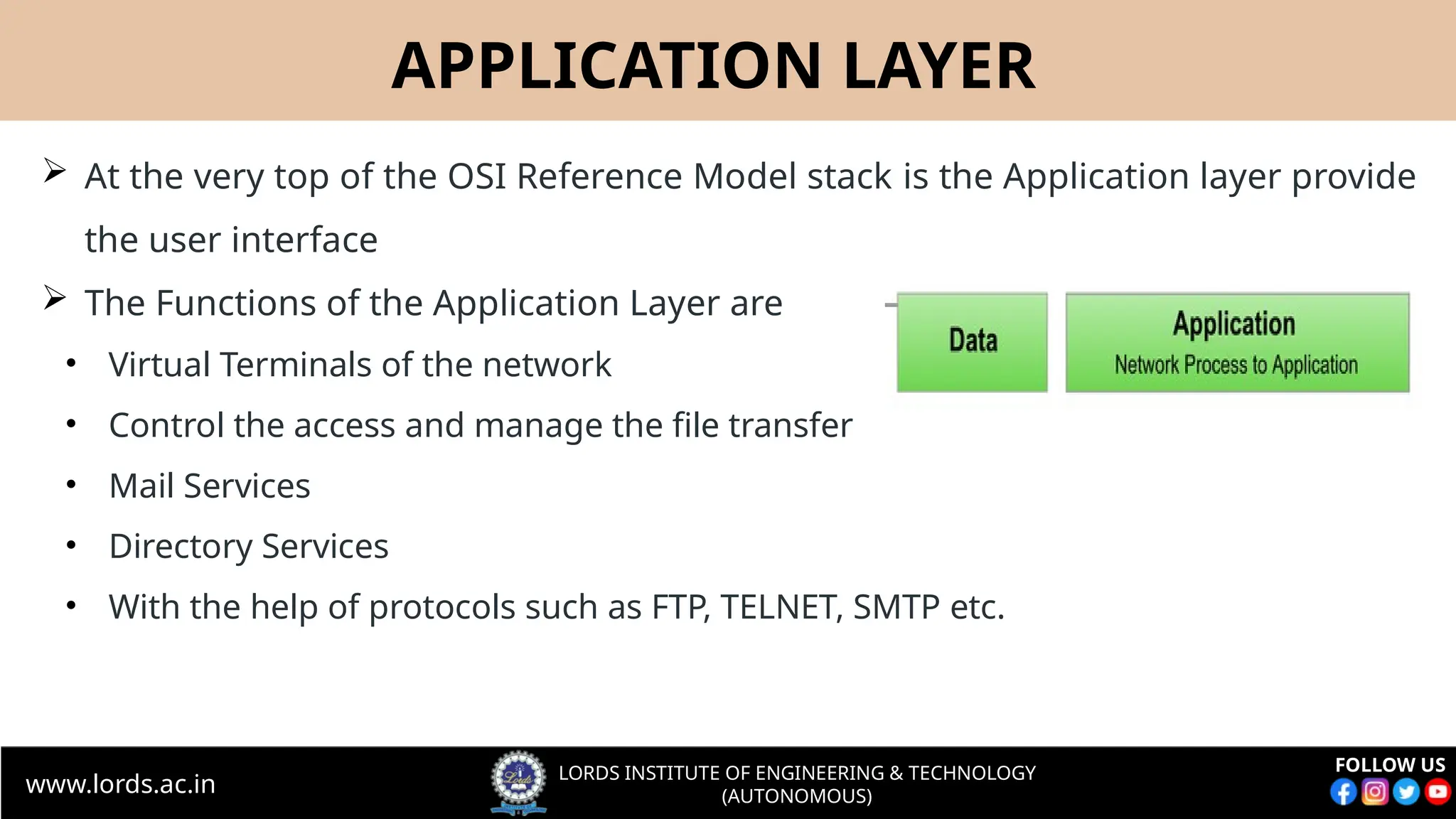
 At the very top of the OSI Reference Model stack is the Application layer provide
the user interface
 The Functions of the Application Layer are
• Virtual Terminals of the network
• Control the access and manage the file transfer
• Mail Services
• Directory Services
• With the help of protocols such as FTP, TELNET, SMTP etc.
FOLLOW US
LORDS INSTITUTE OF ENGINEERING & TECHNOLOGY
(AUTONOMOUS)
www.lords.ac.in
FOLLOW US
Lords Institute of Engineering & Technology
www.lords.ac.in
 The data from the application layer is extracted here and manipulated as per
the required format to transmit over the network.
 The Functions of the Presentation Layer are
 Translation of number systems
 Encryption/ Decryption of data for security
 Compression to reduce the data bits
With the help of protocols such as HTTP, HTML, MPEG, NCP etc.
PRESENTATION LAYER
www.lords.ac.in Lords Institute of Engineering & Technology
FOLLOW US
LORDS INSTITUTE OF ENGINEERING & TECHNOLOGY
(AUTONOMOUS)
www.lords.ac.in
FOLLOW US
Lords Institute of Engineering & Technology
www.lords.ac.in
 Session Layer is responsible for the establishment of connection, maintenance
of sessions, and authentication, and also ensures security.
 The Functions of the Session Layer are
 Session establishment, maintenance, and termination:
 Synchronization
 Dialog Control
With the help of protocols such as RPC, RTCP, PAP etc.
SESSION LAYER
www.lords.ac.in Lords Institute of Engineering & Technology
FOLLOW US
LORDS INSTITUTE OF ENGINEERING & TECHNOLOGY
(AUTONOMOUS)
www.lords.ac.in
FOLLOW US
Lords Institute of Engineering & Technology
www.lords.ac.in
 Transport Layer is responsible for the End to End Delivery of data between
applications
 The Functions of the Transport Layer
 Identifying services
 Multiplexing and Demultiplexing
 Segmentation
 Sequencing and Reassembly
 Error correction
 Flow Control
With the help of protocols such as TCP, UDP, SCTP etc.
TRANSPORT LAYER
www.lords.ac.in Lords Institute of Engineering & Technology
FOLLOW US
LORDS INSTITUTE OF ENGINEERING & TECHNOLOGY
(AUTONOMOUS)
www.lords.ac.in
FOLLOW US
Lords Institute of Engineering & Technology
www.lords.ac.in
 The network layer works for the transmission of data in the form of Packets
from one host to the other located in different networks.
 It also takes care of packet routing i.e. selection of the shortest path to
transmit the packet.
 The sender & receiver’s IP addresses are placed in the header by the network
layer.
NETWORK LAYER
www.lords.ac.in Lords Institute of Engineering & Technology
FOLLOW US
LORDS INSTITUTE OF ENGINEERING & TECHNOLOGY
(AUTONOMOUS)
www.lords.ac.in
FOLLOW US
Lords Institute of Engineering & Technology
www.lords.ac.in
 The Functions of the Network Layer
 Routing
 Logical Addressing
With the help of protocols such as ARP, RARP, ICMP, IGMP etc.
NETWORK LAYER
www.lords.ac.in Lords Institute of Engineering & Technology
FOLLOW US
LORDS INSTITUTE OF ENGINEERING & TECHNOLOGY
(AUTONOMOUS)
www.lords.ac.in
FOLLOW US
Lords Institute of Engineering & Technology
www.lords.ac.in
 Responsible for end to end delivery of data between the devices on LAN
segement
 When a packet arrives in a network, it is the responsibility of the DLL to
transmit it to the Host using its MAC address forming Frames.
DATA LINK LAYER
www.lords.ac.in Lords Institute of Engineering & Technology
FOLLOW US
LORDS INSTITUTE OF ENGINEERING & TECHNOLOGY
(AUTONOMOUS)
www.lords.ac.in
FOLLOW US
Lords Institute of Engineering & Technology
www.lords.ac.in
 The Functions of the Data Link Layer
 Framing
 Physical Addressing
 Synchronization
 Error Control & Flow Control
 Multi-Access
With the help of protocols such as SLIP, PPP, LAP etc.
DATA LINK LAYER
www.lords.ac.in Lords Institute of Engineering & Technology
FOLLOW US
LORDS INSTITUTE OF ENGINEERING & TECHNOLOGY
(AUTONOMOUS)
www.lords.ac.in
FOLLOW US
Lords Institute of Engineering & Technology
www.lords.ac.in
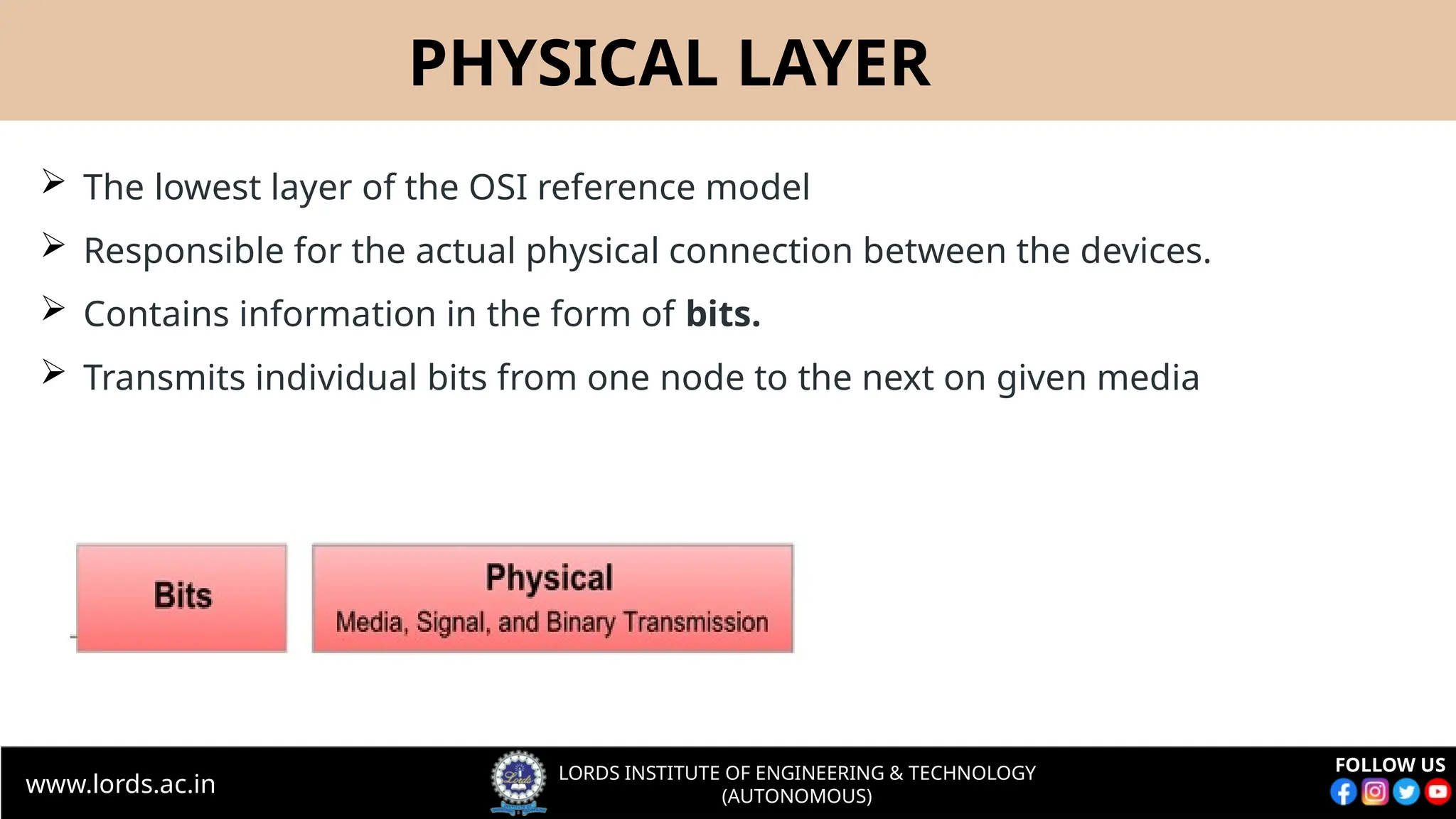
 The lowest layer of the OSI reference model
 Responsible for the actual physical connection between the devices.
 Contains information in the form of bits.
 Transmits individual bits from one node to the next on given media
PHYSICAL LAYER
www.lords.ac.in Lords Institute of Engineering & Technology
FOLLOW US
LORDS INSTITUTE OF ENGINEERING & TECHNOLOGY
(AUTONOMOUS)
www.lords.ac.in
FOLLOW US
Lords Institute of Engineering & Technology
www.lords.ac.in
 The Functions of the Physical Layer
 Representation of bits
 Physical topologies
 Transmission mode
 Line configuration
 Date rate
With the help of protocols such as DSL, ISDN, USB etc.
PHYSICAL LAYER
www.lords.ac.in Lords Institute of Engineering & Technology
FOLLOW US
LORDS INSTITUTE OF ENGINEERING & TECHNOLOGY
(AUTONOMOUS)
www.lords.ac.in
THANK YOU FOR WATCHING
www.lords.ac.in
www.lords.ac.in Lords Institute of Engineering & Technology FOLLOW US

OSI Reference Model and its operation .pptx

  • 1.
    FOLLOW US Computer Networks LECTURE-1 OSI Reference Model Mr. Abdul Rais Assistant Professor, CSE-AIML LIET, Hyderabad FOLLOW US LORDS INSTITUTE OF ENGINEERING & TECHNOLOGY (AUTONOMOUS) www.lords.ac.in
  • 2.
    FOLLOW US Lords Instituteof Engineering & Technology www.lords.ac.in  OSI stands for Open Systems Interconnection.  It has been developed by ISO – ‘International Organization for Standardization‘,  It is a 7-layer architecture  Work collaboratively to transmit the data from one node to another across the globe. INTRODUCTION www.lords.ac.in Lords Institute of Engineering & Technology FOLLOW US LORDS INSTITUTE OF ENGINEERING & TECHNOLOGY (AUTONOMOUS) www.lords.ac.in
  • 3.
    FOLLOW US Lords Instituteof Engineering & Technology www.lords.ac.in  Developed by the International Standards Organization (ISO) as a first step toward international standardization of the protocols used in the various layers.  The model is so called because it deals with connecting open systems-that is, systems that are open for communication with other systems. INTRODUCTION www.lords.ac.in Lords Institute of Engineering & Technology FOLLOW US LORDS INSTITUTE OF ENGINEERING & TECHNOLOGY (AUTONOMOUS) www.lords.ac.in
  • 4.
    FOLLOW US Lords Instituteof Engineering & Technology www.lords.ac.in LAYERED ARCHITECTURE www.lords.ac.in Lords Institute of Engineering & Technology FOLLOW US LORDS INSTITUTE OF ENGINEERING & TECHNOLOGY (AUTONOMOUS) www.lords.ac.in
  • 5.
    FOLLOW US Lords Instituteof Engineering & Technology www.lords.ac.in APPLICATION LAYER www.lords.ac.in Lords Institute of Engineering & Technology  At the very top of the OSI Reference Model stack is the Application layer provide the user interface  The Functions of the Application Layer are • Virtual Terminals of the network • Control the access and manage the file transfer • Mail Services • Directory Services • With the help of protocols such as FTP, TELNET, SMTP etc. FOLLOW US LORDS INSTITUTE OF ENGINEERING & TECHNOLOGY (AUTONOMOUS) www.lords.ac.in
  • 6.
    FOLLOW US Lords Instituteof Engineering & Technology www.lords.ac.in  The data from the application layer is extracted here and manipulated as per the required format to transmit over the network.  The Functions of the Presentation Layer are  Translation of number systems  Encryption/ Decryption of data for security  Compression to reduce the data bits With the help of protocols such as HTTP, HTML, MPEG, NCP etc. PRESENTATION LAYER www.lords.ac.in Lords Institute of Engineering & Technology FOLLOW US LORDS INSTITUTE OF ENGINEERING & TECHNOLOGY (AUTONOMOUS) www.lords.ac.in
  • 7.
    FOLLOW US Lords Instituteof Engineering & Technology www.lords.ac.in  Session Layer is responsible for the establishment of connection, maintenance of sessions, and authentication, and also ensures security.  The Functions of the Session Layer are  Session establishment, maintenance, and termination:  Synchronization  Dialog Control With the help of protocols such as RPC, RTCP, PAP etc. SESSION LAYER www.lords.ac.in Lords Institute of Engineering & Technology FOLLOW US LORDS INSTITUTE OF ENGINEERING & TECHNOLOGY (AUTONOMOUS) www.lords.ac.in
  • 8.
    FOLLOW US Lords Instituteof Engineering & Technology www.lords.ac.in  Transport Layer is responsible for the End to End Delivery of data between applications  The Functions of the Transport Layer  Identifying services  Multiplexing and Demultiplexing  Segmentation  Sequencing and Reassembly  Error correction  Flow Control With the help of protocols such as TCP, UDP, SCTP etc. TRANSPORT LAYER www.lords.ac.in Lords Institute of Engineering & Technology FOLLOW US LORDS INSTITUTE OF ENGINEERING & TECHNOLOGY (AUTONOMOUS) www.lords.ac.in
  • 9.
    FOLLOW US Lords Instituteof Engineering & Technology www.lords.ac.in  The network layer works for the transmission of data in the form of Packets from one host to the other located in different networks.  It also takes care of packet routing i.e. selection of the shortest path to transmit the packet.  The sender & receiver’s IP addresses are placed in the header by the network layer. NETWORK LAYER www.lords.ac.in Lords Institute of Engineering & Technology FOLLOW US LORDS INSTITUTE OF ENGINEERING & TECHNOLOGY (AUTONOMOUS) www.lords.ac.in
  • 10.
    FOLLOW US Lords Instituteof Engineering & Technology www.lords.ac.in  The Functions of the Network Layer  Routing  Logical Addressing With the help of protocols such as ARP, RARP, ICMP, IGMP etc. NETWORK LAYER www.lords.ac.in Lords Institute of Engineering & Technology FOLLOW US LORDS INSTITUTE OF ENGINEERING & TECHNOLOGY (AUTONOMOUS) www.lords.ac.in
  • 11.
    FOLLOW US Lords Instituteof Engineering & Technology www.lords.ac.in  Responsible for end to end delivery of data between the devices on LAN segement  When a packet arrives in a network, it is the responsibility of the DLL to transmit it to the Host using its MAC address forming Frames. DATA LINK LAYER www.lords.ac.in Lords Institute of Engineering & Technology FOLLOW US LORDS INSTITUTE OF ENGINEERING & TECHNOLOGY (AUTONOMOUS) www.lords.ac.in
  • 12.
    FOLLOW US Lords Instituteof Engineering & Technology www.lords.ac.in  The Functions of the Data Link Layer  Framing  Physical Addressing  Synchronization  Error Control & Flow Control  Multi-Access With the help of protocols such as SLIP, PPP, LAP etc. DATA LINK LAYER www.lords.ac.in Lords Institute of Engineering & Technology FOLLOW US LORDS INSTITUTE OF ENGINEERING & TECHNOLOGY (AUTONOMOUS) www.lords.ac.in
  • 13.
    FOLLOW US Lords Instituteof Engineering & Technology www.lords.ac.in  The lowest layer of the OSI reference model  Responsible for the actual physical connection between the devices.  Contains information in the form of bits.  Transmits individual bits from one node to the next on given media PHYSICAL LAYER www.lords.ac.in Lords Institute of Engineering & Technology FOLLOW US LORDS INSTITUTE OF ENGINEERING & TECHNOLOGY (AUTONOMOUS) www.lords.ac.in
  • 14.
    FOLLOW US Lords Instituteof Engineering & Technology www.lords.ac.in  The Functions of the Physical Layer  Representation of bits  Physical topologies  Transmission mode  Line configuration  Date rate With the help of protocols such as DSL, ISDN, USB etc. PHYSICAL LAYER www.lords.ac.in Lords Institute of Engineering & Technology FOLLOW US LORDS INSTITUTE OF ENGINEERING & TECHNOLOGY (AUTONOMOUS) www.lords.ac.in
  • 15.
    THANK YOU FORWATCHING www.lords.ac.in www.lords.ac.in Lords Institute of Engineering & Technology FOLLOW US