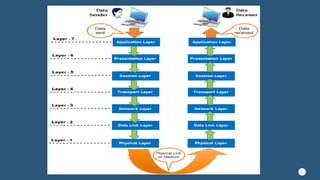
OSI MODEL
SUBJECT: NETWORKING
COURSE : DIPLOMA IN INFORMATION
TECHNOLOGY (DIT)
INSTITUTE : SHAHEEN VOCATIONAL
TRAINING INSTITUTE (SVTI) NAWABSHAH
2
3
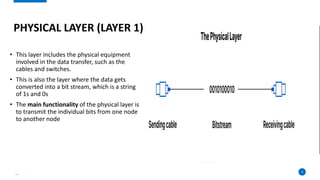
• This layer includes the physical equipment
involved in the data transfer, such as the
cables and switches.
• This is also the layer where the data gets
converted into a bit stream, which is a string
of 1s and 0s
• The main functionality of the physical layer is
to transmit the individual bits from one node
to another node
PHYSICAL LAYER (LAYER 1)
• The second layer of OSI model is data link
layer.
• It is responsible of node to node data delivery.
• It forms frame from the packets that are
received from network layer
4
Data link layer
(layer 2)
FUNCTIONS OF DATA LINK LAYER
• The data packets received from
the network layer are
encapsulated in frames by data
link layer
• During data transmission, due to
signal loss, error might occur in
the data being transmitted.
• To minimize such data error, the
data-link performs error
detection and correction
techniques on the transmitted
data.
5
FRAMING ERROR DETECTION
MEDIA ACCESS CONTROL
• In the network when multiple
devices share the same
communication channel , this
leads to data collision in the
network channel.
• To prevent such collision, the
datalink layer performs checks on
the devices with the same
network channel to avoid
collision.
NETWORK LAYER (LAYER 3
6
• The third layer of OSI model is network layer.
• The main responsibility of network layer is delivery of
data packets from the source to destination.
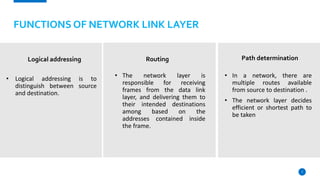
FUNCTIONS OF NETWORK LINK LAYER
• Logical addressing is to
distinguish between source
and destination.
• In a network, there are
multiple routes available
from source to destination .
• The network layer decides
efficient or shortest path to
be taken
7
Logical addressing Path determination
Routing
• The network layer is
responsible for receiving
frames from the data link
layer, and delivering them to
their intended destinations
among based on the
addresses contained inside
the frame.
TRANSPORT LAYER (LAYER 4)
9
• The transport layer (layer 4) is responsible for delivery of
an entire data from an application program on the source
device to a similar application program on the destination
device.
• Provides transfer of data between end users, providing
reliable data delivery.
FUNCTIONS OF
TRANSPORT LAYER
9
Segmentation
One message is splitted into different segments, and
every segment has own sequence number.
All messages are reassembled accurately upon reach at
the their target destination.
9
Error control
•The data link layer checks for the error between each
network. If an error is introduced inside one of the
routers, then this error will not be caught by the data
link layer.
•It only detects those errors that have been
introduced between the beginning and end of the link.
•Therefore, the transport layer performs the checking
for the errors end-to-end to ensure that the packet
has arrived correctly.
FUNCTIONS OF
TRANSPORT LAYER
9
Flow control
• Flow control is used to prevent the sender from
overwhelming the receiver. If the receiver is
overloaded with too much data, then the receiver
discards the packets and asking for the
retransmission of packets.
• This increases network congestion and thus,
reducing the system performance. The transport
layer is responsible for flow control.
FUNCTIONS OF
TRANSPORT LAYER
SESSION LAYER (LAYER 5)
9
• The session layer creates communication channels, called
sessions, between devices.
• It is responsible for opening sessions, ensuring they remain
open and functional while data is being transferred, and
closing them when communication ends.
Session management
9
• Provides the mechanism for opening, closing and managing a
session between end-user application processes, i.e., a semi-
permanent dialogue.
• Communication sessions consist of requests and responses that
occur between applications.
Functions of Session layer
Authentication
9
• Before establishing a session with some network peer, it
is important for one of the computers to know that
another peer it is communicating to is a legitimate one.
• In short terms, you can say that authentication is the
process of verifying that "you are who you say you are".
Functions of Session layer
Authorization
9
• Authorization is the process of verifying that "you are
permitted to do what you are trying to do“
• After authentication user will authorize to access
information.
Functions of Session layer
Presentation layer (layer 2)
9
• The presentation layer prepares data for the application
layer. It defines how two devices should encode, encrypt,
and compress data so it is received correctly on the other
end.
FUNCTIONS OF PRESENTATION LAYER
9
Translation
• The data that the presentation layer receives from the
application layer is a series of characters and numbers,
the data must be converted to bit streams to be readable
by the receiving computer.
9
Encryption and Decryption
• Encryption is the process of scrambling data so that it's
unreadable to unauthorized parties, and decryption is the
process of converting the scrambled data back to a readable
form.
• Because computer systems often handle sensitive information,
the presentation layer performs both of these important
security tasks.
FUNCTIONS OF PRESENTATION LAYER
9
Data compression
• Compression is the process of reducing data size. This process
is helpful for transmitting data because smaller files transmit
more quickly.
• The presentation layer performs compression on the sender's
side to reduce the bandwidth of the transmitting data and
accelerate its rate of transmission.
FUNCTIONS OF PRESENTATION LAYER
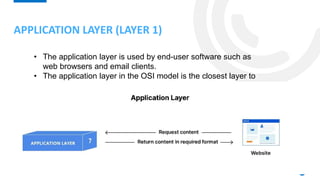
APPLICATION LAYER (LAYER 1)
9
• The application layer is used by end-user software such as
web browsers and email clients.
• The application layer in the OSI model is the closest layer to
the end user which means that the application layer and end
user can interact directly with the software applicationdata to
users
Study Material for
Reference
HTTPS://REALPARS.COM/OSI/
HTTPS://WWW.LIFEWIRE.COM/LAYERS-OF-THE-OSI-
MODEL-ILLUSTRATED-818017
HTTPS://YOUTU.BE/VV4Y_UONEC0

OSI MODEL.pptx

  • 1.
    OSI MODEL SUBJECT: NETWORKING COURSE: DIPLOMA IN INFORMATION TECHNOLOGY (DIT) INSTITUTE : SHAHEEN VOCATIONAL TRAINING INSTITUTE (SVTI) NAWABSHAH
  • 2.
  • 3.
    3 • This layerincludes the physical equipment involved in the data transfer, such as the cables and switches. • This is also the layer where the data gets converted into a bit stream, which is a string of 1s and 0s • The main functionality of the physical layer is to transmit the individual bits from one node to another node PHYSICAL LAYER (LAYER 1)
  • 4.
    • The secondlayer of OSI model is data link layer. • It is responsible of node to node data delivery. • It forms frame from the packets that are received from network layer 4 Data link layer (layer 2)
  • 5.
    FUNCTIONS OF DATALINK LAYER • The data packets received from the network layer are encapsulated in frames by data link layer • During data transmission, due to signal loss, error might occur in the data being transmitted. • To minimize such data error, the data-link performs error detection and correction techniques on the transmitted data. 5 FRAMING ERROR DETECTION MEDIA ACCESS CONTROL • In the network when multiple devices share the same communication channel , this leads to data collision in the network channel. • To prevent such collision, the datalink layer performs checks on the devices with the same network channel to avoid collision.
  • 6.
    NETWORK LAYER (LAYER3 6 • The third layer of OSI model is network layer. • The main responsibility of network layer is delivery of data packets from the source to destination.
  • 7.
    FUNCTIONS OF NETWORKLINK LAYER • Logical addressing is to distinguish between source and destination. • In a network, there are multiple routes available from source to destination . • The network layer decides efficient or shortest path to be taken 7 Logical addressing Path determination Routing • The network layer is responsible for receiving frames from the data link layer, and delivering them to their intended destinations among based on the addresses contained inside the frame.
  • 8.
    TRANSPORT LAYER (LAYER4) 9 • The transport layer (layer 4) is responsible for delivery of an entire data from an application program on the source device to a similar application program on the destination device. • Provides transfer of data between end users, providing reliable data delivery.
  • 9.
    FUNCTIONS OF TRANSPORT LAYER 9 Segmentation Onemessage is splitted into different segments, and every segment has own sequence number. All messages are reassembled accurately upon reach at the their target destination.
  • 10.
    9 Error control •The datalink layer checks for the error between each network. If an error is introduced inside one of the routers, then this error will not be caught by the data link layer. •It only detects those errors that have been introduced between the beginning and end of the link. •Therefore, the transport layer performs the checking for the errors end-to-end to ensure that the packet has arrived correctly. FUNCTIONS OF TRANSPORT LAYER
  • 11.
    9 Flow control • Flowcontrol is used to prevent the sender from overwhelming the receiver. If the receiver is overloaded with too much data, then the receiver discards the packets and asking for the retransmission of packets. • This increases network congestion and thus, reducing the system performance. The transport layer is responsible for flow control. FUNCTIONS OF TRANSPORT LAYER
  • 12.
    SESSION LAYER (LAYER5) 9 • The session layer creates communication channels, called sessions, between devices. • It is responsible for opening sessions, ensuring they remain open and functional while data is being transferred, and closing them when communication ends.
  • 13.
    Session management 9 • Providesthe mechanism for opening, closing and managing a session between end-user application processes, i.e., a semi- permanent dialogue. • Communication sessions consist of requests and responses that occur between applications. Functions of Session layer
  • 14.
    Authentication 9 • Before establishinga session with some network peer, it is important for one of the computers to know that another peer it is communicating to is a legitimate one. • In short terms, you can say that authentication is the process of verifying that "you are who you say you are". Functions of Session layer
  • 15.
    Authorization 9 • Authorization isthe process of verifying that "you are permitted to do what you are trying to do“ • After authentication user will authorize to access information. Functions of Session layer
  • 16.
    Presentation layer (layer2) 9 • The presentation layer prepares data for the application layer. It defines how two devices should encode, encrypt, and compress data so it is received correctly on the other end.
  • 17.
    FUNCTIONS OF PRESENTATIONLAYER 9 Translation • The data that the presentation layer receives from the application layer is a series of characters and numbers, the data must be converted to bit streams to be readable by the receiving computer.
  • 18.
    9 Encryption and Decryption •Encryption is the process of scrambling data so that it's unreadable to unauthorized parties, and decryption is the process of converting the scrambled data back to a readable form. • Because computer systems often handle sensitive information, the presentation layer performs both of these important security tasks. FUNCTIONS OF PRESENTATION LAYER
  • 19.
    9 Data compression • Compressionis the process of reducing data size. This process is helpful for transmitting data because smaller files transmit more quickly. • The presentation layer performs compression on the sender's side to reduce the bandwidth of the transmitting data and accelerate its rate of transmission. FUNCTIONS OF PRESENTATION LAYER
  • 20.
    APPLICATION LAYER (LAYER1) 9 • The application layer is used by end-user software such as web browsers and email clients. • The application layer in the OSI model is the closest layer to the end user which means that the application layer and end user can interact directly with the software applicationdata to users
  • 21.