Interview Questions &
Answers
OSI Model
http://www.allabouttesting.org
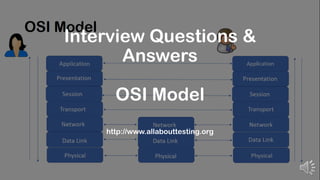
Q. Define OSI layers.
OSI stands Open System Interconnection. There are 7 layers in OSI model.
OSI model helps networking professional in understanding information flow from
one source to destination.
Although, OSI model not performing any function in the networking process.
http://allabouttesting.org
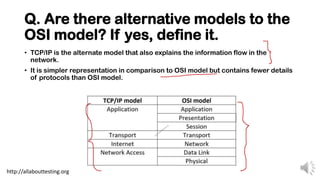
Q. Are there alternative models to the
OSI model? If yes, define it.
• TCP/IP is the alternate model that also explains the information flow in the
network.
• It is simpler representation in comparison to OSI model but contains fewer details
of protocols than OSI model.
http://allabouttesting.org
Q. What are the differences between
TCP and UDP?
Following are differences in TCP and UDP,
• TCP is connection oriented protocol while UDP is
connectionless protocol.
• TCP is more reliable than UDP.
• UDP is faster for data sending than TCP.
• UDP makes error checking but no reporting but TCP makes
checks for errors and reporting.
• TCP provides guaranteed Delivery of Data but UDP has no
guarantee.
• Header size of TCP is 20 bytes while that of UDP is 8 bytes.
http://allabouttesting.org
Q. What is the importance of the OSI
Physical Layer?
• Physical layer resembles actual transfer of information from
source to destination in form of bit stream - electrical impulse,
light or radio signal.
• In simple words, it accepts a frame from data link layer and
convert it into bits. Also accepts bits from physical medium and
convert it into the frame.
• Common protocols for this layer are EIA/TIA-232, EIA/TIA-449,
X.21, HSSI, V.24, V.35 and SONET.
http://allabouttesting.org
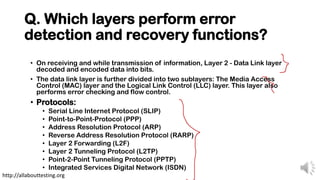
Q. Which layers perform error
detection and recovery functions?
• On receiving and while transmission of information, Layer 2 - Data Link layer
decoded and encoded data into bits.
• The data link layer is further divided into two sublayers: The Media Access
Control (MAC) layer and the Logical Link Control (LLC) layer. This layer also
performs error checking and flow control.
• Protocols:
• Serial Line Internet Protocol (SLIP)
• Point-to-Point-Protocol (PPP)
• Address Resolution Protocol (ARP)
• Reverse Address Resolution Protocol (RARP)
• Layer 2 Forwarding (L2F)
• Layer 2 Tunneling Protocol (L2TP)
• Point-2-Point Tunneling Protocol (PPTP)
• Integrated Services Digital Network (ISDN)
http://allabouttesting.org
Q. How the network administrator
detect the problem?
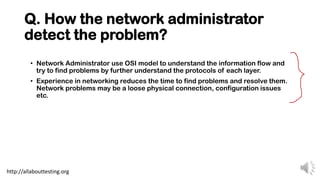
• Network Administrator use OSI model to understand the information flow and
try to find problems by further understand the protocols of each layer.
• Experience in networking reduces the time to find problems and resolve them.
Network problems may be a loose physical connection, configuration issues
etc.
http://allabouttesting.org
Q. What is the difference between
flow control and error control?
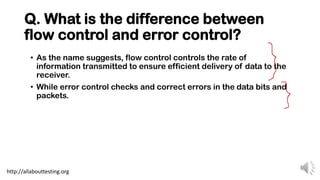
• As the name suggests, flow control controls the rate of
information transmitted to ensure efficient delivery of data to the
receiver.
• While error control checks and correct errors in the data bits and
packets.
http://allabouttesting.org
Q. What is Data Encapsulation ?
• Data encapsulation is a process of adding extra information at
each layer of OSI model while information flow from one host to
another host.
• Information such as source and destination address, protocol
information, type of data etc.
http://allabouttesting.org
Q. MAC address works on which layer?
What are the differences of MAC sublayer
and LLC sublayer?
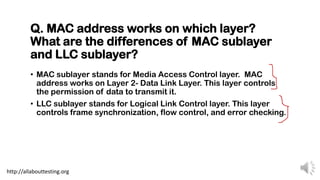
• MAC sublayer stands for Media Access Control layer. MAC
address works on Layer 2- Data Link Layer. This layer controls
the permission of data to transmit it.
• LLC sublayer stands for Logical Link Control layer. This layer
controls frame synchronization, flow control, and error checking.
http://allabouttesting.org
Q. What is the difference between half-duplex
and full-duplex?
• In half-duplex, information can flow in both direction but
not simultaneously.
• While in full-duplex, information can flow in both
direction simultaneously.
http://allabouttesting.org
for watching
http://allabouttesting.org

Osi Model Interview Questions & Answers

  • 1.
    Interview Questions & Answers OSIModel http://www.allabouttesting.org
  • 2.
    Q. Define OSIlayers. OSI stands Open System Interconnection. There are 7 layers in OSI model. OSI model helps networking professional in understanding information flow from one source to destination. Although, OSI model not performing any function in the networking process. http://allabouttesting.org
  • 3.
    Q. Are therealternative models to the OSI model? If yes, define it. • TCP/IP is the alternate model that also explains the information flow in the network. • It is simpler representation in comparison to OSI model but contains fewer details of protocols than OSI model. http://allabouttesting.org
  • 4.
    Q. What arethe differences between TCP and UDP? Following are differences in TCP and UDP, • TCP is connection oriented protocol while UDP is connectionless protocol. • TCP is more reliable than UDP. • UDP is faster for data sending than TCP. • UDP makes error checking but no reporting but TCP makes checks for errors and reporting. • TCP provides guaranteed Delivery of Data but UDP has no guarantee. • Header size of TCP is 20 bytes while that of UDP is 8 bytes. http://allabouttesting.org
  • 5.
    Q. What isthe importance of the OSI Physical Layer? • Physical layer resembles actual transfer of information from source to destination in form of bit stream - electrical impulse, light or radio signal. • In simple words, it accepts a frame from data link layer and convert it into bits. Also accepts bits from physical medium and convert it into the frame. • Common protocols for this layer are EIA/TIA-232, EIA/TIA-449, X.21, HSSI, V.24, V.35 and SONET. http://allabouttesting.org
  • 6.
    Q. Which layersperform error detection and recovery functions? • On receiving and while transmission of information, Layer 2 - Data Link layer decoded and encoded data into bits. • The data link layer is further divided into two sublayers: The Media Access Control (MAC) layer and the Logical Link Control (LLC) layer. This layer also performs error checking and flow control. • Protocols: • Serial Line Internet Protocol (SLIP) • Point-to-Point-Protocol (PPP) • Address Resolution Protocol (ARP) • Reverse Address Resolution Protocol (RARP) • Layer 2 Forwarding (L2F) • Layer 2 Tunneling Protocol (L2TP) • Point-2-Point Tunneling Protocol (PPTP) • Integrated Services Digital Network (ISDN) http://allabouttesting.org
  • 7.
    Q. How thenetwork administrator detect the problem? • Network Administrator use OSI model to understand the information flow and try to find problems by further understand the protocols of each layer. • Experience in networking reduces the time to find problems and resolve them. Network problems may be a loose physical connection, configuration issues etc. http://allabouttesting.org
  • 8.
    Q. What isthe difference between flow control and error control? • As the name suggests, flow control controls the rate of information transmitted to ensure efficient delivery of data to the receiver. • While error control checks and correct errors in the data bits and packets. http://allabouttesting.org
  • 9.
    Q. What isData Encapsulation ? • Data encapsulation is a process of adding extra information at each layer of OSI model while information flow from one host to another host. • Information such as source and destination address, protocol information, type of data etc. http://allabouttesting.org
  • 10.
    Q. MAC addressworks on which layer? What are the differences of MAC sublayer and LLC sublayer? • MAC sublayer stands for Media Access Control layer. MAC address works on Layer 2- Data Link Layer. This layer controls the permission of data to transmit it. • LLC sublayer stands for Logical Link Control layer. This layer controls frame synchronization, flow control, and error checking. http://allabouttesting.org
  • 11.
    Q. What isthe difference between half-duplex and full-duplex? • In half-duplex, information can flow in both direction but not simultaneously. • While in full-duplex, information can flow in both direction simultaneously. http://allabouttesting.org
  • 12.
  • 13.