Where to get the needed computing
Tuesday morning
Igor Sfiligoi <isfiligoi@ucsd.edu>
University of California San Diego
2014 OSG User School Getting the computing
Logistical reminder
• It is OK to ask questions
- During the lecture
- During the demos
- During the exercises
- During the breaks
• If I don't know the answer,
I will find someone who likely does
2014 OSG User School Getting the computing
Introduction
• So, you have a problem that needs
many CPUs to get solved in a
reasonable amount of time
• Where do you get the
needed resources?
Discovery is just
around the corner!
2014 OSG User School Getting the computing
Available options
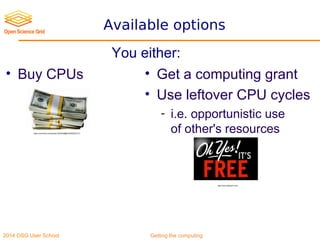
• Buy CPUs • Get a computing grant
• Use leftover CPU cycles
- i.e. opportunistic use
of other's resources
You either:
https://www.flickr.com/photos/15203028@N00/5692453121/
http://www.cattytown.com/
2014 OSG User School Getting the computing
Available options
• Buy CPUs
- Your own hardware
(e.g. a cluster)
- Contribute hardware
to a common pool
- Lease machines on
monthly/yearly basis
- Rent machines on a
per hour basis
• Get a computing grant
• Use leftover CPU cycles
- On friends' hardware
- At your home institution
- On a large-scale
scientific infrastructure
You either:
2014 OSG User School Getting the computing
Available options
• Buy CPUs
- Your own hardware
(e.g. a cluster)
- Contribute hardware
to a common pool
- Lease machines on
monthly/yearly basis
- Rent machines on a
per hour basis
• Get a computing grant
• Use leftover CPU cycles
- On friends' hardware
- At your home institution
- On a large-scale
scientific infrastructure
You either:
2014 OSG User School Getting the computing
Which way to go?
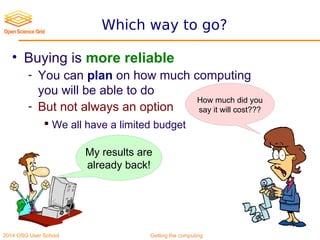
• Buying is more reliable
- You can plan on how much computing
you will be able to do
- But not always an option
 We all have a limited budget
How much did you
say it will cost???
My results are
already back!
2014 OSG User School Getting the computing
Which way to go?
• Buying is more reliable
- You can plan on how much computing
you will be able to do
- But not always an option
(We all have a limited budget)
• Grants are similar in nature
- But may be harder to get than money!
2014 OSG User School Getting the computing
Which way to go?
• Buying is more reliable
• Grants are similar in nature
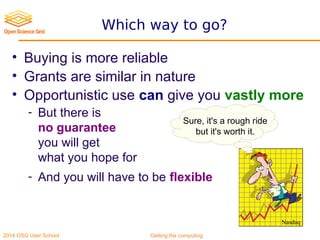
• Opportunistic use can give you vastly more
- But there is
no guarantee
you will get
what you hope for
- And you will have to be flexible
Sure, it's a rough ride
but it's worth it.
Nasdaq
2014 OSG User School Getting the computing
Don't assume flat usage
• Most people have spiky compute needs, e.g.
- You come up with a great idea...
need a gazillion CPUs now to verify it!
Then nothing for a month or more
while you look for the next great one.
- Everybody wants to run a last computing pass
just before that important conference
If you think you are the rare exception,
please bear with me anyhow.
2014 OSG User School Getting the computing
Impact on planning
• You likely cannot afford to buy enough
dedicated resources to cover the peaks
• You should always plan on
using opportunistic resources
- At least for part of the year
- But owning something still a good idea
• Make sure you choose tools that
allow you to do DHTC
2014 OSG User School Getting the computing
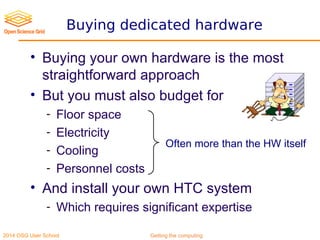
Buying dedicated hardware
• Buying your own hardware is the most
straightforward approach
• But you must also budget for
- Floor space
- Electricity
- Cooling
- Personnel costs
• And install your own HTC system
- Which requires significant expertise
Often more than the HW itself
2014 OSG User School Getting the computing
Server hosting
• You can lease hardware from
commercial entities
- Typically 3-12 months leases
- Popular vendor: Rackspace
• Great for shorter projects
- Likely gives you lower Total Cost of Ownership
 May cost less than buying the HW itself
 And you save on the infrastructure costs
- But still requires you to operate an HTC system
2014 OSG User School Getting the computing
Cloud computing
• Similar to server hosting
- But you pay by the hour
• Most famous is Amazon EC2
(but not the only one)
• Great for spike leveling
- Can get a lot of resources on short notice,
if you have the needed money
- But can be quite expensive
if used over an extended period of time
2014 OSG User School Getting the computing
Cloud computing
• Similar to server hosting
- But you pay by the hour
• Most famous is Amazon EC2
(but not the only one)
• Great for spike leveling
- Can get a lot of resources on short notice,
if you have the needed money
- But can be expensive
You may hear talking
about “Scientific Clouds”.
That's really just another name for
VM-based HTC systems
(so not what I call Cloud here)
2014 OSG User School Getting the computing
Contributing to a common pool
• If you have an existing HTC system
at your institution/campus, it is
likely cheaper to contribute to it
- Economies of scale
- Better expertise
• You will likely not get all of “your”
resources on moment's notice
- But getting them within 24h very realistic
2014 OSG User School Getting the computing
Contributing to a common pool
• If you have an existing HTC system
at your institution/campus, it is
likely cheaper to contribute to it
- Economies of scale
- Better expertise
The HTC system
may also be located
at a different location,
if they allow remote access.
See Condor-G and BOSCO talks later today
2014 OSG User School Getting the computing
Computing Grants
• Some of the US large-scale computing
infrastructures are grant based
- e.g. XSEDE
• You make a proposal, and if you make a
good case, you can get a substantial
CPU allocation on their HTC/HPC system
• Initial effort comparable to buying HW
- A lot of paperwork needed
- And long lead times
2014 OSG User School Getting the computing
Going for opportunistic resources
• All the methods described so far
give you dedicated resources
- i.e. you can count on them being there
when you need them
(at least, after the initial setup period)
- But that may not be enough for your needs
 And you cannot afford more
• Opportunistic resources
may came to the rescue
- Just remember there are no guarantees here
2014 OSG User School Getting the computing
Opportunistic resources
• The opportunistic resources are
essentially machines that are currently
not needed by the owner
- e.g. owners are in the low part of a curve
• Reasons why they may allow you to
use them(instead of turning them off)
- Connections – e.g. Friend's desktop
- Politics – e.g. Funding agency requirement
- Money – e.g. Amazon's spot instances
2014 OSG User School Getting the computing
Free HTC resources
• You should first look close by
- The HTC system at your home institution
may frequently have spare capacity
- They are likely happy to share
• Once that is not enough,
remote HTC clusters
may provide substantial
additional free resources as well
- e.g. Sites on OSG More on OSG
this afternoon
2014 OSG User School Getting the computing
Beggars can't be choosers
• Remember, when you scout for free
resources, you have very few rights
- You are effectively “a beggar”
• You will have to adapt
- Don't expect
to get it your way
 Even though
some sysadmins
may be willing to help
- The more flexible you are, the more free
resources you will be able to use
I hope I didn't
forget any
dependencies!
2014 OSG User School Getting the computing
Consider contributing back
• If you buy hardware, consider
contributing back
- i.e. give unused CPU cycles to others
• A modest amount of gifted CPU
can buy you a lot of good will
- For when you need
to level your own spikes
- Likely not a quid-pro-quo
but don't underestimate
good will
You want me
to do what???
2014 OSG User School Getting the computing
Opportunistic Cloud Resources
• Here opportunistic means cheap(er)
- Not free
• Basically one bids(real money) for resources
- The highest bidder gets the resources
- Until someone else bids higher
 At which point your jobs are killed!
- e.g. Amazon EC2 Spot Instances
• Can get a lot for relatively little money
- But not always
2014 OSG User School Getting the computing
Example
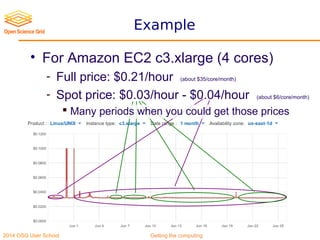
• For Amazon EC2 c3.xlarge (4 cores)
- Full price: $0.21/hour (about $35/core/month)
- Spot price: $0.03/hour - $0.04/hour (about $6/core/month)
 Many periods when you could get those prices
2014 OSG User School Getting the computing
Putting everything together
• You will get most work done if you mix
owned, leased and opportunistic resources
- Spread over many location
- i.e. DHTC
• Plan on using an overlay system early on
- So you don't have to use N different tools
to use N different resource types
- Searching for/Learning about new tools
when you are close to a deadline is no fun
2014 OSG User School Getting the computing
Questions?
• Questions? Comments?
− Feel free to ask me questions later:
Igor Sfiligoi <isfiligoi@ucsd.edu>
• Upcoming sessions
- glideinWMS – the OSG overlay software
- Hands-on exercises
- Tour
27
2014 OSG User School Getting the computing
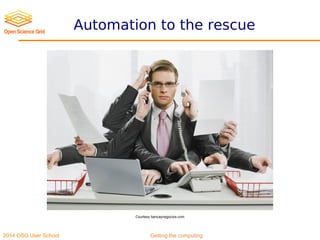
Automation to the rescue
Courtesy bancaynegocios.com
2014 OSG User School Getting the computing
Copyright statement
• Some images contained in this
presentation are the copyrighted
property of ToonClipart.
• As such, these images are being
used under a license from said entities,
and may not be copied or downloaded
without explicit permission from
ToonClipart.

Where to find DHTC resources - OSG School 2014

  • 1.
    Where to getthe needed computing Tuesday morning Igor Sfiligoi <isfiligoi@ucsd.edu> University of California San Diego
  • 2.
    2014 OSG UserSchool Getting the computing Logistical reminder • It is OK to ask questions - During the lecture - During the demos - During the exercises - During the breaks • If I don't know the answer, I will find someone who likely does
  • 3.
    2014 OSG UserSchool Getting the computing Introduction • So, you have a problem that needs many CPUs to get solved in a reasonable amount of time • Where do you get the needed resources? Discovery is just around the corner!
  • 4.
    2014 OSG UserSchool Getting the computing Available options • Buy CPUs • Get a computing grant • Use leftover CPU cycles - i.e. opportunistic use of other's resources You either: https://www.flickr.com/photos/15203028@N00/5692453121/ http://www.cattytown.com/
  • 5.
    2014 OSG UserSchool Getting the computing Available options • Buy CPUs - Your own hardware (e.g. a cluster) - Contribute hardware to a common pool - Lease machines on monthly/yearly basis - Rent machines on a per hour basis • Get a computing grant • Use leftover CPU cycles - On friends' hardware - At your home institution - On a large-scale scientific infrastructure You either:
  • 6.
    2014 OSG UserSchool Getting the computing Available options • Buy CPUs - Your own hardware (e.g. a cluster) - Contribute hardware to a common pool - Lease machines on monthly/yearly basis - Rent machines on a per hour basis • Get a computing grant • Use leftover CPU cycles - On friends' hardware - At your home institution - On a large-scale scientific infrastructure You either:
  • 7.
    2014 OSG UserSchool Getting the computing Which way to go? • Buying is more reliable - You can plan on how much computing you will be able to do - But not always an option  We all have a limited budget How much did you say it will cost??? My results are already back!
  • 8.
    2014 OSG UserSchool Getting the computing Which way to go? • Buying is more reliable - You can plan on how much computing you will be able to do - But not always an option (We all have a limited budget) • Grants are similar in nature - But may be harder to get than money!
  • 9.
    2014 OSG UserSchool Getting the computing Which way to go? • Buying is more reliable • Grants are similar in nature • Opportunistic use can give you vastly more - But there is no guarantee you will get what you hope for - And you will have to be flexible Sure, it's a rough ride but it's worth it. Nasdaq
  • 10.
    2014 OSG UserSchool Getting the computing Don't assume flat usage • Most people have spiky compute needs, e.g. - You come up with a great idea... need a gazillion CPUs now to verify it! Then nothing for a month or more while you look for the next great one. - Everybody wants to run a last computing pass just before that important conference If you think you are the rare exception, please bear with me anyhow.
  • 11.
    2014 OSG UserSchool Getting the computing Impact on planning • You likely cannot afford to buy enough dedicated resources to cover the peaks • You should always plan on using opportunistic resources - At least for part of the year - But owning something still a good idea • Make sure you choose tools that allow you to do DHTC
  • 12.
    2014 OSG UserSchool Getting the computing Buying dedicated hardware • Buying your own hardware is the most straightforward approach • But you must also budget for - Floor space - Electricity - Cooling - Personnel costs • And install your own HTC system - Which requires significant expertise Often more than the HW itself
  • 13.
    2014 OSG UserSchool Getting the computing Server hosting • You can lease hardware from commercial entities - Typically 3-12 months leases - Popular vendor: Rackspace • Great for shorter projects - Likely gives you lower Total Cost of Ownership  May cost less than buying the HW itself  And you save on the infrastructure costs - But still requires you to operate an HTC system
  • 14.
    2014 OSG UserSchool Getting the computing Cloud computing • Similar to server hosting - But you pay by the hour • Most famous is Amazon EC2 (but not the only one) • Great for spike leveling - Can get a lot of resources on short notice, if you have the needed money - But can be quite expensive if used over an extended period of time
  • 15.
    2014 OSG UserSchool Getting the computing Cloud computing • Similar to server hosting - But you pay by the hour • Most famous is Amazon EC2 (but not the only one) • Great for spike leveling - Can get a lot of resources on short notice, if you have the needed money - But can be expensive You may hear talking about “Scientific Clouds”. That's really just another name for VM-based HTC systems (so not what I call Cloud here)
  • 16.
    2014 OSG UserSchool Getting the computing Contributing to a common pool • If you have an existing HTC system at your institution/campus, it is likely cheaper to contribute to it - Economies of scale - Better expertise • You will likely not get all of “your” resources on moment's notice - But getting them within 24h very realistic
  • 17.
    2014 OSG UserSchool Getting the computing Contributing to a common pool • If you have an existing HTC system at your institution/campus, it is likely cheaper to contribute to it - Economies of scale - Better expertise The HTC system may also be located at a different location, if they allow remote access. See Condor-G and BOSCO talks later today
  • 18.
    2014 OSG UserSchool Getting the computing Computing Grants • Some of the US large-scale computing infrastructures are grant based - e.g. XSEDE • You make a proposal, and if you make a good case, you can get a substantial CPU allocation on their HTC/HPC system • Initial effort comparable to buying HW - A lot of paperwork needed - And long lead times
  • 19.
    2014 OSG UserSchool Getting the computing Going for opportunistic resources • All the methods described so far give you dedicated resources - i.e. you can count on them being there when you need them (at least, after the initial setup period) - But that may not be enough for your needs  And you cannot afford more • Opportunistic resources may came to the rescue - Just remember there are no guarantees here
  • 20.
    2014 OSG UserSchool Getting the computing Opportunistic resources • The opportunistic resources are essentially machines that are currently not needed by the owner - e.g. owners are in the low part of a curve • Reasons why they may allow you to use them(instead of turning them off) - Connections – e.g. Friend's desktop - Politics – e.g. Funding agency requirement - Money – e.g. Amazon's spot instances
  • 21.
    2014 OSG UserSchool Getting the computing Free HTC resources • You should first look close by - The HTC system at your home institution may frequently have spare capacity - They are likely happy to share • Once that is not enough, remote HTC clusters may provide substantial additional free resources as well - e.g. Sites on OSG More on OSG this afternoon
  • 22.
    2014 OSG UserSchool Getting the computing Beggars can't be choosers • Remember, when you scout for free resources, you have very few rights - You are effectively “a beggar” • You will have to adapt - Don't expect to get it your way  Even though some sysadmins may be willing to help - The more flexible you are, the more free resources you will be able to use I hope I didn't forget any dependencies!
  • 23.
    2014 OSG UserSchool Getting the computing Consider contributing back • If you buy hardware, consider contributing back - i.e. give unused CPU cycles to others • A modest amount of gifted CPU can buy you a lot of good will - For when you need to level your own spikes - Likely not a quid-pro-quo but don't underestimate good will You want me to do what???
  • 24.
    2014 OSG UserSchool Getting the computing Opportunistic Cloud Resources • Here opportunistic means cheap(er) - Not free • Basically one bids(real money) for resources - The highest bidder gets the resources - Until someone else bids higher  At which point your jobs are killed! - e.g. Amazon EC2 Spot Instances • Can get a lot for relatively little money - But not always
  • 25.
    2014 OSG UserSchool Getting the computing Example • For Amazon EC2 c3.xlarge (4 cores) - Full price: $0.21/hour (about $35/core/month) - Spot price: $0.03/hour - $0.04/hour (about $6/core/month)  Many periods when you could get those prices
  • 26.
    2014 OSG UserSchool Getting the computing Putting everything together • You will get most work done if you mix owned, leased and opportunistic resources - Spread over many location - i.e. DHTC • Plan on using an overlay system early on - So you don't have to use N different tools to use N different resource types - Searching for/Learning about new tools when you are close to a deadline is no fun
  • 27.
    2014 OSG UserSchool Getting the computing Questions? • Questions? Comments? − Feel free to ask me questions later: Igor Sfiligoi <isfiligoi@ucsd.edu> • Upcoming sessions - glideinWMS – the OSG overlay software - Hands-on exercises - Tour 27
  • 28.
    2014 OSG UserSchool Getting the computing Automation to the rescue Courtesy bancaynegocios.com
  • 29.
    2014 OSG UserSchool Getting the computing Copyright statement • Some images contained in this presentation are the copyrighted property of ToonClipart. • As such, these images are being used under a license from said entities, and may not be copied or downloaded without explicit permission from ToonClipart.