CHARITIES
2037
A Report from Amárach Research
December 2017
There is overwhelming desire for change in the charity sector among staff, volunteers, funders,
the general public and beneficiaries. Before embarking on a journey of change, it is critical to
know where you are starting from.
With the generous support and funding from The Ireland Funds, Charities Institute Ireland
together with Amárach Research designed Charities 2037, a program of research with the aim
of providing stakeholders with an opportunity to consider how the charity sector should evolve
over the next two decades.
Amárach Research interviewed 25 key personnel in the area of charity leadership. They included
experts on corporate and charity governance; the patrons of some of the largest charities in
the country; chairs of charitable organisations; charity CEOs and senior executives; academics;
leaders from the private sector; philanthropic organisations; public servants; media commentators,
government policy advisors and public representatives. They provided insight, vision and passion.
We are grateful to them for the time, commitment and investment in this project.
We are also grateful to all those who participated in the quantitative surveys – the public, the staff
and volunteers. Their insights were invaluable to the research programme.
And finally, thanks to the authors of this report Michael McLoughlin and Claire O’Rourke from
Amárach Research.
Lucy Masterson
Chief Executive
Charities Institute Ireland
C H A R I T I E S
I N S T I T U T E
I R E L A N D
3
Contents
Background		 5
The purpose of Charities 2037	6
Context			 6
Charitable organisations	6
Charities: income and contribution to the economy	7
Individual’s engagement with charities as volunteers	7
Ireland in 2037	9
Methodology for this Research	10
Research Strategy	10
Methodology: Qualitative	11
Methodology: Quantitative	11
Methodology: Final Steps	12
Results					 13
Impact and appreciation	13
Public engagement and impact of volunteering	14
Demonstrating the impact: A need for data	16
Professionalism, regulation and funding	17
Regulation		 20
Funding			 21
Finding the right people	22
Public perceptions and understanding	23
Greater transparency	25
Media role in public understanding	26
Overarching theme of and desire for change	28
Into the future	30
References		 34
Table of Tables
Table 1: Stakeholders involved in the project	10
Table 2: Looking ahead to 2037 how much influence, if any, do you think
that each of the following will have on the daily lives of Irish people?	13
Table of Figures
Figure 1: Breakdown of respondents to survey of the general public	 11
Figure 2: Public agreement with charities employing best professionals (2015-2017) 	 17
Figure 3: Public perceptions of wages (2015-2017)	 18
Figure 4: Public agreement that charitable work should be done by volunteers 	 18
Figure 5: Change in attitude to charities	 23
Figure 6: Staff, volunteer and public awareness of the Charities Regulatory Authority 	 24
Figure 7: Public trust in charities (2014-2017)	 25
4
Day by Day
nothing changes
but when I look
back everything
is different.
CS Lewis
5
Background
The charity sector has played and continues to play a key role in Irish society. There are close on
9,000 registered charities in Ireland – ranging from small community groups to organisations with
an international foot print and impact. They impact on all aspects of our lives and it is possible
to argue that people in most families are beneficiaries – often unbeknownst to themselves.
Children benefit from the efforts of sporting and cultural organisations, families benefit from the
provision of education and social support, and older people benefit from a myriad of support
and advocacy structures. All age groups benefit from specialist support in health and social
services, from social housing to specific health related organisations. At home and abroad
Irish charities represent some of the best aspects of Irish life and society – a desire for altruism,
community support and cohesion. They also come from the fact that the State historically has left
gaps in social provision and required or enabled others to step up to close the gap. The causes
and consequences of that gap have been debated widely in other reports, academic papers
and media. Other than to acknowledge its fundamental impact on Irish society, the origins of the
charity sector does not form a core purpose of this report.
Irish society has given to the charity sector for decades and the charity sector has given back to
Irish society for just as long. But the last decade has seen much change in our country. We have
suffered catastrophic economic collapse and moved to recovery – albeit with huge pain. As a
consequence of these and other change drivers – technology, social and demographic change
and education - it is timely to undertake a base line review of what different stakeholders want
from the charity sector.
Before embarking on a journey of change, it is critical to know where you are starting from.
A key driver for change must be a national conversation about the role and future of the charity
sector. All organisations tend to self- perpetuate, but that is fundamentally different to a purpose.
The latest revolution in technology and economics has seen the destruction of many household
serving organisations. Retailing is different; banking is different and media is different. The sense
of local engagement has also changed. In the 1960s the formation of many charities had their
roots in post Vatican 2 social teaching. In a more diverse society, with different social mores, the
same drivers may no longer apply.
While the charitable and voluntary sector has always formed a key part of Irish society, much of
it went unregulated and was often unaccountable. What society wants from the sector and what
charities can give (and require to be effective in return) needs to be considered and reviewed.
Society, government and the charities themselves need to consider what expectations they have
of each other. Government is increasing regulation, reducing income and raising expectations as
to what the charitable sector should contribute. Some charities appear increasingly burdened by
regulation and compliance requirements; unpredictable incomes and a sense of responsibility
without power. Society wants an ever-increasing standard of care and contribution. It requires
increased accountability and professionalism. It sometimes appears as if it wants people to work
for free yet it wants high quality services.
6
The purpose of Charities 2037
Charities Institute Ireland (Charities Institute Ireland) and Amárach Research designed Charities
2037 as a programme of research that aims to provide stakeholders with the opportunity to
consider how the charity/not for profit sector should develop over the next two decades. The aim
was to both engage and challenge stakeholders to describe how they see the role of charitable
organisations developing in contemporary Ireland. It is also designed to provoke debate on
some key issues:
	 •	What should be expected from the charity sector (and conversely what is unrealistic);
	 •	 The role and the need for renewal of volunteers;
	 •	 The impact of regulation;
	 •	The need for professionalism in the charity sector and its implications for
organisational structures (Have we too many charities? Is it a recognised career path?
What is the role of the volunteer into the future? How do we deal with specialists and
specialties?);
	 •	 The role of the state in supporting the charity sector; and
	 •	The requirements for change. Just because an organisation has existed for 50 years
does not mean that it should exist for another 50. Many organisations have a life cycle,
should we begin to think of charities within a similar model?
Context
Charitable organisations
Charities, under the Charities’ Act (2009) are organisations which must be established with a
charitable purpose. Under the Act, “a charitable purpose is a purpose that is of public benefit and
involves: the prevention or relief of poverty or economic hardship; the advancement of education;
the advancement of religion; any other purpose that is of benefit to the community”
(Citizen’s Information Board, 2014).
As part of the Charities Act (2009), numerous governance requirements came into effect for
charities. These include the need for registration for organisations to describe themselves as a
charity, transparent recordings and annual statements of accounts (where income or expenditure
exceeds €10,000), a requirement for annual reports, and adherence to the rules about
fundraising. The Office of the Charities Regulator was also established under the Act and came
into being in 2014. The key functions of the Regulator are to establish and maintain a public
register of charitable organisations operating in Ireland and ensure their compliance with the
Charities Acts.
UK research has found that charities are some of the most trusted bodies, after the armed forces and
the NHS (nfpSynergy, 2017). Following recent scandals in Ireland, we would expect the levels of trust
to be lower, and even to have fallen – and this challenge of recreating public trust is a key outcome of
our research.
7
Charities: income and contribution to the economy
In an excellent and detailed analysis, Benefacts (2017) approximate that one in ten organisations
operating in Ireland are within the ‘third sector’. These comprise a range of charities and not-
for-profits, including educational institutions, and Benefacts estimate that the sector generates
over €10billion annually. Beyond the traditional perspective of the contribution of volunteers,
nonprofits organisations also provide employment to a substantial proportion of the population.
Similarly, research conducted for Comhlámh demonstrated the many socio-economic benefits
accrued for Ireland on the basis of overseas volunteering (McLoughlin, 2013).
As an example, research undertaken for the Community Foundation for Ireland in 2015 included
261 responding organisations. “These organisations cumulatively employed 8,281 employees
(both full and part-time) in paid roles. There were also approximately 67,500 volunteers working
with the organisations surveyed, which means that in total, almost 76,000 people were working
or volunteering in the organisations surveyed” (Coughlin et al., 2015, p7).
Exploring the source of income for charities, research found that state grants/contracts provide
over half of charitable funding, while individual contributions or ‘giving’ provides an additional
25% (The Wheel, 2014). Coughlan et al (2015) found a similar proportion of income coming from
government, followed by just under 16% coming from donations. This implies the reliance of the
charitable sector on government funding.
Individual’s engagement with charities as volunteers
While much of the discussion on charities tends to focus on their service provision and
organisation structure, volunteering opportunities also provides a key activity at various
stages of life for people. According to the CSO, over one quarter of Irish adults were
actively volunteering in Ireland in 2013 (CSO 2015). This was valued as amounting to work
with a value of €2 billion annually. Volunteers enjoy a host of associated benefits, including
subjective reports of happiness and wellbeing. CSO (2015) found that volunteers were
more likely to report high levels of life satisfaction; while volunteers in general were more
likely to indicate high or very high subjective wellbeing (e.g. happiness yesterday, life
being worthwhile and self-reported physical health). In fact, research consistently suggests
volunteering as a protective strategy for mental wellbeing, as well as enhancing the lives of
volunteers in numerous other ways e.g. skill acquisition, involvement in the community and
addition of friendships (Volunteer Ireland, 2017).
8
The best way
to predict
your future
is to create it. 
Abraham Lincoln
9
Ireland in 2037
Thinking about the role of charities into the future it is important to situate their role within the
projections for industry, innovation and the population. Many strategy and vision documents
have been prepared envisaging this future, yet it is the role of charities in service delivery for the
population and the scope for volunteers and staffing within the demographic breakdown that is
easiest to situate the findings for this project.
Looking forward to 2037, CSO has produced population projections nationally and for each of
the planning regions to 2031. In overall terms, the increase in population experienced since 1961
will continue apace – with anticipated growth of 613,000 (13%). The nature and structure of that
population will change.
	 •	Conservatively the population of Dublin could reach 2.6 million by 2050!
		–	The numbers of people aged 25 to 64 is projected to increase by 3.4 per cent for the
State but at a regional level it will fluctuate. The Mid-East, Dublin and Midland regions
are projected to increase by 13.4, 11.7 and 0.3 per cent respectively. All other regions
will experience decreases in the population in this age group.
		–	The number of old persons (65 years and over) will almost double in every region over
the life-time of the projections, with the most marked increases likely to occur in the
Mid-East (+136.5%) and Midland (+95.1%) regions.
Similarly, ESRI population projections to 2030 project an increase of approximately 14% as a
central scenario, with the high population projection with an increase of 23% considered equally
likely due to the potential ramifications of Brexit on European population shifts (Wren et al.,
2017). This implies that not only will there be more people who might engage with charities as
donors or volunteers but also that there will be a greater need for charities by beneficiaries.
10
Methodology for this Research
Research Strategy
Research often explores public perceptions of charities and the impact of engagement with
charities for volunteers. However, in order to provide a robust and rounded picture of the current
charity landscape as well as projections for the sector into the future this research endeavoured
to encapsulate the opinions of a variety of key stakeholder groupings in order to triangulate
their perspectives and examine where commonalities and disparities arose. The breadth of key
stakeholder engagement in the research process provide authenticity and resilience from a policy
perspective. The research team, in collaboration with Charities Institute Ireland, identified a breadth
of key stakeholder groupings with whom to engage for this research process. Outlined below are
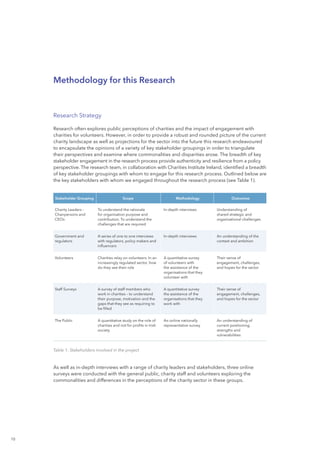
the key stakeholders with whom we engaged throughout the research process (see Table 1).
As well as in-depth interviews with a range of charity leaders and stakeholders, three online
surveys were conducted with the general public, charity staff and volunteers exploring the
commonalities and differences in the perceptions of the charity sector in these groups.
Stakeholder Grouping Scope Methodology Outcomes
Charity Leaders –
Chairpersons and
CEOs
To understand the rationale
for organisation purpose and
contribution. To understand the
challenges that are required
In-depth interviews Understanding of
shared strategic and
organisational challenges
Government and
regulators
A series of one to one interviews
with regulators, policy makers and
influencers
In-depth interviews An understanding of the
context and ambition
Volunteers Charities relay on volunteers. In an
increasingly regulated sector, how
do they see their role
A quantitative survey
of volunteers with
the assistance of the
organisations that they
volunteer with
Their sense of
engagement, challenges,
and hopes for the sector
Staff Surveys A survey of staff members who
work in charities – to understand
their purpose, motivation and the
gaps that they see as requiring to
be filled
A quantitative survey
the assistance of the
organisations that they
work with
Their sense of
engagement, challenges,
and hopes for the sector
The Public A quantitative study on the role of
charities and not for profits in Irish
society
An online nationally
representative survey
An understanding of
current positioning,
strengths and
vulnerabilities
Table 1: Stakeholders involved in the project
11
Methodology: Qualitative
Twenty-five semi-structured interviews were carried out with charity leaders and influencers to
explore the current role of charities, individual organisational structures, the role of volunteers
and staff, effectiveness and relative contributions, challenges encountered by both individual
charities and the sector and thoughts about future directions. The list of stakeholders invited
to contribute to the interviews was agreed between Charities Institute Ireland and Amárach
Research and everyone available to contribute within the timeframe was interviewed by the CEO
of Amárach. These interviews were based on a framework of questions agreed with Charities
Institute Ireland with variation depending on the role of the individual and the flow of the
interviews. The interviews were conducted on a confidential basis – as is the standard practice
with this type of qualitative research programme.
Methodology: Quantitative
To look at the perspectives of the general public, as well as staff and volunteers within charitable
organisations three online surveys were carried out in the course of this research programme.
The survey of the general public was conducted with a nationally representative sample of
1,000 adults aged 16 years of age and older; the sample was nationally representative in terms
of gender, age, region and social class (see Figure 1). Two additional bespoke surveys were
conducted with staff and volunteers. Across the surveys there was a number of core questions
to enable group comparisons as well as individual modules of questions to specifically probe
perceptions, experiences and expectations of relevance to each stakeholder grouping.
Figure 1: Breakdown of respondents to survey of the general public
Gender
Social Class
Age Region
C2DE F50-	 53%ABC1 F50+	 47%
Munster
27%
Conn/Ulster
18%
Rest
of Leinster
26%
Dublin
29%
51%49%
%
18
20
17
31
1416-24
25-34
35-44
45-54
55+
12
The survey of the general public sought to explore the general public’s perceptions of charities,
their role in society, the contributions of volunteers and staff as well as their expectations of
the sector into the future. Specifically, questions were asked regarding: public perceptions of
charities, including funding, governance, efficacy and trust; expectations, including transparency
and distribution of funds; engagement with the sector; and willingness to volunteer and/or
donate. As part of the survey of the general public a number of demographic questions were
asked including previous and current volunteering.
The volunteer survey was completed by 101 current volunteers recruited through the Charities
Institute Ireland network. The volunteers were engaged in a variety of type of charities from
Human Rights, to Education to Religious charities amongst others. Volunteers ranged across age
groups from 16 years of age to 55+, with volunteering experience from less than one year to
over 20 years. Just over one third were male (37%); and in addition to their volunteering over half
(54%) were working full-time while an additional 20% were working part-time. Within the survey
of the general public, less of a gender gap was noted in volunteer status, with males making up
two in five (43%) current volunteers, and nearly half (46%) of those who had ever volunteered.
The staff survey was completed by 364 staff within the charity sector, invited through the
Charities Institute Ireland network. These included staff across a range of ages, regions in
Ireland and at varying levels within organisations from managerial (49%) to service delivery (8%),
administration (9%) and fundraising (25%) as well as others (10%). Respondents were working
across the breadth of types of charitable institutions established for a host of reasons and to help
a range of beneficiaries reflecting the diversity found within the third sector. The vast majority of
staff survey respondents were working full time (88%) and over two thirds were female (69%). The
clear majority of these staff (94%) had worked outside the charity sector previously.
Methodology: Final Steps
Prior to the completion of the report, the initial findings from both the qualitative and quantitative
research were presented at the Charities Institute Ireland conference in October 2017. This
was followed by an expert group round table discussion of the findings and implications of the
research as well as their vision for the future. Some of the issues discussed in this session have
been incorporated into this final report.
13
Results
Impact and appreciation
The overwhelming message across all aspects of the research is that stakeholders feel that the sector
plays a critical role in Irish society. Charity leaders, media, staff, volunteers and the general public
recognise the role that charities play in society as well as the integral services that it has evolved
into delivering. However, despite this recognition, only just over half of the general public think
that charities will continue to have the same or more influence in 20 years, a figure which appears
particularly stark when compared to the perspectives of the future influence of FDI (see Table 2).
Charity leaders believe that charity plays a core part and purpose in Irish Society…
This stems from a variety of factors, including the historical role of the Church as a large and
powerful provider at the heart of the delivery of social services. The relationship between the
Church and State suited both – the Church could exercise power while the State did not have to
provide the services. As the power of the Church has declined the role of the State as a funder
of service provision through the charity sector has grown, but much of the channel of delivery
remains the charity sector.
However, there are two sides to this coin. Seventy percent of the general public feel that the State
is relying too heavily on the charity sector to provide services; while a majority think that there are
too many charities with similar functions (64%) and consequently those with a similar intention
and scope should consider merging (68%). Indeed, even more staff members of charitable
organisations think that there are too many charities with similar functions (78%) and believe that
charities with similar functions should consider merging (79%). However, staff and volunteers do
agree with the general public that charities have an important role to play in Ireland (96% and
90% respectively) and that service provision compliments public services provided by the State
(86% and 80% respectively).
% same or more influence Staff Volunteers Public
Technology 99% 100% 96%
Immigrants 94% 90% 80%
Foreign Companies 93% 93% 86%
Irish Government 85% 85% 75%
Charities 66% 76% 56%
RTÉ 25% 23% 45%
The Catholic Church 6% 7% 23%
Table 2: Looking ahead to 2037 how much influence, if any, do you think that each of the following will have
on the daily lives of Irish people?
14
However, when looking at charities should we be considering number or impact?
Through the stakeholder interviews it became apparent that while charities talk about collaboration,
it only really happens to a limited extent; there are multiples organisations operating in similar
spaces. All bring some difference to their approach – but there is often more overlap than
differentiation. “Within a square mile of here there are seven homeless charities.” There is
undoubtedly competition for funding and resources - and they do compete.
At the same time, there are mixed views regarding the number of charities. Some believe that
there are too few, more believe that there are too many. The key issue is about effectiveness and
delivery. This comes back to measurement of outcomes and impacts. Is the way that charities
in the sector are organised the most effective way to deliver the highest possible service and
impact? When considered further, it appears that despite the conversation related to the number
of charities that in fact the debate should be around the number which are no longer impactful or
fulfilling their purpose. Mergers of charities is an interesting and important conversation to have,
yet people should be mindful of the role for new innovators and ‘disrupters’ in the field as in the
private sector. In fact, the role for charities traditionally was to innovate and create new solutions
which government could then scale up - and this role cannot be forgotten. Another approach is
that of Dóchas, which was cited as an example, where a sector recognised itself as a sector, with a
range of different organisations participating.
Public engagement and impact of volunteering
Consistent with the prevalence of charities in the Irish landscape and their importance for Irish
society, nearly one in five (18%) of the general public are currently engaged as volunteers while
over half (57%) had engaged in volunteering at some point in their lives. The latter figure provides
a key group to engage with as the evolution of charities continues. On average, volunteers spend
16 hours volunteering per month, with nearly one in five (19%) estimating that they volunteer over
21 hours – reflecting the contribution of volunteers to the efficacy of charities and the reliance that
charities have on volunteers for service provision. Positively, of those not currently engaged in
volunteering, two thirds (65%) would be willing to volunteer; and on average they would be willing
to spend 13 hours per month volunteering.
Volunteers are most often galvanised by altruistic impulses and social conscientiousness…
Of the 101 volunteers who completed our survey, over one third (37%) began volunteering
prior to 25 years of age, with an additional 26% beginning to volunteer between 25-34years. It is
therefore important for charities to begin to engage volunteers at school and university, while still
demonstrating the importance of looking to organisations to engage with charities as part of a
corporate social responsibility. Looking at the age of the volunteers who engaged with the survey,
more could be done to engage people in volunteering in later years particularly in the run up-to
and during retirement – but we could caution that we are dealing with a relatively small sample.
People begin to volunteer for a host of reasons. Exploring these in greater detail it was apparent
that the motivation is often multi-faceted and driven by a desire to contribute and to connect to
civil society. Volunteers most frequently indicated that they began volunteering because they
wanted to give back (52%), because they care about the cause supported (49%) or because they
have amassed experience or expertise required by a charity (32%).
15
“I feel this is important to do, and that we have a responsibility to address inequality, climate change,
and poverty. I will choose to use my time to support organisations tackling root causes through
systemic change, but will also respond to requests from individual organisations” (volunteer)
“I understand the valuable role they lay in the fabric of society and feel it is incumbent on me to
help in any way I can deepen their contribution (if I can).” (volunteer)
The enduring role of the community and locality in Irish life continues to propel citizens into
voluntary roles; with the next most frequent reasons included that they were asked by a friend or
colleague (27%), a family connection to the charity (26%) or that the organisation was local (22%).
“It’s a very important part of my life and I think should be part of everyone’s lives…Everyone has
something to give back. Volunteering helps me to know who I am. It helps me stay grounded and
connected within my communities.” (volunteer)
Overall, most volunteers find volunteering satisfying (96%) and feel valued by their organisation
(92%). These volunteers also believe that by volunteering they make a difference to the
organisation (84%) which in turn contributes to the communities and/or beneficiaries (99%). This
contributes to the positive view that these volunteers (94%) are likely to continue volunteering in
charitable organisations into the future.
Volunteers see an opportunity for positive stories regarding the good work and impact that
charities have in society; as well as the contribution to both the sector and the economy which
volunteers provide:
“Promote the good work they do. Account for the number of volunteer hours and the value of
same to the organisation (if the work was carried out by paid staff). This should form part of their
annual report.” (volunteer)
…and there is scope to engage more of the public in charitable activities.
In fact, there are obvious dissemination implications of the biggest reasons picked by the general
public as a barrier to volunteering. After the unchangeable factor of ‘not enough time’, one in ten
(12%) said that they were unsure where to volunteer while an additional one in ten (12%) said that
there was a lack of volunteering opportunities I’m interested in. Particularly in the context where
skilled, professional boards are the aim for many charities there should be roles for many people
to volunteer in non-traditional or atypical ways that may not be apparent to those outside the
sector. In fact, engaging volunteers to use the professional knowledge gained outside the sector
would be valuable for the thousands of charities currently on the register.
It is clear that Irish people understand and recognise the contribution of the third sector to Irish
society and the relevance of volunteers to the efficacy of the sector. However, charities require
more engagement from the public in more ways than just time – trust, buy-in and donations are
also core to the survival of many charitable organisations:
“Public buy in - the next generation seem to be social activists and aware of issues, but not quick
to financially support the issues. They are more keyboard warriors than anything. No one I know,
my age, has a DD set up to a charity. But they will be the first to share something on Facebook or
Twitter because they are interested in that and want to be SEEN to care.” (staff member)
16
Demonstrating the impact: A need for data
One of the key challenges is to provide a consistent understanding to all the stakeholders of the
real impact that charities have to all their stakeholders including:
	 •	 To funders.
	 •	 To the public.
	 •	 To staff and volunteers.
	 •	 To beneficiaries.
This understanding can only come from a demonstration of impact; charities need to monitor
and quantify impact in some way such as numbers of people accessing services etc. There needs
to be a recognition of the importance of research and data - like in the private and public sectors
resources should be allocated to the use of metrics and data as well as communication. The loss
of Atlantic Philanthropy funding that provided funding for overheads and research has left a
funding void for these purposes.
This would enable there to be dissemination of positive messages such as impact and engagement.
The gathering of data would enable charities to have more conviction regarding their impact,
and provide confidence on the side of charities so that the message is not one of apology.
Having evidence gathered would enable the sector to provide proactive messaging about the
sector to increase public trust and sentiment beyond individual charities that are supported and
trusted locally/by their donors. Proactive positive messages of impact could be coordinated
through a body such as Charities Institute Ireland. However, beyond impact on beneficiaries, the
publics’ engagement with charities and stakeholder satisfaction are also important.
At its core, demonstrating impact is something which most stakeholders want to do but it is
constrained by funding, internal capabilities and finding the right KPIs:
“The lack of a professional approach to training, data collection and benchmarking in Ireland
is a challenge. We are lacking very basic tools that would increase our effectiveness. Also there
is a need to have an advocacy and negotiating body to represent the sector’s interests with the
government and suppliers, which should take priority over media focus.” (staff member)
Recommendation
	 •	You simply have to measure (at an economically appropriate cost) the impact of
work done. This has to happen at project, organisation and sectoral level.
	 •	Robust data can lead to robust argument, defence and debate. Within
organisations there has to be measurement and also at a sectoral level.
17
Professionalism, regulation and funding
Public desires for charities are inherently contradictory; professionalism and top-quality service
are the desire but run by volunteers and without overheads…
Charities provide key social services and contribute to Irish life in a multitude of ways, it is
therefore unsurprising that people agree that charities should be good at what they do and
that it is important that charities are run well. However, the model for charitable service delivery
assumes that the bulk of financial outputs is focussed directly on the provision of goods for the
poor. This traditional model causes the outcry over salaries, expenses and costs.
There is a disconnect in the expectations for charities and the level of funding which people
would like to see allocated to the professionalisation of the sector. In the abstract, few people
disagree with the statement that ‘charities should get the best professionals possible to work with
them’ (Figure 2), yet less than half (41%) agree that charities should pay competitive wages for
these professionals. The charity sector (and charity advocates) have a role to play in redefining
the nature of charities; specialist service provision and advocacy services provided by charities
are far more complex than many people perceive. In that context, traditional models of expense
analysis are perceived to be too shallow. Still, Ireland has yet to come to terms with charities as
organisations that are more than volunteer led.
“Charities should get the best
professionals to work for them…”
40%
35%
30%
25%
20%
15%
10%
5%
0%
Strongly agree Slightly agree Neither/nor Slightly disagree Strongly disagree
201720162015
Figure 2: Public agreement with charities employing best professionals (2015-2017)
18
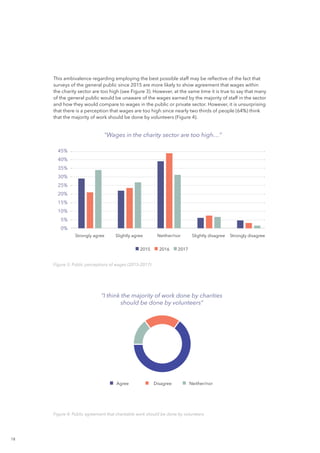
This ambivalence regarding employing the best possible staff may be reflective of the fact that
surveys of the general public since 2015 are more likely to show agreement that wages within
the charity sector are too high (see Figure 3). However, at the same time it is true to say that many
of the general public would be unaware of the wages earned by the majority of staff in the sector
and how they would compare to wages in the public or private sector. However, it is unsurprising
that there is a perception that wages are too high since nearly two thirds of people (64%) think
that the majority of work should be done by volunteers (Figure 4).
“I think the majority of work done by charities
should be done by volunteers”
Neither/norDisagreeAgree
65+15+20+H
Figure 3: Public perceptions of wages (2015-2017)
Figure 4: Public agreement that charitable work should be done by volunteers
201720162015
“Wages in the charity sector are too high…”
45%
40%
35%
30%
25%
20%
15%
10%
5%
0%
Strongly agree Slightly agree Neither/nor Slightly disagree Strongly disagree
19
Despite the desire for well run and professional services provided by the charity sector, there
is a sense that the altruistic motivations of staff should be ahead of any remuneration. This
consistently has been the public perception for a number of years. In line with the perspective
that wages are too high, two thirds of the general public do not think that senior management
in the charity sector should be paid comparable salaries to those in similar sized companies
in the private sector, with half (49%) explicitly agreeing that senior management in the charity
sector should be paid less. There is often outcry regarding the earnings of CEOs of charitable
organisations within the media; interviews with charity leaders remarked on the difficulties for
internal staff to defend their own salaries. Instead there is a role for the organisation’s board who
signed it off or for representative bodies to present this message.
…yet those within the sector see the importance of the role of salaried staff...
Staff and volunteers tended to disagree with the statement that the majority of the work within
charities should be done by volunteers (84% and 53% respectively). This demonstrates the realities of
working and volunteering within the sector; it is easy for the public to expect others to provide top-
quality services without remuneration yet pragmatically it would be impossible for most charitable
organisations to continue to provide the same level of services carried out by volunteers.
…while the reality is that current remuneration models and public sentiment is unsustainable for many.
However, some of the reasons cited why staff feel they are unlikely to remain in employment
within charities reflect the core issues and challenges currently being encountered by the
sector. One of the core deterrents for working within the sector was fallout from recent scandals
including negative public perceptions of those working within charities.
“the public perception of those that work in the charity sector is very demeaning and it is assumed
it should be done for free. It is no longer a job that you announce with pride, to be honest more
shame, even though I know where I work and what I do matters. Tired of defending my job to
strangers and family.” (staff member)
A lack of sufficient pay and/or prospects, raising public expectations regardless of reduced
funding as well as resulting burnout was also mentioned by staff within organisations.
“Salary, insecurity of contracts and inequitable access to entry roles. Money is not the sole driving
motivation for many people in this sector - they are attracted to it because they are passionate about
a cause, feel that charities have an important role to play in society and want to give back. But people
need a reasonable standard of living and security. Some charities are simply out of touch with what
the wider employment market is offering for similar roles in the private and public sector. People are
having to make a choice about passion/vocation and security simply because they have no other
choice - especially considering the cost of living, especially rent, in some of the bigger cities. Entry
routes are also a factor, as a matter of principle. Many entry jobs in this sector come about through
unpaid or low-wage roles. This sector, like some others, is at risk of becoming a sector where only
those that can ‘afford’ to work for free can gain full-time employment.” (staff member)
“I’m [XX] years of age, I’m at essentially CEO level in an organisation, I’m paid under 50,000, have
huge responsibility and a work load that takes over my life. Professionally, said workload also
means I fire fight 90% of the time, which drastically reduces any job satisfaction. I also cannot pay
my staff the salary they deserve, despite members of my team working hours far in excess of what
they’re contracted to and having skills that would be more adequately compensated in the private
sector. I have, like many others I speak to, stopped loving my work and you should love your
work, to work in the charity sector because you don’t do it for the pay. I could get double what I’m
paid, in the private sector and have less responsibility. I have a mortgage like everyone else and
feel that the complete under recognition by government departments and the public at large for
a skilled workforce in the charity sector does not encourage me to stay. It’s a life long financial
20
sacrifice to stay and that’s a big ask these days, with mortgages in Dublin. It seems to be a largely
unpalatable idea, that people who work in the charity sector, are skilled professionals who require
a wage that reflects this. I feel this is something we need to work on. Why are we ok with paying
the CEO of a large telecoms company a six figure salary and not ok with a paying a CEO of a
charity…70k...” (staff member)
Regulation
Regulation is welcome to charity leaders…
Regulation is welcome – it is perceived to offer protection and best practice for the sector. It
should build trust among the sector and give comfort to board members. However, it is also
recognised that governance and governance changes will be a key catalyst in the sector and that
we are only in the foot hills on the journey of change. There is a desire for an enabling regulatory
framework rather than simply a knee jerk reaction. There is also a recognition that many charities
will not be able to deal with the new regulatory regime since all governance shifts requires
resources to migrate.
At the same time regulation is seen to have three distinct advantages:
	 •	 Build public trust
	 •	 Raise operating standards.
	 •	 Create a climate of protection for Board members.
However, volunteers already see key challenges associated with increasing governance
standards and regulation. New regulations such as GDPR are a concern for many as are
increasing governance requirements. Expectations on charitable organisations are very high in
an age that requires an ever-increasing level of professionalism, transparency and governance
standards while competition for resources and funding remains high:
“Lack of funding and huge weight of governance and paperwork.” (volunteer)
“Managing the bureaucracy. Keeping up with constant changes in requirements like health
and safety, insurance, applications, reams of paperwork.” (volunteer)
21
Funding
The Role of the State as a funder is looked on with some scepticism….
The State does fund much of the charitable sector – and in some cases, it funds 100% of activity.
There is a debate whether an organisation that is completely dependent on the State for its
survival can be classified as independent or an NGO. From some perspectives, an organisation
that is completely dependent on the State for funding requires an even more independent
Board. Instead there are charities that nominally have boards, but because of the funding model
they are not in control of their own destiny.
“They don’t just complement the work of the State, they do the work of the State and the
acknowledgement of the State can be scant…. I have been looked on with disdain as if I were a
lobbyist and an activist and Government needs to acknowledge more” (Charity Chairman)
Some interviewees questioned whether the State is seeking both to have its cake and eat it. It is
increasing regulation and in the cases of some organisations is requiring multiple reports to duplicate
government agencies. Stakeholders felt that the State as a funder seeks to micro manage the delivery
of organisations, and yet is not perceived as a driver of change as a funder could and should be.
Charity leaders mentioned that there are charities that no longer apply for State funding because
they believe that the level of reporting required is not proportionate to the funds. The State can also
have unrealistic expectations as to the use of funds – one State funded organisation outlined how
its funder would only allow 5% of the income raised to go on overheads.
Staff and volunteers see funding, regulations and public trust as core challenges for their charities…
Like other organisations at the end of the day money matters: funding/fundraising and budget
are key concerns for staff, particularly in a context for greater demand for services and a
perception that too many charities are competing for same pot. Lack of public trust is another
challenge – which has implications for both fundraising and volunteers. Funding, competition
and public perceptions also have an implication for retaining, training and the professionalism
of staff which was also seen as a challenge.
“Decreased funding but with higher targets to achieve; more reporting to an extreme degree
that impacts on time available for service delivery; quantitative targets that do not support a
holistic approach to the individual or a community development approach. Severe staff stress
due to greatly increased workloads. Lack of ability to plan year-to-year due to lack of multi-annual
funding - we have to tender for the work every year, which takes up a lot of staff time - time that
could be spent on working with clients.” (staff member)
“I feel appreciated by the charity, but not so much by the public. But I feel my ability to really make
a difference is limited. The charities I volunteer for need specialist and highly skilled people to do
the actual work.” (volunteer)
22
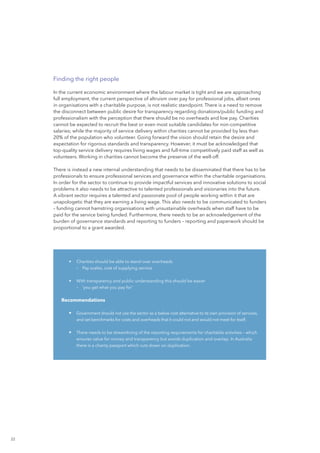
Finding the right people
In the current economic environment where the labour market is tight and we are approaching
full employment, the current perspective of altruism over pay for professional jobs, albeit ones
in organisations with a charitable purpose, is not realistic standpoint. There is a need to remove
the disconnect between public desire for transparency regarding donations/public funding and
professionalism with the perception that there should be no overheads and low pay. Charities
cannot be expected to recruit the best or even most suitable candidates for non-competitive
salaries; while the majority of service delivery within charities cannot be provided by less than
20% of the population who volunteer. Going forward the vision should retain the desire and
expectation for rigorous standards and transparency. However, it must be acknowledged that
top-quality service delivery requires living wages and full-time competitively paid staff as well as
volunteers. Working in charities cannot become the preserve of the well-off.
There is instead a new internal understanding that needs to be disseminated that there has to be
professionals to ensure professional services and governance within the charitable organisations.
In order for the sector to continue to provide impactful services and innovative solutions to social
problems it also needs to be attractive to talented professionals and visionaries into the future.
A vibrant sector requires a talented and passionate pool of people working within it that are
unapologetic that they are earning a living wage. This also needs to be communicated to funders
– funding cannot hamstring organisations with unsustainable overheads when staff have to be
paid for the service being funded. Furthermore, there needs to be an acknowledgement of the
burden of governance standards and reporting to funders – reporting and paperwork should be
proportional to a grant awarded.
•	 Charities should be able to stand over overheads
		 –	 Pay scales, cost of supplying service
•	 With transparency and public understanding this should be easier
	 –	 ‘you get what you pay for’
Recommendations
	•	Government should not use the sector as a below cost alternative to its own provision of services,
and set benchmarks for costs and overheads that it could not and would not meet for itself.
	 •	There needs to be streamlining of the reporting requirements for charitable activities – which
ensures value for money and transparency but avoids duplication and overlap. In Australia
there is a charity passport which cuts down on duplication.
23
Public perceptions and understanding
Looking generally at the sector, people agree that charities are important to society. However,
public perceptions of charities are currently more negative than 12 months ago, with less than
one in ten (7%) saying that their perceptions have become more favourable. Looking at both staff
and volunteers within the sector, who would be expected to have greater engagement and buy-
in, one third of staff and volunteers (33% and 36% respectively) said that their attitudes towards
charities were less favourable than 12 months ago (see Figure 5).
To some extent charitable organisations have been tainted by scandals, yet there are still positive
perceptions at another level. There is a need for public understanding of the diversity that
exists within the sector. Charitable organisations are diverse in terms of their missions, values,
personalities, objectives and even the sectors within which they operate – from healthcare,
education to international development and advocacy. There also needs to be an understanding
that charities should have an ability to innovate and create new solutions to social problems
which then can be scaled up by government, rather than cut-price provision of social services
that should be supplied by the state.
“In what way, if at all, do you think your attitude towards charities
has changed in the last 12 months?”
60%
50%
40%
30%
20%
10%
0%
Less Favourable Same More Favourable
Figure 5: Change in attitude to charities
PublicVolunteersStaff
24
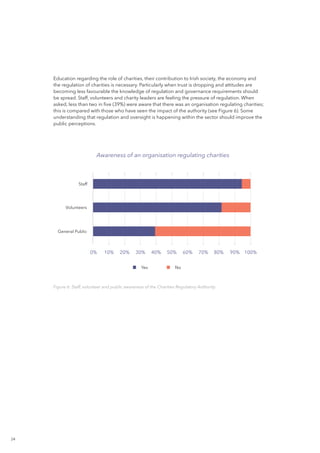
Education regarding the role of charities, their contribution to Irish society, the economy and
the regulation of charities is necessary. Particularly when trust is dropping and attitudes are
becoming less favourable the knowledge of regulation and governance requirements should
be spread. Staff, volunteers and charity leaders are feeling the pressure of regulation. When
asked, less than two in five (39%) were aware that there was an organisation regulating charities;
this is compared with those who have seen the impact of the authority (see Figure 6). Some
understanding that regulation and oversight is happening within the sector should improve the
public perceptions.
Awareness of an organisation regulating charities
100%90%80%70%60%50%40%30%20%10%0%
General Public
Volunteers
Staff
Figure 6: Staff, volunteer and public awareness of the Charities Regulatory Authority.
NoYes
25
Greater transparency
While staff and volunteers appear happy with transparency, public trust in the charity sector
does not appear to have recovered from recent scandals…
Most staff surveyed feel informed about the financial performance of their charity (88%) and
say that their members have been briefed on the financial performance (86%). Similarly, most
volunteers think they know enough about what is going on in the organisation they volunteer
with (87%) and have been kept informed about the financial performance of their charity (75%).
Fewer volunteers are aware of whether their members have been briefed on the financial
performance of their charity (55%) with an additional 23% indicating that they do not know.
However, this indicates that of these respondents that there is good internal transparency
regarding the performance of charities.
Transparency and knowledge are core to public trust in charities – over half (54%) feel they
do not know what charities do with the money donated (the same proportion that don’t trust
donations are used effectively) and the clear majority agree that transparency is not currently
satisfactory for the public (74%). At the same time there is a general sense that the movement
towards transparency should, and will, continue. Ninety six percent of volunteers surveyed think
that charities will have to be more transparent about their spending in the future, with a similar
proportion of staff (94%) and the general public (83%) agreeing.
Looking at levels of trust in charities since 2014, it is apparent that the general public’s levels of
trust in charities has not, and is not, recovering. In fact, levels of trust have remained mainly static
with less than one in ten (7%) saying they trust charities; with this rising to less than one third
(29%) indicating that they have some to full trust (see Figure 7):
Figure 7: Public trust in charities (2014-2017)
“How much do you feel you can trust Irish charities nowadays?”
35%
30%
25%
20%
15%
10%
5%
0%
No trust
at all
Distrust Somewhat
distrust
Neither/nor Somewhat
trust
Trust Trust
completely
2016 201720152014
26
Media role in public understanding
The media have an important role to play in how public perceptions are moulded…
Staff, in particular, think that charities get a raw deal in how they are portrayed by the media with
over two thirds (69%) feeling that charities have been treated unfairly by the media; and three in
five (60%) think that charities response to the media has been ineffective.
Volunteers are slightly more ambivalent regarding the treatment of charities in the media, with
just under half thinking that charities have been treated unfairly (49%); yet over half think that
charities’ responses have been ineffective (55%).
…and this media narrative should include greater collaboration with those working and
volunteering within the sector.
Staff and volunteers want responses to the media to be proactive rather than reactive: they see
an opportunity for positive stories looking at impact and service delivery (but state the need for
issues around compliance and governance to be without jargon e.g. mention of triple lock).
“be more proactive in informing the public about the reality of what it costs to run an organisation
and why it is necessary to spend on things like administration etc. be better at lobbying for
equality and social change instead of fundraising for sticking-plaster responses - moving away
from the traditional work of “charity” to social justice” (volunteer)
Staff suggested that charities should have confidence and pride in their mission and work when
approaching the media:
“A positive campaign, highlighting all of the work done by the charity sector in Ireland, quantifying
what this work amounts to terms of economic and social benefit to society. It is also worth
highlighting that many charities are formed due to a significant lack of services provided by the
State, and that they fill this gap to the best of their abilities, considering the funding conditions
they operate in. A campaign that envisages an Irish society without the charity sector, but with no
improvement in State services, may highlight to the public just how vital the services provided by
the charity sector are.” (staff member)
“I think that some issues are being ignored by charities (cost of administration esp., in light of
scandals), as they are too afraid of drawing attention to themselves. I think the value of the sector
needs to be addressed more when there are issues around costs, or scandals from a “few bad
apples”. I think there should be more assertive responses by an organisational body on behalf
of charities, and it should also be demonstrated that charities are professional organisations the
same as the private sector, and it would all fall apart - particularly services, if left in the hands of
volunteers or underpaid and unskilled workers/volunteers. Also I think having more backing from
the government and public sector bodies would be important- to identify the gaps our services fill
that they simply cannot provide.” (staff member)
27
Staff see the opportunity to engage with the media to educate the public about the charity
sector; they want transparency and for people to understand the cost of service delivery,
particularly the costs of high quality service delivery. Staff mentioned the need to educate
people around 1) the roles of paid staff, 2) the responsibility of charities in terms of delivering
core services to the country and 3) the return on investment on money spent fundraising.
“thinking of larger charities that would have professional PR staff I think charities should be clearer
on the value they add to Irish society and bust some myths for example being able to rely solely
on volunteers“ (volunteer)
“By articulating clearly the added value piece and how they support state services, to demonstrate
where they are filling gaps, by always being transparent on salaries and where funds are going
and by being clear on the sot [sic] of fundraising - across the board. There is a risk if only a few
charities do this as fundraising costs always attract concern. If we communicate to public that for
every 1 spent or invested in fundraising we turn that in 4-5 euro, this is a fantastic return compared
to interest rate or any other business. We need to think creatively about our communication
messages and have a collective communications approach” (staff member)
In the case of bad news stories/charity scandals, staff suggest media is approached where
necessary through representative bodies and with good PR. Staff mentioned the need for quick
and open responses (acknowledging guilt where needs be):
“I think umbrella groups representing charities need to be very clear about how charities operate,
the obligations charities have under legislation, particularly those that are companies limited by
guarantee, the increasing compliance and cost of same. Charities need to be forthright about
the services provided, the challenges faced by underfunded services, constantly responding to
crises and emergencies, the lack of planning for an ageing population and associated needs
which is well documented and well known by our Government and Health Service Executive.
Charities should not be constantly defending the work that is done by a great many hard working
individuals and volunteers. It would not be possible for many charities to operate the variety of
services provided by only engaging volunteers. Staff need to be employed and paid appropriately
for the right skillset, qualifications and experience to engage with and provide a meaningful
service for the people availing of the charity’s services. The public need to understand the reality
of this and a very open and transparent campaign should be done with the media. Unfortunately,
it is common that sensationalism and bad press will sell papers, sometimes the good stories are
never heard. While I absolutely do advocate for transparency and accountability in charities, and it
is great that we do know about bad practices…the good stories and valuable work that is done by
charities and their staff and volunteers needs to be seen too.” (staff member)
“Effective communication, full transparency, accountability, disclosure, take full responsibility for
past lack of oversight and misappropriation of funds, pledge more effective management, cost-
cutting and streamlining with full emphasis on cause.” (volunteer)
28
Perspectives differ regarding the manner in which people think charities should respond to the
media, yet one volunteer said that the sector should be cautious:
“Cautiously as media are sometimes sensational in how they report and negative media can
impact badly on the end user” (volunteer)
Overarching theme of and desire for change
The findings of the stakeholder research seem to highlight a growth in frustration among the
public and an underlying dissatisfaction among those who have engaged with the sector as staff
and volunteers.
If nothing changes the following trends will continue to dog and damage the sector:
	 •	Trust in the sector will continue to decline – creating a climate where the next
scandal creates further negativity about the sector, raises concern about funding and
undermines the sector’s role.
	 •	There is an understanding of the role that charities play, but no real understanding of
how that sector has evolved to meet different and often complex societal needs.
	 •	If there is a scattergun approach to advocacy on behalf of the sector, individual
organisations will continue to suffer collateral impact from unrelated events in different
organisations.
	 •	The public will have a limited understanding of better regulation. Regulation should
make the sector more attractive for engagement, but if it is not understood it is less so.
	 •	There will be limited change, unless the need and opportunity for change is
understood by funders (philanthropists, government and society)
	 •	There will be no clear link made in the need to develop and upgrade the skillset
within the charitable sector unless the charity sector confidently argues on its behalf.
	 •	 Trust and understanding can only grow when facts and knowledge are disseminated
	 •	 It is obvious that the public want greater transparency
	 •	Transparency will increase understanding of where the money goes within charities – over-
heads are a reality
			 •	 Abridged accounts will not lead to either greater transparency or understanding
			 •	Unless full accounts are published the public will continue to think that charities can
run with no administration costs and that salaries are not fit-for-purpose; despite the
fact that most individuals working within charities are earning less than they could in a
similar position in the private sector
Recommendations
	 •	The Charities Regulatory Authority and membership bodies such as Charities Institute
Ireland need to challenge public perceptions particularly regarding unrealistic expectations
and feasibility.
29
	 •	Volunteers are vital to charities and charities are vital for volunteers. There are huge
benefits to volunteering – not just to the organisation, but the nature of the volunteer
purpose will change and engage. Currently the general public does not see or
appreciate that.
The differentiator of a successful charity from other charities is the clarity of its vision and purpose.
The role of the Board in seeking and defining the strategic direction is seen to be critical. The
separation of powers between the executive management and the non-executive board is also
important. The Board must provide absolute clarity on the organisation purpose. Among the
challenges highlighted is the need for boards to stay focussed, steer charities forward and to
avoid distraction.
Some staff also mentioned the lack of a vision for their charity/the sector:
“Overall the challenge for charities is often the challenge for Ireland, in having visionaries and
those in power to look at what we want in our society going forward and how are we going to pay
and deliver these services.” (staff member)
It is apparent that if change is required that there needs to be a clear, direct vision for the future
within each organisation where the board understands the requirements for good governance,
transparent reporting and good fundraising. The board and the sector also need to look forward
– how are the charitable sector going to attract the best leaders in the future? Charities cannot be
expected to attract the best and brightest when those within the sector are feeling defensive and
apologetic about their roles and earning a living. Similarly, ways of attracting volunteers particularly
professional volunteers at a board level need to be examined. Volunteering can happen at various
different levels. As more organisations become more specialist and the operating environment
becomes more complex, organisations need to attract specialists to their activities.
Across all the results it is apparent that the Status Quo needs some flux to enable change
and growth into the future.
•	Professionals and visionaries that are passionate about the sector need to be
encouraged to enter charitable organisations, where salaries are commensurate
with experience and the requirements of the roles
•	Good governance, transparent reporting and good fundraising (The Triple Lock)
should be core to all activities to provide the public with confidence
•	Impact needs to be measured and disseminated
•	There has to be more tangible career benefit for voluntary engagement, partic-
ularly at a board level. Charities Institute Ireland should engage with the profes-
sional bodies to seek to provide quantitative and tangible benefits for engage-
ment, such as CPD hours.
•	Along with the suggested internal changes there needs to be an emphasis on
positive and proactive messaging alongside the media to demonstrate the positive
impact that charities have both at a local and national level. We are past the time
that all publicity is good publicity – the sector should have confidence in its worth.
30
Into the future
We began with the end in mind. We sought out current perspectives so that we could build on
the sector’s strengths and address weaknesses and concerns.
We believe that the charity sector will remain a core part of Irish society in 2037. For that to
happen it needs to plan strategically. We need to move from crisis mode to crisis management.
There are core issues that need to unapologetically put up front and centre by the sector. Other
stakeholders need to be asked to confirm our perspective of our role and purpose.
They must also be asked to help and participate in our evolution.
Organisational Change and Development
We have many charities – and there is a charity purpose inbuilt in Irish society. Some should
clearly consider merging with others – but there was no desire to limit the engagement and
opportunity of new projects or responses to new issues. There is a need to facilitate the transition
of others. If you are not providing excellent services then you need to consider your purpose.
The environment is going to become more complex, not less. But we should not limit those who
see a need and seek to meet it.
Recommendation: The Government should examine some support mechanism to facilitate the
evolution of organisations – using a model such as the Credit Union Restructuring Board (Rebo)
from the Credit Union sector.
Explanation of Purpose and Capability
As society becomes more complex, so too do its needs. It can’t just be about giving alms to the
poor. There is a hierarchy of complexity. Needs and services required can be more complex than
simple poverty alleviation (important though that is). And that may require the distribution of
non-monetary support and specialist skills. Funders need to be mindful of what charities need
to do to deliver services and they need to operate positively in support of the development of
skills and organisations. The skills required to run a €100m charity will be quite different to the
skills required to run a start-up charity. There is an absolute requirement to match needs with the
appropriate skill.
Recommendation: There needs to be a clear communication strategy by those who have an
overview of the sector on the impact that charities have. This could include representative
organisations such as the Charities Institute Ireland; The Regulator; Government and Private
Funders to promote the role and benefits that charities play in Irish society in a positive way.
It will not be done by individual charitable organisations.
31
Professionalisation and future leadership
Throughout the interviews, panel discussion and surveys it was apparent that all stakeholders
acknowledge both the transition towards and the need for the sector to professionalise. However,
there is a disparity in the readiness to assign appropriate funding to this transition when you
compare the perspectives of those within the sector to the general public – there is a cost to
professionalisation and the requirement for overheads needs to be acknowledged. Professionals
need to be paid appropriate wages and the sector needs to invest in attracting, retaining and
training these professionals making the sector an attractive place to work and have a career.
Recommendation: As part of the communication strategy, charity leaders and membership
bodies need to clearly explain where funding is going and the merit of paying competitive
wages to attract the best staff to the sector. There needs to be a clear merit to working in
charitable organisations as well as an obvious career trajectory so that the best professionals
and future leaders will be encouraged into charities rather than other sectors.
Regulation
Regulation will result in short term pain for long term gain. The role of regulation should be
to create a more effective and transparent charity sector with more carrot than stick. But some
will not be able to transform to the new regime and there needs to be some process to enable
them to chart their futures as part of some other organisations.
Recommendation: Regulation will result in the number of charities falling in the short term,
so how do we facilitate their exit from the sector without the beneficiaries being impacted
negatively and without any reputation damage.
Boards
The role of Boards is critical in setting the vision and charitable intent in the organisation. There
needs to be a clear delineation of powers between the board, executive and funders and each
need to understand and respect the other.
Recommendation: People volunteer for charitable work and as organisations become more
complex, the needs of charitable organisations will change. In addition to their core vision and
purpose, charities will need specialist skills in the area of planning, law, accounting, marketing,
impact measurement and human resources. The education and training bodies across many
sectors of the economy must have some recognition of the role of charity volunteering as a
professional development benefit.
32
Volunteers
Alongside the professionalisation of organisation, the role of volunteers remains critical.
It will continue to do so. It benefits society, the volunteer and the organisation. The role
will undoubtedly evolve.
Recommendation: We need case studies of the benefits of volunteering
Government
Government has a number of roles in relation to the charity sector. It is the key funder. It sets the
regulatory framework. It can provide the incentives to encourage private investment. It can also
create the gaps into which charities have to step to ensure protection for the most vulnerable in
our society. Government can also create huge and unnecessary burdens on the sector, through
duplication in reporting, unpredictability in income and confusing its roles as funder, legislator
and reactor.
Recommendation: Government should produce a green paper on the Charity Sector, which lays
down its hopes and ambitions of the sector in all its forms. It needs to promote involvement and
engagement. It needs to demand the highest standards of the sector, but also operate to the
highest standards of governance and engagement when dealing with the sector and individual
organisations.
33
So what will the sector look like in 2037?
	 •	 It will be understood. By all the stakeholders.
	 •	 It will be playing to its strengths
		 –	Passionate, flexible, impactful with people
at its core.
		 –	It will be transparent and open, with streamlined
reporting to stakeholders
		 –	It will have the ability to move quickly
		 –	It will be a core part of an engaged and
compassionate society.
	 •	 It will have world class organisations.
	 •	It will be recognised and understood by all in society
for the benefits that it brings to our society.
	 •	 It will be a defining characteristic of our society.
	 •	It will compliment rather than compete with the work
of the State.
34
References
Benefacts (2017). Benefacts Nonprofit Sector Analysis.
Citizen’s Information Board (2014). Regulation of charities. Relate: The journal of developments in
social services, policy and legislation in Ireland, 41, 8 (August 2014). Retrieved from: http://www.
citizensinformationboard.ie/downloads/relate/relate_2014_08.pdf
Coughlan, A., Dermody, A.  Banka, P. National Guide to Pay and Benefits in Community, Voluntary
and Charitable Organisations 2015. Community Foundation of Ireland, Dublin, 2015
CSO (2015). QNHS Volunteering and Wellbeing. Retrieved from:
http://www.cso.ie/en/releasesandpublications/er/q-vwb/qnhsvolunteeringandwellbeingq32013/
Eastside Primetimers (2016). The Good Merger Index: A review of not-for-profit mergers for 2015/6.
Retrieved from: https://ep-uk.org/publications/charity-mergers-good-merger-index/
McLoughlin, P. (2013). New evidence on overseas volunteering from Ireland and its socio-economic
impact in Ireland
nfpSynergy (2017). Trust in charities and other public institutions: Trend data and analysis.
Retrieved from: https://nfpsynergy.net/free-report/trust-charities-and-other-public-institutions-
may-2017
The Wheel (2014). A Portrait of Ireland’s Non-Profit Sector. Retrieved from: https://www.wheel.ie/
sites/default/files/Portrait%20of%20the%20Non-Profit%20Sector%202014_%20UpdateJun2014.pdf
Volunteer Ireland (2017). The impact of volunteering on the health and well-being of the volunteer.
Retrieved from: http://www.volunteer.ie/wp-content/uploads/2017/05/Volunteer-Ireland-Report-
FINAL.pdf
Wren et al (2017). Projections of Demand for Healthcare in Ireland, 2015-2030. First report from the
Hippocrates Model. Retrieved from: https://www.esri.ie/publications/projections-of-demand-for-
healthcare-in-ireland-2015-2030-first-report-from-the-hippocrates-model/
www.charitiesinstituteireland.ie

Charities 2037

  • 1.
    CHARITIES 2037 A Report fromAmárach Research December 2017
  • 2.
    There is overwhelmingdesire for change in the charity sector among staff, volunteers, funders, the general public and beneficiaries. Before embarking on a journey of change, it is critical to know where you are starting from. With the generous support and funding from The Ireland Funds, Charities Institute Ireland together with Amárach Research designed Charities 2037, a program of research with the aim of providing stakeholders with an opportunity to consider how the charity sector should evolve over the next two decades. Amárach Research interviewed 25 key personnel in the area of charity leadership. They included experts on corporate and charity governance; the patrons of some of the largest charities in the country; chairs of charitable organisations; charity CEOs and senior executives; academics; leaders from the private sector; philanthropic organisations; public servants; media commentators, government policy advisors and public representatives. They provided insight, vision and passion. We are grateful to them for the time, commitment and investment in this project. We are also grateful to all those who participated in the quantitative surveys – the public, the staff and volunteers. Their insights were invaluable to the research programme. And finally, thanks to the authors of this report Michael McLoughlin and Claire O’Rourke from Amárach Research. Lucy Masterson Chief Executive Charities Institute Ireland C H A R I T I E S I N S T I T U T E I R E L A N D
  • 3.
    3 Contents Background 5 The purposeof Charities 2037 6 Context 6 Charitable organisations 6 Charities: income and contribution to the economy 7 Individual’s engagement with charities as volunteers 7 Ireland in 2037 9 Methodology for this Research 10 Research Strategy 10 Methodology: Qualitative 11 Methodology: Quantitative 11 Methodology: Final Steps 12 Results 13 Impact and appreciation 13 Public engagement and impact of volunteering 14 Demonstrating the impact: A need for data 16 Professionalism, regulation and funding 17 Regulation 20 Funding 21 Finding the right people 22 Public perceptions and understanding 23 Greater transparency 25 Media role in public understanding 26 Overarching theme of and desire for change 28 Into the future 30 References 34 Table of Tables Table 1: Stakeholders involved in the project 10 Table 2: Looking ahead to 2037 how much influence, if any, do you think that each of the following will have on the daily lives of Irish people? 13 Table of Figures Figure 1: Breakdown of respondents to survey of the general public 11 Figure 2: Public agreement with charities employing best professionals (2015-2017) 17 Figure 3: Public perceptions of wages (2015-2017) 18 Figure 4: Public agreement that charitable work should be done by volunteers 18 Figure 5: Change in attitude to charities 23 Figure 6: Staff, volunteer and public awareness of the Charities Regulatory Authority 24 Figure 7: Public trust in charities (2014-2017) 25
  • 4.
    4 Day by Day nothingchanges but when I look back everything is different. CS Lewis
  • 5.
    5 Background The charity sectorhas played and continues to play a key role in Irish society. There are close on 9,000 registered charities in Ireland – ranging from small community groups to organisations with an international foot print and impact. They impact on all aspects of our lives and it is possible to argue that people in most families are beneficiaries – often unbeknownst to themselves. Children benefit from the efforts of sporting and cultural organisations, families benefit from the provision of education and social support, and older people benefit from a myriad of support and advocacy structures. All age groups benefit from specialist support in health and social services, from social housing to specific health related organisations. At home and abroad Irish charities represent some of the best aspects of Irish life and society – a desire for altruism, community support and cohesion. They also come from the fact that the State historically has left gaps in social provision and required or enabled others to step up to close the gap. The causes and consequences of that gap have been debated widely in other reports, academic papers and media. Other than to acknowledge its fundamental impact on Irish society, the origins of the charity sector does not form a core purpose of this report. Irish society has given to the charity sector for decades and the charity sector has given back to Irish society for just as long. But the last decade has seen much change in our country. We have suffered catastrophic economic collapse and moved to recovery – albeit with huge pain. As a consequence of these and other change drivers – technology, social and demographic change and education - it is timely to undertake a base line review of what different stakeholders want from the charity sector. Before embarking on a journey of change, it is critical to know where you are starting from. A key driver for change must be a national conversation about the role and future of the charity sector. All organisations tend to self- perpetuate, but that is fundamentally different to a purpose. The latest revolution in technology and economics has seen the destruction of many household serving organisations. Retailing is different; banking is different and media is different. The sense of local engagement has also changed. In the 1960s the formation of many charities had their roots in post Vatican 2 social teaching. In a more diverse society, with different social mores, the same drivers may no longer apply. While the charitable and voluntary sector has always formed a key part of Irish society, much of it went unregulated and was often unaccountable. What society wants from the sector and what charities can give (and require to be effective in return) needs to be considered and reviewed. Society, government and the charities themselves need to consider what expectations they have of each other. Government is increasing regulation, reducing income and raising expectations as to what the charitable sector should contribute. Some charities appear increasingly burdened by regulation and compliance requirements; unpredictable incomes and a sense of responsibility without power. Society wants an ever-increasing standard of care and contribution. It requires increased accountability and professionalism. It sometimes appears as if it wants people to work for free yet it wants high quality services.
  • 6.
    6 The purpose ofCharities 2037 Charities Institute Ireland (Charities Institute Ireland) and Amárach Research designed Charities 2037 as a programme of research that aims to provide stakeholders with the opportunity to consider how the charity/not for profit sector should develop over the next two decades. The aim was to both engage and challenge stakeholders to describe how they see the role of charitable organisations developing in contemporary Ireland. It is also designed to provoke debate on some key issues: • What should be expected from the charity sector (and conversely what is unrealistic); • The role and the need for renewal of volunteers; • The impact of regulation; • The need for professionalism in the charity sector and its implications for organisational structures (Have we too many charities? Is it a recognised career path? What is the role of the volunteer into the future? How do we deal with specialists and specialties?); • The role of the state in supporting the charity sector; and • The requirements for change. Just because an organisation has existed for 50 years does not mean that it should exist for another 50. Many organisations have a life cycle, should we begin to think of charities within a similar model? Context Charitable organisations Charities, under the Charities’ Act (2009) are organisations which must be established with a charitable purpose. Under the Act, “a charitable purpose is a purpose that is of public benefit and involves: the prevention or relief of poverty or economic hardship; the advancement of education; the advancement of religion; any other purpose that is of benefit to the community” (Citizen’s Information Board, 2014). As part of the Charities Act (2009), numerous governance requirements came into effect for charities. These include the need for registration for organisations to describe themselves as a charity, transparent recordings and annual statements of accounts (where income or expenditure exceeds €10,000), a requirement for annual reports, and adherence to the rules about fundraising. The Office of the Charities Regulator was also established under the Act and came into being in 2014. The key functions of the Regulator are to establish and maintain a public register of charitable organisations operating in Ireland and ensure their compliance with the Charities Acts. UK research has found that charities are some of the most trusted bodies, after the armed forces and the NHS (nfpSynergy, 2017). Following recent scandals in Ireland, we would expect the levels of trust to be lower, and even to have fallen – and this challenge of recreating public trust is a key outcome of our research.
  • 7.
    7 Charities: income andcontribution to the economy In an excellent and detailed analysis, Benefacts (2017) approximate that one in ten organisations operating in Ireland are within the ‘third sector’. These comprise a range of charities and not- for-profits, including educational institutions, and Benefacts estimate that the sector generates over €10billion annually. Beyond the traditional perspective of the contribution of volunteers, nonprofits organisations also provide employment to a substantial proportion of the population. Similarly, research conducted for Comhlámh demonstrated the many socio-economic benefits accrued for Ireland on the basis of overseas volunteering (McLoughlin, 2013). As an example, research undertaken for the Community Foundation for Ireland in 2015 included 261 responding organisations. “These organisations cumulatively employed 8,281 employees (both full and part-time) in paid roles. There were also approximately 67,500 volunteers working with the organisations surveyed, which means that in total, almost 76,000 people were working or volunteering in the organisations surveyed” (Coughlin et al., 2015, p7). Exploring the source of income for charities, research found that state grants/contracts provide over half of charitable funding, while individual contributions or ‘giving’ provides an additional 25% (The Wheel, 2014). Coughlan et al (2015) found a similar proportion of income coming from government, followed by just under 16% coming from donations. This implies the reliance of the charitable sector on government funding. Individual’s engagement with charities as volunteers While much of the discussion on charities tends to focus on their service provision and organisation structure, volunteering opportunities also provides a key activity at various stages of life for people. According to the CSO, over one quarter of Irish adults were actively volunteering in Ireland in 2013 (CSO 2015). This was valued as amounting to work with a value of €2 billion annually. Volunteers enjoy a host of associated benefits, including subjective reports of happiness and wellbeing. CSO (2015) found that volunteers were more likely to report high levels of life satisfaction; while volunteers in general were more likely to indicate high or very high subjective wellbeing (e.g. happiness yesterday, life being worthwhile and self-reported physical health). In fact, research consistently suggests volunteering as a protective strategy for mental wellbeing, as well as enhancing the lives of volunteers in numerous other ways e.g. skill acquisition, involvement in the community and addition of friendships (Volunteer Ireland, 2017).
  • 8.
    8 The best way topredict your future is to create it.  Abraham Lincoln
  • 9.
    9 Ireland in 2037 Thinkingabout the role of charities into the future it is important to situate their role within the projections for industry, innovation and the population. Many strategy and vision documents have been prepared envisaging this future, yet it is the role of charities in service delivery for the population and the scope for volunteers and staffing within the demographic breakdown that is easiest to situate the findings for this project. Looking forward to 2037, CSO has produced population projections nationally and for each of the planning regions to 2031. In overall terms, the increase in population experienced since 1961 will continue apace – with anticipated growth of 613,000 (13%). The nature and structure of that population will change. • Conservatively the population of Dublin could reach 2.6 million by 2050! – The numbers of people aged 25 to 64 is projected to increase by 3.4 per cent for the State but at a regional level it will fluctuate. The Mid-East, Dublin and Midland regions are projected to increase by 13.4, 11.7 and 0.3 per cent respectively. All other regions will experience decreases in the population in this age group. – The number of old persons (65 years and over) will almost double in every region over the life-time of the projections, with the most marked increases likely to occur in the Mid-East (+136.5%) and Midland (+95.1%) regions. Similarly, ESRI population projections to 2030 project an increase of approximately 14% as a central scenario, with the high population projection with an increase of 23% considered equally likely due to the potential ramifications of Brexit on European population shifts (Wren et al., 2017). This implies that not only will there be more people who might engage with charities as donors or volunteers but also that there will be a greater need for charities by beneficiaries.
  • 10.
    10 Methodology for thisResearch Research Strategy Research often explores public perceptions of charities and the impact of engagement with charities for volunteers. However, in order to provide a robust and rounded picture of the current charity landscape as well as projections for the sector into the future this research endeavoured to encapsulate the opinions of a variety of key stakeholder groupings in order to triangulate their perspectives and examine where commonalities and disparities arose. The breadth of key stakeholder engagement in the research process provide authenticity and resilience from a policy perspective. The research team, in collaboration with Charities Institute Ireland, identified a breadth of key stakeholder groupings with whom to engage for this research process. Outlined below are the key stakeholders with whom we engaged throughout the research process (see Table 1). As well as in-depth interviews with a range of charity leaders and stakeholders, three online surveys were conducted with the general public, charity staff and volunteers exploring the commonalities and differences in the perceptions of the charity sector in these groups. Stakeholder Grouping Scope Methodology Outcomes Charity Leaders – Chairpersons and CEOs To understand the rationale for organisation purpose and contribution. To understand the challenges that are required In-depth interviews Understanding of shared strategic and organisational challenges Government and regulators A series of one to one interviews with regulators, policy makers and influencers In-depth interviews An understanding of the context and ambition Volunteers Charities relay on volunteers. In an increasingly regulated sector, how do they see their role A quantitative survey of volunteers with the assistance of the organisations that they volunteer with Their sense of engagement, challenges, and hopes for the sector Staff Surveys A survey of staff members who work in charities – to understand their purpose, motivation and the gaps that they see as requiring to be filled A quantitative survey the assistance of the organisations that they work with Their sense of engagement, challenges, and hopes for the sector The Public A quantitative study on the role of charities and not for profits in Irish society An online nationally representative survey An understanding of current positioning, strengths and vulnerabilities Table 1: Stakeholders involved in the project
  • 11.
    11 Methodology: Qualitative Twenty-five semi-structuredinterviews were carried out with charity leaders and influencers to explore the current role of charities, individual organisational structures, the role of volunteers and staff, effectiveness and relative contributions, challenges encountered by both individual charities and the sector and thoughts about future directions. The list of stakeholders invited to contribute to the interviews was agreed between Charities Institute Ireland and Amárach Research and everyone available to contribute within the timeframe was interviewed by the CEO of Amárach. These interviews were based on a framework of questions agreed with Charities Institute Ireland with variation depending on the role of the individual and the flow of the interviews. The interviews were conducted on a confidential basis – as is the standard practice with this type of qualitative research programme. Methodology: Quantitative To look at the perspectives of the general public, as well as staff and volunteers within charitable organisations three online surveys were carried out in the course of this research programme. The survey of the general public was conducted with a nationally representative sample of 1,000 adults aged 16 years of age and older; the sample was nationally representative in terms of gender, age, region and social class (see Figure 1). Two additional bespoke surveys were conducted with staff and volunteers. Across the surveys there was a number of core questions to enable group comparisons as well as individual modules of questions to specifically probe perceptions, experiences and expectations of relevance to each stakeholder grouping. Figure 1: Breakdown of respondents to survey of the general public Gender Social Class Age Region C2DE F50- 53%ABC1 F50+ 47% Munster 27% Conn/Ulster 18% Rest of Leinster 26% Dublin 29% 51%49% % 18 20 17 31 1416-24 25-34 35-44 45-54 55+
  • 12.
    12 The survey ofthe general public sought to explore the general public’s perceptions of charities, their role in society, the contributions of volunteers and staff as well as their expectations of the sector into the future. Specifically, questions were asked regarding: public perceptions of charities, including funding, governance, efficacy and trust; expectations, including transparency and distribution of funds; engagement with the sector; and willingness to volunteer and/or donate. As part of the survey of the general public a number of demographic questions were asked including previous and current volunteering. The volunteer survey was completed by 101 current volunteers recruited through the Charities Institute Ireland network. The volunteers were engaged in a variety of type of charities from Human Rights, to Education to Religious charities amongst others. Volunteers ranged across age groups from 16 years of age to 55+, with volunteering experience from less than one year to over 20 years. Just over one third were male (37%); and in addition to their volunteering over half (54%) were working full-time while an additional 20% were working part-time. Within the survey of the general public, less of a gender gap was noted in volunteer status, with males making up two in five (43%) current volunteers, and nearly half (46%) of those who had ever volunteered. The staff survey was completed by 364 staff within the charity sector, invited through the Charities Institute Ireland network. These included staff across a range of ages, regions in Ireland and at varying levels within organisations from managerial (49%) to service delivery (8%), administration (9%) and fundraising (25%) as well as others (10%). Respondents were working across the breadth of types of charitable institutions established for a host of reasons and to help a range of beneficiaries reflecting the diversity found within the third sector. The vast majority of staff survey respondents were working full time (88%) and over two thirds were female (69%). The clear majority of these staff (94%) had worked outside the charity sector previously. Methodology: Final Steps Prior to the completion of the report, the initial findings from both the qualitative and quantitative research were presented at the Charities Institute Ireland conference in October 2017. This was followed by an expert group round table discussion of the findings and implications of the research as well as their vision for the future. Some of the issues discussed in this session have been incorporated into this final report.
  • 13.
    13 Results Impact and appreciation Theoverwhelming message across all aspects of the research is that stakeholders feel that the sector plays a critical role in Irish society. Charity leaders, media, staff, volunteers and the general public recognise the role that charities play in society as well as the integral services that it has evolved into delivering. However, despite this recognition, only just over half of the general public think that charities will continue to have the same or more influence in 20 years, a figure which appears particularly stark when compared to the perspectives of the future influence of FDI (see Table 2). Charity leaders believe that charity plays a core part and purpose in Irish Society… This stems from a variety of factors, including the historical role of the Church as a large and powerful provider at the heart of the delivery of social services. The relationship between the Church and State suited both – the Church could exercise power while the State did not have to provide the services. As the power of the Church has declined the role of the State as a funder of service provision through the charity sector has grown, but much of the channel of delivery remains the charity sector. However, there are two sides to this coin. Seventy percent of the general public feel that the State is relying too heavily on the charity sector to provide services; while a majority think that there are too many charities with similar functions (64%) and consequently those with a similar intention and scope should consider merging (68%). Indeed, even more staff members of charitable organisations think that there are too many charities with similar functions (78%) and believe that charities with similar functions should consider merging (79%). However, staff and volunteers do agree with the general public that charities have an important role to play in Ireland (96% and 90% respectively) and that service provision compliments public services provided by the State (86% and 80% respectively). % same or more influence Staff Volunteers Public Technology 99% 100% 96% Immigrants 94% 90% 80% Foreign Companies 93% 93% 86% Irish Government 85% 85% 75% Charities 66% 76% 56% RTÉ 25% 23% 45% The Catholic Church 6% 7% 23% Table 2: Looking ahead to 2037 how much influence, if any, do you think that each of the following will have on the daily lives of Irish people?
  • 14.
    14 However, when lookingat charities should we be considering number or impact? Through the stakeholder interviews it became apparent that while charities talk about collaboration, it only really happens to a limited extent; there are multiples organisations operating in similar spaces. All bring some difference to their approach – but there is often more overlap than differentiation. “Within a square mile of here there are seven homeless charities.” There is undoubtedly competition for funding and resources - and they do compete. At the same time, there are mixed views regarding the number of charities. Some believe that there are too few, more believe that there are too many. The key issue is about effectiveness and delivery. This comes back to measurement of outcomes and impacts. Is the way that charities in the sector are organised the most effective way to deliver the highest possible service and impact? When considered further, it appears that despite the conversation related to the number of charities that in fact the debate should be around the number which are no longer impactful or fulfilling their purpose. Mergers of charities is an interesting and important conversation to have, yet people should be mindful of the role for new innovators and ‘disrupters’ in the field as in the private sector. In fact, the role for charities traditionally was to innovate and create new solutions which government could then scale up - and this role cannot be forgotten. Another approach is that of Dóchas, which was cited as an example, where a sector recognised itself as a sector, with a range of different organisations participating. Public engagement and impact of volunteering Consistent with the prevalence of charities in the Irish landscape and their importance for Irish society, nearly one in five (18%) of the general public are currently engaged as volunteers while over half (57%) had engaged in volunteering at some point in their lives. The latter figure provides a key group to engage with as the evolution of charities continues. On average, volunteers spend 16 hours volunteering per month, with nearly one in five (19%) estimating that they volunteer over 21 hours – reflecting the contribution of volunteers to the efficacy of charities and the reliance that charities have on volunteers for service provision. Positively, of those not currently engaged in volunteering, two thirds (65%) would be willing to volunteer; and on average they would be willing to spend 13 hours per month volunteering. Volunteers are most often galvanised by altruistic impulses and social conscientiousness… Of the 101 volunteers who completed our survey, over one third (37%) began volunteering prior to 25 years of age, with an additional 26% beginning to volunteer between 25-34years. It is therefore important for charities to begin to engage volunteers at school and university, while still demonstrating the importance of looking to organisations to engage with charities as part of a corporate social responsibility. Looking at the age of the volunteers who engaged with the survey, more could be done to engage people in volunteering in later years particularly in the run up-to and during retirement – but we could caution that we are dealing with a relatively small sample. People begin to volunteer for a host of reasons. Exploring these in greater detail it was apparent that the motivation is often multi-faceted and driven by a desire to contribute and to connect to civil society. Volunteers most frequently indicated that they began volunteering because they wanted to give back (52%), because they care about the cause supported (49%) or because they have amassed experience or expertise required by a charity (32%).
  • 15.
    15 “I feel thisis important to do, and that we have a responsibility to address inequality, climate change, and poverty. I will choose to use my time to support organisations tackling root causes through systemic change, but will also respond to requests from individual organisations” (volunteer) “I understand the valuable role they lay in the fabric of society and feel it is incumbent on me to help in any way I can deepen their contribution (if I can).” (volunteer) The enduring role of the community and locality in Irish life continues to propel citizens into voluntary roles; with the next most frequent reasons included that they were asked by a friend or colleague (27%), a family connection to the charity (26%) or that the organisation was local (22%). “It’s a very important part of my life and I think should be part of everyone’s lives…Everyone has something to give back. Volunteering helps me to know who I am. It helps me stay grounded and connected within my communities.” (volunteer) Overall, most volunteers find volunteering satisfying (96%) and feel valued by their organisation (92%). These volunteers also believe that by volunteering they make a difference to the organisation (84%) which in turn contributes to the communities and/or beneficiaries (99%). This contributes to the positive view that these volunteers (94%) are likely to continue volunteering in charitable organisations into the future. Volunteers see an opportunity for positive stories regarding the good work and impact that charities have in society; as well as the contribution to both the sector and the economy which volunteers provide: “Promote the good work they do. Account for the number of volunteer hours and the value of same to the organisation (if the work was carried out by paid staff). This should form part of their annual report.” (volunteer) …and there is scope to engage more of the public in charitable activities. In fact, there are obvious dissemination implications of the biggest reasons picked by the general public as a barrier to volunteering. After the unchangeable factor of ‘not enough time’, one in ten (12%) said that they were unsure where to volunteer while an additional one in ten (12%) said that there was a lack of volunteering opportunities I’m interested in. Particularly in the context where skilled, professional boards are the aim for many charities there should be roles for many people to volunteer in non-traditional or atypical ways that may not be apparent to those outside the sector. In fact, engaging volunteers to use the professional knowledge gained outside the sector would be valuable for the thousands of charities currently on the register. It is clear that Irish people understand and recognise the contribution of the third sector to Irish society and the relevance of volunteers to the efficacy of the sector. However, charities require more engagement from the public in more ways than just time – trust, buy-in and donations are also core to the survival of many charitable organisations: “Public buy in - the next generation seem to be social activists and aware of issues, but not quick to financially support the issues. They are more keyboard warriors than anything. No one I know, my age, has a DD set up to a charity. But they will be the first to share something on Facebook or Twitter because they are interested in that and want to be SEEN to care.” (staff member)
  • 16.
    16 Demonstrating the impact:A need for data One of the key challenges is to provide a consistent understanding to all the stakeholders of the real impact that charities have to all their stakeholders including: • To funders. • To the public. • To staff and volunteers. • To beneficiaries. This understanding can only come from a demonstration of impact; charities need to monitor and quantify impact in some way such as numbers of people accessing services etc. There needs to be a recognition of the importance of research and data - like in the private and public sectors resources should be allocated to the use of metrics and data as well as communication. The loss of Atlantic Philanthropy funding that provided funding for overheads and research has left a funding void for these purposes. This would enable there to be dissemination of positive messages such as impact and engagement. The gathering of data would enable charities to have more conviction regarding their impact, and provide confidence on the side of charities so that the message is not one of apology. Having evidence gathered would enable the sector to provide proactive messaging about the sector to increase public trust and sentiment beyond individual charities that are supported and trusted locally/by their donors. Proactive positive messages of impact could be coordinated through a body such as Charities Institute Ireland. However, beyond impact on beneficiaries, the publics’ engagement with charities and stakeholder satisfaction are also important. At its core, demonstrating impact is something which most stakeholders want to do but it is constrained by funding, internal capabilities and finding the right KPIs: “The lack of a professional approach to training, data collection and benchmarking in Ireland is a challenge. We are lacking very basic tools that would increase our effectiveness. Also there is a need to have an advocacy and negotiating body to represent the sector’s interests with the government and suppliers, which should take priority over media focus.” (staff member) Recommendation • You simply have to measure (at an economically appropriate cost) the impact of work done. This has to happen at project, organisation and sectoral level. • Robust data can lead to robust argument, defence and debate. Within organisations there has to be measurement and also at a sectoral level.
  • 17.
    17 Professionalism, regulation andfunding Public desires for charities are inherently contradictory; professionalism and top-quality service are the desire but run by volunteers and without overheads… Charities provide key social services and contribute to Irish life in a multitude of ways, it is therefore unsurprising that people agree that charities should be good at what they do and that it is important that charities are run well. However, the model for charitable service delivery assumes that the bulk of financial outputs is focussed directly on the provision of goods for the poor. This traditional model causes the outcry over salaries, expenses and costs. There is a disconnect in the expectations for charities and the level of funding which people would like to see allocated to the professionalisation of the sector. In the abstract, few people disagree with the statement that ‘charities should get the best professionals possible to work with them’ (Figure 2), yet less than half (41%) agree that charities should pay competitive wages for these professionals. The charity sector (and charity advocates) have a role to play in redefining the nature of charities; specialist service provision and advocacy services provided by charities are far more complex than many people perceive. In that context, traditional models of expense analysis are perceived to be too shallow. Still, Ireland has yet to come to terms with charities as organisations that are more than volunteer led. “Charities should get the best professionals to work for them…” 40% 35% 30% 25% 20% 15% 10% 5% 0% Strongly agree Slightly agree Neither/nor Slightly disagree Strongly disagree 201720162015 Figure 2: Public agreement with charities employing best professionals (2015-2017)
  • 18.
    18 This ambivalence regardingemploying the best possible staff may be reflective of the fact that surveys of the general public since 2015 are more likely to show agreement that wages within the charity sector are too high (see Figure 3). However, at the same time it is true to say that many of the general public would be unaware of the wages earned by the majority of staff in the sector and how they would compare to wages in the public or private sector. However, it is unsurprising that there is a perception that wages are too high since nearly two thirds of people (64%) think that the majority of work should be done by volunteers (Figure 4). “I think the majority of work done by charities should be done by volunteers” Neither/norDisagreeAgree 65+15+20+H Figure 3: Public perceptions of wages (2015-2017) Figure 4: Public agreement that charitable work should be done by volunteers 201720162015 “Wages in the charity sector are too high…” 45% 40% 35% 30% 25% 20% 15% 10% 5% 0% Strongly agree Slightly agree Neither/nor Slightly disagree Strongly disagree
  • 19.
    19 Despite the desirefor well run and professional services provided by the charity sector, there is a sense that the altruistic motivations of staff should be ahead of any remuneration. This consistently has been the public perception for a number of years. In line with the perspective that wages are too high, two thirds of the general public do not think that senior management in the charity sector should be paid comparable salaries to those in similar sized companies in the private sector, with half (49%) explicitly agreeing that senior management in the charity sector should be paid less. There is often outcry regarding the earnings of CEOs of charitable organisations within the media; interviews with charity leaders remarked on the difficulties for internal staff to defend their own salaries. Instead there is a role for the organisation’s board who signed it off or for representative bodies to present this message. …yet those within the sector see the importance of the role of salaried staff... Staff and volunteers tended to disagree with the statement that the majority of the work within charities should be done by volunteers (84% and 53% respectively). This demonstrates the realities of working and volunteering within the sector; it is easy for the public to expect others to provide top- quality services without remuneration yet pragmatically it would be impossible for most charitable organisations to continue to provide the same level of services carried out by volunteers. …while the reality is that current remuneration models and public sentiment is unsustainable for many. However, some of the reasons cited why staff feel they are unlikely to remain in employment within charities reflect the core issues and challenges currently being encountered by the sector. One of the core deterrents for working within the sector was fallout from recent scandals including negative public perceptions of those working within charities. “the public perception of those that work in the charity sector is very demeaning and it is assumed it should be done for free. It is no longer a job that you announce with pride, to be honest more shame, even though I know where I work and what I do matters. Tired of defending my job to strangers and family.” (staff member) A lack of sufficient pay and/or prospects, raising public expectations regardless of reduced funding as well as resulting burnout was also mentioned by staff within organisations. “Salary, insecurity of contracts and inequitable access to entry roles. Money is not the sole driving motivation for many people in this sector - they are attracted to it because they are passionate about a cause, feel that charities have an important role to play in society and want to give back. But people need a reasonable standard of living and security. Some charities are simply out of touch with what the wider employment market is offering for similar roles in the private and public sector. People are having to make a choice about passion/vocation and security simply because they have no other choice - especially considering the cost of living, especially rent, in some of the bigger cities. Entry routes are also a factor, as a matter of principle. Many entry jobs in this sector come about through unpaid or low-wage roles. This sector, like some others, is at risk of becoming a sector where only those that can ‘afford’ to work for free can gain full-time employment.” (staff member) “I’m [XX] years of age, I’m at essentially CEO level in an organisation, I’m paid under 50,000, have huge responsibility and a work load that takes over my life. Professionally, said workload also means I fire fight 90% of the time, which drastically reduces any job satisfaction. I also cannot pay my staff the salary they deserve, despite members of my team working hours far in excess of what they’re contracted to and having skills that would be more adequately compensated in the private sector. I have, like many others I speak to, stopped loving my work and you should love your work, to work in the charity sector because you don’t do it for the pay. I could get double what I’m paid, in the private sector and have less responsibility. I have a mortgage like everyone else and feel that the complete under recognition by government departments and the public at large for a skilled workforce in the charity sector does not encourage me to stay. It’s a life long financial
  • 20.
    20 sacrifice to stayand that’s a big ask these days, with mortgages in Dublin. It seems to be a largely unpalatable idea, that people who work in the charity sector, are skilled professionals who require a wage that reflects this. I feel this is something we need to work on. Why are we ok with paying the CEO of a large telecoms company a six figure salary and not ok with a paying a CEO of a charity…70k...” (staff member) Regulation Regulation is welcome to charity leaders… Regulation is welcome – it is perceived to offer protection and best practice for the sector. It should build trust among the sector and give comfort to board members. However, it is also recognised that governance and governance changes will be a key catalyst in the sector and that we are only in the foot hills on the journey of change. There is a desire for an enabling regulatory framework rather than simply a knee jerk reaction. There is also a recognition that many charities will not be able to deal with the new regulatory regime since all governance shifts requires resources to migrate. At the same time regulation is seen to have three distinct advantages: • Build public trust • Raise operating standards. • Create a climate of protection for Board members. However, volunteers already see key challenges associated with increasing governance standards and regulation. New regulations such as GDPR are a concern for many as are increasing governance requirements. Expectations on charitable organisations are very high in an age that requires an ever-increasing level of professionalism, transparency and governance standards while competition for resources and funding remains high: “Lack of funding and huge weight of governance and paperwork.” (volunteer) “Managing the bureaucracy. Keeping up with constant changes in requirements like health and safety, insurance, applications, reams of paperwork.” (volunteer)
  • 21.
    21 Funding The Role ofthe State as a funder is looked on with some scepticism…. The State does fund much of the charitable sector – and in some cases, it funds 100% of activity. There is a debate whether an organisation that is completely dependent on the State for its survival can be classified as independent or an NGO. From some perspectives, an organisation that is completely dependent on the State for funding requires an even more independent Board. Instead there are charities that nominally have boards, but because of the funding model they are not in control of their own destiny. “They don’t just complement the work of the State, they do the work of the State and the acknowledgement of the State can be scant…. I have been looked on with disdain as if I were a lobbyist and an activist and Government needs to acknowledge more” (Charity Chairman) Some interviewees questioned whether the State is seeking both to have its cake and eat it. It is increasing regulation and in the cases of some organisations is requiring multiple reports to duplicate government agencies. Stakeholders felt that the State as a funder seeks to micro manage the delivery of organisations, and yet is not perceived as a driver of change as a funder could and should be. Charity leaders mentioned that there are charities that no longer apply for State funding because they believe that the level of reporting required is not proportionate to the funds. The State can also have unrealistic expectations as to the use of funds – one State funded organisation outlined how its funder would only allow 5% of the income raised to go on overheads. Staff and volunteers see funding, regulations and public trust as core challenges for their charities… Like other organisations at the end of the day money matters: funding/fundraising and budget are key concerns for staff, particularly in a context for greater demand for services and a perception that too many charities are competing for same pot. Lack of public trust is another challenge – which has implications for both fundraising and volunteers. Funding, competition and public perceptions also have an implication for retaining, training and the professionalism of staff which was also seen as a challenge. “Decreased funding but with higher targets to achieve; more reporting to an extreme degree that impacts on time available for service delivery; quantitative targets that do not support a holistic approach to the individual or a community development approach. Severe staff stress due to greatly increased workloads. Lack of ability to plan year-to-year due to lack of multi-annual funding - we have to tender for the work every year, which takes up a lot of staff time - time that could be spent on working with clients.” (staff member) “I feel appreciated by the charity, but not so much by the public. But I feel my ability to really make a difference is limited. The charities I volunteer for need specialist and highly skilled people to do the actual work.” (volunteer)
  • 22.
    22 Finding the rightpeople In the current economic environment where the labour market is tight and we are approaching full employment, the current perspective of altruism over pay for professional jobs, albeit ones in organisations with a charitable purpose, is not realistic standpoint. There is a need to remove the disconnect between public desire for transparency regarding donations/public funding and professionalism with the perception that there should be no overheads and low pay. Charities cannot be expected to recruit the best or even most suitable candidates for non-competitive salaries; while the majority of service delivery within charities cannot be provided by less than 20% of the population who volunteer. Going forward the vision should retain the desire and expectation for rigorous standards and transparency. However, it must be acknowledged that top-quality service delivery requires living wages and full-time competitively paid staff as well as volunteers. Working in charities cannot become the preserve of the well-off. There is instead a new internal understanding that needs to be disseminated that there has to be professionals to ensure professional services and governance within the charitable organisations. In order for the sector to continue to provide impactful services and innovative solutions to social problems it also needs to be attractive to talented professionals and visionaries into the future. A vibrant sector requires a talented and passionate pool of people working within it that are unapologetic that they are earning a living wage. This also needs to be communicated to funders – funding cannot hamstring organisations with unsustainable overheads when staff have to be paid for the service being funded. Furthermore, there needs to be an acknowledgement of the burden of governance standards and reporting to funders – reporting and paperwork should be proportional to a grant awarded. • Charities should be able to stand over overheads – Pay scales, cost of supplying service • With transparency and public understanding this should be easier – ‘you get what you pay for’ Recommendations • Government should not use the sector as a below cost alternative to its own provision of services, and set benchmarks for costs and overheads that it could not and would not meet for itself. • There needs to be streamlining of the reporting requirements for charitable activities – which ensures value for money and transparency but avoids duplication and overlap. In Australia there is a charity passport which cuts down on duplication.
  • 23.
    23 Public perceptions andunderstanding Looking generally at the sector, people agree that charities are important to society. However, public perceptions of charities are currently more negative than 12 months ago, with less than one in ten (7%) saying that their perceptions have become more favourable. Looking at both staff and volunteers within the sector, who would be expected to have greater engagement and buy- in, one third of staff and volunteers (33% and 36% respectively) said that their attitudes towards charities were less favourable than 12 months ago (see Figure 5). To some extent charitable organisations have been tainted by scandals, yet there are still positive perceptions at another level. There is a need for public understanding of the diversity that exists within the sector. Charitable organisations are diverse in terms of their missions, values, personalities, objectives and even the sectors within which they operate – from healthcare, education to international development and advocacy. There also needs to be an understanding that charities should have an ability to innovate and create new solutions to social problems which then can be scaled up by government, rather than cut-price provision of social services that should be supplied by the state. “In what way, if at all, do you think your attitude towards charities has changed in the last 12 months?” 60% 50% 40% 30% 20% 10% 0% Less Favourable Same More Favourable Figure 5: Change in attitude to charities PublicVolunteersStaff
  • 24.
    24 Education regarding therole of charities, their contribution to Irish society, the economy and the regulation of charities is necessary. Particularly when trust is dropping and attitudes are becoming less favourable the knowledge of regulation and governance requirements should be spread. Staff, volunteers and charity leaders are feeling the pressure of regulation. When asked, less than two in five (39%) were aware that there was an organisation regulating charities; this is compared with those who have seen the impact of the authority (see Figure 6). Some understanding that regulation and oversight is happening within the sector should improve the public perceptions. Awareness of an organisation regulating charities 100%90%80%70%60%50%40%30%20%10%0% General Public Volunteers Staff Figure 6: Staff, volunteer and public awareness of the Charities Regulatory Authority. NoYes
  • 25.
    25 Greater transparency While staffand volunteers appear happy with transparency, public trust in the charity sector does not appear to have recovered from recent scandals… Most staff surveyed feel informed about the financial performance of their charity (88%) and say that their members have been briefed on the financial performance (86%). Similarly, most volunteers think they know enough about what is going on in the organisation they volunteer with (87%) and have been kept informed about the financial performance of their charity (75%). Fewer volunteers are aware of whether their members have been briefed on the financial performance of their charity (55%) with an additional 23% indicating that they do not know. However, this indicates that of these respondents that there is good internal transparency regarding the performance of charities. Transparency and knowledge are core to public trust in charities – over half (54%) feel they do not know what charities do with the money donated (the same proportion that don’t trust donations are used effectively) and the clear majority agree that transparency is not currently satisfactory for the public (74%). At the same time there is a general sense that the movement towards transparency should, and will, continue. Ninety six percent of volunteers surveyed think that charities will have to be more transparent about their spending in the future, with a similar proportion of staff (94%) and the general public (83%) agreeing. Looking at levels of trust in charities since 2014, it is apparent that the general public’s levels of trust in charities has not, and is not, recovering. In fact, levels of trust have remained mainly static with less than one in ten (7%) saying they trust charities; with this rising to less than one third (29%) indicating that they have some to full trust (see Figure 7): Figure 7: Public trust in charities (2014-2017) “How much do you feel you can trust Irish charities nowadays?” 35% 30% 25% 20% 15% 10% 5% 0% No trust at all Distrust Somewhat distrust Neither/nor Somewhat trust Trust Trust completely 2016 201720152014
  • 26.
    26 Media role inpublic understanding The media have an important role to play in how public perceptions are moulded… Staff, in particular, think that charities get a raw deal in how they are portrayed by the media with over two thirds (69%) feeling that charities have been treated unfairly by the media; and three in five (60%) think that charities response to the media has been ineffective. Volunteers are slightly more ambivalent regarding the treatment of charities in the media, with just under half thinking that charities have been treated unfairly (49%); yet over half think that charities’ responses have been ineffective (55%). …and this media narrative should include greater collaboration with those working and volunteering within the sector. Staff and volunteers want responses to the media to be proactive rather than reactive: they see an opportunity for positive stories looking at impact and service delivery (but state the need for issues around compliance and governance to be without jargon e.g. mention of triple lock). “be more proactive in informing the public about the reality of what it costs to run an organisation and why it is necessary to spend on things like administration etc. be better at lobbying for equality and social change instead of fundraising for sticking-plaster responses - moving away from the traditional work of “charity” to social justice” (volunteer) Staff suggested that charities should have confidence and pride in their mission and work when approaching the media: “A positive campaign, highlighting all of the work done by the charity sector in Ireland, quantifying what this work amounts to terms of economic and social benefit to society. It is also worth highlighting that many charities are formed due to a significant lack of services provided by the State, and that they fill this gap to the best of their abilities, considering the funding conditions they operate in. A campaign that envisages an Irish society without the charity sector, but with no improvement in State services, may highlight to the public just how vital the services provided by the charity sector are.” (staff member) “I think that some issues are being ignored by charities (cost of administration esp., in light of scandals), as they are too afraid of drawing attention to themselves. I think the value of the sector needs to be addressed more when there are issues around costs, or scandals from a “few bad apples”. I think there should be more assertive responses by an organisational body on behalf of charities, and it should also be demonstrated that charities are professional organisations the same as the private sector, and it would all fall apart - particularly services, if left in the hands of volunteers or underpaid and unskilled workers/volunteers. Also I think having more backing from the government and public sector bodies would be important- to identify the gaps our services fill that they simply cannot provide.” (staff member)
  • 27.
    27 Staff see theopportunity to engage with the media to educate the public about the charity sector; they want transparency and for people to understand the cost of service delivery, particularly the costs of high quality service delivery. Staff mentioned the need to educate people around 1) the roles of paid staff, 2) the responsibility of charities in terms of delivering core services to the country and 3) the return on investment on money spent fundraising. “thinking of larger charities that would have professional PR staff I think charities should be clearer on the value they add to Irish society and bust some myths for example being able to rely solely on volunteers“ (volunteer) “By articulating clearly the added value piece and how they support state services, to demonstrate where they are filling gaps, by always being transparent on salaries and where funds are going and by being clear on the sot [sic] of fundraising - across the board. There is a risk if only a few charities do this as fundraising costs always attract concern. If we communicate to public that for every 1 spent or invested in fundraising we turn that in 4-5 euro, this is a fantastic return compared to interest rate or any other business. We need to think creatively about our communication messages and have a collective communications approach” (staff member) In the case of bad news stories/charity scandals, staff suggest media is approached where necessary through representative bodies and with good PR. Staff mentioned the need for quick and open responses (acknowledging guilt where needs be): “I think umbrella groups representing charities need to be very clear about how charities operate, the obligations charities have under legislation, particularly those that are companies limited by guarantee, the increasing compliance and cost of same. Charities need to be forthright about the services provided, the challenges faced by underfunded services, constantly responding to crises and emergencies, the lack of planning for an ageing population and associated needs which is well documented and well known by our Government and Health Service Executive. Charities should not be constantly defending the work that is done by a great many hard working individuals and volunteers. It would not be possible for many charities to operate the variety of services provided by only engaging volunteers. Staff need to be employed and paid appropriately for the right skillset, qualifications and experience to engage with and provide a meaningful service for the people availing of the charity’s services. The public need to understand the reality of this and a very open and transparent campaign should be done with the media. Unfortunately, it is common that sensationalism and bad press will sell papers, sometimes the good stories are never heard. While I absolutely do advocate for transparency and accountability in charities, and it is great that we do know about bad practices…the good stories and valuable work that is done by charities and their staff and volunteers needs to be seen too.” (staff member) “Effective communication, full transparency, accountability, disclosure, take full responsibility for past lack of oversight and misappropriation of funds, pledge more effective management, cost- cutting and streamlining with full emphasis on cause.” (volunteer)
  • 28.
    28 Perspectives differ regardingthe manner in which people think charities should respond to the media, yet one volunteer said that the sector should be cautious: “Cautiously as media are sometimes sensational in how they report and negative media can impact badly on the end user” (volunteer) Overarching theme of and desire for change The findings of the stakeholder research seem to highlight a growth in frustration among the public and an underlying dissatisfaction among those who have engaged with the sector as staff and volunteers. If nothing changes the following trends will continue to dog and damage the sector: • Trust in the sector will continue to decline – creating a climate where the next scandal creates further negativity about the sector, raises concern about funding and undermines the sector’s role. • There is an understanding of the role that charities play, but no real understanding of how that sector has evolved to meet different and often complex societal needs. • If there is a scattergun approach to advocacy on behalf of the sector, individual organisations will continue to suffer collateral impact from unrelated events in different organisations. • The public will have a limited understanding of better regulation. Regulation should make the sector more attractive for engagement, but if it is not understood it is less so. • There will be limited change, unless the need and opportunity for change is understood by funders (philanthropists, government and society) • There will be no clear link made in the need to develop and upgrade the skillset within the charitable sector unless the charity sector confidently argues on its behalf. • Trust and understanding can only grow when facts and knowledge are disseminated • It is obvious that the public want greater transparency • Transparency will increase understanding of where the money goes within charities – over- heads are a reality • Abridged accounts will not lead to either greater transparency or understanding • Unless full accounts are published the public will continue to think that charities can run with no administration costs and that salaries are not fit-for-purpose; despite the fact that most individuals working within charities are earning less than they could in a similar position in the private sector Recommendations • The Charities Regulatory Authority and membership bodies such as Charities Institute Ireland need to challenge public perceptions particularly regarding unrealistic expectations and feasibility.
  • 29.
    29 • Volunteers arevital to charities and charities are vital for volunteers. There are huge benefits to volunteering – not just to the organisation, but the nature of the volunteer purpose will change and engage. Currently the general public does not see or appreciate that. The differentiator of a successful charity from other charities is the clarity of its vision and purpose. The role of the Board in seeking and defining the strategic direction is seen to be critical. The separation of powers between the executive management and the non-executive board is also important. The Board must provide absolute clarity on the organisation purpose. Among the challenges highlighted is the need for boards to stay focussed, steer charities forward and to avoid distraction. Some staff also mentioned the lack of a vision for their charity/the sector: “Overall the challenge for charities is often the challenge for Ireland, in having visionaries and those in power to look at what we want in our society going forward and how are we going to pay and deliver these services.” (staff member) It is apparent that if change is required that there needs to be a clear, direct vision for the future within each organisation where the board understands the requirements for good governance, transparent reporting and good fundraising. The board and the sector also need to look forward – how are the charitable sector going to attract the best leaders in the future? Charities cannot be expected to attract the best and brightest when those within the sector are feeling defensive and apologetic about their roles and earning a living. Similarly, ways of attracting volunteers particularly professional volunteers at a board level need to be examined. Volunteering can happen at various different levels. As more organisations become more specialist and the operating environment becomes more complex, organisations need to attract specialists to their activities. Across all the results it is apparent that the Status Quo needs some flux to enable change and growth into the future. • Professionals and visionaries that are passionate about the sector need to be encouraged to enter charitable organisations, where salaries are commensurate with experience and the requirements of the roles • Good governance, transparent reporting and good fundraising (The Triple Lock) should be core to all activities to provide the public with confidence • Impact needs to be measured and disseminated • There has to be more tangible career benefit for voluntary engagement, partic- ularly at a board level. Charities Institute Ireland should engage with the profes- sional bodies to seek to provide quantitative and tangible benefits for engage- ment, such as CPD hours. • Along with the suggested internal changes there needs to be an emphasis on positive and proactive messaging alongside the media to demonstrate the positive impact that charities have both at a local and national level. We are past the time that all publicity is good publicity – the sector should have confidence in its worth.
  • 30.
    30 Into the future Webegan with the end in mind. We sought out current perspectives so that we could build on the sector’s strengths and address weaknesses and concerns. We believe that the charity sector will remain a core part of Irish society in 2037. For that to happen it needs to plan strategically. We need to move from crisis mode to crisis management. There are core issues that need to unapologetically put up front and centre by the sector. Other stakeholders need to be asked to confirm our perspective of our role and purpose. They must also be asked to help and participate in our evolution. Organisational Change and Development We have many charities – and there is a charity purpose inbuilt in Irish society. Some should clearly consider merging with others – but there was no desire to limit the engagement and opportunity of new projects or responses to new issues. There is a need to facilitate the transition of others. If you are not providing excellent services then you need to consider your purpose. The environment is going to become more complex, not less. But we should not limit those who see a need and seek to meet it. Recommendation: The Government should examine some support mechanism to facilitate the evolution of organisations – using a model such as the Credit Union Restructuring Board (Rebo) from the Credit Union sector. Explanation of Purpose and Capability As society becomes more complex, so too do its needs. It can’t just be about giving alms to the poor. There is a hierarchy of complexity. Needs and services required can be more complex than simple poverty alleviation (important though that is). And that may require the distribution of non-monetary support and specialist skills. Funders need to be mindful of what charities need to do to deliver services and they need to operate positively in support of the development of skills and organisations. The skills required to run a €100m charity will be quite different to the skills required to run a start-up charity. There is an absolute requirement to match needs with the appropriate skill. Recommendation: There needs to be a clear communication strategy by those who have an overview of the sector on the impact that charities have. This could include representative organisations such as the Charities Institute Ireland; The Regulator; Government and Private Funders to promote the role and benefits that charities play in Irish society in a positive way. It will not be done by individual charitable organisations.
  • 31.
    31 Professionalisation and futureleadership Throughout the interviews, panel discussion and surveys it was apparent that all stakeholders acknowledge both the transition towards and the need for the sector to professionalise. However, there is a disparity in the readiness to assign appropriate funding to this transition when you compare the perspectives of those within the sector to the general public – there is a cost to professionalisation and the requirement for overheads needs to be acknowledged. Professionals need to be paid appropriate wages and the sector needs to invest in attracting, retaining and training these professionals making the sector an attractive place to work and have a career. Recommendation: As part of the communication strategy, charity leaders and membership bodies need to clearly explain where funding is going and the merit of paying competitive wages to attract the best staff to the sector. There needs to be a clear merit to working in charitable organisations as well as an obvious career trajectory so that the best professionals and future leaders will be encouraged into charities rather than other sectors. Regulation Regulation will result in short term pain for long term gain. The role of regulation should be to create a more effective and transparent charity sector with more carrot than stick. But some will not be able to transform to the new regime and there needs to be some process to enable them to chart their futures as part of some other organisations. Recommendation: Regulation will result in the number of charities falling in the short term, so how do we facilitate their exit from the sector without the beneficiaries being impacted negatively and without any reputation damage. Boards The role of Boards is critical in setting the vision and charitable intent in the organisation. There needs to be a clear delineation of powers between the board, executive and funders and each need to understand and respect the other. Recommendation: People volunteer for charitable work and as organisations become more complex, the needs of charitable organisations will change. In addition to their core vision and purpose, charities will need specialist skills in the area of planning, law, accounting, marketing, impact measurement and human resources. The education and training bodies across many sectors of the economy must have some recognition of the role of charity volunteering as a professional development benefit.
  • 32.
    32 Volunteers Alongside the professionalisationof organisation, the role of volunteers remains critical. It will continue to do so. It benefits society, the volunteer and the organisation. The role will undoubtedly evolve. Recommendation: We need case studies of the benefits of volunteering Government Government has a number of roles in relation to the charity sector. It is the key funder. It sets the regulatory framework. It can provide the incentives to encourage private investment. It can also create the gaps into which charities have to step to ensure protection for the most vulnerable in our society. Government can also create huge and unnecessary burdens on the sector, through duplication in reporting, unpredictability in income and confusing its roles as funder, legislator and reactor. Recommendation: Government should produce a green paper on the Charity Sector, which lays down its hopes and ambitions of the sector in all its forms. It needs to promote involvement and engagement. It needs to demand the highest standards of the sector, but also operate to the highest standards of governance and engagement when dealing with the sector and individual organisations.
  • 33.
    33 So what willthe sector look like in 2037? • It will be understood. By all the stakeholders. • It will be playing to its strengths – Passionate, flexible, impactful with people at its core. – It will be transparent and open, with streamlined reporting to stakeholders – It will have the ability to move quickly – It will be a core part of an engaged and compassionate society. • It will have world class organisations. • It will be recognised and understood by all in society for the benefits that it brings to our society. • It will be a defining characteristic of our society. • It will compliment rather than compete with the work of the State.
  • 34.
    34 References Benefacts (2017). BenefactsNonprofit Sector Analysis. Citizen’s Information Board (2014). Regulation of charities. Relate: The journal of developments in social services, policy and legislation in Ireland, 41, 8 (August 2014). Retrieved from: http://www. citizensinformationboard.ie/downloads/relate/relate_2014_08.pdf Coughlan, A., Dermody, A. Banka, P. National Guide to Pay and Benefits in Community, Voluntary and Charitable Organisations 2015. Community Foundation of Ireland, Dublin, 2015 CSO (2015). QNHS Volunteering and Wellbeing. Retrieved from: http://www.cso.ie/en/releasesandpublications/er/q-vwb/qnhsvolunteeringandwellbeingq32013/ Eastside Primetimers (2016). The Good Merger Index: A review of not-for-profit mergers for 2015/6. Retrieved from: https://ep-uk.org/publications/charity-mergers-good-merger-index/ McLoughlin, P. (2013). New evidence on overseas volunteering from Ireland and its socio-economic impact in Ireland nfpSynergy (2017). Trust in charities and other public institutions: Trend data and analysis. Retrieved from: https://nfpsynergy.net/free-report/trust-charities-and-other-public-institutions- may-2017 The Wheel (2014). A Portrait of Ireland’s Non-Profit Sector. Retrieved from: https://www.wheel.ie/ sites/default/files/Portrait%20of%20the%20Non-Profit%20Sector%202014_%20UpdateJun2014.pdf Volunteer Ireland (2017). The impact of volunteering on the health and well-being of the volunteer. Retrieved from: http://www.volunteer.ie/wp-content/uploads/2017/05/Volunteer-Ireland-Report- FINAL.pdf Wren et al (2017). Projections of Demand for Healthcare in Ireland, 2015-2030. First report from the Hippocrates Model. Retrieved from: https://www.esri.ie/publications/projections-of-demand-for- healthcare-in-ireland-2015-2030-first-report-from-the-hippocrates-model/
  • 36.