www.opensecurityalliance.org


                            INTERNET SECURITY IN INDIA


The internet has revolutionized the way the world thinks,
communicates, collaborates for business, wages war or
terror. It was conceptualized as a system to foster
collaboration and knowledge sharing and has grown into a
medium that (additionally) facilitates communication,
business, commerce, friendship, love, life and much more.
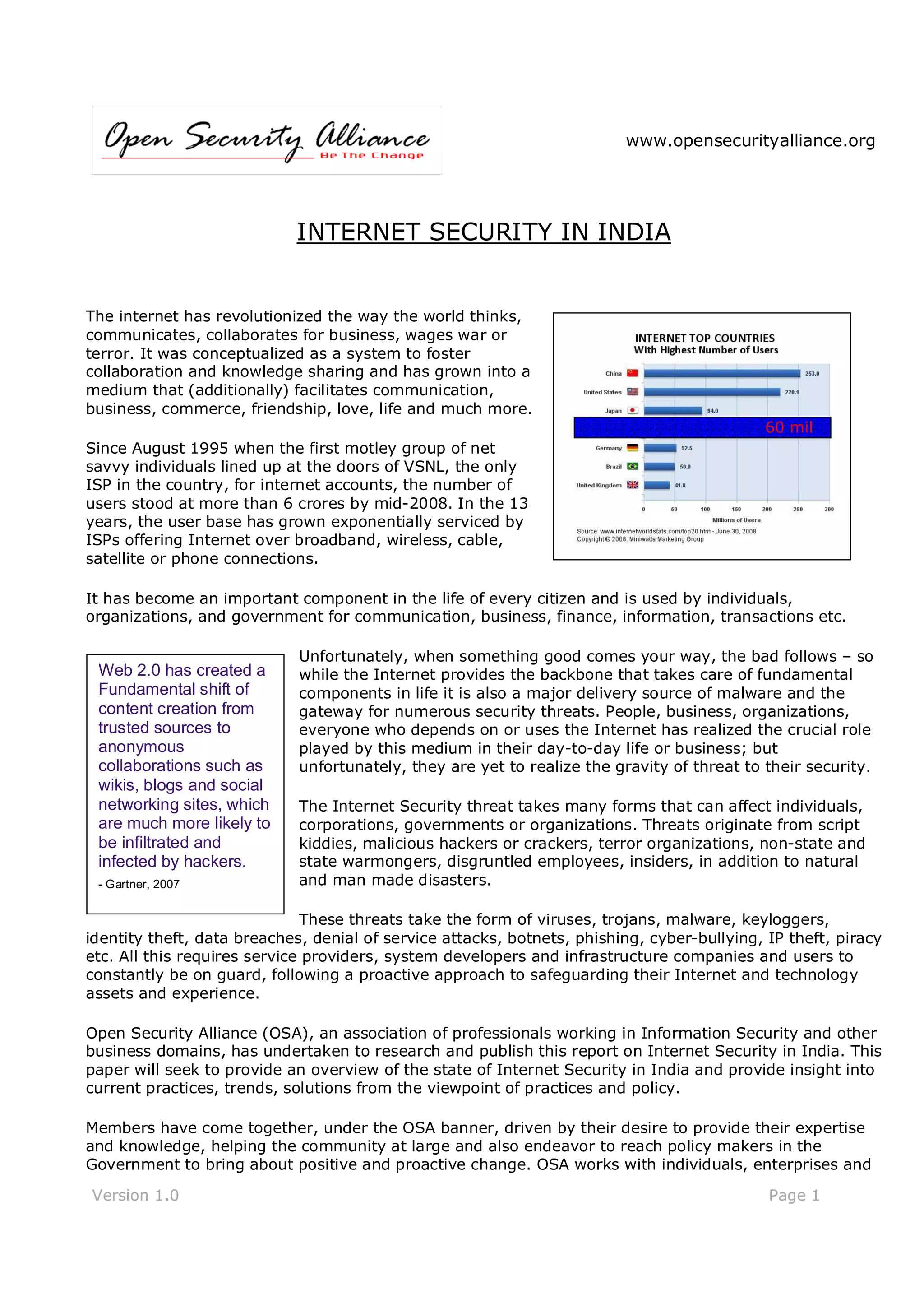
                                                                                             60 mil
Since August 1995 when the first motley group of net
savvy individuals lined up at the doors of VSNL, the only
ISP in the country, for internet accounts, the number of
users stood at more than 6 crores by mid-2008. In the 13
years, the user base has grown exponentially serviced by
ISPs offering Internet over broadband, wireless, cable,
satellite or phone connections.

It has become an important component in the life of every citizen and is used by individuals,
organizations, and government for communication, business, finance, information, transactions etc.

                             Unfortunately, when something good comes your way, the bad follows – so
 Web 2.0 has created a       while the Internet provides the backbone that takes care of fundamental
 Fundamental shift of        components in life it is also a major delivery source of malware and the
 content creation from       gateway for numerous security threats. People, business, organizations,
 trusted sources to          everyone who depends on or uses the Internet has realized the crucial role
 anonymous                   played by this medium in their day-to-day life or business; but
 collaborations such as      unfortunately, they are yet to realize the gravity of threat to their security.
 wikis, blogs and social
 networking sites, which     The Internet Security threat takes many forms that can affect individuals,
 are much more likely to     corporations, governments or organizations. Threats originate from script
 be infiltrated and          kiddies, malicious hackers or crackers, terror organizations, non-state and
 infected by hackers.        state warmongers, disgruntled employees, insiders, in addition to natural
 - Gartner, 2007             and man made disasters.

                              These threats take the form of viruses, trojans, malware, keyloggers,
identity theft, data breaches, denial of service attacks, botnets, phishing, cyber-bullying, IP theft, piracy
etc. All this requires service providers, system developers and infrastructure companies and users to
constantly be on guard, following a proactive approach to safeguarding their Internet and technology
assets and experience.

Open Security Alliance (OSA), an association of professionals working in Information Security and other
business domains, has undertaken to research and publish this report on Internet Security in India. This
paper will seek to provide an overview of the state of Internet Security in India and provide insight into
current practices, trends, solutions from the viewpoint of practices and policy.

Members have come together, under the OSA banner, driven by their desire to provide their expertise
and knowledge, helping the community at large and also endeavor to reach policy makers in the
Government to bring about positive and proactive change. OSA works with individuals, enterprises and

Version 1.0                                                                                  Page 1
www.opensecurityalliance.org


institutions to conduct research and studies in security technology with published reports and white
papers. The objective is to ‘demystify’ security technology and to provide practical and factual solutions
for security issues confronting the community and country.

Since the Alliance members are from different specializations, great value is delivered in providing a
collective, unbiased analysis and perception of Security in technology and business. This paper is
authored by a team of volunteer members of OSA and is written with the spirit of collaboration and the
passion to contribute that symbolizes the essence of the Internet.

In preparing this paper, OSA has taken an approach to identify user groups and broadly define security
issues facing these Internet users. Users have been categorized into three groups - the individual who
may be using the net for personal or professional work or entertainment; an organization or enterprise
that uses the net for facilitating their business transactions, communication and connectivity; and the
Government which will include all departments, bodies, organizations directly and indirectly connected
to the State.

Internet Security is as complex as the WWW and it’s working, and poses multiple to all user groups,
across the world.

The OSA team has followed the classic audit approach to address the subject
by is to gather information on industry practices to establish the terms of
reference, do a current state assessment, collect knowledge about global
practices, conduct a gap analysis by correlating current state with desired        8,10,00,000 Internet
industry and global practices, identify a prioritized list of suggestions for      users as of Nov/08,
action by concerned authorities and propose areas for collaboration.               7.1% penetration. (ITU)

As a first step the OSA team set about identifying and defining the Security       31,30,000 broadband
universe in industry best practices and standards. This was followed by            Internet connections as
interviews and interactions with individuals and enterprise users to arrive at     of Mar.31/08.(TRAI)
the current state assessment.

Next steps included expanding the knowledge with information about global
practices and a study of international organizations that provide thought
leadership in the Security domain. Yeoman work has been done by
organizations like NIST, CERT, CMU, ENISA, OGC, ISO, NSA, DHS, ISACA and many others across the
world and the frameworks, standards, practices and procedures are recognized and used for the value
they provide in mitigating risks from technology related security threats.

India presents a unique technology risk landscape with a net-aware population in urban areas and a
growing user population in rural areas that has to learn to mitigate threats on the Internet. It is
imperative to identify threats and vulnerabilities that may compromise the security of the user or that
of private or public infrastructure. We have to be proactive in initiating mitigation and remedial
strategies through research, studies, education and training. Government agencies, professional
organizations, academic research institutions and private enterprises have to lead the way in
establishing laws, practices and standards that will ensure security for the user.


Version 1.0                                                                                 Page 2
www.opensecurityalliance.org


References:

Awareness on data security on rise
http://www.deccanherald.com/Content/Mar232009/eb20090322125675.asp

Internet World Stats
http://www.internetworldstats.com/asia.htm#in

Internet and Mobile Association of India
http://www.iamai.in/PRelease_detail.aspx?nid=1801&NMonth=1&NYear=2009


Version 1.0                                                                  Page 3

OSA - Internet Security in India

  • 1.
    www.opensecurityalliance.org INTERNET SECURITY IN INDIA The internet has revolutionized the way the world thinks, communicates, collaborates for business, wages war or terror. It was conceptualized as a system to foster collaboration and knowledge sharing and has grown into a medium that (additionally) facilitates communication, business, commerce, friendship, love, life and much more. 60 mil Since August 1995 when the first motley group of net savvy individuals lined up at the doors of VSNL, the only ISP in the country, for internet accounts, the number of users stood at more than 6 crores by mid-2008. In the 13 years, the user base has grown exponentially serviced by ISPs offering Internet over broadband, wireless, cable, satellite or phone connections. It has become an important component in the life of every citizen and is used by individuals, organizations, and government for communication, business, finance, information, transactions etc. Unfortunately, when something good comes your way, the bad follows – so Web 2.0 has created a while the Internet provides the backbone that takes care of fundamental Fundamental shift of components in life it is also a major delivery source of malware and the content creation from gateway for numerous security threats. People, business, organizations, trusted sources to everyone who depends on or uses the Internet has realized the crucial role anonymous played by this medium in their day-to-day life or business; but collaborations such as unfortunately, they are yet to realize the gravity of threat to their security. wikis, blogs and social networking sites, which The Internet Security threat takes many forms that can affect individuals, are much more likely to corporations, governments or organizations. Threats originate from script be infiltrated and kiddies, malicious hackers or crackers, terror organizations, non-state and infected by hackers. state warmongers, disgruntled employees, insiders, in addition to natural - Gartner, 2007 and man made disasters. These threats take the form of viruses, trojans, malware, keyloggers, identity theft, data breaches, denial of service attacks, botnets, phishing, cyber-bullying, IP theft, piracy etc. All this requires service providers, system developers and infrastructure companies and users to constantly be on guard, following a proactive approach to safeguarding their Internet and technology assets and experience. Open Security Alliance (OSA), an association of professionals working in Information Security and other business domains, has undertaken to research and publish this report on Internet Security in India. This paper will seek to provide an overview of the state of Internet Security in India and provide insight into current practices, trends, solutions from the viewpoint of practices and policy. Members have come together, under the OSA banner, driven by their desire to provide their expertise and knowledge, helping the community at large and also endeavor to reach policy makers in the Government to bring about positive and proactive change. OSA works with individuals, enterprises and Version 1.0 Page 1
  • 2.
    www.opensecurityalliance.org institutions to conductresearch and studies in security technology with published reports and white papers. The objective is to ‘demystify’ security technology and to provide practical and factual solutions for security issues confronting the community and country. Since the Alliance members are from different specializations, great value is delivered in providing a collective, unbiased analysis and perception of Security in technology and business. This paper is authored by a team of volunteer members of OSA and is written with the spirit of collaboration and the passion to contribute that symbolizes the essence of the Internet. In preparing this paper, OSA has taken an approach to identify user groups and broadly define security issues facing these Internet users. Users have been categorized into three groups - the individual who may be using the net for personal or professional work or entertainment; an organization or enterprise that uses the net for facilitating their business transactions, communication and connectivity; and the Government which will include all departments, bodies, organizations directly and indirectly connected to the State. Internet Security is as complex as the WWW and it’s working, and poses multiple to all user groups, across the world. The OSA team has followed the classic audit approach to address the subject by is to gather information on industry practices to establish the terms of reference, do a current state assessment, collect knowledge about global practices, conduct a gap analysis by correlating current state with desired 8,10,00,000 Internet industry and global practices, identify a prioritized list of suggestions for users as of Nov/08, action by concerned authorities and propose areas for collaboration. 7.1% penetration. (ITU) As a first step the OSA team set about identifying and defining the Security 31,30,000 broadband universe in industry best practices and standards. This was followed by Internet connections as interviews and interactions with individuals and enterprise users to arrive at of Mar.31/08.(TRAI) the current state assessment. Next steps included expanding the knowledge with information about global practices and a study of international organizations that provide thought leadership in the Security domain. Yeoman work has been done by organizations like NIST, CERT, CMU, ENISA, OGC, ISO, NSA, DHS, ISACA and many others across the world and the frameworks, standards, practices and procedures are recognized and used for the value they provide in mitigating risks from technology related security threats. India presents a unique technology risk landscape with a net-aware population in urban areas and a growing user population in rural areas that has to learn to mitigate threats on the Internet. It is imperative to identify threats and vulnerabilities that may compromise the security of the user or that of private or public infrastructure. We have to be proactive in initiating mitigation and remedial strategies through research, studies, education and training. Government agencies, professional organizations, academic research institutions and private enterprises have to lead the way in establishing laws, practices and standards that will ensure security for the user. Version 1.0 Page 2
  • 3.
    www.opensecurityalliance.org References: Awareness on datasecurity on rise http://www.deccanherald.com/Content/Mar232009/eb20090322125675.asp Internet World Stats http://www.internetworldstats.com/asia.htm#in Internet and Mobile Association of India http://www.iamai.in/PRelease_detail.aspx?nid=1801&NMonth=1&NYear=2009 Version 1.0 Page 3