FRACTURE
Clinical and
radiological
features of
fractures
• A statement that the patient is unable to stand or walk
after an injury or to used the injured part must always
arouse suspicion of a fracture.
• The immediate appearance of deformity in a limb bone is
clearly diagnostic of fracture.
Clinical
examination
• Clinical examination
1. Visible or palpable deformity
2. Local swelling
3. Visible bruising
4. Marked local tenderness over bone
5. Marked impairment of function
Additional clinical
investigation
1. Skin wound
2. State of circulation
1. Color – blue, grey or white?
2. Warmth – warm or cold?
3. Arterial pulses
4. Capillary return – sluggish or
absent?
5. Nerve conductivity – loss of
sensibility?
3. State of the spinal cord and peripheral
nerves – sensibility, motor function and
sweating, bladder function?
Radiographic
examination
1. X-ray
2. Radioisotope scanning
3. Computerized tomography (CT Scan)
4. Magnetic resonance imaging (MRI)
Test of union -
criteria
1. Absence of mobility between the fragments
2. Absence tenderness on firm palpation over the
fractured site
3. Absence of pain when angulation stress is applied at the
site of fracture.
• Radiological test of union – criteria
1. Callus formation – bridging the fracture
2. Continuity of bone trabeculae across a fracture
Principles of
fracture
treatment
• Initial management
1. First aid
2. Clinical assessment
3. Resuscitation
Treatment of
uncomplicated
closed
fracture
Reduction
• Method of reduction
1. Manipulative reduction
2. Reduction by mechanical traction
3. Operative reduction
Humeral
shaft
Distal
forearm
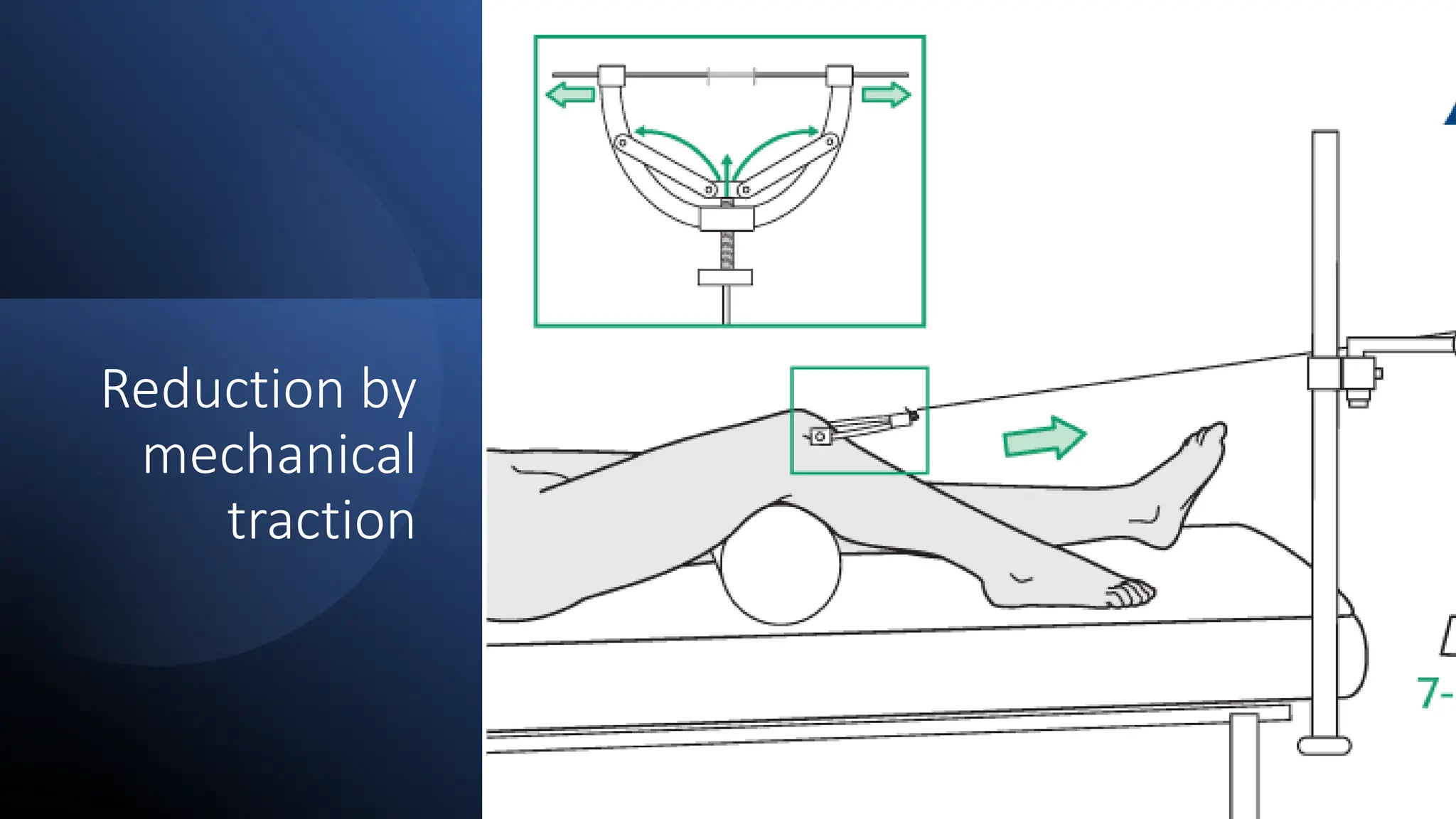
Reduction by
mechanical
traction
Methods of
immobilization
1. Immobilization by plaster, splint or brace
2. Immobilization by continuous traction
3. Immobilization by internal fixation
4. Immobilization by external fixation
Immobilization
by continuous
traction
Methods of
internal
fixation
Plate and screws
Cortical bone graft and screws
Intramedullary nail
Screw-plate and screws
Nail plate
Oblique transfixion screws
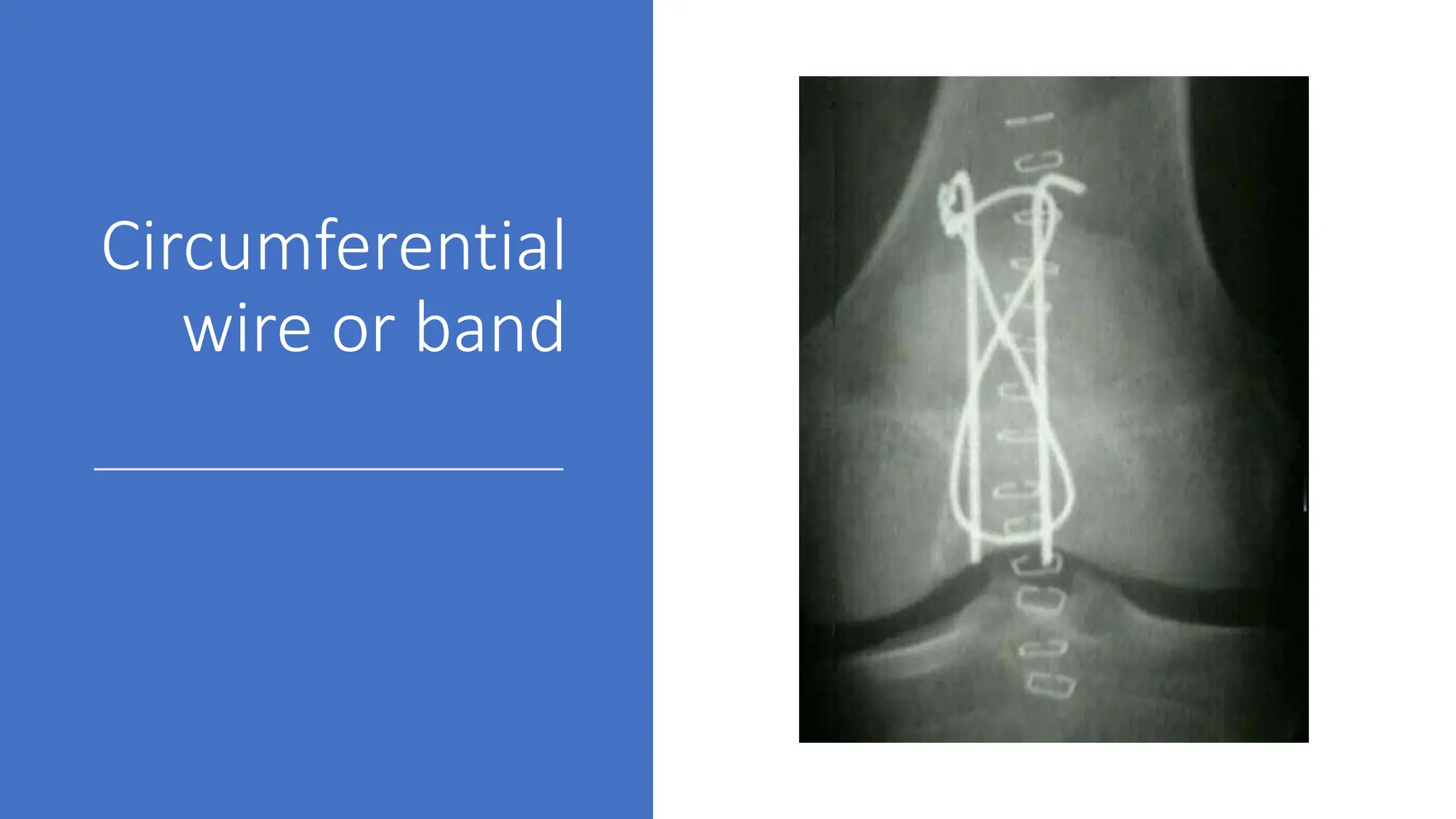
Circumferential wire or band
Plate and
screws
Cortical bone
graft and
screws
Intramedullary
nails
Screw-plate
and screws
Nail plate
Oblique
transfixion
screws
Circumferential
wire or band
Immobilization
by internal
fixation
Immobilization
by external
fixation
Metals for internal fixation
• Metals used must be resistant to corrosion in the tissues
• The following metals are not suitable
1. Silver
2. Iron
3. Ordinary steel
4. Nickel-plated steel
Rehabilitation
• Two purposes for rehabilitation
1. To preserve function so far as possible while fracture is uniting
2. To restore function to normal when the fractured is united.
• Two essential methods
1. Active use
2. Active exercise
Treatment of open fractures
• An open (compound) fracture always demands urgent attention.
• The sooner the wound is treated adequately, the smaller the risk of
infection arising from contaminating organism.

Orthopaedic and surgical conditions - Fractures.pptx