“SUCCESS AND FAILURES IN
ORGANIZATION DESIGN”
ORGANIZATION DESIGN
 Organizational design is a step-by-step methodology which
identifies dysfunctional aspects of work flow, procedures,
structures and systems, realigns them to fit current business
realities/goals and then develops plans to implement the new
changes. The process focuses on improving both the
technical and people side of the business.
BENEFITS OF UPDATING
ORGANIZATION DESIGN
 Excellent customer service
 Increased profitability
 Reduced operating costs
 Improved efficiency and cycle time
 A culture of committed and engaged employees
 A clear strategy for managing and growing your business
IMPACT OF LACKNESS IN OD
 Inefficient workflow with breakdowns and non value-
added steps
 Redundancies in effort (“we don‟t have time to do things
right, but do have time to do them over”)
 Fragmented work with little regard for good of the whole
(Production ships bad parts to meet their quotas)
 Lack of knowledge and focus on the customer
 Silo mentality and turf battles
 Lack of ownership (“It‟s not my job”)
 Cover up and blame rather than identifying and solving
problems
 Delays in decision-making
 People don’t have information or authority to
solve problems when and where they occur
 Management, rather than the front line, is
responsible for solving problems when things
go wrong
 It takes a long time to get something done
 Systems are ill-defined or reinforce wrong
behaviors
 Mistrust between workers and management
10 PRINCIPLES OF SUCCESS OR
FAILURE OF ORGANIZATION DESIGN
 1. Clear performance focus
 Success comes from a tight, clear connection between change expectations
and business results. Failures come when an organization is overly focused
on activities, skills and culture, or structural changes without creating a
tight linkage to business results.
 2. A winning strategy
 Projects & organizations succeed when the strategies play to strengths.
Failure happens when there is an overestimation of strength(s) and/or no
ability to document concrete „wins.‟
 3. A compelling and urgent case for change
 Success happens because there is a widely accepted „felt‟ need for change.
Failure occurs when there is no demonstrated commitment to the need for
change.
 4. Specific change criteria
 In successful efforts, the underlying performance criteria and change
requirements are clear, documented and not negotiable. If the „rules‟ shift
or evolve or can be negotiated, failure follows.
 5. Distinction between decision-driven and behavior-dependent
change
 Some change can be „decided‟ – restructuring, purchases, hires/fires, etc.
Other change is „behavior-dependent‟ – skills development, new
processes, implementing new accountabilities, etc. Organizations that
over „decide‟ and underinvest in „behavior‟ changes fail.
 6. Structure and systems requirements
 Structure and systems (particularly IT) changes may be required for
change but are almost always overused as either the answer or the
excuse. Overdependence on structure and systems results in confusion
and sapped energy, and is a great technique for stalling progress.
 7. Appropriate skills and resources
 Successful change often demands new skills that are being created;
requiring some level of transition resources until new skills are fully
functional.
 8. Mobilized and engaged pivotal groups
 Organizations that succeed tap critical internal influencers to champion the
change and actively engage staff in driving the change..
 9. Tight integration and alignment of all initiatives
 Major change inevitably requires dozens of initiatives (strategy projects,
re-engineering efforts, training, leadership development, communications,
technical redesign, new measurements, etc.). The result is a massive
integration challenge.
 10. Leader ability and willingness to change
 The ceiling on any attempt to change at the project, department or
organization level is set at the leaders‟ willingness to embrace and embody
the change.
EVALUATION OF SUCCESS OR FAILURE
 Surveys:
You should perform customer surveys from time to time.
You can do this by mailing out postcards, asking customers
directly or sending surveys through email. While it is possible to
have good customer service and not make a profit, it is nearly
impossible to have bad customer service and make a profit.
 Prioritize:
Once you have devised several ways to evaluate your
success or failure, prioritize those methods. If you are a startup
business and don't expect to make a profit for a year or so,
numbers may not be your highest priority.
 Ask Your Stakeholders:
Stakeholders are the people who have an interest in how
your business is doing. This includes employees, managers,
lenders, vendors, investors and contractors. Ask your
stakeholders what their perceptions are about how well the
business is doing. Lenders will certainly tell you if they see
financial problems lurking, and vendors will give you an honest
appraisal of what they see in your dealings with them.
 Evaluate the Evidence:
Don't overlook hard numbers. You are either paying the
bills or you are not; you are either making a profit or you are
not, and you are meeting your payroll or you are not.
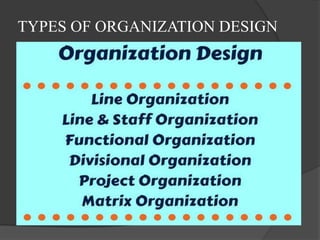
TYPES OF ORGANIZATION DESIGN
CONCLUSION
 Although introducing more efficient business practices to
improve organizational functioning is desirable, executives
should avoid letting their firms become “out of control” by
being skeptical of management fads. Finally, the legal form
a business takes is an important decision with implications
for a firm‟s organizational structure.

Organizational design

  • 2.
    “SUCCESS AND FAILURESIN ORGANIZATION DESIGN”
  • 4.
    ORGANIZATION DESIGN  Organizationaldesign is a step-by-step methodology which identifies dysfunctional aspects of work flow, procedures, structures and systems, realigns them to fit current business realities/goals and then develops plans to implement the new changes. The process focuses on improving both the technical and people side of the business.
  • 5.
    BENEFITS OF UPDATING ORGANIZATIONDESIGN  Excellent customer service  Increased profitability  Reduced operating costs  Improved efficiency and cycle time  A culture of committed and engaged employees  A clear strategy for managing and growing your business
  • 6.
    IMPACT OF LACKNESSIN OD  Inefficient workflow with breakdowns and non value- added steps  Redundancies in effort (“we don‟t have time to do things right, but do have time to do them over”)  Fragmented work with little regard for good of the whole (Production ships bad parts to meet their quotas)  Lack of knowledge and focus on the customer  Silo mentality and turf battles  Lack of ownership (“It‟s not my job”)  Cover up and blame rather than identifying and solving problems
  • 7.
     Delays indecision-making  People don’t have information or authority to solve problems when and where they occur  Management, rather than the front line, is responsible for solving problems when things go wrong  It takes a long time to get something done  Systems are ill-defined or reinforce wrong behaviors  Mistrust between workers and management
  • 8.
    10 PRINCIPLES OFSUCCESS OR FAILURE OF ORGANIZATION DESIGN  1. Clear performance focus  Success comes from a tight, clear connection between change expectations and business results. Failures come when an organization is overly focused on activities, skills and culture, or structural changes without creating a tight linkage to business results.  2. A winning strategy  Projects & organizations succeed when the strategies play to strengths. Failure happens when there is an overestimation of strength(s) and/or no ability to document concrete „wins.‟  3. A compelling and urgent case for change  Success happens because there is a widely accepted „felt‟ need for change. Failure occurs when there is no demonstrated commitment to the need for change.
  • 9.
     4. Specificchange criteria  In successful efforts, the underlying performance criteria and change requirements are clear, documented and not negotiable. If the „rules‟ shift or evolve or can be negotiated, failure follows.  5. Distinction between decision-driven and behavior-dependent change  Some change can be „decided‟ – restructuring, purchases, hires/fires, etc. Other change is „behavior-dependent‟ – skills development, new processes, implementing new accountabilities, etc. Organizations that over „decide‟ and underinvest in „behavior‟ changes fail.  6. Structure and systems requirements  Structure and systems (particularly IT) changes may be required for change but are almost always overused as either the answer or the excuse. Overdependence on structure and systems results in confusion and sapped energy, and is a great technique for stalling progress.
  • 10.
     7. Appropriateskills and resources  Successful change often demands new skills that are being created; requiring some level of transition resources until new skills are fully functional.  8. Mobilized and engaged pivotal groups  Organizations that succeed tap critical internal influencers to champion the change and actively engage staff in driving the change..  9. Tight integration and alignment of all initiatives  Major change inevitably requires dozens of initiatives (strategy projects, re-engineering efforts, training, leadership development, communications, technical redesign, new measurements, etc.). The result is a massive integration challenge.  10. Leader ability and willingness to change  The ceiling on any attempt to change at the project, department or organization level is set at the leaders‟ willingness to embrace and embody the change.
  • 11.
    EVALUATION OF SUCCESSOR FAILURE  Surveys: You should perform customer surveys from time to time. You can do this by mailing out postcards, asking customers directly or sending surveys through email. While it is possible to have good customer service and not make a profit, it is nearly impossible to have bad customer service and make a profit.  Prioritize: Once you have devised several ways to evaluate your success or failure, prioritize those methods. If you are a startup business and don't expect to make a profit for a year or so, numbers may not be your highest priority.
  • 12.
     Ask YourStakeholders: Stakeholders are the people who have an interest in how your business is doing. This includes employees, managers, lenders, vendors, investors and contractors. Ask your stakeholders what their perceptions are about how well the business is doing. Lenders will certainly tell you if they see financial problems lurking, and vendors will give you an honest appraisal of what they see in your dealings with them.  Evaluate the Evidence: Don't overlook hard numbers. You are either paying the bills or you are not; you are either making a profit or you are not, and you are meeting your payroll or you are not.
  • 13.
  • 14.
    CONCLUSION  Although introducingmore efficient business practices to improve organizational functioning is desirable, executives should avoid letting their firms become “out of control” by being skeptical of management fads. Finally, the legal form a business takes is an important decision with implications for a firm‟s organizational structure.