Copyright ©2010 Pearson Education, Inc. Publishing as Prentice Hall 15-1
Organizational Culture
Copyright ©2010 Pearson Education, Inc. Publishing as Prentice Hall 15-2
Organizational
Culture
A system of shared meaning held by members
that distinguishes the organization from other
organizations
•Composed of seven key characteristics
Copyright ©2010 Pearson Education, Inc. Publishing as Prentice Hall 15-3
Seven Characteristics of
Organizational Culture
1. Innovation and Risk Taking
2. Attention to Detail
3. Outcome Orientation
4. People Orientation
5. Team Orientation
6. Aggressiveness
7. Stability
Copyright ©2010 Pearson Education, Inc. Publishing as Prentice Hall 15-4
Culture Is a Descriptive Term
Culture
• Organizational culture is
concerned with how employees
perceive an organization’s
culture, not whether or not they
like it
• Descriptive
Job Satisfaction
• Measures affective responses to
the work environment: concerned
with how employees feel about
the organization
• Evaluative
Copyright ©2010 Pearson Education, Inc. Publishing as Prentice Hall 15-5
Do Organizations Have Uniform
Cultures?
• The dominant culture expresses the core values that are shared by a majority
of the organization’s members
• Subcultures tend to develop in large organizations to reflect common
problems, situations, or experiences of members
• Subcultures mirror the dominant culture but may add to or modify the core
values
Copyright ©2010 Pearson Education, Inc. Publishing as Prentice Hall 15-6
Strong Cultures
• In a strong culture, the organization’s core values are both intensely held
and widely shared
• Strong cultures will:
 Have great influence on the
behavior of its members
 Increase cohesiveness
 Result in lower employee
turnover
Copyright ©2010 Pearson Education, Inc. Publishing as Prentice Hall 15-7
Culture Versus Formalization
• Both seek predictability, orderliness, and consistency
• Culture controls by increasing behavioral consistency
• Formalization controls through policies and written documentation
• Strong cultures can be a substitute for formalization
Copyright ©2010 Pearson Education, Inc. Publishing as Prentice Hall 15-8
Culture’s Five Basic
Functions
• Defines Boundaries
• Conveys a Sense of Identity
• Generates Commitment Beyond Oneself
• Enhances Social Stability
• Sense-making and Control Mechanism
Copyright ©2010 Pearson Education, Inc. Publishing as Prentice Hall 15-9
Culture as a Liability
• Barrier to Change
 Culture is slow to change – even in a dynamic environment
• Barrier to Diversity
 Culture seeks to minimize diversity
 Can embed prevalent bias and prejudice
• Barrier to Acquisitions and Mergers
 Most mergers fail due to cultural incompatibility
Copyright ©2010 Pearson Education, Inc. Publishing as Prentice Hall 15-10
Creating Culture
• Ultimate source of an organization’s culture is its founders
• Founders create culture in three ways:
 By hiring and keeping those who think and feel the same way they do
 Indoctrinating and socializing those employees to their way of thinking
and feeling
 Acting as a role model and encouraging employees to identify with them
Copyright ©2010 Pearson Education, Inc. Publishing as Prentice Hall 15-11
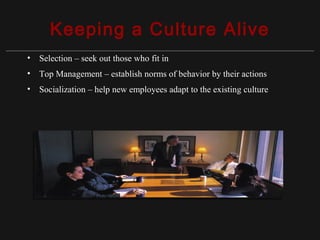
Keeping a Culture Alive
• Selection – seek out those who fit in
• Top Management – establish norms of behavior by their actions
• Socialization – help new employees adapt to the existing culture
Copyright ©2010 Pearson Education, Inc. Publishing as Prentice Hall 15-12
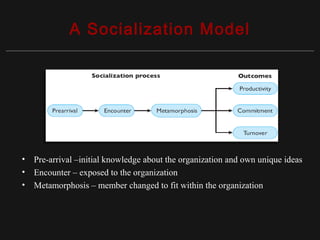
A Socialization Model
• Pre-arrival –initial knowledge about the organization and own unique ideas
• Encounter – exposed to the organization
• Metamorphosis – member changed to fit within the organization
Copyright ©2010 Pearson Education, Inc. Publishing as Prentice Hall 15-13
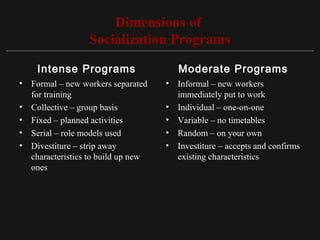
Dimensions of
Socialization Programs
Intense Programs
• Formal – new workers separated
for training
• Collective – group basis
• Fixed – planned activities
• Serial – role models used
• Divestiture – strip away
characteristics to build up new
ones
Moderate Programs
• Informal – new workers
immediately put to work
• Individual – one-on-one
• Variable – no timetables
• Random – on your own
• Investiture – accepts and confirms
existing characteristics
Copyright ©2010 Pearson Education, Inc. Publishing as Prentice Hall 15-14
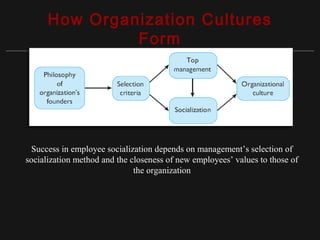
How Organization Cultures
Form
Success in employee socialization depends on management’s selection of
socialization method and the closeness of new employees’ values to those of
the organization
Copyright ©2010 Pearson Education, Inc. Publishing as Prentice Hall 15-15
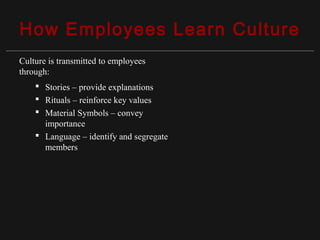
How Employees Learn Culture
Culture is transmitted to employees
through:
 Stories – provide explanations
 Rituals – reinforce key values
 Material Symbols – convey
importance
 Language – identify and segregate
members
Copyright ©2010 Pearson Education, Inc. Publishing as Prentice Hall 15-16
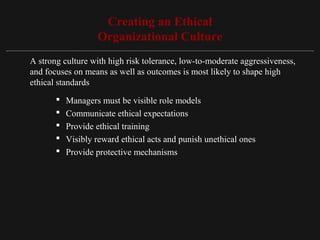
Creating an Ethical
Organizational Culture
A strong culture with high risk tolerance, low-to-moderate aggressiveness,
and focuses on means as well as outcomes is most likely to shape high
ethical standards
 Managers must be visible role models
 Communicate ethical expectations
 Provide ethical training
 Visibly reward ethical acts and punish unethical ones
 Provide protective mechanisms
Copyright ©2010 Pearson Education, Inc. Publishing as Prentice Hall 15-17
Creating a Positive Organizational Culture
A positive culture is one that emphasizes the
following:
•Building on Employee Strengths
•Rewarding More Than Punishing
•Emphasizing Vitality and Growth of the Employee
Copyright ©2010 Pearson Education, Inc. Publishing as Prentice Hall 15-18
Global Implications
National and Organizational Cultures:
 Organizations exist in a global context
Must be aware of local and national cultures
Suggestions and Observations:
• Organizations heavily dependent on foreign markets and labor
• National culture does influence organizational culture
• All managers must be culturally sensitive
Copyright ©2010 Pearson Education, Inc. Publishing as Prentice Hall 15-19
Implications for Managers
• Create the culture you want
when the organization is small
and new
• If established culture needs to be
changed, expect it to take years

Organizational culture (1)

  • 1.
    Copyright ©2010 PearsonEducation, Inc. Publishing as Prentice Hall 15-1 Organizational Culture
  • 2.
    Copyright ©2010 PearsonEducation, Inc. Publishing as Prentice Hall 15-2 Organizational Culture A system of shared meaning held by members that distinguishes the organization from other organizations •Composed of seven key characteristics
  • 3.
    Copyright ©2010 PearsonEducation, Inc. Publishing as Prentice Hall 15-3 Seven Characteristics of Organizational Culture 1. Innovation and Risk Taking 2. Attention to Detail 3. Outcome Orientation 4. People Orientation 5. Team Orientation 6. Aggressiveness 7. Stability
  • 4.
    Copyright ©2010 PearsonEducation, Inc. Publishing as Prentice Hall 15-4 Culture Is a Descriptive Term Culture • Organizational culture is concerned with how employees perceive an organization’s culture, not whether or not they like it • Descriptive Job Satisfaction • Measures affective responses to the work environment: concerned with how employees feel about the organization • Evaluative
  • 5.
    Copyright ©2010 PearsonEducation, Inc. Publishing as Prentice Hall 15-5 Do Organizations Have Uniform Cultures? • The dominant culture expresses the core values that are shared by a majority of the organization’s members • Subcultures tend to develop in large organizations to reflect common problems, situations, or experiences of members • Subcultures mirror the dominant culture but may add to or modify the core values
  • 6.
    Copyright ©2010 PearsonEducation, Inc. Publishing as Prentice Hall 15-6 Strong Cultures • In a strong culture, the organization’s core values are both intensely held and widely shared • Strong cultures will:  Have great influence on the behavior of its members  Increase cohesiveness  Result in lower employee turnover
  • 7.
    Copyright ©2010 PearsonEducation, Inc. Publishing as Prentice Hall 15-7 Culture Versus Formalization • Both seek predictability, orderliness, and consistency • Culture controls by increasing behavioral consistency • Formalization controls through policies and written documentation • Strong cultures can be a substitute for formalization
  • 8.
    Copyright ©2010 PearsonEducation, Inc. Publishing as Prentice Hall 15-8 Culture’s Five Basic Functions • Defines Boundaries • Conveys a Sense of Identity • Generates Commitment Beyond Oneself • Enhances Social Stability • Sense-making and Control Mechanism
  • 9.
    Copyright ©2010 PearsonEducation, Inc. Publishing as Prentice Hall 15-9 Culture as a Liability • Barrier to Change  Culture is slow to change – even in a dynamic environment • Barrier to Diversity  Culture seeks to minimize diversity  Can embed prevalent bias and prejudice • Barrier to Acquisitions and Mergers  Most mergers fail due to cultural incompatibility
  • 10.
    Copyright ©2010 PearsonEducation, Inc. Publishing as Prentice Hall 15-10 Creating Culture • Ultimate source of an organization’s culture is its founders • Founders create culture in three ways:  By hiring and keeping those who think and feel the same way they do  Indoctrinating and socializing those employees to their way of thinking and feeling  Acting as a role model and encouraging employees to identify with them
  • 11.
    Copyright ©2010 PearsonEducation, Inc. Publishing as Prentice Hall 15-11 Keeping a Culture Alive • Selection – seek out those who fit in • Top Management – establish norms of behavior by their actions • Socialization – help new employees adapt to the existing culture
  • 12.
    Copyright ©2010 PearsonEducation, Inc. Publishing as Prentice Hall 15-12 A Socialization Model • Pre-arrival –initial knowledge about the organization and own unique ideas • Encounter – exposed to the organization • Metamorphosis – member changed to fit within the organization
  • 13.
    Copyright ©2010 PearsonEducation, Inc. Publishing as Prentice Hall 15-13 Dimensions of Socialization Programs Intense Programs • Formal – new workers separated for training • Collective – group basis • Fixed – planned activities • Serial – role models used • Divestiture – strip away characteristics to build up new ones Moderate Programs • Informal – new workers immediately put to work • Individual – one-on-one • Variable – no timetables • Random – on your own • Investiture – accepts and confirms existing characteristics
  • 14.
    Copyright ©2010 PearsonEducation, Inc. Publishing as Prentice Hall 15-14 How Organization Cultures Form Success in employee socialization depends on management’s selection of socialization method and the closeness of new employees’ values to those of the organization
  • 15.
    Copyright ©2010 PearsonEducation, Inc. Publishing as Prentice Hall 15-15 How Employees Learn Culture Culture is transmitted to employees through:  Stories – provide explanations  Rituals – reinforce key values  Material Symbols – convey importance  Language – identify and segregate members
  • 16.
    Copyright ©2010 PearsonEducation, Inc. Publishing as Prentice Hall 15-16 Creating an Ethical Organizational Culture A strong culture with high risk tolerance, low-to-moderate aggressiveness, and focuses on means as well as outcomes is most likely to shape high ethical standards  Managers must be visible role models  Communicate ethical expectations  Provide ethical training  Visibly reward ethical acts and punish unethical ones  Provide protective mechanisms
  • 17.
    Copyright ©2010 PearsonEducation, Inc. Publishing as Prentice Hall 15-17 Creating a Positive Organizational Culture A positive culture is one that emphasizes the following: •Building on Employee Strengths •Rewarding More Than Punishing •Emphasizing Vitality and Growth of the Employee
  • 18.
    Copyright ©2010 PearsonEducation, Inc. Publishing as Prentice Hall 15-18 Global Implications National and Organizational Cultures:  Organizations exist in a global context Must be aware of local and national cultures Suggestions and Observations: • Organizations heavily dependent on foreign markets and labor • National culture does influence organizational culture • All managers must be culturally sensitive
  • 19.
    Copyright ©2010 PearsonEducation, Inc. Publishing as Prentice Hall 15-19 Implications for Managers • Create the culture you want when the organization is small and new • If established culture needs to be changed, expect it to take years