Understanding self and
others (Johari Window)
The self
•Answers the question ‘who am I?’
•Meanings attached to a person by self and others
that are based on personal characteristics and on
people’s social roles and membership in various
groups
•Person can have multiple selves stemming from a
variety of identities (Self-pluralism)
•Ideal/possible self
The self
• Product of
• What you are
• What society expects you to be
• What experiences you have and how you deal with them
Self-presentation/impression
management: Revealing yourself to
others
•Self-consciousness – the process of knowing oneself
•Self monitoring - what do you present and why
•Presenting your true self - makes one vulnerable, so
we prefer to act according to social expectations, wear
masks and remain enigmas
• Assumption of maturity and sensitivity
• Of course, sometimes even we do not know our true selves
(cf self-consciousness)
Johari window
•The most useful model to describe the process of
human interaction, more specifically of giving and
receiving feedback
•Model depicts communication windows through
which feedback is given and received
•Through feedback and disclosure, you can reveal
more about yourself to others and learn more
about yourself from others
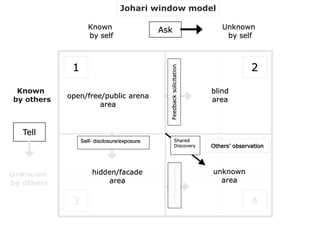
1 2
3 4
Known
by self
Unknown
by self
Ask
open/free/public arena
area
blind
area
unknown
area
hidden/facade
area
Known
by others
Unknown
by others
Tell
Johari window model
Self- disclosure/exposure Shared
Discovery
Feedback
solicitation
Self-discovery
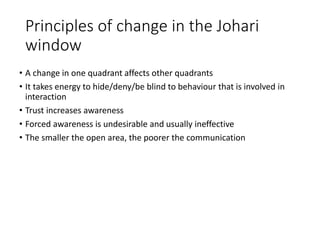
Principles of change in the Johari
window
• A change in one quadrant affects other quadrants
• It takes energy to hide/deny/be blind to behaviour that is involved in
interaction
• Trust increases awareness
• Forced awareness is undesirable and usually ineffective
• The smaller the open area, the poorer the communication
• Interpersonal learning means a change has taken
place so the Q1 is larger and one or more of the
other quadrants also has grown smaller.
• Working with others is facilitated by a large enough
area of free activity. An increased Q1 means more
of the resources and skills in the relationships can
be applied to a task.
• There is universal curiosity about the Unknown
area, but is held in check by custom, social training
and diverse fears.
• Sensitivity means appreciating the covert aspect of
behaviour, in quadrant 2, 3 and 4, and respecting
the desire of others to keep them so.
1
1
1
2
2
2
3
3
3
4
4
4
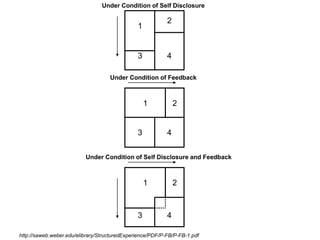
Under Condition of Self Disclosure
Under Condition of Feedback
Under Condition of Self Disclosure and Feedback
http://saweb.weber.edu/elibrary/StructuredExperience/PDF/P-FB/P-FB-1.pdf
Open
H
i
d
d
e
n
Blind
Unknown
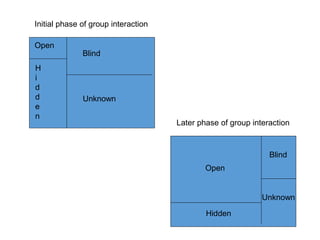
Initial phase of group interaction
Later phase of group interaction
Open
Hidden
Blind
Unknown
Feedback
• Purpose of feedback
• Helps us see ourselves as others see us
• Others learn how we see them
• In so doing, it helps us move towards our goals
• Presupposes a caring, trusting environment
• Which reduces defensiveness
• Which maximises personal growth
• The desire for feedback is often off-set by the fear of asking for such information
The appropriate way
•Feedback should be given such that the person
receiving it
• Hears it in the most objective, least distorted way possible
• Understands it
• Retains the choice of using/not using it
•People need to be trained to give feedback
• Should be given such that the recipient preserves his/her
self-esteem
•Indirect versus direct expression of feelings
• Indirect is safer because it is ambiguous and offers an escape
from commitment and rejection
•Description versus interpretation of behaviour
• Description focuses on observable aspects whereas
interpretation involves attributing intention and could be
wrong
•Non-evaluative versus evaluative feedback
• Non-evaluative looks at behaviour rather than personal
worth and refrains from value-judgments
•Specific versus general feedback
• Specific gives you an opportunity to know what to change
• Freedom of choice to change versus pressure to change
• Freedom of choice to change means that the decision to act on the feedback is
voluntary rather than imposed
• Immediate versus delayed timing
• Immediate feedback is most effective since memory is vivid
• External versus group feedback
• Contingent on circumstances
• Solicited versus imposed feedback
• Solicited is more useful since recipient is open
• Modifiable versus unmodifiable behaviour
• Conscious desire to change is critical
• Motivation to help versus motivation to hurt
• Displacement and projection precipitate harm and conflict
• Data-based versus impressionistic
• Positive and negative versus completely negative
• Suggestive versus prescriptive
• Constructive versus destructive
Receiving feedback
• Elicit versus wait
• Listening and self-analysis versus denial and rationalisation
• Clarifying versus assuming
References
• Assigned course readings
• http://www.noogenesis.com/game_theory/
johari/johari_window.html for Johari window
Benefits of knowing oneself
• Self-awareness promotes personal growth, which in turn enhances
overall functioning (including work performance)
Self-consciousness: The process of
knowing oneself
• Existentialist orientation coupled with personal courage and
conviction
• Conducive socio-cultural environment
• Living comfortably with complexity and contradiction
• Willingness and ability to change
• Time and energy for introspection
Open/Public Blind Spot
Hidden/Facade Area Unknown
Known To Self
Known To Others
Unknown To Others
Unknown To Self
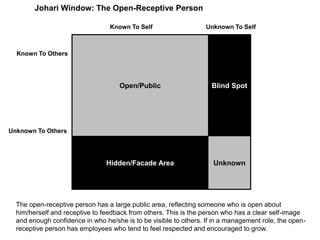
The open-receptive person has a large public area, reflecting someone who is open about
him/herself and receptive to feedback from others. This is the person who has a clear self-image
and enough confidence in who he/she is to be visible to others. If in a management role, the open-
receptive person has employees who tend to feel respected and encouraged to grow.
Johari Window: The Open-Receptive Person
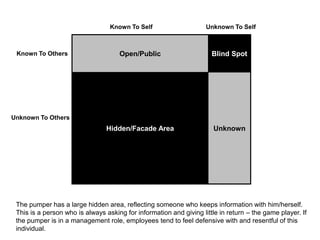
Johari Window: The Pumper
Open/Public Blind Spot
Hidden/Facade Area Unknown
Known To Self
Known To Others
Unknown To Others
Unknown To Self
The pumper has a large hidden area, reflecting someone who keeps information with him/herself.
This is a person who is always asking for information and giving little in return – the game player. If
the pumper is in a management role, employees tend to feel defensive with and resentful of this
individual.
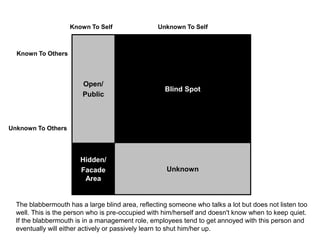
Johari Window: The Blabbermouth
Open/
Public
Blind Spot
Hidden/
Facade
Area
Unknown
Known To Self
Known To Others
Unknown To Others
Unknown To Self
The blabbermouth has a large blind area, reflecting someone who talks a lot but does not listen too
well. This is the person who is pre-occupied with him/herself and doesn't know when to keep quiet.
If the blabbermouth is in a management role, employees tend to get annoyed with this person and
eventually will either actively or passively learn to shut him/her up.
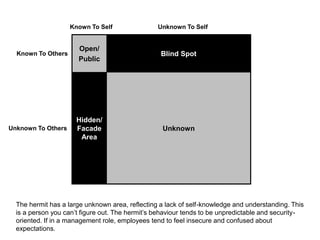
Johari Window: The Hermit
Open/
Public
Blind Spot
Hidden/
Facade
Area
Unknown
Known To Self
Known To Others
Unknown To Others
Unknown To Self
The hermit has a large unknown area, reflecting a lack of self-knowledge and understanding. This
is a person you can’t figure out. The hermit’s behaviour tends to be unpredictable and security-
oriented. If in a management role, employees tend to feel insecure and confused about
expectations.

organizational behaviour johari window model

  • 1.
  • 2.
    The self •Answers thequestion ‘who am I?’ •Meanings attached to a person by self and others that are based on personal characteristics and on people’s social roles and membership in various groups •Person can have multiple selves stemming from a variety of identities (Self-pluralism) •Ideal/possible self
  • 3.
    The self • Productof • What you are • What society expects you to be • What experiences you have and how you deal with them
  • 4.
    Self-presentation/impression management: Revealing yourselfto others •Self-consciousness – the process of knowing oneself •Self monitoring - what do you present and why •Presenting your true self - makes one vulnerable, so we prefer to act according to social expectations, wear masks and remain enigmas • Assumption of maturity and sensitivity • Of course, sometimes even we do not know our true selves (cf self-consciousness)
  • 5.
    Johari window •The mostuseful model to describe the process of human interaction, more specifically of giving and receiving feedback •Model depicts communication windows through which feedback is given and received •Through feedback and disclosure, you can reveal more about yourself to others and learn more about yourself from others
  • 6.
    1 2 3 4 Known byself Unknown by self Ask open/free/public arena area blind area unknown area hidden/facade area Known by others Unknown by others Tell Johari window model Self- disclosure/exposure Shared Discovery Feedback solicitation Self-discovery
  • 7.
    Principles of changein the Johari window • A change in one quadrant affects other quadrants • It takes energy to hide/deny/be blind to behaviour that is involved in interaction • Trust increases awareness • Forced awareness is undesirable and usually ineffective • The smaller the open area, the poorer the communication
  • 8.
    • Interpersonal learningmeans a change has taken place so the Q1 is larger and one or more of the other quadrants also has grown smaller. • Working with others is facilitated by a large enough area of free activity. An increased Q1 means more of the resources and skills in the relationships can be applied to a task. • There is universal curiosity about the Unknown area, but is held in check by custom, social training and diverse fears. • Sensitivity means appreciating the covert aspect of behaviour, in quadrant 2, 3 and 4, and respecting the desire of others to keep them so.
  • 9.
    1 1 1 2 2 2 3 3 3 4 4 4 Under Condition ofSelf Disclosure Under Condition of Feedback Under Condition of Self Disclosure and Feedback http://saweb.weber.edu/elibrary/StructuredExperience/PDF/P-FB/P-FB-1.pdf
  • 10.
    Open H i d d e n Blind Unknown Initial phase ofgroup interaction Later phase of group interaction Open Hidden Blind Unknown
  • 11.
    Feedback • Purpose offeedback • Helps us see ourselves as others see us • Others learn how we see them • In so doing, it helps us move towards our goals • Presupposes a caring, trusting environment • Which reduces defensiveness • Which maximises personal growth • The desire for feedback is often off-set by the fear of asking for such information
  • 12.
    The appropriate way •Feedbackshould be given such that the person receiving it • Hears it in the most objective, least distorted way possible • Understands it • Retains the choice of using/not using it •People need to be trained to give feedback • Should be given such that the recipient preserves his/her self-esteem
  • 13.
    •Indirect versus directexpression of feelings • Indirect is safer because it is ambiguous and offers an escape from commitment and rejection •Description versus interpretation of behaviour • Description focuses on observable aspects whereas interpretation involves attributing intention and could be wrong •Non-evaluative versus evaluative feedback • Non-evaluative looks at behaviour rather than personal worth and refrains from value-judgments •Specific versus general feedback • Specific gives you an opportunity to know what to change
  • 14.
    • Freedom ofchoice to change versus pressure to change • Freedom of choice to change means that the decision to act on the feedback is voluntary rather than imposed • Immediate versus delayed timing • Immediate feedback is most effective since memory is vivid • External versus group feedback • Contingent on circumstances • Solicited versus imposed feedback • Solicited is more useful since recipient is open
  • 15.
    • Modifiable versusunmodifiable behaviour • Conscious desire to change is critical • Motivation to help versus motivation to hurt • Displacement and projection precipitate harm and conflict • Data-based versus impressionistic • Positive and negative versus completely negative • Suggestive versus prescriptive • Constructive versus destructive
  • 16.
    Receiving feedback • Elicitversus wait • Listening and self-analysis versus denial and rationalisation • Clarifying versus assuming
  • 17.
    References • Assigned coursereadings • http://www.noogenesis.com/game_theory/ johari/johari_window.html for Johari window
  • 18.
    Benefits of knowingoneself • Self-awareness promotes personal growth, which in turn enhances overall functioning (including work performance)
  • 19.
    Self-consciousness: The processof knowing oneself • Existentialist orientation coupled with personal courage and conviction • Conducive socio-cultural environment • Living comfortably with complexity and contradiction • Willingness and ability to change • Time and energy for introspection
  • 20.
    Open/Public Blind Spot Hidden/FacadeArea Unknown Known To Self Known To Others Unknown To Others Unknown To Self The open-receptive person has a large public area, reflecting someone who is open about him/herself and receptive to feedback from others. This is the person who has a clear self-image and enough confidence in who he/she is to be visible to others. If in a management role, the open- receptive person has employees who tend to feel respected and encouraged to grow. Johari Window: The Open-Receptive Person
  • 21.
    Johari Window: ThePumper Open/Public Blind Spot Hidden/Facade Area Unknown Known To Self Known To Others Unknown To Others Unknown To Self The pumper has a large hidden area, reflecting someone who keeps information with him/herself. This is a person who is always asking for information and giving little in return – the game player. If the pumper is in a management role, employees tend to feel defensive with and resentful of this individual.
  • 22.
    Johari Window: TheBlabbermouth Open/ Public Blind Spot Hidden/ Facade Area Unknown Known To Self Known To Others Unknown To Others Unknown To Self The blabbermouth has a large blind area, reflecting someone who talks a lot but does not listen too well. This is the person who is pre-occupied with him/herself and doesn't know when to keep quiet. If the blabbermouth is in a management role, employees tend to get annoyed with this person and eventually will either actively or passively learn to shut him/her up.
  • 23.
    Johari Window: TheHermit Open/ Public Blind Spot Hidden/ Facade Area Unknown Known To Self Known To Others Unknown To Others Unknown To Self The hermit has a large unknown area, reflecting a lack of self-knowledge and understanding. This is a person you can’t figure out. The hermit’s behaviour tends to be unpredictable and security- oriented. If in a management role, employees tend to feel insecure and confused about expectations.