ORGANIZATIONAL
CULTURE
Western culture vs Eastern culture
Presentation
 Presented by:
Md. Amran Hossain
Lincoln University college – Malaysia
Definition
 Culture is the unique dominant pattern of
shared beliefs, assumptions, values, and
norms that shape the socialization, symbols,
language and practices of a group of people.
 The attitudes and approaches that typify the
way staff carry out their tasks.
 Culture is developed and transmitted by
people, consciously and unconsciously, to
subsequent generations.
What is the difference between organizational culture
and organizational identity.
 Organizational culture is shared
among members of
organization. Culture represents
heroes stories, success stories, sign,
symbol, etc. But, organizational
identity refers to
how other view about an
organization.
What must be for culture to
exist?
1. It must be shared by the vast majority of
members of a group or society;
2. It must be passed on from generation to
generation; and
3. It must shape behaviour and perceptions.
Cultural iceberg
Observable
elements of
culture
Not observable
•Practices
•Language
•Symbols
•Norms
•Values
•Assumptions
Shared assumptions
 Shared assumptions are the thoughts and
feelings that members of a culture take for
granted and believe to be true.
Values and norms
 Values are the basic beliefs people hold that
specify general preferences and behaviours,
and define what is right and wrong.
 Cultural values are reflected in a society’s morals,
customs and established practices
 Norms are rules that govern behaviours of
groups of people.
Symbols
 A symbols is any visible object, act, or event
that conveys meaning to others. Examples:
 Artefacts
 Dress
 Office layout
 Slogans
 ceremonies
Language
 Language is a shared system of vocal sounds,
written signs, and/or gestures used to convey
meaning among members of a culture.
The Nike swoosh was inspired by the
Greek goddess Nike, the winged goddess
of victory. The swoosh symbolizes her
flight. It conveys the meaning of a brand of
sports shoes
Practices
 Practices are observable cultural customs
such as taboos (culturally forbidden
behaviours) and ceremonies
Socialization
 Socialization is the process by which people
lean valves, norms, behaviours and social
skills. It is the means by which new members
are brought into a culture.
Types of organizational culture
 The basic types of organizational culture
are:
1. Bureaucratic
2. Clan
3. Market
4. Entrepreneurial
Bureaucratic Culture
 In this type of culture the behaviour of
employees is governed by formal rules and
standard operating procedures.
 Such a culture perpetuates stability.
 Organizations with bureaucratic culture tend to
produce standardized goods and services,
examples:
 Government ministries
 Fast food establishments
Clan Culture
 In a clan culture the behaviour of individuals are
shaped by tradition, loyalty, personal commitment,
extensive socialization and self-management.
 A clan culture achieve unity through socialization.
 Long-term employees serve as mentors
 Members are aware of the organization’s history
and have an understanding of the expected
manner of conduct and organizational style.
 Members share feelings of pride in membership.
 Peer pressure to adhere to important norms is
strong
Market Culture
 In a market culture, the values and norms reflect the
significance of achieving measurable and demanding goals
mainly concerning those that are financial and market based.
 Companies with a market culture tend to focus on:
 Sales growth
 Profitability
 Market share
 In a market culture the relationship between individuals and
the organization is contractual (previously agreed).
 Individuals are responsible for their performance; whereas
the organization promises specific rewards for levels of
performance.
 Managers are not judge on their effectiveness as role models
or mentors; but on monthly, quarterly, and annual
performance goals based on profit.
Entrepreneurial Culture
 Organizations
existing in the
context of an
entrepreneurial
culture are
characterized by high
levels of risk taking
and creativity.
 There is a
commitment to
experimentation,
innovation, and being
Steve Jobs – Apple
Relationship between culture and
organizational performance
 Organizational culture has the potential to
enhance organizational performance,
individual satisfaction, the sense of certainty
about how problems are to be handled.
 Culture serves as a control mechanism to
channel behaviour towards desired behaviours
and to prevent undesired behaviours.
Building a strong organizational
culture
1. A common behavioural style must be shared by
managers and employees.
2. Have the same basic approaches to solving
problems, meeting goals, and dealing with
stakeholders.
3. Have share common norms that guide rule
governing rewards and punishment.
4. A strong organizational culture assists in the
creation of a stable organization, the
consequence of which lead to the achievement
of the company’s strategic goals.
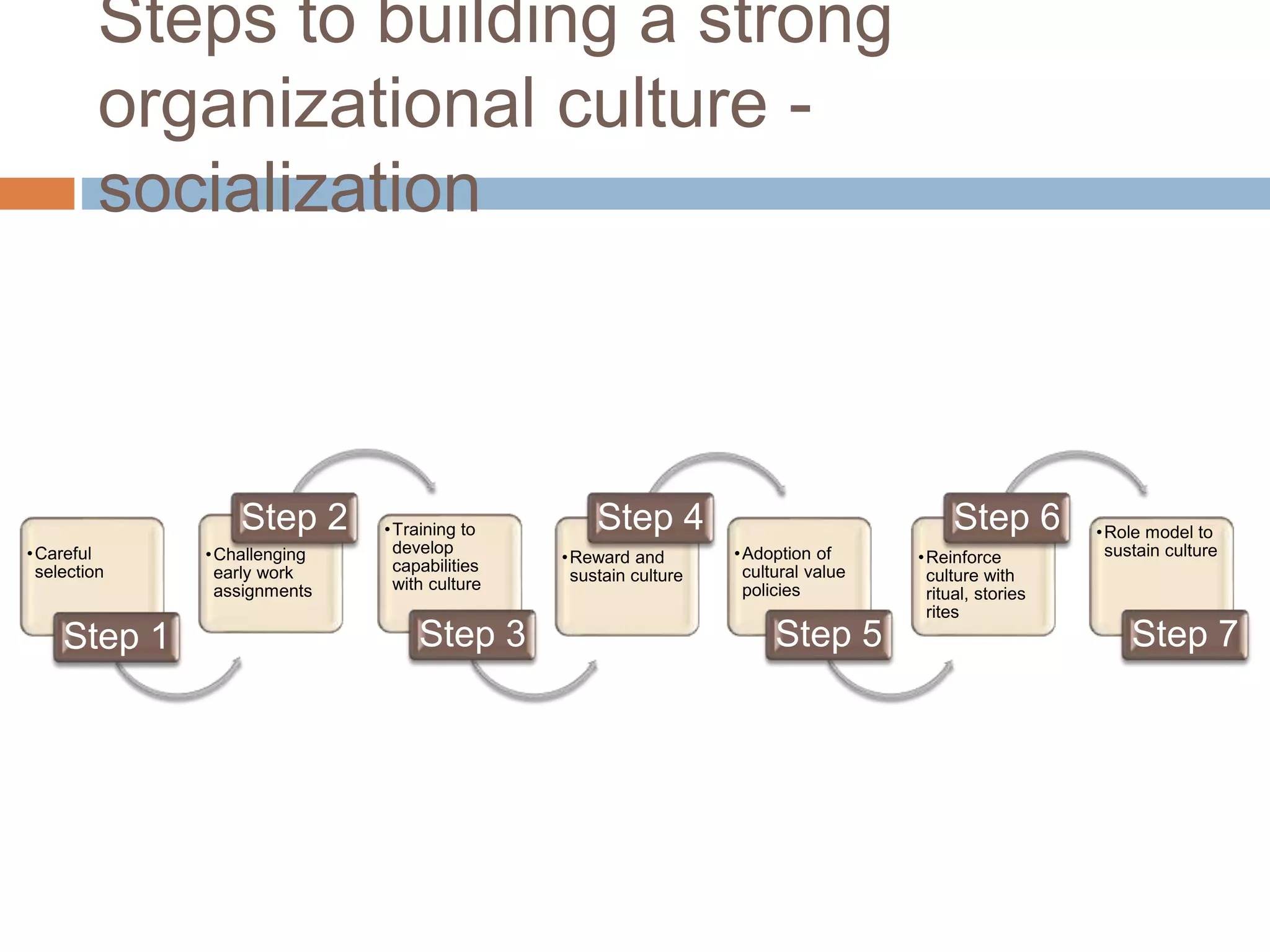
Steps to building a strong
organizational culture -
socialization
•Careful
selection
Step 1
•Challenging
early work
assignments
Step 2 •Training to
develop
capabilities
with culture
Step 3
•Reward and
sustain culture
Step 4
•Adoption of
cultural value
policies
Step 5
•Reinforce
culture with
ritual, stories
rites
Step 6 •Role model to
sustain culture
Step 7
Outcomes of socialization
process
 Job satisfaction
 Role clarity
 High work
performance
 Understanding of
culture
 Commitment to
organization
 Internal values
 Job dissatisfaction
 Role ambiguity and
conflict
 Misunderstanding,
tension, and
perceived lack of
control
 Low job involvement
 Low performance
 Rejection of values
Successful socialization Unsuccessful socialization
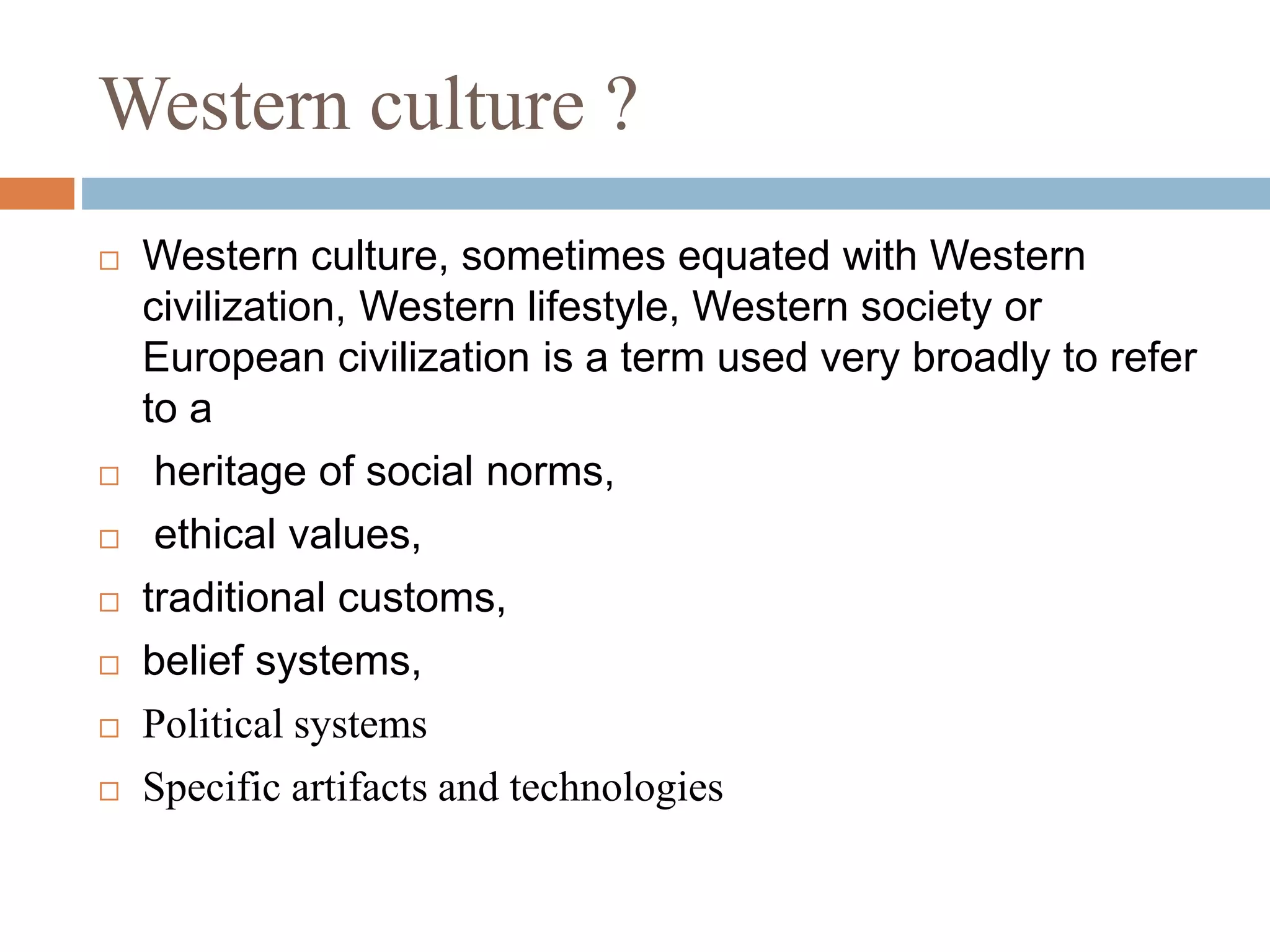
Western culture ?
 Western culture, sometimes equated with Western
civilization, Western lifestyle, Western society or
European civilization is a term used very broadly to refer
to a
 heritage of social norms,
 ethical values,
 traditional customs,
 belief systems,
 Political systems
 Specific artifacts and technologies
Western culture vs Eastern
culture
 Eastern culture
 Internal self control
 Communal
 Hierarchy
 Modesty
 Harmony
 Time is life
 Respect to statues
 Respect to elders
 Long term oriented
Western culture vs Eastern
culture
 Extern control
 Individual
 Equality
 Achievement winning pride
 Time is money & short term oriented
 Respect for result
 Respect competence
 Value privacy & open minded
 Independent and selfish
Thank you

organization culture ppt .pptx

  • 1.
  • 2.
    Presentation  Presented by: Md.Amran Hossain Lincoln University college – Malaysia
  • 3.
    Definition  Culture isthe unique dominant pattern of shared beliefs, assumptions, values, and norms that shape the socialization, symbols, language and practices of a group of people.  The attitudes and approaches that typify the way staff carry out their tasks.  Culture is developed and transmitted by people, consciously and unconsciously, to subsequent generations.
  • 4.
    What is thedifference between organizational culture and organizational identity.  Organizational culture is shared among members of organization. Culture represents heroes stories, success stories, sign, symbol, etc. But, organizational identity refers to how other view about an organization.
  • 5.
    What must befor culture to exist? 1. It must be shared by the vast majority of members of a group or society; 2. It must be passed on from generation to generation; and 3. It must shape behaviour and perceptions.
  • 6.
    Cultural iceberg Observable elements of culture Notobservable •Practices •Language •Symbols •Norms •Values •Assumptions
  • 7.
    Shared assumptions  Sharedassumptions are the thoughts and feelings that members of a culture take for granted and believe to be true.
  • 8.
    Values and norms Values are the basic beliefs people hold that specify general preferences and behaviours, and define what is right and wrong.  Cultural values are reflected in a society’s morals, customs and established practices  Norms are rules that govern behaviours of groups of people.
  • 9.
    Symbols  A symbolsis any visible object, act, or event that conveys meaning to others. Examples:  Artefacts  Dress  Office layout  Slogans  ceremonies
  • 10.
    Language  Language isa shared system of vocal sounds, written signs, and/or gestures used to convey meaning among members of a culture. The Nike swoosh was inspired by the Greek goddess Nike, the winged goddess of victory. The swoosh symbolizes her flight. It conveys the meaning of a brand of sports shoes
  • 11.
    Practices  Practices areobservable cultural customs such as taboos (culturally forbidden behaviours) and ceremonies
  • 12.
    Socialization  Socialization isthe process by which people lean valves, norms, behaviours and social skills. It is the means by which new members are brought into a culture.
  • 13.
    Types of organizationalculture  The basic types of organizational culture are: 1. Bureaucratic 2. Clan 3. Market 4. Entrepreneurial
  • 14.
    Bureaucratic Culture  Inthis type of culture the behaviour of employees is governed by formal rules and standard operating procedures.  Such a culture perpetuates stability.  Organizations with bureaucratic culture tend to produce standardized goods and services, examples:  Government ministries  Fast food establishments
  • 15.
    Clan Culture  Ina clan culture the behaviour of individuals are shaped by tradition, loyalty, personal commitment, extensive socialization and self-management.  A clan culture achieve unity through socialization.  Long-term employees serve as mentors  Members are aware of the organization’s history and have an understanding of the expected manner of conduct and organizational style.  Members share feelings of pride in membership.  Peer pressure to adhere to important norms is strong
  • 16.
    Market Culture  Ina market culture, the values and norms reflect the significance of achieving measurable and demanding goals mainly concerning those that are financial and market based.  Companies with a market culture tend to focus on:  Sales growth  Profitability  Market share  In a market culture the relationship between individuals and the organization is contractual (previously agreed).  Individuals are responsible for their performance; whereas the organization promises specific rewards for levels of performance.  Managers are not judge on their effectiveness as role models or mentors; but on monthly, quarterly, and annual performance goals based on profit.
  • 17.
    Entrepreneurial Culture  Organizations existingin the context of an entrepreneurial culture are characterized by high levels of risk taking and creativity.  There is a commitment to experimentation, innovation, and being Steve Jobs – Apple
  • 18.
    Relationship between cultureand organizational performance  Organizational culture has the potential to enhance organizational performance, individual satisfaction, the sense of certainty about how problems are to be handled.  Culture serves as a control mechanism to channel behaviour towards desired behaviours and to prevent undesired behaviours.
  • 19.
    Building a strongorganizational culture 1. A common behavioural style must be shared by managers and employees. 2. Have the same basic approaches to solving problems, meeting goals, and dealing with stakeholders. 3. Have share common norms that guide rule governing rewards and punishment. 4. A strong organizational culture assists in the creation of a stable organization, the consequence of which lead to the achievement of the company’s strategic goals.
  • 20.
    Steps to buildinga strong organizational culture - socialization •Careful selection Step 1 •Challenging early work assignments Step 2 •Training to develop capabilities with culture Step 3 •Reward and sustain culture Step 4 •Adoption of cultural value policies Step 5 •Reinforce culture with ritual, stories rites Step 6 •Role model to sustain culture Step 7
  • 21.
    Outcomes of socialization process Job satisfaction  Role clarity  High work performance  Understanding of culture  Commitment to organization  Internal values  Job dissatisfaction  Role ambiguity and conflict  Misunderstanding, tension, and perceived lack of control  Low job involvement  Low performance  Rejection of values Successful socialization Unsuccessful socialization
  • 22.
    Western culture ? Western culture, sometimes equated with Western civilization, Western lifestyle, Western society or European civilization is a term used very broadly to refer to a  heritage of social norms,  ethical values,  traditional customs,  belief systems,  Political systems  Specific artifacts and technologies
  • 23.
    Western culture vsEastern culture  Eastern culture  Internal self control  Communal  Hierarchy  Modesty  Harmony  Time is life  Respect to statues  Respect to elders  Long term oriented
  • 24.
    Western culture vsEastern culture  Extern control  Individual  Equality  Achievement winning pride  Time is money & short term oriented  Respect for result  Respect competence  Value privacy & open minded  Independent and selfish
  • 25.