1.Theories/ Views Of Ethics
 Ethics has always been a concern for society and its various
institutions/stakeholders.
 Because different scholars have different perspectives about ethics
due to their working conditions and professions, there are many
views about ethics.
 Even though it is too difficult to put only limited views of ethics,
we have used the following views of ethics for the purpose of this
course.
A.The Utilitarian View Of Ethics
 This approach espoused by Jeremy Bentham and John Stuart Mill, holds
that moral behavior produces the greatest good for the greatest
number.
 The utilitarian ethic focuses on the distribution of benefits and harms
to all stakeholders with the view to maximizing benefits.
 Under this approach, a decision maker is expected to consider the effect
of each decision alternative on all parties and select the one that
optimizes the satisfaction for the greatest number of people.
Utilitarianismisusedfrequentlywhenbusiness
leaders make critical decisions about things
like expansion, store closings, hiring, and
layoffs.
 Utilitarian decision making relies on a systematic
comparison of the costs and benefits to all affected
parties.
 Using such a cost–benefit analysis, a utilitarian
decision maker calculates the utility of the
consequences of all possible alternatives and then
selectstheonethatresultsinthegreatestbenefit.
Simple cost-benefits
analysis is not a utilitarian
calculus unless it includes
consideration of all
stakeholders and a full
accounting of
externalities, worker
preferences, potentially
coercive actions related to
customers, or community
and environmental
effects. 4
B.The Rights/Individualism View Of Ethics
 Given human nature, it is difficult-if not impossible-to eliminateself-
interest.
 The individual rights ethic relies on a list of agreed-upon rights for
everyone that will be upheld by everyone and that becomes the basis for
deciding what is right, just, orfair.
 The rights view of ethics says that ethical decisions are concerned with
respecting and protecting individual liberties and privileges such as
the rights of privacy, freedom of conscience, free speech, life and
safety, and dueprocess.
 Right views of ethics based on behaviour maintain the
fundamental rights of all human being
 There are six moral rights that should be considered
during decision making according to this view.
 They are:
 The right of free consent:
 The right toprivacy:
 The right of freedom of conscience:
 The right of free speech:
 The right to due process:
 The right to life and safety:
C. The Theory Of Justice View Of Ethics
 Thetheoryofjusticeviewofethicsstatesthatdecisionmakersseekto
impose and enforce rules fairly and impartially.
 The justice approach holds that moral decisions must be based on
standards of equity, fairness, and impartiality.
 Justice as it is applied in business ethics involves evaluations of fairness
or the disposition to deal with perceived injustices of others.
 Justice is fair treatment and due reward in accordance with ethical or
legal standards.
 Three types of justice provide a framework for evaluating the
fairness of different situations.
 These are
 Distributive justice,
 Procedural justice, and
 Interactional justice.
D. Integrative-social Contracts Theory
 Integrative social contracts theory proposes that ethical decisions should be
based on empirical (what is) and normative (what should be) factors.
 This view is based on the integration of two “contracts” the general social contract
and a more specific contract among members of a specific community that might
be affected by a decision.
 The term “integrative”is used to illustrate that ISCT is based on a hypothetical
social contract whose terms allowfor the generationofbinding ethical obligations
through the recognition of actual norms created in real social and economic
communities.
2. Ethical Egoism &Subjectivism
Ethical Egoism
 Egoism defines right or acceptable behavior
in terms of its consequences for the
individual. They believe that they should
make decisions that maximize their own
self-interest, which is defined differently by
each individual.
 The egoist „s creed generally can be stated as
“Do the act that promotes the greatest good
for oneself”.
Ethical Subjectivism
 Ethical subjectivism argues that no ethical
theory is objectively true. Statements
contained in those theories, such as the duty to
act in one‟s self interest, are only true as
long as they are believed by the person
holding the theory. Therefore, ethics
becomes less a matter of what is objectively
true and more a matter of individual
perception.
Cont‟d
 Many believe that egoistic people and
companies are inherently unethical,
are short-term oriented,and will take
advantage of anyopportunity.
 For example, if you would benefit
more from keeping 100,000 than you
would from donating it to charity
then the morally correct decision
would be to keep the money for
yourself if you are an ethical egoist.
Cont‟d
 Ethical subjectivist would argue that those
supposedly objective justifications are really
just subjective statements of the person‟s
values and desires.
 If Person A believes it is morally right to keep
100,000 instead of donating it to charity, then
for Person A that is the ethical thing to do.
However, if Person B believes donating the
money to others would be ethically correct
then for Person B that is the correct ethical
decision.
Cont‟d
 Ethical egoism contends each person has a
duty to act in ways that promote his or her
self-interest above the interests of all
others. When a moral decision must be
made, the person should exclusively
consider how the results will benefit him or
her.
 However, there is also enlightened egoism.
Enlightened egoists take a long-range
perspective and allow for the well-being
of others although their own self-interest
remains paramount.
Cont‟d
 People have different opinions, but where
morality isconcerned,thereare noʺfactsʺ
and no one is ʺrightʺ. People just feel
differently, and that‟s the end of it. This is
the basic thought behind Ethical
Subjectivism.
 Ethical Subjectivism is the idea that our
moral opinions are based on our feelings
and nothing more. On this view, there is
no such thing as ʺobjectiveʺ right or
Cont‟d
 An example of enlightened
egoism is helping a turtle across
a highway because, if killed, the
person would feeldistressed.
 To feel good, or eliminate the
chance of a feeling of distress,
the person helps the turtle to
cross the road.
Cont‟d
 Ethical subjectivism contends
that objective concepts of good
and evil or right and wrong do
not exist.
 This leads into other theories
such as moral relativism which
suggests these concepts are
determined by agreement.
3. Principles of BusinessEthics
 In today „s ultra-competitive, high tech, interdependent business world,
charisma without conscience and cleverness without character is arecipe for
economic and personal failure of marathon proportions.
 Competitiveness, ambition and innovation will always be important to success
but they must be regulated by core ethical principles like the ones described
below.
 Ethical principles are universal standards of right and wrong prescribing the
kindofbehavioranethicalcompanyorpersonshouldandshouldnotengagein.
 Principles is characterized by its being permanent or remain constant,work
anywhere, when violated produce destruction and contain inherent
judgment.
 In business, how people judge your character is critical to sustainable
success because it is the basis of trust and credibility. Abraham Lincoln
described “character as the tree and reputation as the shadow”.
Thus, your reputation is purely a function of perceptions while your
character is determined and defined by your actions (i.e., Whether
your actions are honorable and ethical according to the 12 ethical
principles):
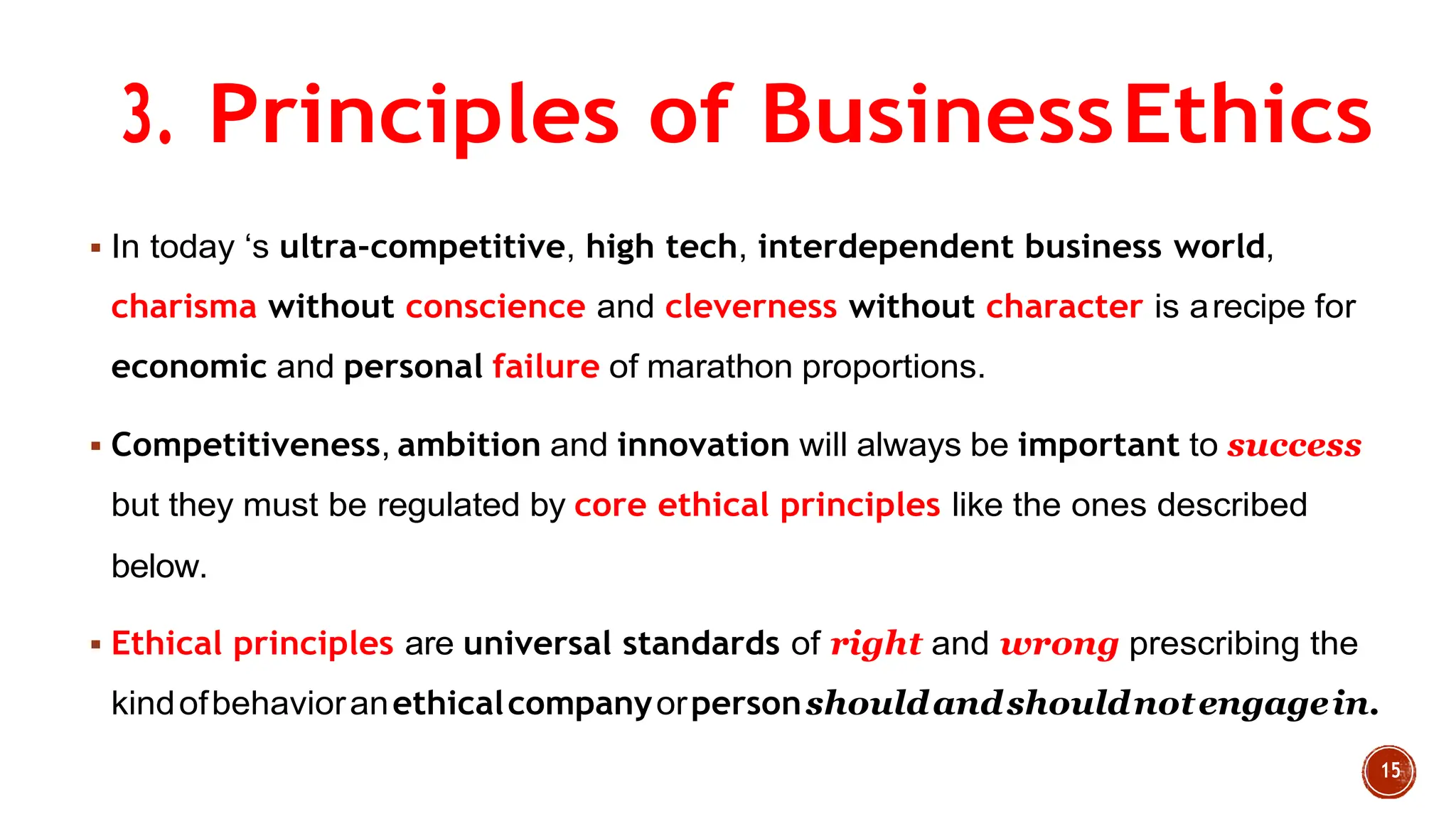
1) Honesty:
Ethical executives do not deliberately
mislead or deceive others by
misrepresentations, overstatements,
partial truths, selective omissions, or any
other means and when trust requires it, they
supply relevant information and correct
misapprehensions of fact.
2) Integrity:
Ethical executives earn the trust of others
through personal integrity.
Integrity refers to a wholeness of
character demonstrated by consistency
between thoughts, words and actions.
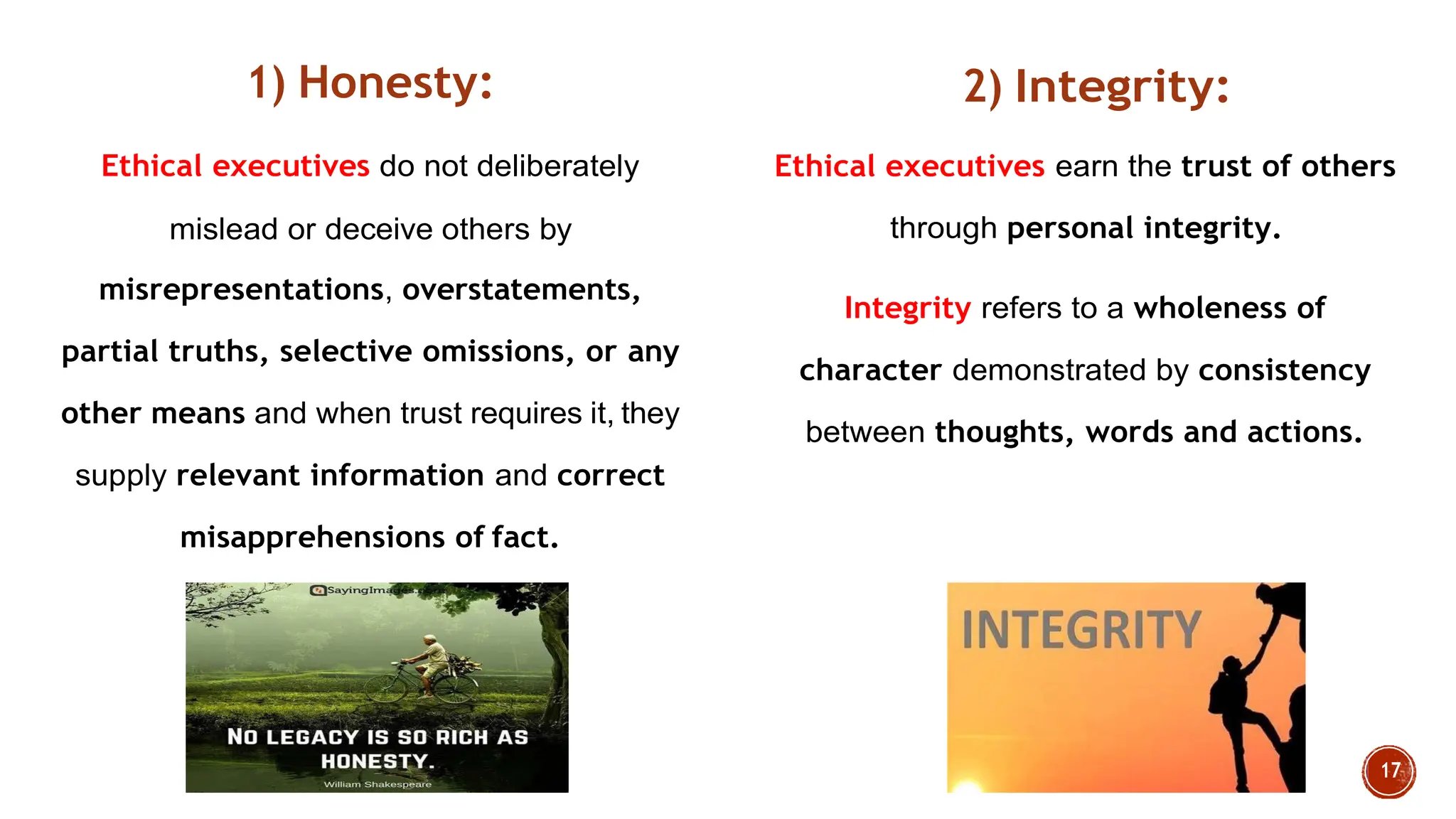
3) Promise-Keeping:
Ethical executives can be trusted because
they make every reasonable effort tofulfill
the letter and spirit of their promises and
commitments.
Theydonotinterpretagreementsinan
unreasonablytechnicalorlegalistic
manner.
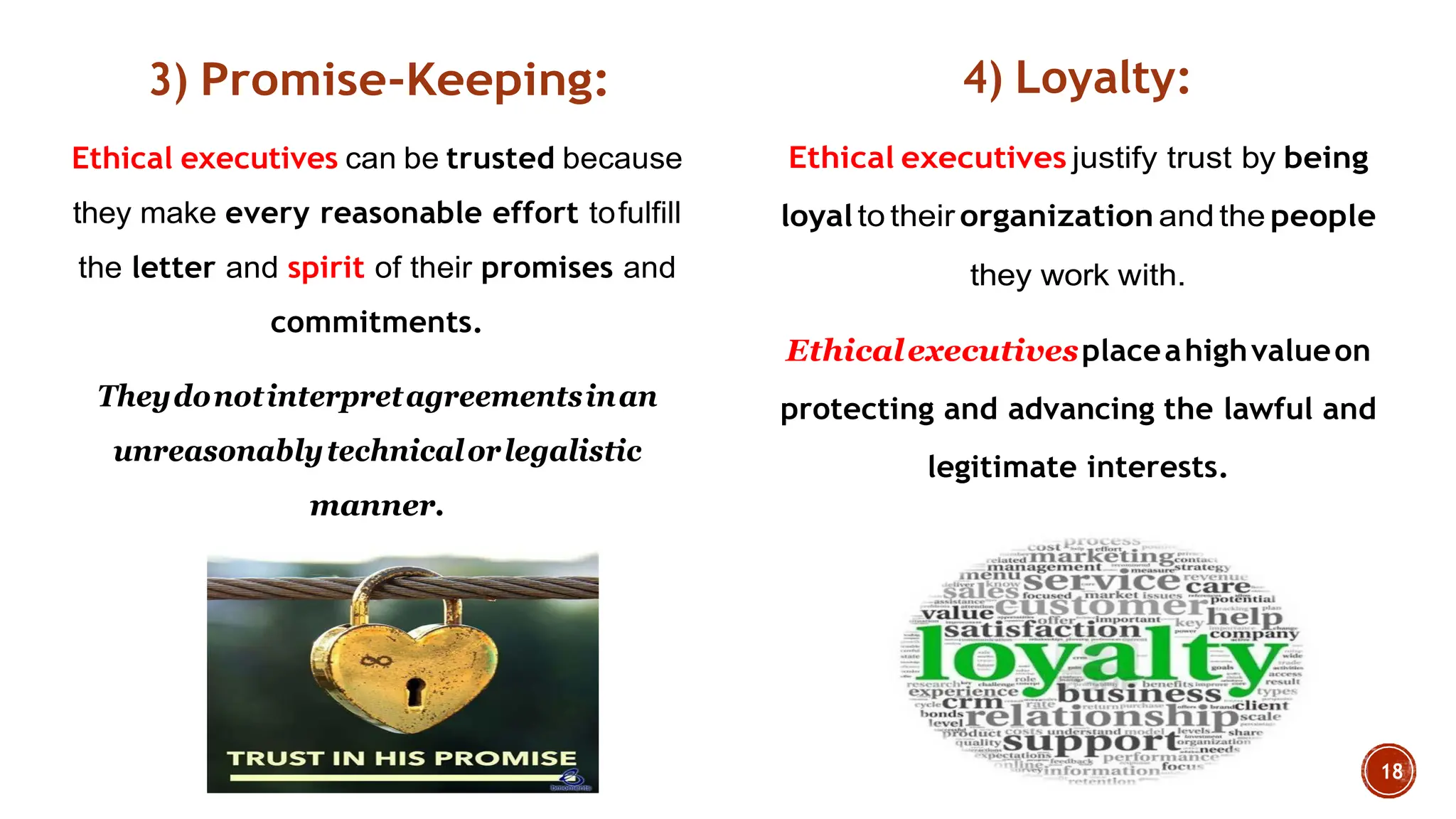
4) Loyalty:
Ethical executives justify trust by being
loyalto their organization and the people
they work with.
Ethicalexecutivesplaceahighvalueon
protecting and advancing the lawful and
legitimate interests.
5) Fairness:
Ethical executives are fundamentally
committed to fairness.
Ethical executives manifest a
commitment to justice, the equal
treatment of individuals, tolerance for
and acceptance ofdiversity.
6) Caring:
Ethical executives are caring,
compassionate, benevolent and kind.
Ethical executives seek to accomplish
their business objectives in a manner that
causes the least harm and the greatest
positive good.
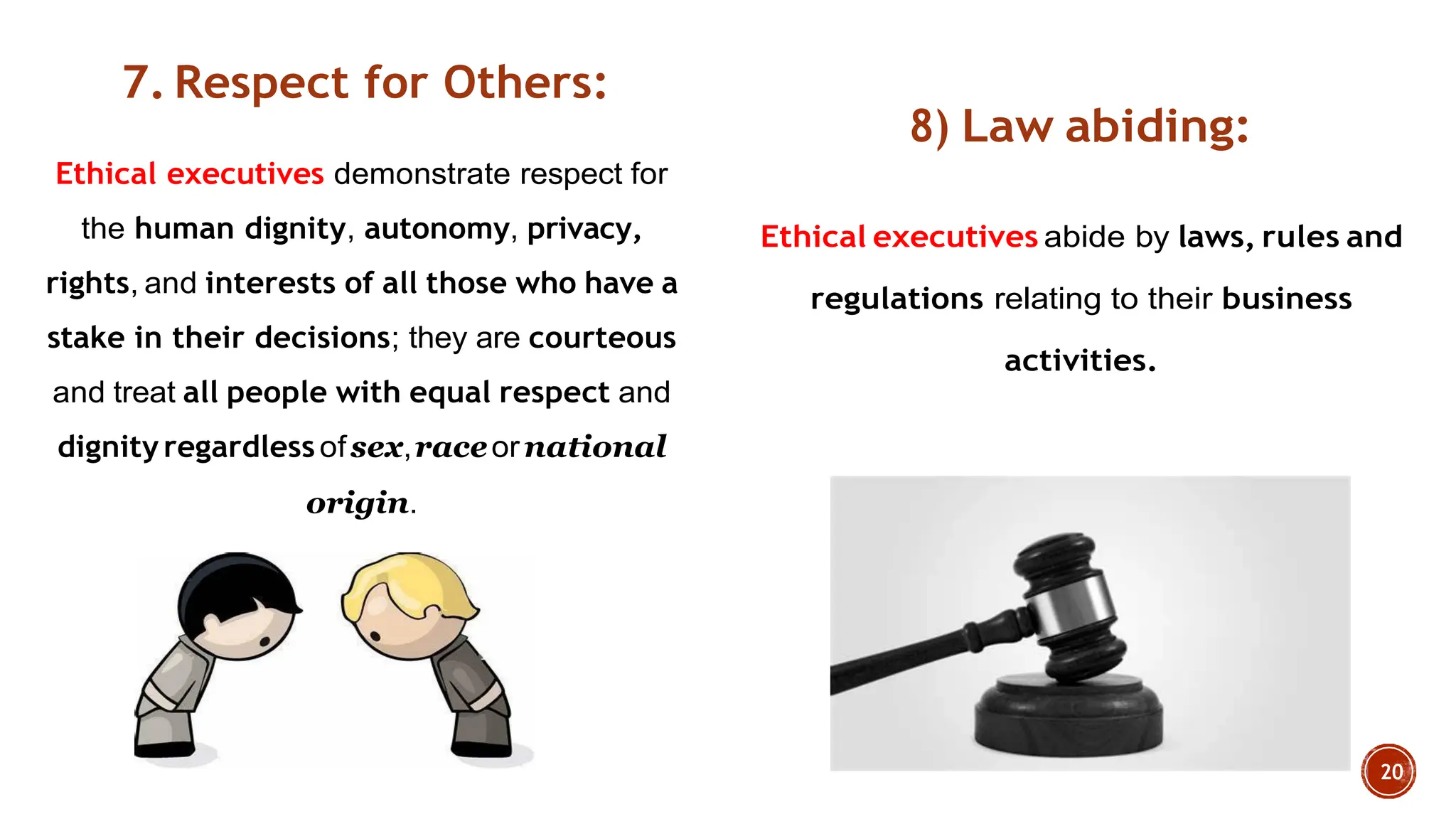
7. Respect for Others:
Ethical executives demonstrate respect for
the human dignity, autonomy, privacy,
rights, and interests of all those who have a
stake in their decisions; they are courteous
and treat all people with equal respect and
dignity regardlessofsex,raceornational
origin.
8) Law abiding:
Ethical executives abide by laws, rules and
regulations relating to their business
activities.
9) Commitment to Excellence
Ethicalexecutivespursueexcellencein
performing their duties, are well-
informed and prepared, and constantly
endeavortoincreasetheirproficiencyin
all areas ofresponsibility.
10) Leadership:
Ethical executives are conscious of the
responsibilities and opportunities of
their position of leadership and seek to be
positive ethical role models by their own
conduct and by creating a good
environment.
11) ReputationandMorale:
Ethical executives understand the
importance of their own and their
company‟s reputation as well as the
importance of the pride and good morale
of employees.
12) Accountability:
Ethical executives acknowledge and accept
personal accountability for the ethical
quality of their decisions and omissions to
themselves, their colleagues, their
companies, and their communities.
“To Educate The Mind Without The Morals Is
To Educate A Menace To Society.”
Theodore Roosevelt

Business Ethis and Corporate SRChapter-3.pdf

  • 2.
    1.Theories/ Views OfEthics  Ethics has always been a concern for society and its various institutions/stakeholders.  Because different scholars have different perspectives about ethics due to their working conditions and professions, there are many views about ethics.  Even though it is too difficult to put only limited views of ethics, we have used the following views of ethics for the purpose of this course.
  • 3.
    A.The Utilitarian ViewOf Ethics  This approach espoused by Jeremy Bentham and John Stuart Mill, holds that moral behavior produces the greatest good for the greatest number.  The utilitarian ethic focuses on the distribution of benefits and harms to all stakeholders with the view to maximizing benefits.  Under this approach, a decision maker is expected to consider the effect of each decision alternative on all parties and select the one that optimizes the satisfaction for the greatest number of people.
  • 4.
    Utilitarianismisusedfrequentlywhenbusiness leaders make criticaldecisions about things like expansion, store closings, hiring, and layoffs.  Utilitarian decision making relies on a systematic comparison of the costs and benefits to all affected parties.  Using such a cost–benefit analysis, a utilitarian decision maker calculates the utility of the consequences of all possible alternatives and then selectstheonethatresultsinthegreatestbenefit. Simple cost-benefits analysis is not a utilitarian calculus unless it includes consideration of all stakeholders and a full accounting of externalities, worker preferences, potentially coercive actions related to customers, or community and environmental effects. 4
  • 5.
    B.The Rights/Individualism ViewOf Ethics  Given human nature, it is difficult-if not impossible-to eliminateself- interest.  The individual rights ethic relies on a list of agreed-upon rights for everyone that will be upheld by everyone and that becomes the basis for deciding what is right, just, orfair.  The rights view of ethics says that ethical decisions are concerned with respecting and protecting individual liberties and privileges such as the rights of privacy, freedom of conscience, free speech, life and safety, and dueprocess.
  • 6.
     Right viewsof ethics based on behaviour maintain the fundamental rights of all human being  There are six moral rights that should be considered during decision making according to this view.  They are:  The right of free consent:  The right toprivacy:  The right of freedom of conscience:  The right of free speech:  The right to due process:  The right to life and safety:
  • 7.
    C. The TheoryOf Justice View Of Ethics  Thetheoryofjusticeviewofethicsstatesthatdecisionmakersseekto impose and enforce rules fairly and impartially.  The justice approach holds that moral decisions must be based on standards of equity, fairness, and impartiality.  Justice as it is applied in business ethics involves evaluations of fairness or the disposition to deal with perceived injustices of others.  Justice is fair treatment and due reward in accordance with ethical or legal standards.
  • 8.
     Three typesof justice provide a framework for evaluating the fairness of different situations.  These are  Distributive justice,  Procedural justice, and  Interactional justice.
  • 10.
    D. Integrative-social ContractsTheory  Integrative social contracts theory proposes that ethical decisions should be based on empirical (what is) and normative (what should be) factors.  This view is based on the integration of two “contracts” the general social contract and a more specific contract among members of a specific community that might be affected by a decision.  The term “integrative”is used to illustrate that ISCT is based on a hypothetical social contract whose terms allowfor the generationofbinding ethical obligations through the recognition of actual norms created in real social and economic communities.
  • 11.
    2. Ethical Egoism&Subjectivism Ethical Egoism  Egoism defines right or acceptable behavior in terms of its consequences for the individual. They believe that they should make decisions that maximize their own self-interest, which is defined differently by each individual.  The egoist „s creed generally can be stated as “Do the act that promotes the greatest good for oneself”. Ethical Subjectivism  Ethical subjectivism argues that no ethical theory is objectively true. Statements contained in those theories, such as the duty to act in one‟s self interest, are only true as long as they are believed by the person holding the theory. Therefore, ethics becomes less a matter of what is objectively true and more a matter of individual perception.
  • 12.
    Cont‟d  Many believethat egoistic people and companies are inherently unethical, are short-term oriented,and will take advantage of anyopportunity.  For example, if you would benefit more from keeping 100,000 than you would from donating it to charity then the morally correct decision would be to keep the money for yourself if you are an ethical egoist. Cont‟d  Ethical subjectivist would argue that those supposedly objective justifications are really just subjective statements of the person‟s values and desires.  If Person A believes it is morally right to keep 100,000 instead of donating it to charity, then for Person A that is the ethical thing to do. However, if Person B believes donating the money to others would be ethically correct then for Person B that is the correct ethical decision.
  • 13.
    Cont‟d  Ethical egoismcontends each person has a duty to act in ways that promote his or her self-interest above the interests of all others. When a moral decision must be made, the person should exclusively consider how the results will benefit him or her.  However, there is also enlightened egoism. Enlightened egoists take a long-range perspective and allow for the well-being of others although their own self-interest remains paramount. Cont‟d  People have different opinions, but where morality isconcerned,thereare noʺfactsʺ and no one is ʺrightʺ. People just feel differently, and that‟s the end of it. This is the basic thought behind Ethical Subjectivism.  Ethical Subjectivism is the idea that our moral opinions are based on our feelings and nothing more. On this view, there is no such thing as ʺobjectiveʺ right or
  • 14.
    Cont‟d  An exampleof enlightened egoism is helping a turtle across a highway because, if killed, the person would feeldistressed.  To feel good, or eliminate the chance of a feeling of distress, the person helps the turtle to cross the road. Cont‟d  Ethical subjectivism contends that objective concepts of good and evil or right and wrong do not exist.  This leads into other theories such as moral relativism which suggests these concepts are determined by agreement.
  • 15.
    3. Principles ofBusinessEthics  In today „s ultra-competitive, high tech, interdependent business world, charisma without conscience and cleverness without character is arecipe for economic and personal failure of marathon proportions.  Competitiveness, ambition and innovation will always be important to success but they must be regulated by core ethical principles like the ones described below.  Ethical principles are universal standards of right and wrong prescribing the kindofbehavioranethicalcompanyorpersonshouldandshouldnotengagein.
  • 16.
     Principles ischaracterized by its being permanent or remain constant,work anywhere, when violated produce destruction and contain inherent judgment.  In business, how people judge your character is critical to sustainable success because it is the basis of trust and credibility. Abraham Lincoln described “character as the tree and reputation as the shadow”. Thus, your reputation is purely a function of perceptions while your character is determined and defined by your actions (i.e., Whether your actions are honorable and ethical according to the 12 ethical principles):
  • 17.
    1) Honesty: Ethical executivesdo not deliberately mislead or deceive others by misrepresentations, overstatements, partial truths, selective omissions, or any other means and when trust requires it, they supply relevant information and correct misapprehensions of fact. 2) Integrity: Ethical executives earn the trust of others through personal integrity. Integrity refers to a wholeness of character demonstrated by consistency between thoughts, words and actions.
  • 18.
    3) Promise-Keeping: Ethical executivescan be trusted because they make every reasonable effort tofulfill the letter and spirit of their promises and commitments. Theydonotinterpretagreementsinan unreasonablytechnicalorlegalistic manner. 4) Loyalty: Ethical executives justify trust by being loyalto their organization and the people they work with. Ethicalexecutivesplaceahighvalueon protecting and advancing the lawful and legitimate interests.
  • 19.
    5) Fairness: Ethical executivesare fundamentally committed to fairness. Ethical executives manifest a commitment to justice, the equal treatment of individuals, tolerance for and acceptance ofdiversity. 6) Caring: Ethical executives are caring, compassionate, benevolent and kind. Ethical executives seek to accomplish their business objectives in a manner that causes the least harm and the greatest positive good.
  • 20.
    7. Respect forOthers: Ethical executives demonstrate respect for the human dignity, autonomy, privacy, rights, and interests of all those who have a stake in their decisions; they are courteous and treat all people with equal respect and dignity regardlessofsex,raceornational origin. 8) Law abiding: Ethical executives abide by laws, rules and regulations relating to their business activities.
  • 21.
    9) Commitment toExcellence Ethicalexecutivespursueexcellencein performing their duties, are well- informed and prepared, and constantly endeavortoincreasetheirproficiencyin all areas ofresponsibility. 10) Leadership: Ethical executives are conscious of the responsibilities and opportunities of their position of leadership and seek to be positive ethical role models by their own conduct and by creating a good environment.
  • 22.
    11) ReputationandMorale: Ethical executivesunderstand the importance of their own and their company‟s reputation as well as the importance of the pride and good morale of employees. 12) Accountability: Ethical executives acknowledge and accept personal accountability for the ethical quality of their decisions and omissions to themselves, their colleagues, their companies, and their communities.
  • 23.
    “To Educate TheMind Without The Morals Is To Educate A Menace To Society.” Theodore Roosevelt