.
Aanchal Mishra,
T.Y B. Pharmacy,
SVB’s College of Pharmacy.
Separation of binary mixture
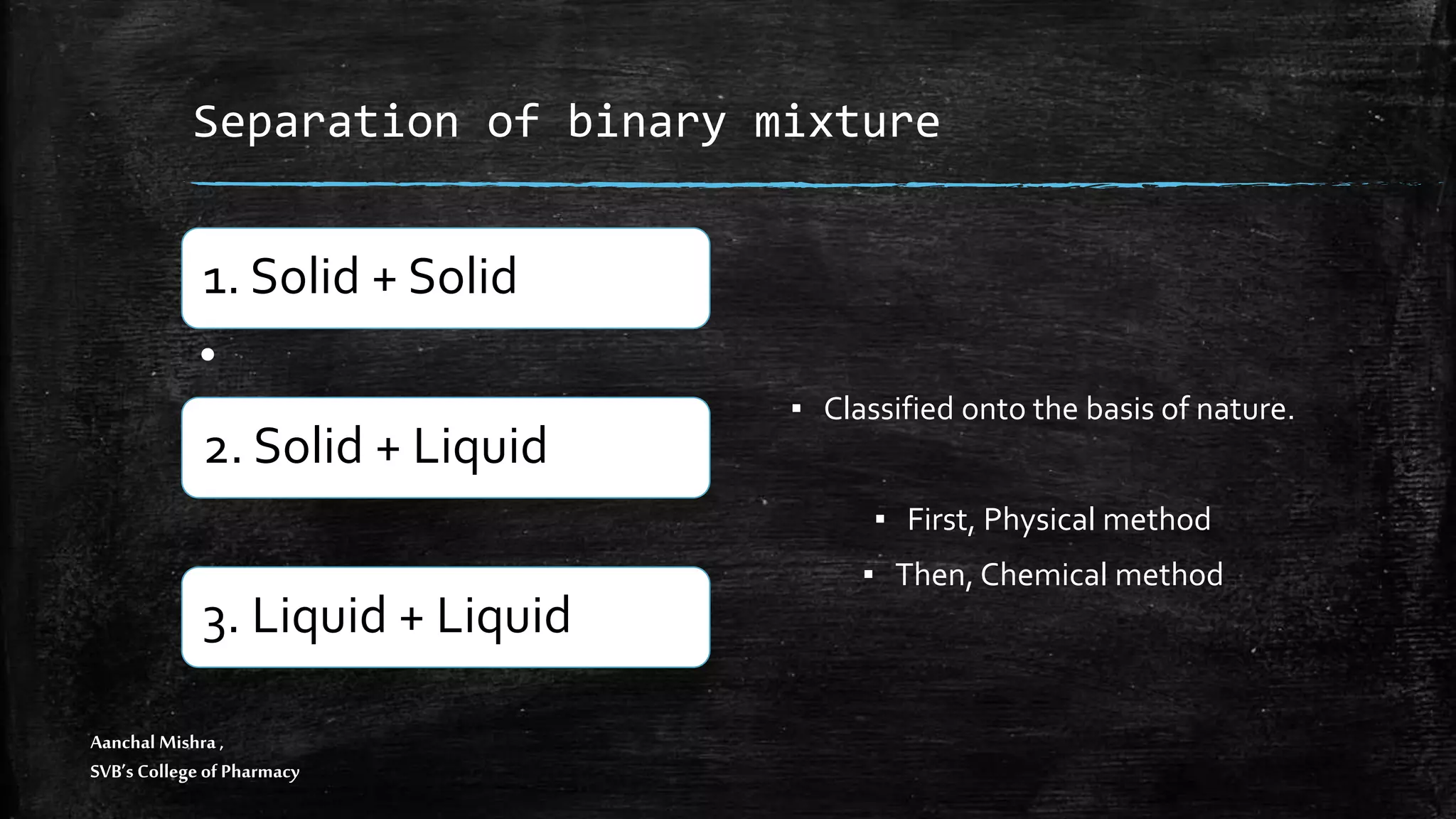
1. Solid + Solid
•
2. Solid + Liquid
3. Liquid + Liquid
▪ Classified onto the basis of nature.
▪ First, Physical method
▪ Then, Chemical method
Aanchal Mishra ,
SVB’s Collegeof Pharmacy
Separation of Binary mixtures
Aanchal Mishra ,
SVB’s College of Pharmacy
WHAT IS PHYSICAL METHOD?
.
Mixture+
Water, Filter-
Evaporate
Residue after
evap in petri
dish
A cmpd –WS
B cmpd-WI
Water
separation
Residue in form
of syrupy mass
A cmpd –WS
B cmpd -Sugar/Carbohydrate
Ether
separation
Used in cases of –
A. WS acid +WI acid
B. WS Neutral +WI acid
C. WS Neutral +WSWeak acid
D. WS base +WI acid……etc
It can be commonly found in
Such mixtures.
AanchalMishra ,
SVB’sCollegeof Pharmacy
WHAT IS CHEMICAL METHOD?
.
Mixture + sat.
NaHCO3
Effervescence
Confirm by
adding conc.
HCl to filtrate
Strong acid
confirmed
Residue 1, no
effervescence
Residue 1 + dil. NaOH
Dissolves in
NaOH
Doesn’t
dissolves in
NaOH
Used forWI compounds.
Aanchal Mishra ,
SVB’sCollegeof Pharmacy
Dissolves
in NaOH
Filtrate +
Conc. HCl
White ppt
ofWA
Weak
Acid
Doesn’t
dissolves in
NaOH
To residue,
add 10% dil.
HCl
Dissolves in
HCl - base
probability
To it, add
strong NaOH,
regeneration
BASE
Doesn’t
Dissolves
Other cmpd,
NEUTRAL
Continued….
Aanchal Mishra ,
SVB’sCollegeof Pharmacy
Separation of Liquid binary mixture
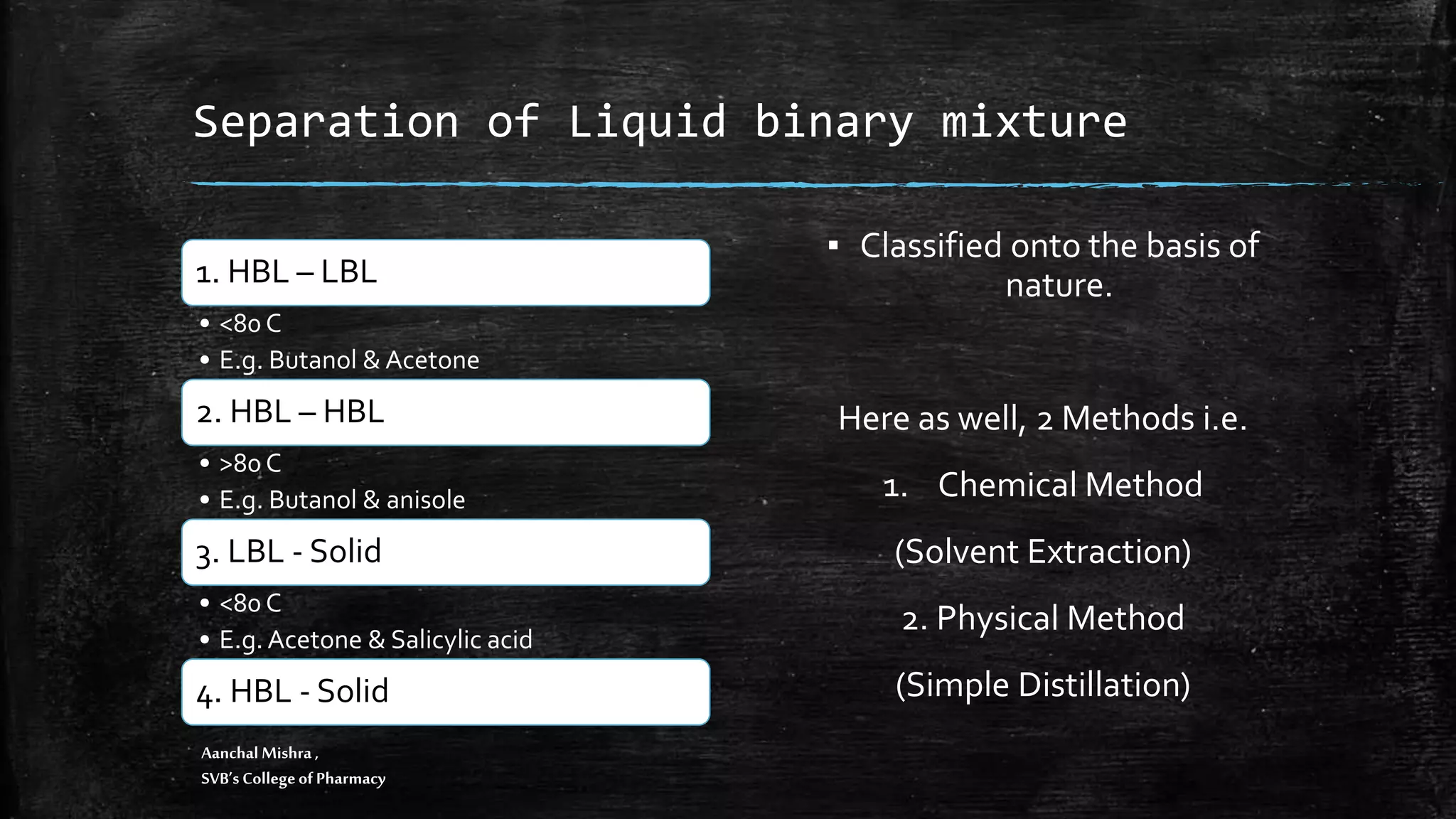
1. HBL – LBL
• <80 C
• E.g. Butanol & Acetone
2. HBL – HBL
• >80 C
• E.g. Butanol & anisole
3. LBL - Solid
• <80 C
• E.g. Acetone & Salicylic acid
4. HBL - Solid
▪ Classified onto the basis of
nature.
Here as well, 2 Methods i.e.
1. Chemical Method
(Solvent Extraction)
2. Physical Method
(Simple Distillation)
AanchalMishra ,
SVB’sCollegeof Pharmacy
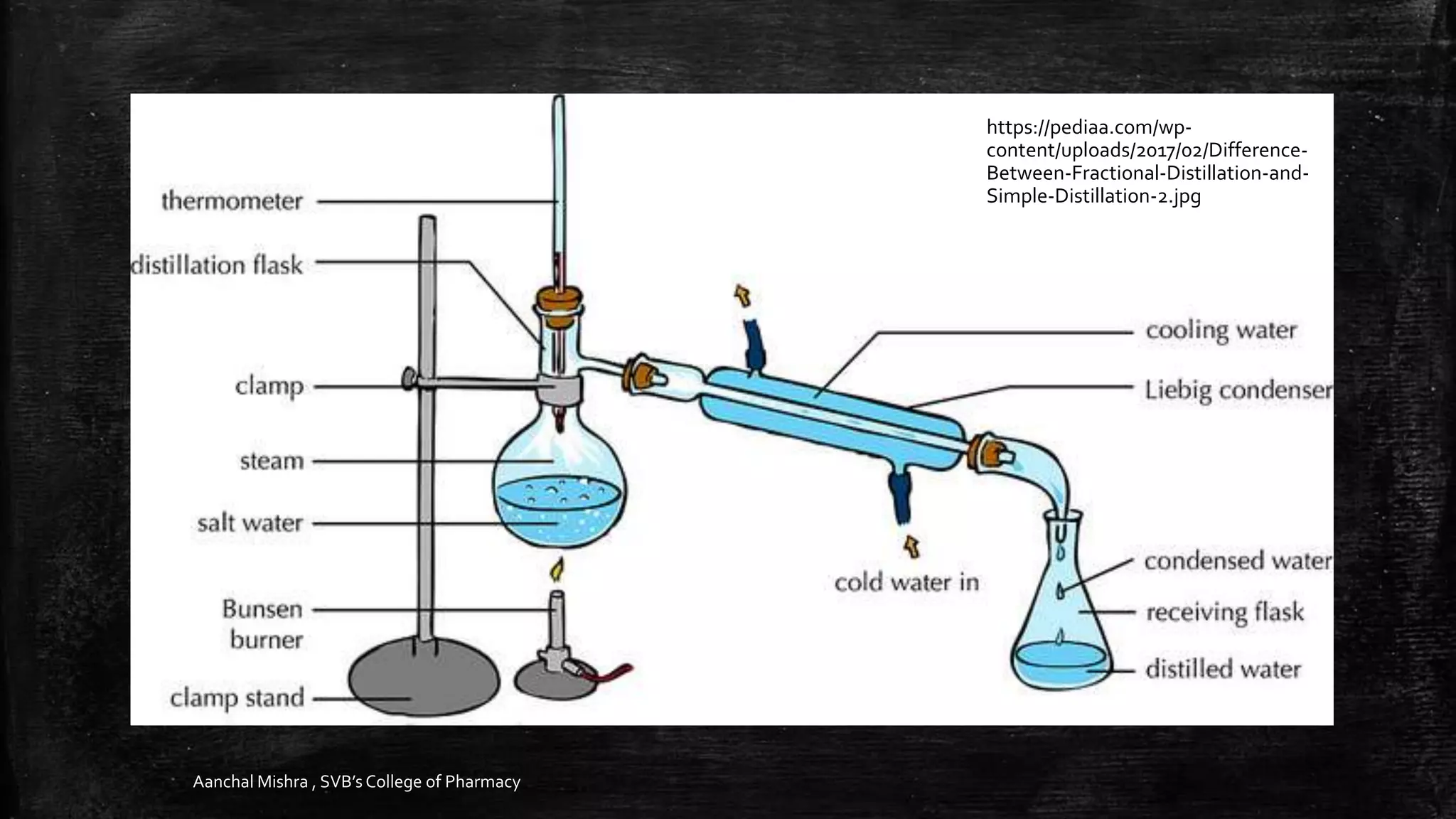
Separation of Liquid Binary Mixture
Aanchal Mishra , SVB’s College of Pharmacy
https://pediaa.com/wp-
content/uploads/2017/02/Difference-
Between-Fractional-Distillation-and-
Simple-Distillation-2.jpg
Aanchal Mishra ,
SVB’sCollegeof Pharmacy
https://www.sas.upenn.edu/~zhall/flowchartone.JPG
RECRYSTALLIZATION
Choose a
particular
solvent
Heat the
solvent & add
to mixture
Begin cooling
solution at RT
Add charcoal
for better
processing
Boil & then, let
it cool
Collect the
crystals by
Filtration
AanchalMishra ,
SVB’sCollegeof Pharmacy
A. Chloroform – 61.2C – LBL
B. Urea– WS Base
C. Benzoic Acid– WI SA
D. B- Napthol– WI WA
E. M- Nitroaniline–WI base
F. Biphenyl – WI Neutral
AanchalMishra ,
SVB’sCollegeof Pharmacy
A+B+C+D+E+F
A – chloroform
separated
B+C+D+E+F
B will be separated
- Urea- WS Base
C+D+E+F
C – Benzoic acid
(regenerate
using HCl
D+E+F
Physical
Distillation
Water
Sat.
NAHCO3
AanchalMishra ,
SVB’sCollegeof Pharmacy
D+E+F
Napthol will be
separated.
Reg. with conc. HCl
E+F
NA will be separated.
Reg with strong NaOH
F – Biphenyl as
residue
Neutral
Dil.
10% NaOH
10% dil.
HCl
AanchalMishra ,
SVB’sCollegeof Pharmacy
Aanchal Mishra , SVB’s College of Pharmacy

Organic Chemistry - Binary mixture separation

  • 1.
    . Aanchal Mishra, T.Y B.Pharmacy, SVB’s College of Pharmacy.
  • 2.
    Separation of binarymixture 1. Solid + Solid • 2. Solid + Liquid 3. Liquid + Liquid ▪ Classified onto the basis of nature. ▪ First, Physical method ▪ Then, Chemical method Aanchal Mishra , SVB’s Collegeof Pharmacy
  • 3.
    Separation of Binarymixtures Aanchal Mishra , SVB’s College of Pharmacy
  • 4.
    WHAT IS PHYSICALMETHOD? . Mixture+ Water, Filter- Evaporate Residue after evap in petri dish A cmpd –WS B cmpd-WI Water separation Residue in form of syrupy mass A cmpd –WS B cmpd -Sugar/Carbohydrate Ether separation Used in cases of – A. WS acid +WI acid B. WS Neutral +WI acid C. WS Neutral +WSWeak acid D. WS base +WI acid……etc It can be commonly found in Such mixtures. AanchalMishra , SVB’sCollegeof Pharmacy
  • 5.
    WHAT IS CHEMICALMETHOD? . Mixture + sat. NaHCO3 Effervescence Confirm by adding conc. HCl to filtrate Strong acid confirmed Residue 1, no effervescence Residue 1 + dil. NaOH Dissolves in NaOH Doesn’t dissolves in NaOH Used forWI compounds. Aanchal Mishra , SVB’sCollegeof Pharmacy
  • 6.
    Dissolves in NaOH Filtrate + Conc.HCl White ppt ofWA Weak Acid Doesn’t dissolves in NaOH To residue, add 10% dil. HCl Dissolves in HCl - base probability To it, add strong NaOH, regeneration BASE Doesn’t Dissolves Other cmpd, NEUTRAL Continued…. Aanchal Mishra , SVB’sCollegeof Pharmacy
  • 7.
    Separation of Liquidbinary mixture 1. HBL – LBL • <80 C • E.g. Butanol & Acetone 2. HBL – HBL • >80 C • E.g. Butanol & anisole 3. LBL - Solid • <80 C • E.g. Acetone & Salicylic acid 4. HBL - Solid ▪ Classified onto the basis of nature. Here as well, 2 Methods i.e. 1. Chemical Method (Solvent Extraction) 2. Physical Method (Simple Distillation) AanchalMishra , SVB’sCollegeof Pharmacy
  • 8.
    Separation of LiquidBinary Mixture
  • 9.
    Aanchal Mishra ,SVB’s College of Pharmacy https://pediaa.com/wp- content/uploads/2017/02/Difference- Between-Fractional-Distillation-and- Simple-Distillation-2.jpg
  • 10.
    Aanchal Mishra , SVB’sCollegeofPharmacy https://www.sas.upenn.edu/~zhall/flowchartone.JPG
  • 11.
    RECRYSTALLIZATION Choose a particular solvent Heat the solvent& add to mixture Begin cooling solution at RT Add charcoal for better processing Boil & then, let it cool Collect the crystals by Filtration AanchalMishra , SVB’sCollegeof Pharmacy
  • 12.
    A. Chloroform –61.2C – LBL B. Urea– WS Base C. Benzoic Acid– WI SA D. B- Napthol– WI WA E. M- Nitroaniline–WI base F. Biphenyl – WI Neutral AanchalMishra , SVB’sCollegeof Pharmacy
  • 13.
    A+B+C+D+E+F A – chloroform separated B+C+D+E+F Bwill be separated - Urea- WS Base C+D+E+F C – Benzoic acid (regenerate using HCl D+E+F Physical Distillation Water Sat. NAHCO3 AanchalMishra , SVB’sCollegeof Pharmacy
  • 14.
    D+E+F Napthol will be separated. Reg.with conc. HCl E+F NA will be separated. Reg with strong NaOH F – Biphenyl as residue Neutral Dil. 10% NaOH 10% dil. HCl AanchalMishra , SVB’sCollegeof Pharmacy
  • 15.
    Aanchal Mishra ,SVB’s College of Pharmacy