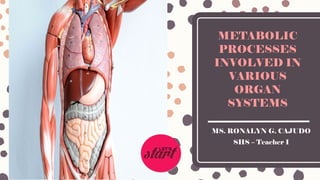
METABOLIC
PROCESSES
INVOLVED IN
VARIOUS
ORGAN
SYSTEMS
MS. RONALYN G. CAJUDO
SHS – Teacher I
Objective:
Explain the different metabolic
processes involved in the
various organ system
EARTH AND LIFE SCIENCE – Grade 11
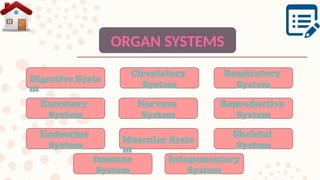
ORGAN SYSTEMS
Digestive Syste
m
Circulatory
System
Respiratory
System
Excretory
System
Nervous
System
Reproductive
System
Endocrine
System
Muscular Syste
m
Skeletal
System
Immune
System
Integumentary
System
DIGESTIVE SYSTEM
Involves physical digestion,
the breakdown of food into
smaller particles which occurs in
the mouth and stomach
Chemical digestion is the
breakdown of large molecules
such as protein, starch and fats.
CIRCULATORY SYSTEM
Transports blood from the
heart to the lungs, to oxygenate
blood.
Systematic circulation
carries oxygen – rich blood from
the heart to organs and tissues.
RESPIRATORY SYSTEM
Supplies body cells with
oxygen; carbon dioxide as waste
products.
The organs involve are
heart, blood vessels, blood and
lymph nodes.
EXCRETORY SYSTEM
removes waste from the
body
The organs functioning are
the kidneys, urinary bladder,
ureter and urethra.
NERVOUS SYSTEM
Regulates behavior,
maintains homeostasis, controls
sensory and motor functions.
Organs are spinal cord,
nerves and brain.
REPRODUCTIVE
SYSTEM
Involves the production of
new individuals.
Organs are testes and penis
in males and ovaries and uterus in
females.
ENDOCRINE SYSTEM
It regulates, coordinates, and
controls a number of body
functions by secreting chemicals
into the bloodstream. These
secretions help control moods,
growth and development, and
metabolism
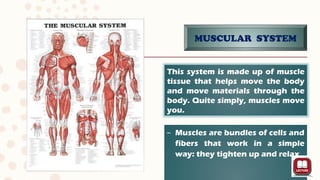
MUSCULAR SYSTEM
This system is made up of muscle
tissue that helps move the body
and move materials through the
body. Quite simply, muscles move
you.
– Muscles are bundles of cells and
fibers that work in a simple
way: they tighten up and relax
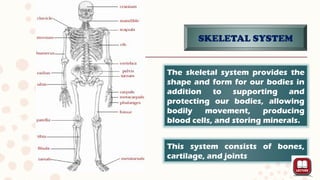
SKELETAL SYSTEM
The skeletal system provides the
shape and form for our bodies in
addition to supporting and
protecting our bodies, allowing
bodily movement, producing
blood cells, and storing minerals.
This system consists of bones,
cartilage, and joints
IMMUNE SYSTEM
a collection of structures and
processes within the body — is to
protect against disease or other
potentially damaging foreign
bodies. When functioning
properly, the immune system
identifies a variety of threats,
including viruses, bacteria and
parasites, and distinguishes them
from the body's own healthy
tissue
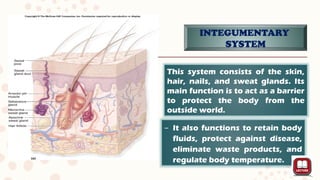
INTEGUMENTARY
SYSTEM
This system consists of the skin,
hair, nails, and sweat glands. Its
main function is to act as a barrier
to protect the body from the
outside world.
– It also functions to retain body
fluids, protect against disease,
eliminate waste products, and
regulate body temperature.
This provides the shape and form for our bodies in
addition to supporting and protecting our bodies,
allowing bodily movement, producing blood cells, and
storing minerals.
SKELETAL
INTEGUMENTARY URINARY
DIGESTIVE
Involves the production of new individuals.
LYMPHATIC
NERVOUS REPRODUCTIVE
EXCRETORY
Involves physical digestion, the breakdown of food
into smaller particles which occurs in the mouth and
stomach
RESPIRATORY
MUSCULAR INTEGUMENTARY
DIGESTIVE
Regulates behavior, maintains homeostasis,
controls sensory and motor functions
CIRCULATORY
RESPIRATORY NERVOUS
EXCRETORY
Organ System.pptx powerpoint presentation

Organ System.pptx powerpoint presentation