UNIVERSIDAD NACIONAL DE CHIMBORAZO
FACULTAD DE CIENCIAS DE LA EDUCACIÓN HUMANAS Y
TECNOLOGÍAS
CARRERA DE IDIOMAS – INGLES
GRAMMAR V
ORDER OF ADJECTIVES
Names:
Darío Amancha
Patricio Castillo
Elvis Guaranga
ORDER OF ADJECTIVES
The use of adjectives is essential when trying to describe a noun or pronoun. Good writers and
speakers are able to use adjectives to create clear, mental images for the reader or listener. As
you continue to work on your English, don’t be afraid to use multiple adjectives to describe
something. Using more than three physically descriptive type adjectives in sequence to describe
one noun or pronoun would sound a little awkward. When using multiple adjectives in a
sequence, you must be aware of the correct adjective order. The proper order of adjectives is
listed below along with some examples for each category.
Adjectives sometimes appear after the verb To Be
 He is short.
 She is tall.
Adjectives sometimes appear before a noun.
 Red car
 Old hat
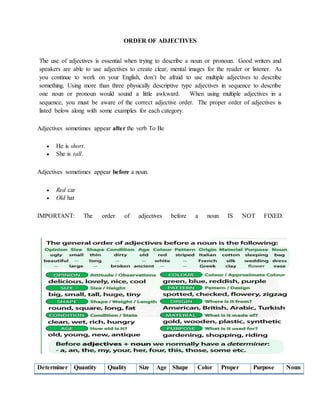
IMPORTANT: The order of adjectives before a noun IS NOT FIXED.
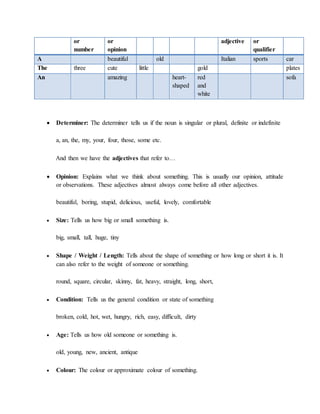
Determiner Quantity Quality Size Age Shape Color Proper Purpose Noun
or
number
or
opinion
adjective or
qualifier
A beautiful old Italian sports car
The three cute little gold plates
An amazing heart-
shaped
red
and
white
sofa
 Determiner: The determiner tells us if the noun is singular or plural, definite or indefinite
a, an, the, my, your, four, those, some etc.
And then we have the adjectives that refer to…
 Opinion: Explains what we think about something. This is usually our opinion, attitude
or observations. These adjectives almost always come before all other adjectives.
beautiful, boring, stupid, delicious, useful, lovely, comfortable
 Size: Tells us how big or small something is.
big, small, tall, huge, tiny
 Shape / Weight / Length: Tells about the shape of something or how long or short it is. It
can also refer to the weight of someone or something.
round, square, circular, skinny, fat, heavy, straight, long, short,
 Condition: Tells us the general condition or state of something
broken, cold, hot, wet, hungry, rich, easy, difficult, dirty
 Age: Tells us how old someone or something is.
old, young, new, ancient, antique
 Colour: The colour or approximate colour of something.
green, white, blue, reddish, purple
 Pattern: The pattern or design of something.
striped, spotted, checked, flowery
 Origin: Tells us where something is from.
American, British, Italian, eastern, Australian, Chilean
 Material: What is the thing made of or constructed of?
gold, wooden, silk, paper, synthetic, cotton, woolen
 Purpose/Qualifier/Use: What is it for? These adjectives often end in –ing.
sleeping (bag), gardening (gloves), shopping (bag), wedding (dress)
 Noun: The person or thing that is being described
Here are some examples:
1. I love that really old big green antique car that always parked at the end of the street.
[quality - age - size - color - proper adjective]
2. My sister has a big, beautiful, tan and white, bulldog. [size - quality - color - color]
3. A wonderful old Italian clock. [opinion - age - origin]
4. A big square blue box. [dimension - shape - color]
5. A disgusting pink plastic ornament. [opinion - color - material]
6. Some slim new French trousers. [dimension - age - origin]
7. A wonderful old Italian clock. [opinion - age - origin]
8. I bought a pair of black leather shoes. [color - material]
When there are two or more adjectives that are from the same group, the word and is placed
between the two adjectives:
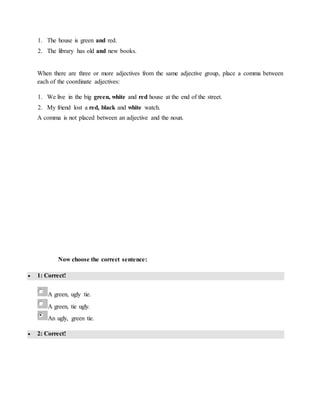
1. The house is green and red.
2. The library has old and new books.
When there are three or more adjectives from the same adjective group, place a comma between
each of the coordinate adjectives:
1. We live in the big green, white and red house at the end of the street.
2. My friend lost a red, black and white watch.
A comma is not placed between an adjective and the noun.
Now choose the correct sentence:
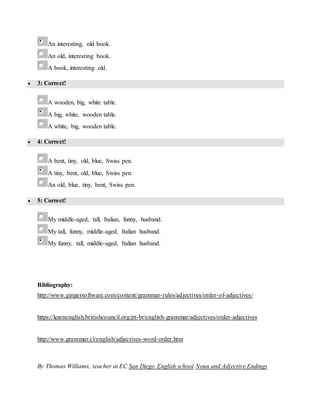
 1: Correct!
A green, ugly tie.
A green, tie ugly.
An ugly, green tie.
 2: Correct!
An interesting, old book.
An old, interesting book.
A book, interesting old.
 3: Correct!
A wooden, big, white table.
A big, white, wooden table.
A white, big, wooden table.
 4: Correct!
A bent, tiny, old, blue, Swiss pen.
A tiny, bent, old, blue, Swiss pen.
An old, blue, tiny, bent, Swiss pen.
 5: Correct!
My middle-aged, tall, Italian, funny, husband.
My tall, funny, middle-aged, Italian husband.
My funny, tall, middle-aged, Italian husband.
Bibliography:
http://www.gingersoftware.com/content/grammar-rules/adjectives/order-of-adjectives/
https://learnenglish.britishcouncil.org/pt-br/english-grammar/adjectives/order-adjectives
http://www.grammar.cl/english/adjectives-word-order.htm
By Thomas Williams, teacher at EC San Diego English school Noun and Adjective Endings
http://www.ecenglish.com/learnenglish/lessons/adjective-word-order

Order of adjectives

  • 1.
    UNIVERSIDAD NACIONAL DECHIMBORAZO FACULTAD DE CIENCIAS DE LA EDUCACIÓN HUMANAS Y TECNOLOGÍAS CARRERA DE IDIOMAS – INGLES GRAMMAR V ORDER OF ADJECTIVES Names: Darío Amancha Patricio Castillo Elvis Guaranga
  • 2.
    ORDER OF ADJECTIVES Theuse of adjectives is essential when trying to describe a noun or pronoun. Good writers and speakers are able to use adjectives to create clear, mental images for the reader or listener. As you continue to work on your English, don’t be afraid to use multiple adjectives to describe something. Using more than three physically descriptive type adjectives in sequence to describe one noun or pronoun would sound a little awkward. When using multiple adjectives in a sequence, you must be aware of the correct adjective order. The proper order of adjectives is listed below along with some examples for each category. Adjectives sometimes appear after the verb To Be  He is short.  She is tall. Adjectives sometimes appear before a noun.  Red car  Old hat IMPORTANT: The order of adjectives before a noun IS NOT FIXED. Determiner Quantity Quality Size Age Shape Color Proper Purpose Noun
  • 3.
    or number or opinion adjective or qualifier A beautifulold Italian sports car The three cute little gold plates An amazing heart- shaped red and white sofa  Determiner: The determiner tells us if the noun is singular or plural, definite or indefinite a, an, the, my, your, four, those, some etc. And then we have the adjectives that refer to…  Opinion: Explains what we think about something. This is usually our opinion, attitude or observations. These adjectives almost always come before all other adjectives. beautiful, boring, stupid, delicious, useful, lovely, comfortable  Size: Tells us how big or small something is. big, small, tall, huge, tiny  Shape / Weight / Length: Tells about the shape of something or how long or short it is. It can also refer to the weight of someone or something. round, square, circular, skinny, fat, heavy, straight, long, short,  Condition: Tells us the general condition or state of something broken, cold, hot, wet, hungry, rich, easy, difficult, dirty  Age: Tells us how old someone or something is. old, young, new, ancient, antique  Colour: The colour or approximate colour of something.
  • 4.
    green, white, blue,reddish, purple  Pattern: The pattern or design of something. striped, spotted, checked, flowery  Origin: Tells us where something is from. American, British, Italian, eastern, Australian, Chilean  Material: What is the thing made of or constructed of? gold, wooden, silk, paper, synthetic, cotton, woolen  Purpose/Qualifier/Use: What is it for? These adjectives often end in –ing. sleeping (bag), gardening (gloves), shopping (bag), wedding (dress)  Noun: The person or thing that is being described Here are some examples: 1. I love that really old big green antique car that always parked at the end of the street. [quality - age - size - color - proper adjective] 2. My sister has a big, beautiful, tan and white, bulldog. [size - quality - color - color] 3. A wonderful old Italian clock. [opinion - age - origin] 4. A big square blue box. [dimension - shape - color] 5. A disgusting pink plastic ornament. [opinion - color - material] 6. Some slim new French trousers. [dimension - age - origin] 7. A wonderful old Italian clock. [opinion - age - origin] 8. I bought a pair of black leather shoes. [color - material] When there are two or more adjectives that are from the same group, the word and is placed between the two adjectives:
  • 5.
    1. The houseis green and red. 2. The library has old and new books. When there are three or more adjectives from the same adjective group, place a comma between each of the coordinate adjectives: 1. We live in the big green, white and red house at the end of the street. 2. My friend lost a red, black and white watch. A comma is not placed between an adjective and the noun. Now choose the correct sentence:  1: Correct! A green, ugly tie. A green, tie ugly. An ugly, green tie.  2: Correct!
  • 6.
    An interesting, oldbook. An old, interesting book. A book, interesting old.  3: Correct! A wooden, big, white table. A big, white, wooden table. A white, big, wooden table.  4: Correct! A bent, tiny, old, blue, Swiss pen. A tiny, bent, old, blue, Swiss pen. An old, blue, tiny, bent, Swiss pen.  5: Correct! My middle-aged, tall, Italian, funny, husband. My tall, funny, middle-aged, Italian husband. My funny, tall, middle-aged, Italian husband. Bibliography: http://www.gingersoftware.com/content/grammar-rules/adjectives/order-of-adjectives/ https://learnenglish.britishcouncil.org/pt-br/english-grammar/adjectives/order-adjectives http://www.grammar.cl/english/adjectives-word-order.htm By Thomas Williams, teacher at EC San Diego English school Noun and Adjective Endings
  • 7.