Md. Rony Ibne Masud
Faculty of Veterinary Science
Bangladesh Agricultural University
Orchitis in Farm Animals
Contents-
Introduction
Prevalence
Etiology
Clinical sign
Consequences
Diagnosis
Treatment
Prevention and control
Introduction
Orchitis (or-KIE-tis) is an inflammation of one or both testicles
Primarily by bacterial or viral infections
Secondarily caused by Trauma, Testicular torsion, Scrotal hernia
More commonly unilateral than bilateral
May involve epididymis
Hematogenous spread may occur
Prevalence
Occurs all over the year
More than 3 years of ages bulls are more susceptible
Orchitis (9.77%) among 2646 clinical cases on cattle in Upazilla Veterinary Hospital, Chauhali,
Sirajganj during the period from January to December 2014
Orchitis 0.5% in calves, 2.5% in steers and 2.0% in adults Mirpur khas abattoir, among 200
slaughtered animals sample (2008)
Etiology
Brucella abortus
Brucella canis
Brucella melatensis
Brucella suis
Actinomyces pyogenes
Streptococcus spp
Staphylococcus spp
E. coli
Proteous
Mycoplasma
Trypanosoma evansi (Journal of Parasitic Disease-2019)
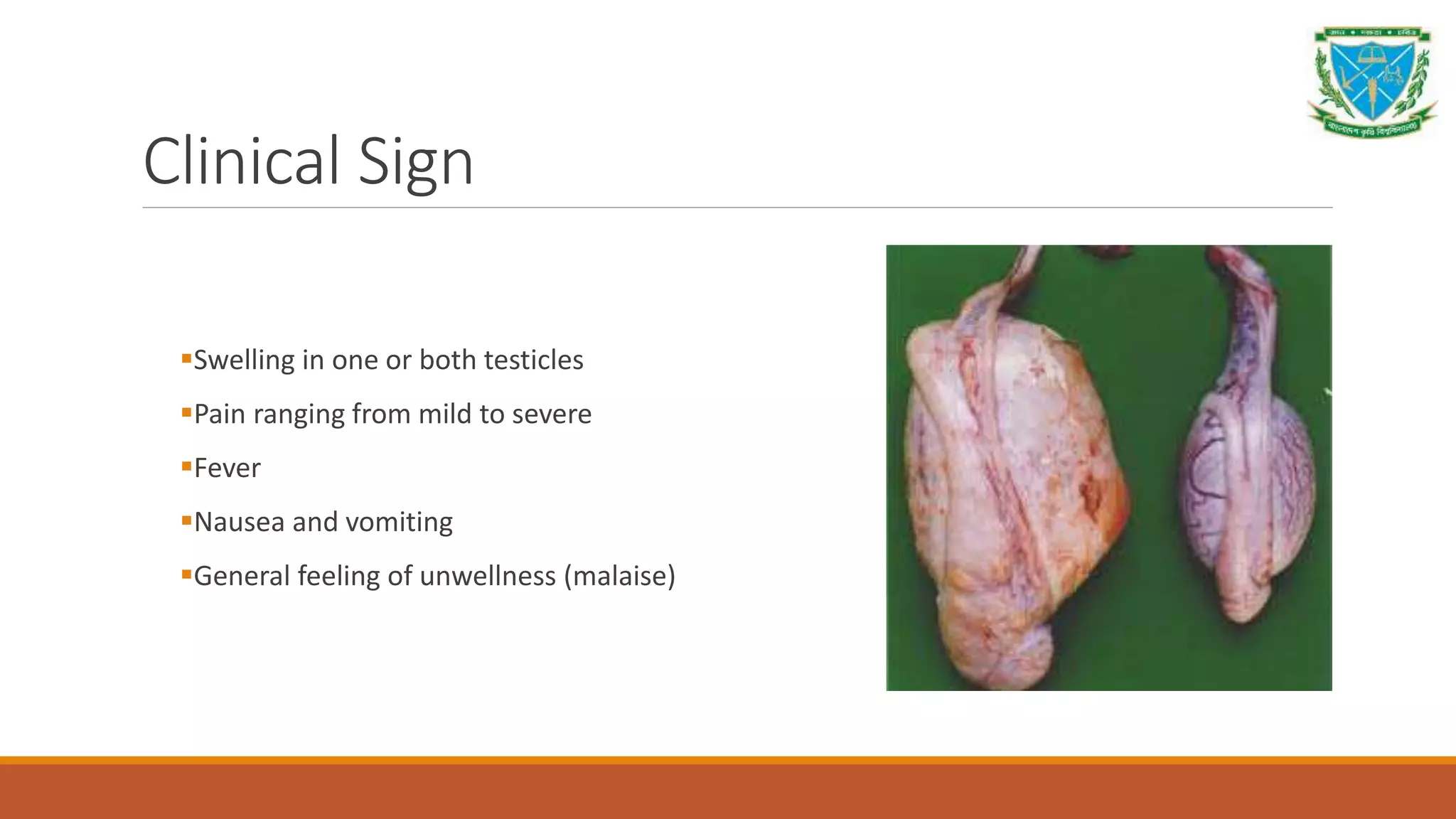
Clinical Sign
Swelling in one or both testicles
Pain ranging from mild to severe
Fever
Nausea and vomiting
General feeling of unwellness (malaise)
Clinical Sign
Consequences
i. Orchitis in one testicle
ii. Affect other testicle
iii. Thermal injury from inflammation
iv. Inflammation in tunica albuginea
v. Pressure necrosis
vi. Thromboembosis of blood vessels
vii. Destruction of spermatogenic tissue
viii. Lose its ability to function normally
Diagnosis
History
Clinical sign
Ultrasound examination-
(Ultrasound with color Doppler can determine if the blood flow to testicles is lower than
normal- indicating torsion- or higher than normal, which helps confirm the diagnosis of
orchitis)
Thermography
STI Screen test-
Organism culture
Treatment:
Sexual rest
Dressing with antiseptic solutions
Application of ice packs or cold water (30 minutes 3 times daily)
Systemic antibiotic therapy-
Drug of choice: Trimethoprim-sulfonamide, Enrofloxacin, amoxicillin or norfloxacin
 Glucocorticoids
Surgical removal of testicle
N:B Medical treatment is not satisfactory to return the testes in normal functions
Research findings on Treatment
2002-Turkey Journal- 600 mg/day rifampicin plus 200 mg/day doxycycline for 6 weeks,
recovered clinically within 3 week (Kadikoylu et. all 2002)
The Journal of urology-2010- Orchiectomy followed by oral tetracycline for 6 weeks.
Streptomycin also is given for 14 days intramuscularly
Combination of long-acting oxytetracycline and streptomycin gives good result
(King, E. H, 2021) found swelling subsided in tasted bulls following treatment with
oxytetracycline.
Moderate value males should be culled
Surgical removal of one testicle allow other testicle to eventually compensate
Brucella affected animals never be used for further AI
Prevention and control
Hygienic
management
Vaccination
Regular
inspection
Thank you

Orchitis in farm animals.pptx

  • 1.
    Md. Rony IbneMasud Faculty of Veterinary Science Bangladesh Agricultural University Orchitis in Farm Animals
  • 2.
  • 3.
    Introduction Orchitis (or-KIE-tis) isan inflammation of one or both testicles Primarily by bacterial or viral infections Secondarily caused by Trauma, Testicular torsion, Scrotal hernia More commonly unilateral than bilateral May involve epididymis Hematogenous spread may occur
  • 4.
    Prevalence Occurs all overthe year More than 3 years of ages bulls are more susceptible Orchitis (9.77%) among 2646 clinical cases on cattle in Upazilla Veterinary Hospital, Chauhali, Sirajganj during the period from January to December 2014 Orchitis 0.5% in calves, 2.5% in steers and 2.0% in adults Mirpur khas abattoir, among 200 slaughtered animals sample (2008)
  • 5.
    Etiology Brucella abortus Brucella canis Brucellamelatensis Brucella suis Actinomyces pyogenes Streptococcus spp Staphylococcus spp E. coli Proteous Mycoplasma Trypanosoma evansi (Journal of Parasitic Disease-2019)
  • 6.
    Clinical Sign Swelling inone or both testicles Pain ranging from mild to severe Fever Nausea and vomiting General feeling of unwellness (malaise)
  • 7.
  • 8.
    Consequences i. Orchitis inone testicle ii. Affect other testicle iii. Thermal injury from inflammation iv. Inflammation in tunica albuginea v. Pressure necrosis vi. Thromboembosis of blood vessels vii. Destruction of spermatogenic tissue viii. Lose its ability to function normally
  • 9.
    Diagnosis History Clinical sign Ultrasound examination- (Ultrasoundwith color Doppler can determine if the blood flow to testicles is lower than normal- indicating torsion- or higher than normal, which helps confirm the diagnosis of orchitis) Thermography STI Screen test- Organism culture
  • 10.
    Treatment: Sexual rest Dressing withantiseptic solutions Application of ice packs or cold water (30 minutes 3 times daily) Systemic antibiotic therapy- Drug of choice: Trimethoprim-sulfonamide, Enrofloxacin, amoxicillin or norfloxacin  Glucocorticoids Surgical removal of testicle N:B Medical treatment is not satisfactory to return the testes in normal functions
  • 11.
    Research findings onTreatment 2002-Turkey Journal- 600 mg/day rifampicin plus 200 mg/day doxycycline for 6 weeks, recovered clinically within 3 week (Kadikoylu et. all 2002) The Journal of urology-2010- Orchiectomy followed by oral tetracycline for 6 weeks. Streptomycin also is given for 14 days intramuscularly Combination of long-acting oxytetracycline and streptomycin gives good result (King, E. H, 2021) found swelling subsided in tasted bulls following treatment with oxytetracycline.
  • 12.
    Moderate value malesshould be culled Surgical removal of one testicle allow other testicle to eventually compensate Brucella affected animals never be used for further AI
  • 13.
  • 14.