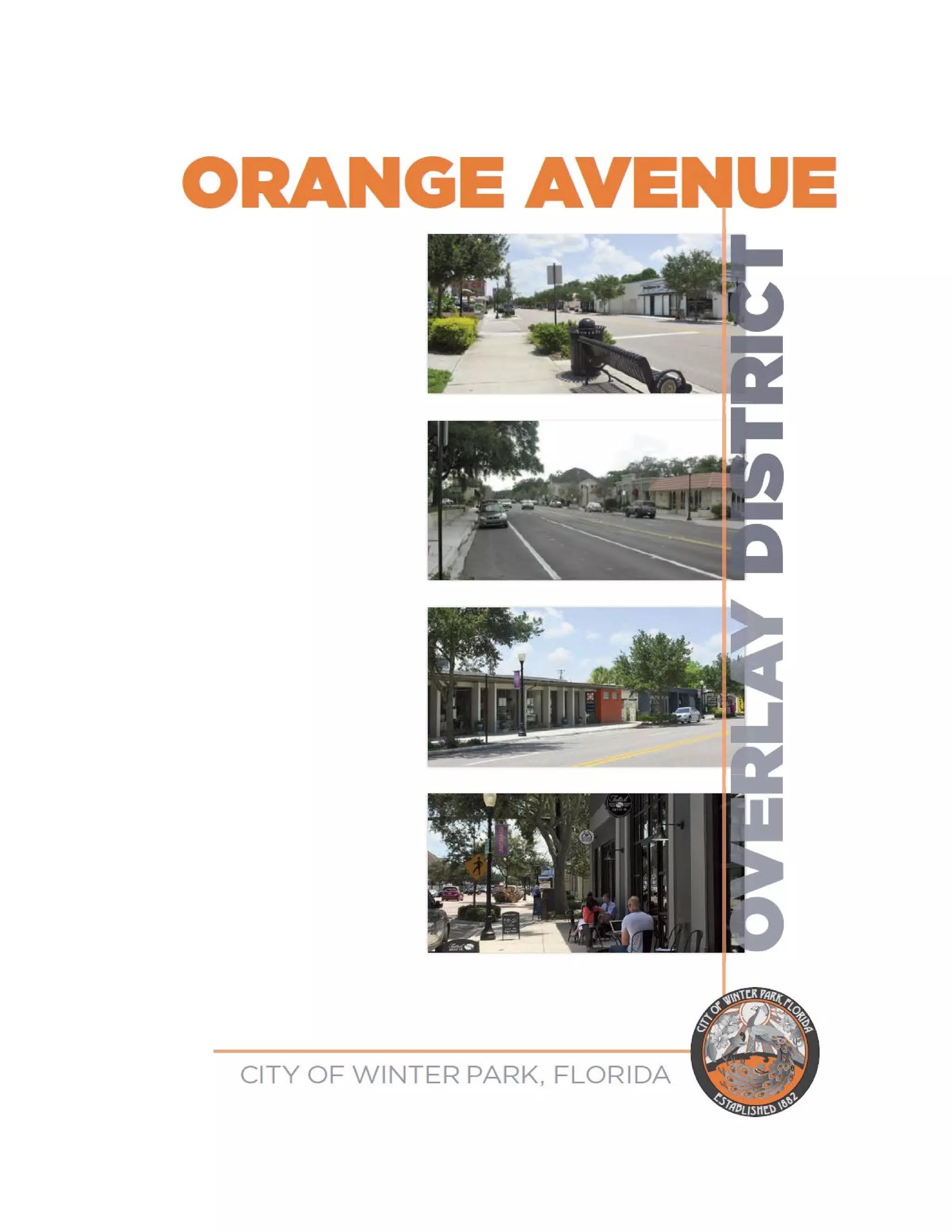
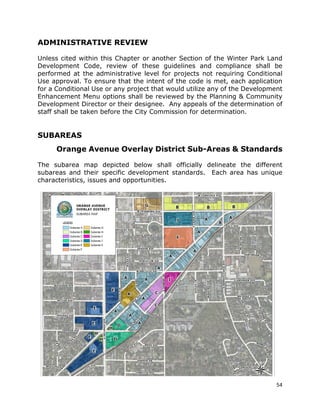
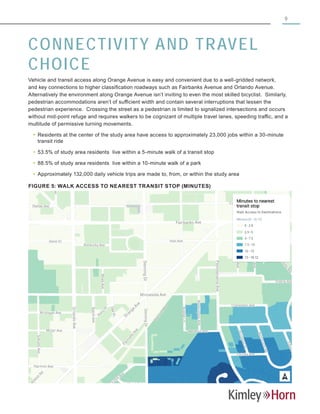
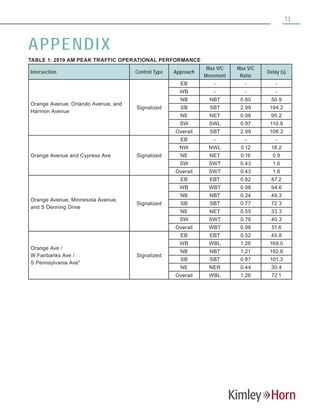
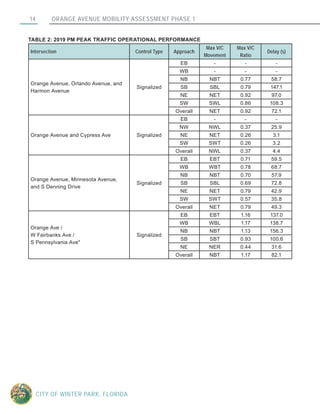
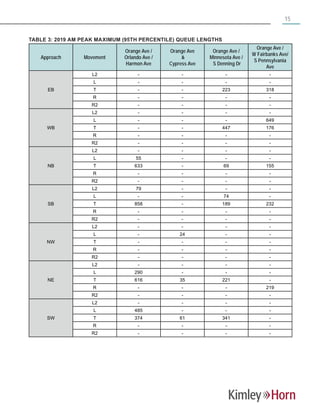
1
2
Special Thanks:
City Commission
Mayor Steve Leary
Vice-Mayor Greg Seidel
Commissioner Carolyn Cooper
Commissioner Sarah Sprinkel
Commissioner Todd Weaver
Planning & Zoning Board
Chair Ross Johnston
Vice-Chair Ray Waugh, P.E.
Laura Turner, AICP
Dr. Owen Beitsch, AICP
Chuck Bell
Christian Swann
Laura Walda
Adam Bert
Orange Avenue Overlay Steering Committee
Phil Kean, AIA – Mayor Leary Appointee
Sally Flynn – Vice-Mayor Seidel Appointee
Michael Dick – Commissioner Cooper Appointee
Lamont Garber – Commissioner Sprinkel Appointee
Sheila De Ciccio – Commissioner Weaver Appointee
Laura Turner, AICP – Planning & Zoning Board Representative
Bill Sullivan – Vision Winter Park Representative
Lambrine Macejewski – Community Redevelopment Agency Advisory Board Representative
Ben Ellis, P.E. – Keep Winter Park Beautiful & Sustainable Board Representative
Jill Hamilton Buss – Transportation Advisory Board Representative
Bill Segal – Economic Development Advisory Board Representative
City of Winter Park Staff
Kim Breland – Planning & Community Development
Allison McGillis, AICP, CNU-A – Planning & Community Development
Kyle Dudgeon, AICP – Community Redevelopment Agency & Economic Development
Nick Lewis – Planning & Community Development
John Nico – Planning & Community Development
Russ Carol – Information Technology
Bronce Stephenson, MPA – Planning & Community Development
Consultants
Kimley-Horn (Traffic/Mobility) & Zyscovich Architects (Massing Studies)
3
SECTION ONE
BACKGROUND
HISTORY
Orange Avenue in Winter Park traces its roots to the horse and buggy days of
yesteryear, when it was called the Orlando-Winter Park Highway, and Denning
Drive was known as Maitland Avenue. Some of the original names associated
with ownership of Orange Avenue properties are well known in Winter Park
even today - the Capen family, Loring Chase, Oliver Chapman, Swoope, the
Knowles family, JE Harper and Frank Fairbanks. Early business involvement
by such important companies as Overstreet Turpentine Company and the
Winter Park Company reflected the importance of Orange Avenue to the
growing City of Winter Park.
Today, the area is a menagerie of assorted businesses, with the quaint charm
of the area known as Designers Row, the Winter Park Playhouse as a great
cultural asset, and the Rollins Baseball stadium. Additionally, the area has a
number of restaurants, boutiques and business offices. Jewett Orthopedic is
a key presence along Orange Avenue and the largest employer in the area.
But, as new investment has been made on smaller properties, many of the
older properties and larger properties have further declined and seen little to
no investment. Currently, of the nearly 75 acres within the Orange Avenue
Overlay District, at least 20 acres are vacant, undeveloped, or not utilized.
Many properties have been purchased just for the available parking, leaving
the building empty. The lack of new investment and the numerous larger
properties that have fallen into further decline have certainly negatively
impacted the small businesses in the area and in many people’s eyes, the area
is simply a cut-through for traffic, creating no life on the street.
4
But the bones are there for Orange Avenue to be the next great Place in Winter
Park. There exists a great mix of small businesses, restaurants, design firms,
boutiques and other retailers that can serve as the foundation on which to
build a special Place. A place to bring your family and friends. A place where
students can grab a cup of coffee and study. A place where you can safely
walk or ride your bike. A place where you can escape to the tranquil beauty
of nearby Mead Botanical Garden. A place to spend a whole day shopping,
relaxing, enjoying food and drink, seeing old friends and making new ones.
With the vision, passion, careful planning and boldness that have created the
Winter Park that this community loves, Orange Avenue can be the newest
jewel in the crown of Winter Park.
Why Create the Orange Avenue Overlay?
It is the intent of the Orange Avenue Overlay (OAO) District to provide
enhanced standards to protect and promote the unique characteristics of the
Orange Avenue area and create a distinct gateway into Winter Park. This
Overlay District is used to create a sense of place established through specific
architectural styles, streetscape design, open space areas, setbacks, site
design, landscaping and other regulatory controls.
The City of Winter Park has discussed the possible redevelopment of Orange
Avenue for many years, but little has been achieved. The City Commission
made the creation of a Mixed-Use Overlay District a priority in the
Comprehensive Plan and also directed staff to create a process that would
bring forward a Mixed-Use Overlay District.
Overlay Districts
The first question to many is, what is an Overlay District?
An Overlay District is planning tool that can provide the flexibility to achieve
a vision for an area that would not be able to be created with basic inflexible
zoning codes. An Overlay District is a geographically designated area where
certain additional codes are overlaid atop underlying zoning district(s). In
many cases, the new codes adopted in the overlay replace the codes that are
dictated in the underlying zoning districts, so it essentially acts as a new
zoning codes for a particular area. The district modifies or supplements the
base zoning regulations and allows for flexibility in design and the ability to
apply more area specific requirements including, but not limited to,
architecture, height, setbacks, use, open space, landscaping, historic
preservation, floor area ratio, parking, public improvements, access,
stormwater, etc.
5
Placemaking
The concept of Placemaking has been a major component of the Orange
Avenue Overlay creation. By using the community input that was provided as
a part of the Vision Winter Park process, the process of updating the
Comprehensive Plan, and from the Orange Avenue public input process, a
vision for the area began to take shape.
Placemaking can be defined as both an overarching idea and a hands-on
approach for improving a neighborhood, city, or region. Placemaking inspires
people to collectively reimagine and reinvent public spaces as the heart of
every community. Strengthening the connection between people and the
places they share, placemaking refers to a collaborative process by which we
can shape our public and private realm in order to maximize shared value.
More than just promoting better urban design, placemaking facilitates creative
patterns of use, paying particular attention to the physical, cultural, and social
identities that define a place and support its ongoing evolution. With
community-based participation at its center, an effective placemaking process
capitalizes on a local community's assets, inspiration, and potential, and it
results in the creation of quality public spaces that contribute to people's
health, happiness, and well-being.
GOALS
The Goals of the Orange Avenue Overlay District are to:
a. Encourage sustainable development and redevelopment that will become
a long-term asset to Winter Park;
b. Create and enhance connectivity to the surrounding neighborhoods and
promote connectivity to all of Winter Park;
c. Utilize and incentivize private development and/or redevelopment to
create solutions for the existing problems that small properties and
business-owners in the Orange Avenue area face;
d. Create public improvements that will benefit all residents and visitors of
Winter Park;
6
e. Provide the opportunity for existing businesses and properties to improve
their structures, their businesses and their building facades;
f. Restrict uses and create regulations that promote the development of the
Orange Avenue area as a special place within Winter Park that promotes
an environment of arts, healthy-living, cuisine, culture, heritage, social
interaction, healthcare, local business, education, connectivity and
community;
g. Create better connectivity to and the promotion of Mead Botanical
Garden;
h. Meet the goals of the Community Redevelopment Agency (CRA) in the
areas of the Overlay that fall within the CRA boundary;
i. Protect and encourage development of an area that represents a
significant opportunity for public and private investment, which is
important to the long-term economic health of Winter Park;
j. Establish regulations that protect the investment of existing and new
businesses from unattractive, unsustainable and non-compatible uses;
k. Ensure the area is visually pleasing and creates place that encourages
community and is developed in a coordinated fashion;
l. Follow the principles of the Vision Winter Park, Comprehensive Plan and
Sustainability Plan documents;
m. Encourage mixed-use development;
n. Give special attention to landscaping, architectural detail, meaningful
open space, buffering, signage, lighting, and building setbacks;
o. Encourage architectural creativity, quality and variation to create a unique
district with its own identity;
p. Promote the history of Winter Park and the Orange Avenue area, including
the area known as Designers Row;
q. Keep the traditional scale within the majority of the district;
r. Create an Arts & Cultural Corridor;
s. Protect and promote Historic architecture, where it exists in the area;
t. Attract new businesses, retain small businesses and encourage locally-
owned businesses in the Orange Avenue area;
7
VISION WINTER PARK
The Winter Park Visioning process and subsequent document that was created
in 2016 have been guiding principles for the creation of this Overlay District.
The Vision Winter Park Document states the following:
Our Vision - Winter Park is the city of arts and culture, cherishing its
traditional scale and charm while building a healthy and sustainable future
for all generations.
Vision Themes:
• Cherish and sustain Winter Park’s extraordinary quality of life.
• Plan our growth through a collaborative process that protects our city’s
timeless scale and character.
• Enhance the Winter Park brand through a flourishing community of arts
and culture.
• Build and embrace our local institutions for lifelong learning and future
generations.
COMPREHENSIVE PLAN
The Winter Park Comprehensive Plan, adopted by the City Commission in
2017, has a number of goals, objectives and policies that have guided to the
creation of the Orange Avenue Overlay District. The following are applicable:
• GOAL 1-1: MAINTAIN THE CITY’S CHARACTER
Ensure the City of Winter Park maintains its traditional scale and low
density residential character while at the same time providing for the
most effective provision of services; to promote sustainable community
development now and for future generations; to promote conscientious
economic development in appropriate locations, to promote quality infill
and redevelopment which strengthens the character of the City, to
protect sensitive natural areas by directing growth to environmentally
appropriate areas, and prohibit those uses which are incompatible.
• OBJECTIVE 1-1.2: Development Scale
Encourage development that fosters pedestrian connectivity,
appropriate design and landscaping with building mass and scale.
• Policy 1-2.4.14: Mixed Use Designation
Within one year from the adoption of this Comprehensive Plan, the City
will create a mixed use overlay or district for commercially designated
parcels that would be intended to facilitate design and use flexibility to
8
achieve pedestrian scale, innovative transit connectivity and maximizing
open space within a commercially viable and architecturally desirable
design. Complementary uses may include, but are not limited to retail,
entertainment, office, civic and residential uses. The City shall also
prepare companion land development code regulations that implement
the proposed mixed use overlay or district simultaneously with any
policy amendments related to this overlay or district. All policies related
to this overlay or district will be subject to a Comprehensive Plan
amendment.
• OBJECTIVE 1-4.1: Maintain the Economic Vitality of the City
Plan and manage the City’s growth and redevelopment to promote an
attractive business climate while protecting the residential character of
Winter Park.
• Policy 1-4.1.3: Redevelopment Along Major Corridors
The City will monitor the redevelopment of its major commercial
arterials including Orlando Avenue, Lee Road, Fairbanks Avenue, Aloma
Avenue, and Orange Avenue to determine trends, employment activity,
high areas of redevelopment activity and compatibility and work to
create policies and implementation tools to ensure quality.
• Policy 1-5.2.5: Ensure Compatible Size, Form & Function are
Achieved in Areas Designated Medium- and High-Density
Residential
The City shall apply regulatory measures within Medium and High-
Density Residential designated areas in order to avoid land use
compatibility conflicts due to dissimilar building types, size, mass,
articulation, height, and other design features or ancillary loss of views,
privacy, and access to light, as well as noxious impacts of traffic, noise,
adverse changes in drainage patterns, and other negative effects of
incompatible development.
• Policy 1-5.2.6: Investigate Policies for Density Issues
Surrounding, Multiple Family Structures.
The City shall investigate approaches for revising land use policies
addressing renovation or redevelopment of all multi-family regulations
for apartments and condominiums, including their size, scale, design
aesthetics and amenities.
9
• OBJECTIVE 1-5.4: Development/Redevelopment of Multi-Family
Residential, Commercial, Office & Mixed-Use Areas.
The City shall provide for development and redevelopment of its
commercial and office areas when compatible with the scale and
character the surrounding area context.
• Policy 1-5.4.1: Redevelopment of Areas Designated Commercial
& Office/Professional
The City shall consider adopting architectural design review guidelines
along major transportation corridors, including form-based code,
identify building types and/or structural design features that shall be
encouraged and those to be discouraged due to their adverse impacts
on property in the immediate area.
• Policy 1-5.4.2: Improve Design Procedures & Resources and
Architectural Review
The City shall periodically update approved design guidelines to enhance
the quality of architectural design, achieve more compatible
relationships in the design of buildings, avoid unsightly appearance,
avoid inordinate contrast in building mass, scale, height, articulation,
and other design features.
• Policy 1-5.4.7: Gateway Plan for Development or Redevelopment
of Properties
The City shall create Gateway Plans and design studies for the potential
redevelopment of the major transportation corridors leading into Winter
Park to include:
 1. West Fairbanks Avenue from I-4 east to Orlando Avenue;
 2. Orlando Avenue from the southern City limits to the northern
City limits;
 3. Aloma Avenue from the City limits west to Lakemont Avenue;
 4. Orange Avenue from Fairbanks Avenue to Orlando Avenue;
 5. Lee Road from I-4 to Orlando Avenue.
• Policy 1-5.4.8: Enhance the Appeal & Improve the Property
Values of Certain Gateway Corridor Entrances into the City of
Winter Park
In order to establish, maintain and enhance the character and aesthetic
appeal of certain important gateway corridor entrances into the City of
Winter Park, and to increase the property values along such gateway
corridor entrances to the City, in order to distinguish those gateways as
attractive entrances into the City, the City shall, prohibit certain
business types along the frontage of those roadway corridors to exclude
any new or used car sales businesses, auto repair businesses, resale
10
stores or pawn shops, vapor lounges or smoke shops, adult oriented
businesses, gas/service stations and convenience stores.
• GOAL 1-7: COLLABORATIVE PLANNING PROCESS
The City will embrace a collaborative planning process that evaluates
and monitors the Goals, Objectives and Policies outlined in this Plan and
enhances the community.
• Policy 1-F-3: Prohibit Certain Business Types in Mead Garden
Planning Area in Order to Preserve the Character of the Orange
Avenue & Fairbanks Avenue Gateways to Winter Park
The City shall prohibit certain business types within this Mead Garden
Planning Area along Orange Avenue and Fairbanks Avenue including
new or used car sales, new auto repair businesses, vapor stores and
smoke shops, resale stores or pawn shops, tattoo businesses, adult
oriented businesses, fast food businesses and convenience stores, as
this portion of Orange Avenue and Fairbanks Avenue are gateways into
the downtown and central business district of the City of Winter Park.
• Policy 1-F-4: Support Restoration of Mead Botanical Garden.
The City shall encourage the restoration of Mead Botanical Garden.
• Policy 1-F-17: Orange Avenue Design Guidelines.
The City shall consider design guidelines for the Orange Avenue corridor
from Orlando Avenue to Fairbanks Avenue in order to protect and
maintain the scale and appearance of this gateway corridor.
• GOAL 2-1: BALANCED TRANSPORTATION SYSTEM.
The City of Winter Park desires to ensure a balanced and safe
transportation system that promotes a walkable, bicycle-friendly
environment that encourages transit as well as ensures efficiencies
along the roadway network.
• OBJECTIVE 2-1.1: Safe & Balanced Multimodal System.
The City shall create a Mobility Plan that promotes and supports the
broad transportation needs of the community.
• Policy 2-1.1.1: Multimodal Activities.
The City defines mobility as the provision of multiple opportunities or
choices in transportation modes for travel within and to/from the City
through a multi-modal transportation system. The general hierarchy of
modes is 1) walking, 2) bicycling, 3) transit (bus and rail), and 4) private
vehicles. The primary focus or overall mobility strategy is on the
minimum provision of facilities for all modes and the connectivity based
11
upon the mode hierarchy. Where adequate facilities exist for all modes,
the City will prioritize enhancing the quality and integration of the
facilities based upon the mode hierarchy.
• Policy 5-1.1.3: Urban Form & Pattern
The City shall integrate land use patterns and transportation systems by
assuring that character, design, and intensity of development is
compatible with adjacent transportation infrastructure and services. The
City shall continue to facilitate an urban form following planning
concepts inherent to neo-traditional neighborhood planning philosophies
(i.e., grid system street pattern, residential and non-residential uses
within walking distance, public open spaces and plazas).
• Policy 5-2.6.4: Location of Park & Open Space Dedications
Where park and open space dedications required of new development
are placed on-site, they shall be placed in areas that provide the
greatest protection to and preserve the most environmentally important
and sensitive.
• GOAL 6-1: PROVIDE ADEQUATE RECREATION AND OPEN SPACE
By preserving, maintaining and enhancing a quality system of parks,
open space and recreational facilities which satisfy the needs of the
current and future residents of Winter Park.
• OBJECTIVE 6-1.1: Provision of Public Park Land
The City of Winter Park shall assure that appropriate amounts of park
land and open space will be within the public domain so as to meet the
standards of this plan.
• OBJECTIVE 6-2.2: Integration of Neighborhood Design With
Parks & Open Space
Neighborhoods shall be planned and designed with parks and open
space that provide available recreation opportunities for nearby
residents.
• Policy 6-2.2.1: Park Accessibility to Neighborhoods
Neighborhoods shall be planned with park lands and open spaces
intermixed with residential development and accessible within walking
distance to residents. Park land within neighborhoods shall be designed
to foster opportunities for social interaction and shall serve as a focal
point for the surrounding residential areas.
12
• OBJECTIVE 6-3.4: Interconnect Park System with Recreation &
Transportation Trails and Paths
The City shall provide a park and open space system to interconnect
parks by pedestrian and bicycle path lanes.
• Policy 6-3.4.1: Link Parks & Public Open Space
The City shall provide bikeways, where possible and where public safety
permits, to link open space and parks both internally and regionally to
Winter Park. New park location and design should take into
consideration the presence or feasibility to the park with other City
facilities via bicycle paths and lanes.
13
SECTION TWO
PROCESS
Work Performed In-House
What is unique about this process is that in the past, the City has relied on
outside consultants to perform most of the large-scale planning initiatives.
These processes don’t always allow for as much public participation and there
is a feeling in the community that by the time the draft document is presented,
there is no real opportunity to change the language. Additionally, the work
was performed by people who may not live and work in the community, and
may not have the insight of those who know Winter Park best.
That is why this process has been so different. This process was done
completely in-house, with City staff from various departments involved, but
led by the City of Winter Park Planning and Community Development team.
Many studies have been performed on Orange Avenue in the past, but no
actual codes or actionable documents had been created. The desired outcome
for this process was to finally create updates to codes and planning documents
that would actually stimulate thoughtful development.
Though the Planning team has great insight into the community, staff wanted
an implementable plan that would be developed by Winter Park, for Winter
Park. Therefore, a process was created that would be guided by the public
from the start to the finish.
Staff utilized a Transportation Consultant, Kimley-Horn, to perform initial
traffic assessments and to begin looking at the impact that varying
development scenarios would have on Orange Avenue. They were also tasked
with looking at ways to improve safety for pedestrians, cyclists and vehicles
in the area. Analysis will continue throughout the redevelopment process as
actual project proposals are brought forward. Additionally, staff utilized
14
Architectural Consultant, Zyscovich & Associates to create models of different
development scenarios to study massing and how to incorporate nodes of
intensity that would create parking solutions, while keeping the traditional and
walkable scale of the area.
This Overlay process represents more than 14 months of work by City staff.
Design Charette
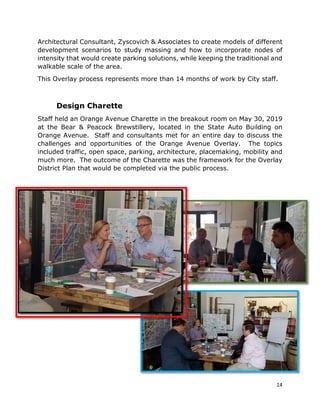
Staff held an Orange Avenue Charette in the breakout room on May 30, 2019
at the Bear & Peacock Brewstillery, located in the State Auto Building on
Orange Avenue. Staff and consultants met for an entire day to discuss the
challenges and opportunities of the Orange Avenue Overlay. The topics
included traffic, open space, parking, architecture, placemaking, mobility and
much more. The outcome of the Charette was the framework for the Overlay
District Plan that would be completed via the public process.
15
PUBLIC INPUT
The input of the Winter Park community has been at the forefront of this
planning initiative. A great deal of public input had been gathered by past
studies and initiatives such as Vision Winter Park or the updating of the
Comprehensive Plan, but staff would start again, with the first step being
public input as a part of this Overlay process.
First Public Input Meeting
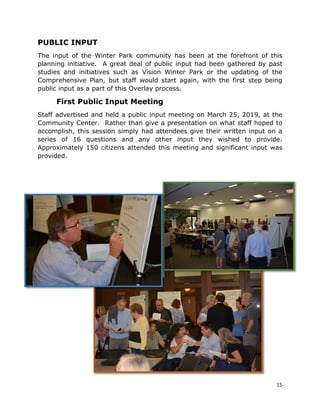
Staff advertised and held a public input meeting on March 25, 2019, at the
Community Center. Rather than give a presentation on what staff hoped to
accomplish, this session simply had attendees give their written input on a
series of 16 questions and any other input they wished to provide.
Approximately 150 citizens attended this meeting and significant input was
provided.
16
Stakeholder (2nd
) Public Input Meeting
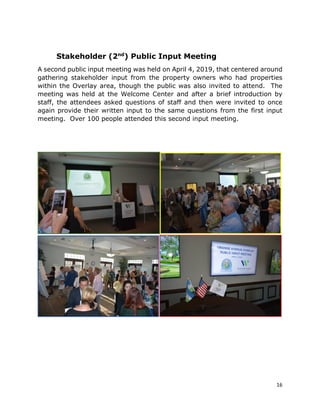
A second public input meeting was held on April 4, 2019, that centered around
gathering stakeholder input from the property owners who had properties
within the Overlay area, though the public was also invited to attend. The
meeting was held at the Welcome Center and after a brief introduction by
staff, the attendees asked questions of staff and then were invited to once
again provide their written input to the same questions from the first input
meeting. Over 100 people attended this second input meeting.
17
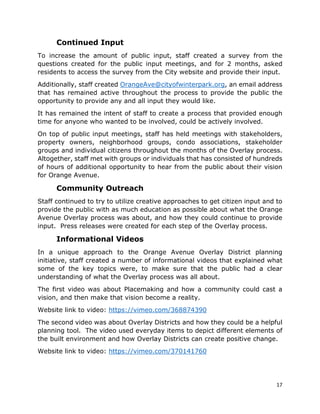
Continued Input
To increase the amount of public input, staff created a survey from the
questions created for the public input meetings, and for 2 months, asked
residents to access the survey from the City website and provide their input.
Additionally, staff created OrangeAve@cityofwinterpark.org, an email address
that has remained active throughout the process to provide the public the
opportunity to provide any and all input they would like.
It has remained the intent of staff to create a process that provided enough
time for anyone who wanted to be involved, could be actively involved.
On top of public input meetings, staff has held meetings with stakeholders,
property owners, neighborhood groups, condo associations, stakeholder
groups and individual citizens throughout the months of the Overlay process.
Altogether, staff met with groups or individuals that has consisted of hundreds
of hours of additional opportunity to hear from the public about their vision
for Orange Avenue.
Community Outreach
Staff continued to try to utilize creative approaches to get citizen input and to
provide the public with as much education as possible about what the Orange
Avenue Overlay process was about, and how they could continue to provide
input. Press releases were created for each step of the Overlay process.
Informational Videos
In a unique approach to the Orange Avenue Overlay District planning
initiative, staff created a number of informational videos that explained what
some of the key topics were, to make sure that the public had a clear
understanding of what the Overlay process was all about.
The first video was about Placemaking and how a community could cast a
vision, and then make that vision become a reality.
Website link to video: https://vimeo.com/368874390
The second video was about Overlay Districts and how they could be a helpful
planning tool. The video used everyday items to depict different elements of
the built environment and how Overlay Districts can create positive change.
Website link to video: https://vimeo.com/370141760
18
The third video was about Mixed-Use. The video had a number of Orange
Avenue Overlay Steering Committee members and Planning & Zoning Board
members discussing their favorite mixed-use areas in Winter Park.
Website link to video: https://vimeo.com/371477044
The fourth video showed the public process and the public input that given
throughout the Overlay process. That video will become available after the
January 13, 2020 City Commission meeting.
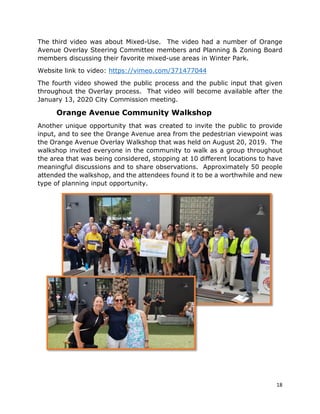
Orange Avenue Community Walkshop
Another unique opportunity that was created to invite the public to provide
input, and to see the Orange Avenue area from the pedestrian viewpoint was
the Orange Avenue Overlay Walkshop that was held on August 20, 2019. The
walkshop invited everyone in the community to walk as a group throughout
the area that was being considered, stopping at 10 different locations to have
meaningful discussions and to share observations. Approximately 50 people
attended the walkshop, and the attendees found it to be a worthwhile and new
type of planning input opportunity.
19
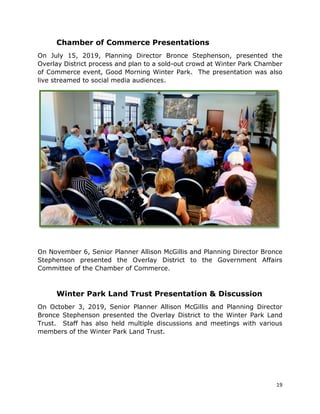
Chamber of Commerce Presentations
On July 15, 2019, Planning Director Bronce Stephenson, presented the
Overlay District process and plan to a sold-out crowd at Winter Park Chamber
of Commerce event, Good Morning Winter Park. The presentation was also
live streamed to social media audiences.
On November 6, Senior Planner Allison McGillis and Planning Director Bronce
Stephenson presented the Overlay District to the Government Affairs
Committee of the Chamber of Commerce.
Winter Park Land Trust Presentation & Discussion
On October 3, 2019, Senior Planner Allison McGillis and Planning Director
Bronce Stephenson presented the Overlay District to the Winter Park Land
Trust. Staff has also held multiple discussions and meetings with various
members of the Winter Park Land Trust.
20
Additional Planned Public Outreach
• On December 2, 2019, staff will present the Overlay District language
to the Winter Park Rotary Club.
• On December 18, 2019, staff will hold a public information meeting in
the lobby of the Gateway Plaza building at 1201 Orlando Ave for
property owners within the Orange Avenue Overlay area. Notice was
sent to all property owners within the Overlay District and the public is
welcome to attend as well.
• On December 21, 2019, staff will have a booth at the Winter Park
Farmers Market to be available to discuss the Orange Avenue Overlay
District with anyone who has questions, concerns or suggestions.
Staff will at the booth from 7AM until 1PM.
Commitment to Public Input, Education & Involvement
By the end of this Overlay process, there will have been 19 publicly advertised
meetings where the public was invited to attend, provide input, comment or
ask questions. Additionally, there will have been 2 worksessions open for the
public to attend by the Planning & Zoning Board, along with two City
Commission work sessions.
Community Support of the Overlay Process
“People make Winter Park what it is and what it hopes to be. The Orange
Avenue Overly District process took urban planning out of City Hall on to the
streets. The expertise of city staff was joined by a parade of highly skilled
volunteers, business owners, and interested citizens. Walking the pavement,
seeing everyday activity, enhanced the urban planning process like never
before.”
- David A. Odahowski
President & CEO, Edyth Bush Charitable Foundation
21
“As the principal representative of one of the largest landowners with
property in the proposed overlay district, I received the news of the Orange
Avenue review with great skepticism based on the myriad outside
consultants and visioning processes of the past. Many in number but few in
result, the past processes largely seemed to leave us only a large expense
and a broad brush proposal of “here’s what you should do,” based largely on
comparisons to other cities that are not matches for Winter Park. However,
my skepticism has turned to optimism. This process, for the first time taking
into account local subject matter experts, the public (and most specifically,
those likely to be most affected by the changes) and the landowners
themselves, has yielded a phenomenal collaborative and engaging
environment that has the chance to offer meaningful change in some
desperately needed areas. The City planning staff should be commended for
their vision and effort to date to make this a reality.”
- Frank A. Hamner
The Law Offices of Frank A. Hamner, P.A.
“I have been involved in several planning initiatives over the past 20 years
on Orange Avenue. The current initiative is taking a more holistic,
community wide approach than I have experienced in the past. The changes
on Orange Avenue, if any, will radiate to the surrounding areas and
consideration of how all areas can coalesce and benefit in an integrated
fashion, is a positive change to the traditional planning process.”
- Stephanie Henley
Principal, Beasley & Henley Interior Design
22
ORANGE AVENUE OVERLAY STEERING COMMITTEE
Staff requested that the City Commission allow for the creation of a Steering
Committee, to represent the public and to guide the development of the
Overlay language. The City Commission adopted a Resolution that created
the Orange Avenue Overlay Steering Committee. The Resolution stated:
“WHEREAS, in accordance with Chapter 2, Section 2-48(n), City of
Winter Park Code of Ordinances, the City Commission hereby creates a
temporary eleven (11) member Orange Avenue Overlay Steering
Committee for the purpose of evaluating the potential creation of an
Orange Avenue Overlay District and associated changes to the Land
Development Code and Comprehensive Plan and making
recommendations concerning the same to the City Commission.”
Orange Avenue Overlay Steering Committee Roster:
The Steering Committee had a citizen appointed by the Mayor and each
Commissioner, plus a representative from Boards and Committees that had
close ties to the creation of an Overlay District. The Committee consisted of
the following members:
• Phil Kean, AIA – Mayor Leary Appointee
• Sally Flynn – Vice-Mayor Seidel Appointee
• Michael Dick – Commissioner Cooper Appointee
• Lamont Garber – Commissioner Sprinkel Appointee
• Sheila De Ciccio – Commissioner Weaver Appointee
• Laura Turner, AICP – Planning & Zoning Board Representative
• Bill Sullivan – Vision Winter Park Representative
• Lambrine Macejewski – CRA Advisory Board Representative
• Ben Ellis, P.E. – Keep Winter Park Beautiful & Sustainable Board
Representative
• Jill Hamilton Buss – Transportation Advisory Board Representative
• Bill Segal – Economic Development Advisory Board Representative
23
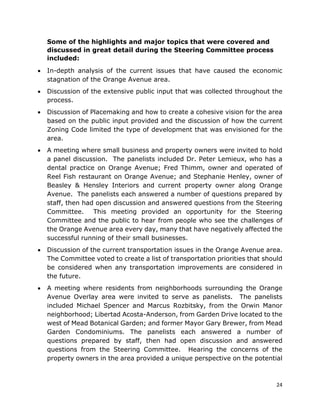
Steering Committee Meetings
Over 26 weeks, the 11-member Steering Committee held a total of 13
meetings (including the walkshop), which invited the public to attend and
allowed for public comment at each meeting. The Steering Committee
covered a variety of topics over their extensive meeting schedule. The
Committee voted on the following language that established their goals:
“The Steering Committee shall guide code language for the successful
implementation of the Orange Avenue Overlay. The language shall
incorporate the city’s Vision and Comprehensive Plan goals of creating
a mixed-use district and a gateway into Winter Park. The language shall
enhance the Orange Avenue area identity and experience, while
increasing safety and mobility. It shall provide enhanced and flexible
development standards to create the opportunity for positive and
sustainable public and private improvements and redevelopment of the
area. The Committee shall make a recommendation of the draft
language to the City Commission for final approval.”
24
Some of the highlights and major topics that were covered and
discussed in great detail during the Steering Committee process
included:
• In-depth analysis of the current issues that have caused the economic
stagnation of the Orange Avenue area.
• Discussion of the extensive public input that was collected throughout the
process.
• Discussion of Placemaking and how to create a cohesive vision for the area
based on the public input provided and the discussion of how the current
Zoning Code limited the type of development that was envisioned for the
area.
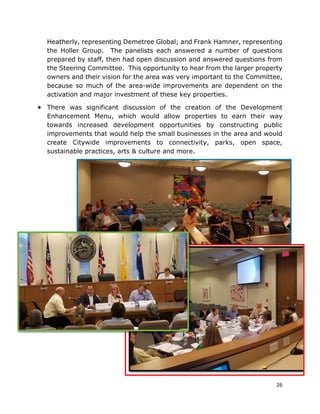
• A meeting where small business and property owners were invited to hold
a panel discussion. The panelists included Dr. Peter Lemieux, who has a
dental practice on Orange Avenue; Fred Thimm, owner and operated of
Reel Fish restaurant on Orange Avenue; and Stephanie Henley, owner of
Beasley & Hensley Interiors and current property owner along Orange
Avenue. The panelists each answered a number of questions prepared by
staff, then had open discussion and answered questions from the Steering
Committee. This meeting provided an opportunity for the Steering
Committee and the public to hear from people who see the challenges of
the Orange Avenue area every day, many that have negatively affected the
successful running of their small businesses.
• Discussion of the current transportation issues in the Orange Avenue area.
The Committee voted to create a list of transportation priorities that should
be considered when any transportation improvements are considered in
the future.
• A meeting where residents from neighborhoods surrounding the Orange
Avenue Overlay area were invited to serve as panelists. The panelists
included Michael Spencer and Marcus Rozbitsky, from the Orwin Manor
neighborhood; Libertad Acosta-Anderson, from Garden Drive located to the
west of Mead Botanical Garden; and former Mayor Gary Brewer, from Mead
Garden Condominiums. The panelists each answered a number of
questions prepared by staff, then had open discussion and answered
questions from the Steering Committee. Hearing the concerns of the
property owners in the area provided a unique perspective on the potential
25
redevelopment of the area and what challenges the current state of the
Orange Avenue area creates for those who live nearby.
• Discussion of the allowable uses and the uses that should not be allowed
as the area is transformed into a more walkable and vibrant mixed-use
district.
• A meeting where stakeholders who have existing larger developed
properties were invited to serve on a panel. The panelists included: Ray
Colado, owner of the Gateway Plaza Building (Commerce National Bank);
Ed Kania, VP of Business and Finance & Treasurer from Rollins College; and
Jon Albert, CEO of Jewett Orthopedic. The panelists each answered a
number of questions prepared by staff, then had open discussion and
answered questions from the Steering Committee. This opportunity
provided another perspective of businesses that have larger operations in
the area, but still have many issues that affect their operations. They also
shared their visions for the development of the area, hoping that more
property owners make significant investment or reinvestment on their
properties as well
• The Committee discussed the first design and architectural guidelines that
would be created for Winter Park development. Those are reflected in the
new Orange Avenue Overlay District code language.
• In-depth discussion and analysis of the flooding, traffic and parking
shortages that have created the biggest challenges for the Orange Avenue
area. The discussion led to the realization that the Orange Avenue codes
should take a more modern, intelligent and sustainable view of how parking
structures are treated and calculated, with the Committee agreeing that
parking garages should not count towards the Floor Area Ratio of a
property, as long as certain criteria are met. The discussion also included
looking at shared parking arrangements and encouraging the businesses
in the area to share parking. The outcome of these discussions are found
throughout the new code language of the Orange Avenue Overlay District
and in the Development Enhancement Menu included in the code language.
• The Committee discussed the creation of separate subareas and the unique
standards that each subarea would have.
• The Committee had the owners of the three properties that are expected
to see major redevelopment to for a panel discussion. The panelists
included: Randy Knight, City Manager of the City of Winter Park; Michelle
26
Heatherly, representing Demetree Global; and Frank Hamner, representing
the Holler Group. The panelists each answered a number of questions
prepared by staff, then had open discussion and answered questions from
the Steering Committee. This opportunity to hear from the larger property
owners and their vision for the area was very important to the Committee,
because so much of the area-wide improvements are dependent on the
activation and major investment of these key properties.
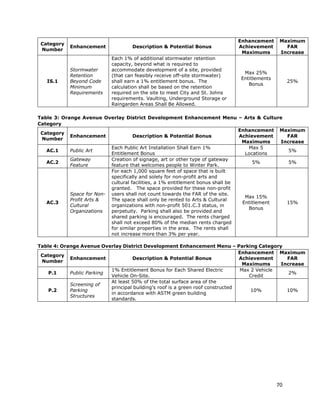
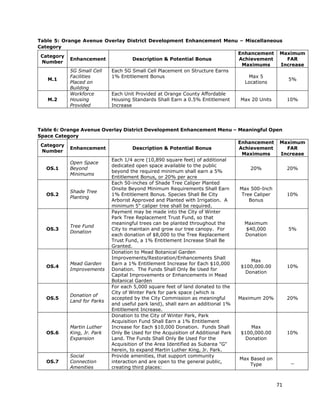
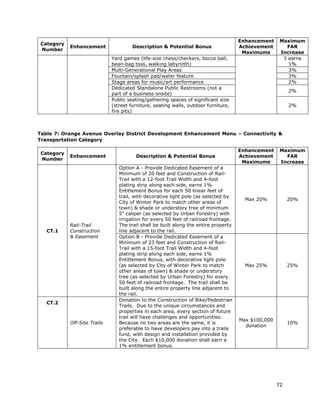
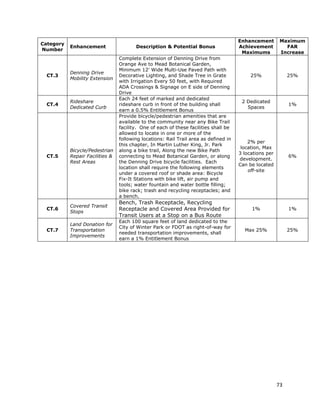
• There was significant discussion of the creation of the Development
Enhancement Menu, which would allow properties to earn their way
towards increased development opportunities by constructing public
improvements that would help the small businesses in the area and would
create Citywide improvements to connectivity, parks, open space,
sustainable practices, arts & culture and more.
27
RECOMMENDATION
At their final meeting on November 13, 2019, the Orange Avenue Overlay
Steering Committee voted 8-2 to recommend approval of the Final Draft
language, with minor changes that were discussed at the meeting. The major
topic that all members of the Steering Committee could not agree upon was
whether or not the City-owned Progress Point property should be developed,
to what scale it should be developed, and whether or not it should be used as
a park.
28
SECTION THREE
DATA
PARKING
A major point of discussion throughout the Overlay process has been the
opportunity to create new parking solutions that can help an area that has
serious need for available parking. Currently, the vacant or unused properties
at Progress Point, the former Holler RV site, the former Lombardi’s Seafood
(Demetree) site and Bank of the Ozarks are the only available off-street
parking. These properties are not legally designated for public parking, but
have served as the overflow parking relief areas for some time. When these
areas are developed and if they are developed without providing some
available space for public and/or shared/leased parking use, the severe
parking shortage will only be exacerbated and the likely outcome is that
existing small businesses in the area will not be able to survive.
Parking Walkshed
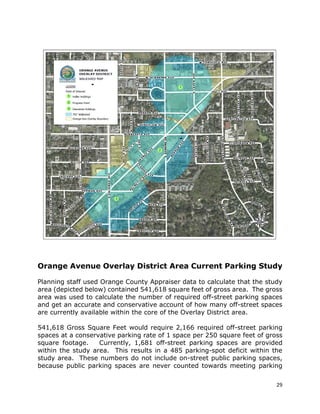
It is important to understand that parking needs to be strategically located
within walking distance of destinations. According to Urban Land Institute
studies, a typical person has a comfortable walk-shed of about 750 feet from
where they park to their destination (see exhibit below). This Orange Avenue
process has found that there is the opportunity and desire to create public
parking structures or shared parking structures at the former Holler RV site,
the Progress Point site and the Demetree (Former Lombardi’s Seafood) site.
Shown here is the 750-foot walkshed applied to those properties, which
uniquely cover the majority of the Orange Avenue Overlay District area. The
existing conditions and opportunities just happen to uniquely be set up to
meet a 750-foot walkshed from most of the properties within the Overlay area
that may need to utilize available parking in area garages.
29
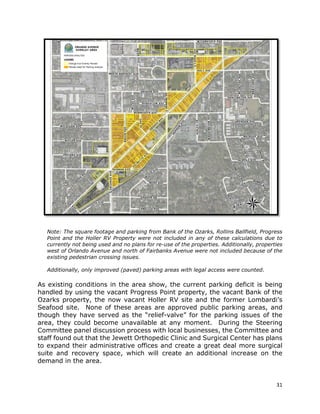
Orange Avenue Overlay District Area Current Parking Study
Planning staff used Orange County Appraiser data to calculate that the study
area (depicted below) contained 541,618 square feet of gross area. The gross
area was used to calculate the number of required off-street parking spaces
and get an accurate and conservative account of how many off-street spaces
are currently available within the core of the Overlay District area.
541,618 Gross Square Feet would require 2,166 required off-street parking
spaces at a conservative parking rate of 1 space per 250 square feet of gross
square footage. Currently, 1,681 off-street parking spaces are provided
within the study area. This results in a 485 parking-spot deficit within the
study area. These numbers do not include on-street public parking spaces,
because public parking spaces are never counted towards meeting parking
30
requirements for development. This study shows that approximately 485
parking spaces would be needed in order to get the businesses in the district
to a base level that would meet code. All new development within the district
would need to provide their own additional parking.
As a basic exercise that shows how much space would be needed to provide
enough parking to make all businesses in the district meet the code minimums
and be made “whole”, we can assume the following calculations:
• Per code, each standard parking space is required to be designed at a
minimum size of 18’ x 9’, or 162 square feet.
• 162 square feet per space X 485 spaces would result in a need of 78,570
square feet of parking spaces, or 1.8 acres of land.
• Unfortunately, this calculation only incudes the parking spaces needed
and does not include the aisles and drives needed to access said parking.
The average square footage for each parking space, which includes the
area needed for aisles and access, is approximately 350 square feet per
parking space according to industry standards.
• If we calculate the 350 square feet per space needed, multiplied by the
485 spaces that are currently in deficit, we get a result of 169,750
square feet, or approximately 3.9 acres of parking lot area that would
be needed to eliminate the deficit.
• This 3.9 acres of needed area also creates 3.9 acres of additional
impervious surface in an area that is significantly underserved with
stormwater capacity. Additionally, creating 3.9 acres of surface parking
is a very unsustainable design as it adds to the urban heat island effect,
creates major stormwater capacity needs and would not add to the
aesthetic appeal of the area. Additionally, the area to handle this
capacity does not currently exist. Therefore, every opportunity to create
shared parking arrangements and the more sustainable use of
structured parking must be utilized.
31
Note: The square footage and parking from Bank of the Ozarks, Rollins Ballfield, Progress
Point and the Holler RV Property were not included in any of these calculations due to
currently not being used and no plans for re-use of the properties. Additionally, properties
west of Orlando Avenue and north of Fairbanks Avenue were not included because of the
existing pedestrian crossing issues.
Additionally, only improved (paved) parking areas with legal access were counted.
As existing conditions in the area show, the current parking deficit is being
handled by using the vacant Progress Point property, the vacant Bank of the
Ozarks property, the now vacant Holler RV site and the former Lombardi’s
Seafood site. None of these areas are approved public parking areas, and
though they have served as the “relief-valve” for the parking issues of the
area, they could become unavailable at any moment. During the Steering
Committee panel discussion process with local businesses, the Committee and
staff found out that the Jewett Orthopedic Clinic and Surgical Center has plans
to expand their administrative offices and create a great deal more surgical
suite and recovery space, which will create an additional increase on the
demand in the area.
32
This parking study was conducted as a result of hearing throughout the
Orange Avenue Overlay process that there were significant parking
deficiencies in the area. This study provides confirmation that if additional
parking is not planned for and provided within the area, businesses will
continue to suffer and many small businesses will likely not survive. Utilizing
the potential investment on the key larger pieces of land at Progress Point,
Bank of the Ozarks, the Holler site and the Demetree site is paramount to the
potential success and revitalization of the district. By creating surplus parking
and the opportunity for shared or leased parking arrangements in newly
constructed parking structures on these sites, we have the only realistic
solution available, which also happens to be the most sustainable approach.
What must be continually considered is that these properties need to be
provided with enough leasable space to provide the economic opportunity to
construct these new parking structures. If the economics of the development
potential on these sites do not work, the area will continue to suffer and little
change can be expected. If these key properties were to develop at a smaller
scale and potentially only utilize surface parking lots, there would no solutions
created.
TRAFFIC
The adverse traffic conditions in the area have been thoroughly discussed and
analyzed throughout the development of this plan. The Orange Avenue
corridor has very high traffic numbers and is bookended by the most
dangerous intersection in town (Orange Ave & Fairbanks Ave) and the 3rd most
dangerous intersection in town (Orange Ave & 17-92). Additionally, the area
between these intersections averages approximately 100 reported crashes a
year and the pedestrian/bicycle crashes have a very high rate of injury.
Traffic issues were one of the primary issues discussed by the public during
the input gathering of this process. These concerns have been further echoed
by business owners and nearby residents. During the walkshop, these traffic
concerns became very evident to those who tried to navigate the area on foot
during rush hour. Traffic studies and analyses have been performed on the
corridor and the draft report is included in the appendix to this text. The initial
findings, as expected, discussed that speeds in the area are too high, there
are no pedestrian safety mechanisms in place, that the intersections do no
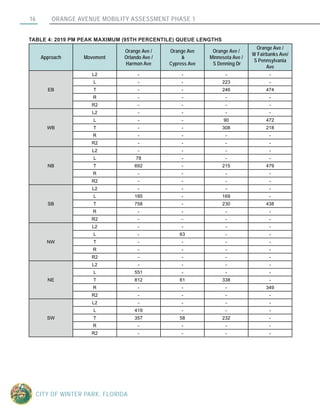
function well and that the area sees a high volume of crashes. According to
data provided by MetroPlan, over 70% (average) of the traffic on Orange
Avenue uses the road simply as a cut through. Only 13% (average) of the
trips in the corridor either start or end in the Orange Avenue area. A final
33
analysis is being prepared and will be made available to the public. As each
new project is proposed, a traffic study will have to be performed.
STORMWATER
Another topic that was identified early in the process as a major concern for
the area was stormwater and flooding. The input provided from area
businesses and residents showed staff the areas of concern. The initial
stormwater analysis showed there are some areas of minor flooding that can
be fixed by smaller infrastructure upgrades and connections, but reveled no
major infrastructure overhauls were needed.
It became evident that the largest issue related to stormwater was the fact
that because the Orange Avenue Overlay area was built out prior to current
stormwater standards, the area does not retain, detain or provide stormwater
treatment of any kind. The water simply runs off the sites, carrying debris
and pollutants and enters the City stormwater system untreated. The majority
of the area flows north to Lake Mendsen (water body in MLK, Jr. Park) and
then to Lake Killarney. Often, the water flows through Lake Midget and Lake
Rose as well, which allow overflow of untreated stormwater to enter the
aquifer through drainwells. Having untreated stormwater that enters directly
into the City’s stormwater conveyance system is the largest and most pressing
stormwater issue in the area. Therefore, development enhancements are
offered to properties that will detour and treat the stormwater that currently
harms our system and enters our Chain of Lakes. Additionally, redevelopment
of the larger properties in the area will require that these properties hold and
treat the stormwater on their sites that currently flows off the site untreated.
As stormwater capacity is not the major issue, but rather the treatment of
runoff, this plan offers meaningful solutions to the issues in the area.
Additionally, as redevelopment occurs on larger properties, the City can utilize
the active construction in the area and around the sites to make some minor
system upgrades that should alleviate the smaller areas of flooding.
34
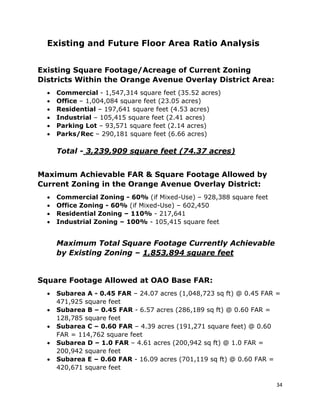
Existing and Future Floor Area Ratio Analysis
Existing Square Footage/Acreage of Current Zoning
Districts Within the Orange Avenue Overlay District Area:
• Commercial - 1,547,314 square feet (35.52 acres)
• Office – 1,004,084 square feet (23.05 acres)
• Residential – 197,641 square feet (4.53 acres)
• Industrial – 105,415 square feet (2.41 acres)
• Parking Lot – 93,571 square feet (2.14 acres)
• Parks/Rec – 290,181 square feet (6.66 acres)
Total - 3,239,909 square feet (74.37 acres)
Maximum Achievable FAR & Square Footage Allowed by
Current Zoning in the Orange Avenue Overlay District:
• Commercial Zoning - 60% (if Mixed-Use) – 928,388 square feet
• Office Zoning - 60% (if Mixed-Use) – 602,450
• Residential Zoning – 110% - 217,641
• Industrial Zoning – 100% - 105,415 square feet
Maximum Total Square Footage Currently Achievable
by Existing Zoning – 1,853,894 square feet
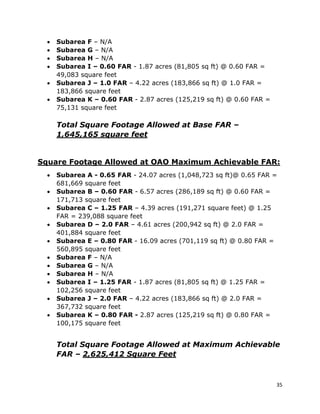
Square Footage Allowed at OAO Base FAR:
• Subarea A - 0.45 FAR – 24.07 acres (1,048,723 sq ft) @ 0.45 FAR =
471,925 square feet
• Subarea B – 0.45 FAR - 6.57 acres (286,189 sq ft) @ 0.60 FAR =
128,785 square feet
• Subarea C – 0.60 FAR – 4.39 acres (191,271 square feet) @ 0.60
FAR = 114,762 square feet
• Subarea D – 1.0 FAR – 4.61 acres (200,942 sq ft) @ 1.0 FAR =
200,942 square feet
• Subarea E – 0.60 FAR - 16.09 acres (701,119 sq ft) @ 0.60 FAR =
420,671 square feet
35
• Subarea F – N/A
• Subarea G – N/A
• Subarea H – N/A
• Subarea I – 0.60 FAR - 1.87 acres (81,805 sq ft) @ 0.60 FAR =
49,083 square feet
• Subarea J – 1.0 FAR – 4.22 acres (183,866 sq ft) @ 1.0 FAR =
183,866 square feet
• Subarea K – 0.60 FAR - 2.87 acres (125,219 sq ft) @ 0.60 FAR =
75,131 square feet
Total Square Footage Allowed at Base FAR –
1,645,165 square feet
Square Footage Allowed at OAO Maximum Achievable FAR:
• Subarea A - 0.65 FAR - 24.07 acres (1,048,723 sq ft)@ 0.65 FAR =
681,669 square feet
• Subarea B – 0.60 FAR - 6.57 acres (286,189 sq ft) @ 0.60 FAR =
171,713 square feet
• Subarea C – 1.25 FAR – 4.39 acres (191,271 square feet) @ 1.25
FAR = 239,088 square feet
• Subarea D – 2.0 FAR – 4.61 acres (200,942 sq ft) @ 2.0 FAR =
401,884 square feet
• Subarea E – 0.80 FAR - 16.09 acres (701,119 sq ft) @ 0.80 FAR =
560,895 square feet
• Subarea F – N/A
• Subarea G – N/A
• Subarea H – N/A
• Subarea I – 1.25 FAR - 1.87 acres (81,805 sq ft) @ 1.25 FAR =
102,256 square feet
• Subarea J – 2.0 FAR – 4.22 acres (183,866 sq ft) @ 2.0 FAR =
367,732 square feet
• Subarea K – 0.80 FAR - 2.87 acres (125,219 sq ft) @ 0.80 FAR =
100,175 square feet
Total Square Footage Allowed at Maximum Achievable
FAR – 2,625,412 Square Feet
36
SECTION FOUR
OVERLAY DISTRICT PLAN
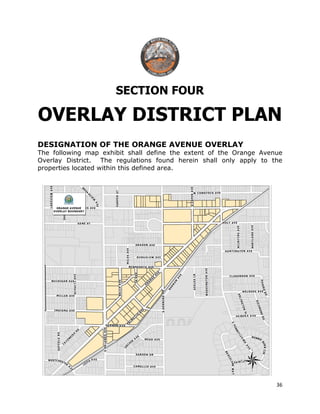
DESIGNATION OF THE ORANGE AVENUE OVERLAY
The following map exhibit shall define the extent of the Orange Avenue
Overlay District. The regulations found herein shall only apply to the
properties located within this defined area.
37
ARCHITECTURAL & SITE DESIGN STANDARDS
Building Height & Setbacks/Stepbacks
Building Height & Setbacks/Stepbacks. To allow for flexibility in design, but
preserving development standards that will not create more massing than
necessary, buildings shall be measured in stories. Only floors visible on the
exterior of the building shall be counted towards building height (ex. A 4-story
building wraps around a 5-story interior parking garage, only the 4 stories
would count as they are the only part visible).
The first floor of any building shall be allowed to be a maximum of 20 feet in
height. Mezzanine, balcony or loft levels shall be allowed within the first story,
as long as they do not cover more than 30% of the first-floor area and stay
within the maximum 20-foot first floor height area. Mezzanines, balconies or
lofts shall not be allowed above the first floor. Each floor above the first floor
shall have a maximum height of 13 feet. Buildings shall be allowed to transfer
unused floor heights to other floors, as long as the maximum cumulative
height is not exceeded.
For multi-story buildings over two stories in height, some degree of terracing
and/or additional setbacks to accomplish vertical articulation is mandated to
create relief to the overall massing of the building facades, as discussed later
in this chapter.
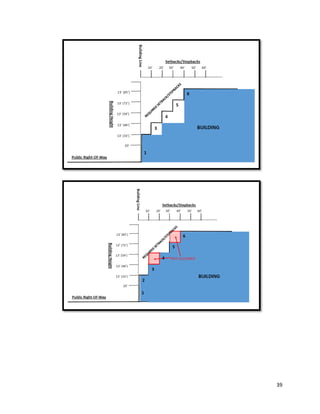
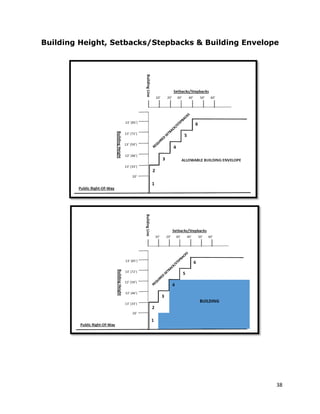
For any building over two stories in height that is located along Orlando
Avenue or Fairbanks Avenue on the property line, each additional floor shall
be setback a minimum of ten (10) feet, or shall be within the allowable
envelope as depicted in the figures below:
38
Building Height, Setbacks/Stepbacks & Building Envelope
39
40
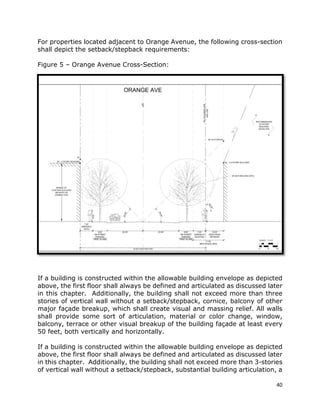
For properties located adjacent to Orange Avenue, the following cross-section
shall depict the setback/stepback requirements:
Figure 5 – Orange Avenue Cross-Section:
If a building is constructed within the allowable building envelope as depicted
above, the first floor shall always be defined and articulated as discussed later
in this chapter. Additionally, the building shall not exceed more than three
stories of vertical wall without a setback/stepback, cornice, balcony of other
major façade breakup, which shall create visual and massing relief. All walls
shall provide some sort of articulation, material or color change, window,
balcony, terrace or other visual breakup of the building façade at least every
50 feet, both vertically and horizontally.
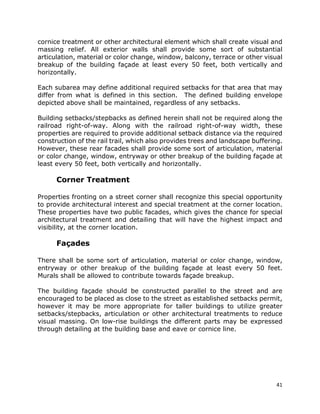
If a building is constructed within the allowable building envelope as depicted
above, the first floor shall always be defined and articulated as discussed later
in this chapter. Additionally, the building shall not exceed more than 3-stories
of vertical wall without a setback/stepback, substantial building articulation, a
41
cornice treatment or other architectural element which shall create visual and
massing relief. All exterior walls shall provide some sort of substantial
articulation, material or color change, window, balcony, terrace or other visual
breakup of the building façade at least every 50 feet, both vertically and
horizontally.
Each subarea may define additional required setbacks for that area that may
differ from what is defined in this section. The defined building envelope
depicted above shall be maintained, regardless of any setbacks.
Building setbacks/stepbacks as defined herein shall not be required along the
railroad right-of-way. Along with the railroad right-of-way width, these
properties are required to provide additional setback distance via the required
construction of the rail trail, which also provides trees and landscape buffering.
However, these rear facades shall provide some sort of articulation, material
or color change, window, entryway or other breakup of the building façade at
least every 50 feet, both vertically and horizontally.
Corner Treatment
Properties fronting on a street corner shall recognize this special opportunity
to provide architectural interest and special treatment at the corner location.
These properties have two public facades, which gives the chance for special
architectural treatment and detailing that will have the highest impact and
visibility, at the corner location.
Façades
There shall be some sort of articulation, material or color change, window,
entryway or other breakup of the building façade at least every 50 feet.
Murals shall be allowed to contribute towards façade breakup.
The building façade should be constructed parallel to the street and are
encouraged to be placed as close to the street as established setbacks permit,
however it may be more appropriate for taller buildings to utilize greater
setbacks/stepbacks, articulation or other architectural treatments to reduce
visual massing. On low-rise buildings the different parts may be expressed
through detailing at the building base and eave or cornice line.
42
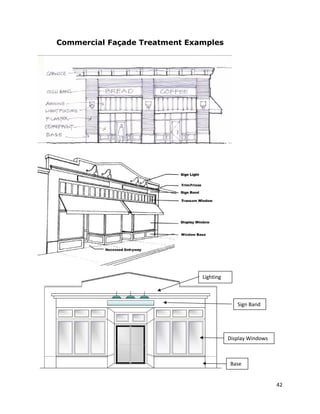
Commercial Façade Treatment Examples
Base
Display Windows
Sign Band
Lighting
43
Other Notes on the Treatment of Façades
Roof lines, parapets and building heights shall be architecturally articulated
and diverse in design form with adequately scaled and proportioned
architectural treatments which complement the building’s design.
The window, wall and roofing treatment should be of high-quality materials
and consistent on both the front and the back of the building. Allowable
building materials shall include brick, natural stone, glass, architectural metal,
concrete, wood, or similar material with a longer life expectancy. EIFS shall
not be allowed. Stucco, plastics, hardiboard siding (or similar materials) or
concrete block shall not exceed more than 50% of any façade. Detailing is
encouraged to enhance the façade.
Structures shall be sited so as to create visual relationships with sidewalks,
street alignments, trees, green space and neighboring businesses; create
visual anchors at entries, provide interesting architectural perspectives
featuring appropriate facade treatments and maximize the pedestrian
relationship to the sidewalk. They shall also take into consideration the
existing structures and be in unison with their scale and style.
Lower Story
The lower story of the building has the most immediate visual impact on the
passerby. Traditionally, buildings along urban streets have a high proportion
of glazing to solid wall surface, with higher floor to floor heights, on the first
story. To maintain continuity with this treatment, buildings on Orange Avenue
shall have 25% minimum glass on the first story and shall be allowed height
up to 20 feet. The first floor shall be clearly defined and articulated from
upper stories.
Building Entrance
Primary building entrances in the Orange Avenue Overlay District shall be
clearly defined, and shall be recessed or framed by a sheltering element such
as an awning, arcade, overhang, or portico (in order to provide weather
protection for pedestrians). Public entrances flush with the building wall with
no cover are discouraged. Awnings are encouraged. Awning standards
include:
a. Awnings for a building façade shall be of compatible color, look,
shape, and height;
b. Awnings shall provide vertical clearance of no less than eight (8) feet
above sidewalks; and
44
c. Awnings are not allowed to hang over vehicular traffic ways
Building Setbacks along Orange Avenue
It is the intent of this Chapter to enhance and preserve the character of the
Orange Avenue Overlay District by promoting parking area placement to the
rear of lots and bring visually pleasing building architecture closer to the to
the street. Therefore, front building setbacks may be reduced to a distance
that creates at least fifteen (15) feet of sidewalk space from the back of curb
(not including the landscape bumpouts).
Architectural Towers, Spires, Chimneys, Or Other
Architectural Appendages
Any architectural tower, spire, chimney, flag pole or other architectural
appendage to a building shall conform to that district’s height limit. However,
when necessary to meet the building code requirements, chimneys may
exceed the height by that minimum required distance.
If provided for within the respective nonresidential zoning district,
architectural appendages, embellishments and other architectural features
may be permitted to exceed the roof heights specified in that section, on a
limited basis encompassing no more than 30 percent of the building roof
length and area, up to eight feet of additional height upon approval of the city
commission, based on a finding that said features are compatible with
adjacent projects.
Mechanical Penthouses, Rooftop Mechanical and Air-
Conditioning Equipment, Stair Tower Enclosures,
Elevators and Parapets
Mechanical penthouses, mechanical and air-conditioning equipment, stair
tower enclosures, or elevators on rooftops of buildings shall not exceed a total
height of ten feet above the allowable building height. Any penthouses shall
only be used for mechanical equipment to serve the building. Parapets, or
mansard roofs serving as parapets, may extend a maximum of five feet above
the height limit in the zoning district unless other parapet heights are more
restrictive for the respective zoning district. In addition, mechanical
equipment and air-conditioning equipment on rooftops shall be screened from
view from ground level on all buildings in all zoning districts and shall be
located to the maximum extent possible so that they are not visible from any
street.
45
TRANSPORTATION & CONNECTIVITY
Steering Committee Multi-Modal Transportation
Recommendations
The Orange Avenue Overlay Steering Committee was focused primarily on the
land use elements of the creation of the Overlay District. Transportation is a
major part of the expected change in the area, so the Steering Committee
wanted to provide recommendations for future transportation improvements
in the area. Any future transportation improvements in the Overlay area will
certainly go through an extensive review and design process, but there are a
number of recommendations from the Steering Committee that should be
considered as a part of any future improvements:
• The hierarchy of Transportation from the Comprehensive Plan should be
kept at the forefront of any future improvements. This hierarchy places
the pedestrian at the front, followed by bicyclists, then public transit
users and vehicles as the last transportation method considered in
design.
• Transportation enhancements should encourage decorative lighting,
landscaping and the continued planting of canopy trees along roads,
sidewalks and pathways to create shade and the green aesthetic that
Winter Park is known for.
• The most important transportation or mobility upgrade is the extension
of the Complete Street Denning Drive improvements from their current
terminus at the Intersection of Orange Avenue, Minnesota Avenue &
Denning Drive, down to the entrance to Mead Gardens.
• As potential traffic calming improvements are considered along Orange
Avenue, ensure that area wide impacts are considered.
• Sidewalks along Orange Avenue are encouraged to be at least 15 feet
wide, with appropriate lighting, tree canopy, vegetated areas and
covering to protect from the elements.
• The redesign or “right-sizing” of Orange Avenue should be evaluated.
The current design is unsafe for all modes of transportation and does
not allow for the safe usage of public parking.
• Pedestrian safety in the area should be enhanced at every opportunity.
• Consider using pedestrian crosswalks with design elements that create
art or murals in the road, which also enhance pedestrian safety.
• Strong consideration should be given to the utilization of traffic
circles/roundabouts to create continuous flow and to provide better
46
turning opportunities at congested intersections, specifically at the
intersection of Denning Drive, Minnesota Avenue and Orange Avenue.
• Efforts should be made to provide connectivity to the surrounding
residential areas for pedestrians and cyclists.
• Street Design that reduces speeds on Orange Avenue should be
incorporated.
• A minimum 12-foot wide multi-use bike and pedestrian pathway should
be designed along the railroad to provide access and connectivity.
• Fairbanks Avenue Streetscape should include landscaped buffering
between roadway & sidewalk.
Connectivity
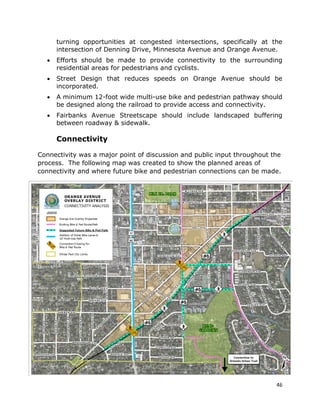
Connectivity was a major point of discussion and public input throughout the
process. The following map was created to show the planned areas of
connectivity and where future bike and pedestrian connections can be made.
47
MIXED-USE DEVELOPMENTS
Buildings in the Orange Avenue Overlay District are encouraged to contain
ground floor retail, office, personal service or restaurant spaces. Multi-story
buildings with a mix of uses such as office, hotel, retail, personal services,
commercial, and residential are encouraged. Residential uses above
commercial spaces are encouraged and shall be allowed by right in this
district, subject to meeting adopted Fire Code and Building Code
requirements. Mixed-Use shall be a minimum of 25% of new developments
to avoid single-user development that will detract from a vibrant mixed-use
area.
MEANINGFUL OPEN SPACE
The guiding documents of the Sustainability Plan, the Comprehensive Plan and
Vision Winter Park have a strong emphasis on the creation of open space.
Additionally, more meaningful open space and green space was one of the
topics that was repeated throughout the public input process.
Currently, the Winter Park Land Development Code does not have any open
space requirements for new development. It is the intent of the Orange
Avenue Overlay District to ensure that the development and enhancement of
properties includes the creation of meaningful, useable, accessible, green and
beautiful open space that invites the public to relax, interact, recreate, unwind
and stimulate social connection. Many of the existing properties do not have
much opportunity for the creation of open space due to smaller size and other
site constraints, so improvements to the rights-of-way and streetscape that
create these spaces are very important. Where properties are planned for
larger-scale redevelopment, meaningful open space and the design of
structures around these open spaces is the most important consideration. At
a minimum, each property 1.5 acres in size and above that is redeveloped
shall provide at least 25% meaningful open space, which is open to and
available to the public. At least 50% of open-space areas provided shall be
pervious or semi-pervious to allow for percolation of stormwater and the
creation of greenspace and vegetation. Pervious areas such as retention
ponds, parking lot islands or small-scale landscape planting areas around
building bases shall not be counted as open space. Open space shall be areas
that are open and inviting to the public. Open space can include green areas,
hardscape areas, semi-pervious areas, balcony or roof areas that are open to
the public and other similar-type spaces. At least 90% of the open space shall
be provided at ground level. The intent is that each of these areas create the
opportunity for social interaction, relaxation, recreation and reflection.
48
PARKING
Parking Lots & Parking Structures
One of the most discussed topics during the creation of the Orange Avenue
Overlay District was about parking. Specifically, the lack of available off-street
parking and the limitations that it creates for existing businesses in the area.
The discussions were also about putting parking areas at the rear of
businesses to screen unsightly parking areas with more aesthetically
appealing architecture. Additionally, there is a desire to construct parking
structures, which are a more sustainable way to handle parking needs, but
there are also requirements to screen parking structures to the highest
feasible scale.
Commercial Parking Requirements
Unless specifically listed herein, parking shall be provided in accordance with
the Land Development Code requirements.
• General Business and Retail Commercial: One parking space for each
333 square feet of gross floor space.
• Office, Professional or Public Buildings: One parking space for each
333 square feet of gross floor space.
• Hotel: One parking space for each guest room shall be provided. Other
ancillary uses in the hotel (restaurant, spa, retail, meeting space, etc)
shall only be required to provide parking at 50% of the off-street parking
requirements defined in Section 58.86 of the Land Development Code.
• Restaurants, Food Service Establishments, Nightclubs, Taverns or
Lounges: One space for every four seats.
Bicycle Parking shall be required per Land Development Code Standards.
Where large projects provide parking garages, 20% of the required bike
parking shall be provided onsite. The other 80% of required bike parking may
be located within City right-of-way throughout the Overlay District. The City
of Winter Park shall determine where the off-site parking shall be located.
Required parking may be located within 750 feet of the building, or within the
closest parking structure where excess parking is available for lease. In the
event of new construction, addition, or change in intensity of use of the
principal building or property being serviced by the remote parking lot, all
existing parking spaces located on such remote lot shall be allocated to the
existing building or principal use to meet the minimum requirements of this
article, and any additional spaces may then be allocated to that portion of the
49
building or property which is the subject of the new construction, addition, or
change in intensity of use.
Residential Parking Requirements
Unless defined herein, parking in the Orange Avenue Overlay District shall be
designed and provided in accordance with the Winter Park Land Development
Code.
Multi-family development parking requirements shall be provided as follows:
1) Each one-bedroom or studio unit shall be required to provide 1.25
dedicated parking spaces per unit.
2) Each two-bedroom unit shall be required to provide 1.5 dedicated
spaces per unit.
3) Each three-bedroom or above unit shall be required to provide 2
dedicated parking spaces per unit.
Off-Street Parking Design
Parking access to properties along Orange Avenue should ideally be from side
streets if frontage is available on a side street. If side street frontage is not
available, a driveway will be allowed from Orange Avenue, providing the
driveway and building gap surrounding it is minimized. Cross-access
agreements are encouraged, to reduce the number of curb cuts and
driveways. The intent is to maintain the building street wall without large
voids for access driveways. The goal in this parking arrangement is to
decrease the visibility of parking from the street as much as possible, by
having parking behind the building and to reduce the turning movements with
limited visibility across multiple lanes of traffic.
Parking garages shall be set back from the Orange Avenue, Fairbanks Avenue
or Orlando Avenue frontages and screened by liner buildings or other
treatments as required in this chapter. Parking should also be accessed from
side streets to the maximum extent. They should also be designed in an
architectural style that is compatible with its building counterpart and shall
also conform to the City’s parking garage design guidelines.
Parking Exclusion
A parking exclusion shall apply only to existing square footage or floor space.
Parking shall be provided as required by the Land Development Code or this
chapter for any net new building or net new floor space created by
redevelopment, new construction, additions, alterations or remodeling or for
50
any change in use requiring additional parking such as an office or retail space
conversion to restaurant. Existing parking spaces may be counted to satisfy
this requirement only where such existing spaces are in excess of the parking
space requirements of this section for any existing floor space.
Floor Area Ratio (FAR) For Parking Structures
One of the major changes to current Winter Park Development Standards in
this Overlay District is the opportunity for parking structures to not count
towards the Floor Area Ratio (FAR) for any property within the Overlay District.
Winter Park is rare in that parking garages are counted towards FAR. Floor
Area Ratio is the maximum extent to which a property can be developed, so
this is a vital part to the potential for development of any property. The
current requirement to count FAR of parking structures leads to the surface
parking being the only economical way to build new projects. The mixed-use
areas in town that have seen success have relied on parking structures to be
successful. Few cities choose to count parking garages towards FAR. This
code requirement makes development that uses parking garages very difficult,
resulting in the shopping center type development with large impervious
surface parking lots. This type of parking is very unsustainable and does not
contribute towards the aesthetics and maintaining the tree that makes Winter
Park special.
As with other areas of this Overlay District, the new or enhanced development
standards must be earned, not simply given. Within the Overlay District,
parking garage FAR shall not count as long as the following conditions are met
for each structure:
• Parking constructed shall allow for a minimum of 50% of the parking
spaces to be shared-parking, meaning the parking spaces are available
for lease for other properties in the area that can utilize the parking
during hours when the parking is not needed by the users of the
property where the garage is located.
• Provide for multi-property parking collectives. For smaller-scale
garages, multiple property owners may create a collective where
parking can be built on a property that can serve multiple properties
that do not have adequate available parking.
• Provide electric vehicle charging stations for a minimum of 2% of all
spaces within the structure.
• Provide and construct parking spaces at least 10% above what is
required to meet code minimum requirements. This excess parking
must either be available for lease to properties in the area or shall be
provided for free public parking.
51
• The parking structures are made available to the general public for free
on Saturday and/or Sunday mornings from 6AM to 11AM for community
events in the Orange Avenue Overlay Area or for public events at Mead
Botanical Garden.
• Parking structures shall be screened at least 50% on all visible sides
with Green Walls, Living Walls, Murals (that do not include advertising
of any type) or other Screening Treatments.
Parking structures that do not meet all of the requirements listed above shall
not be exempt from FAR calculations.
Parking structures on the north side of Fairbanks Avenue or west of Orlando
Avenue shall not be exempt from FAR.
Parking provided to accommodate residential units or hotels shall not be
required to be shared or count towards the shared parking ratio requirement.
Parking Structures shall not be required to provide setbacks from residential
areas as outlined in other areas of the Land Development Code, but shall meet
height, building setback, allowable building envelope area and screening
requirements as outlined in this code.
DENSITY TRANSFER
A key component to any mixed-use district is the inclusion and promotion of
residential uses. Mixed-use districts that do not allow for residential units at
an appropriate scale are then simply commercial districts. Mixed-Use, at its
core, is all about the live, work and play components. Though the words
density and multi-family can often be associated with fear and
misconceptions, not having people who live in an area and bring life to the
area will not be a true mixed-use area. Winter Park is a very low-density
area in the traditional single-family areas, but this does not mean that multi-
family living in certain areas is not appropriate, especially in mixed-use
areas, such as the successful areas around Park Avenue and Hannibal
Square. Additionally, having people who live in a mixed-use district brings
24-hour eyes and ears to a place, making it more than just a commercial
area, it also becomes a neighborhood.
A unique part of the Orange Avenue Overlay District is the allowance for
density that currently exists in the Orange Avenue area by right to be
transferred into two specific subareas. As it currently stands, each
commercial, office, industrial or residential area in the Overlay District is
52
entitled with a density of 17 units per acre. Given this, over 1,100
residential units are currently entitled within the current zoning of the area.
Only properties under common ownership within the Overlay area at the
time of the adoption of this code or vacated rights-of-way shall be allowed to
transfer the existing residential entitlements from other subareas into
subarea D or subarea J. Only the existing residential units that exist
currently may be transferred into subareas D or J. Units cannot be
transferred out of these subareas and no other subareas may transfer
density between them. Additionally, only the units can be transferred, not
the entitled square footage or FAR. Once the residential entitlements are
transferred from other commonly-owned properties, no residential units can
be constructed on the site that transfers the units, as the residential unit
rights no longer exist. Additional properties purchased after the date of the
adoption of this Overlay District shall not be eligible for density transfer.
The intent of the density transfer is to create nodes of intensity, allowing for
residential uses, which are key to the successful creation of mixed-use
districts and create development that can fund the needed parking and
regional stormwater areas in the district. Allowing density transfer into
these areas would allow for approximately 350-400 total units to be built.
Given the size and shape of the other properties within the area, it is not
feasible for other larger multi-family developments to be built. There would
not be the land size needed for the building and parking, the allowable FAR
would be too low as well. And the parking would count towards FAR because
residential parking spaces are not allowed to be used in shared parking
calculations, so the FAR exemptions could not be met. There may be some
smaller projects or remodels that construct a few units above existing retail
or office, but no other larger projects would be feasible, keeping the actual
density of the area much lower than it could be (1,100 units). By clustering
the intensity, there will be a reduction in overall massing and building
heights throughout the Orange Avenue Overlay area, keeping as much of the
smaller scale development as possible to maintain the character of the area.
This language shall not allow transfer of units into other Subareas. The map
below depicts the properties within this subarea that qualify for this density
transfer.
53
54
ADMINISTRATIVE REVIEW
Unless cited within this Chapter or another Section of the Winter Park Land
Development Code, review of these guidelines and compliance shall be
performed at the administrative level for projects not requiring Conditional
Use approval. To ensure that the intent of the code is met, each application
for a Conditional Use or any project that would utilize any of the Development
Enhancement Menu options shall be reviewed by the Planning & Community
Development Director or their designee. Any appeals of the determination of
staff shall be taken before the City Commission for determination.
SUBAREAS
Orange Avenue Overlay District Sub-Areas & Standards
The subarea map depicted below shall officially delineate the different
subareas and their specific development standards. Each area has unique
characteristics, issues and opportunities.
55
General Subarea Development Standards
Due to the unique geography of the Orange Avenue corridor and the Orange
Avenue Overlay District, it was determined that a number of areas with very
unique issues and opportunities existed. After much consideration, a number
of subareas were created to help the existing businesses in the area, create
more economic opportunity, address issues that have plagued the area for
many years, create a meaningful gateway into Winter Park and to create a
special place in the community. Because each of these areas are unique, they
each have their own development standards and opportunities.
After the creation of the Orange Avenue Overlay District, no changes to the
subarea map shall be allowed. No variances to maximum number of stories,
maximum allowable Floor Area Ratio, allowed uses, required open space or
maximum residential density shall be granted. Variances to other
development standards shall be considered, with sufficient showing of
reasoning and hardship.
The standards detailed in this plan are the maximum density and intensity
parameters potentially permitted in each respective subarea. These maximum
bulk standards are not an entitlement and are not achievable in all situations.
Many factors may limit the achievable FAR including limitations imposed by
the maximum height, physical limitations imposed by property dimensions
and natural features as well as compliance with applicable code requirements
such as, but not limited to parking, setbacks, lot coverage and design
standards.
Orange Avenue Subarea Descriptions:
Subarea A
This subarea consists mostly of existing buildings on smaller lots that were
developed prior to Winter Park’s current Building Codes or Land Development
Code regulations. Therefore, the vast majority of these properties contain
legally non-conforming structures. These properties are typically
nonconforming in one or more of the following areas: Floor Area Ratio (FAR),
Off-Street Parking, Stormwater Retention, Impervious Area, and Landscaping.
These buildings have typically not been altered or remodeled to a great degree
because if the valuation of the remodel exceeds 50% of the valuation of the
building, the entire property would be required to be brought into conformance
with all building and Land Development Codes.
56
This area also has great character and the majority of the buildings are built
at a very human-scale. In order to allow for the remodeling and renovation
of the buildings within this subarea and to enhance the Orange Avenue
Overlay District, the 50% valuation threshold shall not apply to these
properties and the properties shall not be required to comply with current
Land Development Code standards, as long as additional square footage is not
added to the buildings. If additional square footage is added, the properties
shall be required only to provide the required parking for the new net square
footage of the property. All remodels, renovations or reconstructions that are
allowed to remain as legally non-conforming with Land Development Code
standards, shall still be required to meet applicable Building and life safety
codes as determined by the City of Winter Park Building Official and/or Fire
Official. If the use of the building is changed (i.e. office conversion to café),
parking shall be provided as required by Code.
(a) Exemptions. The following Land Development Code Requirements shall
not be required to be met for renovation or remodel of existing structures
that will maintain the existing use of the property:
1. Floor Area Ratio
2. Minimum Parking Requirements
3. Stormwater Retention
4. Impervious Surface Percentage
5. Setbacks
6. Landscaping
7. Height
(b) Reconstruction of Buildings. Given the age of buildings within the area,
the properties within this subarea shall be allowed to reconstruct the
same building footprint when the building on the site is completely
demolished, regardless of non-conforming status, on the site without
being required to meet all development standards. Reconstruction of
buildings shall only be required to provide stormwater retention and the
sidewalk widths as described herein. All building and life safety codes
shall be met with all reconstruction.
(c) Subarea A Development Standards:
1. Base Floor Area Ratio: 45%
2. Maximum Achievable Floor Area Ratio: 65%
57
3. Maximum Height: 2 Stories for any properties abutting Orange Avenue,
and 3 stories for all other properties within the subarea.
4. Maximum Impervious Coverage: 85%
5. Setbacks: None, except front setbacks must allow for at least a 15-foot
wide sidewalk along Orange Avenue. Fairbanks Avenue and Orlando
Avenue shall each be designed to provide for a 10-foot wide sidewalk
with a minimum 2-foot landscape buffer on the back of curb. Where the
building requires an additional setback to achieve the required sidewalk,
the area shall be dedicated as a public access easement.
6. Maximum Residential Density: 17 units per acre
Subarea B
This subarea consists of unique commercial lots that are located adjacent to
single-family residential zoning. In order to mitigate the lack of transitional
areas between single-family homes and the Commercial areas and heavy
traffic of Fairbanks Avenue, special consideration should be given to
setbacks, screening and uses. This area is ideal for commercial frontages
along Fairbanks Avenue and residential uses along the border of the single-
family residential area.
Cross-access easements will be required upon re-development of the
properties to limit the number of curb-cuts and driveways along Fairbanks
Avenue.
(a) Subarea B Development Standards:
1. Base Floor Area Ratio: 45%
2. Maximum Achievable Floor Area Ratio: 60%
3. Maximum Height: 2 stories at front setback line and at rear setback
line. Structures may increase to 3 stories if the 3rd floor is set back
an additional 10 feet from front and rear setback lines. 3rd floors
shall only allow residential uses.
4. Maximum Impervious Coverage: 85%
5. Setbacks:
a. Street: None, except front setbacks must allow for at least a 10-foot
wide sidewalk and 2-foot landscape buffer area on the back of curb
along Fairbanks Avenue.
58
b. Side: 0
c. Rear: 20
d. Third stories shall require an additional 10-foot setback from the
front and rear setbacks.
6. Maximum Residential Density: 17 units per acre
Subarea C
This subarea is defined as the city owned, Progress Point property. It sits at
one of the major intersections along Orange Avenue. This property currently
serves as the relief valve of overflow parking for businesses nearby. In order
to mitigate the lack of parking in the area, there should be special
consideration for a parking garage on this property. There are also
stormwater drainage concerns along Orange Avenue due to the age of the
development in this area, so special considerations should be given for
regional stormwater retention on this property. Due to its proximity to Mead
Botanical Garden, this area provides a unique opportunity for a gateway and
signage to direct the public to Mead Botanical Garden.
(a) Subarea C Development Standards:
1. Base Floor Area Ratio: 60%
2. Maximum Achievable Floor Area Ratio: 125%
3. Maximum Height: 4 Stories
4. Maximum Impervious Coverage: 85%
5. Setbacks: 0 front setback along Orange Avenue, Denning Drive, or
Palmetto Avenue, except front setbacks must allow for at least a 15-foot
wide sidewalk. Where the building requires an additional setback to
achieve a 15-foot sidewalk, the area shall be dedicated as a public
access easement.
6. Maximum Residential Density: 17 units per acre
(b) Required Development Enhancements. In order to be eligible for any
Development Enhancement Bonuses, any future development of the
property shall include the following item(s) from the Development
Enhancement Menu: CT.1
59
(c) Intersection and Open Space Viewshed. Due to the unique shape of the
property and proximity to a unique intersection, this additional
requirement shall apply. Where the property lines meet at the
intersection of Denning Drive and Orange Avenue shall create the
starting point for this additional setback. From the starting point, going
150 feet back along Orange Avenue and along Denning Drive and
connecting these two points, the additional viewshed and setback
triangle shall be established.
(d) Road Closures. Closing and vacation of the Palmetto Avenue right-of-
way shall be encouraged, subject to City Commission approval, as the
street bisects the property and creates limited development
opportunities of the site. Driveways that allow public through-access
may be allowed in-lieu of vacated streets, if deemed necessary. Closed
and vacated right-of-way shall be entitled at the same level as the
subarea it falls within.
(e) Additional Development Requirements. A monument sign at least 3 feet
in height and 5 feet in width, set in a landscaped bed, shall be required
to be provided at the intersection of Denning Drive, Minnesota Drive and
Orange Avenue, which directs the public to Mead Botanical Garden. The
City of Winter Park shall approve the design and location of the sign.
Subarea D
This subarea represents a significant and unique opportunity for
redevelopment, and can also address many of the area-wide issues that
currently exist. A former industrial site, that has significant frontage along
the railroad, but has also been collectively purchased by one owner, and has
significant visibility and opportunity to be a gateway into Winter Park city
limits. Additionally, the properties within this subarea are adjacent to the
intersection of Orlando Avenue, Harmon Avenue and Orange Avenue. Other
properties at this same intersection have developed to a larger scale,
massing and height, but due to the presence of city-owned parkland and
larger parcel size, the buildings have been set back far enough that the
increased massing and height are not as visually imposing. This area is one
of the only areas within the Overlay District where additional building height
could be considered. This area is also very important to addressing the
regional stormwater and parking issues. It is also key to creating the
gateway into Winter Park.
60
(a) Subarea D Development Standards:
1. Base Floor Area Ratio: 100%
2. Maximum Achievable Floor Area Ratio: 200%
3. Maximum Height: 7 Stories
4. Maximum Impervious Coverage: 75%
5. Setbacks:
a. Street: 20 feet along Orlando Ave, 0 feet along Orange Avenue
b. Rear: 20
6. Maximum Residential Density: 17 units per acre
(b) Density Transfer. Properties under common ownership within the
Overlay area at the time of the adoption of this code or vacated rights-
of-way shall be allowed to transfer the existing residential entitlements
to this subarea D, though not the square footage. Once the residential
entitlements are transferred from other commonly-owned properties, no
residential units can be constructed on the site that transfers the units.
Additional properties purchased after the date of the adoption of this
Overlay District shall not be eligible for density transfer. The intent is
to create nodes of intensity, allowing for residential uses, which are key
to the successful creation of mixed-use districts and create development
that can fund the needed parking and regional stormwater areas in the
district. By clustering the intensity, there will be a reduction in overall
massing and building heights throughout the Orange Avenue Overlay
area. Density Transfer shall only allow the transfer of currently entitled
units into the defined Subarea. This language shall not allow transfer
of units into other Subareas. The map below depicts the properties
within this subarea that qualify for this density transfer.
61
(c) Required Development Enhancements. In order to be eligible for any
Development Enhancement Bonuses, any future development of the
property shall include the following item(s) from the Development
Enhancement Menu: CT.1
(d) Road Closures. Closing and vacation of the Harmon Avenue or Vivian
Avenue right-of-way shall be encouraged, subject to City Commission
approval, as the street bisects the property or creates limited
development of the site. Private driveways that allow public through-
access shall be allowed in-lieu of vacated streets, if necessary. Closed
and vacated right-of-way shall be entitled at the same level as the
subarea it falls within.
Subarea E
This subarea consists of properties located along Orlando Avenue, a high-
traffic and commercially-zoned area. Many of these properties are at an age
where redevelopment is becoming more attractive. These properties have
the unique ability to support the Orange Ave area due to their size and their
ability to provide additional parking for the areas that are currently deficient
in available parking. Additionally, these properties are located along the
most visible and highly-trafficked area of Winter Park, so it is appropriate to
62
have enhanced architectural standards for these important gateway
properties. These properties would develop with additional setback
requirements, architectural standards and would encourage a mix of uses.
(a) Subarea E Development Standards.
1. Base Floor Area Ratio: 60%
2. Maximum Achievable Floor Area Ratio: 80%
3. Maximum Height: Maximum 4 Stories.
4. Maximum Impervious Coverage: 85%
5. Setbacks:
a. Street: 20 feet. Setbacks must allow for at least a 10-foot wide
sidewalk and 2-foot landscape buffer area along Orlando Avenue.
b. Side:5 feet
c. Rear: 20 feet. If abutting residential, shall be a minimum of 20 feet or
equal to building height, whichever is greater.
6. Maximum Residential Density: 17 units per acre
(b) Road Closures. Closing and vacation of the Vivian Avenue right-of-
way shall be encouraged, subject to City Commission approval, as the
street essentially serves as a private driveway and parking lot
extension for a single property. Driveways that allow public through-
access shall be allowed in-lieu of vacated streets. Closed and vacated
right-of-way shall be entitled at the same level as the subarea it falls
within.
Subarea F
This subarea is the location of the Rollins Baseball Stadium and has
underlying zoning of Parks & Recreation. This area shall not be used for any
other future purpose than public space, recreation, open sports/recreation
facilities, including ancillary structures, or the parking needed to support
these uses. No offices, classrooms, residences or other college uses shall be
allowed on the property.
(a) Subarea F Development Standards:
63
1. Base Floor Area Ratio: 20%
2. Maximum Achievable Floor Area Ratio: 20%
3. Maximum Height: 2 Stories
4. Maximum Impervious Coverage: 50%
5. Setbacks: None, except street setbacks must allow for at least a 15-
foot wide sidewalk. Where the building requires an additional setback
to achieve a 15-foot sidewalk, the area shall be dedicated as a public
access easement.
6. Maximum Residential Density: No Residential Uses Allowed
Subarea G
This subarea represents an opportunity to expand Martin Luther King Jr.,
Park and to create an increased greenway connection to Mead Botanical
Garden and other areas of the city. This area also provides opportunities for
regional stormwater improvements. The uses in this area may continue as
legally non-conforming uses, but the buildings cannot be increased in size
and the properties can have no future use other than parkland/open space.
(a) Subarea G Development Standards:
1. Base Floor Area Ratio:45%
2. Maximum Achievable Floor Area Ratio: 45%
3. Maximum Height: 3 Stories
4. Maximum Impervious Coverage: 85%
5. Setbacks: None, except front setbacks must allow for at least a 10-
foot wide sidewalk.
6. Maximum Residential Density: 17 Units/Acre
(b) Additional Development Requirements. It is the intent of the City of
Winter Park to acquire these properties for the extension of Martin
Luther King, Jr. Park and to provide for transportation improvements.
Any properties acquired by the City of Winter Park shall be dedicated
as parkland or towards transportation improvements.
64
Subarea H
This subarea consists of existing city-owned parkland/open space. This area
shall not be used for any purpose other than open space, enhanced parkland
or connectivity. The area cannot be used to meet open space requirements
for other properties in the area.
(a) Subarea H Development Standards:
1. Base Floor Area Ratio: 0%
2. Maximum Achievable Floor Area Ratio: 0%
3. Maximum Height: N/A
4. Maximum Impervious Coverage: N/A
5. Setbacks: N/A
6. Maximum Residential Density: N/A
Subarea I
This subarea is a unique triangle shaped property that is adjacent to the
intersection of Orange Avenue, Denning Drive and Minnesota Avenue. It has
the potential to address some of the regional issues, but is limited by the
unique geometry of the site. The subarea can provide needed right-of-way
for potential intersection improvements that will improve traffic flow along
the corridor. It shall also accommodate the Denning Drive multi-modal
transportation improvements.
(a) Subarea I Development Standards:
1. Base Floor Area Ratio: 60%
2. Maximum Achievable Floor Area Ratio: 125%
3. Maximum Height: 3 Stories
4. Maximum Impervious Coverage: 75%
5. Setbacks: 0 front setback, except front setbacks must allow for at
least a 15-foot wide sidewalk. Where the building requires an
additional setback to achieve a 15-foot sidewalk, the area shall be
dedicated as a public access easement.
6. Maximum Residential Density: 17 units per acre
65
(b) Required Development Enhancements. In order to be eligible for any
Development Enhancement Bonuses, any future development of the
property shall include the following item(s) from the Development
Enhancement Menu: CT.7. The City of Winter Park shall determine the
area required to be dedicated for intersection improvements.
(c) Intersection and Open Space Viewshed. Due to the unique shape of
the property and proximity to a unique intersection, this additional
requirement shall apply. Where the property lines meet at the
intersection of Denning Drive and Minnesota Avenue shall create the
starting point for this additional setback. From the starting point,
going 50 feet back along Minnesota Avenue and along Denning Drive
and connecting these 2 points, the additional viewshed and setback
triangle shall be established.
Subarea J
This subarea is uniquely situated in an area where it has the ability to
address many of the issues present in the area. The area east of Denning
Drive has a great need for parking, but has very little available. This area
also has frontage along Fairbanks Avenue, where the City needs additional
right-of-way to add dedicated left-turn lanes with vehicle stacking on
eastbound and westbound Fairbanks Avenue at Denning Drive. This subarea
is also situated adjacent to the recent Denning Drive Complete Street and
overlooks the Rollins Baseball stadium. Due to the size of the property,
additional height and massing may be appropriate, if properly designed.
(a) Subarea J Development Standards:
1. Base Floor Area Ratio: 100%
2. Maximum Achievable Floor Area Ratio: 200%
3. Maximum Height: 5 Stories
4. Maximum Impervious Coverage: 75%
5. Setbacks: 0 Streetside. Setbacks must allow for at least a 10-foot
wide sidewalk and 2-foot landscape buffer area at the back of curb
along all adjacent streets.
6. Maximum Residential Density: 17 units per acre
66
(b) Required Development Enhancements: In order to be eligible for any
Development Enhancement Bonuses, any future development of the
property shall include the following item(s) from the Development
Enhancement Menu: CT.7. The City of Winter Park shall determine
the area required to be dedicated for intersection improvements.
(c) Road Closures. Closing and/or Vacation of either the South Capen
Avenue or Holt Avenue rights-of-way shall be encouraged, subject to
City Commission approval, given that these roads are not heavily
trafficked and mainly serve only the subject property in this area. If
these streets are closed, they shall remain open to the public and be
used only for pedestrian or bicycle access, and may not be used
towards open space requirements for the adjacent properties.
(d) Density Transfer. Additionally, properties under common ownership
within the Overlay area at the time of the adoption of this code or
vacated rights-of-way shall be allowed to transfer the existing
residential entitlements from other subareas to this subarea J, though
not the square footage. Once the residential entitlements are
transferred from other commonly-owned properties, no residential
units can be constructed on the site that transfers the units.
Additional properties purchased after the date of the adoption of this
Overlay District shall not be eligible for density transfer. The intent is
to create nodes of intensity, allowing for residential uses, which are
key to the successful creation of mixed-use districts and create
development that can fund the needed parking and regional
stormwater areas in the district. By clustering the intensity, there will
be a reduction in overall massing and building heights throughout the
Orange Avenue Overlay area. The map below depicts the properties
within this subarea that qualify for this density transfer. Density
Transfer shall only allow the transfer of currently entitled units into
the defined Subarea. This language shall not allow transfer of units
into other Subareas.
67
Subarea K
This subarea represents the main campus of the Jewett Orthopedic Clinic
and Surgery Center, the largest employer along the corridor and one of the
longest-tenured businesses along Orange Avenue. This property has plans
for future expansion and has already made significant investment in the
area. Emphasis shall be placed on the modification of the façade and
landscape areas that front Orange Avenue, to create a more walkable area
and to create aesthetic and open space improvements to the area.
(a) Subarea K Development Standards:
1. Base Floor Area Ratio: 60%
2. Maximum Achievable Floor Area Ratio: 80%
3. Maximum Height: Maximum 3 Stories.
4. Maximum Impervious Coverage: 85%
5. Setbacks:
68
a. 0 front setback along Orange Avenue, except front setbacks must
allow for at least a 15-foot wide sidewalk. Where the building
requires an additional setback to achieve a 15-foot sidewalk, the area
shall be dedicated as a public access easement.
b. Side:5 feet
c. Rear: 20 feet. If abutting residential, shall be a minimum of 20 feet or
equal to building height, whichever is greater.
6. Maximum Residential Density: 17 units per acre
ORANGE AVENUE OVERLAY DEVELOPMENT ENHANCEMENT
MENU
Throughout the many years of studying the Orange Avenue area, the reasons
that development and redevelopment have been slow to occur, typically
center around lack of parking, lack of safety in mobility (dangerous traffic),
stormwater, no meaningful open space that created community, no
connectivity, a lack of sense of “place”, and zoning codes that do not allow for
return-on-investment for properties in the area. The Orange Avenue Overlay
Steering Committee process determined that changes were needed if the
Orange Avenue area was going to thrive. Given the limited areas that could
address the issues that have plagued the area, it was determined that
enhanced development entitlements should be considered, but should be
earned, rather than simply given to the properties in the area. The consensus
was that property owners and developers should have to provide solutions
that helped the smaller businesses in the area and to provide solutions that
provided benefit to all of Winter Park.
Percentage-Based Development Enhancement Menu
Percentage-Based Development Enhancement Menu. As a part of this solution,
utilization of a percentage-based upgrade system for certain subareas
properties within the Orange Avenue Overlay District to earn additional
development entitlements (FAR) to be able to get to their maximum
achievable FAR by providing certain public improvements and area-wide
solutions is shown below. proposed. The reason for the system is to capitalize
on the potential development of the larger properties to address the severe
shortage of area-wide parking, meaningful open-space, stormwater and other
issues that have led to the longstanding economic stagnation of the area.
69
In exchange for the ability to earn additional development entitlements above
those currently allowed in the zoning code, certain public improvements and
area-wide solutions will be required by those who develop or re-develop
properties. Adding parking that will address the area-wide shortage will
require structured parking, which comes at a high cost, so certain properties
will be allowed to build at higher than traditional bulk standard entitlements
in order to have enough leasable space to be able to fund the construction of
structured parking and public improvements that will be required.
Property owners or developers may use any combination of the Development
Enhancement Menu to earn their way up to the Maximum Achievable Floor
Area Ratio. The maximum achievable FAR shall not be exceeded. Certain
subareas shall require certain Enhancements to be met.
The following Orange Avenue Overlay District Development Enhancement
Menu was created to address the wide-ranging issues affecting the Orange
Avenue area, while meeting the goals of the Comprehensive Plan, the Vision
Winter Park plan and the Winter Park Sustainability Plan. To ensure that the
intent of the Development Enhancement Menu is met, any project that utilizes
this menu shall be reviewed by the Planning & Community Development
Director or his/her designee.
Table 1: Orange Avenue Overlay District Development Enhancement Menu – Sustainability
Category
Category
Number
Enhancement Description & Potential Bonus
Enhancement
Achievement
Maximums
Maximum
FAR
Increase
S.1
Shared Electric
Vehicle On-
Site
1% Entitlement Bonus for Each Shared Electric
Vehicle On-Site.
Max 2 Vehicle
Credit
2%
S.2 Green Roof
At least 50% of the total surface area of the
principal building's roof is a green roof constructed
in accordance with ASTM green building
standards.
10% 10%
S.3
Renewable
Energy
For Each Percentage of the Total Electricity Used
On the Property That Is Generated Onsite, a 1%
Entitlement Increase Shall Be Granted.
10% 10%
S.4 Recycling
Recycling Receptacles provided for each use on
the site building and large collection receptacle
placed in the dumpster area of the site.
2% 2%
S.5
Rainwater
Reuse
At least 75% of rain water from the roofs of
structures is captured and recycled for landscape
irrigation.
5% 5%
Table 2: Orange Avenue Overlay District Development Enhancement Menu – Infrastructure &
Stormwater Category
70
Category
Number
Enhancement Description & Potential Bonus
Enhancement
Achievement
Maximums
Maximum
FAR
Increase
IS.1
Stormwater
Retention
Beyond Code
Minimum
Requirements
Each 1% of additional stormwater retention
capacity, beyond what is required to
accommodate development of a site, provided
(that can feasibly receive off-site stormwater)
shall earn a 1% entitlement bonus. The
calculation shall be based on the retention
required on the site to meet City and St. Johns
requirements. Vaulting, Underground Storage or
Raingarden Areas Shall Be Allowed.
Max 25%
Entitlements
Bonus
25%
Table 3: Orange Avenue Overlay District Development Enhancement Menu – Arts & Culture
Category
Category
Number
Enhancement Description & Potential Bonus
Enhancement
Achievement
Maximums
Maximum
FAR
Increase
AC.1 Public Art
Each Public Art Installation Shall Earn 1%
Entitlement Bonus
Max 5
Locations
5%
AC.2
Gateway
Feature
Creation of signage, art or other type of gateway
feature that welcomes people to Winter Park.
5% 5%
AC.3
Space for Non-
Profit Arts &
Cultural
Organizations
For each 1,000 square feet of space that is built
specifically and solely for non-profit arts and
cultural facilities, a 1% entitlement bonus shall be
granted. The space provided for these non-profit
users shall not count towards the FAR of the site.
The space shall only be rented to Arts & Cultural
organizations with non-profit 501.C.3 status, in
perpetuity. Parking shall also be provided and
shared parking is encouraged. The rents charged
shall not exceed 80% of the median rents charged
for similar properties in the area. The rents shall
not increase more than 3% per year.
Max 15%
Entitlement
Bonus
15%
Table 4: Orange Avenue Overlay District Development Enhancement Menu – Parking Category
Category
Number
Enhancement Description & Potential Bonus
Enhancement
Achievement
Maximums
Maximum
FAR
Increase
P.1 Public Parking
1% Entitlement Bonus for Each Shared Electric
Vehicle On-Site.
Max 2 Vehicle
Credit
2%
P.2
Screening of
Parking
Structures
At least 50% of the total surface area of the
principal building's roof is a green roof constructed
in accordance with ASTM green building
standards.
10% 10%
71
Table 5: Orange Avenue Overlay District Development Enhancement Menu – Miscellaneous
Category
Category
Number
Enhancement Description & Potential Bonus
Enhancement
Achievement
Maximums
Maximum
FAR
Increase
M.1
5G Small Cell
Facilities
Placed on
Building
Each 5G Small Cell Placement on Structure Earns
1% Entitlement Bonus Max 5
Locations
5%
M.2
Workforce
Housing
Provided
Each Unit Provided at Orange County Affordable
Housing Standards Shall Earn a 0.5% Entitlement
Increase
Max 20 Units 10%
Table 6: Orange Avenue Overlay District Development Enhancement Menu – Meaningful Open
Space Category
Category
Number
Enhancement Description & Potential Bonus
Enhancement
Achievement
Maximums
Maximum
FAR
Increase
OS.1
Open Space
Beyond
Minimums
Each 1/4 acre (10,890 square feet) of additional
dedicated open space available to the public
beyond the required minimum shall earn a 5%
Entitlement Bonus, or 20% per acre
20% 20%
OS.2
Shade Tree
Planting
Each 50-inches of Shade Tree Caliper Planted
Onsite Beyond Minimum Requirements Shall Earn
1% Entitlement Bonus. Species Shall Be City
Arborist Approved and Planted with Irrigation. A
minimum 5" caliper tree shall be required.
Max 500-Inch
Tree Caliper
Bonus
10%
OS.3
Tree Fund
Donation
Payment may be made into the City of Winter
Park Tree Replacement Trust Fund, so that
meaningful trees can be planted throughout the
City to maintain and grow our tree canopy. For
each donation of $8,000 to the Tree Replacement
Trust Fund, a 1% Entitlement Increase Shall Be
Granted.
Maximum
$40,000
Donation
5%
OS.4
Mead Garden
Improvements
Donation to Mead Botanical Garden
Improvements/Restoration/Enhancements Shall
Earn a 1% Entitlement Increase for Each $10,000
Donation. The Funds Shall Only Be Used for
Capital Improvements or Enhancements in Mead
Botanical Garden
Max
$100,000.00
Donation
10%
OS.5
Donation of
Land for Parks
For each 5,000 square feet of land donated to the
City of Winter Park for park space (which is
accepted by the City Commission as meaningful
and useful park land), shall earn an additional 1%
Entitlement Increase.
Maximum 20% 20%
OS.6
Martin Luther
King, Jr. Park
Expansion
Donation to the City of Winter Park, Park
Acquisition Fund Shall Earn a 1% Entitlement
Increase for Each $10,000 Donation. Funds Shall
Only Be Used for the Acquisition of Additional Park
Land. The Funds Shall Only Be Used For the
Acquisition of the Area Identified as Subarea "G"
herein, to expand Martin Luther King, Jr. Park.
Max
$100,000.00
Donation
10%
OS.7
Social
Connection
Amenities
Provide amenities, that support community
interaction and are open to the general public,
creating third places:
Max Based on
Type
_
72
Category
Number
Enhancement Description & Potential Bonus
Enhancement
Achievement
Maximums
Maximum
FAR
Increase
Yard games (life-size chess/checkers, bocce ball,
bean-bag toss, walking labyrinth)
3 earns
1%
Multi-Generational Play Areas 3%
Fountain/splash pad/water feature 3%
Stage areas for music/art performance 2%
Dedicated Standalone Public Restrooms (not a
part of a business onsite)
2%
Public seating/gathering spaces of significant size
(street furniture, seating walls, outdoor furniture,
fire pits)
2%
Table 7: Orange Avenue Overlay District Development Enhancement Menu – Connectivity &
Transportation Category
Category
Number
Enhancement Description & Potential Bonus
Enhancement
Achievement
Maximums
Maximum
FAR
Increase
CT.1
Rail-Trail
Construction
& Easement
Option A - Provide Dedicated Easement of a
Minimum of 20 feet and Construction of Rail-
Trail with a 12-foot Trail Width and 4-foot
plating strip along each side, earns 1%
Entitlement Bonus for each 50 linear feet of
trail, with decorative light pole (as selected by
City of Winter Park to match other areas of
town) & shade or understory tree of minimum
5" caliper (as selected by Urban Forestry) with
irrigation for every 50 feet of railroad frontage.
The trail shall be built along the entire property
line adjacent to the rail.
Max 20% 20%
Option B - Provide Dedicated Easement of a
Minimum of 23 feet and Construction of Rail-
Trail with a 15-foot Trail Width and 4-foot
plating strip along each side, earns 1%
Entitlement Bonus, with decorative light pole
(as selected by City of Winter Park to match
other areas of town) & shade or understory
tree (as selected by Urban Forestry) for every
50 feet of railroad frontage. The trail shall be
built along the entire property line adjacent to
the rail.
Max 25% 25%
CT.2
Off-Site Trails
Donation to the Construction of Bike/Pedestrian
Trails. Due to the unique circumstances and
properties in each area, every section of future
trail will have challenges and opportunities.
Because no two areas are the same, it is
preferable to have developers pay into a trails
fund, with design and installation provided by
the City. Each $10,000 donation shall earn a
1% entitlement bonus.
Max $100,000
donation
10%
73
Category
Number
Enhancement Description & Potential Bonus
Enhancement
Achievement
Maximums
Maximum
FAR
Increase
CT.3
Denning Drive
Mobility Extension
Complete Extension of Denning Drive from
Orange Ave to Mead Botanical Garden,
Minimum 12' Wide Multi-Use Paved Path with
Decorative Lighting, and Shade Tree in Grate
with Irrigation Every 50 feet, with Required
ADA Crossings & Signage on E side of Denning
Drive
25% 25%
CT.4
Rideshare
Dedicated Curb
Each 24 feet of marked and dedicated
rideshare curb in front of the building shall
earn a 0.5% Entitlement Bonus
2 Dedicated
Spaces
1%
CT.5
Bicycle/Pedestrian
Repair Facilities &
Rest Areas
Provide bicycle/pedestrian amenities that are
available to the community near any Bike Trail
facility. One of each of these facilities shall be
allowed to locate in one or more of the
following locations: Rail Trail area as defined in
this chapter, In Martin Luther King, Jr. Park
along a bike trail, Along the new Bike Path
connecting to Mead Botanical Garden, or along
the Denning Drive bicycle facilities. Each
location shall require the following elements
under a covered roof or shade area: Bicycle
Fix-It Stations with bike lift, air pump and
tools; water fountain and water bottle filling;
bike rack; trash and recycling receptacles; and
a bench.
2% per
location, Max
3 locations per
development.
Can be located
off-site
6%
CT.6
Covered Transit
Stops
Bench, Trash Receptacle, Recycling
Receptacle and Covered Area Provided for
Transit Users at a Stop on a Bus Route
1% 1%
CT.7
Land Donation for
Transportation
Improvements
Each 100 square feet of land dedicated to the
City of Winter Park or FDOT as right-of-way for
needed transportation improvements, shall
earn a 1% Entitlement Bonus
Max 25% 25%
74
EXECUTIVE SUMMARY
This process has been a transformative way of creating a community-based
planning process. This Overlay District was created as a result of the
Comprehensive Plan calling for a new way of exploring the creation of Mixed-
Use Overlay Districts. This process was not driven by developers or in
response to any sort of planned development, instead it was based on the
input of the Community and through the guidance of a Steering Committee
that spent six months exploring the problems that have led to the economic
stagnation of the Orange Avenue Overlay District. The findings and
recommendations from the Committee were based on solutions to problems
that have hurt small businesses in the area for many years. Additionally, the
Committee used the Vision Winter Park Plan, the Sustainability Plan and the
Comprehensive Plan to create a new way of looking at development in Winter
Park and allowing for development bonuses to be earned, rather than simply
given through rezoning or variance. City staff and the Winter Park community
worked together to create the vision for Orange Avenue. A vision that kept
traditional scale, created a more walkable district, created safety for all modes
of transportation, assisted small businesses, found creative solutions to area-
wide issues, ensured high-quality development, created more open space and
brought connectivity to the area. The end result of this process will be the
creation of the next great Place in Winter Park, one the community will be
proud to call their own.
1
STUDY AREA AND CONTEXT
Orange Avenue serves as a commuter corridor, but is also a visible gateway to Winter Park from neighboring
jurisdictions. The study area includes Orange Avenue (SR 427) from US 17/92 (Orlando Avenue) to SR
426 (Fairbanks Avenue). In addition to the signalized intersections at the study area boundaries, the
study also includes signalized intersections at Cypress Avenue and at Minnesota Avenue /Denning Drive.
Development along Orange Avenue is characterized by one to two floor attached and detached retail and
office buildings at shallow to medium setbacks. Parking is often located on-street or along the side and rear of
buildings. However, as Orange Avenue continues to attract development interest, it has the potential to carry
development at higher intensities and densities that support a safer and more diverse suite of travel choices.
FIGURE 1: CORRIDOR STUDY AREA
SORLANDOAVE
OXFORDR
SDENNINGDR
MI NNE S OTA AV E
H A R MON A VE
HOL T A V E
OR
C
H
ID
A
V
E
S
PENNSYLVAN
IA
AVE
W FA IR B AN K S A V E
SCAPENAVE
OAKPL
HARPERST
W CO M S TO CK A VE
ME L RO S E A VE
O
R
A
N
G
E
A
V
E
AR A G ON A VE
B
R
O
A
D
V
IE
W
A
VE
HU NT IN G TO N A VE
B
ARCELONAW
AY
RICHMONDRD
F AI R FAX AV E
NE S
B
A
L
C
H
AVE
G AR D E N D R
MILESAVE
SA NT I AG O
D
R
V E
ARLINGTONPL
P
A
L
M
E
T
T
O
A
V
E
ME A D A VE
BU NG A L OW A V E
MCINTYREAVE
MARYLANDAVE
AZALEALN
WASHINGTONAVE
LEITH
AV E
B
A
R
N
U
M
A
V
E
CL AR E N DO N A VE
BONNIE
BURNCIR
ORANGE AVENUE MOBILITY ASSESSMENT PHASE 12
CITY OF WINTER PARK, FLORIDA
DRIVING PRINCIPLES
Understanding the future of Orange Avenue requires a holistic look at several interrelated elements. The
intent of this mobility assessment is to promote corridor enhancements that fulfill a variety of community
expectations including development interest, safety, operations, placemaking, connectivity, and travel
choices. This mobility assessment considers these five driving principles and highlights the key factors of
each that must be considered as the future vision of the corridor is realized.
DEVELOPMENT INTEREST
As interest in developing along Orange Avenue continues, careful consideration will need to be given to both
preservation and redevelopment or infill strategies to ensure that the City’s timeless scale and character are
maintained as stated in Vision Winter Park.
SAFETY
As identified in the City of Winter Park Comprehensive Plan, the City seeks to create a safe transportation
network for all users and all travel modes. The ability for Orange Avenue to achieve its full potential will be
influenced by the level of safety and comfort those using the corridor experience.
OPERATIONS
Today Orange Avenue serves as a commuter corridor, and in some locations serves over 30,000 vehicles
per day. This information helps provide an understanding of the current operation of the corridor and how
future alternatives will impact daily users and the transportation network as a whole. Traffic operations is an
important consideration; however, its appropriate to consider traffic in the context of a variety of goals for the
corridor. The modern approach to evaluating corridor alternatives shouldn’t be exclusively influenced by traffic
operations. While this initial memorandum documents existing traffic and operations, future evaluation efforts
will be broadened to include the other driving principles for the corridor.
PLACEMAKING
The City of Winter Park’s brand is evident along Orange Avenue through landscaped bulb-outs, brick paver
crosswalks, and desirable destinations. It will continue to be important to consider landscaping, branding, and
urban design features that will further enhance the creation of quality places with lasting value.
CONNECTIVITY AND TRAVEL CHOICE
Orange Avenue boasts a well-connected residential population with access to a strong street network,
transit options, and employment opportunities. In the Comprehensive Plan, the City places an emphasis on
the provision of a balanced multimodal network that promotes a walkable, bicycle-friendly environment that
encourages transit use as well as ensures efficiency on the road network. As the corridor continues to be
improved, maintaining and enhancing this connectivity and modal balance will be critical.
ORANGE AVENUE MOBILITY ASSESSMENT PHASE 14
CITY OF WINTER PARK, FLORIDA
SAFETY
In the last five years, nearly 500 crashes have occurred along Orange Avenue or at it’s major intersections.
Crashes are predominately “rear-end” collisions that result in only property damage. However, between July
2014 and July 2019, eight of nine crashes involving a pedestrian or bicyclist resulted in an injury. Additionally,
nearly 27% of crashes were noted as “sideswipe same direction,” or “collision with a parked vehicle.” The
map below highlights over 120 injury crashes that occurred along the corridor or at study intersections.
Concentrations are highest at Fairbanks Avenue and Orlando Avenue. The future alternatives for Orange
Avenue should consider safety enhancements for all corridor users, such as enhanced pedestrian crossings
and access management strategies.
FIGURE 2: JULY 2014 TO JULY 2019 INJURY CRASHES
5
OPERATIONS
Orange Avenue is a 4-lane undivided roadway with select areas that include on-street parking. Orange
Avenue is functionally classified as an Urban Principal Arterial. There are no turn lanes, with exception
to the boundary intersections (US 17/92 and Fairbanks). Sidewalks of varying widths are included, with
street lights, benches, transit stops, and shade trees provided along the roadway. Lane widths vary
between 10’ and 10.5’ wide in the locations that were measured. Parking lane widths (measured from
the face of curb) are approximately 8’ wide. The total distance from face-of-curb to face-of-curb is
approximately 55-56’ for the areas that have on-street parking. There is no on-street parking in the block
immediately south of Pennsylvania Avenue. Similarly, there is no on-street parking in the 340’ northeast
of the Orlando Avenue intersection. The posted speed limit along Orange Avenue is 30 mph. Many
intersections and mid-block locations have bulb-outs that reduce crossing distances. A typical view of the
roadway is shown in Figure 3 and Figure 4.
FIGURE 3: TYPICAL VIEW OF ORANGE AVENUE (LOOKING NORTH NEAR CAPEN AVENUE)
FIGURE 4: EXISTING TYPICAL SECTION OF ORANGE AVENUE
Travel Lane
10 to 10.5-ft
On-Street
Parking
8-ft
Sidewalk/Buffer
*width varies*
On-Street
Parking
8-ft
Travel Lane
10 to 10.5-ft
Travel Lane
10 to 10.5-ft
Travel Lane
10 to 10.5-ft
Sidewalk/Buffer
*width varies*
ORANGE AVENUE MOBILITY ASSESSMENT PHASE 16
CITY OF WINTER PARK, FLORIDA
DATA COLLECTION AND ANALYSIS
Existing signal timing plans were obtained from City staff and used for the analysis. Turning movement
counts were collected May 15, 2019 from 7:00 am to 9:00 am and from 4:00 pm to 6:00 pm for all study area
intersections.
A site visit was conducted June 19th to observe operating conditions. Noteworthy observations include:
yy Several vehicles were observed speeding through the corridor, some in excess of 40 mph
yy Metered westbound conditions approaching the study area from the upstream Fairbanks Avenue & New
York Avenue intersection
yy On-street parking is parking is sporadically utilized during typical retail hours. The travel speeds and
multiple travel lanes make parallel parking an intimidating maneuver for many. (top right image)
yy Sight distance is limited by tight right-of-way and setbacks at the intersection of Orange Avenue, Denning
Drive & Minnesota Avenue (top left image)
yy Existing trees along the road in bulb-outs provide good shade for pedestrians (bottom left image)
yy Only one bicyclist was observed during the site visit
yy Long queues were observed at the intersections, due in part to long cycle lengths and multiple change
intervals for the extra intersection legs (bottom right image)
OPERATIONAL PERFORMANCE
Operational performance of the corridor was assessed using Synchro software at the study area intersections
for AM and PM peak-hour conditions. The resulting volume-to-capacity ratios and average vehicle delays are
shown in Table 1 and Table 2 of the Appendix. The maximum (95th percentile) queue lengths are shown in
Table 3 and 4 of the Appendix. As shown in the tables, the study area intersections operate with congestion,
near their operating capacities.
7
ORANGE AVENUE MOBILITY ASSESSMENT PHASE 18
CITY OF WINTER PARK, FLORIDA
PLACEMAKING
The City has taken many proactive steps along Orange Avenue to provide a strong sense of place and
preserve the scale and character associated with Winter Park. As the corridor attracts new development, as
well as redevelopment, the City should work to ensure the corridor evolves to become a welcoming gateway
corridor with consistent landscaping, lighting, and pedestrian scale amenities. Any changes to the corridor
should be carefully selected to include elements that compliment the desired character and quality of place
expectations for the corridor.
9
CONNECTIVITY AND TRAVEL
CHOICE
Vehicle and transit access along Orange Avenue is easy and convenient due to a well-gridded network,
and key connections to higher classification roadways such as Fairbanks Avenue and Orlando Avenue.
Alternatively the environment along Orange Avenue isn’t inviting to even the most skilled bicyclist. Similarly,
pedestrian accommodations aren’t of sufficient width and contain several interruptions that lessen the
pedestrian experience. Crossing the street as a pedestrian is limited to signalized intersections and occurs
without mid-point refuge and requires walkers to be cognizant of multiple travel lanes, speeding traffic, and a
multitude of permissive turning movements.
yy Residents at the center of the study area have access to approximately 23,000 jobs within a 30-minute
transit ride
yy 53.5% of study area residents live within a 5-minute walk of a transit stop
yy 88.5% of study area residents live within a 10-minute walk of a park
yy Approximately 132,000 daily vehicle trips are made to, from, or within the study area
FIGURE 5: WALK ACCESS TO NEAREST TRANSIT STOP (MINUTES)
13
APPENDIX
TABLE 1: 2019 AM PEAK TRAFFIC OPERATIONAL PERFORMANCE
Intersection Control Type Approach
Max V/C
Movement
Max V/C
Ratio
Delay (s)
Orange Avenue, Orlando Avenue, and
Harmon Avenue
Signalized
EB - - -
WB - - -
NB NBT 0.80 50.9
SB SBT 2.99 194.2
NE NET 0.96 95.2
SW SWL 0.97 110.9
Overall SBT 2.99 106.2
Orange Avenue and Cypress Ave Signalized
EB - - -
NW NWL 0.12 18.2
NE NET 0.16 0.9
SW SWT 0.43 1.6
Overall SWT 0.43 1.6
Orange Avenue, Minnesota Avenue,
and S Denning Drive
Signalized
EB EBT 0.82 67.2
WB WBT 0.98 94.6
NB NBT 0.24 49.3
SB SBT 0.77 72.3
NE NET 0.55 33.3
SW SWT 0.79 40.3
Overall WBT 0.98 51.6
Orange Ave /
W Fairbanks Ave /
S Pennsylvania Ave"
Signalized
EB EBT 0.52 45.8
WB WBL 1.26 169.0
NB NBT 1.21 192.6
SB SBT 0.87 101.3
NE NER 0.44 30.4
Overall WBL 1.26 72.1
ORANGE AVENUE MOBILITY ASSESSMENT PHASE 114
CITY OF WINTER PARK, FLORIDA
TABLE 2: 2019 PM PEAK TRAFFIC OPERATIONAL PERFORMANCE
Intersection Control Type Approach
Max V/C
Movement
Max V/C
Ratio
Delay (s)
Orange Avenue, Orlando Avenue, and
Harmon Avenue
Signalized
EB - - -
WB - - -
NB NBT 0.77 58.7
SB SBL 0.79 147.1
NE NET 0.92 97.0
SW SWL 0.86 108.3
Overall NET 0.92 72.1
Orange Avenue and Cypress Ave Signalized
EB - - -
NW NWL 0.37 25.9
NE NET 0.26 3.1
SW SWT 0.26 3.2
Overall NWL 0.37 4.4
Orange Avenue, Minnesota Avenue,
and S Denning Drive
Signalized
EB EBT 0.71 59.5
WB WBT 0.78 68.7
NB NBT 0.70 57.9
SB SBL 0.69 72.8
NE NET 0.79 42.9
SW SWT 0.57 35.8
Overall NET 0.79 49.3
Orange Ave /
W Fairbanks Ave /
S Pennsylvania Ave"
Signalized
EB EBT 1.16 137.0
WB WBL 1.17 138.7
NB NBT 1.13 156.3
SB SBT 0.93 100.6
NE NER 0.44 31.6
Overall NBT 1.17 82.1
15
TABLE 3: 2019 AM PEAK MAXIMUM (95TH PERCENTILE) QUEUE LENGTHS
Approach Movement
Orange Ave /
Orlando Ave /
Harmon Ave
Orange Ave
&
Cypress Ave
Orange Ave /
Minnesota Ave /
S Denning Dr
Orange Ave /
W Fairbanks Ave/
S Pennsylvania
Ave
EB
L2 - - - -
L - - - -
T - - 223 318
R - - - -
R2 - - - -
WB
L2 - - - -
L - - - 649
T - - 447 176
R - - - -
R2 - - - -
NB
L2 - - - -
L 55 - - -
T 633 - 69 155
R - - - -
R2 - - - -
SB
L2 79 - - -
L - - 74 -
T 858 - 189 232
R - - - -
R2 - - - -
NW
L2 - - - -
L - 24 - -
T - - - -
R - - - -
R2 - - - -
NE
L2 - - - -
L 290 - - -
T 616 35 221 -
R - - - 219
R2 - - - -
SW
L2 - - - -
L 485 - - -
T 374 61 341 -
R - - - -
R2 - - - -
ORANGE AVENUE MOBILITY ASSESSMENT PHASE 116
CITY OF WINTER PARK, FLORIDA
TABLE 4: 2019 PM PEAK MAXIMUM (95TH PERCENTILE) QUEUE LENGTHS
Approach Movement
Orange Ave /
Orlando Ave /
Harmon Ave
Orange Ave
&
Cypress Ave
Orange Ave /
Minnesota Ave /
S Denning Dr
Orange Ave /
W Fairbanks Ave/
S Pennsylvania
Ave
EB
L2 - - - -
L - - 223 -
T - - 246 474
R - - - -
R2 - - - -
WB
L2 - - - -
L - - 90 472
T - - 308 218
R - - - -
R2 - - - -
NB
L2 - - - -
L 78 - - -
T 692 - 215 479
R - - - -
R2 - - - -
SB
L2 - - - -
L 185 - 169 -
T 758 - 230 438
R - - - -
R2 - - - -
NW
L2 - - - -
L - 63 - -
T - - - -
R - - - -
R2 - - - -
NE
L2 - - - -
L 551 - - -
T 812 61 338 -
R - - - 349
R2 - - - -
SW
L2 - - - -
L 419 - - -
T 357 58 232 -
R - - - -
R2 - - - -

Orange Avenue Overlay Final Report

  • 1.
  • 2.
    2 Special Thanks: City Commission MayorSteve Leary Vice-Mayor Greg Seidel Commissioner Carolyn Cooper Commissioner Sarah Sprinkel Commissioner Todd Weaver Planning & Zoning Board Chair Ross Johnston Vice-Chair Ray Waugh, P.E. Laura Turner, AICP Dr. Owen Beitsch, AICP Chuck Bell Christian Swann Laura Walda Adam Bert Orange Avenue Overlay Steering Committee Phil Kean, AIA – Mayor Leary Appointee Sally Flynn – Vice-Mayor Seidel Appointee Michael Dick – Commissioner Cooper Appointee Lamont Garber – Commissioner Sprinkel Appointee Sheila De Ciccio – Commissioner Weaver Appointee Laura Turner, AICP – Planning & Zoning Board Representative Bill Sullivan – Vision Winter Park Representative Lambrine Macejewski – Community Redevelopment Agency Advisory Board Representative Ben Ellis, P.E. – Keep Winter Park Beautiful & Sustainable Board Representative Jill Hamilton Buss – Transportation Advisory Board Representative Bill Segal – Economic Development Advisory Board Representative City of Winter Park Staff Kim Breland – Planning & Community Development Allison McGillis, AICP, CNU-A – Planning & Community Development Kyle Dudgeon, AICP – Community Redevelopment Agency & Economic Development Nick Lewis – Planning & Community Development John Nico – Planning & Community Development Russ Carol – Information Technology Bronce Stephenson, MPA – Planning & Community Development Consultants Kimley-Horn (Traffic/Mobility) & Zyscovich Architects (Massing Studies)
  • 3.
    3 SECTION ONE BACKGROUND HISTORY Orange Avenuein Winter Park traces its roots to the horse and buggy days of yesteryear, when it was called the Orlando-Winter Park Highway, and Denning Drive was known as Maitland Avenue. Some of the original names associated with ownership of Orange Avenue properties are well known in Winter Park even today - the Capen family, Loring Chase, Oliver Chapman, Swoope, the Knowles family, JE Harper and Frank Fairbanks. Early business involvement by such important companies as Overstreet Turpentine Company and the Winter Park Company reflected the importance of Orange Avenue to the growing City of Winter Park. Today, the area is a menagerie of assorted businesses, with the quaint charm of the area known as Designers Row, the Winter Park Playhouse as a great cultural asset, and the Rollins Baseball stadium. Additionally, the area has a number of restaurants, boutiques and business offices. Jewett Orthopedic is a key presence along Orange Avenue and the largest employer in the area. But, as new investment has been made on smaller properties, many of the older properties and larger properties have further declined and seen little to no investment. Currently, of the nearly 75 acres within the Orange Avenue Overlay District, at least 20 acres are vacant, undeveloped, or not utilized. Many properties have been purchased just for the available parking, leaving the building empty. The lack of new investment and the numerous larger properties that have fallen into further decline have certainly negatively impacted the small businesses in the area and in many people’s eyes, the area is simply a cut-through for traffic, creating no life on the street.
  • 4.
    4 But the bonesare there for Orange Avenue to be the next great Place in Winter Park. There exists a great mix of small businesses, restaurants, design firms, boutiques and other retailers that can serve as the foundation on which to build a special Place. A place to bring your family and friends. A place where students can grab a cup of coffee and study. A place where you can safely walk or ride your bike. A place where you can escape to the tranquil beauty of nearby Mead Botanical Garden. A place to spend a whole day shopping, relaxing, enjoying food and drink, seeing old friends and making new ones. With the vision, passion, careful planning and boldness that have created the Winter Park that this community loves, Orange Avenue can be the newest jewel in the crown of Winter Park. Why Create the Orange Avenue Overlay? It is the intent of the Orange Avenue Overlay (OAO) District to provide enhanced standards to protect and promote the unique characteristics of the Orange Avenue area and create a distinct gateway into Winter Park. This Overlay District is used to create a sense of place established through specific architectural styles, streetscape design, open space areas, setbacks, site design, landscaping and other regulatory controls. The City of Winter Park has discussed the possible redevelopment of Orange Avenue for many years, but little has been achieved. The City Commission made the creation of a Mixed-Use Overlay District a priority in the Comprehensive Plan and also directed staff to create a process that would bring forward a Mixed-Use Overlay District. Overlay Districts The first question to many is, what is an Overlay District? An Overlay District is planning tool that can provide the flexibility to achieve a vision for an area that would not be able to be created with basic inflexible zoning codes. An Overlay District is a geographically designated area where certain additional codes are overlaid atop underlying zoning district(s). In many cases, the new codes adopted in the overlay replace the codes that are dictated in the underlying zoning districts, so it essentially acts as a new zoning codes for a particular area. The district modifies or supplements the base zoning regulations and allows for flexibility in design and the ability to apply more area specific requirements including, but not limited to, architecture, height, setbacks, use, open space, landscaping, historic preservation, floor area ratio, parking, public improvements, access, stormwater, etc.
  • 5.
    5 Placemaking The concept ofPlacemaking has been a major component of the Orange Avenue Overlay creation. By using the community input that was provided as a part of the Vision Winter Park process, the process of updating the Comprehensive Plan, and from the Orange Avenue public input process, a vision for the area began to take shape. Placemaking can be defined as both an overarching idea and a hands-on approach for improving a neighborhood, city, or region. Placemaking inspires people to collectively reimagine and reinvent public spaces as the heart of every community. Strengthening the connection between people and the places they share, placemaking refers to a collaborative process by which we can shape our public and private realm in order to maximize shared value. More than just promoting better urban design, placemaking facilitates creative patterns of use, paying particular attention to the physical, cultural, and social identities that define a place and support its ongoing evolution. With community-based participation at its center, an effective placemaking process capitalizes on a local community's assets, inspiration, and potential, and it results in the creation of quality public spaces that contribute to people's health, happiness, and well-being. GOALS The Goals of the Orange Avenue Overlay District are to: a. Encourage sustainable development and redevelopment that will become a long-term asset to Winter Park; b. Create and enhance connectivity to the surrounding neighborhoods and promote connectivity to all of Winter Park; c. Utilize and incentivize private development and/or redevelopment to create solutions for the existing problems that small properties and business-owners in the Orange Avenue area face; d. Create public improvements that will benefit all residents and visitors of Winter Park;
  • 6.
    6 e. Provide theopportunity for existing businesses and properties to improve their structures, their businesses and their building facades; f. Restrict uses and create regulations that promote the development of the Orange Avenue area as a special place within Winter Park that promotes an environment of arts, healthy-living, cuisine, culture, heritage, social interaction, healthcare, local business, education, connectivity and community; g. Create better connectivity to and the promotion of Mead Botanical Garden; h. Meet the goals of the Community Redevelopment Agency (CRA) in the areas of the Overlay that fall within the CRA boundary; i. Protect and encourage development of an area that represents a significant opportunity for public and private investment, which is important to the long-term economic health of Winter Park; j. Establish regulations that protect the investment of existing and new businesses from unattractive, unsustainable and non-compatible uses; k. Ensure the area is visually pleasing and creates place that encourages community and is developed in a coordinated fashion; l. Follow the principles of the Vision Winter Park, Comprehensive Plan and Sustainability Plan documents; m. Encourage mixed-use development; n. Give special attention to landscaping, architectural detail, meaningful open space, buffering, signage, lighting, and building setbacks; o. Encourage architectural creativity, quality and variation to create a unique district with its own identity; p. Promote the history of Winter Park and the Orange Avenue area, including the area known as Designers Row; q. Keep the traditional scale within the majority of the district; r. Create an Arts & Cultural Corridor; s. Protect and promote Historic architecture, where it exists in the area; t. Attract new businesses, retain small businesses and encourage locally- owned businesses in the Orange Avenue area;
  • 7.
    7 VISION WINTER PARK TheWinter Park Visioning process and subsequent document that was created in 2016 have been guiding principles for the creation of this Overlay District. The Vision Winter Park Document states the following: Our Vision - Winter Park is the city of arts and culture, cherishing its traditional scale and charm while building a healthy and sustainable future for all generations. Vision Themes: • Cherish and sustain Winter Park’s extraordinary quality of life. • Plan our growth through a collaborative process that protects our city’s timeless scale and character. • Enhance the Winter Park brand through a flourishing community of arts and culture. • Build and embrace our local institutions for lifelong learning and future generations. COMPREHENSIVE PLAN The Winter Park Comprehensive Plan, adopted by the City Commission in 2017, has a number of goals, objectives and policies that have guided to the creation of the Orange Avenue Overlay District. The following are applicable: • GOAL 1-1: MAINTAIN THE CITY’S CHARACTER Ensure the City of Winter Park maintains its traditional scale and low density residential character while at the same time providing for the most effective provision of services; to promote sustainable community development now and for future generations; to promote conscientious economic development in appropriate locations, to promote quality infill and redevelopment which strengthens the character of the City, to protect sensitive natural areas by directing growth to environmentally appropriate areas, and prohibit those uses which are incompatible. • OBJECTIVE 1-1.2: Development Scale Encourage development that fosters pedestrian connectivity, appropriate design and landscaping with building mass and scale. • Policy 1-2.4.14: Mixed Use Designation Within one year from the adoption of this Comprehensive Plan, the City will create a mixed use overlay or district for commercially designated parcels that would be intended to facilitate design and use flexibility to
  • 8.
    8 achieve pedestrian scale,innovative transit connectivity and maximizing open space within a commercially viable and architecturally desirable design. Complementary uses may include, but are not limited to retail, entertainment, office, civic and residential uses. The City shall also prepare companion land development code regulations that implement the proposed mixed use overlay or district simultaneously with any policy amendments related to this overlay or district. All policies related to this overlay or district will be subject to a Comprehensive Plan amendment. • OBJECTIVE 1-4.1: Maintain the Economic Vitality of the City Plan and manage the City’s growth and redevelopment to promote an attractive business climate while protecting the residential character of Winter Park. • Policy 1-4.1.3: Redevelopment Along Major Corridors The City will monitor the redevelopment of its major commercial arterials including Orlando Avenue, Lee Road, Fairbanks Avenue, Aloma Avenue, and Orange Avenue to determine trends, employment activity, high areas of redevelopment activity and compatibility and work to create policies and implementation tools to ensure quality. • Policy 1-5.2.5: Ensure Compatible Size, Form & Function are Achieved in Areas Designated Medium- and High-Density Residential The City shall apply regulatory measures within Medium and High- Density Residential designated areas in order to avoid land use compatibility conflicts due to dissimilar building types, size, mass, articulation, height, and other design features or ancillary loss of views, privacy, and access to light, as well as noxious impacts of traffic, noise, adverse changes in drainage patterns, and other negative effects of incompatible development. • Policy 1-5.2.6: Investigate Policies for Density Issues Surrounding, Multiple Family Structures. The City shall investigate approaches for revising land use policies addressing renovation or redevelopment of all multi-family regulations for apartments and condominiums, including their size, scale, design aesthetics and amenities.
  • 9.
    9 • OBJECTIVE 1-5.4:Development/Redevelopment of Multi-Family Residential, Commercial, Office & Mixed-Use Areas. The City shall provide for development and redevelopment of its commercial and office areas when compatible with the scale and character the surrounding area context. • Policy 1-5.4.1: Redevelopment of Areas Designated Commercial & Office/Professional The City shall consider adopting architectural design review guidelines along major transportation corridors, including form-based code, identify building types and/or structural design features that shall be encouraged and those to be discouraged due to their adverse impacts on property in the immediate area. • Policy 1-5.4.2: Improve Design Procedures & Resources and Architectural Review The City shall periodically update approved design guidelines to enhance the quality of architectural design, achieve more compatible relationships in the design of buildings, avoid unsightly appearance, avoid inordinate contrast in building mass, scale, height, articulation, and other design features. • Policy 1-5.4.7: Gateway Plan for Development or Redevelopment of Properties The City shall create Gateway Plans and design studies for the potential redevelopment of the major transportation corridors leading into Winter Park to include:  1. West Fairbanks Avenue from I-4 east to Orlando Avenue;  2. Orlando Avenue from the southern City limits to the northern City limits;  3. Aloma Avenue from the City limits west to Lakemont Avenue;  4. Orange Avenue from Fairbanks Avenue to Orlando Avenue;  5. Lee Road from I-4 to Orlando Avenue. • Policy 1-5.4.8: Enhance the Appeal & Improve the Property Values of Certain Gateway Corridor Entrances into the City of Winter Park In order to establish, maintain and enhance the character and aesthetic appeal of certain important gateway corridor entrances into the City of Winter Park, and to increase the property values along such gateway corridor entrances to the City, in order to distinguish those gateways as attractive entrances into the City, the City shall, prohibit certain business types along the frontage of those roadway corridors to exclude any new or used car sales businesses, auto repair businesses, resale
  • 10.
    10 stores or pawnshops, vapor lounges or smoke shops, adult oriented businesses, gas/service stations and convenience stores. • GOAL 1-7: COLLABORATIVE PLANNING PROCESS The City will embrace a collaborative planning process that evaluates and monitors the Goals, Objectives and Policies outlined in this Plan and enhances the community. • Policy 1-F-3: Prohibit Certain Business Types in Mead Garden Planning Area in Order to Preserve the Character of the Orange Avenue & Fairbanks Avenue Gateways to Winter Park The City shall prohibit certain business types within this Mead Garden Planning Area along Orange Avenue and Fairbanks Avenue including new or used car sales, new auto repair businesses, vapor stores and smoke shops, resale stores or pawn shops, tattoo businesses, adult oriented businesses, fast food businesses and convenience stores, as this portion of Orange Avenue and Fairbanks Avenue are gateways into the downtown and central business district of the City of Winter Park. • Policy 1-F-4: Support Restoration of Mead Botanical Garden. The City shall encourage the restoration of Mead Botanical Garden. • Policy 1-F-17: Orange Avenue Design Guidelines. The City shall consider design guidelines for the Orange Avenue corridor from Orlando Avenue to Fairbanks Avenue in order to protect and maintain the scale and appearance of this gateway corridor. • GOAL 2-1: BALANCED TRANSPORTATION SYSTEM. The City of Winter Park desires to ensure a balanced and safe transportation system that promotes a walkable, bicycle-friendly environment that encourages transit as well as ensures efficiencies along the roadway network. • OBJECTIVE 2-1.1: Safe & Balanced Multimodal System. The City shall create a Mobility Plan that promotes and supports the broad transportation needs of the community. • Policy 2-1.1.1: Multimodal Activities. The City defines mobility as the provision of multiple opportunities or choices in transportation modes for travel within and to/from the City through a multi-modal transportation system. The general hierarchy of modes is 1) walking, 2) bicycling, 3) transit (bus and rail), and 4) private vehicles. The primary focus or overall mobility strategy is on the minimum provision of facilities for all modes and the connectivity based
  • 11.
    11 upon the modehierarchy. Where adequate facilities exist for all modes, the City will prioritize enhancing the quality and integration of the facilities based upon the mode hierarchy. • Policy 5-1.1.3: Urban Form & Pattern The City shall integrate land use patterns and transportation systems by assuring that character, design, and intensity of development is compatible with adjacent transportation infrastructure and services. The City shall continue to facilitate an urban form following planning concepts inherent to neo-traditional neighborhood planning philosophies (i.e., grid system street pattern, residential and non-residential uses within walking distance, public open spaces and plazas). • Policy 5-2.6.4: Location of Park & Open Space Dedications Where park and open space dedications required of new development are placed on-site, they shall be placed in areas that provide the greatest protection to and preserve the most environmentally important and sensitive. • GOAL 6-1: PROVIDE ADEQUATE RECREATION AND OPEN SPACE By preserving, maintaining and enhancing a quality system of parks, open space and recreational facilities which satisfy the needs of the current and future residents of Winter Park. • OBJECTIVE 6-1.1: Provision of Public Park Land The City of Winter Park shall assure that appropriate amounts of park land and open space will be within the public domain so as to meet the standards of this plan. • OBJECTIVE 6-2.2: Integration of Neighborhood Design With Parks & Open Space Neighborhoods shall be planned and designed with parks and open space that provide available recreation opportunities for nearby residents. • Policy 6-2.2.1: Park Accessibility to Neighborhoods Neighborhoods shall be planned with park lands and open spaces intermixed with residential development and accessible within walking distance to residents. Park land within neighborhoods shall be designed to foster opportunities for social interaction and shall serve as a focal point for the surrounding residential areas.
  • 12.
    12 • OBJECTIVE 6-3.4:Interconnect Park System with Recreation & Transportation Trails and Paths The City shall provide a park and open space system to interconnect parks by pedestrian and bicycle path lanes. • Policy 6-3.4.1: Link Parks & Public Open Space The City shall provide bikeways, where possible and where public safety permits, to link open space and parks both internally and regionally to Winter Park. New park location and design should take into consideration the presence or feasibility to the park with other City facilities via bicycle paths and lanes.
  • 13.
    13 SECTION TWO PROCESS Work PerformedIn-House What is unique about this process is that in the past, the City has relied on outside consultants to perform most of the large-scale planning initiatives. These processes don’t always allow for as much public participation and there is a feeling in the community that by the time the draft document is presented, there is no real opportunity to change the language. Additionally, the work was performed by people who may not live and work in the community, and may not have the insight of those who know Winter Park best. That is why this process has been so different. This process was done completely in-house, with City staff from various departments involved, but led by the City of Winter Park Planning and Community Development team. Many studies have been performed on Orange Avenue in the past, but no actual codes or actionable documents had been created. The desired outcome for this process was to finally create updates to codes and planning documents that would actually stimulate thoughtful development. Though the Planning team has great insight into the community, staff wanted an implementable plan that would be developed by Winter Park, for Winter Park. Therefore, a process was created that would be guided by the public from the start to the finish. Staff utilized a Transportation Consultant, Kimley-Horn, to perform initial traffic assessments and to begin looking at the impact that varying development scenarios would have on Orange Avenue. They were also tasked with looking at ways to improve safety for pedestrians, cyclists and vehicles in the area. Analysis will continue throughout the redevelopment process as actual project proposals are brought forward. Additionally, staff utilized
  • 14.
    14 Architectural Consultant, Zyscovich& Associates to create models of different development scenarios to study massing and how to incorporate nodes of intensity that would create parking solutions, while keeping the traditional and walkable scale of the area. This Overlay process represents more than 14 months of work by City staff. Design Charette Staff held an Orange Avenue Charette in the breakout room on May 30, 2019 at the Bear & Peacock Brewstillery, located in the State Auto Building on Orange Avenue. Staff and consultants met for an entire day to discuss the challenges and opportunities of the Orange Avenue Overlay. The topics included traffic, open space, parking, architecture, placemaking, mobility and much more. The outcome of the Charette was the framework for the Overlay District Plan that would be completed via the public process.
  • 15.
    15 PUBLIC INPUT The inputof the Winter Park community has been at the forefront of this planning initiative. A great deal of public input had been gathered by past studies and initiatives such as Vision Winter Park or the updating of the Comprehensive Plan, but staff would start again, with the first step being public input as a part of this Overlay process. First Public Input Meeting Staff advertised and held a public input meeting on March 25, 2019, at the Community Center. Rather than give a presentation on what staff hoped to accomplish, this session simply had attendees give their written input on a series of 16 questions and any other input they wished to provide. Approximately 150 citizens attended this meeting and significant input was provided.
  • 16.
    16 Stakeholder (2nd ) PublicInput Meeting A second public input meeting was held on April 4, 2019, that centered around gathering stakeholder input from the property owners who had properties within the Overlay area, though the public was also invited to attend. The meeting was held at the Welcome Center and after a brief introduction by staff, the attendees asked questions of staff and then were invited to once again provide their written input to the same questions from the first input meeting. Over 100 people attended this second input meeting.
  • 17.
    17 Continued Input To increasethe amount of public input, staff created a survey from the questions created for the public input meetings, and for 2 months, asked residents to access the survey from the City website and provide their input. Additionally, staff created OrangeAve@cityofwinterpark.org, an email address that has remained active throughout the process to provide the public the opportunity to provide any and all input they would like. It has remained the intent of staff to create a process that provided enough time for anyone who wanted to be involved, could be actively involved. On top of public input meetings, staff has held meetings with stakeholders, property owners, neighborhood groups, condo associations, stakeholder groups and individual citizens throughout the months of the Overlay process. Altogether, staff met with groups or individuals that has consisted of hundreds of hours of additional opportunity to hear from the public about their vision for Orange Avenue. Community Outreach Staff continued to try to utilize creative approaches to get citizen input and to provide the public with as much education as possible about what the Orange Avenue Overlay process was about, and how they could continue to provide input. Press releases were created for each step of the Overlay process. Informational Videos In a unique approach to the Orange Avenue Overlay District planning initiative, staff created a number of informational videos that explained what some of the key topics were, to make sure that the public had a clear understanding of what the Overlay process was all about. The first video was about Placemaking and how a community could cast a vision, and then make that vision become a reality. Website link to video: https://vimeo.com/368874390 The second video was about Overlay Districts and how they could be a helpful planning tool. The video used everyday items to depict different elements of the built environment and how Overlay Districts can create positive change. Website link to video: https://vimeo.com/370141760
  • 18.
    18 The third videowas about Mixed-Use. The video had a number of Orange Avenue Overlay Steering Committee members and Planning & Zoning Board members discussing their favorite mixed-use areas in Winter Park. Website link to video: https://vimeo.com/371477044 The fourth video showed the public process and the public input that given throughout the Overlay process. That video will become available after the January 13, 2020 City Commission meeting. Orange Avenue Community Walkshop Another unique opportunity that was created to invite the public to provide input, and to see the Orange Avenue area from the pedestrian viewpoint was the Orange Avenue Overlay Walkshop that was held on August 20, 2019. The walkshop invited everyone in the community to walk as a group throughout the area that was being considered, stopping at 10 different locations to have meaningful discussions and to share observations. Approximately 50 people attended the walkshop, and the attendees found it to be a worthwhile and new type of planning input opportunity.
  • 19.
    19 Chamber of CommercePresentations On July 15, 2019, Planning Director Bronce Stephenson, presented the Overlay District process and plan to a sold-out crowd at Winter Park Chamber of Commerce event, Good Morning Winter Park. The presentation was also live streamed to social media audiences. On November 6, Senior Planner Allison McGillis and Planning Director Bronce Stephenson presented the Overlay District to the Government Affairs Committee of the Chamber of Commerce. Winter Park Land Trust Presentation & Discussion On October 3, 2019, Senior Planner Allison McGillis and Planning Director Bronce Stephenson presented the Overlay District to the Winter Park Land Trust. Staff has also held multiple discussions and meetings with various members of the Winter Park Land Trust.
  • 20.
    20 Additional Planned PublicOutreach • On December 2, 2019, staff will present the Overlay District language to the Winter Park Rotary Club. • On December 18, 2019, staff will hold a public information meeting in the lobby of the Gateway Plaza building at 1201 Orlando Ave for property owners within the Orange Avenue Overlay area. Notice was sent to all property owners within the Overlay District and the public is welcome to attend as well. • On December 21, 2019, staff will have a booth at the Winter Park Farmers Market to be available to discuss the Orange Avenue Overlay District with anyone who has questions, concerns or suggestions. Staff will at the booth from 7AM until 1PM. Commitment to Public Input, Education & Involvement By the end of this Overlay process, there will have been 19 publicly advertised meetings where the public was invited to attend, provide input, comment or ask questions. Additionally, there will have been 2 worksessions open for the public to attend by the Planning & Zoning Board, along with two City Commission work sessions. Community Support of the Overlay Process “People make Winter Park what it is and what it hopes to be. The Orange Avenue Overly District process took urban planning out of City Hall on to the streets. The expertise of city staff was joined by a parade of highly skilled volunteers, business owners, and interested citizens. Walking the pavement, seeing everyday activity, enhanced the urban planning process like never before.” - David A. Odahowski President & CEO, Edyth Bush Charitable Foundation
  • 21.
    21 “As the principalrepresentative of one of the largest landowners with property in the proposed overlay district, I received the news of the Orange Avenue review with great skepticism based on the myriad outside consultants and visioning processes of the past. Many in number but few in result, the past processes largely seemed to leave us only a large expense and a broad brush proposal of “here’s what you should do,” based largely on comparisons to other cities that are not matches for Winter Park. However, my skepticism has turned to optimism. This process, for the first time taking into account local subject matter experts, the public (and most specifically, those likely to be most affected by the changes) and the landowners themselves, has yielded a phenomenal collaborative and engaging environment that has the chance to offer meaningful change in some desperately needed areas. The City planning staff should be commended for their vision and effort to date to make this a reality.” - Frank A. Hamner The Law Offices of Frank A. Hamner, P.A. “I have been involved in several planning initiatives over the past 20 years on Orange Avenue. The current initiative is taking a more holistic, community wide approach than I have experienced in the past. The changes on Orange Avenue, if any, will radiate to the surrounding areas and consideration of how all areas can coalesce and benefit in an integrated fashion, is a positive change to the traditional planning process.” - Stephanie Henley Principal, Beasley & Henley Interior Design
  • 22.
    22 ORANGE AVENUE OVERLAYSTEERING COMMITTEE Staff requested that the City Commission allow for the creation of a Steering Committee, to represent the public and to guide the development of the Overlay language. The City Commission adopted a Resolution that created the Orange Avenue Overlay Steering Committee. The Resolution stated: “WHEREAS, in accordance with Chapter 2, Section 2-48(n), City of Winter Park Code of Ordinances, the City Commission hereby creates a temporary eleven (11) member Orange Avenue Overlay Steering Committee for the purpose of evaluating the potential creation of an Orange Avenue Overlay District and associated changes to the Land Development Code and Comprehensive Plan and making recommendations concerning the same to the City Commission.” Orange Avenue Overlay Steering Committee Roster: The Steering Committee had a citizen appointed by the Mayor and each Commissioner, plus a representative from Boards and Committees that had close ties to the creation of an Overlay District. The Committee consisted of the following members: • Phil Kean, AIA – Mayor Leary Appointee • Sally Flynn – Vice-Mayor Seidel Appointee • Michael Dick – Commissioner Cooper Appointee • Lamont Garber – Commissioner Sprinkel Appointee • Sheila De Ciccio – Commissioner Weaver Appointee • Laura Turner, AICP – Planning & Zoning Board Representative • Bill Sullivan – Vision Winter Park Representative • Lambrine Macejewski – CRA Advisory Board Representative • Ben Ellis, P.E. – Keep Winter Park Beautiful & Sustainable Board Representative • Jill Hamilton Buss – Transportation Advisory Board Representative • Bill Segal – Economic Development Advisory Board Representative
  • 23.
    23 Steering Committee Meetings Over26 weeks, the 11-member Steering Committee held a total of 13 meetings (including the walkshop), which invited the public to attend and allowed for public comment at each meeting. The Steering Committee covered a variety of topics over their extensive meeting schedule. The Committee voted on the following language that established their goals: “The Steering Committee shall guide code language for the successful implementation of the Orange Avenue Overlay. The language shall incorporate the city’s Vision and Comprehensive Plan goals of creating a mixed-use district and a gateway into Winter Park. The language shall enhance the Orange Avenue area identity and experience, while increasing safety and mobility. It shall provide enhanced and flexible development standards to create the opportunity for positive and sustainable public and private improvements and redevelopment of the area. The Committee shall make a recommendation of the draft language to the City Commission for final approval.”
  • 24.
    24 Some of thehighlights and major topics that were covered and discussed in great detail during the Steering Committee process included: • In-depth analysis of the current issues that have caused the economic stagnation of the Orange Avenue area. • Discussion of the extensive public input that was collected throughout the process. • Discussion of Placemaking and how to create a cohesive vision for the area based on the public input provided and the discussion of how the current Zoning Code limited the type of development that was envisioned for the area. • A meeting where small business and property owners were invited to hold a panel discussion. The panelists included Dr. Peter Lemieux, who has a dental practice on Orange Avenue; Fred Thimm, owner and operated of Reel Fish restaurant on Orange Avenue; and Stephanie Henley, owner of Beasley & Hensley Interiors and current property owner along Orange Avenue. The panelists each answered a number of questions prepared by staff, then had open discussion and answered questions from the Steering Committee. This meeting provided an opportunity for the Steering Committee and the public to hear from people who see the challenges of the Orange Avenue area every day, many that have negatively affected the successful running of their small businesses. • Discussion of the current transportation issues in the Orange Avenue area. The Committee voted to create a list of transportation priorities that should be considered when any transportation improvements are considered in the future. • A meeting where residents from neighborhoods surrounding the Orange Avenue Overlay area were invited to serve as panelists. The panelists included Michael Spencer and Marcus Rozbitsky, from the Orwin Manor neighborhood; Libertad Acosta-Anderson, from Garden Drive located to the west of Mead Botanical Garden; and former Mayor Gary Brewer, from Mead Garden Condominiums. The panelists each answered a number of questions prepared by staff, then had open discussion and answered questions from the Steering Committee. Hearing the concerns of the property owners in the area provided a unique perspective on the potential
  • 25.
    25 redevelopment of thearea and what challenges the current state of the Orange Avenue area creates for those who live nearby. • Discussion of the allowable uses and the uses that should not be allowed as the area is transformed into a more walkable and vibrant mixed-use district. • A meeting where stakeholders who have existing larger developed properties were invited to serve on a panel. The panelists included: Ray Colado, owner of the Gateway Plaza Building (Commerce National Bank); Ed Kania, VP of Business and Finance & Treasurer from Rollins College; and Jon Albert, CEO of Jewett Orthopedic. The panelists each answered a number of questions prepared by staff, then had open discussion and answered questions from the Steering Committee. This opportunity provided another perspective of businesses that have larger operations in the area, but still have many issues that affect their operations. They also shared their visions for the development of the area, hoping that more property owners make significant investment or reinvestment on their properties as well • The Committee discussed the first design and architectural guidelines that would be created for Winter Park development. Those are reflected in the new Orange Avenue Overlay District code language. • In-depth discussion and analysis of the flooding, traffic and parking shortages that have created the biggest challenges for the Orange Avenue area. The discussion led to the realization that the Orange Avenue codes should take a more modern, intelligent and sustainable view of how parking structures are treated and calculated, with the Committee agreeing that parking garages should not count towards the Floor Area Ratio of a property, as long as certain criteria are met. The discussion also included looking at shared parking arrangements and encouraging the businesses in the area to share parking. The outcome of these discussions are found throughout the new code language of the Orange Avenue Overlay District and in the Development Enhancement Menu included in the code language. • The Committee discussed the creation of separate subareas and the unique standards that each subarea would have. • The Committee had the owners of the three properties that are expected to see major redevelopment to for a panel discussion. The panelists included: Randy Knight, City Manager of the City of Winter Park; Michelle
  • 26.
    26 Heatherly, representing DemetreeGlobal; and Frank Hamner, representing the Holler Group. The panelists each answered a number of questions prepared by staff, then had open discussion and answered questions from the Steering Committee. This opportunity to hear from the larger property owners and their vision for the area was very important to the Committee, because so much of the area-wide improvements are dependent on the activation and major investment of these key properties. • There was significant discussion of the creation of the Development Enhancement Menu, which would allow properties to earn their way towards increased development opportunities by constructing public improvements that would help the small businesses in the area and would create Citywide improvements to connectivity, parks, open space, sustainable practices, arts & culture and more.
  • 27.
    27 RECOMMENDATION At their finalmeeting on November 13, 2019, the Orange Avenue Overlay Steering Committee voted 8-2 to recommend approval of the Final Draft language, with minor changes that were discussed at the meeting. The major topic that all members of the Steering Committee could not agree upon was whether or not the City-owned Progress Point property should be developed, to what scale it should be developed, and whether or not it should be used as a park.
  • 28.
    28 SECTION THREE DATA PARKING A majorpoint of discussion throughout the Overlay process has been the opportunity to create new parking solutions that can help an area that has serious need for available parking. Currently, the vacant or unused properties at Progress Point, the former Holler RV site, the former Lombardi’s Seafood (Demetree) site and Bank of the Ozarks are the only available off-street parking. These properties are not legally designated for public parking, but have served as the overflow parking relief areas for some time. When these areas are developed and if they are developed without providing some available space for public and/or shared/leased parking use, the severe parking shortage will only be exacerbated and the likely outcome is that existing small businesses in the area will not be able to survive. Parking Walkshed It is important to understand that parking needs to be strategically located within walking distance of destinations. According to Urban Land Institute studies, a typical person has a comfortable walk-shed of about 750 feet from where they park to their destination (see exhibit below). This Orange Avenue process has found that there is the opportunity and desire to create public parking structures or shared parking structures at the former Holler RV site, the Progress Point site and the Demetree (Former Lombardi’s Seafood) site. Shown here is the 750-foot walkshed applied to those properties, which uniquely cover the majority of the Orange Avenue Overlay District area. The existing conditions and opportunities just happen to uniquely be set up to meet a 750-foot walkshed from most of the properties within the Overlay area that may need to utilize available parking in area garages.
  • 29.
    29 Orange Avenue OverlayDistrict Area Current Parking Study Planning staff used Orange County Appraiser data to calculate that the study area (depicted below) contained 541,618 square feet of gross area. The gross area was used to calculate the number of required off-street parking spaces and get an accurate and conservative account of how many off-street spaces are currently available within the core of the Overlay District area. 541,618 Gross Square Feet would require 2,166 required off-street parking spaces at a conservative parking rate of 1 space per 250 square feet of gross square footage. Currently, 1,681 off-street parking spaces are provided within the study area. This results in a 485 parking-spot deficit within the study area. These numbers do not include on-street public parking spaces, because public parking spaces are never counted towards meeting parking
  • 30.
    30 requirements for development.This study shows that approximately 485 parking spaces would be needed in order to get the businesses in the district to a base level that would meet code. All new development within the district would need to provide their own additional parking. As a basic exercise that shows how much space would be needed to provide enough parking to make all businesses in the district meet the code minimums and be made “whole”, we can assume the following calculations: • Per code, each standard parking space is required to be designed at a minimum size of 18’ x 9’, or 162 square feet. • 162 square feet per space X 485 spaces would result in a need of 78,570 square feet of parking spaces, or 1.8 acres of land. • Unfortunately, this calculation only incudes the parking spaces needed and does not include the aisles and drives needed to access said parking. The average square footage for each parking space, which includes the area needed for aisles and access, is approximately 350 square feet per parking space according to industry standards. • If we calculate the 350 square feet per space needed, multiplied by the 485 spaces that are currently in deficit, we get a result of 169,750 square feet, or approximately 3.9 acres of parking lot area that would be needed to eliminate the deficit. • This 3.9 acres of needed area also creates 3.9 acres of additional impervious surface in an area that is significantly underserved with stormwater capacity. Additionally, creating 3.9 acres of surface parking is a very unsustainable design as it adds to the urban heat island effect, creates major stormwater capacity needs and would not add to the aesthetic appeal of the area. Additionally, the area to handle this capacity does not currently exist. Therefore, every opportunity to create shared parking arrangements and the more sustainable use of structured parking must be utilized.
  • 31.
    31 Note: The squarefootage and parking from Bank of the Ozarks, Rollins Ballfield, Progress Point and the Holler RV Property were not included in any of these calculations due to currently not being used and no plans for re-use of the properties. Additionally, properties west of Orlando Avenue and north of Fairbanks Avenue were not included because of the existing pedestrian crossing issues. Additionally, only improved (paved) parking areas with legal access were counted. As existing conditions in the area show, the current parking deficit is being handled by using the vacant Progress Point property, the vacant Bank of the Ozarks property, the now vacant Holler RV site and the former Lombardi’s Seafood site. None of these areas are approved public parking areas, and though they have served as the “relief-valve” for the parking issues of the area, they could become unavailable at any moment. During the Steering Committee panel discussion process with local businesses, the Committee and staff found out that the Jewett Orthopedic Clinic and Surgical Center has plans to expand their administrative offices and create a great deal more surgical suite and recovery space, which will create an additional increase on the demand in the area.
  • 32.
    32 This parking studywas conducted as a result of hearing throughout the Orange Avenue Overlay process that there were significant parking deficiencies in the area. This study provides confirmation that if additional parking is not planned for and provided within the area, businesses will continue to suffer and many small businesses will likely not survive. Utilizing the potential investment on the key larger pieces of land at Progress Point, Bank of the Ozarks, the Holler site and the Demetree site is paramount to the potential success and revitalization of the district. By creating surplus parking and the opportunity for shared or leased parking arrangements in newly constructed parking structures on these sites, we have the only realistic solution available, which also happens to be the most sustainable approach. What must be continually considered is that these properties need to be provided with enough leasable space to provide the economic opportunity to construct these new parking structures. If the economics of the development potential on these sites do not work, the area will continue to suffer and little change can be expected. If these key properties were to develop at a smaller scale and potentially only utilize surface parking lots, there would no solutions created. TRAFFIC The adverse traffic conditions in the area have been thoroughly discussed and analyzed throughout the development of this plan. The Orange Avenue corridor has very high traffic numbers and is bookended by the most dangerous intersection in town (Orange Ave & Fairbanks Ave) and the 3rd most dangerous intersection in town (Orange Ave & 17-92). Additionally, the area between these intersections averages approximately 100 reported crashes a year and the pedestrian/bicycle crashes have a very high rate of injury. Traffic issues were one of the primary issues discussed by the public during the input gathering of this process. These concerns have been further echoed by business owners and nearby residents. During the walkshop, these traffic concerns became very evident to those who tried to navigate the area on foot during rush hour. Traffic studies and analyses have been performed on the corridor and the draft report is included in the appendix to this text. The initial findings, as expected, discussed that speeds in the area are too high, there are no pedestrian safety mechanisms in place, that the intersections do no function well and that the area sees a high volume of crashes. According to data provided by MetroPlan, over 70% (average) of the traffic on Orange Avenue uses the road simply as a cut through. Only 13% (average) of the trips in the corridor either start or end in the Orange Avenue area. A final
  • 33.
    33 analysis is beingprepared and will be made available to the public. As each new project is proposed, a traffic study will have to be performed. STORMWATER Another topic that was identified early in the process as a major concern for the area was stormwater and flooding. The input provided from area businesses and residents showed staff the areas of concern. The initial stormwater analysis showed there are some areas of minor flooding that can be fixed by smaller infrastructure upgrades and connections, but reveled no major infrastructure overhauls were needed. It became evident that the largest issue related to stormwater was the fact that because the Orange Avenue Overlay area was built out prior to current stormwater standards, the area does not retain, detain or provide stormwater treatment of any kind. The water simply runs off the sites, carrying debris and pollutants and enters the City stormwater system untreated. The majority of the area flows north to Lake Mendsen (water body in MLK, Jr. Park) and then to Lake Killarney. Often, the water flows through Lake Midget and Lake Rose as well, which allow overflow of untreated stormwater to enter the aquifer through drainwells. Having untreated stormwater that enters directly into the City’s stormwater conveyance system is the largest and most pressing stormwater issue in the area. Therefore, development enhancements are offered to properties that will detour and treat the stormwater that currently harms our system and enters our Chain of Lakes. Additionally, redevelopment of the larger properties in the area will require that these properties hold and treat the stormwater on their sites that currently flows off the site untreated. As stormwater capacity is not the major issue, but rather the treatment of runoff, this plan offers meaningful solutions to the issues in the area. Additionally, as redevelopment occurs on larger properties, the City can utilize the active construction in the area and around the sites to make some minor system upgrades that should alleviate the smaller areas of flooding.
  • 34.
    34 Existing and FutureFloor Area Ratio Analysis Existing Square Footage/Acreage of Current Zoning Districts Within the Orange Avenue Overlay District Area: • Commercial - 1,547,314 square feet (35.52 acres) • Office – 1,004,084 square feet (23.05 acres) • Residential – 197,641 square feet (4.53 acres) • Industrial – 105,415 square feet (2.41 acres) • Parking Lot – 93,571 square feet (2.14 acres) • Parks/Rec – 290,181 square feet (6.66 acres) Total - 3,239,909 square feet (74.37 acres) Maximum Achievable FAR & Square Footage Allowed by Current Zoning in the Orange Avenue Overlay District: • Commercial Zoning - 60% (if Mixed-Use) – 928,388 square feet • Office Zoning - 60% (if Mixed-Use) – 602,450 • Residential Zoning – 110% - 217,641 • Industrial Zoning – 100% - 105,415 square feet Maximum Total Square Footage Currently Achievable by Existing Zoning – 1,853,894 square feet Square Footage Allowed at OAO Base FAR: • Subarea A - 0.45 FAR – 24.07 acres (1,048,723 sq ft) @ 0.45 FAR = 471,925 square feet • Subarea B – 0.45 FAR - 6.57 acres (286,189 sq ft) @ 0.60 FAR = 128,785 square feet • Subarea C – 0.60 FAR – 4.39 acres (191,271 square feet) @ 0.60 FAR = 114,762 square feet • Subarea D – 1.0 FAR – 4.61 acres (200,942 sq ft) @ 1.0 FAR = 200,942 square feet • Subarea E – 0.60 FAR - 16.09 acres (701,119 sq ft) @ 0.60 FAR = 420,671 square feet
  • 35.
    35 • Subarea F– N/A • Subarea G – N/A • Subarea H – N/A • Subarea I – 0.60 FAR - 1.87 acres (81,805 sq ft) @ 0.60 FAR = 49,083 square feet • Subarea J – 1.0 FAR – 4.22 acres (183,866 sq ft) @ 1.0 FAR = 183,866 square feet • Subarea K – 0.60 FAR - 2.87 acres (125,219 sq ft) @ 0.60 FAR = 75,131 square feet Total Square Footage Allowed at Base FAR – 1,645,165 square feet Square Footage Allowed at OAO Maximum Achievable FAR: • Subarea A - 0.65 FAR - 24.07 acres (1,048,723 sq ft)@ 0.65 FAR = 681,669 square feet • Subarea B – 0.60 FAR - 6.57 acres (286,189 sq ft) @ 0.60 FAR = 171,713 square feet • Subarea C – 1.25 FAR – 4.39 acres (191,271 square feet) @ 1.25 FAR = 239,088 square feet • Subarea D – 2.0 FAR – 4.61 acres (200,942 sq ft) @ 2.0 FAR = 401,884 square feet • Subarea E – 0.80 FAR - 16.09 acres (701,119 sq ft) @ 0.80 FAR = 560,895 square feet • Subarea F – N/A • Subarea G – N/A • Subarea H – N/A • Subarea I – 1.25 FAR - 1.87 acres (81,805 sq ft) @ 1.25 FAR = 102,256 square feet • Subarea J – 2.0 FAR – 4.22 acres (183,866 sq ft) @ 2.0 FAR = 367,732 square feet • Subarea K – 0.80 FAR - 2.87 acres (125,219 sq ft) @ 0.80 FAR = 100,175 square feet Total Square Footage Allowed at Maximum Achievable FAR – 2,625,412 Square Feet
  • 36.
    36 SECTION FOUR OVERLAY DISTRICTPLAN DESIGNATION OF THE ORANGE AVENUE OVERLAY The following map exhibit shall define the extent of the Orange Avenue Overlay District. The regulations found herein shall only apply to the properties located within this defined area.
  • 37.
    37 ARCHITECTURAL & SITEDESIGN STANDARDS Building Height & Setbacks/Stepbacks Building Height & Setbacks/Stepbacks. To allow for flexibility in design, but preserving development standards that will not create more massing than necessary, buildings shall be measured in stories. Only floors visible on the exterior of the building shall be counted towards building height (ex. A 4-story building wraps around a 5-story interior parking garage, only the 4 stories would count as they are the only part visible). The first floor of any building shall be allowed to be a maximum of 20 feet in height. Mezzanine, balcony or loft levels shall be allowed within the first story, as long as they do not cover more than 30% of the first-floor area and stay within the maximum 20-foot first floor height area. Mezzanines, balconies or lofts shall not be allowed above the first floor. Each floor above the first floor shall have a maximum height of 13 feet. Buildings shall be allowed to transfer unused floor heights to other floors, as long as the maximum cumulative height is not exceeded. For multi-story buildings over two stories in height, some degree of terracing and/or additional setbacks to accomplish vertical articulation is mandated to create relief to the overall massing of the building facades, as discussed later in this chapter. For any building over two stories in height that is located along Orlando Avenue or Fairbanks Avenue on the property line, each additional floor shall be setback a minimum of ten (10) feet, or shall be within the allowable envelope as depicted in the figures below:
  • 38.
  • 39.
  • 40.
    40 For properties locatedadjacent to Orange Avenue, the following cross-section shall depict the setback/stepback requirements: Figure 5 – Orange Avenue Cross-Section: If a building is constructed within the allowable building envelope as depicted above, the first floor shall always be defined and articulated as discussed later in this chapter. Additionally, the building shall not exceed more than three stories of vertical wall without a setback/stepback, cornice, balcony of other major façade breakup, which shall create visual and massing relief. All walls shall provide some sort of articulation, material or color change, window, balcony, terrace or other visual breakup of the building façade at least every 50 feet, both vertically and horizontally. If a building is constructed within the allowable building envelope as depicted above, the first floor shall always be defined and articulated as discussed later in this chapter. Additionally, the building shall not exceed more than 3-stories of vertical wall without a setback/stepback, substantial building articulation, a
  • 41.
    41 cornice treatment orother architectural element which shall create visual and massing relief. All exterior walls shall provide some sort of substantial articulation, material or color change, window, balcony, terrace or other visual breakup of the building façade at least every 50 feet, both vertically and horizontally. Each subarea may define additional required setbacks for that area that may differ from what is defined in this section. The defined building envelope depicted above shall be maintained, regardless of any setbacks. Building setbacks/stepbacks as defined herein shall not be required along the railroad right-of-way. Along with the railroad right-of-way width, these properties are required to provide additional setback distance via the required construction of the rail trail, which also provides trees and landscape buffering. However, these rear facades shall provide some sort of articulation, material or color change, window, entryway or other breakup of the building façade at least every 50 feet, both vertically and horizontally. Corner Treatment Properties fronting on a street corner shall recognize this special opportunity to provide architectural interest and special treatment at the corner location. These properties have two public facades, which gives the chance for special architectural treatment and detailing that will have the highest impact and visibility, at the corner location. Façades There shall be some sort of articulation, material or color change, window, entryway or other breakup of the building façade at least every 50 feet. Murals shall be allowed to contribute towards façade breakup. The building façade should be constructed parallel to the street and are encouraged to be placed as close to the street as established setbacks permit, however it may be more appropriate for taller buildings to utilize greater setbacks/stepbacks, articulation or other architectural treatments to reduce visual massing. On low-rise buildings the different parts may be expressed through detailing at the building base and eave or cornice line.
  • 42.
    42 Commercial Façade TreatmentExamples Base Display Windows Sign Band Lighting
  • 43.
    43 Other Notes onthe Treatment of Façades Roof lines, parapets and building heights shall be architecturally articulated and diverse in design form with adequately scaled and proportioned architectural treatments which complement the building’s design. The window, wall and roofing treatment should be of high-quality materials and consistent on both the front and the back of the building. Allowable building materials shall include brick, natural stone, glass, architectural metal, concrete, wood, or similar material with a longer life expectancy. EIFS shall not be allowed. Stucco, plastics, hardiboard siding (or similar materials) or concrete block shall not exceed more than 50% of any façade. Detailing is encouraged to enhance the façade. Structures shall be sited so as to create visual relationships with sidewalks, street alignments, trees, green space and neighboring businesses; create visual anchors at entries, provide interesting architectural perspectives featuring appropriate facade treatments and maximize the pedestrian relationship to the sidewalk. They shall also take into consideration the existing structures and be in unison with their scale and style. Lower Story The lower story of the building has the most immediate visual impact on the passerby. Traditionally, buildings along urban streets have a high proportion of glazing to solid wall surface, with higher floor to floor heights, on the first story. To maintain continuity with this treatment, buildings on Orange Avenue shall have 25% minimum glass on the first story and shall be allowed height up to 20 feet. The first floor shall be clearly defined and articulated from upper stories. Building Entrance Primary building entrances in the Orange Avenue Overlay District shall be clearly defined, and shall be recessed or framed by a sheltering element such as an awning, arcade, overhang, or portico (in order to provide weather protection for pedestrians). Public entrances flush with the building wall with no cover are discouraged. Awnings are encouraged. Awning standards include: a. Awnings for a building façade shall be of compatible color, look, shape, and height; b. Awnings shall provide vertical clearance of no less than eight (8) feet above sidewalks; and
  • 44.
    44 c. Awnings arenot allowed to hang over vehicular traffic ways Building Setbacks along Orange Avenue It is the intent of this Chapter to enhance and preserve the character of the Orange Avenue Overlay District by promoting parking area placement to the rear of lots and bring visually pleasing building architecture closer to the to the street. Therefore, front building setbacks may be reduced to a distance that creates at least fifteen (15) feet of sidewalk space from the back of curb (not including the landscape bumpouts). Architectural Towers, Spires, Chimneys, Or Other Architectural Appendages Any architectural tower, spire, chimney, flag pole or other architectural appendage to a building shall conform to that district’s height limit. However, when necessary to meet the building code requirements, chimneys may exceed the height by that minimum required distance. If provided for within the respective nonresidential zoning district, architectural appendages, embellishments and other architectural features may be permitted to exceed the roof heights specified in that section, on a limited basis encompassing no more than 30 percent of the building roof length and area, up to eight feet of additional height upon approval of the city commission, based on a finding that said features are compatible with adjacent projects. Mechanical Penthouses, Rooftop Mechanical and Air- Conditioning Equipment, Stair Tower Enclosures, Elevators and Parapets Mechanical penthouses, mechanical and air-conditioning equipment, stair tower enclosures, or elevators on rooftops of buildings shall not exceed a total height of ten feet above the allowable building height. Any penthouses shall only be used for mechanical equipment to serve the building. Parapets, or mansard roofs serving as parapets, may extend a maximum of five feet above the height limit in the zoning district unless other parapet heights are more restrictive for the respective zoning district. In addition, mechanical equipment and air-conditioning equipment on rooftops shall be screened from view from ground level on all buildings in all zoning districts and shall be located to the maximum extent possible so that they are not visible from any street.
  • 45.
    45 TRANSPORTATION & CONNECTIVITY SteeringCommittee Multi-Modal Transportation Recommendations The Orange Avenue Overlay Steering Committee was focused primarily on the land use elements of the creation of the Overlay District. Transportation is a major part of the expected change in the area, so the Steering Committee wanted to provide recommendations for future transportation improvements in the area. Any future transportation improvements in the Overlay area will certainly go through an extensive review and design process, but there are a number of recommendations from the Steering Committee that should be considered as a part of any future improvements: • The hierarchy of Transportation from the Comprehensive Plan should be kept at the forefront of any future improvements. This hierarchy places the pedestrian at the front, followed by bicyclists, then public transit users and vehicles as the last transportation method considered in design. • Transportation enhancements should encourage decorative lighting, landscaping and the continued planting of canopy trees along roads, sidewalks and pathways to create shade and the green aesthetic that Winter Park is known for. • The most important transportation or mobility upgrade is the extension of the Complete Street Denning Drive improvements from their current terminus at the Intersection of Orange Avenue, Minnesota Avenue & Denning Drive, down to the entrance to Mead Gardens. • As potential traffic calming improvements are considered along Orange Avenue, ensure that area wide impacts are considered. • Sidewalks along Orange Avenue are encouraged to be at least 15 feet wide, with appropriate lighting, tree canopy, vegetated areas and covering to protect from the elements. • The redesign or “right-sizing” of Orange Avenue should be evaluated. The current design is unsafe for all modes of transportation and does not allow for the safe usage of public parking. • Pedestrian safety in the area should be enhanced at every opportunity. • Consider using pedestrian crosswalks with design elements that create art or murals in the road, which also enhance pedestrian safety. • Strong consideration should be given to the utilization of traffic circles/roundabouts to create continuous flow and to provide better
  • 46.
    46 turning opportunities atcongested intersections, specifically at the intersection of Denning Drive, Minnesota Avenue and Orange Avenue. • Efforts should be made to provide connectivity to the surrounding residential areas for pedestrians and cyclists. • Street Design that reduces speeds on Orange Avenue should be incorporated. • A minimum 12-foot wide multi-use bike and pedestrian pathway should be designed along the railroad to provide access and connectivity. • Fairbanks Avenue Streetscape should include landscaped buffering between roadway & sidewalk. Connectivity Connectivity was a major point of discussion and public input throughout the process. The following map was created to show the planned areas of connectivity and where future bike and pedestrian connections can be made.
  • 47.
    47 MIXED-USE DEVELOPMENTS Buildings inthe Orange Avenue Overlay District are encouraged to contain ground floor retail, office, personal service or restaurant spaces. Multi-story buildings with a mix of uses such as office, hotel, retail, personal services, commercial, and residential are encouraged. Residential uses above commercial spaces are encouraged and shall be allowed by right in this district, subject to meeting adopted Fire Code and Building Code requirements. Mixed-Use shall be a minimum of 25% of new developments to avoid single-user development that will detract from a vibrant mixed-use area. MEANINGFUL OPEN SPACE The guiding documents of the Sustainability Plan, the Comprehensive Plan and Vision Winter Park have a strong emphasis on the creation of open space. Additionally, more meaningful open space and green space was one of the topics that was repeated throughout the public input process. Currently, the Winter Park Land Development Code does not have any open space requirements for new development. It is the intent of the Orange Avenue Overlay District to ensure that the development and enhancement of properties includes the creation of meaningful, useable, accessible, green and beautiful open space that invites the public to relax, interact, recreate, unwind and stimulate social connection. Many of the existing properties do not have much opportunity for the creation of open space due to smaller size and other site constraints, so improvements to the rights-of-way and streetscape that create these spaces are very important. Where properties are planned for larger-scale redevelopment, meaningful open space and the design of structures around these open spaces is the most important consideration. At a minimum, each property 1.5 acres in size and above that is redeveloped shall provide at least 25% meaningful open space, which is open to and available to the public. At least 50% of open-space areas provided shall be pervious or semi-pervious to allow for percolation of stormwater and the creation of greenspace and vegetation. Pervious areas such as retention ponds, parking lot islands or small-scale landscape planting areas around building bases shall not be counted as open space. Open space shall be areas that are open and inviting to the public. Open space can include green areas, hardscape areas, semi-pervious areas, balcony or roof areas that are open to the public and other similar-type spaces. At least 90% of the open space shall be provided at ground level. The intent is that each of these areas create the opportunity for social interaction, relaxation, recreation and reflection.
  • 48.
    48 PARKING Parking Lots &Parking Structures One of the most discussed topics during the creation of the Orange Avenue Overlay District was about parking. Specifically, the lack of available off-street parking and the limitations that it creates for existing businesses in the area. The discussions were also about putting parking areas at the rear of businesses to screen unsightly parking areas with more aesthetically appealing architecture. Additionally, there is a desire to construct parking structures, which are a more sustainable way to handle parking needs, but there are also requirements to screen parking structures to the highest feasible scale. Commercial Parking Requirements Unless specifically listed herein, parking shall be provided in accordance with the Land Development Code requirements. • General Business and Retail Commercial: One parking space for each 333 square feet of gross floor space. • Office, Professional or Public Buildings: One parking space for each 333 square feet of gross floor space. • Hotel: One parking space for each guest room shall be provided. Other ancillary uses in the hotel (restaurant, spa, retail, meeting space, etc) shall only be required to provide parking at 50% of the off-street parking requirements defined in Section 58.86 of the Land Development Code. • Restaurants, Food Service Establishments, Nightclubs, Taverns or Lounges: One space for every four seats. Bicycle Parking shall be required per Land Development Code Standards. Where large projects provide parking garages, 20% of the required bike parking shall be provided onsite. The other 80% of required bike parking may be located within City right-of-way throughout the Overlay District. The City of Winter Park shall determine where the off-site parking shall be located. Required parking may be located within 750 feet of the building, or within the closest parking structure where excess parking is available for lease. In the event of new construction, addition, or change in intensity of use of the principal building or property being serviced by the remote parking lot, all existing parking spaces located on such remote lot shall be allocated to the existing building or principal use to meet the minimum requirements of this article, and any additional spaces may then be allocated to that portion of the
  • 49.
    49 building or propertywhich is the subject of the new construction, addition, or change in intensity of use. Residential Parking Requirements Unless defined herein, parking in the Orange Avenue Overlay District shall be designed and provided in accordance with the Winter Park Land Development Code. Multi-family development parking requirements shall be provided as follows: 1) Each one-bedroom or studio unit shall be required to provide 1.25 dedicated parking spaces per unit. 2) Each two-bedroom unit shall be required to provide 1.5 dedicated spaces per unit. 3) Each three-bedroom or above unit shall be required to provide 2 dedicated parking spaces per unit. Off-Street Parking Design Parking access to properties along Orange Avenue should ideally be from side streets if frontage is available on a side street. If side street frontage is not available, a driveway will be allowed from Orange Avenue, providing the driveway and building gap surrounding it is minimized. Cross-access agreements are encouraged, to reduce the number of curb cuts and driveways. The intent is to maintain the building street wall without large voids for access driveways. The goal in this parking arrangement is to decrease the visibility of parking from the street as much as possible, by having parking behind the building and to reduce the turning movements with limited visibility across multiple lanes of traffic. Parking garages shall be set back from the Orange Avenue, Fairbanks Avenue or Orlando Avenue frontages and screened by liner buildings or other treatments as required in this chapter. Parking should also be accessed from side streets to the maximum extent. They should also be designed in an architectural style that is compatible with its building counterpart and shall also conform to the City’s parking garage design guidelines. Parking Exclusion A parking exclusion shall apply only to existing square footage or floor space. Parking shall be provided as required by the Land Development Code or this chapter for any net new building or net new floor space created by redevelopment, new construction, additions, alterations or remodeling or for
  • 50.
    50 any change inuse requiring additional parking such as an office or retail space conversion to restaurant. Existing parking spaces may be counted to satisfy this requirement only where such existing spaces are in excess of the parking space requirements of this section for any existing floor space. Floor Area Ratio (FAR) For Parking Structures One of the major changes to current Winter Park Development Standards in this Overlay District is the opportunity for parking structures to not count towards the Floor Area Ratio (FAR) for any property within the Overlay District. Winter Park is rare in that parking garages are counted towards FAR. Floor Area Ratio is the maximum extent to which a property can be developed, so this is a vital part to the potential for development of any property. The current requirement to count FAR of parking structures leads to the surface parking being the only economical way to build new projects. The mixed-use areas in town that have seen success have relied on parking structures to be successful. Few cities choose to count parking garages towards FAR. This code requirement makes development that uses parking garages very difficult, resulting in the shopping center type development with large impervious surface parking lots. This type of parking is very unsustainable and does not contribute towards the aesthetics and maintaining the tree that makes Winter Park special. As with other areas of this Overlay District, the new or enhanced development standards must be earned, not simply given. Within the Overlay District, parking garage FAR shall not count as long as the following conditions are met for each structure: • Parking constructed shall allow for a minimum of 50% of the parking spaces to be shared-parking, meaning the parking spaces are available for lease for other properties in the area that can utilize the parking during hours when the parking is not needed by the users of the property where the garage is located. • Provide for multi-property parking collectives. For smaller-scale garages, multiple property owners may create a collective where parking can be built on a property that can serve multiple properties that do not have adequate available parking. • Provide electric vehicle charging stations for a minimum of 2% of all spaces within the structure. • Provide and construct parking spaces at least 10% above what is required to meet code minimum requirements. This excess parking must either be available for lease to properties in the area or shall be provided for free public parking.
  • 51.
    51 • The parkingstructures are made available to the general public for free on Saturday and/or Sunday mornings from 6AM to 11AM for community events in the Orange Avenue Overlay Area or for public events at Mead Botanical Garden. • Parking structures shall be screened at least 50% on all visible sides with Green Walls, Living Walls, Murals (that do not include advertising of any type) or other Screening Treatments. Parking structures that do not meet all of the requirements listed above shall not be exempt from FAR calculations. Parking structures on the north side of Fairbanks Avenue or west of Orlando Avenue shall not be exempt from FAR. Parking provided to accommodate residential units or hotels shall not be required to be shared or count towards the shared parking ratio requirement. Parking Structures shall not be required to provide setbacks from residential areas as outlined in other areas of the Land Development Code, but shall meet height, building setback, allowable building envelope area and screening requirements as outlined in this code. DENSITY TRANSFER A key component to any mixed-use district is the inclusion and promotion of residential uses. Mixed-use districts that do not allow for residential units at an appropriate scale are then simply commercial districts. Mixed-Use, at its core, is all about the live, work and play components. Though the words density and multi-family can often be associated with fear and misconceptions, not having people who live in an area and bring life to the area will not be a true mixed-use area. Winter Park is a very low-density area in the traditional single-family areas, but this does not mean that multi- family living in certain areas is not appropriate, especially in mixed-use areas, such as the successful areas around Park Avenue and Hannibal Square. Additionally, having people who live in a mixed-use district brings 24-hour eyes and ears to a place, making it more than just a commercial area, it also becomes a neighborhood. A unique part of the Orange Avenue Overlay District is the allowance for density that currently exists in the Orange Avenue area by right to be transferred into two specific subareas. As it currently stands, each commercial, office, industrial or residential area in the Overlay District is
  • 52.
    52 entitled with adensity of 17 units per acre. Given this, over 1,100 residential units are currently entitled within the current zoning of the area. Only properties under common ownership within the Overlay area at the time of the adoption of this code or vacated rights-of-way shall be allowed to transfer the existing residential entitlements from other subareas into subarea D or subarea J. Only the existing residential units that exist currently may be transferred into subareas D or J. Units cannot be transferred out of these subareas and no other subareas may transfer density between them. Additionally, only the units can be transferred, not the entitled square footage or FAR. Once the residential entitlements are transferred from other commonly-owned properties, no residential units can be constructed on the site that transfers the units, as the residential unit rights no longer exist. Additional properties purchased after the date of the adoption of this Overlay District shall not be eligible for density transfer. The intent of the density transfer is to create nodes of intensity, allowing for residential uses, which are key to the successful creation of mixed-use districts and create development that can fund the needed parking and regional stormwater areas in the district. Allowing density transfer into these areas would allow for approximately 350-400 total units to be built. Given the size and shape of the other properties within the area, it is not feasible for other larger multi-family developments to be built. There would not be the land size needed for the building and parking, the allowable FAR would be too low as well. And the parking would count towards FAR because residential parking spaces are not allowed to be used in shared parking calculations, so the FAR exemptions could not be met. There may be some smaller projects or remodels that construct a few units above existing retail or office, but no other larger projects would be feasible, keeping the actual density of the area much lower than it could be (1,100 units). By clustering the intensity, there will be a reduction in overall massing and building heights throughout the Orange Avenue Overlay area, keeping as much of the smaller scale development as possible to maintain the character of the area. This language shall not allow transfer of units into other Subareas. The map below depicts the properties within this subarea that qualify for this density transfer.
  • 53.
  • 54.
    54 ADMINISTRATIVE REVIEW Unless citedwithin this Chapter or another Section of the Winter Park Land Development Code, review of these guidelines and compliance shall be performed at the administrative level for projects not requiring Conditional Use approval. To ensure that the intent of the code is met, each application for a Conditional Use or any project that would utilize any of the Development Enhancement Menu options shall be reviewed by the Planning & Community Development Director or their designee. Any appeals of the determination of staff shall be taken before the City Commission for determination. SUBAREAS Orange Avenue Overlay District Sub-Areas & Standards The subarea map depicted below shall officially delineate the different subareas and their specific development standards. Each area has unique characteristics, issues and opportunities.
  • 55.
    55 General Subarea DevelopmentStandards Due to the unique geography of the Orange Avenue corridor and the Orange Avenue Overlay District, it was determined that a number of areas with very unique issues and opportunities existed. After much consideration, a number of subareas were created to help the existing businesses in the area, create more economic opportunity, address issues that have plagued the area for many years, create a meaningful gateway into Winter Park and to create a special place in the community. Because each of these areas are unique, they each have their own development standards and opportunities. After the creation of the Orange Avenue Overlay District, no changes to the subarea map shall be allowed. No variances to maximum number of stories, maximum allowable Floor Area Ratio, allowed uses, required open space or maximum residential density shall be granted. Variances to other development standards shall be considered, with sufficient showing of reasoning and hardship. The standards detailed in this plan are the maximum density and intensity parameters potentially permitted in each respective subarea. These maximum bulk standards are not an entitlement and are not achievable in all situations. Many factors may limit the achievable FAR including limitations imposed by the maximum height, physical limitations imposed by property dimensions and natural features as well as compliance with applicable code requirements such as, but not limited to parking, setbacks, lot coverage and design standards. Orange Avenue Subarea Descriptions: Subarea A This subarea consists mostly of existing buildings on smaller lots that were developed prior to Winter Park’s current Building Codes or Land Development Code regulations. Therefore, the vast majority of these properties contain legally non-conforming structures. These properties are typically nonconforming in one or more of the following areas: Floor Area Ratio (FAR), Off-Street Parking, Stormwater Retention, Impervious Area, and Landscaping. These buildings have typically not been altered or remodeled to a great degree because if the valuation of the remodel exceeds 50% of the valuation of the building, the entire property would be required to be brought into conformance with all building and Land Development Codes.
  • 56.
    56 This area alsohas great character and the majority of the buildings are built at a very human-scale. In order to allow for the remodeling and renovation of the buildings within this subarea and to enhance the Orange Avenue Overlay District, the 50% valuation threshold shall not apply to these properties and the properties shall not be required to comply with current Land Development Code standards, as long as additional square footage is not added to the buildings. If additional square footage is added, the properties shall be required only to provide the required parking for the new net square footage of the property. All remodels, renovations or reconstructions that are allowed to remain as legally non-conforming with Land Development Code standards, shall still be required to meet applicable Building and life safety codes as determined by the City of Winter Park Building Official and/or Fire Official. If the use of the building is changed (i.e. office conversion to café), parking shall be provided as required by Code. (a) Exemptions. The following Land Development Code Requirements shall not be required to be met for renovation or remodel of existing structures that will maintain the existing use of the property: 1. Floor Area Ratio 2. Minimum Parking Requirements 3. Stormwater Retention 4. Impervious Surface Percentage 5. Setbacks 6. Landscaping 7. Height (b) Reconstruction of Buildings. Given the age of buildings within the area, the properties within this subarea shall be allowed to reconstruct the same building footprint when the building on the site is completely demolished, regardless of non-conforming status, on the site without being required to meet all development standards. Reconstruction of buildings shall only be required to provide stormwater retention and the sidewalk widths as described herein. All building and life safety codes shall be met with all reconstruction. (c) Subarea A Development Standards: 1. Base Floor Area Ratio: 45% 2. Maximum Achievable Floor Area Ratio: 65%
  • 57.
    57 3. Maximum Height:2 Stories for any properties abutting Orange Avenue, and 3 stories for all other properties within the subarea. 4. Maximum Impervious Coverage: 85% 5. Setbacks: None, except front setbacks must allow for at least a 15-foot wide sidewalk along Orange Avenue. Fairbanks Avenue and Orlando Avenue shall each be designed to provide for a 10-foot wide sidewalk with a minimum 2-foot landscape buffer on the back of curb. Where the building requires an additional setback to achieve the required sidewalk, the area shall be dedicated as a public access easement. 6. Maximum Residential Density: 17 units per acre Subarea B This subarea consists of unique commercial lots that are located adjacent to single-family residential zoning. In order to mitigate the lack of transitional areas between single-family homes and the Commercial areas and heavy traffic of Fairbanks Avenue, special consideration should be given to setbacks, screening and uses. This area is ideal for commercial frontages along Fairbanks Avenue and residential uses along the border of the single- family residential area. Cross-access easements will be required upon re-development of the properties to limit the number of curb-cuts and driveways along Fairbanks Avenue. (a) Subarea B Development Standards: 1. Base Floor Area Ratio: 45% 2. Maximum Achievable Floor Area Ratio: 60% 3. Maximum Height: 2 stories at front setback line and at rear setback line. Structures may increase to 3 stories if the 3rd floor is set back an additional 10 feet from front and rear setback lines. 3rd floors shall only allow residential uses. 4. Maximum Impervious Coverage: 85% 5. Setbacks: a. Street: None, except front setbacks must allow for at least a 10-foot wide sidewalk and 2-foot landscape buffer area on the back of curb along Fairbanks Avenue.
  • 58.
    58 b. Side: 0 c.Rear: 20 d. Third stories shall require an additional 10-foot setback from the front and rear setbacks. 6. Maximum Residential Density: 17 units per acre Subarea C This subarea is defined as the city owned, Progress Point property. It sits at one of the major intersections along Orange Avenue. This property currently serves as the relief valve of overflow parking for businesses nearby. In order to mitigate the lack of parking in the area, there should be special consideration for a parking garage on this property. There are also stormwater drainage concerns along Orange Avenue due to the age of the development in this area, so special considerations should be given for regional stormwater retention on this property. Due to its proximity to Mead Botanical Garden, this area provides a unique opportunity for a gateway and signage to direct the public to Mead Botanical Garden. (a) Subarea C Development Standards: 1. Base Floor Area Ratio: 60% 2. Maximum Achievable Floor Area Ratio: 125% 3. Maximum Height: 4 Stories 4. Maximum Impervious Coverage: 85% 5. Setbacks: 0 front setback along Orange Avenue, Denning Drive, or Palmetto Avenue, except front setbacks must allow for at least a 15-foot wide sidewalk. Where the building requires an additional setback to achieve a 15-foot sidewalk, the area shall be dedicated as a public access easement. 6. Maximum Residential Density: 17 units per acre (b) Required Development Enhancements. In order to be eligible for any Development Enhancement Bonuses, any future development of the property shall include the following item(s) from the Development Enhancement Menu: CT.1
  • 59.
    59 (c) Intersection andOpen Space Viewshed. Due to the unique shape of the property and proximity to a unique intersection, this additional requirement shall apply. Where the property lines meet at the intersection of Denning Drive and Orange Avenue shall create the starting point for this additional setback. From the starting point, going 150 feet back along Orange Avenue and along Denning Drive and connecting these two points, the additional viewshed and setback triangle shall be established. (d) Road Closures. Closing and vacation of the Palmetto Avenue right-of- way shall be encouraged, subject to City Commission approval, as the street bisects the property and creates limited development opportunities of the site. Driveways that allow public through-access may be allowed in-lieu of vacated streets, if deemed necessary. Closed and vacated right-of-way shall be entitled at the same level as the subarea it falls within. (e) Additional Development Requirements. A monument sign at least 3 feet in height and 5 feet in width, set in a landscaped bed, shall be required to be provided at the intersection of Denning Drive, Minnesota Drive and Orange Avenue, which directs the public to Mead Botanical Garden. The City of Winter Park shall approve the design and location of the sign. Subarea D This subarea represents a significant and unique opportunity for redevelopment, and can also address many of the area-wide issues that currently exist. A former industrial site, that has significant frontage along the railroad, but has also been collectively purchased by one owner, and has significant visibility and opportunity to be a gateway into Winter Park city limits. Additionally, the properties within this subarea are adjacent to the intersection of Orlando Avenue, Harmon Avenue and Orange Avenue. Other properties at this same intersection have developed to a larger scale, massing and height, but due to the presence of city-owned parkland and larger parcel size, the buildings have been set back far enough that the increased massing and height are not as visually imposing. This area is one of the only areas within the Overlay District where additional building height could be considered. This area is also very important to addressing the regional stormwater and parking issues. It is also key to creating the gateway into Winter Park.
  • 60.
    60 (a) Subarea DDevelopment Standards: 1. Base Floor Area Ratio: 100% 2. Maximum Achievable Floor Area Ratio: 200% 3. Maximum Height: 7 Stories 4. Maximum Impervious Coverage: 75% 5. Setbacks: a. Street: 20 feet along Orlando Ave, 0 feet along Orange Avenue b. Rear: 20 6. Maximum Residential Density: 17 units per acre (b) Density Transfer. Properties under common ownership within the Overlay area at the time of the adoption of this code or vacated rights- of-way shall be allowed to transfer the existing residential entitlements to this subarea D, though not the square footage. Once the residential entitlements are transferred from other commonly-owned properties, no residential units can be constructed on the site that transfers the units. Additional properties purchased after the date of the adoption of this Overlay District shall not be eligible for density transfer. The intent is to create nodes of intensity, allowing for residential uses, which are key to the successful creation of mixed-use districts and create development that can fund the needed parking and regional stormwater areas in the district. By clustering the intensity, there will be a reduction in overall massing and building heights throughout the Orange Avenue Overlay area. Density Transfer shall only allow the transfer of currently entitled units into the defined Subarea. This language shall not allow transfer of units into other Subareas. The map below depicts the properties within this subarea that qualify for this density transfer.
  • 61.
    61 (c) Required DevelopmentEnhancements. In order to be eligible for any Development Enhancement Bonuses, any future development of the property shall include the following item(s) from the Development Enhancement Menu: CT.1 (d) Road Closures. Closing and vacation of the Harmon Avenue or Vivian Avenue right-of-way shall be encouraged, subject to City Commission approval, as the street bisects the property or creates limited development of the site. Private driveways that allow public through- access shall be allowed in-lieu of vacated streets, if necessary. Closed and vacated right-of-way shall be entitled at the same level as the subarea it falls within. Subarea E This subarea consists of properties located along Orlando Avenue, a high- traffic and commercially-zoned area. Many of these properties are at an age where redevelopment is becoming more attractive. These properties have the unique ability to support the Orange Ave area due to their size and their ability to provide additional parking for the areas that are currently deficient in available parking. Additionally, these properties are located along the most visible and highly-trafficked area of Winter Park, so it is appropriate to
  • 62.
    62 have enhanced architecturalstandards for these important gateway properties. These properties would develop with additional setback requirements, architectural standards and would encourage a mix of uses. (a) Subarea E Development Standards. 1. Base Floor Area Ratio: 60% 2. Maximum Achievable Floor Area Ratio: 80% 3. Maximum Height: Maximum 4 Stories. 4. Maximum Impervious Coverage: 85% 5. Setbacks: a. Street: 20 feet. Setbacks must allow for at least a 10-foot wide sidewalk and 2-foot landscape buffer area along Orlando Avenue. b. Side:5 feet c. Rear: 20 feet. If abutting residential, shall be a minimum of 20 feet or equal to building height, whichever is greater. 6. Maximum Residential Density: 17 units per acre (b) Road Closures. Closing and vacation of the Vivian Avenue right-of- way shall be encouraged, subject to City Commission approval, as the street essentially serves as a private driveway and parking lot extension for a single property. Driveways that allow public through- access shall be allowed in-lieu of vacated streets. Closed and vacated right-of-way shall be entitled at the same level as the subarea it falls within. Subarea F This subarea is the location of the Rollins Baseball Stadium and has underlying zoning of Parks & Recreation. This area shall not be used for any other future purpose than public space, recreation, open sports/recreation facilities, including ancillary structures, or the parking needed to support these uses. No offices, classrooms, residences or other college uses shall be allowed on the property. (a) Subarea F Development Standards:
  • 63.
    63 1. Base FloorArea Ratio: 20% 2. Maximum Achievable Floor Area Ratio: 20% 3. Maximum Height: 2 Stories 4. Maximum Impervious Coverage: 50% 5. Setbacks: None, except street setbacks must allow for at least a 15- foot wide sidewalk. Where the building requires an additional setback to achieve a 15-foot sidewalk, the area shall be dedicated as a public access easement. 6. Maximum Residential Density: No Residential Uses Allowed Subarea G This subarea represents an opportunity to expand Martin Luther King Jr., Park and to create an increased greenway connection to Mead Botanical Garden and other areas of the city. This area also provides opportunities for regional stormwater improvements. The uses in this area may continue as legally non-conforming uses, but the buildings cannot be increased in size and the properties can have no future use other than parkland/open space. (a) Subarea G Development Standards: 1. Base Floor Area Ratio:45% 2. Maximum Achievable Floor Area Ratio: 45% 3. Maximum Height: 3 Stories 4. Maximum Impervious Coverage: 85% 5. Setbacks: None, except front setbacks must allow for at least a 10- foot wide sidewalk. 6. Maximum Residential Density: 17 Units/Acre (b) Additional Development Requirements. It is the intent of the City of Winter Park to acquire these properties for the extension of Martin Luther King, Jr. Park and to provide for transportation improvements. Any properties acquired by the City of Winter Park shall be dedicated as parkland or towards transportation improvements.
  • 64.
    64 Subarea H This subareaconsists of existing city-owned parkland/open space. This area shall not be used for any purpose other than open space, enhanced parkland or connectivity. The area cannot be used to meet open space requirements for other properties in the area. (a) Subarea H Development Standards: 1. Base Floor Area Ratio: 0% 2. Maximum Achievable Floor Area Ratio: 0% 3. Maximum Height: N/A 4. Maximum Impervious Coverage: N/A 5. Setbacks: N/A 6. Maximum Residential Density: N/A Subarea I This subarea is a unique triangle shaped property that is adjacent to the intersection of Orange Avenue, Denning Drive and Minnesota Avenue. It has the potential to address some of the regional issues, but is limited by the unique geometry of the site. The subarea can provide needed right-of-way for potential intersection improvements that will improve traffic flow along the corridor. It shall also accommodate the Denning Drive multi-modal transportation improvements. (a) Subarea I Development Standards: 1. Base Floor Area Ratio: 60% 2. Maximum Achievable Floor Area Ratio: 125% 3. Maximum Height: 3 Stories 4. Maximum Impervious Coverage: 75% 5. Setbacks: 0 front setback, except front setbacks must allow for at least a 15-foot wide sidewalk. Where the building requires an additional setback to achieve a 15-foot sidewalk, the area shall be dedicated as a public access easement. 6. Maximum Residential Density: 17 units per acre
  • 65.
    65 (b) Required DevelopmentEnhancements. In order to be eligible for any Development Enhancement Bonuses, any future development of the property shall include the following item(s) from the Development Enhancement Menu: CT.7. The City of Winter Park shall determine the area required to be dedicated for intersection improvements. (c) Intersection and Open Space Viewshed. Due to the unique shape of the property and proximity to a unique intersection, this additional requirement shall apply. Where the property lines meet at the intersection of Denning Drive and Minnesota Avenue shall create the starting point for this additional setback. From the starting point, going 50 feet back along Minnesota Avenue and along Denning Drive and connecting these 2 points, the additional viewshed and setback triangle shall be established. Subarea J This subarea is uniquely situated in an area where it has the ability to address many of the issues present in the area. The area east of Denning Drive has a great need for parking, but has very little available. This area also has frontage along Fairbanks Avenue, where the City needs additional right-of-way to add dedicated left-turn lanes with vehicle stacking on eastbound and westbound Fairbanks Avenue at Denning Drive. This subarea is also situated adjacent to the recent Denning Drive Complete Street and overlooks the Rollins Baseball stadium. Due to the size of the property, additional height and massing may be appropriate, if properly designed. (a) Subarea J Development Standards: 1. Base Floor Area Ratio: 100% 2. Maximum Achievable Floor Area Ratio: 200% 3. Maximum Height: 5 Stories 4. Maximum Impervious Coverage: 75% 5. Setbacks: 0 Streetside. Setbacks must allow for at least a 10-foot wide sidewalk and 2-foot landscape buffer area at the back of curb along all adjacent streets. 6. Maximum Residential Density: 17 units per acre
  • 66.
    66 (b) Required DevelopmentEnhancements: In order to be eligible for any Development Enhancement Bonuses, any future development of the property shall include the following item(s) from the Development Enhancement Menu: CT.7. The City of Winter Park shall determine the area required to be dedicated for intersection improvements. (c) Road Closures. Closing and/or Vacation of either the South Capen Avenue or Holt Avenue rights-of-way shall be encouraged, subject to City Commission approval, given that these roads are not heavily trafficked and mainly serve only the subject property in this area. If these streets are closed, they shall remain open to the public and be used only for pedestrian or bicycle access, and may not be used towards open space requirements for the adjacent properties. (d) Density Transfer. Additionally, properties under common ownership within the Overlay area at the time of the adoption of this code or vacated rights-of-way shall be allowed to transfer the existing residential entitlements from other subareas to this subarea J, though not the square footage. Once the residential entitlements are transferred from other commonly-owned properties, no residential units can be constructed on the site that transfers the units. Additional properties purchased after the date of the adoption of this Overlay District shall not be eligible for density transfer. The intent is to create nodes of intensity, allowing for residential uses, which are key to the successful creation of mixed-use districts and create development that can fund the needed parking and regional stormwater areas in the district. By clustering the intensity, there will be a reduction in overall massing and building heights throughout the Orange Avenue Overlay area. The map below depicts the properties within this subarea that qualify for this density transfer. Density Transfer shall only allow the transfer of currently entitled units into the defined Subarea. This language shall not allow transfer of units into other Subareas.
  • 67.
    67 Subarea K This subarearepresents the main campus of the Jewett Orthopedic Clinic and Surgery Center, the largest employer along the corridor and one of the longest-tenured businesses along Orange Avenue. This property has plans for future expansion and has already made significant investment in the area. Emphasis shall be placed on the modification of the façade and landscape areas that front Orange Avenue, to create a more walkable area and to create aesthetic and open space improvements to the area. (a) Subarea K Development Standards: 1. Base Floor Area Ratio: 60% 2. Maximum Achievable Floor Area Ratio: 80% 3. Maximum Height: Maximum 3 Stories. 4. Maximum Impervious Coverage: 85% 5. Setbacks:
  • 68.
    68 a. 0 frontsetback along Orange Avenue, except front setbacks must allow for at least a 15-foot wide sidewalk. Where the building requires an additional setback to achieve a 15-foot sidewalk, the area shall be dedicated as a public access easement. b. Side:5 feet c. Rear: 20 feet. If abutting residential, shall be a minimum of 20 feet or equal to building height, whichever is greater. 6. Maximum Residential Density: 17 units per acre ORANGE AVENUE OVERLAY DEVELOPMENT ENHANCEMENT MENU Throughout the many years of studying the Orange Avenue area, the reasons that development and redevelopment have been slow to occur, typically center around lack of parking, lack of safety in mobility (dangerous traffic), stormwater, no meaningful open space that created community, no connectivity, a lack of sense of “place”, and zoning codes that do not allow for return-on-investment for properties in the area. The Orange Avenue Overlay Steering Committee process determined that changes were needed if the Orange Avenue area was going to thrive. Given the limited areas that could address the issues that have plagued the area, it was determined that enhanced development entitlements should be considered, but should be earned, rather than simply given to the properties in the area. The consensus was that property owners and developers should have to provide solutions that helped the smaller businesses in the area and to provide solutions that provided benefit to all of Winter Park. Percentage-Based Development Enhancement Menu Percentage-Based Development Enhancement Menu. As a part of this solution, utilization of a percentage-based upgrade system for certain subareas properties within the Orange Avenue Overlay District to earn additional development entitlements (FAR) to be able to get to their maximum achievable FAR by providing certain public improvements and area-wide solutions is shown below. proposed. The reason for the system is to capitalize on the potential development of the larger properties to address the severe shortage of area-wide parking, meaningful open-space, stormwater and other issues that have led to the longstanding economic stagnation of the area.
  • 69.
    69 In exchange forthe ability to earn additional development entitlements above those currently allowed in the zoning code, certain public improvements and area-wide solutions will be required by those who develop or re-develop properties. Adding parking that will address the area-wide shortage will require structured parking, which comes at a high cost, so certain properties will be allowed to build at higher than traditional bulk standard entitlements in order to have enough leasable space to be able to fund the construction of structured parking and public improvements that will be required. Property owners or developers may use any combination of the Development Enhancement Menu to earn their way up to the Maximum Achievable Floor Area Ratio. The maximum achievable FAR shall not be exceeded. Certain subareas shall require certain Enhancements to be met. The following Orange Avenue Overlay District Development Enhancement Menu was created to address the wide-ranging issues affecting the Orange Avenue area, while meeting the goals of the Comprehensive Plan, the Vision Winter Park plan and the Winter Park Sustainability Plan. To ensure that the intent of the Development Enhancement Menu is met, any project that utilizes this menu shall be reviewed by the Planning & Community Development Director or his/her designee. Table 1: Orange Avenue Overlay District Development Enhancement Menu – Sustainability Category Category Number Enhancement Description & Potential Bonus Enhancement Achievement Maximums Maximum FAR Increase S.1 Shared Electric Vehicle On- Site 1% Entitlement Bonus for Each Shared Electric Vehicle On-Site. Max 2 Vehicle Credit 2% S.2 Green Roof At least 50% of the total surface area of the principal building's roof is a green roof constructed in accordance with ASTM green building standards. 10% 10% S.3 Renewable Energy For Each Percentage of the Total Electricity Used On the Property That Is Generated Onsite, a 1% Entitlement Increase Shall Be Granted. 10% 10% S.4 Recycling Recycling Receptacles provided for each use on the site building and large collection receptacle placed in the dumpster area of the site. 2% 2% S.5 Rainwater Reuse At least 75% of rain water from the roofs of structures is captured and recycled for landscape irrigation. 5% 5% Table 2: Orange Avenue Overlay District Development Enhancement Menu – Infrastructure & Stormwater Category
  • 70.
    70 Category Number Enhancement Description &Potential Bonus Enhancement Achievement Maximums Maximum FAR Increase IS.1 Stormwater Retention Beyond Code Minimum Requirements Each 1% of additional stormwater retention capacity, beyond what is required to accommodate development of a site, provided (that can feasibly receive off-site stormwater) shall earn a 1% entitlement bonus. The calculation shall be based on the retention required on the site to meet City and St. Johns requirements. Vaulting, Underground Storage or Raingarden Areas Shall Be Allowed. Max 25% Entitlements Bonus 25% Table 3: Orange Avenue Overlay District Development Enhancement Menu – Arts & Culture Category Category Number Enhancement Description & Potential Bonus Enhancement Achievement Maximums Maximum FAR Increase AC.1 Public Art Each Public Art Installation Shall Earn 1% Entitlement Bonus Max 5 Locations 5% AC.2 Gateway Feature Creation of signage, art or other type of gateway feature that welcomes people to Winter Park. 5% 5% AC.3 Space for Non- Profit Arts & Cultural Organizations For each 1,000 square feet of space that is built specifically and solely for non-profit arts and cultural facilities, a 1% entitlement bonus shall be granted. The space provided for these non-profit users shall not count towards the FAR of the site. The space shall only be rented to Arts & Cultural organizations with non-profit 501.C.3 status, in perpetuity. Parking shall also be provided and shared parking is encouraged. The rents charged shall not exceed 80% of the median rents charged for similar properties in the area. The rents shall not increase more than 3% per year. Max 15% Entitlement Bonus 15% Table 4: Orange Avenue Overlay District Development Enhancement Menu – Parking Category Category Number Enhancement Description & Potential Bonus Enhancement Achievement Maximums Maximum FAR Increase P.1 Public Parking 1% Entitlement Bonus for Each Shared Electric Vehicle On-Site. Max 2 Vehicle Credit 2% P.2 Screening of Parking Structures At least 50% of the total surface area of the principal building's roof is a green roof constructed in accordance with ASTM green building standards. 10% 10%
  • 71.
    71 Table 5: OrangeAvenue Overlay District Development Enhancement Menu – Miscellaneous Category Category Number Enhancement Description & Potential Bonus Enhancement Achievement Maximums Maximum FAR Increase M.1 5G Small Cell Facilities Placed on Building Each 5G Small Cell Placement on Structure Earns 1% Entitlement Bonus Max 5 Locations 5% M.2 Workforce Housing Provided Each Unit Provided at Orange County Affordable Housing Standards Shall Earn a 0.5% Entitlement Increase Max 20 Units 10% Table 6: Orange Avenue Overlay District Development Enhancement Menu – Meaningful Open Space Category Category Number Enhancement Description & Potential Bonus Enhancement Achievement Maximums Maximum FAR Increase OS.1 Open Space Beyond Minimums Each 1/4 acre (10,890 square feet) of additional dedicated open space available to the public beyond the required minimum shall earn a 5% Entitlement Bonus, or 20% per acre 20% 20% OS.2 Shade Tree Planting Each 50-inches of Shade Tree Caliper Planted Onsite Beyond Minimum Requirements Shall Earn 1% Entitlement Bonus. Species Shall Be City Arborist Approved and Planted with Irrigation. A minimum 5" caliper tree shall be required. Max 500-Inch Tree Caliper Bonus 10% OS.3 Tree Fund Donation Payment may be made into the City of Winter Park Tree Replacement Trust Fund, so that meaningful trees can be planted throughout the City to maintain and grow our tree canopy. For each donation of $8,000 to the Tree Replacement Trust Fund, a 1% Entitlement Increase Shall Be Granted. Maximum $40,000 Donation 5% OS.4 Mead Garden Improvements Donation to Mead Botanical Garden Improvements/Restoration/Enhancements Shall Earn a 1% Entitlement Increase for Each $10,000 Donation. The Funds Shall Only Be Used for Capital Improvements or Enhancements in Mead Botanical Garden Max $100,000.00 Donation 10% OS.5 Donation of Land for Parks For each 5,000 square feet of land donated to the City of Winter Park for park space (which is accepted by the City Commission as meaningful and useful park land), shall earn an additional 1% Entitlement Increase. Maximum 20% 20% OS.6 Martin Luther King, Jr. Park Expansion Donation to the City of Winter Park, Park Acquisition Fund Shall Earn a 1% Entitlement Increase for Each $10,000 Donation. Funds Shall Only Be Used for the Acquisition of Additional Park Land. The Funds Shall Only Be Used For the Acquisition of the Area Identified as Subarea "G" herein, to expand Martin Luther King, Jr. Park. Max $100,000.00 Donation 10% OS.7 Social Connection Amenities Provide amenities, that support community interaction and are open to the general public, creating third places: Max Based on Type _
  • 72.
    72 Category Number Enhancement Description &Potential Bonus Enhancement Achievement Maximums Maximum FAR Increase Yard games (life-size chess/checkers, bocce ball, bean-bag toss, walking labyrinth) 3 earns 1% Multi-Generational Play Areas 3% Fountain/splash pad/water feature 3% Stage areas for music/art performance 2% Dedicated Standalone Public Restrooms (not a part of a business onsite) 2% Public seating/gathering spaces of significant size (street furniture, seating walls, outdoor furniture, fire pits) 2% Table 7: Orange Avenue Overlay District Development Enhancement Menu – Connectivity & Transportation Category Category Number Enhancement Description & Potential Bonus Enhancement Achievement Maximums Maximum FAR Increase CT.1 Rail-Trail Construction & Easement Option A - Provide Dedicated Easement of a Minimum of 20 feet and Construction of Rail- Trail with a 12-foot Trail Width and 4-foot plating strip along each side, earns 1% Entitlement Bonus for each 50 linear feet of trail, with decorative light pole (as selected by City of Winter Park to match other areas of town) & shade or understory tree of minimum 5" caliper (as selected by Urban Forestry) with irrigation for every 50 feet of railroad frontage. The trail shall be built along the entire property line adjacent to the rail. Max 20% 20% Option B - Provide Dedicated Easement of a Minimum of 23 feet and Construction of Rail- Trail with a 15-foot Trail Width and 4-foot plating strip along each side, earns 1% Entitlement Bonus, with decorative light pole (as selected by City of Winter Park to match other areas of town) & shade or understory tree (as selected by Urban Forestry) for every 50 feet of railroad frontage. The trail shall be built along the entire property line adjacent to the rail. Max 25% 25% CT.2 Off-Site Trails Donation to the Construction of Bike/Pedestrian Trails. Due to the unique circumstances and properties in each area, every section of future trail will have challenges and opportunities. Because no two areas are the same, it is preferable to have developers pay into a trails fund, with design and installation provided by the City. Each $10,000 donation shall earn a 1% entitlement bonus. Max $100,000 donation 10%
  • 73.
    73 Category Number Enhancement Description &Potential Bonus Enhancement Achievement Maximums Maximum FAR Increase CT.3 Denning Drive Mobility Extension Complete Extension of Denning Drive from Orange Ave to Mead Botanical Garden, Minimum 12' Wide Multi-Use Paved Path with Decorative Lighting, and Shade Tree in Grate with Irrigation Every 50 feet, with Required ADA Crossings & Signage on E side of Denning Drive 25% 25% CT.4 Rideshare Dedicated Curb Each 24 feet of marked and dedicated rideshare curb in front of the building shall earn a 0.5% Entitlement Bonus 2 Dedicated Spaces 1% CT.5 Bicycle/Pedestrian Repair Facilities & Rest Areas Provide bicycle/pedestrian amenities that are available to the community near any Bike Trail facility. One of each of these facilities shall be allowed to locate in one or more of the following locations: Rail Trail area as defined in this chapter, In Martin Luther King, Jr. Park along a bike trail, Along the new Bike Path connecting to Mead Botanical Garden, or along the Denning Drive bicycle facilities. Each location shall require the following elements under a covered roof or shade area: Bicycle Fix-It Stations with bike lift, air pump and tools; water fountain and water bottle filling; bike rack; trash and recycling receptacles; and a bench. 2% per location, Max 3 locations per development. Can be located off-site 6% CT.6 Covered Transit Stops Bench, Trash Receptacle, Recycling Receptacle and Covered Area Provided for Transit Users at a Stop on a Bus Route 1% 1% CT.7 Land Donation for Transportation Improvements Each 100 square feet of land dedicated to the City of Winter Park or FDOT as right-of-way for needed transportation improvements, shall earn a 1% Entitlement Bonus Max 25% 25%
  • 74.
    74 EXECUTIVE SUMMARY This processhas been a transformative way of creating a community-based planning process. This Overlay District was created as a result of the Comprehensive Plan calling for a new way of exploring the creation of Mixed- Use Overlay Districts. This process was not driven by developers or in response to any sort of planned development, instead it was based on the input of the Community and through the guidance of a Steering Committee that spent six months exploring the problems that have led to the economic stagnation of the Orange Avenue Overlay District. The findings and recommendations from the Committee were based on solutions to problems that have hurt small businesses in the area for many years. Additionally, the Committee used the Vision Winter Park Plan, the Sustainability Plan and the Comprehensive Plan to create a new way of looking at development in Winter Park and allowing for development bonuses to be earned, rather than simply given through rezoning or variance. City staff and the Winter Park community worked together to create the vision for Orange Avenue. A vision that kept traditional scale, created a more walkable district, created safety for all modes of transportation, assisted small businesses, found creative solutions to area- wide issues, ensured high-quality development, created more open space and brought connectivity to the area. The end result of this process will be the creation of the next great Place in Winter Park, one the community will be proud to call their own.
  • 75.
    1 STUDY AREA ANDCONTEXT Orange Avenue serves as a commuter corridor, but is also a visible gateway to Winter Park from neighboring jurisdictions. The study area includes Orange Avenue (SR 427) from US 17/92 (Orlando Avenue) to SR 426 (Fairbanks Avenue). In addition to the signalized intersections at the study area boundaries, the study also includes signalized intersections at Cypress Avenue and at Minnesota Avenue /Denning Drive. Development along Orange Avenue is characterized by one to two floor attached and detached retail and office buildings at shallow to medium setbacks. Parking is often located on-street or along the side and rear of buildings. However, as Orange Avenue continues to attract development interest, it has the potential to carry development at higher intensities and densities that support a safer and more diverse suite of travel choices. FIGURE 1: CORRIDOR STUDY AREA SORLANDOAVE OXFORDR SDENNINGDR MI NNE S OTA AV E H A R MON A VE HOL T A V E OR C H ID A V E S PENNSYLVAN IA AVE W FA IR B AN K S A V E SCAPENAVE OAKPL HARPERST W CO M S TO CK A VE ME L RO S E A VE O R A N G E A V E AR A G ON A VE B R O A D V IE W A VE HU NT IN G TO N A VE B ARCELONAW AY RICHMONDRD F AI R FAX AV E NE S B A L C H AVE G AR D E N D R MILESAVE SA NT I AG O D R V E ARLINGTONPL P A L M E T T O A V E ME A D A VE BU NG A L OW A V E MCINTYREAVE MARYLANDAVE AZALEALN WASHINGTONAVE LEITH AV E B A R N U M A V E CL AR E N DO N A VE BONNIE BURNCIR
  • 76.
    ORANGE AVENUE MOBILITYASSESSMENT PHASE 12 CITY OF WINTER PARK, FLORIDA DRIVING PRINCIPLES Understanding the future of Orange Avenue requires a holistic look at several interrelated elements. The intent of this mobility assessment is to promote corridor enhancements that fulfill a variety of community expectations including development interest, safety, operations, placemaking, connectivity, and travel choices. This mobility assessment considers these five driving principles and highlights the key factors of each that must be considered as the future vision of the corridor is realized. DEVELOPMENT INTEREST As interest in developing along Orange Avenue continues, careful consideration will need to be given to both preservation and redevelopment or infill strategies to ensure that the City’s timeless scale and character are maintained as stated in Vision Winter Park. SAFETY As identified in the City of Winter Park Comprehensive Plan, the City seeks to create a safe transportation network for all users and all travel modes. The ability for Orange Avenue to achieve its full potential will be influenced by the level of safety and comfort those using the corridor experience. OPERATIONS Today Orange Avenue serves as a commuter corridor, and in some locations serves over 30,000 vehicles per day. This information helps provide an understanding of the current operation of the corridor and how future alternatives will impact daily users and the transportation network as a whole. Traffic operations is an important consideration; however, its appropriate to consider traffic in the context of a variety of goals for the corridor. The modern approach to evaluating corridor alternatives shouldn’t be exclusively influenced by traffic operations. While this initial memorandum documents existing traffic and operations, future evaluation efforts will be broadened to include the other driving principles for the corridor. PLACEMAKING The City of Winter Park’s brand is evident along Orange Avenue through landscaped bulb-outs, brick paver crosswalks, and desirable destinations. It will continue to be important to consider landscaping, branding, and urban design features that will further enhance the creation of quality places with lasting value. CONNECTIVITY AND TRAVEL CHOICE Orange Avenue boasts a well-connected residential population with access to a strong street network, transit options, and employment opportunities. In the Comprehensive Plan, the City places an emphasis on the provision of a balanced multimodal network that promotes a walkable, bicycle-friendly environment that encourages transit use as well as ensures efficiency on the road network. As the corridor continues to be improved, maintaining and enhancing this connectivity and modal balance will be critical.
  • 77.
    ORANGE AVENUE MOBILITYASSESSMENT PHASE 14 CITY OF WINTER PARK, FLORIDA SAFETY In the last five years, nearly 500 crashes have occurred along Orange Avenue or at it’s major intersections. Crashes are predominately “rear-end” collisions that result in only property damage. However, between July 2014 and July 2019, eight of nine crashes involving a pedestrian or bicyclist resulted in an injury. Additionally, nearly 27% of crashes were noted as “sideswipe same direction,” or “collision with a parked vehicle.” The map below highlights over 120 injury crashes that occurred along the corridor or at study intersections. Concentrations are highest at Fairbanks Avenue and Orlando Avenue. The future alternatives for Orange Avenue should consider safety enhancements for all corridor users, such as enhanced pedestrian crossings and access management strategies. FIGURE 2: JULY 2014 TO JULY 2019 INJURY CRASHES
  • 78.
    5 OPERATIONS Orange Avenue isa 4-lane undivided roadway with select areas that include on-street parking. Orange Avenue is functionally classified as an Urban Principal Arterial. There are no turn lanes, with exception to the boundary intersections (US 17/92 and Fairbanks). Sidewalks of varying widths are included, with street lights, benches, transit stops, and shade trees provided along the roadway. Lane widths vary between 10’ and 10.5’ wide in the locations that were measured. Parking lane widths (measured from the face of curb) are approximately 8’ wide. The total distance from face-of-curb to face-of-curb is approximately 55-56’ for the areas that have on-street parking. There is no on-street parking in the block immediately south of Pennsylvania Avenue. Similarly, there is no on-street parking in the 340’ northeast of the Orlando Avenue intersection. The posted speed limit along Orange Avenue is 30 mph. Many intersections and mid-block locations have bulb-outs that reduce crossing distances. A typical view of the roadway is shown in Figure 3 and Figure 4. FIGURE 3: TYPICAL VIEW OF ORANGE AVENUE (LOOKING NORTH NEAR CAPEN AVENUE) FIGURE 4: EXISTING TYPICAL SECTION OF ORANGE AVENUE Travel Lane 10 to 10.5-ft On-Street Parking 8-ft Sidewalk/Buffer *width varies* On-Street Parking 8-ft Travel Lane 10 to 10.5-ft Travel Lane 10 to 10.5-ft Travel Lane 10 to 10.5-ft Sidewalk/Buffer *width varies*
  • 79.
    ORANGE AVENUE MOBILITYASSESSMENT PHASE 16 CITY OF WINTER PARK, FLORIDA DATA COLLECTION AND ANALYSIS Existing signal timing plans were obtained from City staff and used for the analysis. Turning movement counts were collected May 15, 2019 from 7:00 am to 9:00 am and from 4:00 pm to 6:00 pm for all study area intersections. A site visit was conducted June 19th to observe operating conditions. Noteworthy observations include: yy Several vehicles were observed speeding through the corridor, some in excess of 40 mph yy Metered westbound conditions approaching the study area from the upstream Fairbanks Avenue & New York Avenue intersection yy On-street parking is parking is sporadically utilized during typical retail hours. The travel speeds and multiple travel lanes make parallel parking an intimidating maneuver for many. (top right image) yy Sight distance is limited by tight right-of-way and setbacks at the intersection of Orange Avenue, Denning Drive & Minnesota Avenue (top left image) yy Existing trees along the road in bulb-outs provide good shade for pedestrians (bottom left image) yy Only one bicyclist was observed during the site visit yy Long queues were observed at the intersections, due in part to long cycle lengths and multiple change intervals for the extra intersection legs (bottom right image) OPERATIONAL PERFORMANCE Operational performance of the corridor was assessed using Synchro software at the study area intersections for AM and PM peak-hour conditions. The resulting volume-to-capacity ratios and average vehicle delays are shown in Table 1 and Table 2 of the Appendix. The maximum (95th percentile) queue lengths are shown in Table 3 and 4 of the Appendix. As shown in the tables, the study area intersections operate with congestion, near their operating capacities.
  • 80.
  • 81.
    ORANGE AVENUE MOBILITYASSESSMENT PHASE 18 CITY OF WINTER PARK, FLORIDA PLACEMAKING The City has taken many proactive steps along Orange Avenue to provide a strong sense of place and preserve the scale and character associated with Winter Park. As the corridor attracts new development, as well as redevelopment, the City should work to ensure the corridor evolves to become a welcoming gateway corridor with consistent landscaping, lighting, and pedestrian scale amenities. Any changes to the corridor should be carefully selected to include elements that compliment the desired character and quality of place expectations for the corridor.
  • 82.
    9 CONNECTIVITY AND TRAVEL CHOICE Vehicleand transit access along Orange Avenue is easy and convenient due to a well-gridded network, and key connections to higher classification roadways such as Fairbanks Avenue and Orlando Avenue. Alternatively the environment along Orange Avenue isn’t inviting to even the most skilled bicyclist. Similarly, pedestrian accommodations aren’t of sufficient width and contain several interruptions that lessen the pedestrian experience. Crossing the street as a pedestrian is limited to signalized intersections and occurs without mid-point refuge and requires walkers to be cognizant of multiple travel lanes, speeding traffic, and a multitude of permissive turning movements. yy Residents at the center of the study area have access to approximately 23,000 jobs within a 30-minute transit ride yy 53.5% of study area residents live within a 5-minute walk of a transit stop yy 88.5% of study area residents live within a 10-minute walk of a park yy Approximately 132,000 daily vehicle trips are made to, from, or within the study area FIGURE 5: WALK ACCESS TO NEAREST TRANSIT STOP (MINUTES)
  • 83.
    13 APPENDIX TABLE 1: 2019AM PEAK TRAFFIC OPERATIONAL PERFORMANCE Intersection Control Type Approach Max V/C Movement Max V/C Ratio Delay (s) Orange Avenue, Orlando Avenue, and Harmon Avenue Signalized EB - - - WB - - - NB NBT 0.80 50.9 SB SBT 2.99 194.2 NE NET 0.96 95.2 SW SWL 0.97 110.9 Overall SBT 2.99 106.2 Orange Avenue and Cypress Ave Signalized EB - - - NW NWL 0.12 18.2 NE NET 0.16 0.9 SW SWT 0.43 1.6 Overall SWT 0.43 1.6 Orange Avenue, Minnesota Avenue, and S Denning Drive Signalized EB EBT 0.82 67.2 WB WBT 0.98 94.6 NB NBT 0.24 49.3 SB SBT 0.77 72.3 NE NET 0.55 33.3 SW SWT 0.79 40.3 Overall WBT 0.98 51.6 Orange Ave / W Fairbanks Ave / S Pennsylvania Ave" Signalized EB EBT 0.52 45.8 WB WBL 1.26 169.0 NB NBT 1.21 192.6 SB SBT 0.87 101.3 NE NER 0.44 30.4 Overall WBL 1.26 72.1
  • 84.
    ORANGE AVENUE MOBILITYASSESSMENT PHASE 114 CITY OF WINTER PARK, FLORIDA TABLE 2: 2019 PM PEAK TRAFFIC OPERATIONAL PERFORMANCE Intersection Control Type Approach Max V/C Movement Max V/C Ratio Delay (s) Orange Avenue, Orlando Avenue, and Harmon Avenue Signalized EB - - - WB - - - NB NBT 0.77 58.7 SB SBL 0.79 147.1 NE NET 0.92 97.0 SW SWL 0.86 108.3 Overall NET 0.92 72.1 Orange Avenue and Cypress Ave Signalized EB - - - NW NWL 0.37 25.9 NE NET 0.26 3.1 SW SWT 0.26 3.2 Overall NWL 0.37 4.4 Orange Avenue, Minnesota Avenue, and S Denning Drive Signalized EB EBT 0.71 59.5 WB WBT 0.78 68.7 NB NBT 0.70 57.9 SB SBL 0.69 72.8 NE NET 0.79 42.9 SW SWT 0.57 35.8 Overall NET 0.79 49.3 Orange Ave / W Fairbanks Ave / S Pennsylvania Ave" Signalized EB EBT 1.16 137.0 WB WBL 1.17 138.7 NB NBT 1.13 156.3 SB SBT 0.93 100.6 NE NER 0.44 31.6 Overall NBT 1.17 82.1
  • 85.
    15 TABLE 3: 2019AM PEAK MAXIMUM (95TH PERCENTILE) QUEUE LENGTHS Approach Movement Orange Ave / Orlando Ave / Harmon Ave Orange Ave & Cypress Ave Orange Ave / Minnesota Ave / S Denning Dr Orange Ave / W Fairbanks Ave/ S Pennsylvania Ave EB L2 - - - - L - - - - T - - 223 318 R - - - - R2 - - - - WB L2 - - - - L - - - 649 T - - 447 176 R - - - - R2 - - - - NB L2 - - - - L 55 - - - T 633 - 69 155 R - - - - R2 - - - - SB L2 79 - - - L - - 74 - T 858 - 189 232 R - - - - R2 - - - - NW L2 - - - - L - 24 - - T - - - - R - - - - R2 - - - - NE L2 - - - - L 290 - - - T 616 35 221 - R - - - 219 R2 - - - - SW L2 - - - - L 485 - - - T 374 61 341 - R - - - - R2 - - - -
  • 86.
    ORANGE AVENUE MOBILITYASSESSMENT PHASE 116 CITY OF WINTER PARK, FLORIDA TABLE 4: 2019 PM PEAK MAXIMUM (95TH PERCENTILE) QUEUE LENGTHS Approach Movement Orange Ave / Orlando Ave / Harmon Ave Orange Ave & Cypress Ave Orange Ave / Minnesota Ave / S Denning Dr Orange Ave / W Fairbanks Ave/ S Pennsylvania Ave EB L2 - - - - L - - 223 - T - - 246 474 R - - - - R2 - - - - WB L2 - - - - L - - 90 472 T - - 308 218 R - - - - R2 - - - - NB L2 - - - - L 78 - - - T 692 - 215 479 R - - - - R2 - - - - SB L2 - - - - L 185 - 169 - T 758 - 230 438 R - - - - R2 - - - - NW L2 - - - - L - 63 - - T - - - - R - - - - R2 - - - - NE L2 - - - - L 551 - - - T 812 61 338 - R - - - 349 R2 - - - - SW L2 - - - - L 419 - - - T 357 58 232 - R - - - - R2 - - - -