SCHOOL OF ARCHITECTURE, BUILDING AND DESIGN
FOUNDATION IN NATURAL & BUILT ENVIRONMENT
Full Name: HWANG WEI LI
Student ID: 0319756
Module: Effective Public Communication
Session: September, 2014
Submission date: 19 January 2015
INDIVIDUAL ORAL PRESENTATION PART A – TRADITIONAL HOUSES AROUND
THE WORLD
Historical
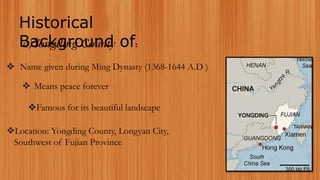
Background of:a)Yongding County
 Name given during Ming Dynasty (1368-1644 A.D )
 Means peace forever
Famous for its beautiful landscape
Location: Yongding County, Longyan City,
Southwest of Fujian Province
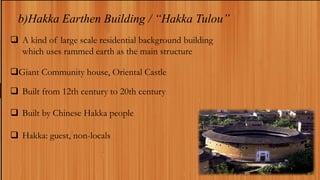
b)Hakka Earthen Building / “Hakka Tulou”
 A kind of large scale residential background building
which uses rammed earth as the main structure
Giant Community house, Oriental Castle
 Built from 12th century to 20th century
 Built by Chinese Hakka people
 Hakka: guest, non-locals
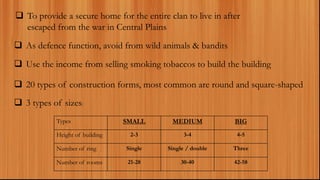
 To provide a secure home for the entire clan to live in after
escaped from the war in Central Plains
 As defence function, avoid from wild animals & bandits
 Use the income from selling smoking tobaccos to build the building
 20 types of construction forms, most common are round and square-shaped
 3 types of sizes:
Types SMALL MEDIUM BIG
Height of building 2-3 3-4 4-5
Number of ring Single Single / double Three
Number of rooms 21-28 30-40 42-58
STRUCTURE AND LAYOUT
a)Structure
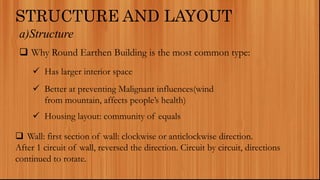
 Why Round Earthen Building is the most common type:
 Has larger interior space
 Better at preventing Malignant influences(wind
from mountain, affects people’s health)
 Housing layout: community of equals
 Wall: first section of wall: clockwise or anticlockwise direction.
After 1 circuit of wall, reversed the direction. Circuit by circuit, directions
continued to rotate.
b) Characteristics of buildings
• only one gate leading into building (safety)
• Exterior: military fortresses Interior: solid apartment
• thick rammed earth:
 ordinary bullets, cannonballs can’t penetrate
 Warm in winter, cool in summer
• Outer building is earth, inner building is wood
ROUND BUILDING WITHIN THE ROUND BUILDING
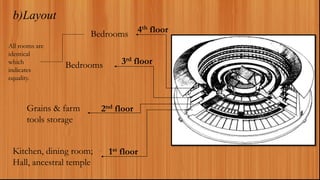
b)Layout
1st floor
2nd floor
3rd floor
4th floor
Kitchen, dining room;
Hall, ancestral temple
Grains & farm
tools storage
Bedrooms
Bedrooms
All rooms are
identical
which
indicates
equality.
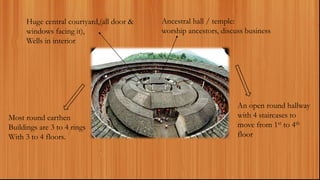
Ancestral hall / temple:
worship ancestors, discuss business
Huge central courtyard,(all door &
windows facing it),
Wells in interior
An open round hallway
with 4 staircases to
move from 1st to 4th
floor
Most round earthen
Buildings are 3 to 4 rings
With 3 to 4 floors.
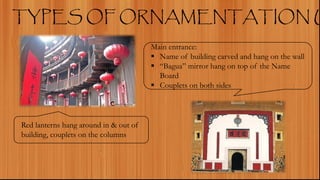
TYPES OF ORNAMENTATION U
Red lanterns hang around in & out of
building, couplets on the columns
Main entrance:
 Name of building carved and hang on the wall
 “Bagua” mirror hang on top of the Name
Board
 Couplets on both sides
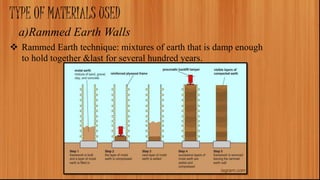
TYPE OF MATERIALS USED
a)Rammed Earth Walls
 Rammed Earth technique: mixtures of earth that is damp enough
to hold together &last for several hundred years.
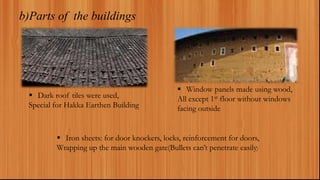
b)Parts of the buildings
 Dark roof tiles were used,
Special for Hakka Earthen Building
 Window panels made using wood,
All except 1st floor without windows
facing outside
 Iron sheets: for door knockers, locks, reinforcement for doors,
Wrapping up the main wooden gate(Bullets can’t penetrate easily)
OTHER RELEVANT INFORMATION
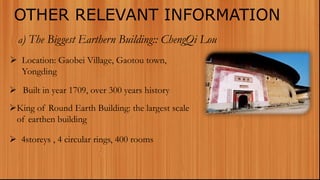
a) The Biggest Earthern Building:: ChengQi Lou
 Location: Gaobei Village, Gaotou town,
Yongding
 Built in year 1709, over 300 years history
King of Round Earth Building: the largest scale
of earthen building
 4storeys , 4 circular rings, 400 rooms
b)UNESCO
o Become one of the World Heritage Sites, July 2008
o Total of 46 sites chosen include:
 3 clusters: Chuxi, Hongkeng, Gaobei villages
2 towers: Zhenfu, Yanxiang towers
Reference:
 China Highlights, 2014. Yongding Hakka Roundhouses. [online]. Available at: <
http://www.chinahighlights.com/yongding/attraction/yongding-hakka-roundhouses.htm > [Accessed 14
January 2015]
• Travel China Guide.com. Earth towers of the Hakkas. [online]. Available at: <
http://www.travelchinaguide.com/attraction/fujian/fuzhou/earth_tower.htm > [Accessed 15 January 2015]
• Cultural China. Hakka Tulou Houses of Yongding County. [online]. Available at: < http://www.cultural-
china.com/chinaWH/html/en/18Traditions85.html > [Accessed 14 January 2015]
• Hakka Tulou. History and Evolution. [online]. Available at: <
http://www.amazingfujiantulou.com/history_evolution.html > [Accessed 16 January 2015]
• Hakka Tulou. Overview. [online]. Available at: < http://www.amazingfujiantulou.com/overview.html >
[Accessed 16 January 2015]
• Hakka Tulou. How a Tulou was created. [online]. Available at:
< http://www.amazingfujiantulou.com/how_a_tulou_was_constructed.html > [Accessed 16 January 2015]
• Hakka Tulou. Unique Hakka Architecture . [online]. Available at: <
http://www.amazingfujiantulou.com/unique_hakka_architecture.html > [Accessed 16 January 2015]

Oral presentation part a EPC TULOU

  • 1.
    SCHOOL OF ARCHITECTURE,BUILDING AND DESIGN FOUNDATION IN NATURAL & BUILT ENVIRONMENT Full Name: HWANG WEI LI Student ID: 0319756 Module: Effective Public Communication Session: September, 2014 Submission date: 19 January 2015 INDIVIDUAL ORAL PRESENTATION PART A – TRADITIONAL HOUSES AROUND THE WORLD
  • 2.
    Historical Background of:a)Yongding County Name given during Ming Dynasty (1368-1644 A.D )  Means peace forever Famous for its beautiful landscape Location: Yongding County, Longyan City, Southwest of Fujian Province
  • 3.
    b)Hakka Earthen Building/ “Hakka Tulou”  A kind of large scale residential background building which uses rammed earth as the main structure Giant Community house, Oriental Castle  Built from 12th century to 20th century  Built by Chinese Hakka people  Hakka: guest, non-locals
  • 4.
     To providea secure home for the entire clan to live in after escaped from the war in Central Plains  As defence function, avoid from wild animals & bandits  Use the income from selling smoking tobaccos to build the building  20 types of construction forms, most common are round and square-shaped  3 types of sizes: Types SMALL MEDIUM BIG Height of building 2-3 3-4 4-5 Number of ring Single Single / double Three Number of rooms 21-28 30-40 42-58
  • 5.
    STRUCTURE AND LAYOUT a)Structure Why Round Earthen Building is the most common type:  Has larger interior space  Better at preventing Malignant influences(wind from mountain, affects people’s health)  Housing layout: community of equals  Wall: first section of wall: clockwise or anticlockwise direction. After 1 circuit of wall, reversed the direction. Circuit by circuit, directions continued to rotate.
  • 6.
    b) Characteristics ofbuildings • only one gate leading into building (safety) • Exterior: military fortresses Interior: solid apartment • thick rammed earth:  ordinary bullets, cannonballs can’t penetrate  Warm in winter, cool in summer • Outer building is earth, inner building is wood ROUND BUILDING WITHIN THE ROUND BUILDING
  • 7.
    b)Layout 1st floor 2nd floor 3rdfloor 4th floor Kitchen, dining room; Hall, ancestral temple Grains & farm tools storage Bedrooms Bedrooms All rooms are identical which indicates equality.
  • 8.
    Ancestral hall /temple: worship ancestors, discuss business Huge central courtyard,(all door & windows facing it), Wells in interior An open round hallway with 4 staircases to move from 1st to 4th floor Most round earthen Buildings are 3 to 4 rings With 3 to 4 floors.
  • 9.
    TYPES OF ORNAMENTATIONU Red lanterns hang around in & out of building, couplets on the columns Main entrance:  Name of building carved and hang on the wall  “Bagua” mirror hang on top of the Name Board  Couplets on both sides
  • 10.
    TYPE OF MATERIALSUSED a)Rammed Earth Walls  Rammed Earth technique: mixtures of earth that is damp enough to hold together &last for several hundred years.
  • 11.
    b)Parts of thebuildings  Dark roof tiles were used, Special for Hakka Earthen Building  Window panels made using wood, All except 1st floor without windows facing outside  Iron sheets: for door knockers, locks, reinforcement for doors, Wrapping up the main wooden gate(Bullets can’t penetrate easily)
  • 12.
    OTHER RELEVANT INFORMATION a)The Biggest Earthern Building:: ChengQi Lou  Location: Gaobei Village, Gaotou town, Yongding  Built in year 1709, over 300 years history King of Round Earth Building: the largest scale of earthen building  4storeys , 4 circular rings, 400 rooms
  • 13.
    b)UNESCO o Become oneof the World Heritage Sites, July 2008 o Total of 46 sites chosen include:  3 clusters: Chuxi, Hongkeng, Gaobei villages 2 towers: Zhenfu, Yanxiang towers
  • 14.
    Reference:  China Highlights,2014. Yongding Hakka Roundhouses. [online]. Available at: < http://www.chinahighlights.com/yongding/attraction/yongding-hakka-roundhouses.htm > [Accessed 14 January 2015] • Travel China Guide.com. Earth towers of the Hakkas. [online]. Available at: < http://www.travelchinaguide.com/attraction/fujian/fuzhou/earth_tower.htm > [Accessed 15 January 2015] • Cultural China. Hakka Tulou Houses of Yongding County. [online]. Available at: < http://www.cultural- china.com/chinaWH/html/en/18Traditions85.html > [Accessed 14 January 2015] • Hakka Tulou. History and Evolution. [online]. Available at: < http://www.amazingfujiantulou.com/history_evolution.html > [Accessed 16 January 2015] • Hakka Tulou. Overview. [online]. Available at: < http://www.amazingfujiantulou.com/overview.html > [Accessed 16 January 2015] • Hakka Tulou. How a Tulou was created. [online]. Available at: < http://www.amazingfujiantulou.com/how_a_tulou_was_constructed.html > [Accessed 16 January 2015] • Hakka Tulou. Unique Hakka Architecture . [online]. Available at: < http://www.amazingfujiantulou.com/unique_hakka_architecture.html > [Accessed 16 January 2015]