ORAL HYGIENE INDEX (OHI)
ORAL HYGIENE INDEX SIMPLIFIED (OHI-S)
CLASSIFICATION & EXTENT OF PERIODONTITIS
ORAL HYGIENE INDEX (OHI)
ORAL HYGIENE INDEX SIMPLIFIED (OHI-S)
CLASSIFICATION & EXTENT OF PERIODONTITIS
Harshada shirsat
(IVTH BDS)
Harshada shirsat
(IVTH BDS)
WHAT ARE INDICES?
Dental index or indices are devices to find out the
incidence, prevalence and severity of the disease, based on
which preventive programs can be adopted.
An index is an expression of the clinical observation in a
numerical value. It helps to describe the status of the
individual or group with respect to a condition being
measured.
"A numerical value describing the relative status of a
population on a graduated scale with definite upper and
lower limits, which is designed to permit and facilitate
comparison with other populations classified by the same
criteria and methods”
- Russell A.L.
DEFINITION
ORAL HYGIENE INDEX (OHI)
(developed in 1960 by John C. Greene and Jack R.
Vermillion)
It was depicted as a sensitive, simple and rapid method for
assessing group or individual oral hygiene quantitatively.
Methodology:
The Oral Hygiene Index comprises of 2 components,
1) The Debris Index (DI)
2) The Calculus Index (CI).
Each segment is examined for debris or calculus.From
each segment one tooth is used for calculating the
individual index, for that particular segment. The tooth
used for the calculation must have the greatest area
covered by either debris or calculus.
Segment 1: Distal to the right
cuspid on the maxillary arch
Segment 2: Mesial to the right
and left first bicuspids on the
maxillary arch
Segment 3: Distal to the left
cuspid on the maxillary arch
Segment 4: Distal to the left
cuspid on the mandibular arch
Segment 5: Mesial to the right
and left first bicuspids on the
mandibular arch
Segment 6: Distal to the right
cuspid on the mandibular arch
.
Rules:
1. Only fully erupted permanent teeth are scored.
(occlusal or incisal surface has reached the occlusal
plane)
2. Third molars are not included.
3. The scoring for the buccal/labial and lingual surfaces is
based on the tooth in the designated segment that has
the greatest surface area of debris for the DI or
supragingival and subgingival calculus for the Ci.
Therefore, the buccal/labial score and the lingual score
for a segment need not be taken from the same tooth.
No 23 explorer (Shepherd’s hook)
Move the explorer along the buccal/ labial and lingual surface
and look for amount of debris collected on explorer.
Procedure:
• For the Debris Index,
A No. 23 explorer is used for estimating the amount of
supragingival and subgingival calculus.
• For the Calculus Index,
Supragingival Calculus
Denotes deposits usually white to yellowish brown in colour
occlusal to free gingival margin
Subgingival Calculus
Denotes deposits usually light brown to black in colour,apical to
free gingival margin
Calculation:
The buccal/labial and lingual scores are tabulated and totaled for
each segment and arch. The debris and calculus scores are
tabulated separately and the indices for each are calculated
independently.
SIMPLIFIED ORAL HYGIENE INDEX (OHI-S)
(developed in 1964 by John .C Greene and
Jack R. Vermillion.)
Why OHI-S was Needed?
Even though the Oral Hygiene Index was determined to be simple
and sensitive, it was time-consuming and required more decision
making.
The Simplified Oral Hygiene Index (OHI-S) differs from the Oral
Hygiene Index in,
• The number of tooth surfaces scored (6 rather than 12)
• The method of selecting the surface to be scored
• The scores, which can be obtained
However, the criteria and scoring for the tooth surfaces remain
the same.
Rules
•At least two of the six possible tooth surfaces must
have been examined.
•Third molars are included only if they are functional
•Natural teeth with full crown restorations and surfaces
reduced in height by caries or trauma are not scored.
•If an index tooth/ substitute cannot be scored,it is
marked with X in a box
Mouth mirror, No. 23 explorer (Shepherd's Hook)
Instruments Used-
The oral hygiene examination and scoring for the DI always should
precede the oral examination and scoring for the CI.
INTERPRETATION
For an individual score-
• Scores are calculated to one decimal place
For a group of individuals-
• The debris and calculus scores are obtained by calculating
the average of the individual scores.
• The group scores may be calculated to one or two decimal
places, depending on the sample size.
Uses of OHI-S Index :
• It has been widely used in studies of the epidemiology of
periodontal disease.
• It is useful in evaluation of dental health education programs
in public school systems.
• It is used in evaluating the cleansing efficiency of tooth
brushes.
• It is used to evaluate an individual's level of oral cleanliness
PERIODONTITIS
Periodontitis is defined as "an inflammatory disease of the
supporting tissues of the teeth caused by specific
microorganisms or groups of specific microorganisms,
resulting in progressive destruction of the periodontal
ligament and alveolar bone with increased probing depth
formation, recession, or both."
The clinical feature that distinguishes periodontitis from
gingivitis is the presence of clinically detectable attachment
loss as a result of inflammatory destruction of the periodontal
ligament and alveolar bone. This loss is often accompanied by
periodontal pocket formation.
AAP held an International Workshop for the Classification of
Periodontal Diseases in 1999
CLASSIFICATION
Classification of the different forms of periodontitis was simplified
to describe three general disease forms:
1) CHRONIC PERIODONTITIS
2) AGGRESSIVE PERIODONTITIS
3) PERIODONTITIS AS A MANIFESTATION OF SYSTEMIC
DISEASE
Chronic periodontitis may be further subclassified into
localized and generalized forms and characterized as mild,
moderate, or severe based on the common features described
previously and the following specific features:
• Localized form: <30% of teeth involved
• Generalized form: >30% of teeth involved
• Mild: 1 to 2 mm clinical attachment loss (CAL)
• Moderate: 3 to 4 mm clinical attachment loss (CAL)
• Severe: 5 mm or more clinical attachment loss (CAL)
Clinical Attachment Loss:
Is the measurement of distance from cemento-enamel
junction (CEJ) to the apical extent (depth) of periodontal sulcus
It involve two measurments-
1)pocket probing depth
2)gingival margin level
First, measure the pocket depth with periodontal Probe
Then, measure the distance from marginal gingiva to
the CEJ
• If the gingival margin level above the level of CEJ, then
assign a negative sign to the number (e.g., 1, -2, -3...)
• If the gingival margin level at the same level of CEJ,
then the number is ZERO
• If the gingival margin level below the level of CEJ, then
assign a positive sign to the number (e.g., +1. +2, +3....)
HOW TO MEASURE?
NOW WE ADD THE TWO NUMBERS TOGETHER, AND
THE RESULT IS THE CLINICAL ATTACHMENT LOSS
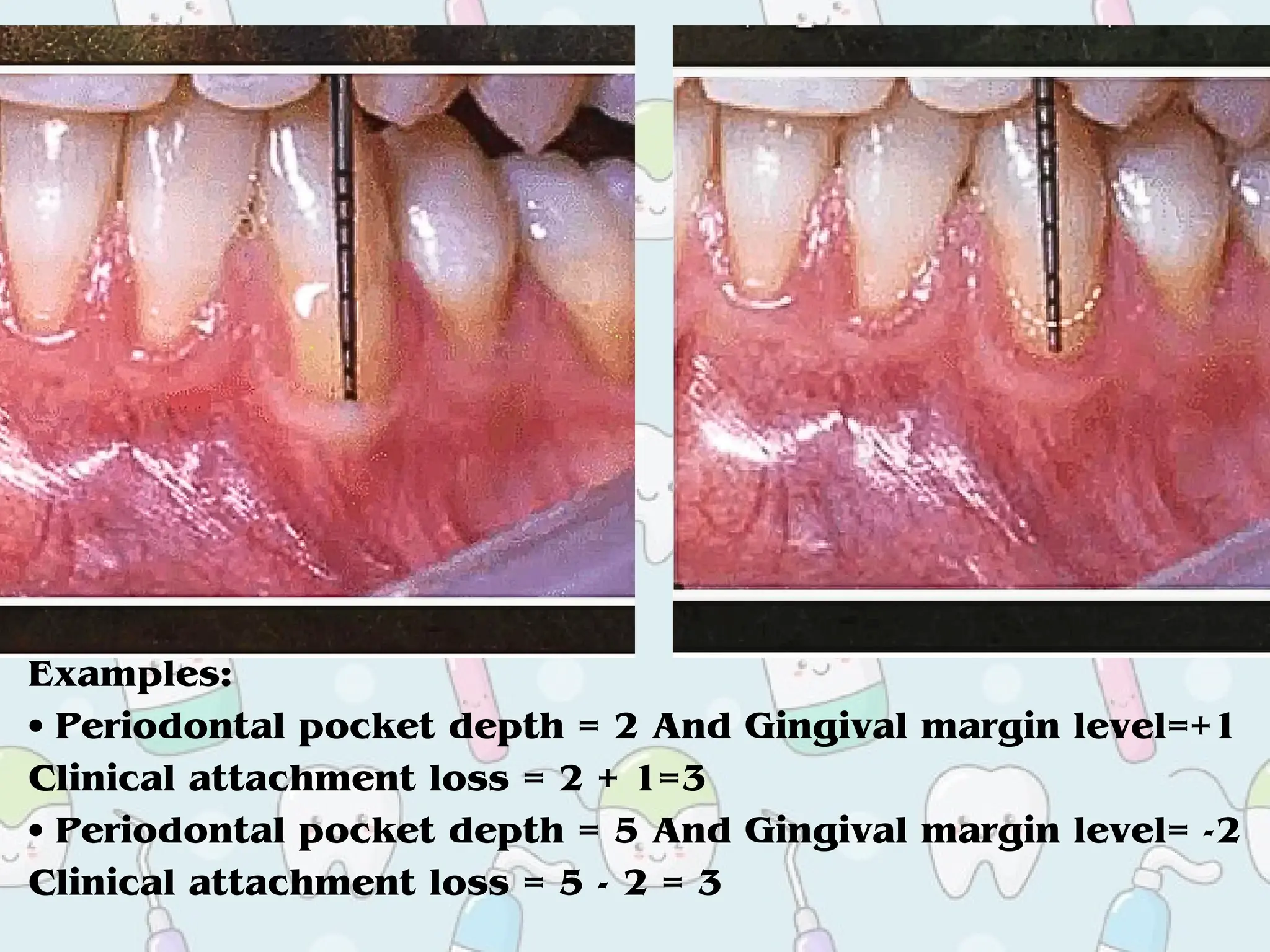
Examples:
• Periodontal pocket depth = 2 And Gingival margin level=+1
Clinical attachment loss = 2 + 1=3
• Periodontal pocket depth = 5 And Gingival margin level= -2
Clinical attachment loss = 5 - 2 = 3
The following characteristics are common to patients with
chronic periodontitis:
• Prevalent in adults but can occur in children
• Amount of destruction consistent with local factors
• Associated with a variable microbial pattern
• Subgingival calculus frequently found
• Slow-to-moderate rate of progression with possible periods o
rapid progression
• Possibly modified by or associated with the following:
Systemic diseases such as diabetes mellitus and human
immunodeficiency virus (HIV) infection
Local factors predisposing to periodontitis
Environmental factors such as cigarette smoking and
emotional stress
Thank You !!
Thank You !!

Oral hygiene index simplified pptttttpdf

  • 1.
    ORAL HYGIENE INDEX(OHI) ORAL HYGIENE INDEX SIMPLIFIED (OHI-S) CLASSIFICATION & EXTENT OF PERIODONTITIS ORAL HYGIENE INDEX (OHI) ORAL HYGIENE INDEX SIMPLIFIED (OHI-S) CLASSIFICATION & EXTENT OF PERIODONTITIS Harshada shirsat (IVTH BDS) Harshada shirsat (IVTH BDS)
  • 2.
    WHAT ARE INDICES? Dentalindex or indices are devices to find out the incidence, prevalence and severity of the disease, based on which preventive programs can be adopted. An index is an expression of the clinical observation in a numerical value. It helps to describe the status of the individual or group with respect to a condition being measured. "A numerical value describing the relative status of a population on a graduated scale with definite upper and lower limits, which is designed to permit and facilitate comparison with other populations classified by the same criteria and methods” - Russell A.L.
  • 3.
  • 4.
    ORAL HYGIENE INDEX(OHI) (developed in 1960 by John C. Greene and Jack R. Vermillion) It was depicted as a sensitive, simple and rapid method for assessing group or individual oral hygiene quantitatively. Methodology: The Oral Hygiene Index comprises of 2 components, 1) The Debris Index (DI) 2) The Calculus Index (CI). Each segment is examined for debris or calculus.From each segment one tooth is used for calculating the individual index, for that particular segment. The tooth used for the calculation must have the greatest area covered by either debris or calculus.
  • 5.
    Segment 1: Distalto the right cuspid on the maxillary arch Segment 2: Mesial to the right and left first bicuspids on the maxillary arch Segment 3: Distal to the left cuspid on the maxillary arch Segment 4: Distal to the left cuspid on the mandibular arch Segment 5: Mesial to the right and left first bicuspids on the mandibular arch Segment 6: Distal to the right cuspid on the mandibular arch .
  • 6.
    Rules: 1. Only fullyerupted permanent teeth are scored. (occlusal or incisal surface has reached the occlusal plane) 2. Third molars are not included. 3. The scoring for the buccal/labial and lingual surfaces is based on the tooth in the designated segment that has the greatest surface area of debris for the DI or supragingival and subgingival calculus for the Ci. Therefore, the buccal/labial score and the lingual score for a segment need not be taken from the same tooth.
  • 7.
    No 23 explorer(Shepherd’s hook) Move the explorer along the buccal/ labial and lingual surface and look for amount of debris collected on explorer. Procedure: • For the Debris Index,
  • 8.
    A No. 23explorer is used for estimating the amount of supragingival and subgingival calculus. • For the Calculus Index, Supragingival Calculus Denotes deposits usually white to yellowish brown in colour occlusal to free gingival margin Subgingival Calculus Denotes deposits usually light brown to black in colour,apical to free gingival margin
  • 10.
    Calculation: The buccal/labial andlingual scores are tabulated and totaled for each segment and arch. The debris and calculus scores are tabulated separately and the indices for each are calculated independently.
  • 12.
    SIMPLIFIED ORAL HYGIENEINDEX (OHI-S) (developed in 1964 by John .C Greene and Jack R. Vermillion.) Why OHI-S was Needed? Even though the Oral Hygiene Index was determined to be simple and sensitive, it was time-consuming and required more decision making. The Simplified Oral Hygiene Index (OHI-S) differs from the Oral Hygiene Index in, • The number of tooth surfaces scored (6 rather than 12) • The method of selecting the surface to be scored • The scores, which can be obtained However, the criteria and scoring for the tooth surfaces remain the same.
  • 14.
    Rules •At least twoof the six possible tooth surfaces must have been examined. •Third molars are included only if they are functional •Natural teeth with full crown restorations and surfaces reduced in height by caries or trauma are not scored. •If an index tooth/ substitute cannot be scored,it is marked with X in a box Mouth mirror, No. 23 explorer (Shepherd's Hook) Instruments Used-
  • 15.
    The oral hygieneexamination and scoring for the DI always should precede the oral examination and scoring for the CI.
  • 17.
  • 19.
    For an individualscore- • Scores are calculated to one decimal place For a group of individuals- • The debris and calculus scores are obtained by calculating the average of the individual scores. • The group scores may be calculated to one or two decimal places, depending on the sample size. Uses of OHI-S Index : • It has been widely used in studies of the epidemiology of periodontal disease. • It is useful in evaluation of dental health education programs in public school systems. • It is used in evaluating the cleansing efficiency of tooth brushes. • It is used to evaluate an individual's level of oral cleanliness
  • 20.
    PERIODONTITIS Periodontitis is definedas "an inflammatory disease of the supporting tissues of the teeth caused by specific microorganisms or groups of specific microorganisms, resulting in progressive destruction of the periodontal ligament and alveolar bone with increased probing depth formation, recession, or both." The clinical feature that distinguishes periodontitis from gingivitis is the presence of clinically detectable attachment loss as a result of inflammatory destruction of the periodontal ligament and alveolar bone. This loss is often accompanied by periodontal pocket formation.
  • 21.
    AAP held anInternational Workshop for the Classification of Periodontal Diseases in 1999 CLASSIFICATION Classification of the different forms of periodontitis was simplified to describe three general disease forms: 1) CHRONIC PERIODONTITIS 2) AGGRESSIVE PERIODONTITIS 3) PERIODONTITIS AS A MANIFESTATION OF SYSTEMIC DISEASE
  • 22.
    Chronic periodontitis maybe further subclassified into localized and generalized forms and characterized as mild, moderate, or severe based on the common features described previously and the following specific features: • Localized form: <30% of teeth involved • Generalized form: >30% of teeth involved • Mild: 1 to 2 mm clinical attachment loss (CAL) • Moderate: 3 to 4 mm clinical attachment loss (CAL) • Severe: 5 mm or more clinical attachment loss (CAL)
  • 23.
    Clinical Attachment Loss: Isthe measurement of distance from cemento-enamel junction (CEJ) to the apical extent (depth) of periodontal sulcus It involve two measurments- 1)pocket probing depth 2)gingival margin level
  • 24.
    First, measure thepocket depth with periodontal Probe Then, measure the distance from marginal gingiva to the CEJ • If the gingival margin level above the level of CEJ, then assign a negative sign to the number (e.g., 1, -2, -3...) • If the gingival margin level at the same level of CEJ, then the number is ZERO • If the gingival margin level below the level of CEJ, then assign a positive sign to the number (e.g., +1. +2, +3....) HOW TO MEASURE? NOW WE ADD THE TWO NUMBERS TOGETHER, AND THE RESULT IS THE CLINICAL ATTACHMENT LOSS
  • 25.
    Examples: • Periodontal pocketdepth = 2 And Gingival margin level=+1 Clinical attachment loss = 2 + 1=3 • Periodontal pocket depth = 5 And Gingival margin level= -2 Clinical attachment loss = 5 - 2 = 3
  • 26.
    The following characteristicsare common to patients with chronic periodontitis: • Prevalent in adults but can occur in children • Amount of destruction consistent with local factors • Associated with a variable microbial pattern • Subgingival calculus frequently found • Slow-to-moderate rate of progression with possible periods o rapid progression • Possibly modified by or associated with the following: Systemic diseases such as diabetes mellitus and human immunodeficiency virus (HIV) infection Local factors predisposing to periodontitis Environmental factors such as cigarette smoking and emotional stress
  • 27.