Stochastic Theory of Lineshape
Oleksandr Kazakov
January 28, 2015
Oleksandr Kazakov Stochastic Theory of Lineshape
Outline
1 Treatment of motional and exchange narrowing in magnetic
resonance.
2 Algorithm approach on assignment and inversion of Liouville
Matrix.
3 STOL Ver. 1.0 for simulating stochastic lineshapes.
Oleksandr Kazakov Stochastic Theory of Lineshape
Outline
1 Treatment of motional and exchange narrowing in magnetic
resonance.
2 Algorithm approach on assignment and inversion of Liouville
Matrix.
3 STOL Ver. 1.0 for simulating stochastic lineshapes.
Oleksandr Kazakov Stochastic Theory of Lineshape
Outline
1 Treatment of motional and exchange narrowing in magnetic
resonance.
2 Algorithm approach on assignment and inversion of Liouville
Matrix.
3 STOL Ver. 1.0 for simulating stochastic lineshapes.
Oleksandr Kazakov Stochastic Theory of Lineshape
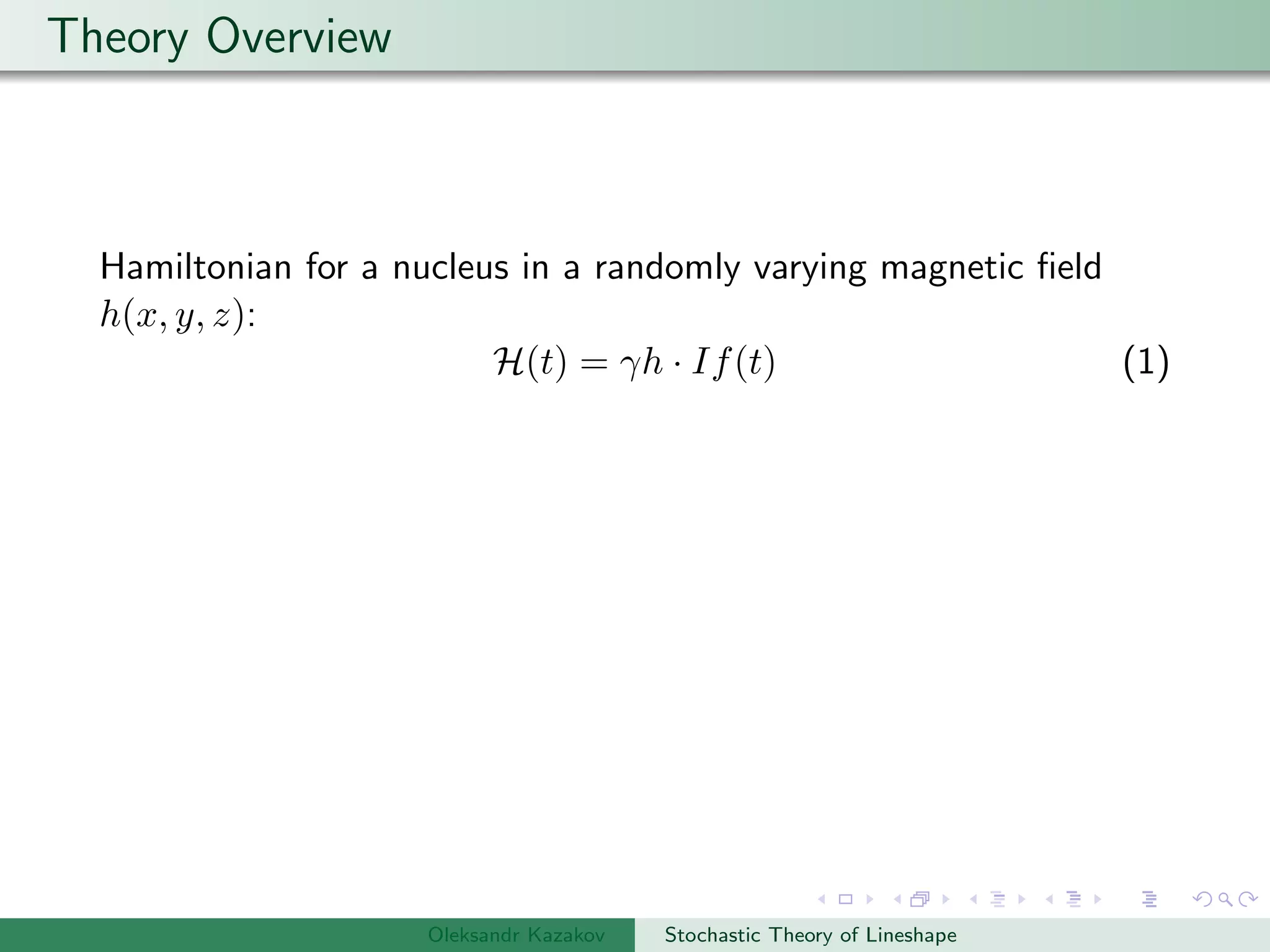
Theory Overview
Hamiltonian for a nucleus in a randomly varying magnetic field
h(x, y, z):
H(t) = γh · If(t) (1)
Oleksandr Kazakov Stochastic Theory of Lineshape
Theory Overview
Hamiltonian for a nucleus in a randomly varying magnetic field
h(x, y, z):
H(t) = γh · If(t) (1)
What will happen if we add a fixed magnetic field H0 along
positive x?
H(t) = γH0Iz + γh · If(t) (2)
Oleksandr Kazakov Stochastic Theory of Lineshape
Theory Overview
Hamiltonian for a nucleus in a randomly varying magnetic field
h(x, y, z):
H(t) = γh · If(t) (1)
What will happen if we add a fixed magnetic field H0 along
positive x?
H(t) = γH0Iz + γh · If(t) (2)
[H(t), H(t) ] = 0
Oleksandr Kazakov Stochastic Theory of Lineshape
Theory Overview
Probability of the emission of a photon with wave vector k and
frequency ω by the system from state |λ to its final state |α :
Pλα(k) =
| α|H(+)|λ |2
(ω + Eα − Eλ)2 + 1
4Γ2
(3)
Oleksandr Kazakov Stochastic Theory of Lineshape
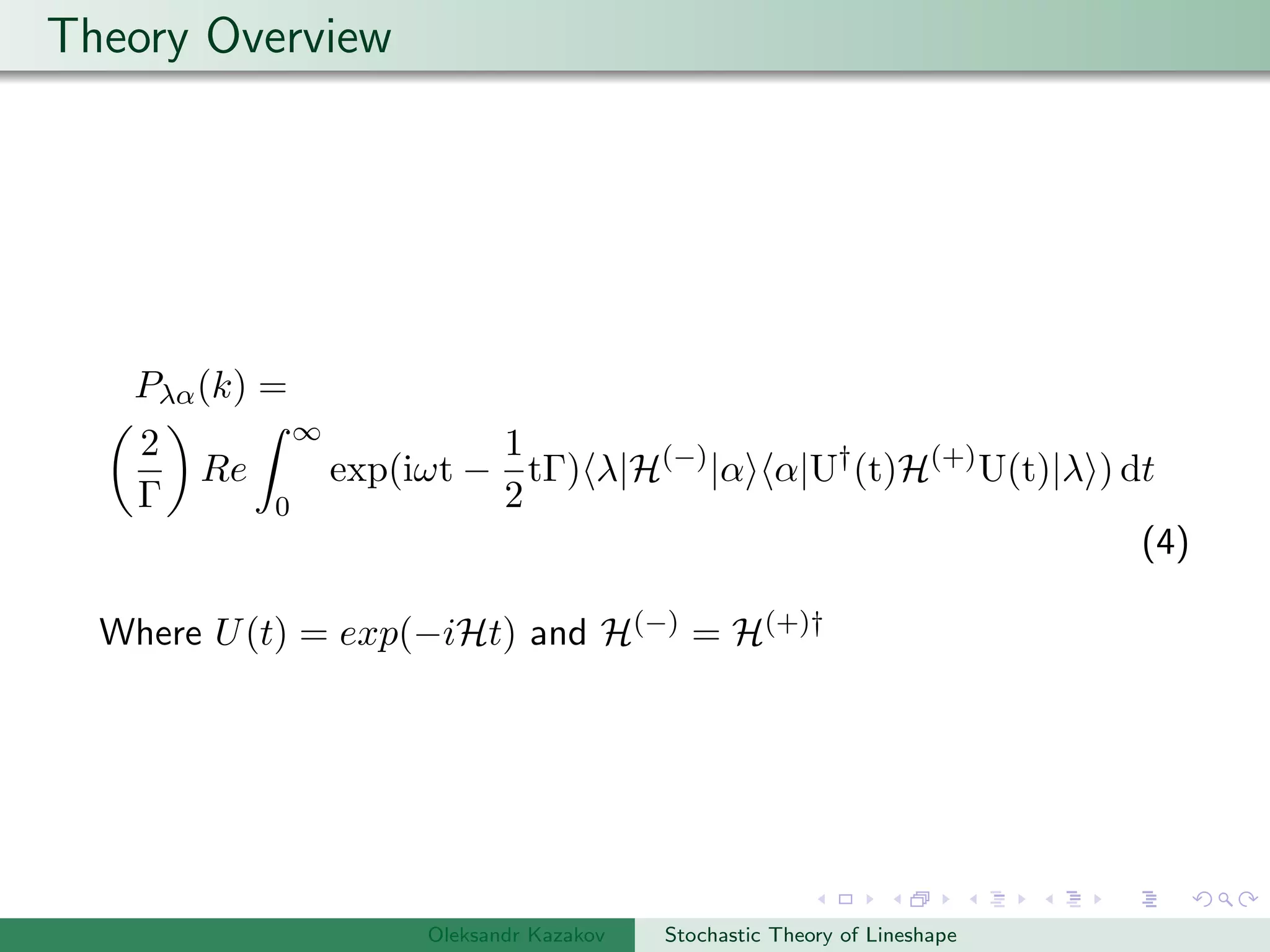
Theory Overview
Pλα(k) =
2
Γ
Re
∞
0
exp(iωt −
1
2
tΓ) λ|H(−)
|α α|U†
(t)H(+)
U(t)|λ ) dt
(4)
Where U(t) = exp(−iHt) and H(−) = H(+)†
Oleksandr Kazakov Stochastic Theory of Lineshape
Theory Overview
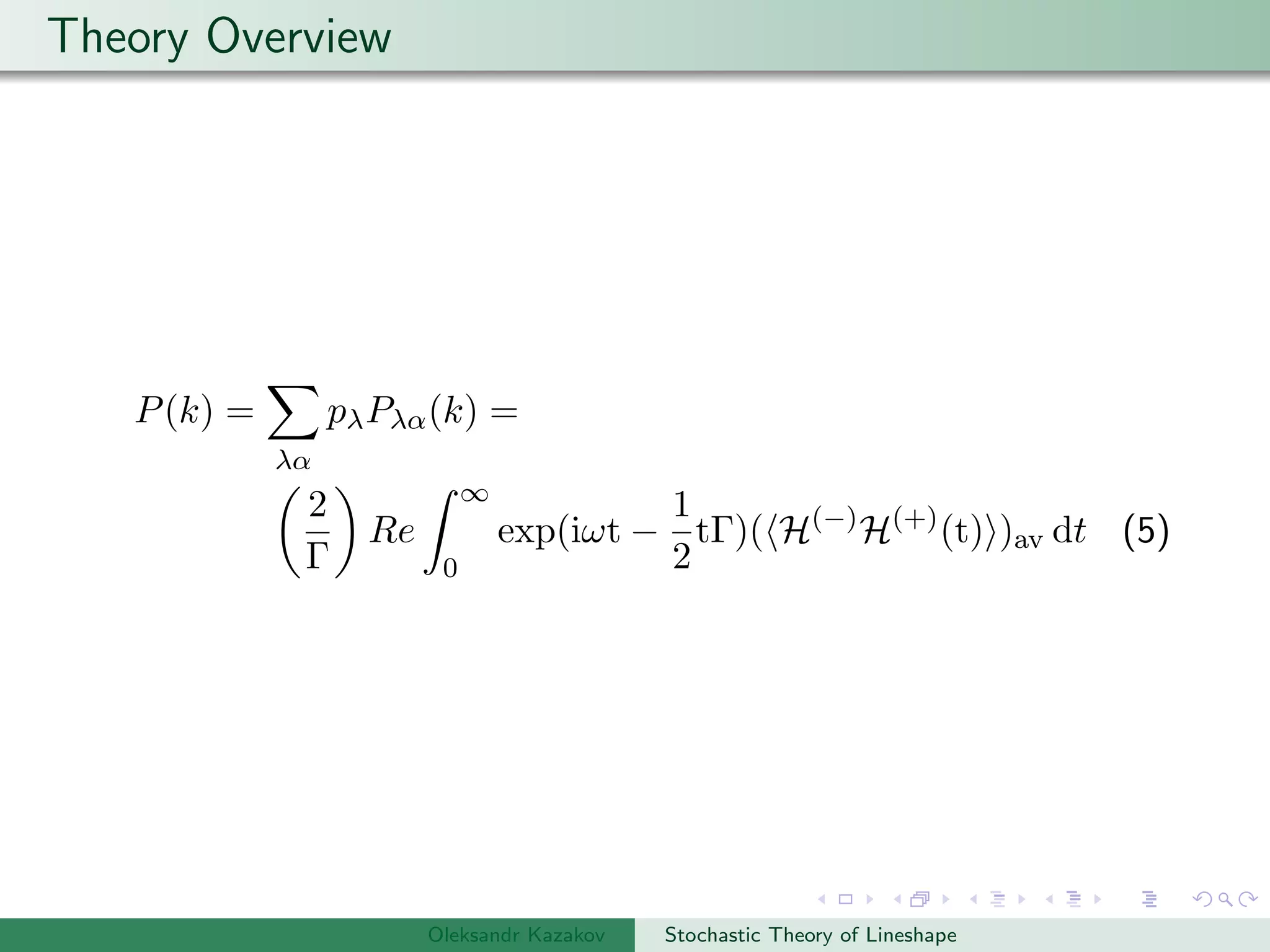
P(k) =
λα
pλPλα(k) =
2
Γ
Re
∞
0
exp(iωt −
1
2
tΓ)( H(−)
H(+)
(t) )av dt (5)
Oleksandr Kazakov Stochastic Theory of Lineshape
Theory Overview
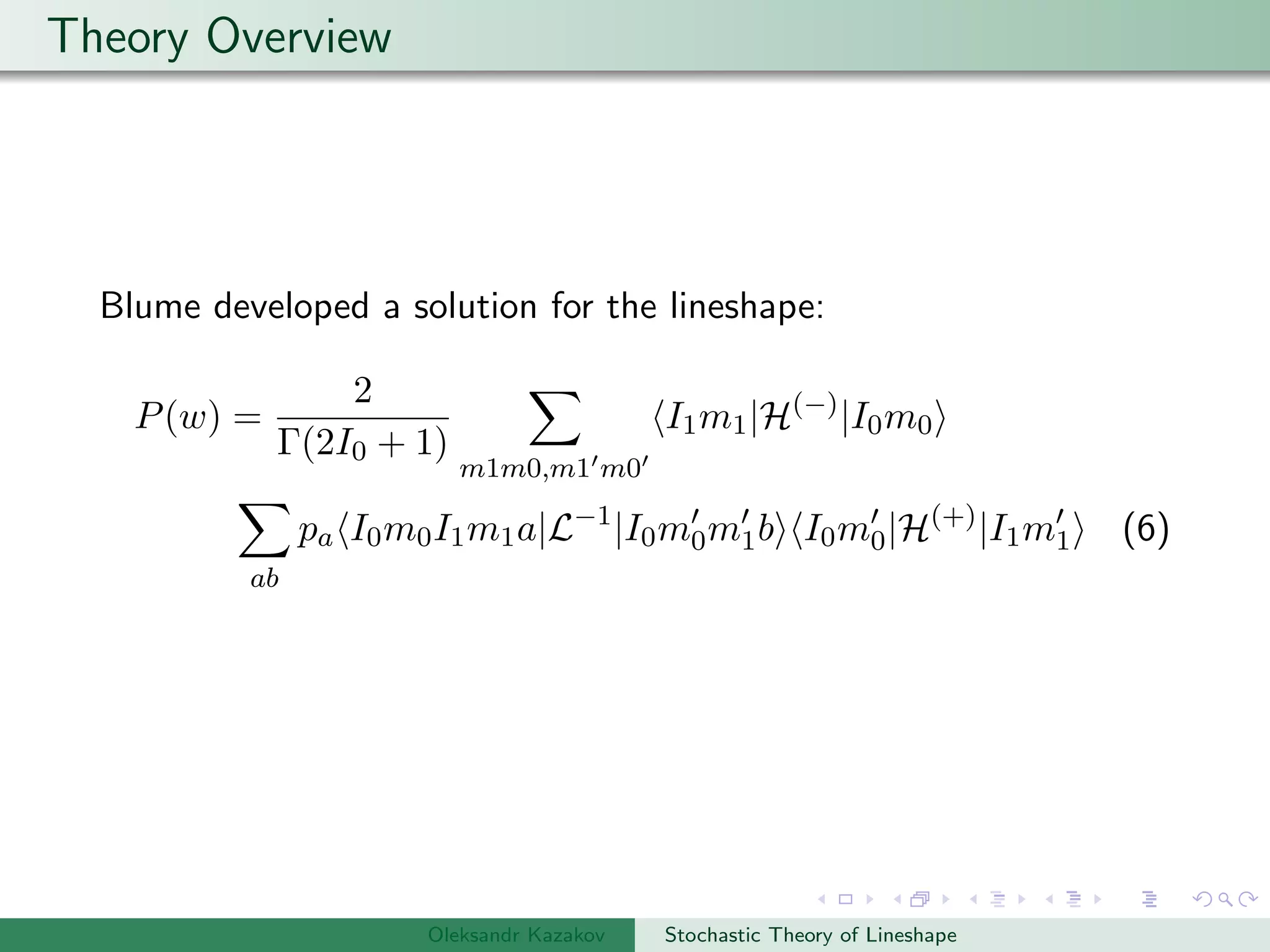
Blume developed a solution for the lineshape:
P(w) =
2
Γ(2I0 + 1)
m1m0,m1 m0
I1m1|H(−)
|I0m0
ab
pa I0m0I1m1a|L−1
|I0m0m1b I0m0|H(+)
|I1m1 (6)
Oleksandr Kazakov Stochastic Theory of Lineshape
Theory Overview
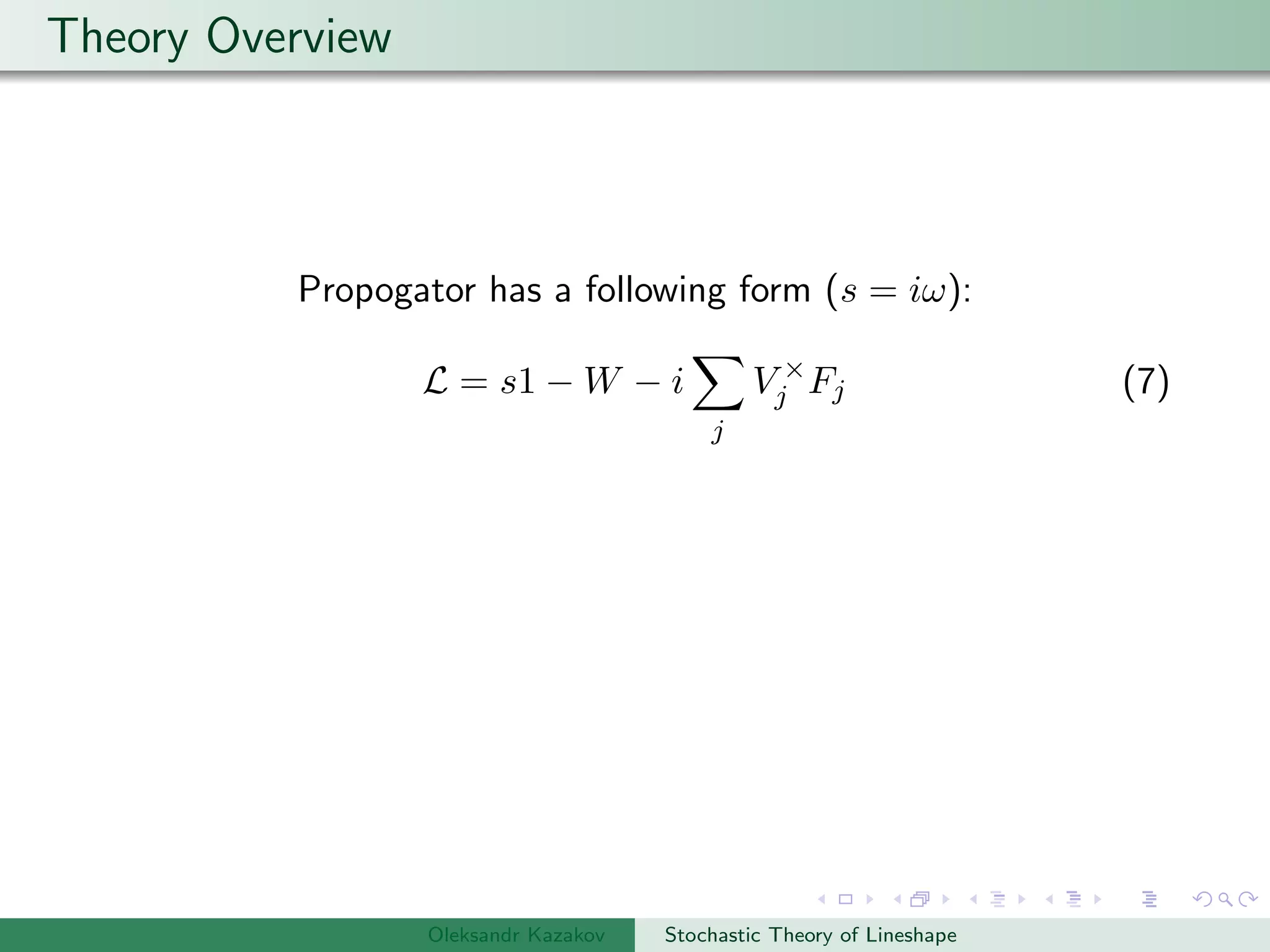
Propogator has a following form (s = iω):
L = s1 − W − i
j
V ×
j Fj (7)
Oleksandr Kazakov Stochastic Theory of Lineshape
Theory Overview
Propogator has a following form (s = iω):
L = s1 − W − i
j
V ×
j Fj (7)
L = s1 − W − i
j
(Vj ⊗ Fj − Fj ⊗ Vj) (8)
Oleksandr Kazakov Stochastic Theory of Lineshape
Theory Overview
For easier implementation we can also rewritte as:
P(s) =
2
Γ(2I0 + 1)
H(−)
δm1m0 H(+)
δm0m1
[sδabδm1m1
δm0m0
− (a|W|b)δm0m0
δm1m1
− i(a|F|a)δab[ I0m0|Vj|I0m0 δm0m0
− I1m1|Vj|I1m1 δm1m1
]−1
(9)
Oleksandr Kazakov Stochastic Theory of Lineshape
Problem
Algorithm to generate arrays values and perform where index i and
j for Ai,j are composed of 3 subindices A(m0,m1,a),(m0,m1,b) in a
simplest case having only nuclear spin.
Ai,j = A(m0S,m1S,m0I ,m1I ,a),(m0S,m1S,m0I ,m1I ,b) =
[sδabδm1m1
δm0m0
− (a|W|b)δm0m0
δm1m1
− i(a|F|a)δab[ I0m0|Vj|I0m0 δm0m0
− I1m1|Vj|I1m1 δm1m1
]−1
(10)
It is possible to do assignment of Liouville Matrix by hand up to
size 8 × 8 but what if its size expands to 256 × 256 or
1 · 106 × 1 · 106?
Oleksandr Kazakov Stochastic Theory of Lineshape
Where to go?
1 Matlab
Multidimensional arrays(N-D) implementation appeared in
recent Matlab 2014b
2 Java
Supports Multidimensional arrays implementation since 1995
Oleksandr Kazakov Stochastic Theory of Lineshape
Where to go?
1 Matlab
Multidimensional arrays(N-D) implementation appeared in
recent Matlab 2014b
2 Java
Supports Multidimensional arrays implementation since 1995
Oleksandr Kazakov Stochastic Theory of Lineshape
Algorithm Development in Stages
Generate 6-D array: A[a][b][m0][m1][m0][m1]
Oleksandr Kazakov Stochastic Theory of Lineshape
Algorithm Development in Stages
Generate 6-D array: A[a][b][m0][m1][m0][m1]
Cast 6-D array into 2-D: A[a][b][m0][m1][m0][m1] → A [i][j]
Oleksandr Kazakov Stochastic Theory of Lineshape
Algorithm Development in Stages
Generate 6-D array: A[a][b][m0][m1][m0][m1]
Cast 6-D array into 2-D: A[a][b][m0][m1][m0][m1] → A [i][j]
Perform 2-D array inversion: A [i][j] = A [i][j]−1
Oleksandr Kazakov Stochastic Theory of Lineshape
Algorithm Development in Stages
Generate 6-D array: A[a][b][m0][m1][m0][m1]
Cast 6-D array into 2-D: A[a][b][m0][m1][m0][m1] → A [i][j]
Perform 2-D array inversion: A [i][j] = A [i][j]−1
Cast 2-D array back into 6-D array:
A [i][j] → A[a][b][m0][m1][m0][m1]
Oleksandr Kazakov Stochastic Theory of Lineshape
Algorithm Development in Stages
Generate 6-D array: A[a][b][m0][m1][m0][m1]
Cast 6-D array into 2-D: A[a][b][m0][m1][m0][m1] → A [i][j]
Perform 2-D array inversion: A [i][j] = A [i][j]−1
Cast 2-D array back into 6-D array:
A [i][j] → A[a][b][m0][m1][m0][m1]
Go back to the equation 6 and do the summation.
Oleksandr Kazakov Stochastic Theory of Lineshape
Algorithm Development in Stages
Generate 6-D array: A[a][b][m0][m1][m0][m1]
Cast 6-D array into 2-D: A[a][b][m0][m1][m0][m1] → A [i][j]
Perform 2-D array inversion: A [i][j] = A [i][j]−1
Cast 2-D array back into 6-D array:
A [i][j] → A[a][b][m0][m1][m0][m1]
Go back to the equation 6 and do the summation.
Plot the results.
Oleksandr Kazakov Stochastic Theory of Lineshape
Encoding Table Example
A simple example of encription of 6 different combinations between
3 indecies that are used to cast back 6-D array from
2-D(A[a][:][m0][m1][:][:] → A [i][:]).
a, m0, m1 Output Count
1, 1/2, 1/2 → 000 1
1, −1/2, 1/2 → 010 2
1, 1/2, −1/2 → 001 3
2, 1/2, 1/2 → 100 4
2, 1/2, 1/2 → 101 5
2, −1/2, −1/2 → 111 6
Oleksandr Kazakov Stochastic Theory of Lineshape
Code Sample
Java Method to store reference for the elements of 6-D array after
converting into 2-D array. Elements being converted and saved
into string format.
public static String[] genind(int m_0,int m_1, int a1 ){
int x=1;
String Y[] = new String[max];
for(int k=0;k<m_0;k++){
for(int l=0;l<m_1;l++){
for(int a=0;a<a1;a++){
Y[x-1]=String.format("%03d",a+10*k+100*l);
x++;
}
}
}
return Y;
} Oleksandr Kazakov Stochastic Theory of Lineshape
Code Sample
Casting 6-D array into 2-D:
for(int k=0; k<m_0;k++){
for(int l=0; l<m_1; l++){
for(int m=0; m<m_01; m++){
for(int n=0;n<m_11; n++){
for(int a=0; a<a1; a++){
for(int b=0; b<b1;b++){
tr[index(k,l,a,Y)][index(m,n,b,Y)]=matrix[a][b][k][l][m][n];
}
}
}
}
}
}
return tr;
}
Oleksandr Kazakov Stochastic Theory of Lineshape
Code Sample
Converting from 2-D array back to 6-D array:
public static Object[][][][][][] matrixturn(Complex
tr[][], String Y[]){
for(int k=0; k<max;k++){
for(int l=0; l<max; l++){
hn[a1indback(k,Y)][b1indback(l,Y)][m0indback(k,Y)]...
[m1indback(k,Y)][m01indback(l,Y)][m11indback(l,Y)]=tr[k][l];
}
}
return hamatrixnew;
}
Oleksandr Kazakov Stochastic Theory of Lineshape
Code Sample
Method for the extraction of element reference in 2-D array to that
in 6-D:
public static int m0indexback( int k, String Y[]){
int m0=0;
int f=Integer.parseInt(Y[k]);
m0=(int) Math.floor((f/100));
return m0;
}
public static int m1indexback( int k,String Y[]){
int m1=0;
int ff=Integer.parseInt(Y[k]);
m1=(int) Math.floor((ff-Math.floor(ff/100)*100)/10);
return m1;
}
Oleksandr Kazakov Stochastic Theory of Lineshape
Code Sample
Method for the extraction of element reference in 2-D array to that
in 6-D to perform summation:
public static int a1indexback(int k,String Y[]){
int fff=Integer.parseInt(Y[k]);
int a1=0;
a1= (int) (Math.floor(fff-Math.floor(fff/100)*100)-...
Math.floor((fff-Math.floor(fff/100)*100)/10)*10);
return a1;
}
Oleksandr Kazakov Stochastic Theory of Lineshape
Results
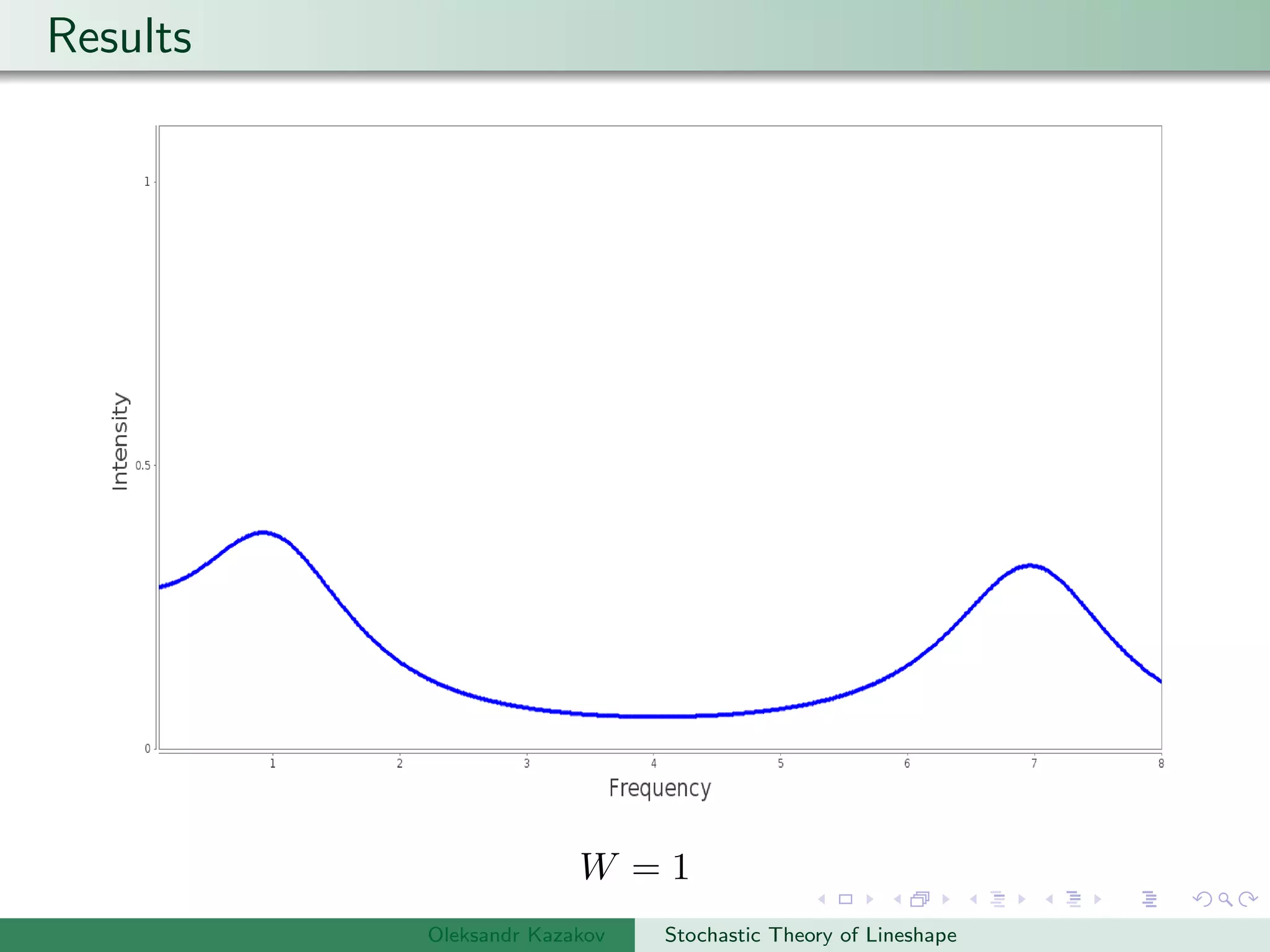
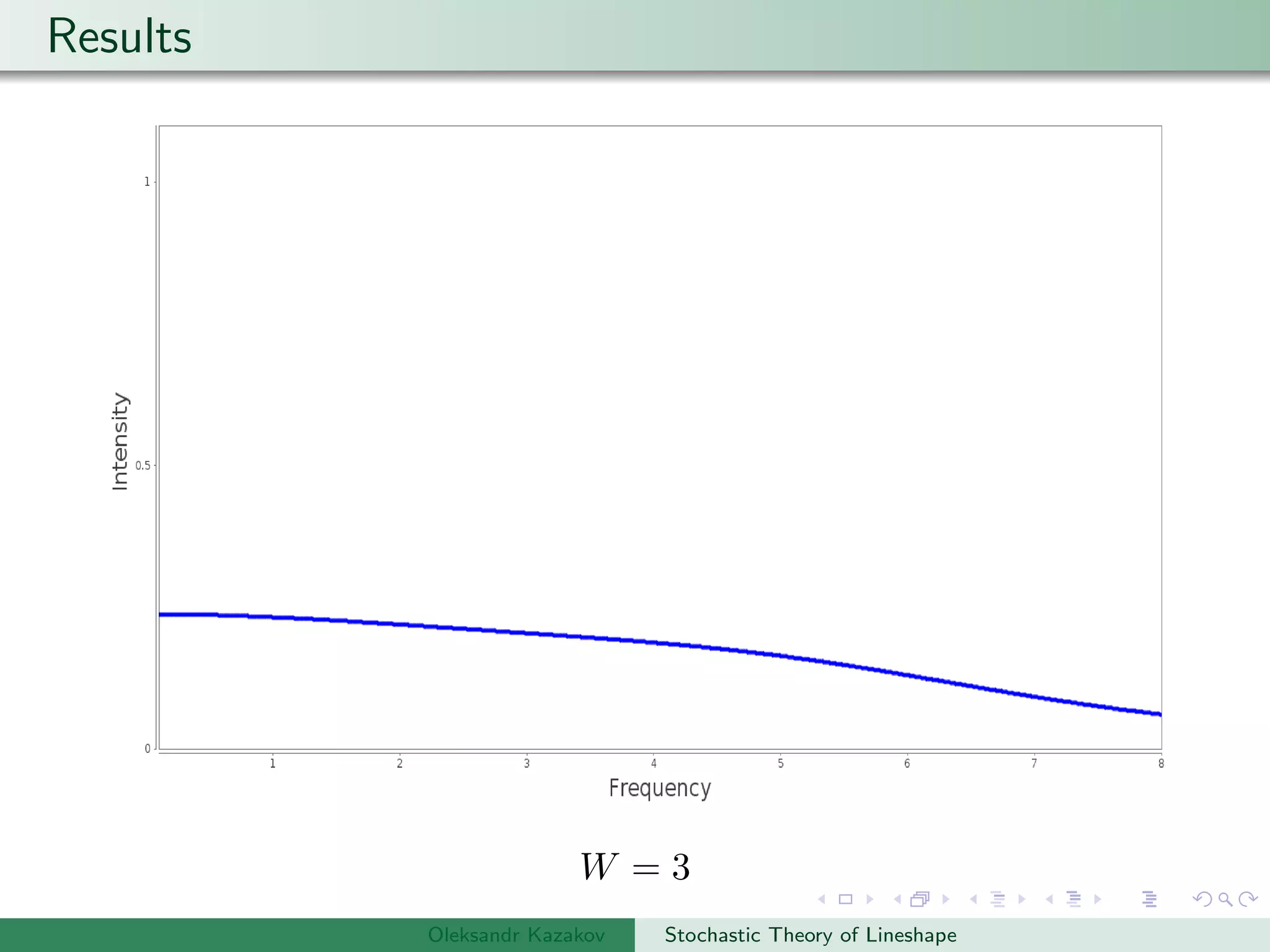
To illustrate that algorithm works Nuclear Zeeman Hamiltonian
was introduced of the form:
H = HIz + h · If(t) (11)
Where fixed magnetic field set along z−direction
Oleksandr Kazakov Stochastic Theory of Lineshape
Results
NMR line shape for spin-1
2 nucleus in a fixed magnetic field
along z axis and fluctuating field along x axis
Oleksandr Kazakov Stochastic Theory of Lineshape
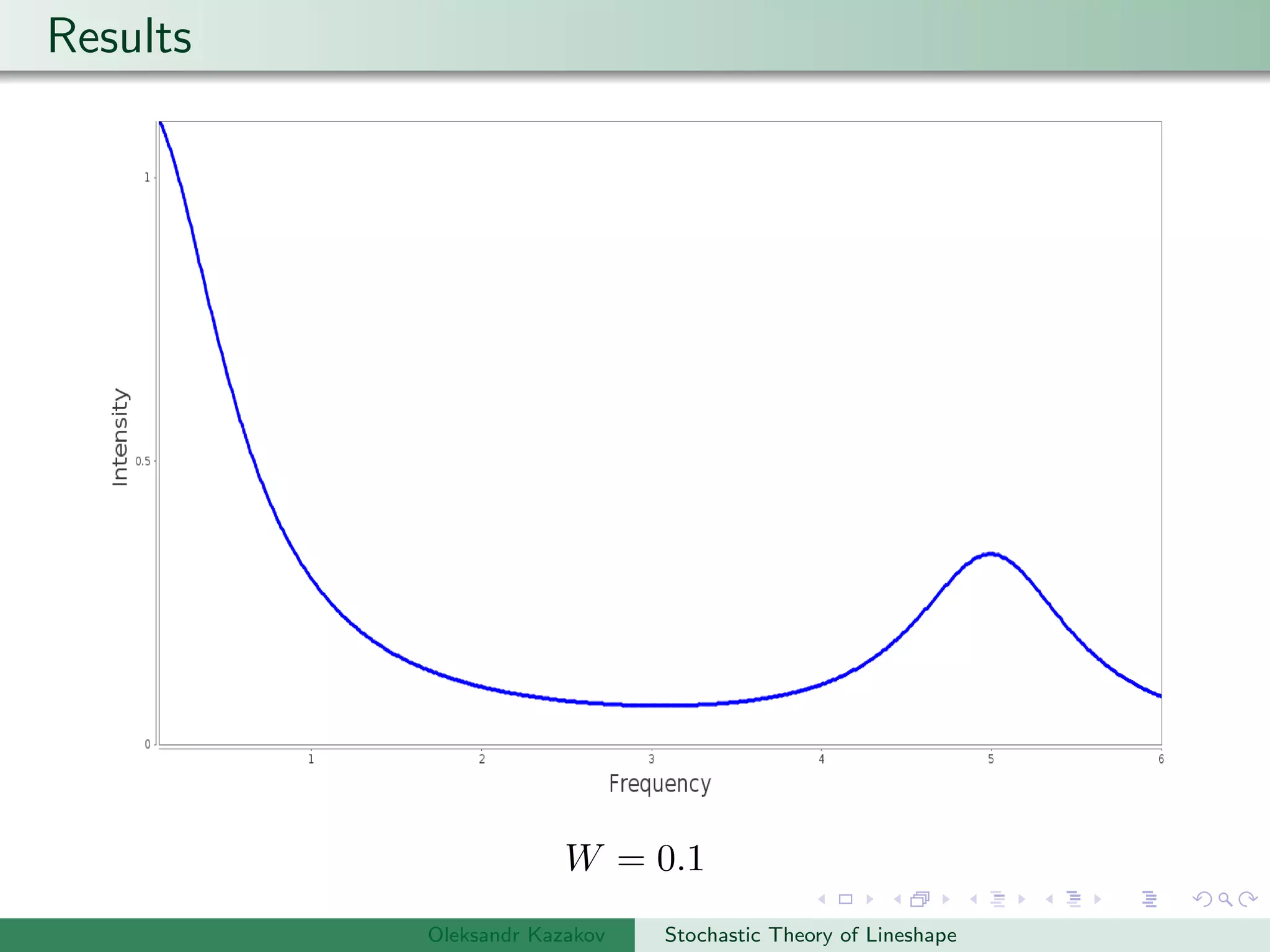
Results
W = 0.1
Oleksandr Kazakov Stochastic Theory of Lineshape
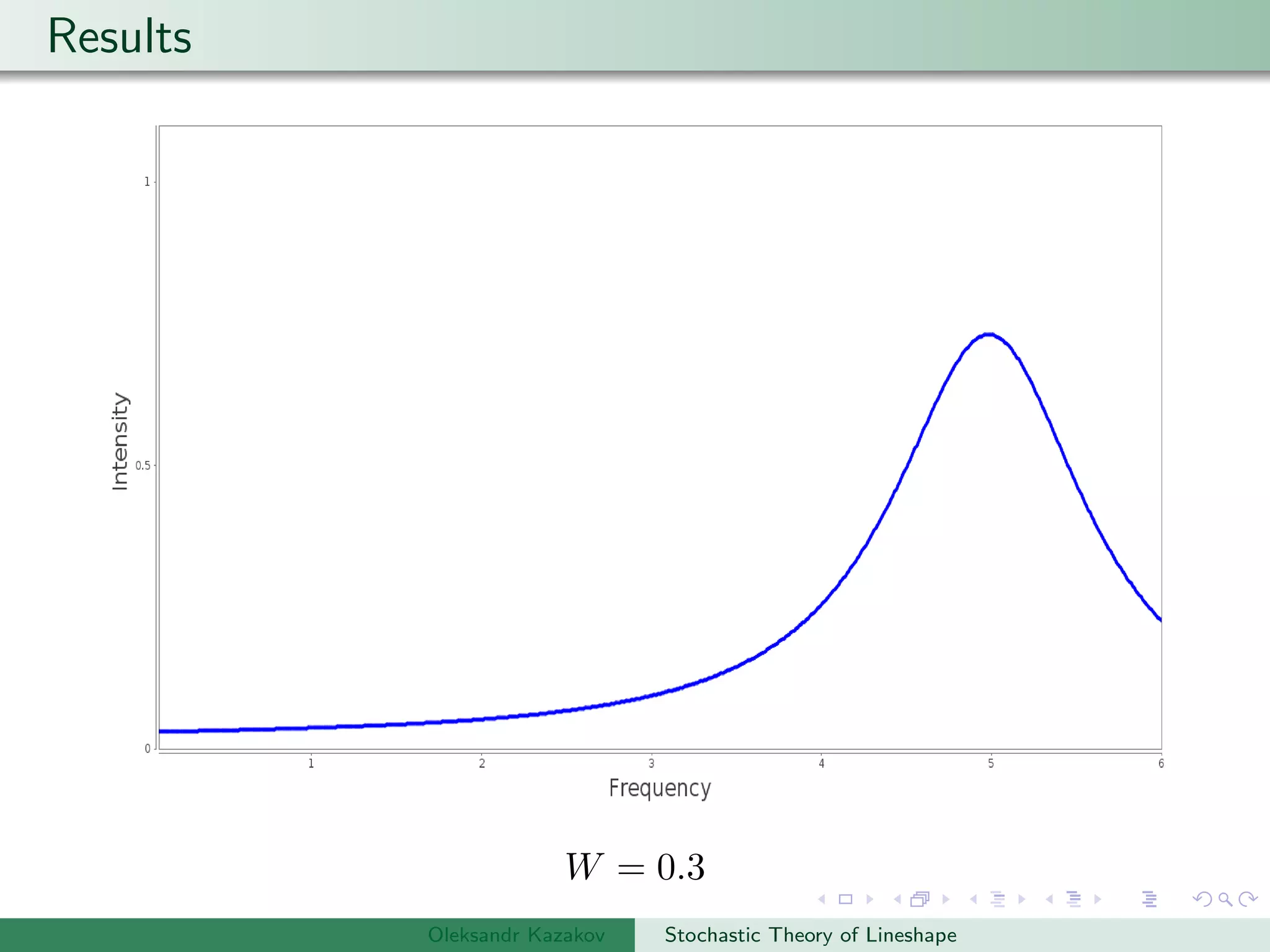
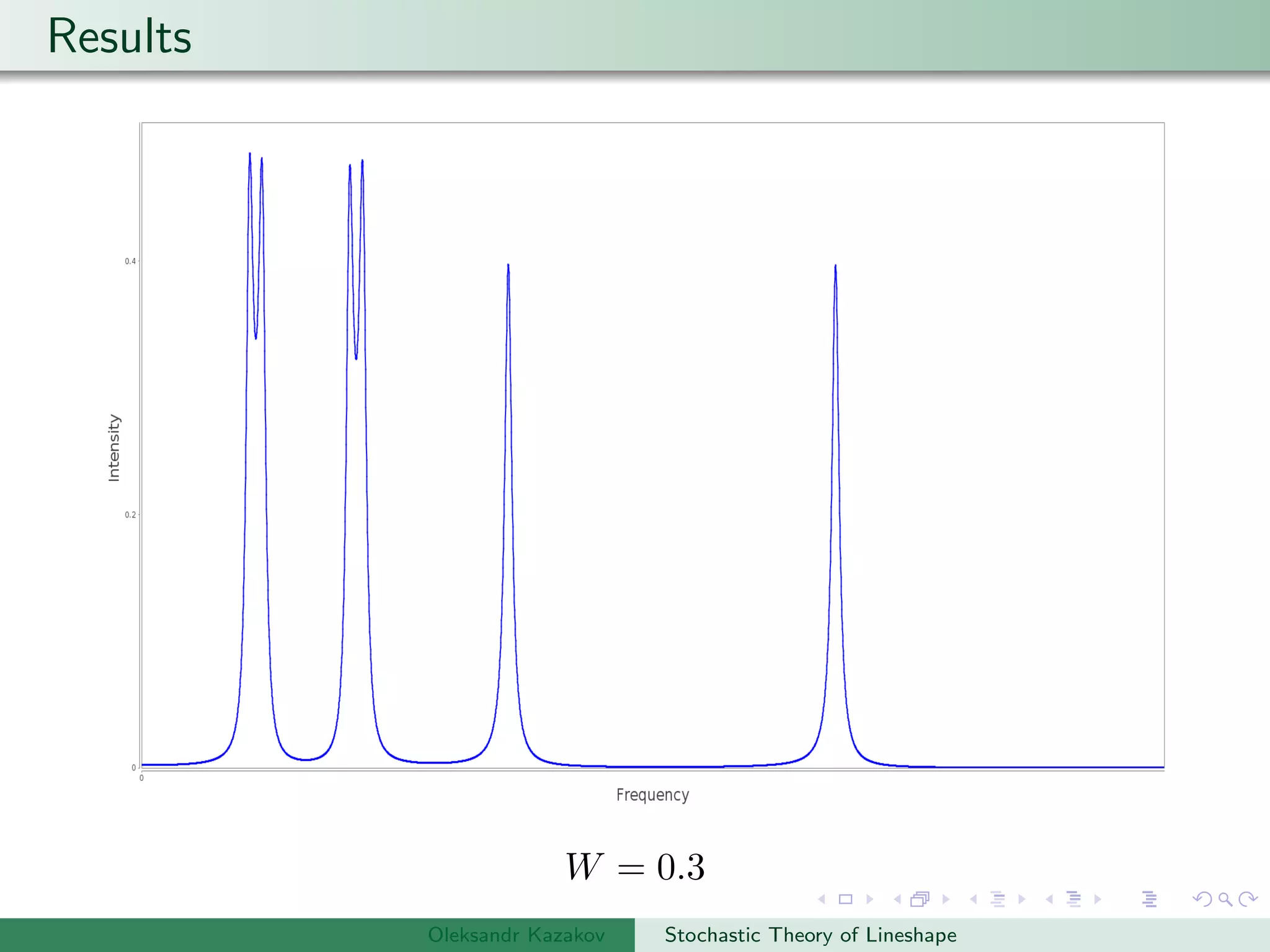
Results
W = 0.3
Oleksandr Kazakov Stochastic Theory of Lineshape
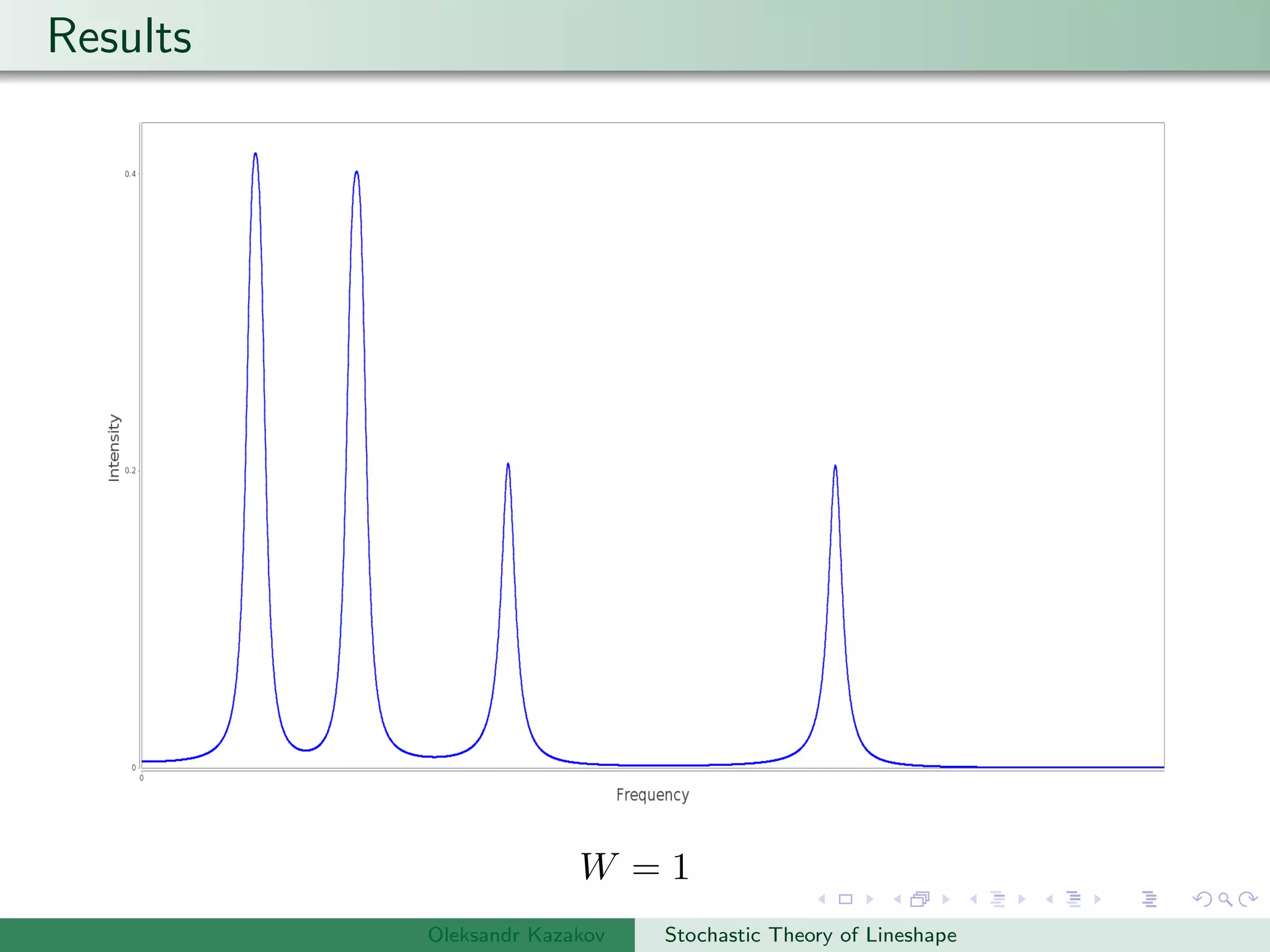
Results
W = 1
Oleksandr Kazakov Stochastic Theory of Lineshape
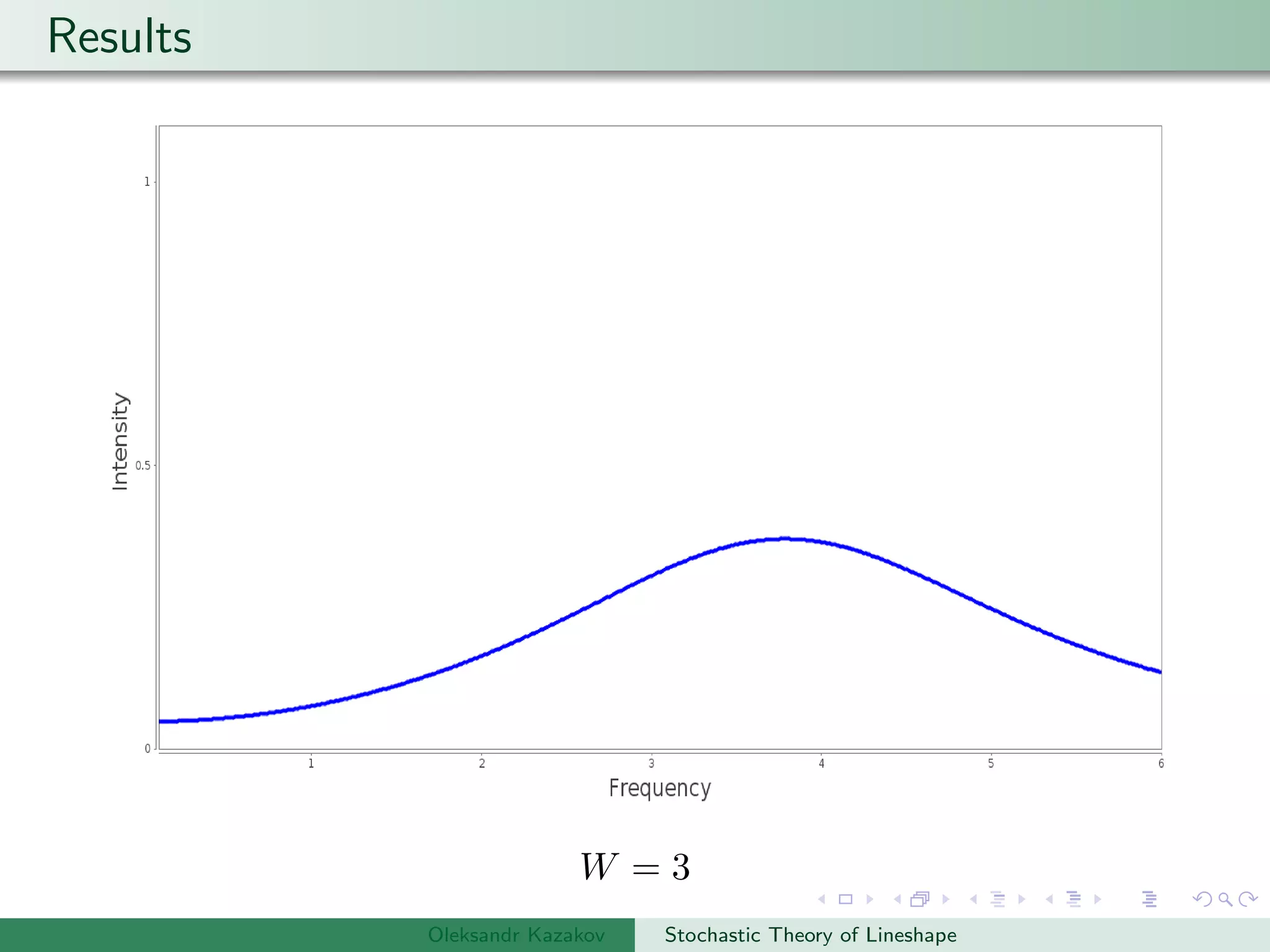
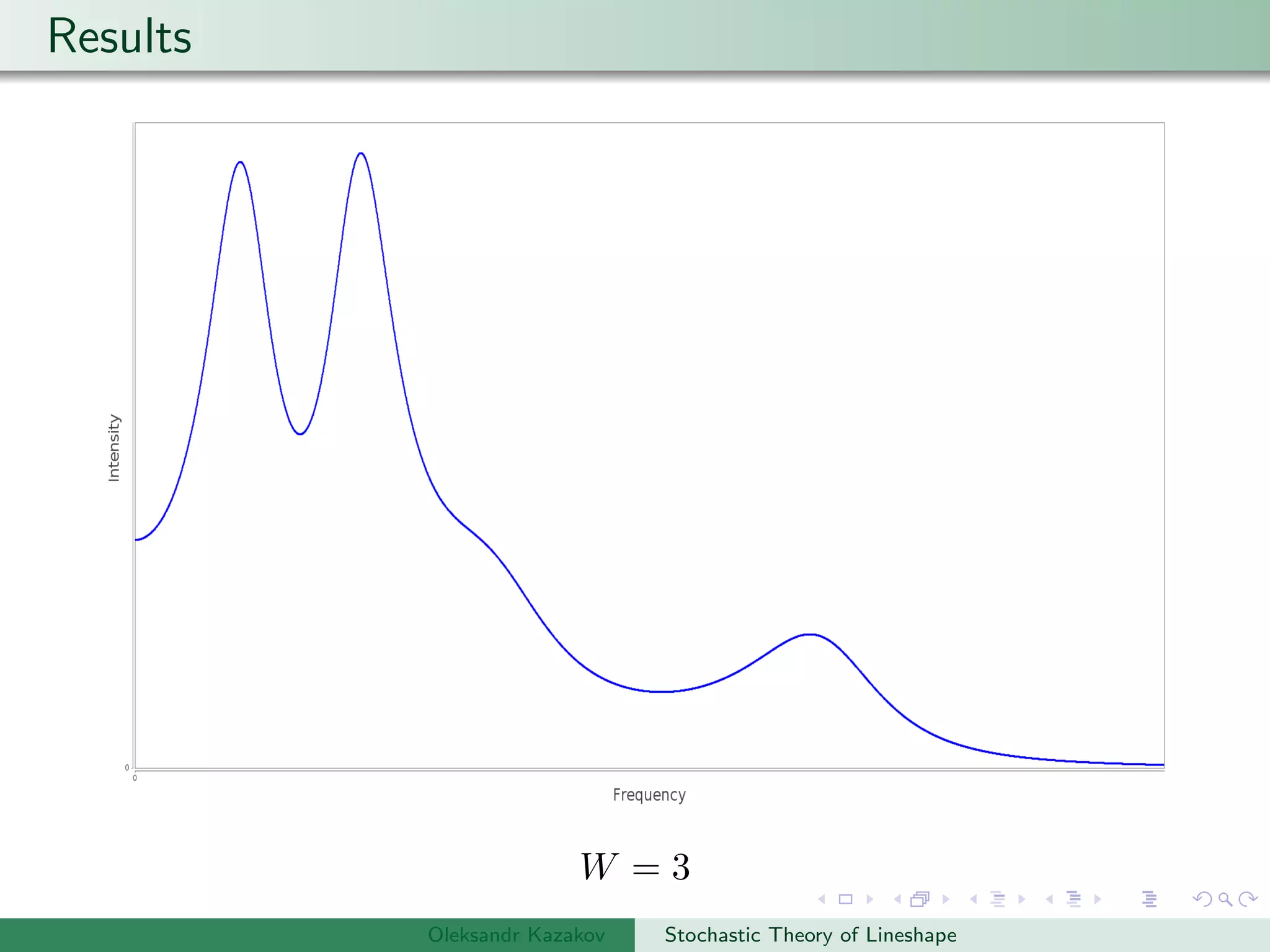
Results
W = 3
Oleksandr Kazakov Stochastic Theory of Lineshape
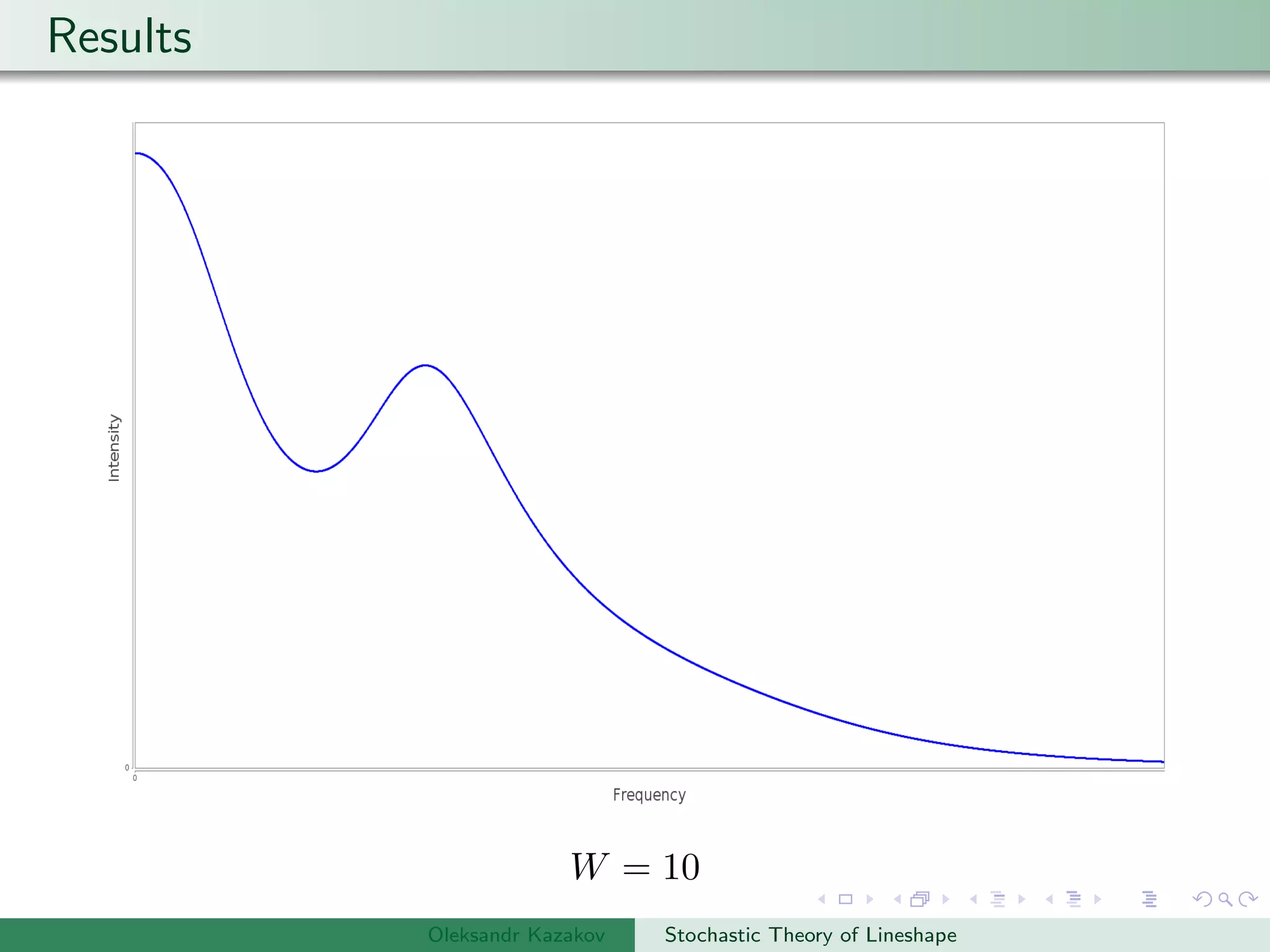
Results
W = 10
Oleksandr Kazakov Stochastic Theory of Lineshape
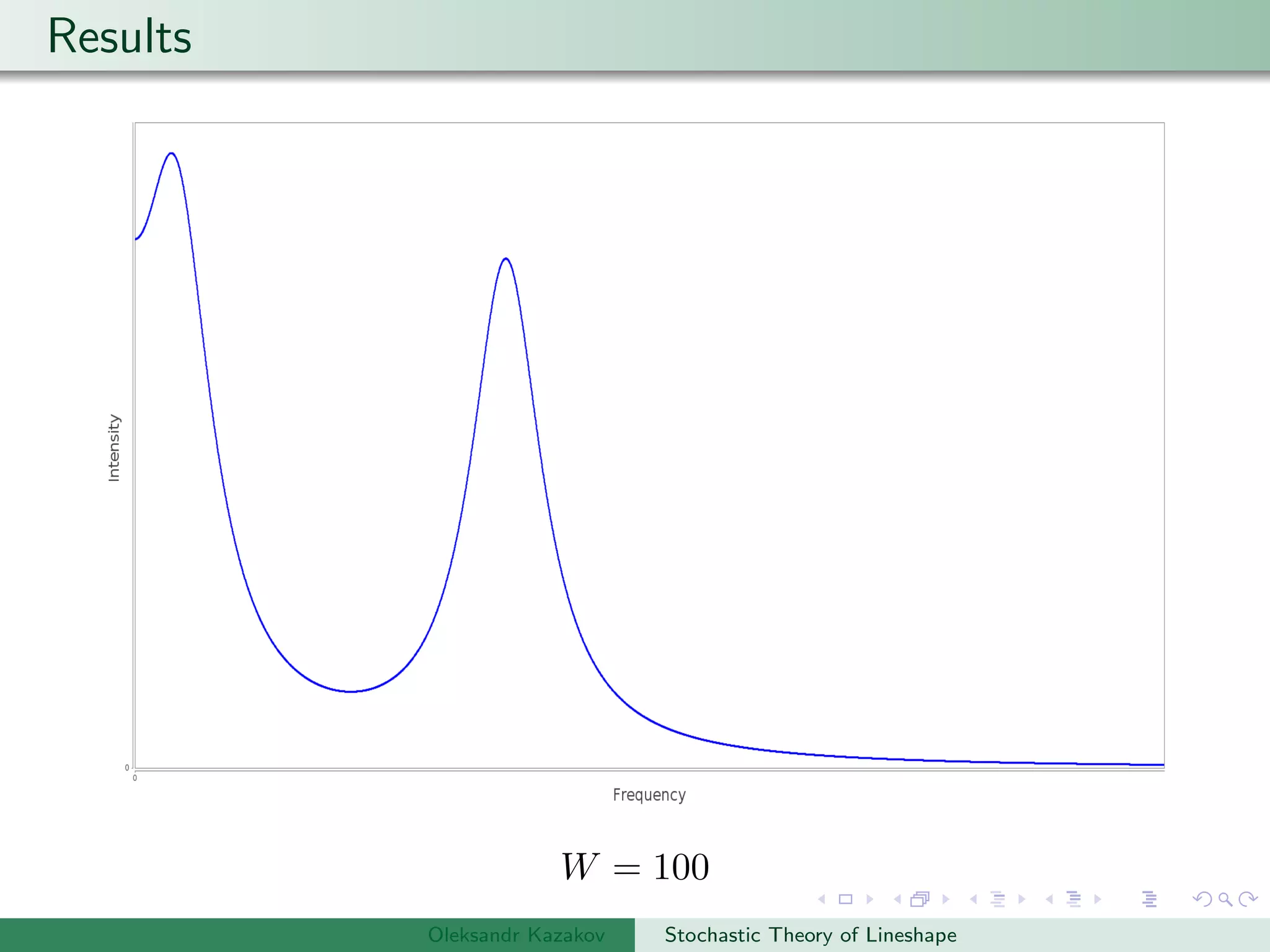
Results
W = 100
Oleksandr Kazakov Stochastic Theory of Lineshape
Results
NMR line shape for spin-1
2 nucleus in a fixed magnetic field
along z axis and fluctuating field along z axis
Oleksandr Kazakov Stochastic Theory of Lineshape
Results
W = 0.1
Oleksandr Kazakov Stochastic Theory of Lineshape
Results
W = 0.3
Oleksandr Kazakov Stochastic Theory of Lineshape
Results
W = 1
Oleksandr Kazakov Stochastic Theory of Lineshape
Results
W = 3
Oleksandr Kazakov Stochastic Theory of Lineshape
Results
W = 10
Oleksandr Kazakov Stochastic Theory of Lineshape
Results
W = 100
Oleksandr Kazakov Stochastic Theory of Lineshape
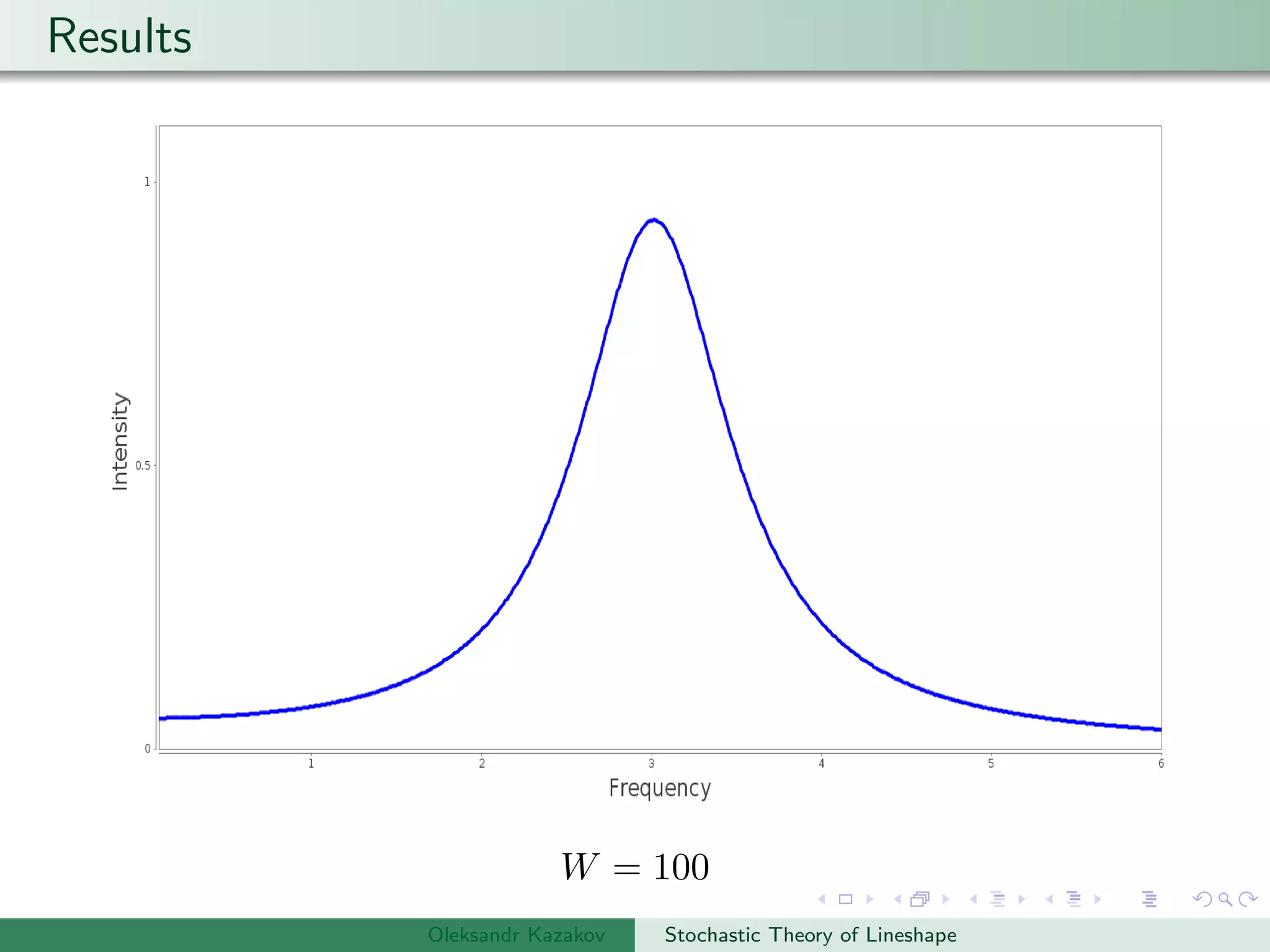
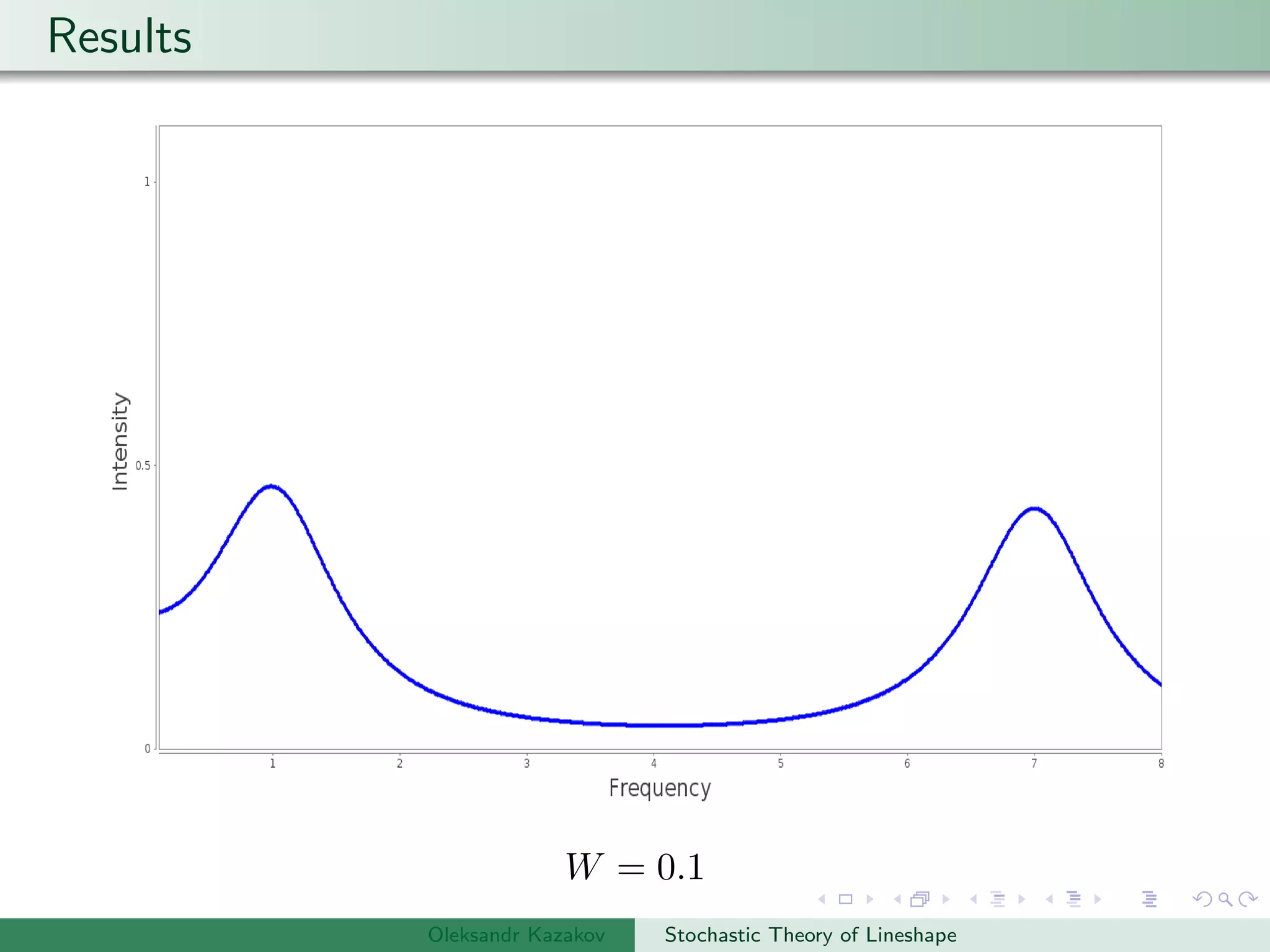
Results
NMR line shape for spin-1
2 nucleus in a fixed magnetic field
along z axis and fluctuating field along y axis. Jump rate
W = 0.1and100
Oleksandr Kazakov Stochastic Theory of Lineshape
Results
W = 0.1
Oleksandr Kazakov Stochastic Theory of Lineshape
Results
W = 1
Oleksandr Kazakov Stochastic Theory of Lineshape
Results
W = 1
Oleksandr Kazakov Stochastic Theory of Lineshape
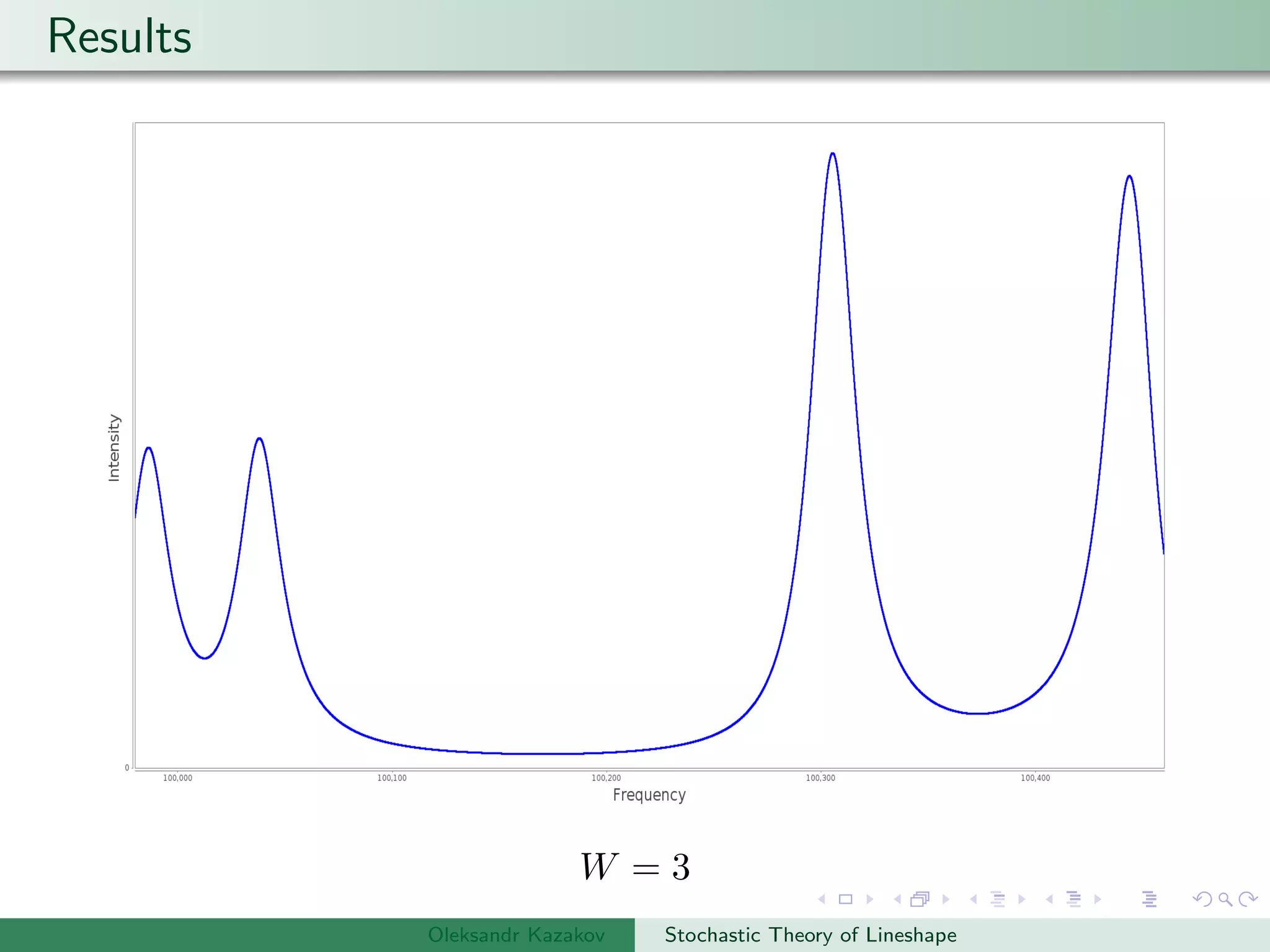
Results
W = 3
Oleksandr Kazakov Stochastic Theory of Lineshape
Results
W = 10
Oleksandr Kazakov Stochastic Theory of Lineshape
Results
W = 100
Oleksandr Kazakov Stochastic Theory of Lineshape
Plotting 3-D graphs using JZY3D OpenGL library
Figure: NMR line shape for spin- 1
2
nucleus in a fixed magnetic field along z axis and fluctuating field along z
axis. Frequency along x-axis, fluctuating field along y-axis and intensity along z-axis. Transition rateW = 0.1
Oleksandr Kazakov Stochastic Theory of Lineshape
ISTO Approach
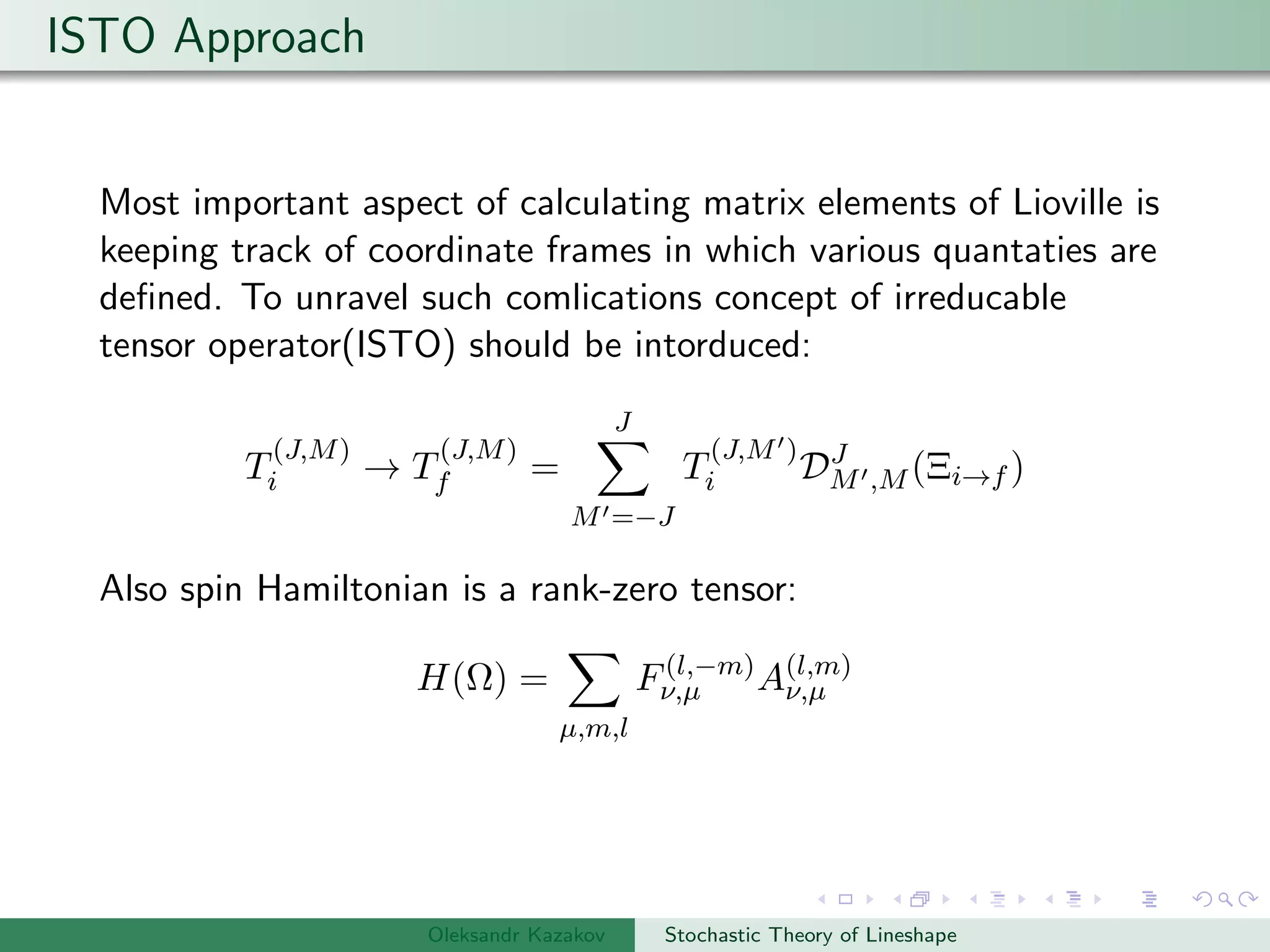
Most important aspect of calculating matrix elements of Lioville is
keeping track of coordinate frames in which various quantaties are
defined. To unravel such comlications concept of irreducable
tensor operator(ISTO) should be intorduced:
T
(J,M)
i → T
(J,M)
f =
J
M =−J
T
(J,M )
i DJ
M ,M (Ξi→f )
Also spin Hamiltonian is a rank-zero tensor:
H(Ω) =
µ,m,l
F(l,−m)
ν,µ A(l,m)
ν,µ
Oleksandr Kazakov Stochastic Theory of Lineshape
Zeeman Splitting
To account for the anisotropy of the Zeeman response to an
applied magnetic field, an effective Hamiltonian using a so-called g
tensor is used. Note that Hamiltonian has the following form:
Hzm = µBH · g · S
and thus Zeeman magnetic tensor and spin operators can be
written in principal axis frame as following:
F
[2](P)
±2(g) = −
1
2
βe(gxx − gyy) A
[2](P)
±2(g) = 0
F
[2](P)
±1(g) = 0 A
[2](P)
±1(g) = 0
F
[2](P)
0(g) = −
2
3
βe(gzz −
1
2
(gxx + gyy) A
[2](P)
0(g) = −
2
3
SzHz
F
[0](P)
0(g) =
1
√
3
(gxx + gyy + gzz A
[0](P)
0(g) =
1
√
3
)
Oleksandr Kazakov Stochastic Theory of Lineshape
Coordinate Frames Transformation
F
[l](L)
m(g) = (Dl
m,2(ΩL→P ) + Dl
m,−2(ΩL→P ))∗F
[2](P)
2(g) + (Dl
m,0(ΩL→P ))∗F
[2](P)
0(g)
F tensor components should satisfy identity:
(F
[l]
q )∗ = (−1)2+qF
[l]
−q
Oleksandr Kazakov Stochastic Theory of Lineshape
Coordinate Frames Transformation(Explicit)
F
[2],(L)
1(g) = −(F
[2],(L)
−1(g) )∗
= −e−iα
([sin(β)cos(β)cos(2γ) − isin(β)sin(2γ)]F
2(P)
2(g) −
3
2
sin(β)cos(β)F
2(P)
0(g) )
F
[2],(L)
0(g) =
3
2
sin2
(β)cos(2γ)F
2(P)
2(g) +
1
2
(3cos2
(β) − 1)F
2(P)
0(g)
F
[2],(L)
2(g) = (F
[2],(L)
−2(g) )∗
= ei2α
([
1 + cos2(β)
2
cos(2γ) + icos(β)sin(2γ)]F
2(P)
2(g) +
3
8
sin2
(β)F
2(P)
0(g) )
Oleksandr Kazakov Stochastic Theory of Lineshape
Zeeman Splitting
Now we all set to construct Hamiltonian where all quantities are
evaluated in the lab frame:
Hzm = A
[2]
0 F
[2]
0 + A
[0]
0 F
[0]
0
Oleksandr Kazakov Stochastic Theory of Lineshape
Abstracting from Blume simplified two-state model
Oleksandr Kazakov Stochastic Theory of Lineshape
Octahedron
Oleksandr Kazakov Stochastic Theory of Lineshape
Zeeman Splitting Lineshape
W = 0.1
Oleksandr Kazakov Stochastic Theory of Lineshape
Zeeman Splitting Lineshape
W = 0.5
Oleksandr Kazakov Stochastic Theory of Lineshape
Zeeman Splitting Lineshape
W = 1
Oleksandr Kazakov Stochastic Theory of Lineshape
Zeeman Splitting Lineshape
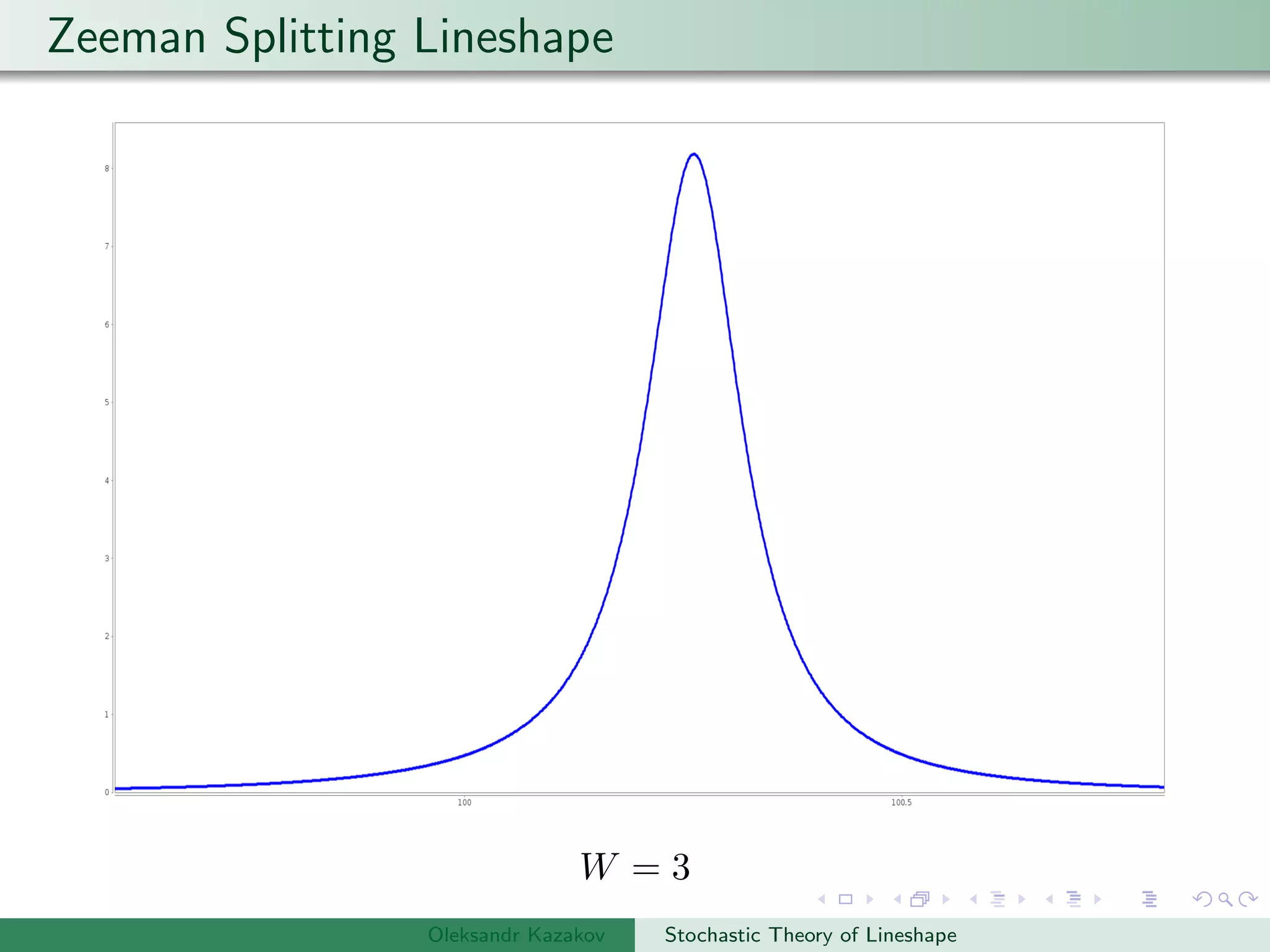
W = 3
Oleksandr Kazakov Stochastic Theory of Lineshape
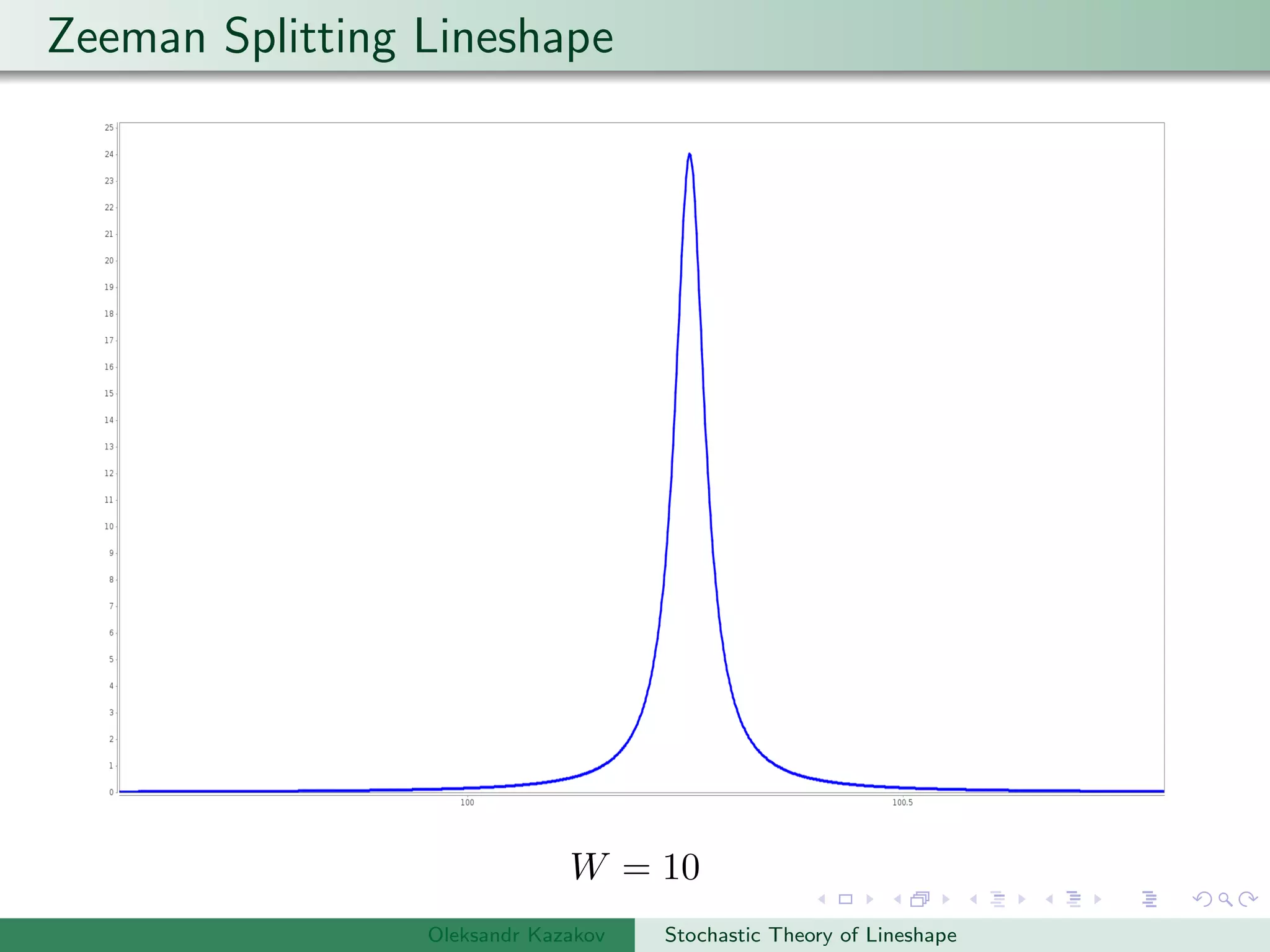
Zeeman Splitting Lineshape
W = 10
Oleksandr Kazakov Stochastic Theory of Lineshape
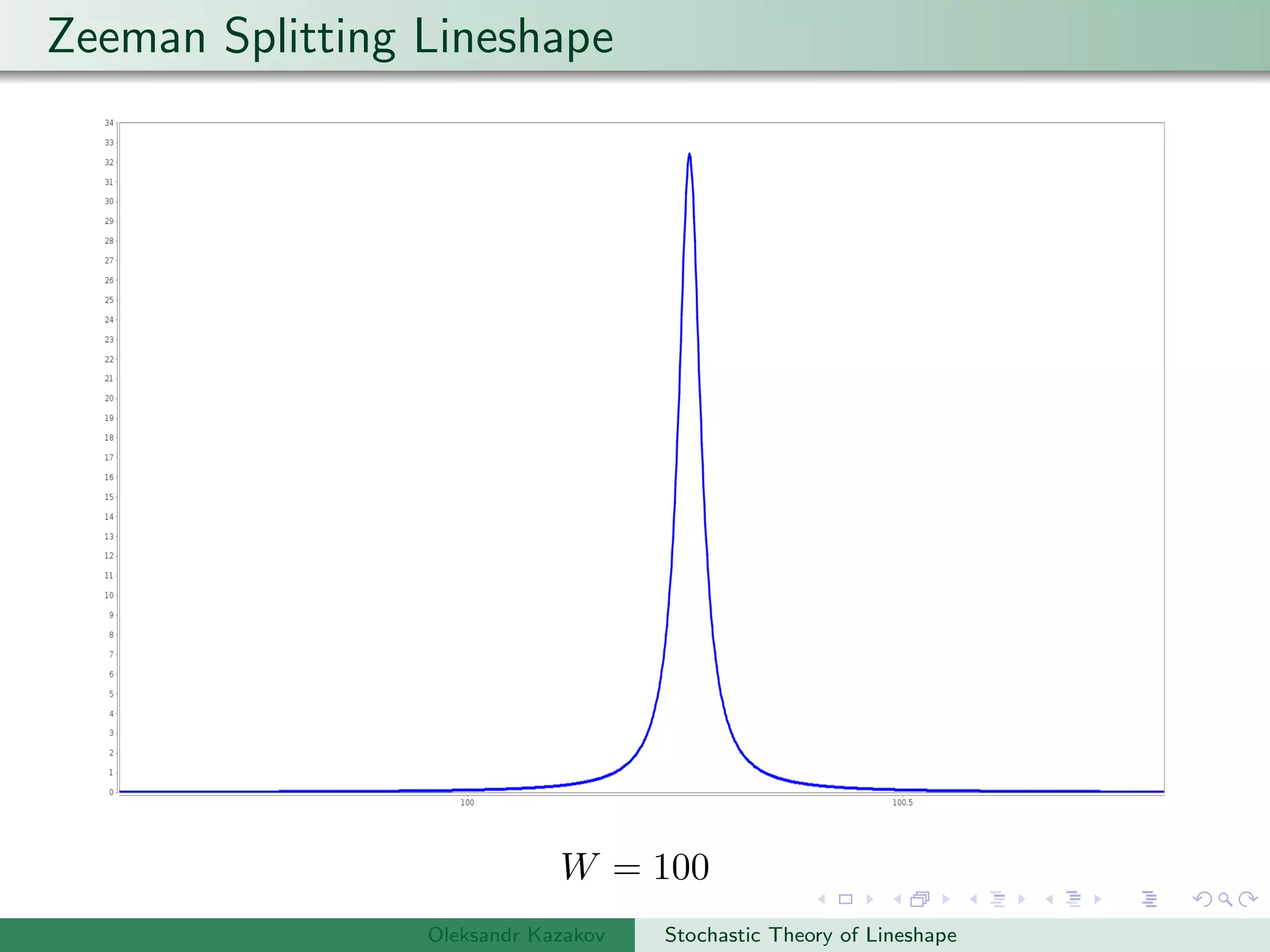
Zeeman Splitting Lineshape
W = 100
Oleksandr Kazakov Stochastic Theory of Lineshape
In EPR, it is important to consider hyperfine interaction between
the EPR active electron and neighboring nuclei. Most general
Hamiltonian has the following form:
Hhf = I · A · S
Hyperfine tensor
and spin operators can be written in principal axis frame as following:
F
[2](P)
±2(hf) = −
1
2
βe(Axx − Ayy) A
[2](P)
±2(hf) = −
1
2
S±I±
F
[2](P)
±1(hf) = 0 A
[2](P)
±1(hf) = ±
1
2
(S±Iz + SzI±)
F
[2](P)
0(hf) = −
2
3
βe(Azz −
1
2
(Axx + Ayy)) A
[2](P)
0(hf) = −
2
3
SzIz −
1
4
(S+I− + S−I+)
F
[0](P)
0(hf) =
1
√
3
(Axx + Ayy + Azz) A
[0](P)
0(hf) =
1
√
3
SzIz −
1
4
(S+I− + S−I+)
Oleksandr Kazakov Stochastic Theory of Lineshape
In the same manner as Zeeman Hamiltonian we can rewritte:
Hhf = A
[2]
0 F
[2]
0 + A
[0]
0 F
[0]
0 + A
[2]
1 (F
[2]
1 )∗
+ A
[2]
−1F
[2]
1
so generalizing:
Hres = Hzm + Hhf
Oleksandr Kazakov Stochastic Theory of Lineshape
Slides with both Hyperfine and Zeeman coupling S-I 1/2 at Low
Field(H=8)
Oleksandr Kazakov Stochastic Theory of Lineshape
Results
W = 0.1
Oleksandr Kazakov Stochastic Theory of Lineshape
Results
W = 0.3
Oleksandr Kazakov Stochastic Theory of Lineshape
Results
W = 1
Oleksandr Kazakov Stochastic Theory of Lineshape
Results
W = 3
Oleksandr Kazakov Stochastic Theory of Lineshape
Results
W = 10
Oleksandr Kazakov Stochastic Theory of Lineshape
Results
W = 100
Oleksandr Kazakov Stochastic Theory of Lineshape
Slides with both Hyperfine and Zeeman coupling S(1/2)-I(1/2) at
high field.H = 12 · 103
Oleksandr Kazakov Stochastic Theory of Lineshape
Results
W = 0.1
Oleksandr Kazakov Stochastic Theory of Lineshape
Results
W = 0.3
Oleksandr Kazakov Stochastic Theory of Lineshape
Results
W = 1
Oleksandr Kazakov Stochastic Theory of Lineshape
Results
W = 3
Oleksandr Kazakov Stochastic Theory of Lineshape
Results
W = 10
Oleksandr Kazakov Stochastic Theory of Lineshape
Results
W = 100
Oleksandr Kazakov Stochastic Theory of Lineshape
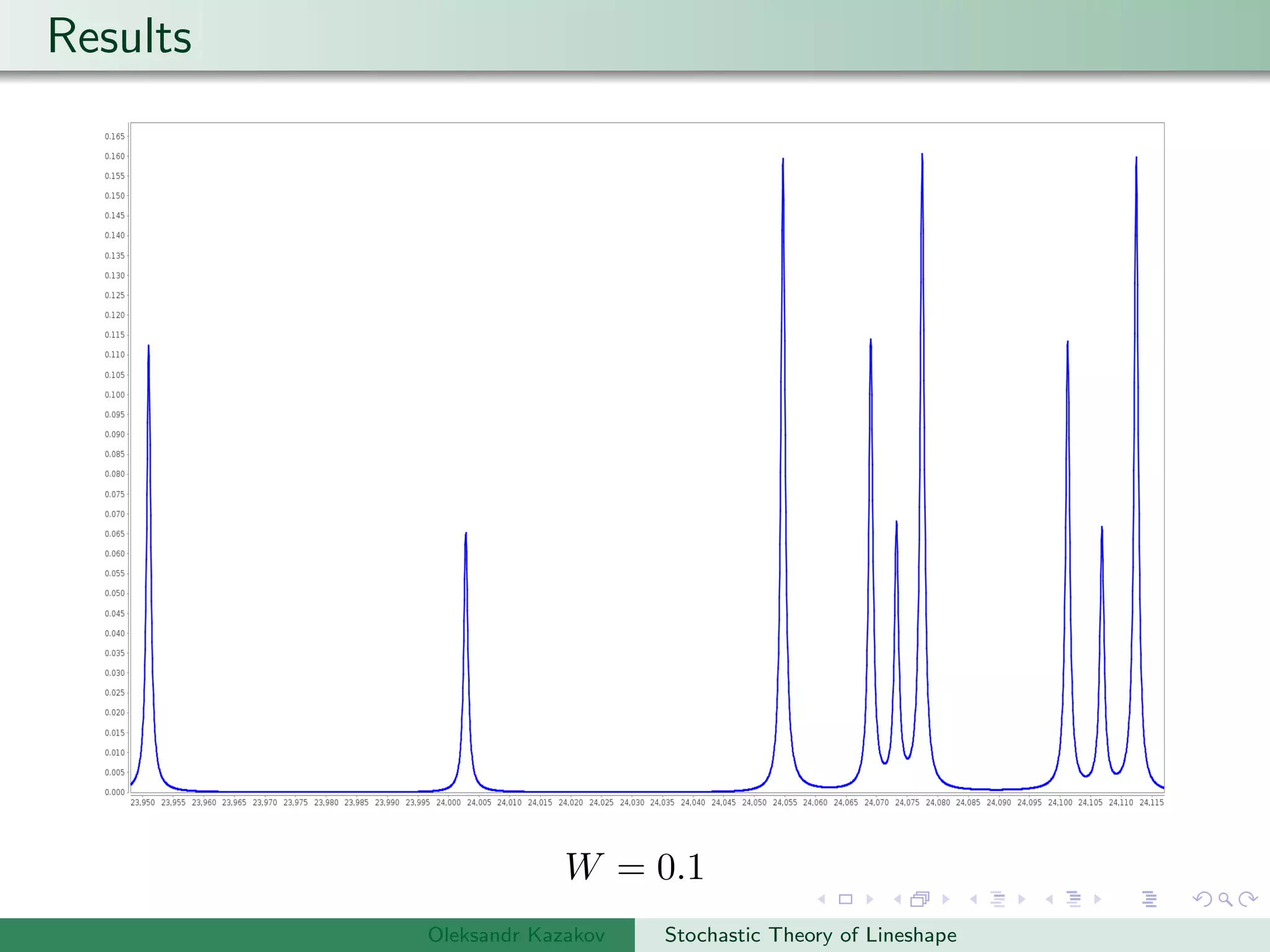
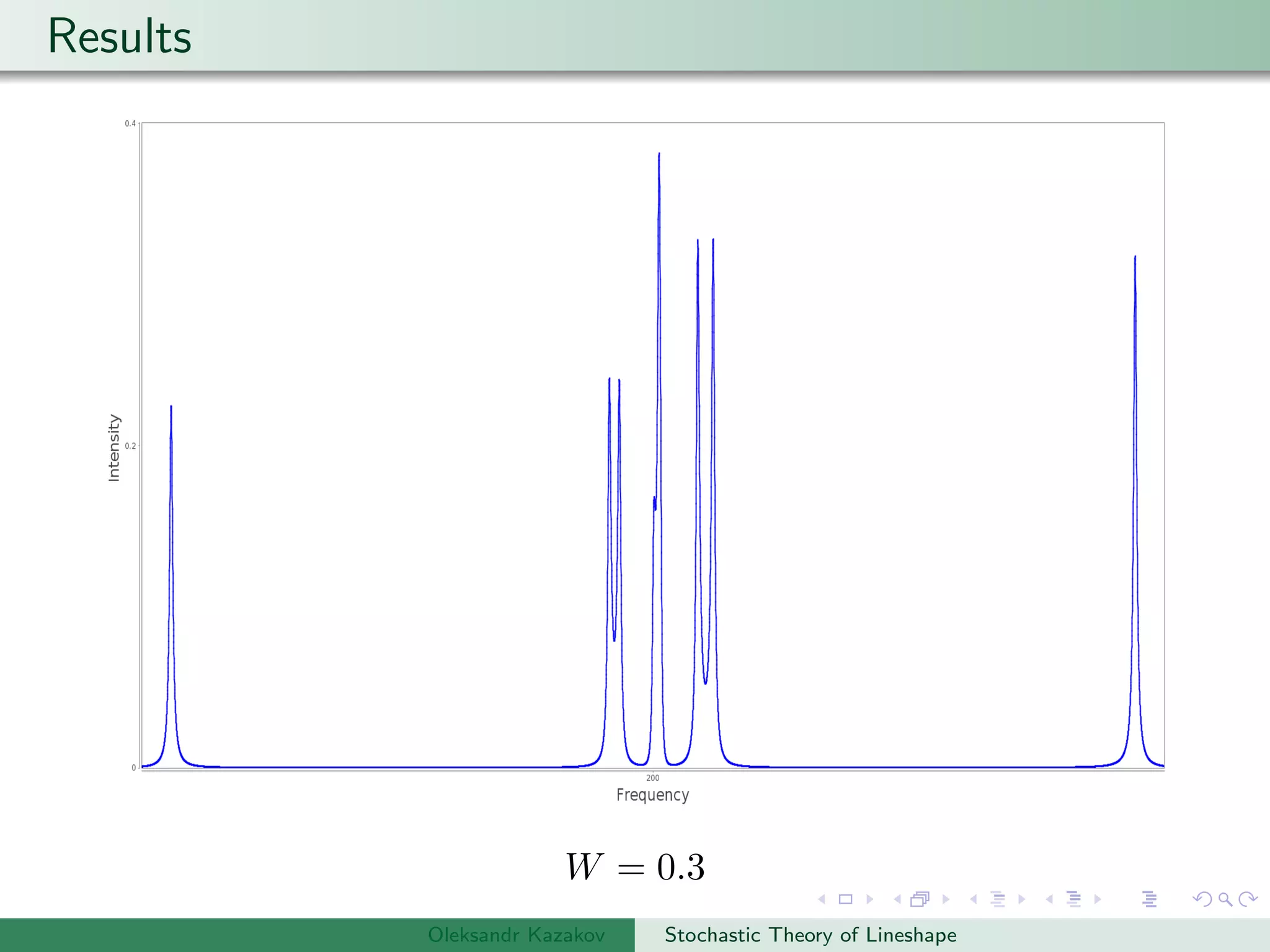
Hyperfine and Zeeman splitting for spins S(1/2)-I(1) coupling
Oleksandr Kazakov Stochastic Theory of Lineshape
Results
W = 0.1
Oleksandr Kazakov Stochastic Theory of Lineshape
Results
W = 0.3
Oleksandr Kazakov Stochastic Theory of Lineshape
Results
W = 1
Oleksandr Kazakov Stochastic Theory of Lineshape
Results
W = 3
Oleksandr Kazakov Stochastic Theory of Lineshape
Results
W = 10
Oleksandr Kazakov Stochastic Theory of Lineshape
Results
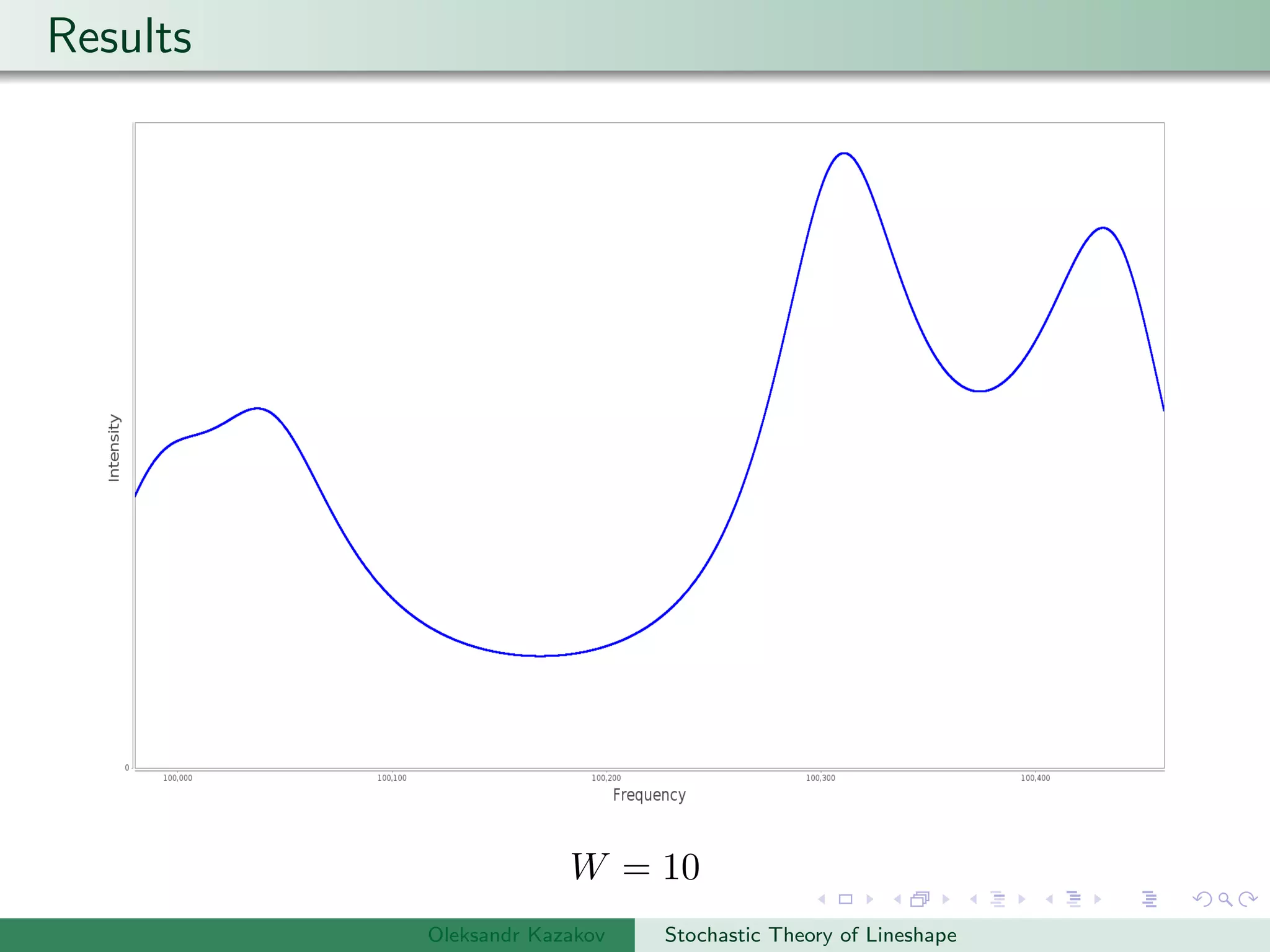
W = 0.1, H = 100
Oleksandr Kazakov Stochastic Theory of Lineshape
Results
W = 0.3
Oleksandr Kazakov Stochastic Theory of Lineshape
Results
W = 1
Oleksandr Kazakov Stochastic Theory of Lineshape
Results
W = 3
Oleksandr Kazakov Stochastic Theory of Lineshape
Results
W = 10
Oleksandr Kazakov Stochastic Theory of Lineshape
Results
W = 0.01, H = 2 · 105
Oleksandr Kazakov Stochastic Theory of Lineshape
Conclusion:
Algorithm for populating and inverting stochastic luneshape
have been developed and succesfully tested.
Developed algorithm is universal not only to stochastic indices
but spin values can be varied as well.
Ongoing Work:
Efficiency of the computationg have to be boosted and
currently code have been transferred to the Matlab.
Extending possible number of stochastic and quantum states
for coupled S − I spins.
Oleksandr Kazakov Stochastic Theory of Lineshape

Oral Exam Slides

  • 1.
    Stochastic Theory ofLineshape Oleksandr Kazakov January 28, 2015 Oleksandr Kazakov Stochastic Theory of Lineshape
  • 2.
    Outline 1 Treatment ofmotional and exchange narrowing in magnetic resonance. 2 Algorithm approach on assignment and inversion of Liouville Matrix. 3 STOL Ver. 1.0 for simulating stochastic lineshapes. Oleksandr Kazakov Stochastic Theory of Lineshape
  • 3.
    Outline 1 Treatment ofmotional and exchange narrowing in magnetic resonance. 2 Algorithm approach on assignment and inversion of Liouville Matrix. 3 STOL Ver. 1.0 for simulating stochastic lineshapes. Oleksandr Kazakov Stochastic Theory of Lineshape
  • 4.
    Outline 1 Treatment ofmotional and exchange narrowing in magnetic resonance. 2 Algorithm approach on assignment and inversion of Liouville Matrix. 3 STOL Ver. 1.0 for simulating stochastic lineshapes. Oleksandr Kazakov Stochastic Theory of Lineshape
  • 5.
    Theory Overview Hamiltonian fora nucleus in a randomly varying magnetic field h(x, y, z): H(t) = γh · If(t) (1) Oleksandr Kazakov Stochastic Theory of Lineshape
  • 6.
    Theory Overview Hamiltonian fora nucleus in a randomly varying magnetic field h(x, y, z): H(t) = γh · If(t) (1) What will happen if we add a fixed magnetic field H0 along positive x? H(t) = γH0Iz + γh · If(t) (2) Oleksandr Kazakov Stochastic Theory of Lineshape
  • 7.
    Theory Overview Hamiltonian fora nucleus in a randomly varying magnetic field h(x, y, z): H(t) = γh · If(t) (1) What will happen if we add a fixed magnetic field H0 along positive x? H(t) = γH0Iz + γh · If(t) (2) [H(t), H(t) ] = 0 Oleksandr Kazakov Stochastic Theory of Lineshape
  • 8.
    Theory Overview Probability ofthe emission of a photon with wave vector k and frequency ω by the system from state |λ to its final state |α : Pλα(k) = | α|H(+)|λ |2 (ω + Eα − Eλ)2 + 1 4Γ2 (3) Oleksandr Kazakov Stochastic Theory of Lineshape
  • 9.
    Theory Overview Pλα(k) = 2 Γ Re ∞ 0 exp(iωt− 1 2 tΓ) λ|H(−) |α α|U† (t)H(+) U(t)|λ ) dt (4) Where U(t) = exp(−iHt) and H(−) = H(+)† Oleksandr Kazakov Stochastic Theory of Lineshape
  • 10.
    Theory Overview P(k) = λα pλPλα(k)= 2 Γ Re ∞ 0 exp(iωt − 1 2 tΓ)( H(−) H(+) (t) )av dt (5) Oleksandr Kazakov Stochastic Theory of Lineshape
  • 11.
    Theory Overview Blume developeda solution for the lineshape: P(w) = 2 Γ(2I0 + 1) m1m0,m1 m0 I1m1|H(−) |I0m0 ab pa I0m0I1m1a|L−1 |I0m0m1b I0m0|H(+) |I1m1 (6) Oleksandr Kazakov Stochastic Theory of Lineshape
  • 12.
    Theory Overview Propogator hasa following form (s = iω): L = s1 − W − i j V × j Fj (7) Oleksandr Kazakov Stochastic Theory of Lineshape
  • 13.
    Theory Overview Propogator hasa following form (s = iω): L = s1 − W − i j V × j Fj (7) L = s1 − W − i j (Vj ⊗ Fj − Fj ⊗ Vj) (8) Oleksandr Kazakov Stochastic Theory of Lineshape
  • 14.
    Theory Overview For easierimplementation we can also rewritte as: P(s) = 2 Γ(2I0 + 1) H(−) δm1m0 H(+) δm0m1 [sδabδm1m1 δm0m0 − (a|W|b)δm0m0 δm1m1 − i(a|F|a)δab[ I0m0|Vj|I0m0 δm0m0 − I1m1|Vj|I1m1 δm1m1 ]−1 (9) Oleksandr Kazakov Stochastic Theory of Lineshape
  • 15.
    Problem Algorithm to generatearrays values and perform where index i and j for Ai,j are composed of 3 subindices A(m0,m1,a),(m0,m1,b) in a simplest case having only nuclear spin. Ai,j = A(m0S,m1S,m0I ,m1I ,a),(m0S,m1S,m0I ,m1I ,b) = [sδabδm1m1 δm0m0 − (a|W|b)δm0m0 δm1m1 − i(a|F|a)δab[ I0m0|Vj|I0m0 δm0m0 − I1m1|Vj|I1m1 δm1m1 ]−1 (10) It is possible to do assignment of Liouville Matrix by hand up to size 8 × 8 but what if its size expands to 256 × 256 or 1 · 106 × 1 · 106? Oleksandr Kazakov Stochastic Theory of Lineshape
  • 16.
    Where to go? 1Matlab Multidimensional arrays(N-D) implementation appeared in recent Matlab 2014b 2 Java Supports Multidimensional arrays implementation since 1995 Oleksandr Kazakov Stochastic Theory of Lineshape
  • 17.
    Where to go? 1Matlab Multidimensional arrays(N-D) implementation appeared in recent Matlab 2014b 2 Java Supports Multidimensional arrays implementation since 1995 Oleksandr Kazakov Stochastic Theory of Lineshape
  • 18.
    Oleksandr Kazakov StochasticTheory of Lineshape
  • 19.
    Algorithm Development inStages Generate 6-D array: A[a][b][m0][m1][m0][m1] Oleksandr Kazakov Stochastic Theory of Lineshape
  • 20.
    Algorithm Development inStages Generate 6-D array: A[a][b][m0][m1][m0][m1] Cast 6-D array into 2-D: A[a][b][m0][m1][m0][m1] → A [i][j] Oleksandr Kazakov Stochastic Theory of Lineshape
  • 21.
    Algorithm Development inStages Generate 6-D array: A[a][b][m0][m1][m0][m1] Cast 6-D array into 2-D: A[a][b][m0][m1][m0][m1] → A [i][j] Perform 2-D array inversion: A [i][j] = A [i][j]−1 Oleksandr Kazakov Stochastic Theory of Lineshape
  • 22.
    Algorithm Development inStages Generate 6-D array: A[a][b][m0][m1][m0][m1] Cast 6-D array into 2-D: A[a][b][m0][m1][m0][m1] → A [i][j] Perform 2-D array inversion: A [i][j] = A [i][j]−1 Cast 2-D array back into 6-D array: A [i][j] → A[a][b][m0][m1][m0][m1] Oleksandr Kazakov Stochastic Theory of Lineshape
  • 23.
    Algorithm Development inStages Generate 6-D array: A[a][b][m0][m1][m0][m1] Cast 6-D array into 2-D: A[a][b][m0][m1][m0][m1] → A [i][j] Perform 2-D array inversion: A [i][j] = A [i][j]−1 Cast 2-D array back into 6-D array: A [i][j] → A[a][b][m0][m1][m0][m1] Go back to the equation 6 and do the summation. Oleksandr Kazakov Stochastic Theory of Lineshape
  • 24.
    Algorithm Development inStages Generate 6-D array: A[a][b][m0][m1][m0][m1] Cast 6-D array into 2-D: A[a][b][m0][m1][m0][m1] → A [i][j] Perform 2-D array inversion: A [i][j] = A [i][j]−1 Cast 2-D array back into 6-D array: A [i][j] → A[a][b][m0][m1][m0][m1] Go back to the equation 6 and do the summation. Plot the results. Oleksandr Kazakov Stochastic Theory of Lineshape
  • 25.
    Encoding Table Example Asimple example of encription of 6 different combinations between 3 indecies that are used to cast back 6-D array from 2-D(A[a][:][m0][m1][:][:] → A [i][:]). a, m0, m1 Output Count 1, 1/2, 1/2 → 000 1 1, −1/2, 1/2 → 010 2 1, 1/2, −1/2 → 001 3 2, 1/2, 1/2 → 100 4 2, 1/2, 1/2 → 101 5 2, −1/2, −1/2 → 111 6 Oleksandr Kazakov Stochastic Theory of Lineshape
  • 26.
    Code Sample Java Methodto store reference for the elements of 6-D array after converting into 2-D array. Elements being converted and saved into string format. public static String[] genind(int m_0,int m_1, int a1 ){ int x=1; String Y[] = new String[max]; for(int k=0;k<m_0;k++){ for(int l=0;l<m_1;l++){ for(int a=0;a<a1;a++){ Y[x-1]=String.format("%03d",a+10*k+100*l); x++; } } } return Y; } Oleksandr Kazakov Stochastic Theory of Lineshape
  • 27.
    Code Sample Casting 6-Darray into 2-D: for(int k=0; k<m_0;k++){ for(int l=0; l<m_1; l++){ for(int m=0; m<m_01; m++){ for(int n=0;n<m_11; n++){ for(int a=0; a<a1; a++){ for(int b=0; b<b1;b++){ tr[index(k,l,a,Y)][index(m,n,b,Y)]=matrix[a][b][k][l][m][n]; } } } } } } return tr; } Oleksandr Kazakov Stochastic Theory of Lineshape
  • 28.
    Code Sample Converting from2-D array back to 6-D array: public static Object[][][][][][] matrixturn(Complex tr[][], String Y[]){ for(int k=0; k<max;k++){ for(int l=0; l<max; l++){ hn[a1indback(k,Y)][b1indback(l,Y)][m0indback(k,Y)]... [m1indback(k,Y)][m01indback(l,Y)][m11indback(l,Y)]=tr[k][l]; } } return hamatrixnew; } Oleksandr Kazakov Stochastic Theory of Lineshape
  • 29.
    Code Sample Method forthe extraction of element reference in 2-D array to that in 6-D: public static int m0indexback( int k, String Y[]){ int m0=0; int f=Integer.parseInt(Y[k]); m0=(int) Math.floor((f/100)); return m0; } public static int m1indexback( int k,String Y[]){ int m1=0; int ff=Integer.parseInt(Y[k]); m1=(int) Math.floor((ff-Math.floor(ff/100)*100)/10); return m1; } Oleksandr Kazakov Stochastic Theory of Lineshape
  • 30.
    Code Sample Method forthe extraction of element reference in 2-D array to that in 6-D to perform summation: public static int a1indexback(int k,String Y[]){ int fff=Integer.parseInt(Y[k]); int a1=0; a1= (int) (Math.floor(fff-Math.floor(fff/100)*100)-... Math.floor((fff-Math.floor(fff/100)*100)/10)*10); return a1; } Oleksandr Kazakov Stochastic Theory of Lineshape
  • 31.
    Oleksandr Kazakov StochasticTheory of Lineshape
  • 32.
    Results To illustrate thatalgorithm works Nuclear Zeeman Hamiltonian was introduced of the form: H = HIz + h · If(t) (11) Where fixed magnetic field set along z−direction Oleksandr Kazakov Stochastic Theory of Lineshape
  • 33.
    Results NMR line shapefor spin-1 2 nucleus in a fixed magnetic field along z axis and fluctuating field along x axis Oleksandr Kazakov Stochastic Theory of Lineshape
  • 34.
    Results W = 0.1 OleksandrKazakov Stochastic Theory of Lineshape
  • 35.
    Results W = 0.3 OleksandrKazakov Stochastic Theory of Lineshape
  • 36.
    Results W = 1 OleksandrKazakov Stochastic Theory of Lineshape
  • 37.
    Results W = 3 OleksandrKazakov Stochastic Theory of Lineshape
  • 38.
    Results W = 10 OleksandrKazakov Stochastic Theory of Lineshape
  • 39.
    Results W = 100 OleksandrKazakov Stochastic Theory of Lineshape
  • 40.
    Results NMR line shapefor spin-1 2 nucleus in a fixed magnetic field along z axis and fluctuating field along z axis Oleksandr Kazakov Stochastic Theory of Lineshape
  • 41.
    Results W = 0.1 OleksandrKazakov Stochastic Theory of Lineshape
  • 42.
    Results W = 0.3 OleksandrKazakov Stochastic Theory of Lineshape
  • 43.
    Results W = 1 OleksandrKazakov Stochastic Theory of Lineshape
  • 44.
    Results W = 3 OleksandrKazakov Stochastic Theory of Lineshape
  • 45.
    Results W = 10 OleksandrKazakov Stochastic Theory of Lineshape
  • 46.
    Results W = 100 OleksandrKazakov Stochastic Theory of Lineshape
  • 47.
    Results NMR line shapefor spin-1 2 nucleus in a fixed magnetic field along z axis and fluctuating field along y axis. Jump rate W = 0.1and100 Oleksandr Kazakov Stochastic Theory of Lineshape
  • 48.
    Results W = 0.1 OleksandrKazakov Stochastic Theory of Lineshape
  • 49.
    Results W = 1 OleksandrKazakov Stochastic Theory of Lineshape
  • 50.
    Results W = 1 OleksandrKazakov Stochastic Theory of Lineshape
  • 51.
    Results W = 3 OleksandrKazakov Stochastic Theory of Lineshape
  • 52.
    Results W = 10 OleksandrKazakov Stochastic Theory of Lineshape
  • 53.
    Results W = 100 OleksandrKazakov Stochastic Theory of Lineshape
  • 54.
    Oleksandr Kazakov StochasticTheory of Lineshape
  • 55.
    Plotting 3-D graphsusing JZY3D OpenGL library Figure: NMR line shape for spin- 1 2 nucleus in a fixed magnetic field along z axis and fluctuating field along z axis. Frequency along x-axis, fluctuating field along y-axis and intensity along z-axis. Transition rateW = 0.1 Oleksandr Kazakov Stochastic Theory of Lineshape
  • 56.
    ISTO Approach Most importantaspect of calculating matrix elements of Lioville is keeping track of coordinate frames in which various quantaties are defined. To unravel such comlications concept of irreducable tensor operator(ISTO) should be intorduced: T (J,M) i → T (J,M) f = J M =−J T (J,M ) i DJ M ,M (Ξi→f ) Also spin Hamiltonian is a rank-zero tensor: H(Ω) = µ,m,l F(l,−m) ν,µ A(l,m) ν,µ Oleksandr Kazakov Stochastic Theory of Lineshape
  • 57.
    Zeeman Splitting To accountfor the anisotropy of the Zeeman response to an applied magnetic field, an effective Hamiltonian using a so-called g tensor is used. Note that Hamiltonian has the following form: Hzm = µBH · g · S and thus Zeeman magnetic tensor and spin operators can be written in principal axis frame as following: F [2](P) ±2(g) = − 1 2 βe(gxx − gyy) A [2](P) ±2(g) = 0 F [2](P) ±1(g) = 0 A [2](P) ±1(g) = 0 F [2](P) 0(g) = − 2 3 βe(gzz − 1 2 (gxx + gyy) A [2](P) 0(g) = − 2 3 SzHz F [0](P) 0(g) = 1 √ 3 (gxx + gyy + gzz A [0](P) 0(g) = 1 √ 3 ) Oleksandr Kazakov Stochastic Theory of Lineshape
  • 58.
    Coordinate Frames Transformation F [l](L) m(g)= (Dl m,2(ΩL→P ) + Dl m,−2(ΩL→P ))∗F [2](P) 2(g) + (Dl m,0(ΩL→P ))∗F [2](P) 0(g) F tensor components should satisfy identity: (F [l] q )∗ = (−1)2+qF [l] −q Oleksandr Kazakov Stochastic Theory of Lineshape
  • 59.
    Coordinate Frames Transformation(Explicit) F [2],(L) 1(g)= −(F [2],(L) −1(g) )∗ = −e−iα ([sin(β)cos(β)cos(2γ) − isin(β)sin(2γ)]F 2(P) 2(g) − 3 2 sin(β)cos(β)F 2(P) 0(g) ) F [2],(L) 0(g) = 3 2 sin2 (β)cos(2γ)F 2(P) 2(g) + 1 2 (3cos2 (β) − 1)F 2(P) 0(g) F [2],(L) 2(g) = (F [2],(L) −2(g) )∗ = ei2α ([ 1 + cos2(β) 2 cos(2γ) + icos(β)sin(2γ)]F 2(P) 2(g) + 3 8 sin2 (β)F 2(P) 0(g) ) Oleksandr Kazakov Stochastic Theory of Lineshape
  • 60.
    Zeeman Splitting Now weall set to construct Hamiltonian where all quantities are evaluated in the lab frame: Hzm = A [2] 0 F [2] 0 + A [0] 0 F [0] 0 Oleksandr Kazakov Stochastic Theory of Lineshape
  • 61.
    Abstracting from Blumesimplified two-state model Oleksandr Kazakov Stochastic Theory of Lineshape
  • 62.
  • 63.
    Zeeman Splitting Lineshape W= 0.1 Oleksandr Kazakov Stochastic Theory of Lineshape
  • 64.
    Zeeman Splitting Lineshape W= 0.5 Oleksandr Kazakov Stochastic Theory of Lineshape
  • 65.
    Zeeman Splitting Lineshape W= 1 Oleksandr Kazakov Stochastic Theory of Lineshape
  • 66.
    Zeeman Splitting Lineshape W= 3 Oleksandr Kazakov Stochastic Theory of Lineshape
  • 67.
    Zeeman Splitting Lineshape W= 10 Oleksandr Kazakov Stochastic Theory of Lineshape
  • 68.
    Zeeman Splitting Lineshape W= 100 Oleksandr Kazakov Stochastic Theory of Lineshape
  • 69.
    In EPR, itis important to consider hyperfine interaction between the EPR active electron and neighboring nuclei. Most general Hamiltonian has the following form: Hhf = I · A · S Hyperfine tensor and spin operators can be written in principal axis frame as following: F [2](P) ±2(hf) = − 1 2 βe(Axx − Ayy) A [2](P) ±2(hf) = − 1 2 S±I± F [2](P) ±1(hf) = 0 A [2](P) ±1(hf) = ± 1 2 (S±Iz + SzI±) F [2](P) 0(hf) = − 2 3 βe(Azz − 1 2 (Axx + Ayy)) A [2](P) 0(hf) = − 2 3 SzIz − 1 4 (S+I− + S−I+) F [0](P) 0(hf) = 1 √ 3 (Axx + Ayy + Azz) A [0](P) 0(hf) = 1 √ 3 SzIz − 1 4 (S+I− + S−I+) Oleksandr Kazakov Stochastic Theory of Lineshape
  • 70.
    In the samemanner as Zeeman Hamiltonian we can rewritte: Hhf = A [2] 0 F [2] 0 + A [0] 0 F [0] 0 + A [2] 1 (F [2] 1 )∗ + A [2] −1F [2] 1 so generalizing: Hres = Hzm + Hhf Oleksandr Kazakov Stochastic Theory of Lineshape
  • 71.
    Slides with bothHyperfine and Zeeman coupling S-I 1/2 at Low Field(H=8) Oleksandr Kazakov Stochastic Theory of Lineshape
  • 72.
    Results W = 0.1 OleksandrKazakov Stochastic Theory of Lineshape
  • 73.
    Results W = 0.3 OleksandrKazakov Stochastic Theory of Lineshape
  • 74.
    Results W = 1 OleksandrKazakov Stochastic Theory of Lineshape
  • 75.
    Results W = 3 OleksandrKazakov Stochastic Theory of Lineshape
  • 76.
    Results W = 10 OleksandrKazakov Stochastic Theory of Lineshape
  • 77.
    Results W = 100 OleksandrKazakov Stochastic Theory of Lineshape
  • 78.
    Slides with bothHyperfine and Zeeman coupling S(1/2)-I(1/2) at high field.H = 12 · 103 Oleksandr Kazakov Stochastic Theory of Lineshape
  • 79.
    Results W = 0.1 OleksandrKazakov Stochastic Theory of Lineshape
  • 80.
    Results W = 0.3 OleksandrKazakov Stochastic Theory of Lineshape
  • 81.
    Results W = 1 OleksandrKazakov Stochastic Theory of Lineshape
  • 82.
    Results W = 3 OleksandrKazakov Stochastic Theory of Lineshape
  • 83.
    Results W = 10 OleksandrKazakov Stochastic Theory of Lineshape
  • 84.
    Results W = 100 OleksandrKazakov Stochastic Theory of Lineshape
  • 85.
    Hyperfine and Zeemansplitting for spins S(1/2)-I(1) coupling Oleksandr Kazakov Stochastic Theory of Lineshape
  • 86.
    Results W = 0.1 OleksandrKazakov Stochastic Theory of Lineshape
  • 87.
    Results W = 0.3 OleksandrKazakov Stochastic Theory of Lineshape
  • 88.
    Results W = 1 OleksandrKazakov Stochastic Theory of Lineshape
  • 89.
    Results W = 3 OleksandrKazakov Stochastic Theory of Lineshape
  • 90.
    Results W = 10 OleksandrKazakov Stochastic Theory of Lineshape
  • 91.
    Results W = 0.1,H = 100 Oleksandr Kazakov Stochastic Theory of Lineshape
  • 92.
    Results W = 0.3 OleksandrKazakov Stochastic Theory of Lineshape
  • 93.
    Results W = 1 OleksandrKazakov Stochastic Theory of Lineshape
  • 94.
    Results W = 3 OleksandrKazakov Stochastic Theory of Lineshape
  • 95.
    Results W = 10 OleksandrKazakov Stochastic Theory of Lineshape
  • 96.
    Results W = 0.01,H = 2 · 105 Oleksandr Kazakov Stochastic Theory of Lineshape
  • 97.
    Conclusion: Algorithm for populatingand inverting stochastic luneshape have been developed and succesfully tested. Developed algorithm is universal not only to stochastic indices but spin values can be varied as well. Ongoing Work: Efficiency of the computationg have to be boosted and currently code have been transferred to the Matlab. Extending possible number of stochastic and quantum states for coupled S − I spins. Oleksandr Kazakov Stochastic Theory of Lineshape