

New Revenue Standard:
How SaaS companies are
approaching the new
revenue standard
May 2015
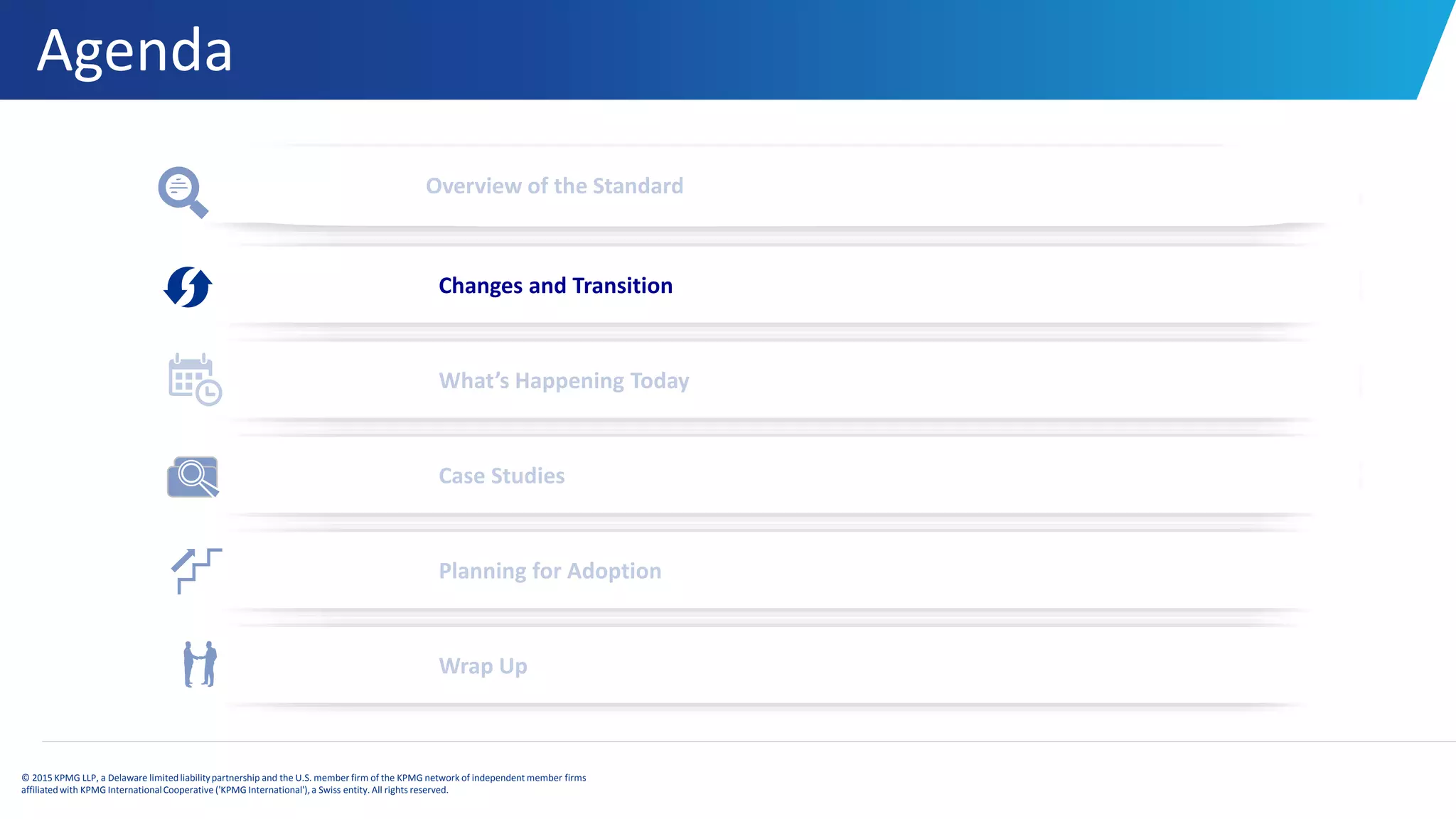
Agenda
Overview of the Standard
Changes and Transition
What’s Happening Today
Case Studies
Planning for Adoption
Wrap Up
© 2015 KPMG LLP, a Delaware limitedliabilitypartnership and the U.S. member firm of the KPMG network of independent member firms
affiliatedwith KPMG InternationalCooperative ('KPMG International'), a Swiss entity. All rights reserved.
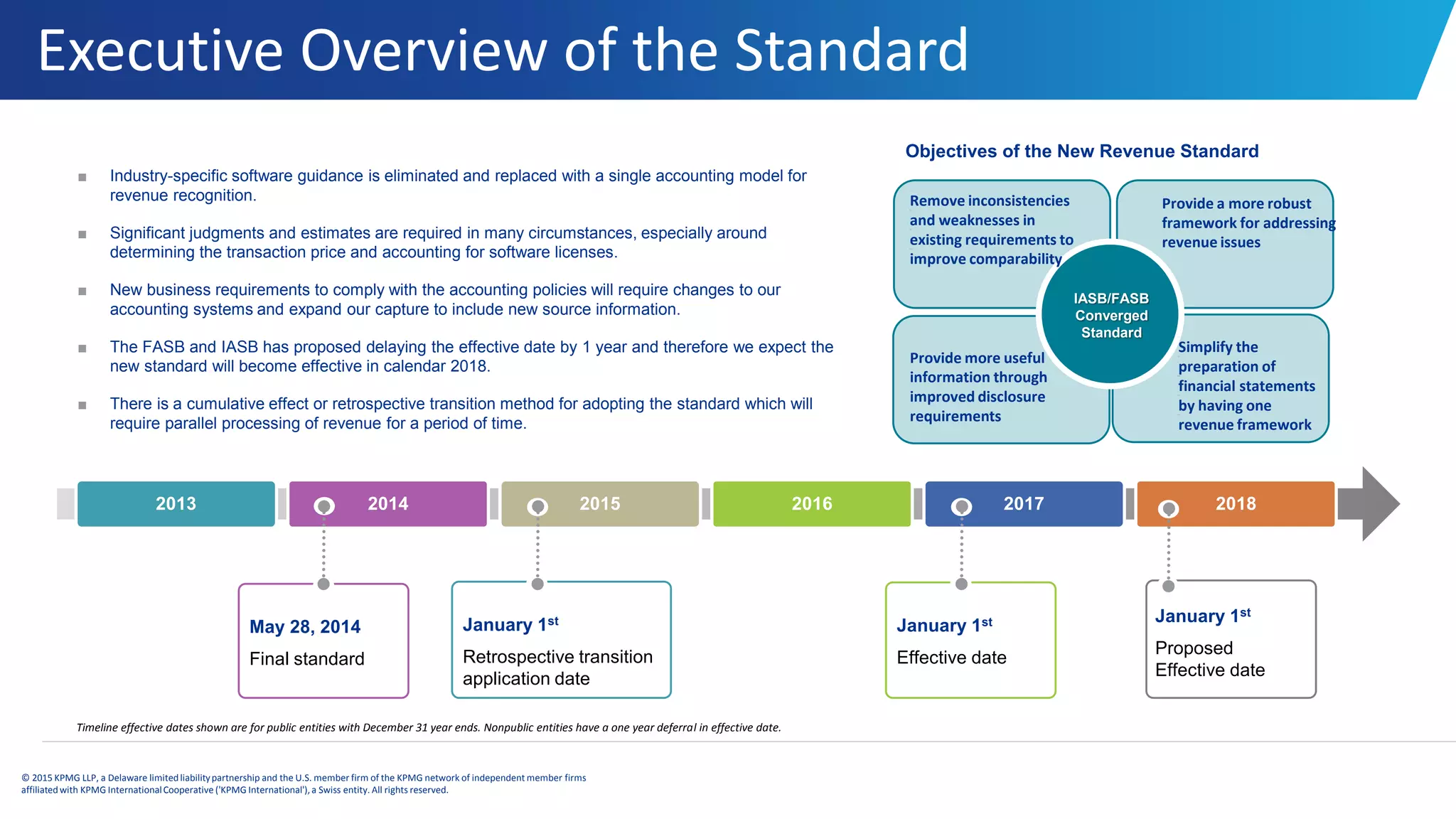
Executive Overview of the Standard
© 2015 KPMG LLP, a Delaware limitedliabilitypartnership and the U.S. member firm of the KPMG network of independent member firms
affiliatedwith KPMG InternationalCooperative ('KPMG International'), a Swiss entity. All rights reserved.
■ Industry-specific software guidance is eliminated and replaced with a single accounting model for
revenue recognition.
■ Significant judgments and estimates are required in many circumstances, especially around
determining the transaction price and accounting for software licenses.
■ New business requirements to comply with the accounting policies will require changes to our
accounting systems and expand our capture to include new source information.
■ The FASB and IASB has proposed delaying the effective date by 1 year and therefore we expect the
new standard will become effective in calendar 2018.
■ There is a cumulative effect or retrospective transition method for adopting the standard which will
require parallel processing of revenue for a period of time.
201820162013 2014 20172015
January 1st
Retrospective transition
application date
January 1st
Effective date
May 28, 2014
Final standard
January 1st
Proposed
Effective date
Timeline effective dates shown are for public entities with December 31 year ends. Nonpublic entities have a one year deferral in effective date.
Remove inconsistencies
and weaknesses in
existing requirements to
improve comparability
Provide a more robust
framework for addressing
revenue issues
Provide more useful
information through
improved disclosure
requirements
Simplify the
preparation of
financial statements
by having one
revenue framework
IASB/FASB
Converged
Standard
Objectives of the New Revenue Standard
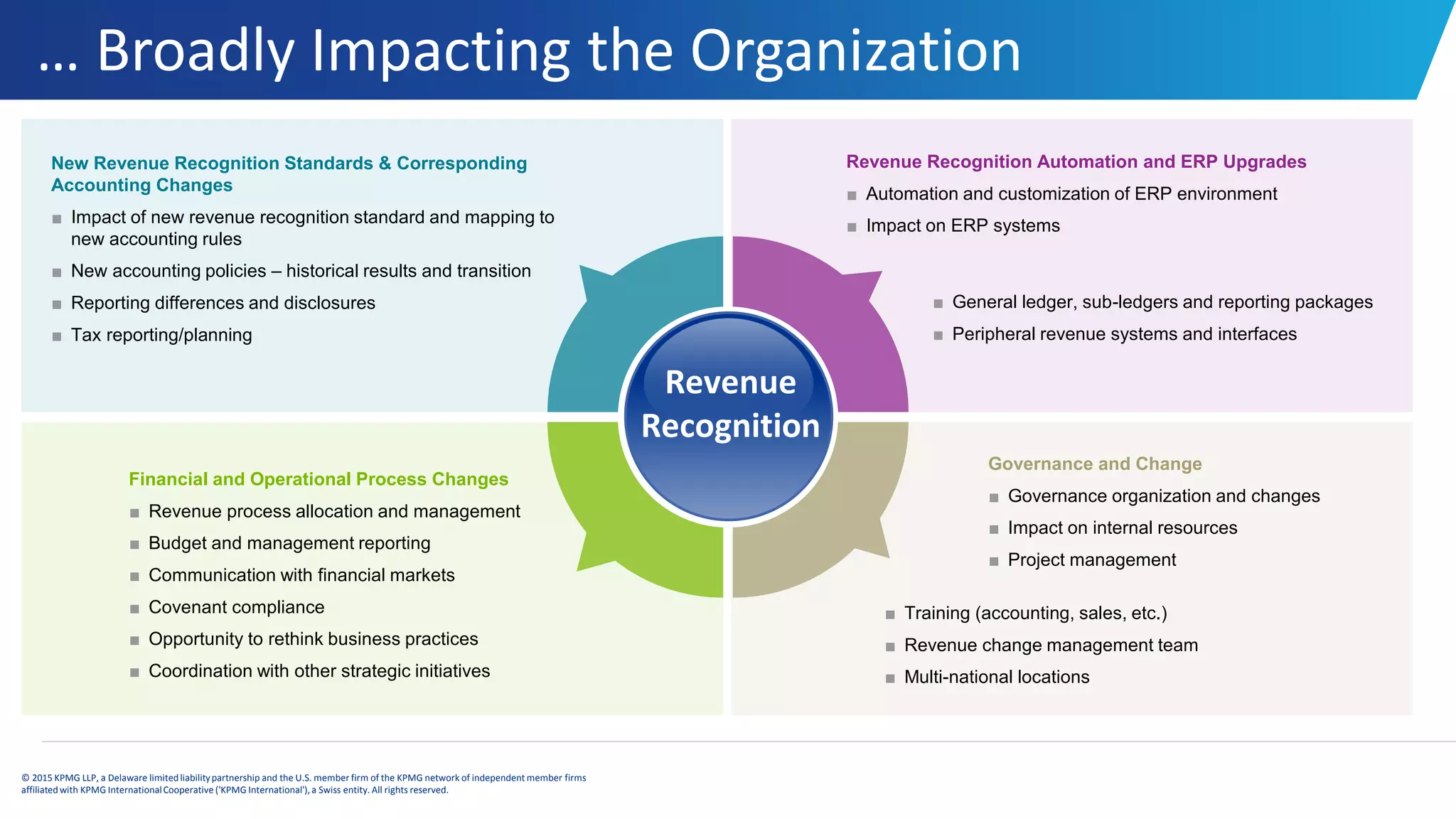
… Broadly Impacting the Organization
© 2015 KPMG LLP, a Delaware limitedliabilitypartnership and the U.S. member firm of the KPMG network of independent member firms
affiliatedwith KPMG InternationalCooperative ('KPMG International'), a Swiss entity. All rights reserved.
New Revenue Recognition Standards & Corresponding
Accounting Changes
■ Impact of new revenue recognition standard and mapping to
new accounting rules
■ New accounting policies – historical results and transition
■ Reporting differences and disclosures
■ Tax reporting/planning
Revenue Recognition Automation and ERP Upgrades
■ Automation and customization of ERP environment
■ Impact on ERP systems
■ General ledger, sub-ledgers and reporting packages
■ Peripheral revenue systems and interfaces
Financial and Operational Process Changes
■ Revenue process allocation and management
■ Budget and management reporting
■ Communication with financial markets
■ Covenant compliance
■ Opportunity to rethink business practices
■ Coordination with other strategic initiatives
Governance and Change
■ Governance organization and changes
■ Impact on internal resources
■ Project management
■ Training (accounting, sales, etc.)
■ Revenue change management team
■ Multi-national locations
Revenue
Recognition
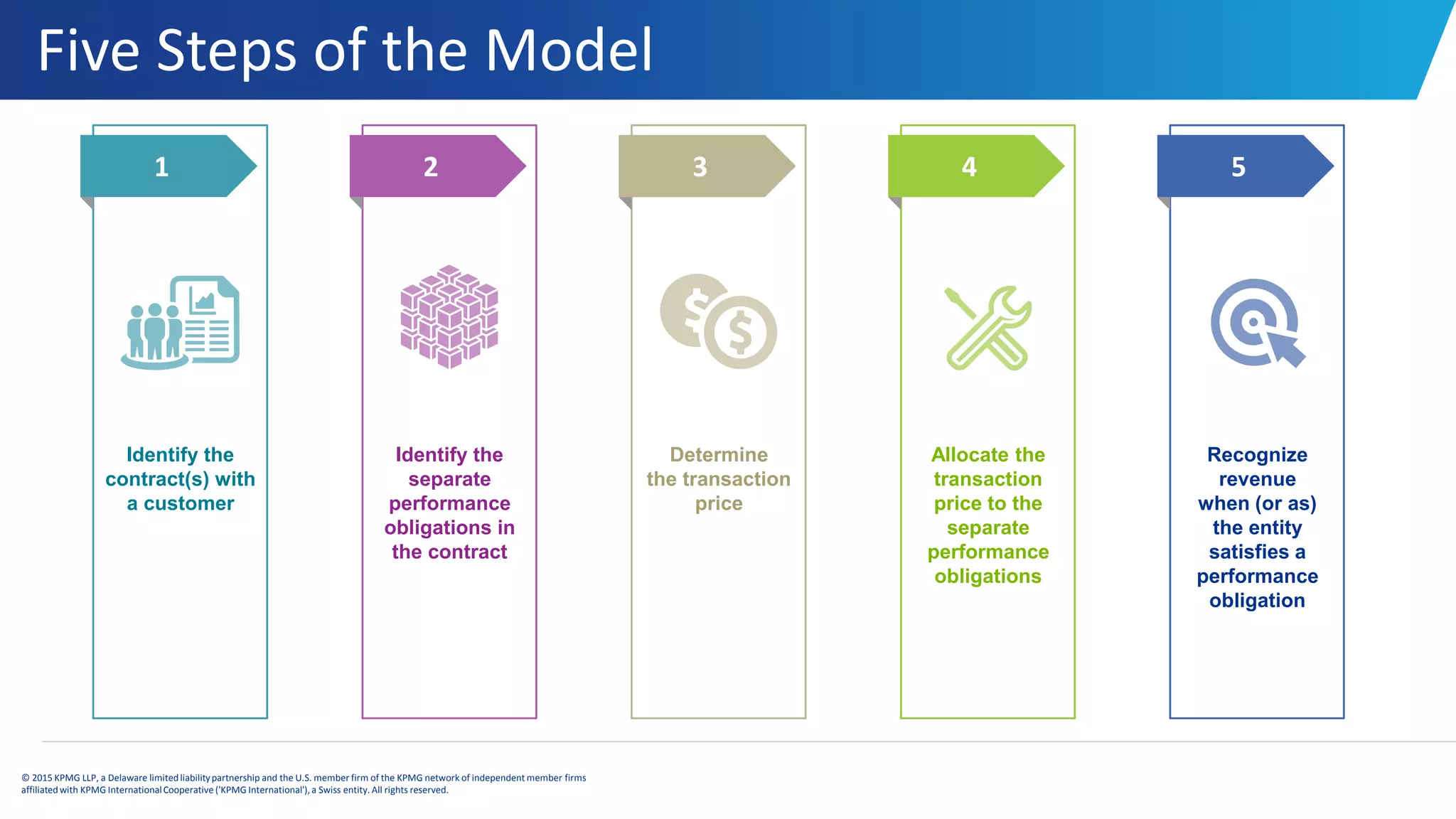
Five Steps of the Model
© 2015 KPMG LLP, a Delaware limitedliabilitypartnership and the U.S. member firm of the KPMG network of independent member firms
affiliatedwith KPMG InternationalCooperative ('KPMG International'), a Swiss entity. All rights reserved.
Identify the
contract(s) with
a customer
1
Identify the
separate
performance
obligations in
the contract
2
Determine
the transaction
price
3
Allocate the
transaction
price to the
separate
performance
obligations
4
Recognize
revenue
when (or as)
the entity
satisfies a
performance
obligation
5
Agenda
© 2015 KPMG LLP, a Delaware limitedliabilitypartnership and the U.S. member firm of the KPMG network of independent member firms
affiliatedwith KPMG InternationalCooperative ('KPMG International'), a Swiss entity. All rights reserved.
Overview of the Standard
Changes and Transition
What’s Happening Today
Case Studies
Planning for Adoption
Wrap Up
Agenda
© 2015 KPMG LLP, a Delaware limitedliabilitypartnership and the U.S. member firm of the KPMG network of independent member firms
affiliatedwith KPMG InternationalCooperative ('KPMG International'), a Swiss entity. All rights reserved.
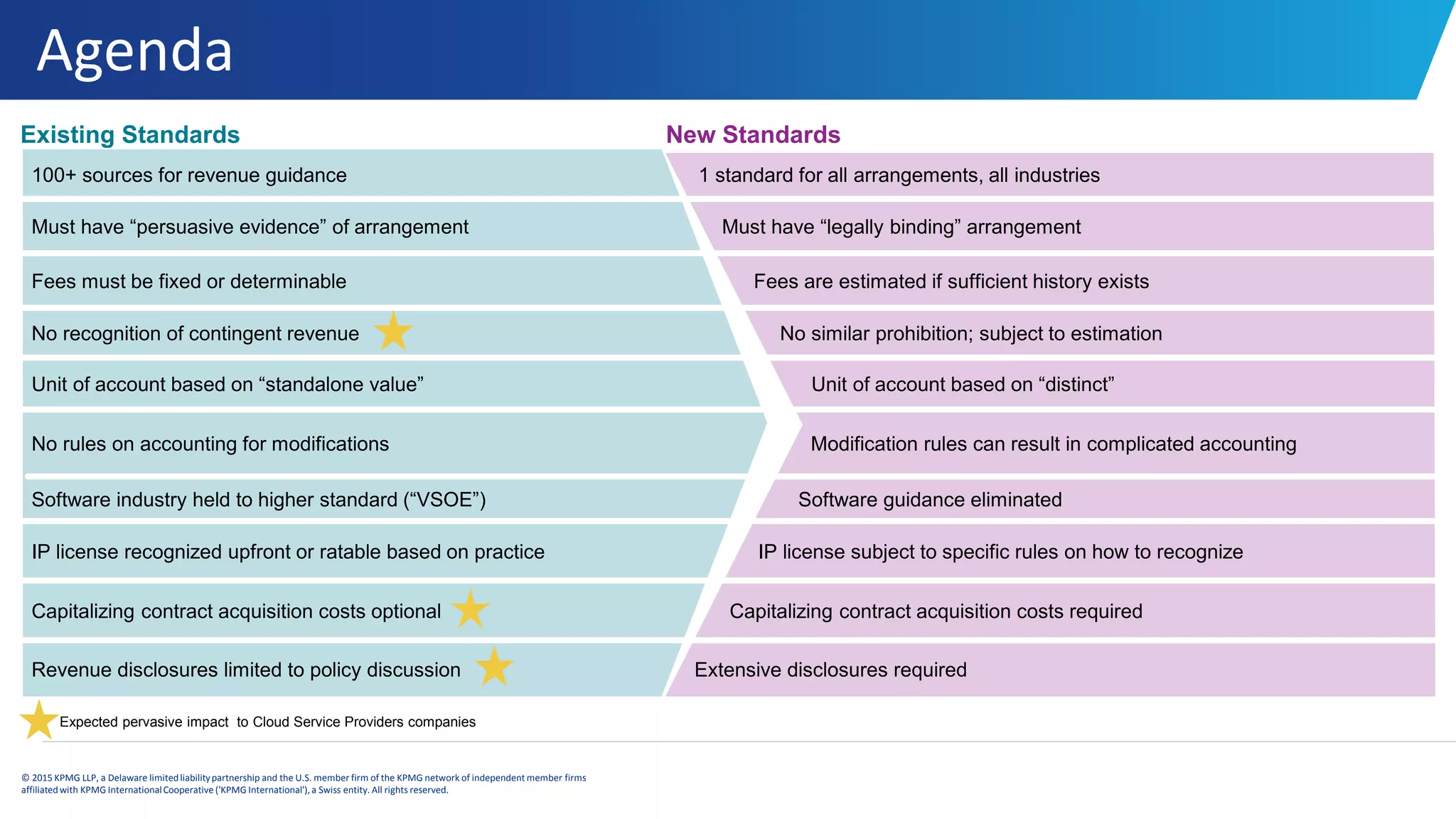
100+ sources for revenue guidance
Fees must be fixed or determinable
Must have “persuasive evidence” of arrangement
No recognition of contingent revenue
Unit of account based on “standalone value”
No rules on accounting for modifications
Capitalizing contract acquisition costs optional
Software industry held to higher standard (“VSOE”)
IP license recognized upfront or ratable based on practice
Revenue disclosures limited to policy discussion
Existing Standards New Standards
1 standard for all arrangements, all industries
Must have “legally binding” arrangement
Fees are estimated if sufficient history exists
No similar prohibition; subject to estimation
Unit of account based on “distinct”
Modification rules can result in complicated accounting
Software guidance eliminated
IP license subject to specific rules on how to recognize
Capitalizing contract acquisition costs required
Extensive disclosures required
Expected pervasive impact to Cloud Service Providers companies
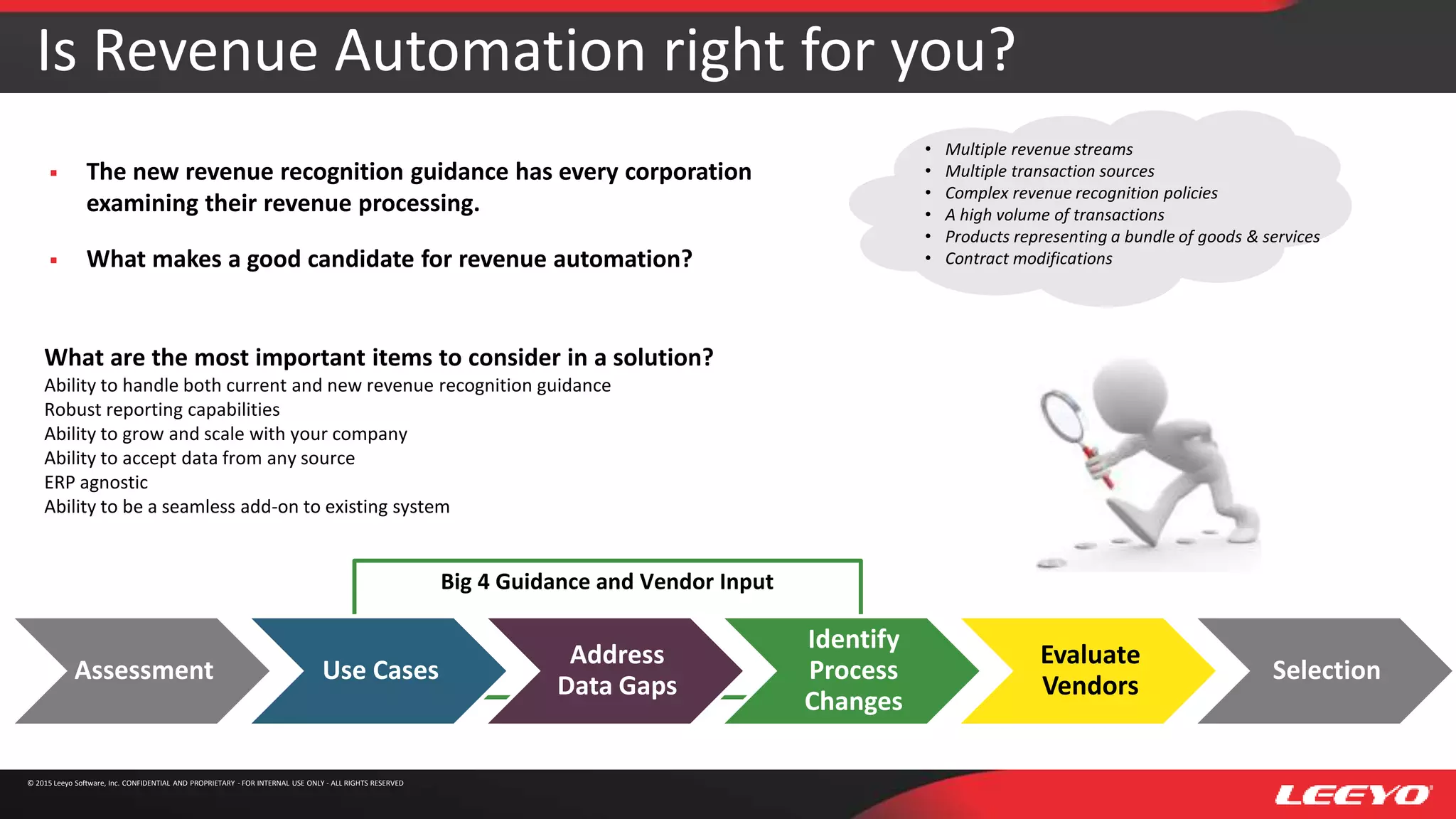
Big 4 Guidance and Vendor Input
Is Revenue Automation right for you?
© 2015 Leeyo Software, Inc. CONFIDENTIAL AND PROPRIETARY - FOR INTERNAL USE ONLY - ALL RIGHTS RESERVED
Assessment Use Cases
Address
Data Gaps
Identify
Process
Changes
Evaluate
Vendors
Selection
What are the most important items to consider in a solution?
Ability to handle both current and new revenue recognition guidance
Robust reporting capabilities
Ability to grow and scale with your company
Ability to accept data from any source
ERP agnostic
Ability to be a seamless add-on to existing system
 The new revenue recognition guidance has every corporation
examining their revenue processing.
 What makes a good candidate for revenue automation?
• Multiple revenue streams
• Multiple transaction sources
• Complex revenue recognition policies
• A high volume of transactions
• Products representing a bundle of goods & services
• Contract modifications
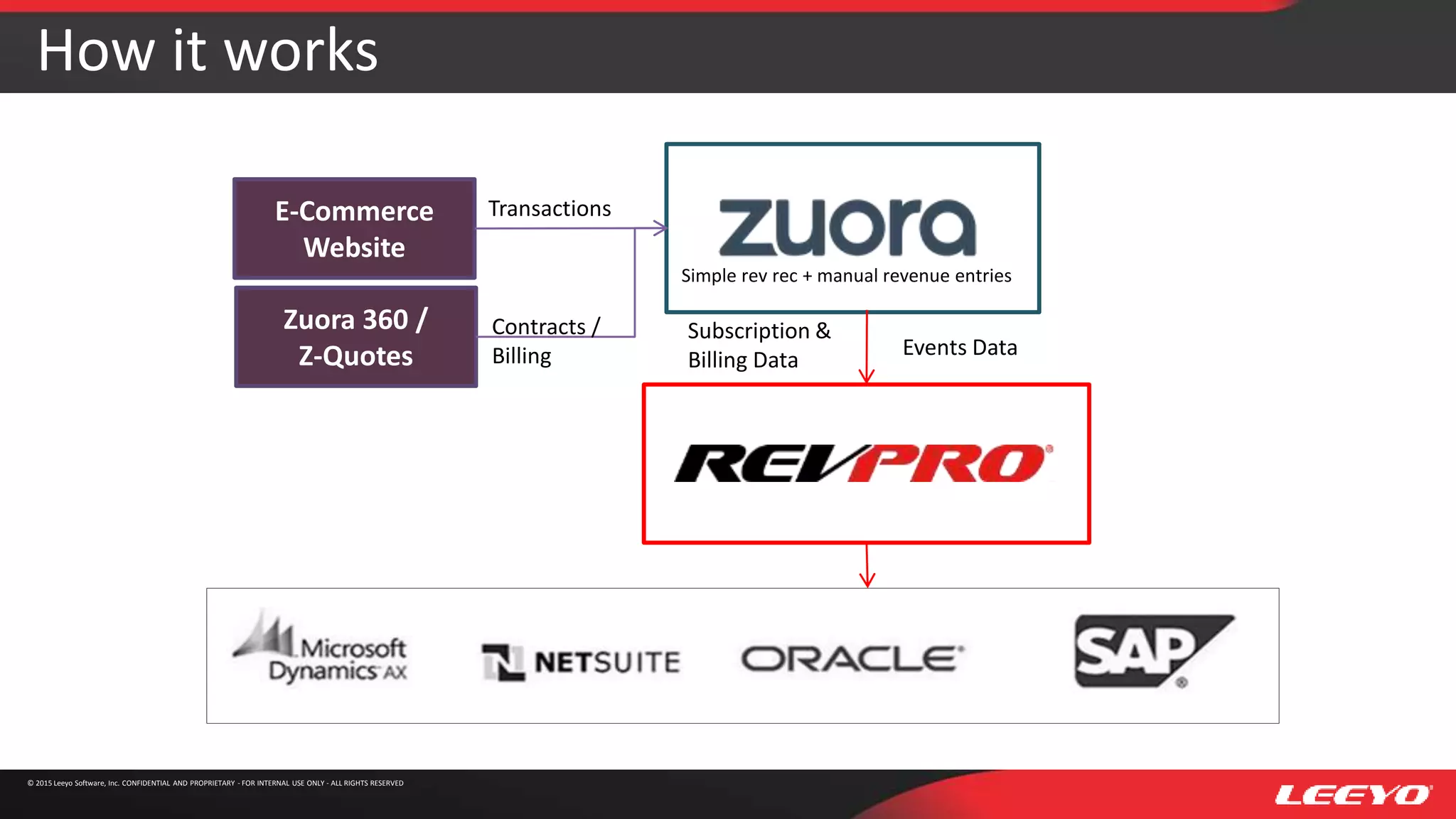
How it works
© 2015 Leeyo Software, Inc. CONFIDENTIAL AND PROPRIETARY - FOR INTERNAL USE ONLY - ALL RIGHTS RESERVED
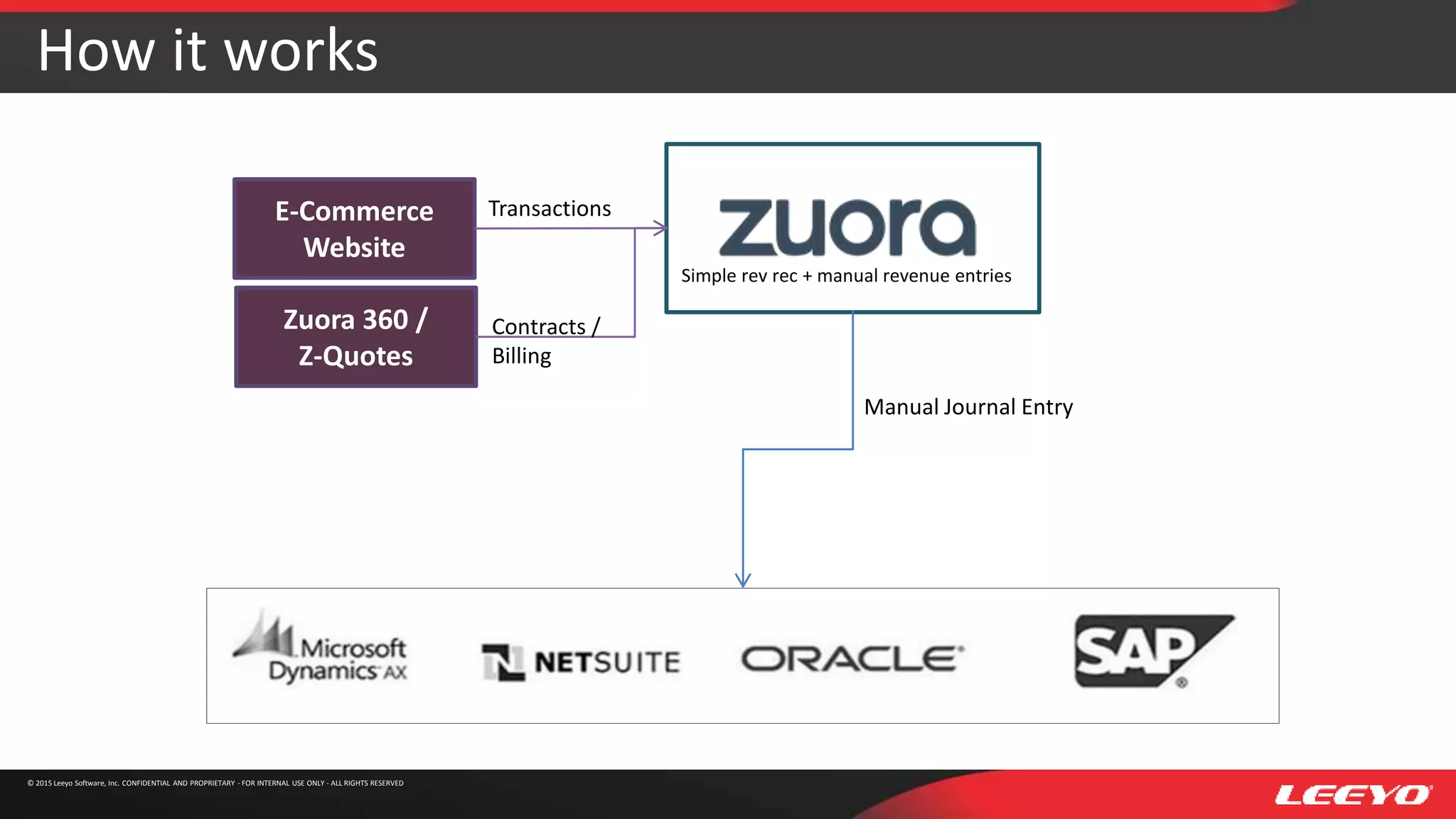
E-Commerce
Website
Zuora 360 /
Z-Quotes
Transactions
Contracts /
Billing
Manual Journal Entry
Simple rev rec + manual revenue entries
How it works
© 2015 Leeyo Software, Inc. CONFIDENTIAL AND PROPRIETARY - FOR INTERNAL USE ONLY - ALL RIGHTS RESERVED
E-Commerce
Website
Zuora 360 /
Z-Quotes
Transactions
Contracts /
Billing
Simple rev rec + manual revenue entries
Subscription &
Billing Data
Events Data
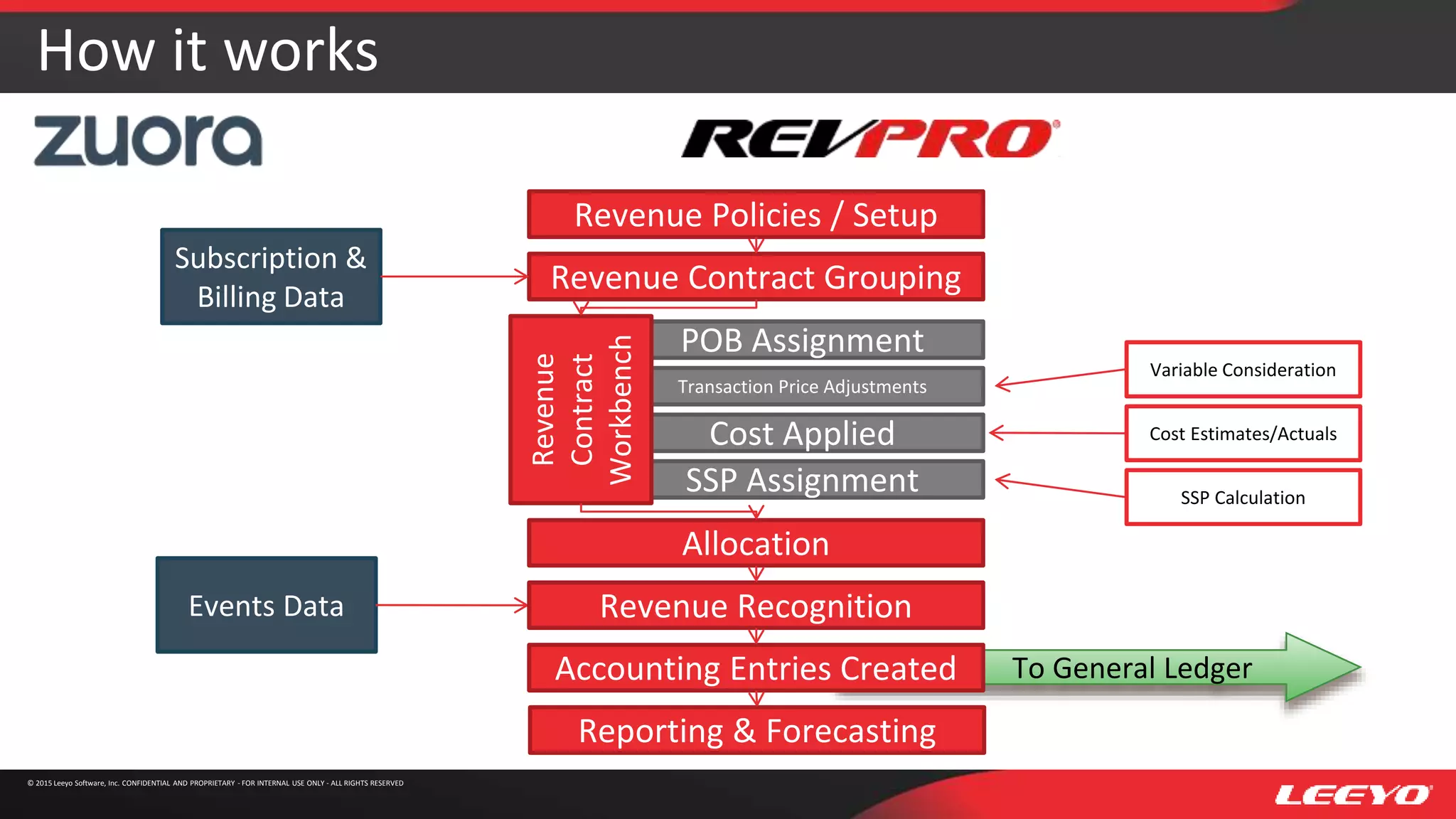
How it works
To General Ledger
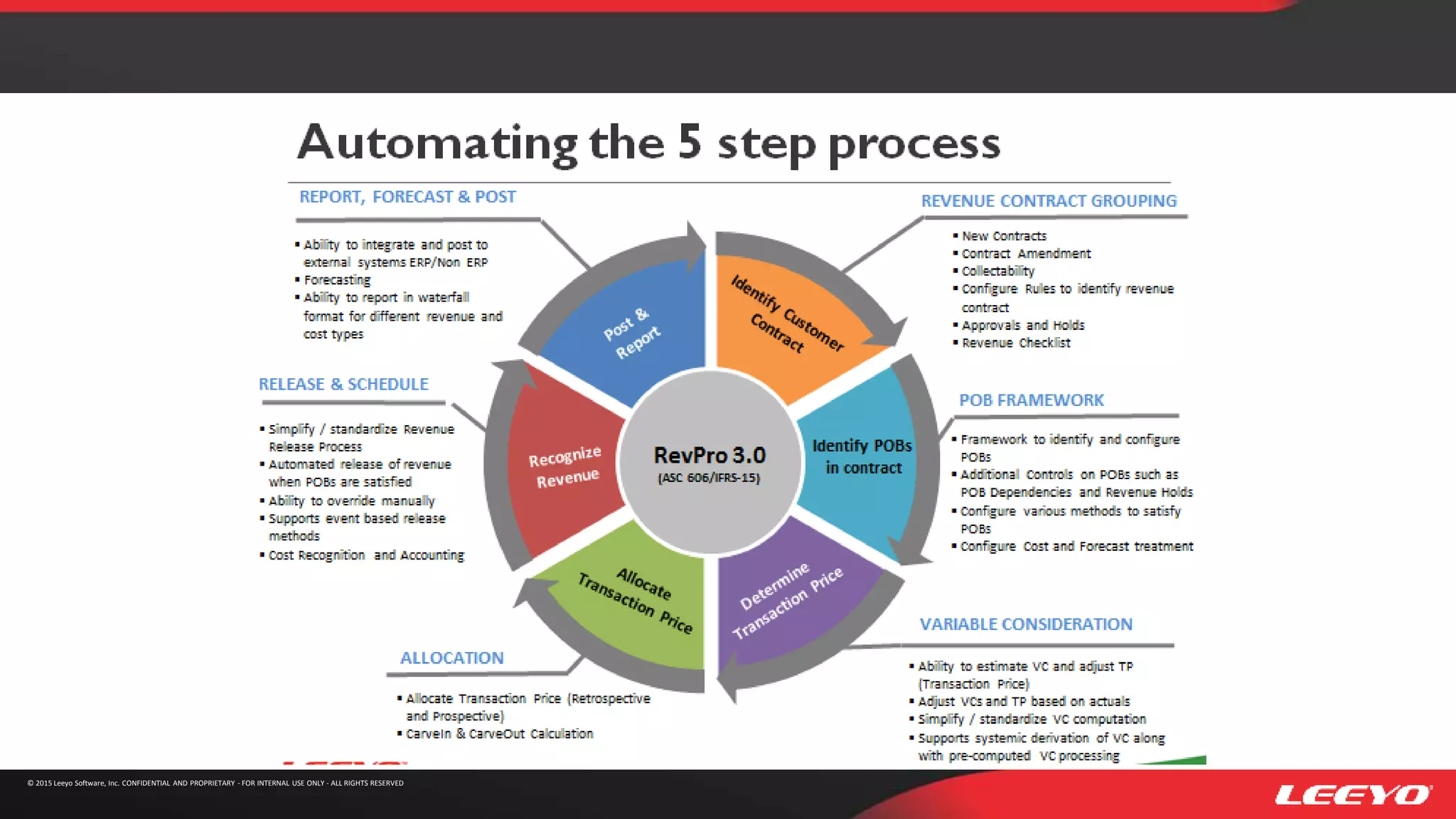
Revenue Policies / Setup
Revenue Contract Grouping
POB Assignment
Transaction Price Adjustments
Variable Consideration
SSP Assignment
Allocation
Subscription &
Billing Data
Events Data
Accounting Entries Created
Revenue Recognition
SSP Calculation
Cost Applied Cost Estimates/Actuals
Revenue
Contract
Workbench
Reporting & Forecasting
© 2015 Leeyo Software, Inc. CONFIDENTIAL AND PROPRIETARY - FOR INTERNAL USE ONLY - ALL RIGHTS RESERVED
Agenda
© 2015 KPMG LLP, a Delaware limitedliabilitypartnership and the U.S. member firm of the KPMG network of independent member firms
affiliatedwith KPMG InternationalCooperative ('KPMG International'), a Swiss entity. All rights reserved.
Overview of the Standard
Changes and Transitions
Case Studies
Planning for Adoption
Wrap Up
What’s Happening Today
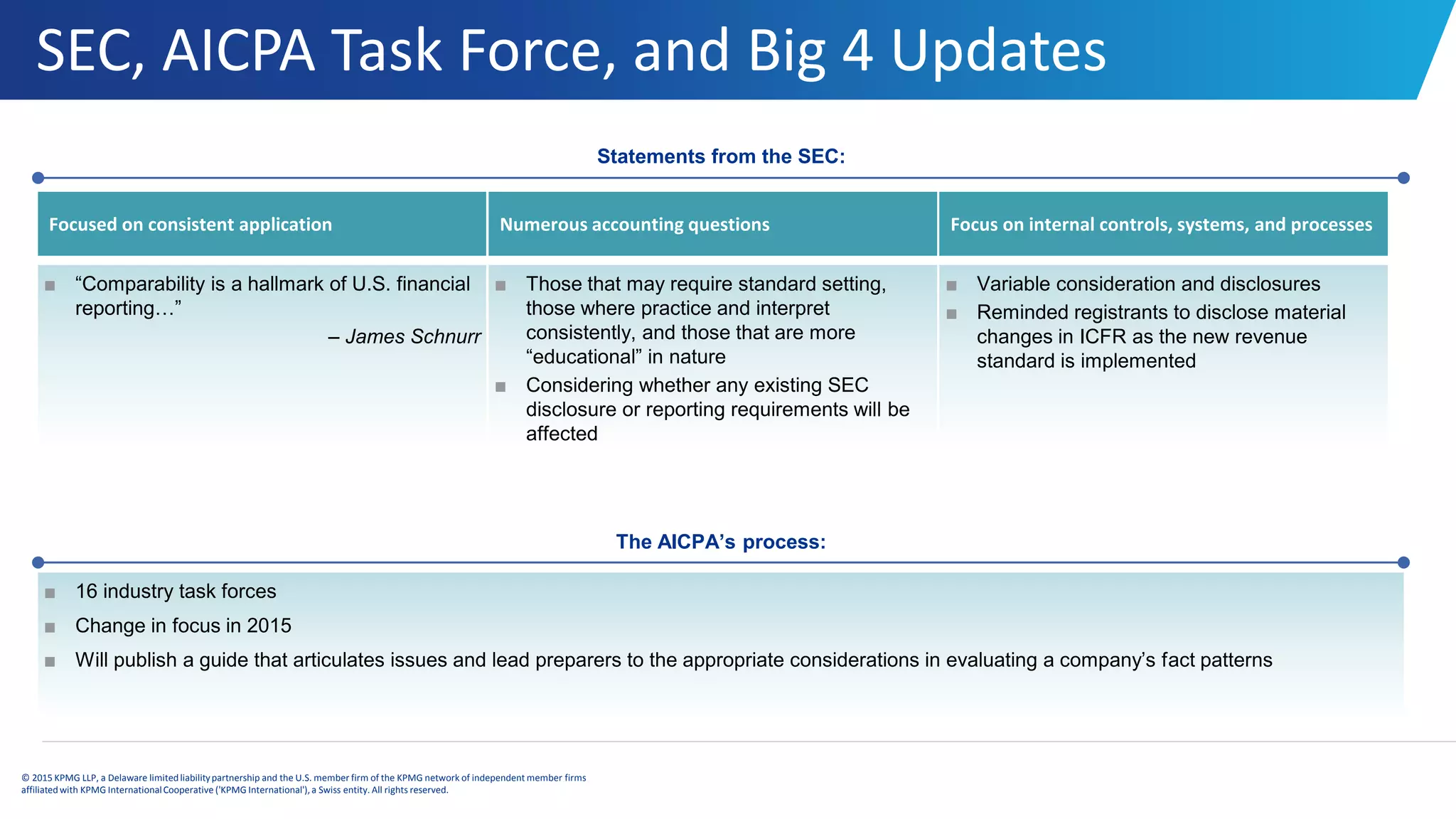
SEC, AICPA Task Force, and Big 4 Updates
© 2015 KPMG LLP, a Delaware limitedliabilitypartnership and the U.S. member firm of the KPMG network of independent member firms
affiliatedwith KPMG InternationalCooperative ('KPMG International'), a Swiss entity. All rights reserved.
Statements from the SEC:
■ “Comparability is a hallmark of U.S. financial
reporting…”
– James Schnurr
Focused on consistent application
■ Those that may require standard setting,
those where practice and interpret
consistently, and those that are more
“educational” in nature
■ Considering whether any existing SEC
disclosure or reporting requirements will be
affected
Numerous accounting questions
■ Variable consideration and disclosures
■ Reminded registrants to disclose material
changes in ICFR as the new revenue
standard is implemented
Focus on internal controls, systems, and processes
The AICPA’s process:
■ 16 industry task forces
■ Change in focus in 2015
■ Will publish a guide that articulates issues and lead preparers to the appropriate considerations in evaluating a company’s fact patterns
Deferral of effective date and transition considerations
© 2015 KPMG LLP, a Delaware limitedliabilitypartnership and the U.S. member firm of the KPMG network of independent member firms
affiliatedwith KPMG InternationalCooperative ('KPMG International'), a Swiss entity. All rights reserved.
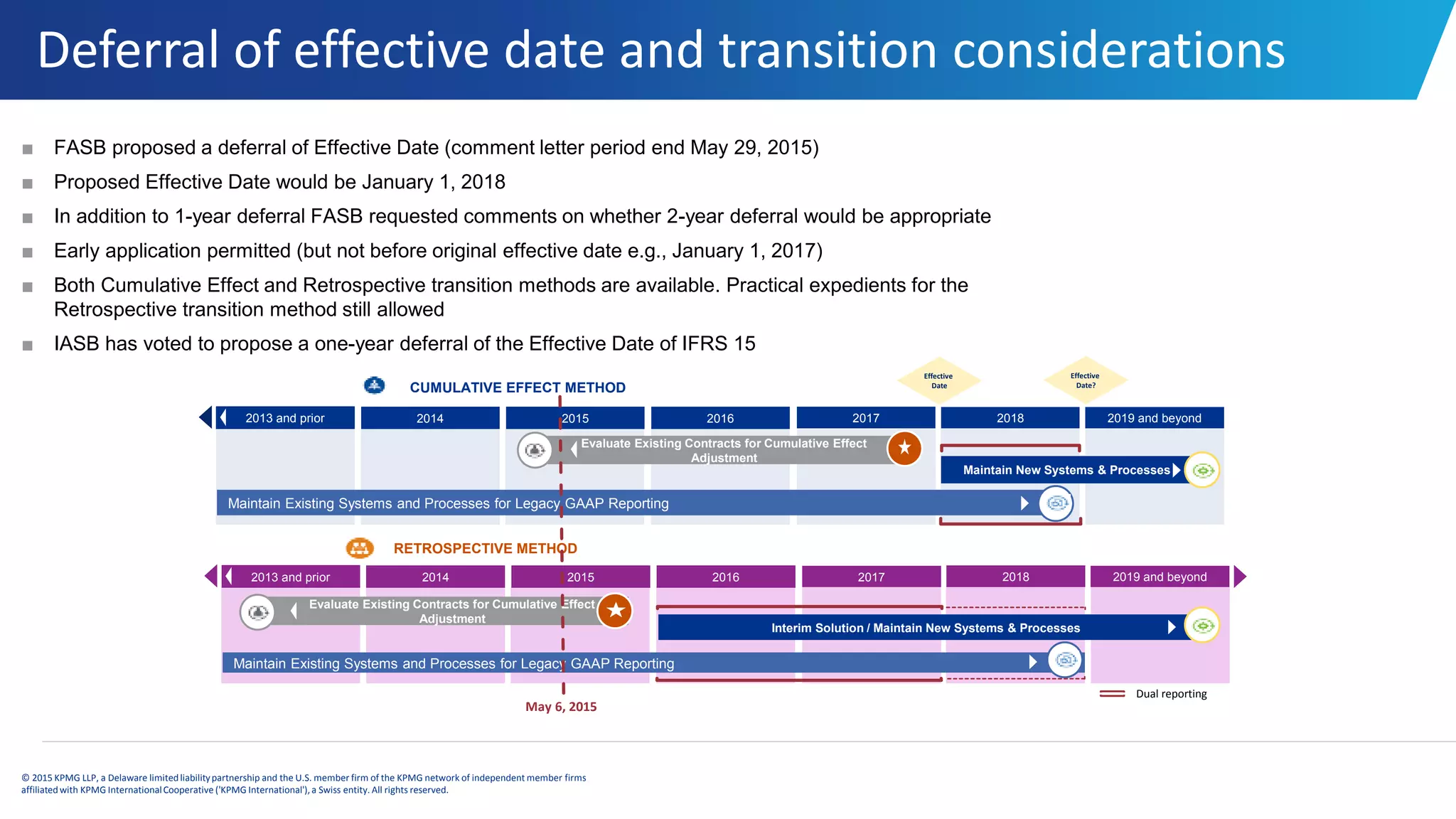
■ FASB proposed a deferral of Effective Date (comment letter period end May 29, 2015)
■ Proposed Effective Date would be January 1, 2018
■ In addition to 1-year deferral FASB requested comments on whether 2-year deferral would be appropriate
■ Early application permitted (but not before original effective date e.g., January 1, 2017)
■ Both Cumulative Effect and Retrospective transition methods are available. Practical expedients for the
Retrospective transition method still allowed
■ IASB has voted to propose a one-year deferral of the Effective Date of IFRS 15
CUMULATIVE EFFECT METHOD
2014 2015 2016 2017 20182013 and prior 2019 and beyond
Evaluate Existing Contracts for Cumulative Effect
Adjustment
Maintain Existing Systems and Processes for Legacy GAAP Reporting
RETROSPECTIVE METHOD
Interim Solution / Maintain New Systems & Processes
Dual reporting
2014 2015 2016 2017 20182013 and prior 2019 and beyond
Evaluate Existing Contracts for Cumulative Effect
Adjustment
Maintain Existing Systems and Processes for Legacy GAAP Reporting
Maintain New Systems & Processes
Effective
Date?
May 6, 2015
Effective
Date
Interpretation Considerations
© 2015 KPMG LLP, a Delaware limitedliabilitypartnership and the U.S. member firm of the KPMG network of independent member firms
affiliatedwith KPMG InternationalCooperative ('KPMG International'), a Swiss entity. All rights reserved.
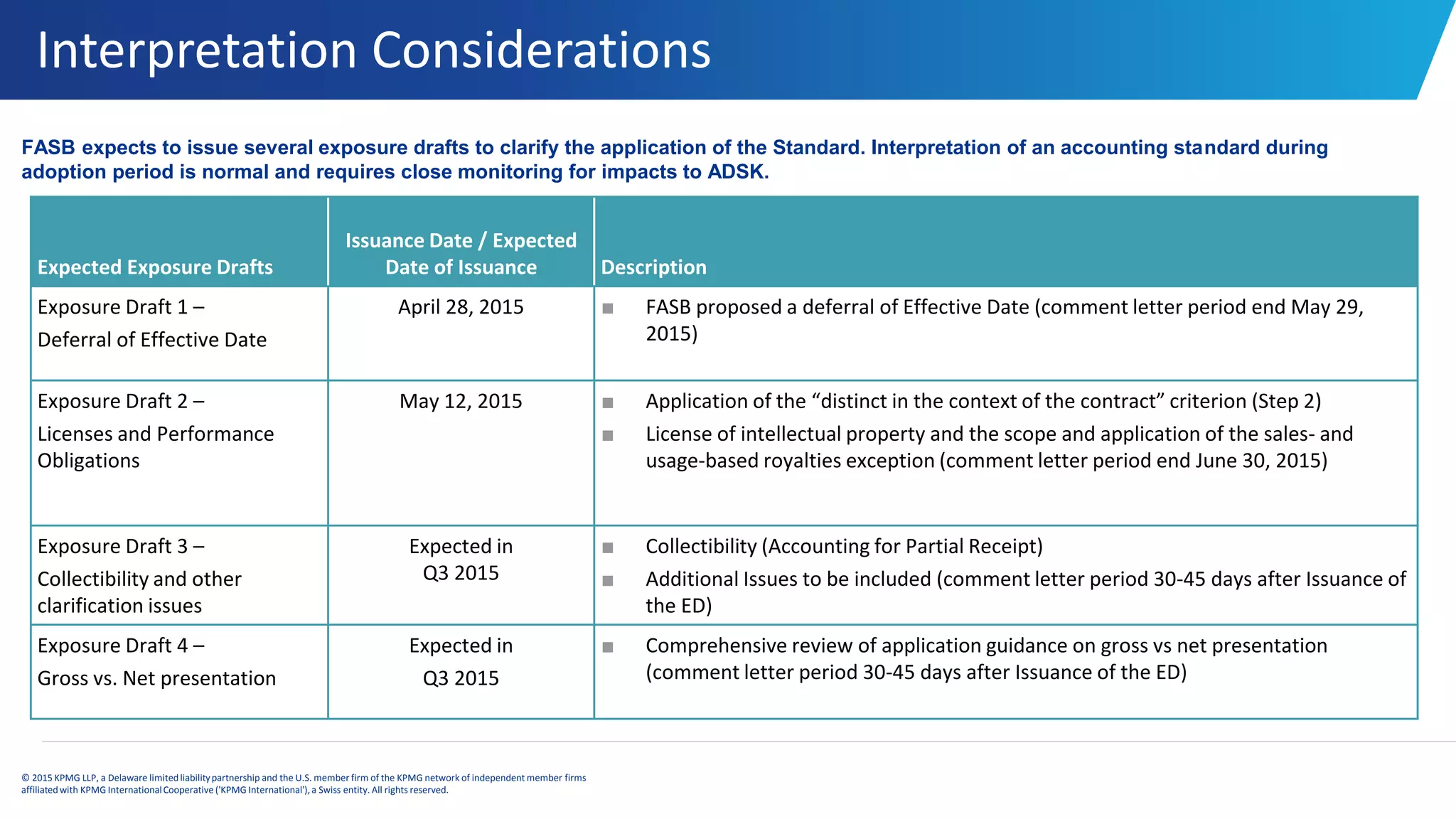
FASB expects to issue several exposure drafts to clarify the application of the Standard. Interpretation of an accounting standard during
adoption period is normal and requires close monitoring for impacts to ADSK.
Expected Exposure Drafts
Issuance Date / Expected
Date of Issuance Description
Exposure Draft 1 –
Deferral of Effective Date
April 28, 2015 ■ FASB proposed a deferral of Effective Date (comment letter period end May 29,
2015)
Exposure Draft 2 –
Licenses and Performance
Obligations
May 12, 2015 ■ Application of the “distinct in the context of the contract” criterion (Step 2)
■ License of intellectual property and the scope and application of the sales- and
usage-based royalties exception (comment letter period end June 30, 2015)
Exposure Draft 3 –
Collectibility and other
clarification issues
Expected in
Q3 2015
■ Collectibility (Accounting for Partial Receipt)
■ Additional Issues to be included (comment letter period 30-45 days after Issuance of
the ED)
Exposure Draft 4 –
Gross vs. Net presentation
Expected in
Q3 2015
■ Comprehensive review of application guidance on gross vs net presentation
(comment letter period 30-45 days after Issuance of the ED)
Agenda
© 2015 KPMG LLP, a Delaware limitedliabilitypartnership and the U.S. member firm of the KPMG network of independent member firms
affiliatedwith KPMG InternationalCooperative ('KPMG International'), a Swiss entity. All rights reserved.
Overview of the Standard
Changes and Transitions
What’s Happening Today
Planning for Adoption
Wrap Up
Case Studies
Case Study 1: Variable Consideration
Contingent Revenue
© 2015 KPMG LLP, a Delaware limitedliabilitypartnership and the U.S. member firm of the KPMG network of independent member firms
affiliatedwith KPMG InternationalCooperative ('KPMG International'), a Swiss entity. All rights reserved.
Step 3
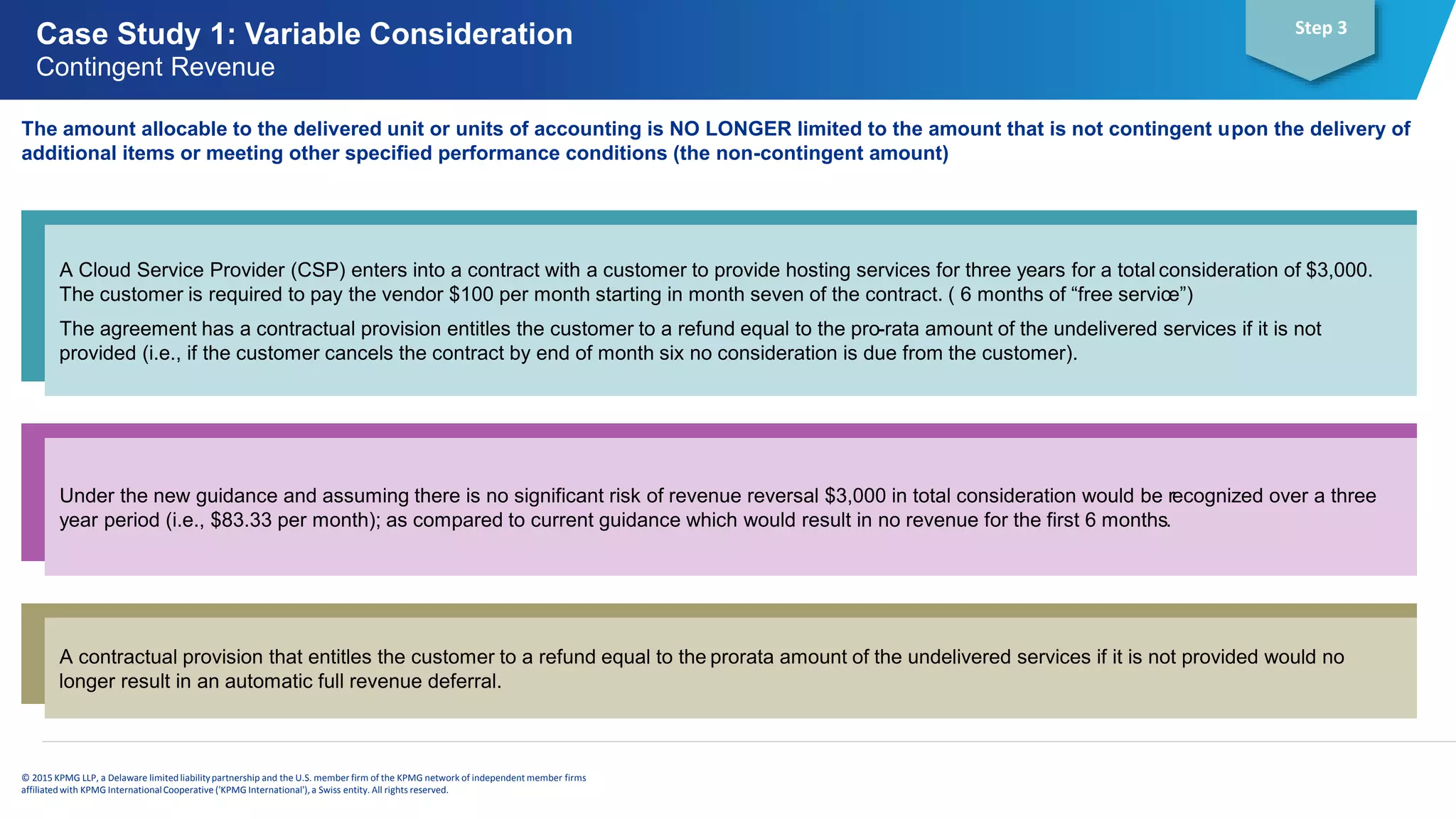
The amount allocable to the delivered unit or units of accounting is NO LONGER limited to the amount that is not contingent upon the delivery of
additional items or meeting other specified performance conditions (the non-contingent amount)
A Cloud Service Provider (CSP) enters into a contract with a customer to provide hosting services for three years for a total consideration of $3,000.
The customer is required to pay the vendor $100 per month starting in month seven of the contract. ( 6 months of “free service”)
The agreement has a contractual provision entitles the customer to a refund equal to the pro-rata amount of the undelivered services if it is not
provided (i.e., if the customer cancels the contract by end of month six no consideration is due from the customer).
A contractual provision that entitles the customer to a refund equal to the prorata amount of the undelivered services if it is not provided would no
longer result in an automatic full revenue deferral.
Under the new guidance and assuming there is no significant risk of revenue reversal $3,000 in total consideration would be recognized over a three
year period (i.e., $83.33 per month); as compared to current guidance which would result in no revenue for the first 6 months.
© 2015 KPMG LLP, a Delaware limitedliabilitypartnership and the U.S. member firm of the KPMG network of independent member firms
affiliatedwith KPMG InternationalCooperative ('KPMG International'), a Swiss entity. All rights reserved.
Step 3
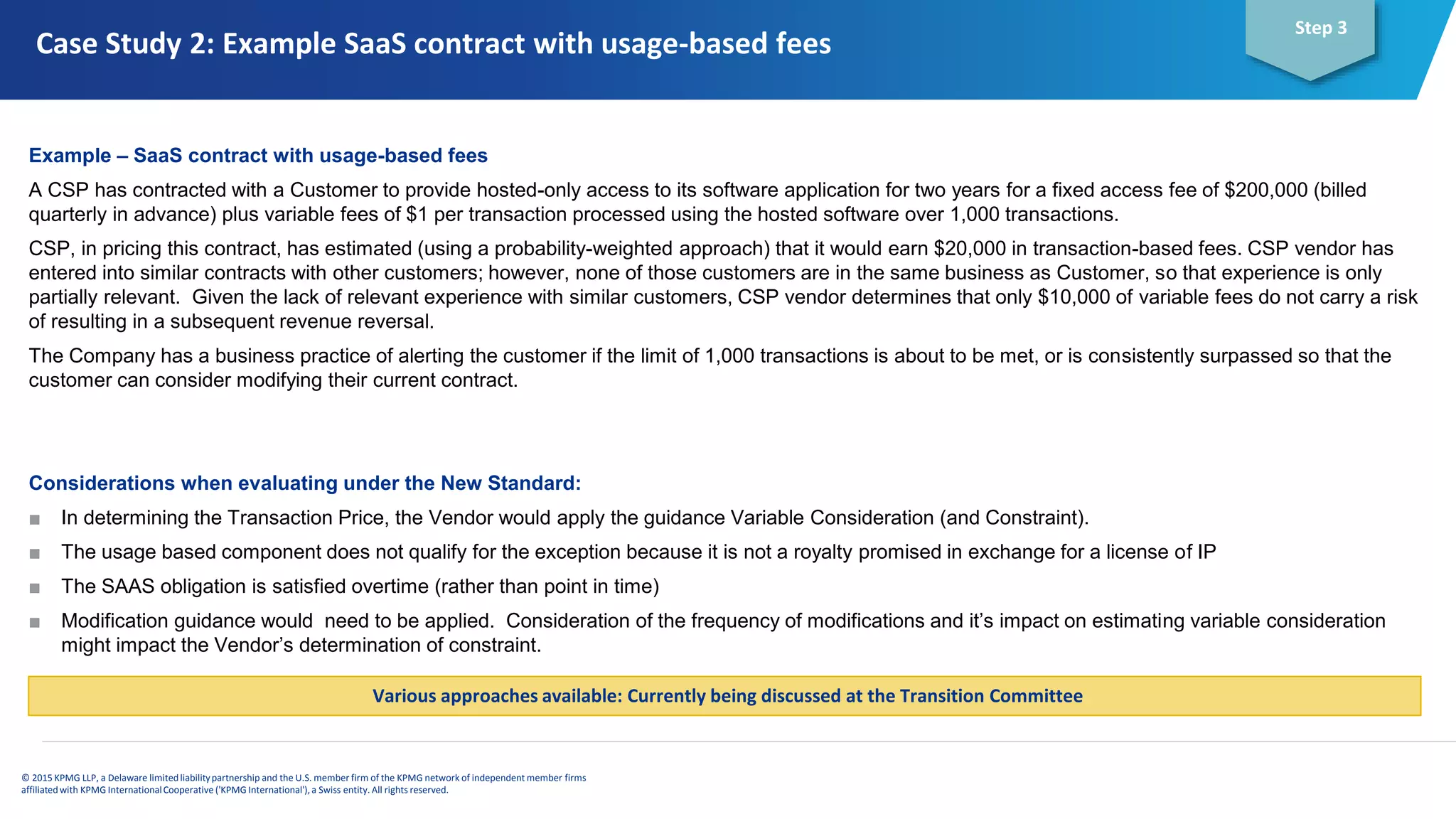
Example – SaaS contract with usage-based fees
A CSP has contracted with a Customer to provide hosted-only access to its software application for two years for a fixed access fee of $200,000 (billed
quarterly in advance) plus variable fees of $1 per transaction processed using the hosted software over 1,000 transactions.
CSP, in pricing this contract, has estimated (using a probability-weighted approach) that it would earn $20,000 in transaction-based fees. CSP vendor has
entered into similar contracts with other customers; however, none of those customers are in the same business as Customer, so that experience is only
partially relevant. Given the lack of relevant experience with similar customers, CSP vendor determines that only $10,000 of variable fees do not carry a risk
of resulting in a subsequent revenue reversal.
The Company has a business practice of alerting the customer if the limit of 1,000 transactions is about to be met, or is consistently surpassed so that the
customer can consider modifying their current contract.
Considerations when evaluating under the New Standard:
■ In determining the Transaction Price, the Vendor would apply the guidance Variable Consideration (and Constraint).
■ The usage based component does not qualify for the exception because it is not a royalty promised in exchange for a license of IP
■ The SAAS obligation is satisfied overtime (rather than point in time)
■ Modification guidance would need to be applied. Consideration of the frequency of modifications and it’s impact on estimating variable consideration
might impact the Vendor’s determination of constraint.
Various approaches available: Currently being discussed at the Transition Committee
Case Study 2: Example SaaS contract with usage-based fees
© 2015 KPMG LLP, a Delaware limitedliabilitypartnership and the U.S. member firm of the KPMG network of independent member firms
affiliatedwith KPMG InternationalCooperative ('KPMG International'), a Swiss entity. All rights reserved.
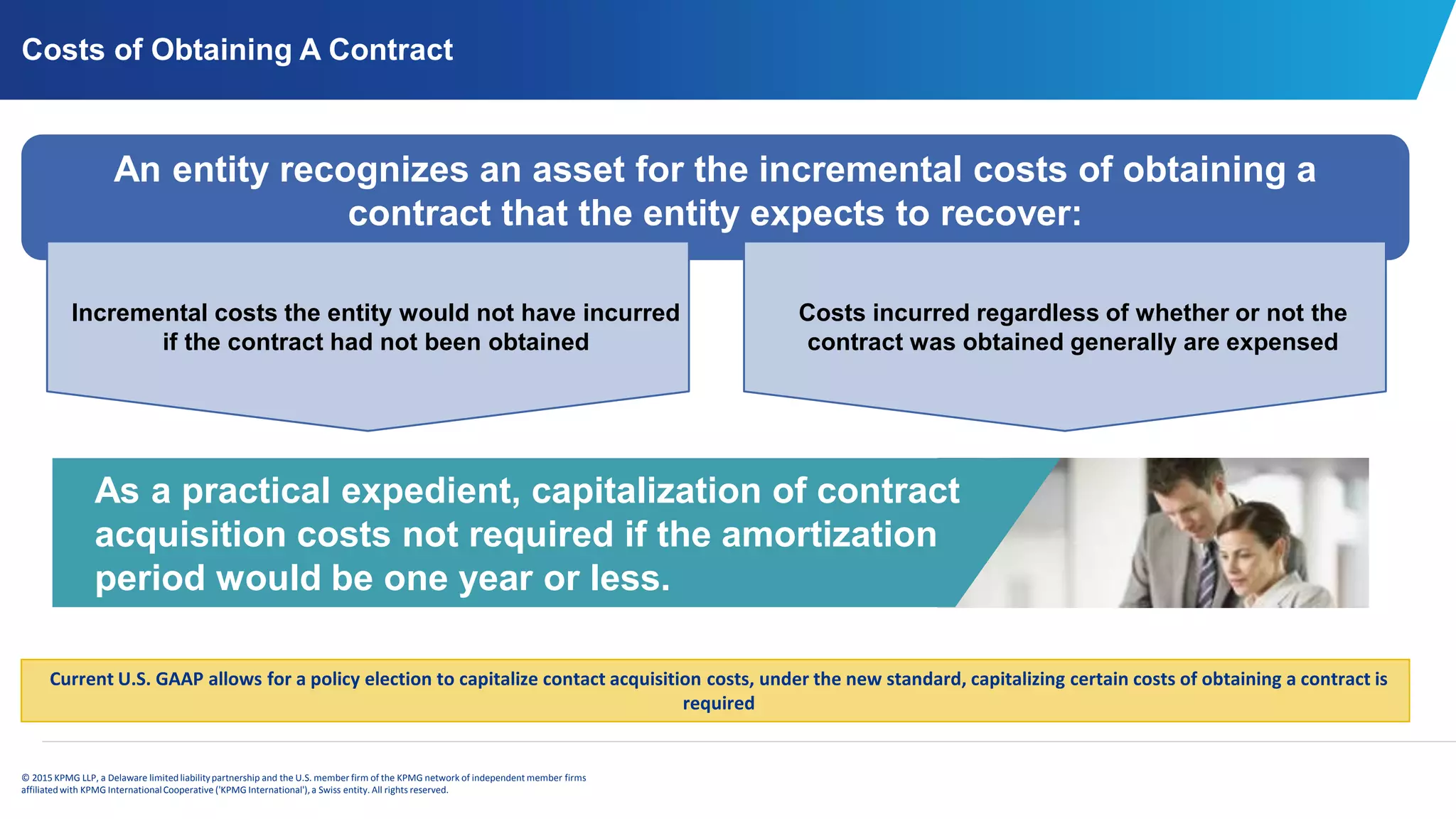
Costs of Obtaining A Contract
As a practical expedient, capitalization of contract
acquisition costs not required if the amortization
period would be one year or less.
An entity recognizes an asset for the incremental costs of obtaining a
contract that the entity expects to recover:
Incremental costs the entity would not have incurred
if the contract had not been obtained
Costs incurred regardless of whether or not the
contract was obtained generally are expensed
Current U.S. GAAP allows for a policy election to capitalize contact acquisition costs, under the new standard, capitalizing certain costs of obtaining a contract is
required
© 2015 Leeyo Software, Inc. CONFIDENTIAL AND PROPRIETARY - FOR INTERNAL USE ONLY - ALL RIGHTS RESERVED
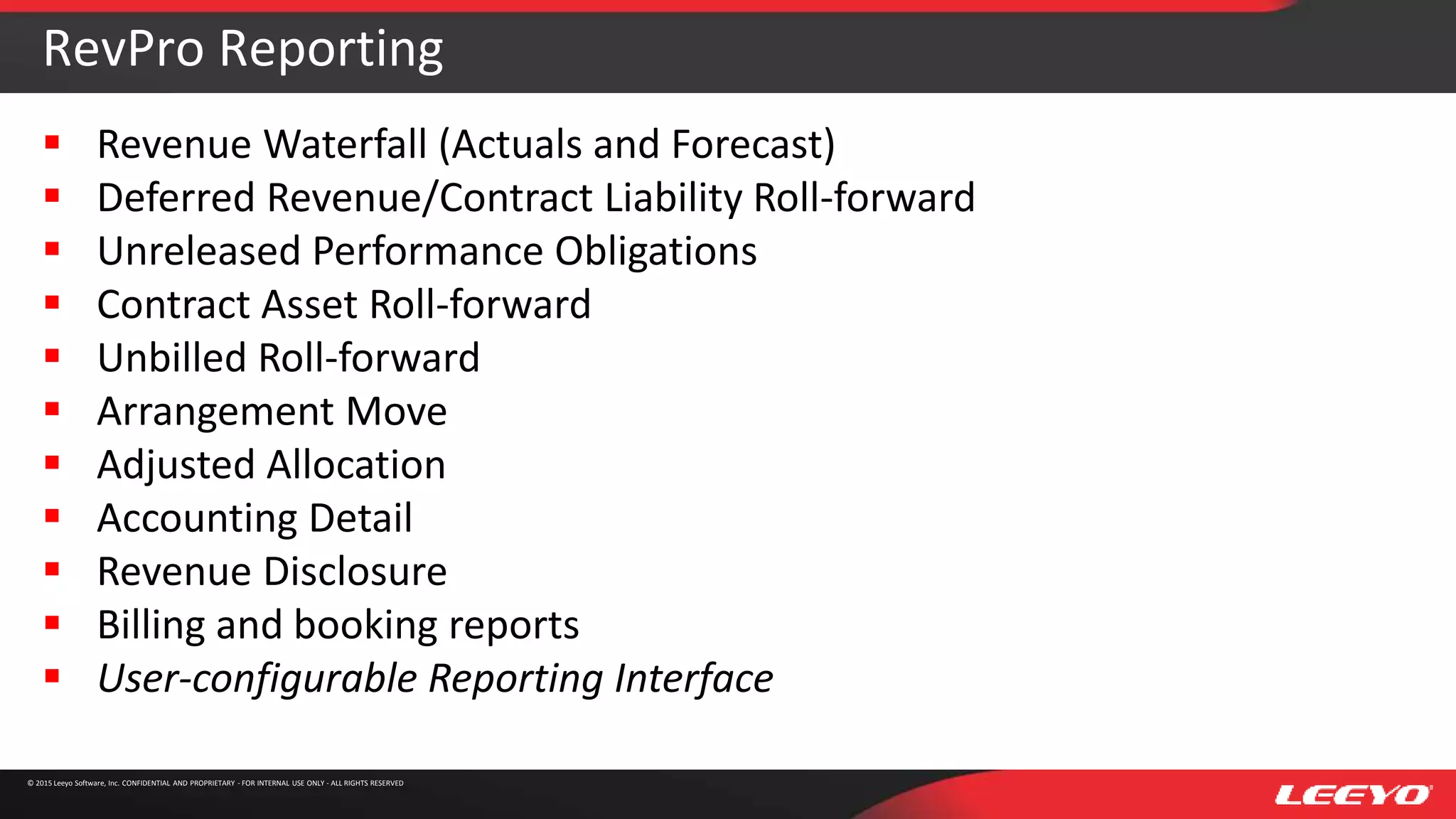
RevPro Reporting
 Revenue Waterfall (Actuals and Forecast)
 Deferred Revenue/Contract Liability Roll-forward
 Unreleased Performance Obligations
 Contract Asset Roll-forward
 Unbilled Roll-forward
 Arrangement Move
 Adjusted Allocation
 Accounting Detail
 Revenue Disclosure
 Billing and booking reports
 User-configurable Reporting Interface
Agenda
© 2015 KPMG LLP, a Delaware limitedliabilitypartnership and the U.S. member firm of the KPMG network of independent member firms
affiliatedwith KPMG InternationalCooperative ('KPMG International'), a Swiss entity. All rights reserved.
Overview of the Standard
Changes and Transitions
What’s Happening Today
Case Studies
Wrap Up
Planning for Adoption
© 2015 KPMG LLP, a Delaware limitedliabilitypartnership and the U.S. member firm of the KPMG network of independent member firms
affiliatedwith KPMG InternationalCooperative ('KPMG International'), a Swiss entity. All rights reserved.
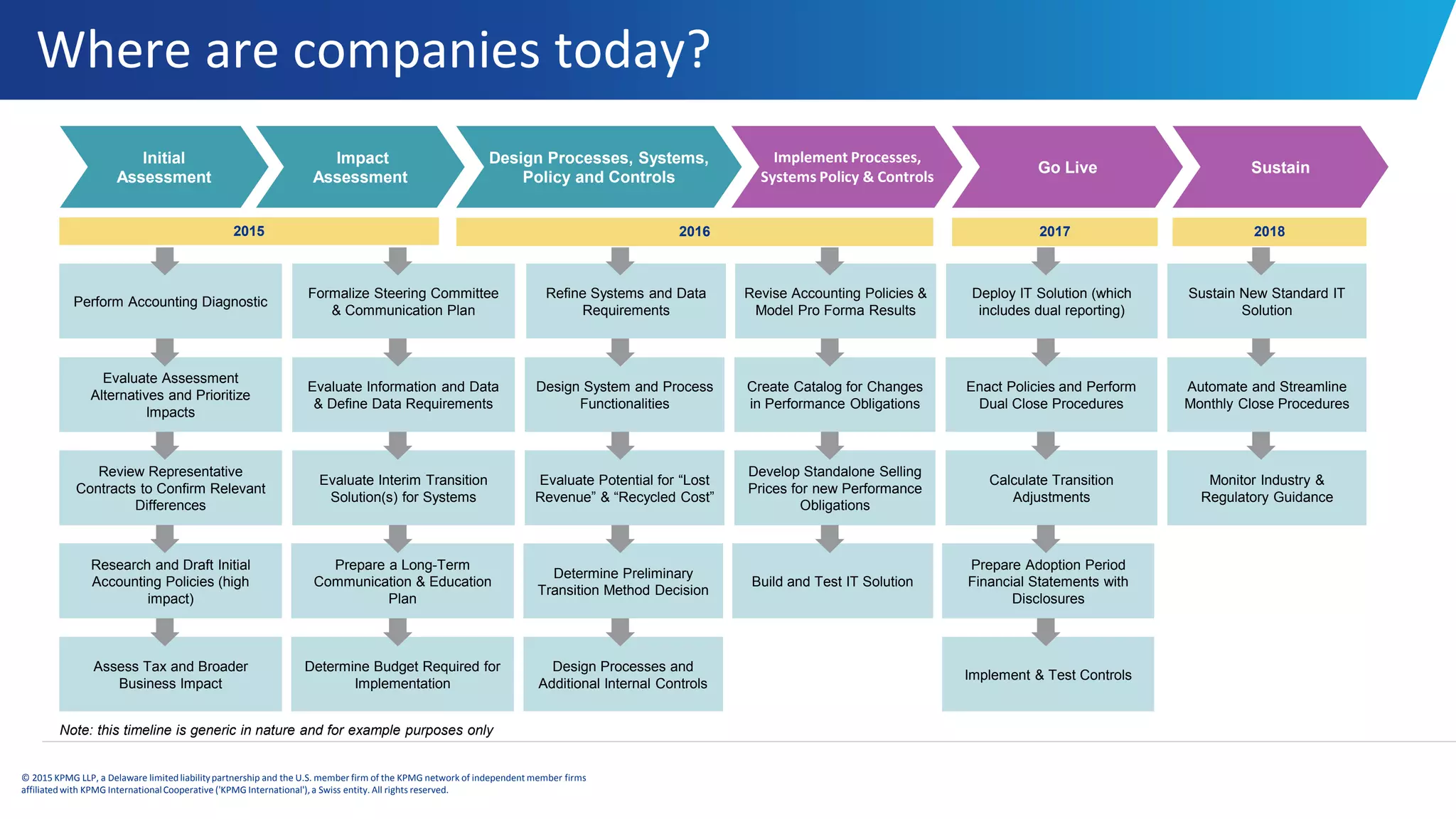
Where are companies today?
2015 2018
Assess Tax and Broader
Business Impact
Determine Budget Required for
Implementation
Design Processes and
Additional Internal Controls
Implement & Test Controls
2017
Evaluate Assessment
Alternatives and Prioritize
Impacts
Design System and Process
Functionalities
Evaluate Information and Data
& Define Data Requirements
Create Catalog for Changes
in Performance Obligations
Automate and Streamline
Monthly Close Procedures
Enact Policies and Perform
Dual Close Procedures
2016
Build and Test IT Solution
Prepare Adoption Period
Financial Statements with
Disclosures
Prepare a Long-Term
Communication & Education
Plan
Determine Preliminary
Transition Method Decision
Research and Draft Initial
Accounting Policies (high
impact)
Revise Accounting Policies &
Model Pro Forma Results
Refine Systems and Data
Requirements
Sustain New Standard IT
Solution
Deploy IT Solution (which
includes dual reporting)
Perform Accounting Diagnostic
Formalize Steering Committee
& Communication Plan
Evaluate Potential for “Lost
Revenue” & “Recycled Cost”
Review Representative
Contracts to Confirm Relevant
Differences
Evaluate Interim Transition
Solution(s) for Systems
Develop Standalone Selling
Prices for new Performance
Obligations
Calculate Transition
Adjustments
Monitor Industry &
Regulatory Guidance
Note: this timeline is generic in nature and for example purposes only
Initial
Assessment
Impact
Assessment
Design Processes, Systems,
Policy and Controls
SustainGo Live
Implement Processes,
Systems Policy & Controls
© 2015 Leeyo Software, Inc. CONFIDENTIAL AND PROPRIETARY - FOR INTERNAL USE ONLY - ALL RIGHTS RESERVED
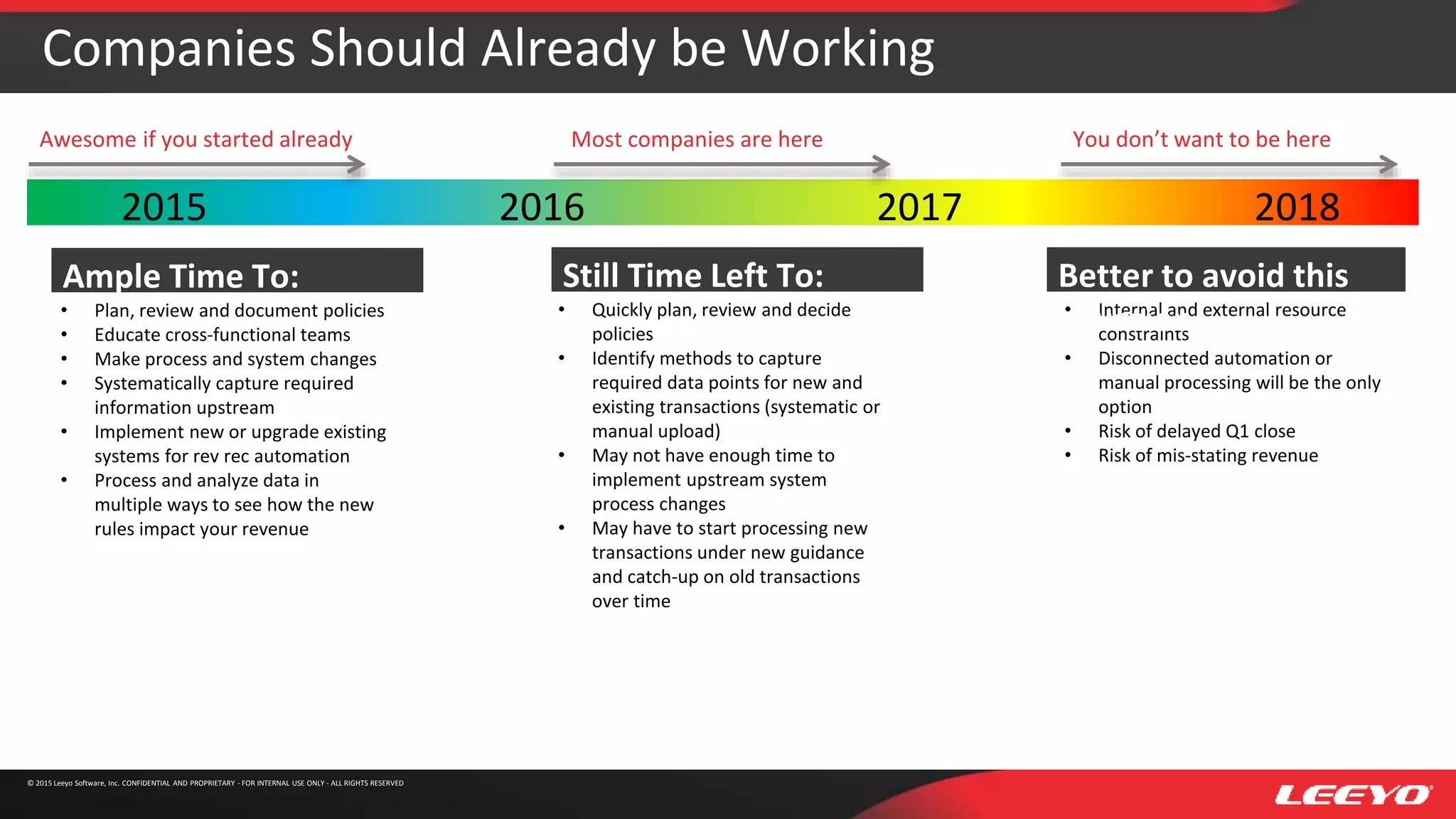
Companies Should Already be Working
2015 2016 2017 2018
Awesome if you started already Most companies are here You don’t want to be here
• Plan, review and document policies
• Educate cross-functional teams
• Make process and system changes
• Systematically capture required
information upstream
• Implement new or upgrade existing
systems for rev rec automation
• Process and analyze data in
multiple ways to see how the new
rules impact your revenue
Ample Time To:
• Quickly plan, review and decide
policies
• Identify methods to capture
required data points for new and
existing transactions (systematic or
manual upload)
• May not have enough time to
implement upstream system
process changes
• May have to start processing new
transactions under new guidance
and catch-up on old transactions
over time
Still Time Left To:
• Internal and external resource
constraints
• Disconnected automation or
manual processing will be the only
option
• Risk of delayed Q1 close
• Risk of mis-stating revenue
Better to avoid this
situation
© 2015 KPMG LLP, a Delaware limitedliabilitypartnership and the U.S. member firm of the KPMG network of independent member firms
affiliatedwith KPMG InternationalCooperative ('KPMG International'), a Swiss entity. All rights reserved.
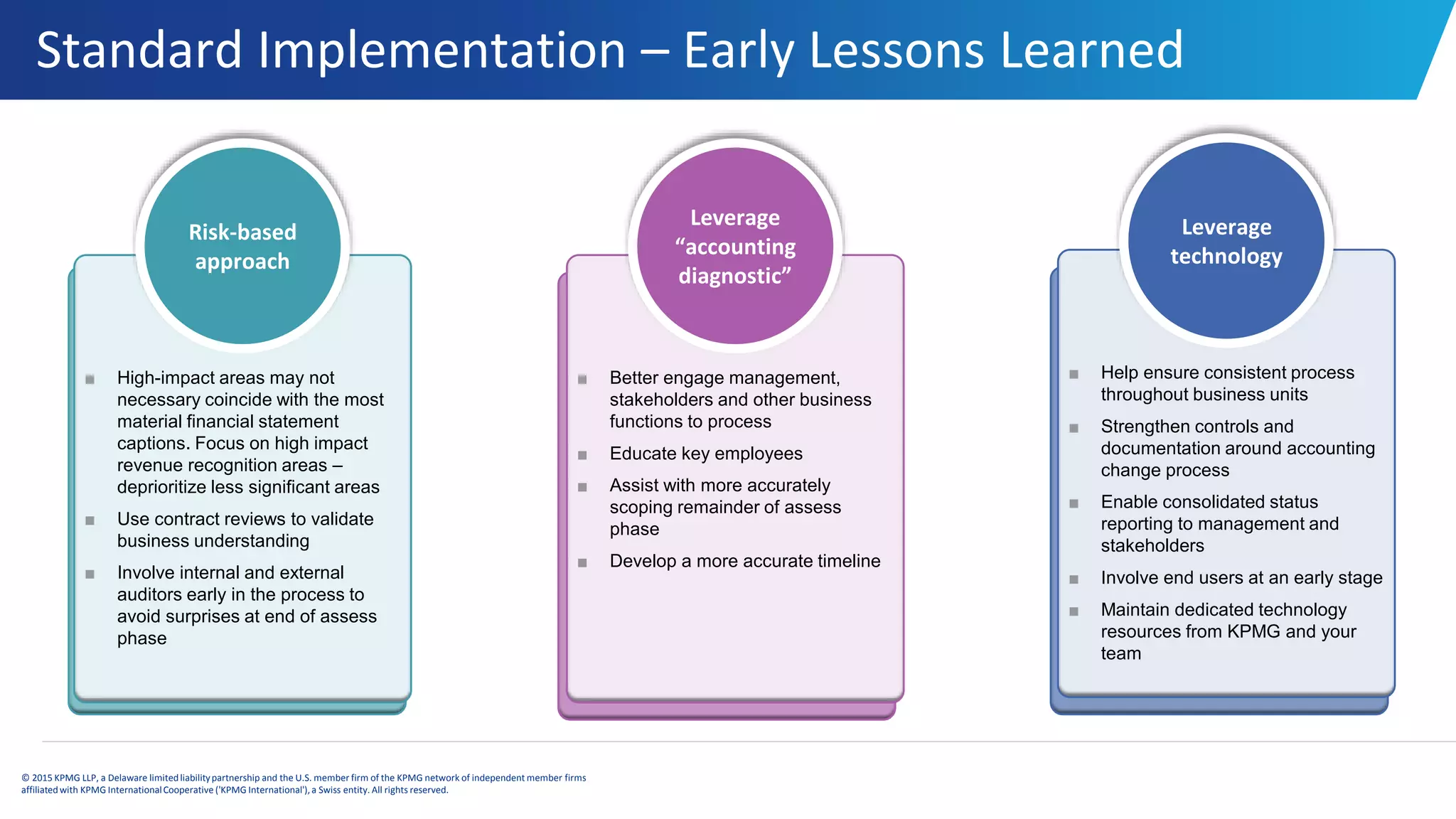
Standard Implementation – Early Lessons Learned
■ High-impact areas may not
necessary coincide with the most
material financial statement
captions. Focus on high impact
revenue recognition areas –
deprioritize less significant areas
■ Use contract reviews to validate
business understanding
■ Involve internal and external
auditors early in the process to
avoid surprises at end of assess
phase
Risk-based
approach
■ Better engage management,
stakeholders and other business
functions to process
■ Educate key employees
■ Assist with more accurately
scoping remainder of assess
phase
■ Develop a more accurate timeline
Leverage
“accounting
diagnostic”
■ Help ensure consistent process
throughout business units
■ Strengthen controls and
documentation around accounting
change process
■ Enable consolidated status
reporting to management and
stakeholders
■ Involve end users at an early stage
■ Maintain dedicated technology
resources from KPMG and your
team
Leverage
technology
Agenda
© 2015 KPMG LLP, a Delaware limitedliabilitypartnership and the U.S. member firm of the KPMG network of independent member firms
affiliatedwith KPMG InternationalCooperative ('KPMG International'), a Swiss entity. All rights reserved.
Overview of the Standard
Changes and Transitions
What’s Happening Today
Case Studies
Planning for Adoption
Wrap Up
What Questions do You Have?
© 2015 KPMG LLP, a Delaware limitedliabilitypartnership and the U.S. member firm of the KPMG network of independent member firms
affiliatedwith KPMG InternationalCooperative ('KPMG International'), a Swiss entity. All rights reserved.
The information contained herein is of a general nature
and is not intended to address the circumstances of any
particular individual or entity. Although we endeavor to
provide accurate and timely information, there can be no
guarantee that such information is accurate as of the date
it is received or that it will continue to be accurate in the
future. No one should act on such information without
appropriate professional advice after a thorough
examination of the particular situation.
© 2015 KPMG LLP, a Delaware limited liability
partnership and the U.S. member firm of the KPMG
network of independent member firms affiliated with
KPMG International Cooperative ('KPMG International'), a
Swiss entity. All rights reserved.
The KPMG name, logo and “cutting through complexity”
are registered trademarks or trademarks of KPMG
International.

Subscribed 2015: The New Revenue Standard: How SaaS are Approaching the New Revenue Standard

  • 1.
    New Revenue Standard: HowSaaS companies are approaching the new revenue standard May 2015
  • 2.
    Agenda Overview of theStandard Changes and Transition What’s Happening Today Case Studies Planning for Adoption Wrap Up © 2015 KPMG LLP, a Delaware limitedliabilitypartnership and the U.S. member firm of the KPMG network of independent member firms affiliatedwith KPMG InternationalCooperative ('KPMG International'), a Swiss entity. All rights reserved.
  • 3.
    Executive Overview ofthe Standard © 2015 KPMG LLP, a Delaware limitedliabilitypartnership and the U.S. member firm of the KPMG network of independent member firms affiliatedwith KPMG InternationalCooperative ('KPMG International'), a Swiss entity. All rights reserved. ■ Industry-specific software guidance is eliminated and replaced with a single accounting model for revenue recognition. ■ Significant judgments and estimates are required in many circumstances, especially around determining the transaction price and accounting for software licenses. ■ New business requirements to comply with the accounting policies will require changes to our accounting systems and expand our capture to include new source information. ■ The FASB and IASB has proposed delaying the effective date by 1 year and therefore we expect the new standard will become effective in calendar 2018. ■ There is a cumulative effect or retrospective transition method for adopting the standard which will require parallel processing of revenue for a period of time. 201820162013 2014 20172015 January 1st Retrospective transition application date January 1st Effective date May 28, 2014 Final standard January 1st Proposed Effective date Timeline effective dates shown are for public entities with December 31 year ends. Nonpublic entities have a one year deferral in effective date. Remove inconsistencies and weaknesses in existing requirements to improve comparability Provide a more robust framework for addressing revenue issues Provide more useful information through improved disclosure requirements Simplify the preparation of financial statements by having one revenue framework IASB/FASB Converged Standard Objectives of the New Revenue Standard
  • 4.
    … Broadly Impactingthe Organization © 2015 KPMG LLP, a Delaware limitedliabilitypartnership and the U.S. member firm of the KPMG network of independent member firms affiliatedwith KPMG InternationalCooperative ('KPMG International'), a Swiss entity. All rights reserved. New Revenue Recognition Standards & Corresponding Accounting Changes ■ Impact of new revenue recognition standard and mapping to new accounting rules ■ New accounting policies – historical results and transition ■ Reporting differences and disclosures ■ Tax reporting/planning Revenue Recognition Automation and ERP Upgrades ■ Automation and customization of ERP environment ■ Impact on ERP systems ■ General ledger, sub-ledgers and reporting packages ■ Peripheral revenue systems and interfaces Financial and Operational Process Changes ■ Revenue process allocation and management ■ Budget and management reporting ■ Communication with financial markets ■ Covenant compliance ■ Opportunity to rethink business practices ■ Coordination with other strategic initiatives Governance and Change ■ Governance organization and changes ■ Impact on internal resources ■ Project management ■ Training (accounting, sales, etc.) ■ Revenue change management team ■ Multi-national locations Revenue Recognition
  • 5.
    Five Steps ofthe Model © 2015 KPMG LLP, a Delaware limitedliabilitypartnership and the U.S. member firm of the KPMG network of independent member firms affiliatedwith KPMG InternationalCooperative ('KPMG International'), a Swiss entity. All rights reserved. Identify the contract(s) with a customer 1 Identify the separate performance obligations in the contract 2 Determine the transaction price 3 Allocate the transaction price to the separate performance obligations 4 Recognize revenue when (or as) the entity satisfies a performance obligation 5
  • 6.
    Agenda © 2015 KPMGLLP, a Delaware limitedliabilitypartnership and the U.S. member firm of the KPMG network of independent member firms affiliatedwith KPMG InternationalCooperative ('KPMG International'), a Swiss entity. All rights reserved. Overview of the Standard Changes and Transition What’s Happening Today Case Studies Planning for Adoption Wrap Up
  • 7.
    Agenda © 2015 KPMGLLP, a Delaware limitedliabilitypartnership and the U.S. member firm of the KPMG network of independent member firms affiliatedwith KPMG InternationalCooperative ('KPMG International'), a Swiss entity. All rights reserved. 100+ sources for revenue guidance Fees must be fixed or determinable Must have “persuasive evidence” of arrangement No recognition of contingent revenue Unit of account based on “standalone value” No rules on accounting for modifications Capitalizing contract acquisition costs optional Software industry held to higher standard (“VSOE”) IP license recognized upfront or ratable based on practice Revenue disclosures limited to policy discussion Existing Standards New Standards 1 standard for all arrangements, all industries Must have “legally binding” arrangement Fees are estimated if sufficient history exists No similar prohibition; subject to estimation Unit of account based on “distinct” Modification rules can result in complicated accounting Software guidance eliminated IP license subject to specific rules on how to recognize Capitalizing contract acquisition costs required Extensive disclosures required Expected pervasive impact to Cloud Service Providers companies
  • 8.
    Big 4 Guidanceand Vendor Input Is Revenue Automation right for you? © 2015 Leeyo Software, Inc. CONFIDENTIAL AND PROPRIETARY - FOR INTERNAL USE ONLY - ALL RIGHTS RESERVED Assessment Use Cases Address Data Gaps Identify Process Changes Evaluate Vendors Selection What are the most important items to consider in a solution? Ability to handle both current and new revenue recognition guidance Robust reporting capabilities Ability to grow and scale with your company Ability to accept data from any source ERP agnostic Ability to be a seamless add-on to existing system  The new revenue recognition guidance has every corporation examining their revenue processing.  What makes a good candidate for revenue automation? • Multiple revenue streams • Multiple transaction sources • Complex revenue recognition policies • A high volume of transactions • Products representing a bundle of goods & services • Contract modifications
  • 9.
    How it works ©2015 Leeyo Software, Inc. CONFIDENTIAL AND PROPRIETARY - FOR INTERNAL USE ONLY - ALL RIGHTS RESERVED E-Commerce Website Zuora 360 / Z-Quotes Transactions Contracts / Billing Manual Journal Entry Simple rev rec + manual revenue entries
  • 10.
    How it works ©2015 Leeyo Software, Inc. CONFIDENTIAL AND PROPRIETARY - FOR INTERNAL USE ONLY - ALL RIGHTS RESERVED E-Commerce Website Zuora 360 / Z-Quotes Transactions Contracts / Billing Simple rev rec + manual revenue entries Subscription & Billing Data Events Data
  • 11.
    How it works ToGeneral Ledger Revenue Policies / Setup Revenue Contract Grouping POB Assignment Transaction Price Adjustments Variable Consideration SSP Assignment Allocation Subscription & Billing Data Events Data Accounting Entries Created Revenue Recognition SSP Calculation Cost Applied Cost Estimates/Actuals Revenue Contract Workbench Reporting & Forecasting © 2015 Leeyo Software, Inc. CONFIDENTIAL AND PROPRIETARY - FOR INTERNAL USE ONLY - ALL RIGHTS RESERVED
  • 12.
    Agenda © 2015 KPMGLLP, a Delaware limitedliabilitypartnership and the U.S. member firm of the KPMG network of independent member firms affiliatedwith KPMG InternationalCooperative ('KPMG International'), a Swiss entity. All rights reserved. Overview of the Standard Changes and Transitions Case Studies Planning for Adoption Wrap Up What’s Happening Today
  • 13.
    SEC, AICPA TaskForce, and Big 4 Updates © 2015 KPMG LLP, a Delaware limitedliabilitypartnership and the U.S. member firm of the KPMG network of independent member firms affiliatedwith KPMG InternationalCooperative ('KPMG International'), a Swiss entity. All rights reserved. Statements from the SEC: ■ “Comparability is a hallmark of U.S. financial reporting…” – James Schnurr Focused on consistent application ■ Those that may require standard setting, those where practice and interpret consistently, and those that are more “educational” in nature ■ Considering whether any existing SEC disclosure or reporting requirements will be affected Numerous accounting questions ■ Variable consideration and disclosures ■ Reminded registrants to disclose material changes in ICFR as the new revenue standard is implemented Focus on internal controls, systems, and processes The AICPA’s process: ■ 16 industry task forces ■ Change in focus in 2015 ■ Will publish a guide that articulates issues and lead preparers to the appropriate considerations in evaluating a company’s fact patterns
  • 14.
    Deferral of effectivedate and transition considerations © 2015 KPMG LLP, a Delaware limitedliabilitypartnership and the U.S. member firm of the KPMG network of independent member firms affiliatedwith KPMG InternationalCooperative ('KPMG International'), a Swiss entity. All rights reserved. ■ FASB proposed a deferral of Effective Date (comment letter period end May 29, 2015) ■ Proposed Effective Date would be January 1, 2018 ■ In addition to 1-year deferral FASB requested comments on whether 2-year deferral would be appropriate ■ Early application permitted (but not before original effective date e.g., January 1, 2017) ■ Both Cumulative Effect and Retrospective transition methods are available. Practical expedients for the Retrospective transition method still allowed ■ IASB has voted to propose a one-year deferral of the Effective Date of IFRS 15 CUMULATIVE EFFECT METHOD 2014 2015 2016 2017 20182013 and prior 2019 and beyond Evaluate Existing Contracts for Cumulative Effect Adjustment Maintain Existing Systems and Processes for Legacy GAAP Reporting RETROSPECTIVE METHOD Interim Solution / Maintain New Systems & Processes Dual reporting 2014 2015 2016 2017 20182013 and prior 2019 and beyond Evaluate Existing Contracts for Cumulative Effect Adjustment Maintain Existing Systems and Processes for Legacy GAAP Reporting Maintain New Systems & Processes Effective Date? May 6, 2015 Effective Date
  • 15.
    Interpretation Considerations © 2015KPMG LLP, a Delaware limitedliabilitypartnership and the U.S. member firm of the KPMG network of independent member firms affiliatedwith KPMG InternationalCooperative ('KPMG International'), a Swiss entity. All rights reserved. FASB expects to issue several exposure drafts to clarify the application of the Standard. Interpretation of an accounting standard during adoption period is normal and requires close monitoring for impacts to ADSK. Expected Exposure Drafts Issuance Date / Expected Date of Issuance Description Exposure Draft 1 – Deferral of Effective Date April 28, 2015 ■ FASB proposed a deferral of Effective Date (comment letter period end May 29, 2015) Exposure Draft 2 – Licenses and Performance Obligations May 12, 2015 ■ Application of the “distinct in the context of the contract” criterion (Step 2) ■ License of intellectual property and the scope and application of the sales- and usage-based royalties exception (comment letter period end June 30, 2015) Exposure Draft 3 – Collectibility and other clarification issues Expected in Q3 2015 ■ Collectibility (Accounting for Partial Receipt) ■ Additional Issues to be included (comment letter period 30-45 days after Issuance of the ED) Exposure Draft 4 – Gross vs. Net presentation Expected in Q3 2015 ■ Comprehensive review of application guidance on gross vs net presentation (comment letter period 30-45 days after Issuance of the ED)
  • 16.
    Agenda © 2015 KPMGLLP, a Delaware limitedliabilitypartnership and the U.S. member firm of the KPMG network of independent member firms affiliatedwith KPMG InternationalCooperative ('KPMG International'), a Swiss entity. All rights reserved. Overview of the Standard Changes and Transitions What’s Happening Today Planning for Adoption Wrap Up Case Studies
  • 17.
    Case Study 1:Variable Consideration Contingent Revenue © 2015 KPMG LLP, a Delaware limitedliabilitypartnership and the U.S. member firm of the KPMG network of independent member firms affiliatedwith KPMG InternationalCooperative ('KPMG International'), a Swiss entity. All rights reserved. Step 3 The amount allocable to the delivered unit or units of accounting is NO LONGER limited to the amount that is not contingent upon the delivery of additional items or meeting other specified performance conditions (the non-contingent amount) A Cloud Service Provider (CSP) enters into a contract with a customer to provide hosting services for three years for a total consideration of $3,000. The customer is required to pay the vendor $100 per month starting in month seven of the contract. ( 6 months of “free service”) The agreement has a contractual provision entitles the customer to a refund equal to the pro-rata amount of the undelivered services if it is not provided (i.e., if the customer cancels the contract by end of month six no consideration is due from the customer). A contractual provision that entitles the customer to a refund equal to the prorata amount of the undelivered services if it is not provided would no longer result in an automatic full revenue deferral. Under the new guidance and assuming there is no significant risk of revenue reversal $3,000 in total consideration would be recognized over a three year period (i.e., $83.33 per month); as compared to current guidance which would result in no revenue for the first 6 months.
  • 18.
    © 2015 KPMGLLP, a Delaware limitedliabilitypartnership and the U.S. member firm of the KPMG network of independent member firms affiliatedwith KPMG InternationalCooperative ('KPMG International'), a Swiss entity. All rights reserved. Step 3 Example – SaaS contract with usage-based fees A CSP has contracted with a Customer to provide hosted-only access to its software application for two years for a fixed access fee of $200,000 (billed quarterly in advance) plus variable fees of $1 per transaction processed using the hosted software over 1,000 transactions. CSP, in pricing this contract, has estimated (using a probability-weighted approach) that it would earn $20,000 in transaction-based fees. CSP vendor has entered into similar contracts with other customers; however, none of those customers are in the same business as Customer, so that experience is only partially relevant. Given the lack of relevant experience with similar customers, CSP vendor determines that only $10,000 of variable fees do not carry a risk of resulting in a subsequent revenue reversal. The Company has a business practice of alerting the customer if the limit of 1,000 transactions is about to be met, or is consistently surpassed so that the customer can consider modifying their current contract. Considerations when evaluating under the New Standard: ■ In determining the Transaction Price, the Vendor would apply the guidance Variable Consideration (and Constraint). ■ The usage based component does not qualify for the exception because it is not a royalty promised in exchange for a license of IP ■ The SAAS obligation is satisfied overtime (rather than point in time) ■ Modification guidance would need to be applied. Consideration of the frequency of modifications and it’s impact on estimating variable consideration might impact the Vendor’s determination of constraint. Various approaches available: Currently being discussed at the Transition Committee Case Study 2: Example SaaS contract with usage-based fees
  • 19.
    © 2015 KPMGLLP, a Delaware limitedliabilitypartnership and the U.S. member firm of the KPMG network of independent member firms affiliatedwith KPMG InternationalCooperative ('KPMG International'), a Swiss entity. All rights reserved. Costs of Obtaining A Contract As a practical expedient, capitalization of contract acquisition costs not required if the amortization period would be one year or less. An entity recognizes an asset for the incremental costs of obtaining a contract that the entity expects to recover: Incremental costs the entity would not have incurred if the contract had not been obtained Costs incurred regardless of whether or not the contract was obtained generally are expensed Current U.S. GAAP allows for a policy election to capitalize contact acquisition costs, under the new standard, capitalizing certain costs of obtaining a contract is required
  • 20.
    © 2015 LeeyoSoftware, Inc. CONFIDENTIAL AND PROPRIETARY - FOR INTERNAL USE ONLY - ALL RIGHTS RESERVED
  • 21.
    © 2015 LeeyoSoftware, Inc. CONFIDENTIAL AND PROPRIETARY - FOR INTERNAL USE ONLY - ALL RIGHTS RESERVED RevPro Reporting  Revenue Waterfall (Actuals and Forecast)  Deferred Revenue/Contract Liability Roll-forward  Unreleased Performance Obligations  Contract Asset Roll-forward  Unbilled Roll-forward  Arrangement Move  Adjusted Allocation  Accounting Detail  Revenue Disclosure  Billing and booking reports  User-configurable Reporting Interface
  • 22.
    Agenda © 2015 KPMGLLP, a Delaware limitedliabilitypartnership and the U.S. member firm of the KPMG network of independent member firms affiliatedwith KPMG InternationalCooperative ('KPMG International'), a Swiss entity. All rights reserved. Overview of the Standard Changes and Transitions What’s Happening Today Case Studies Wrap Up Planning for Adoption
  • 23.
    © 2015 KPMGLLP, a Delaware limitedliabilitypartnership and the U.S. member firm of the KPMG network of independent member firms affiliatedwith KPMG InternationalCooperative ('KPMG International'), a Swiss entity. All rights reserved. Where are companies today? 2015 2018 Assess Tax and Broader Business Impact Determine Budget Required for Implementation Design Processes and Additional Internal Controls Implement & Test Controls 2017 Evaluate Assessment Alternatives and Prioritize Impacts Design System and Process Functionalities Evaluate Information and Data & Define Data Requirements Create Catalog for Changes in Performance Obligations Automate and Streamline Monthly Close Procedures Enact Policies and Perform Dual Close Procedures 2016 Build and Test IT Solution Prepare Adoption Period Financial Statements with Disclosures Prepare a Long-Term Communication & Education Plan Determine Preliminary Transition Method Decision Research and Draft Initial Accounting Policies (high impact) Revise Accounting Policies & Model Pro Forma Results Refine Systems and Data Requirements Sustain New Standard IT Solution Deploy IT Solution (which includes dual reporting) Perform Accounting Diagnostic Formalize Steering Committee & Communication Plan Evaluate Potential for “Lost Revenue” & “Recycled Cost” Review Representative Contracts to Confirm Relevant Differences Evaluate Interim Transition Solution(s) for Systems Develop Standalone Selling Prices for new Performance Obligations Calculate Transition Adjustments Monitor Industry & Regulatory Guidance Note: this timeline is generic in nature and for example purposes only Initial Assessment Impact Assessment Design Processes, Systems, Policy and Controls SustainGo Live Implement Processes, Systems Policy & Controls
  • 24.
    © 2015 LeeyoSoftware, Inc. CONFIDENTIAL AND PROPRIETARY - FOR INTERNAL USE ONLY - ALL RIGHTS RESERVED Companies Should Already be Working 2015 2016 2017 2018 Awesome if you started already Most companies are here You don’t want to be here • Plan, review and document policies • Educate cross-functional teams • Make process and system changes • Systematically capture required information upstream • Implement new or upgrade existing systems for rev rec automation • Process and analyze data in multiple ways to see how the new rules impact your revenue Ample Time To: • Quickly plan, review and decide policies • Identify methods to capture required data points for new and existing transactions (systematic or manual upload) • May not have enough time to implement upstream system process changes • May have to start processing new transactions under new guidance and catch-up on old transactions over time Still Time Left To: • Internal and external resource constraints • Disconnected automation or manual processing will be the only option • Risk of delayed Q1 close • Risk of mis-stating revenue Better to avoid this situation
  • 25.
    © 2015 KPMGLLP, a Delaware limitedliabilitypartnership and the U.S. member firm of the KPMG network of independent member firms affiliatedwith KPMG InternationalCooperative ('KPMG International'), a Swiss entity. All rights reserved. Standard Implementation – Early Lessons Learned ■ High-impact areas may not necessary coincide with the most material financial statement captions. Focus on high impact revenue recognition areas – deprioritize less significant areas ■ Use contract reviews to validate business understanding ■ Involve internal and external auditors early in the process to avoid surprises at end of assess phase Risk-based approach ■ Better engage management, stakeholders and other business functions to process ■ Educate key employees ■ Assist with more accurately scoping remainder of assess phase ■ Develop a more accurate timeline Leverage “accounting diagnostic” ■ Help ensure consistent process throughout business units ■ Strengthen controls and documentation around accounting change process ■ Enable consolidated status reporting to management and stakeholders ■ Involve end users at an early stage ■ Maintain dedicated technology resources from KPMG and your team Leverage technology
  • 26.
    Agenda © 2015 KPMGLLP, a Delaware limitedliabilitypartnership and the U.S. member firm of the KPMG network of independent member firms affiliatedwith KPMG InternationalCooperative ('KPMG International'), a Swiss entity. All rights reserved. Overview of the Standard Changes and Transitions What’s Happening Today Case Studies Planning for Adoption Wrap Up
  • 27.
    What Questions doYou Have? © 2015 KPMG LLP, a Delaware limitedliabilitypartnership and the U.S. member firm of the KPMG network of independent member firms affiliatedwith KPMG InternationalCooperative ('KPMG International'), a Swiss entity. All rights reserved.
  • 28.
    The information containedherein is of a general nature and is not intended to address the circumstances of any particular individual or entity. Although we endeavor to provide accurate and timely information, there can be no guarantee that such information is accurate as of the date it is received or that it will continue to be accurate in the future. No one should act on such information without appropriate professional advice after a thorough examination of the particular situation. © 2015 KPMG LLP, a Delaware limited liability partnership and the U.S. member firm of the KPMG network of independent member firms affiliated with KPMG International Cooperative ('KPMG International'), a Swiss entity. All rights reserved. The KPMG name, logo and “cutting through complexity” are registered trademarks or trademarks of KPMG International.