1
Project ASPIRE
CRP0 – Oracle Item Master
June 29, 2015
2
Agenda
 Design Decisions
 Item Types and Templates
 Item Catalog and Item Category
 Defining a new item – Assurant Device
 Serial Numbering, Lot Control and Grade attributes
 Item Relationships
 Customer Item Cross References
3
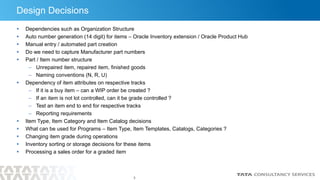
Design Decisions
 Dependencies such as Organization Structure
 Auto number generation (14 digit) for items – Oracle Inventory extension / Oracle Product Hub
 Manual entry / automated part creation
 Do we need to capture Manufacturer part numbers
 Part / Item number structure
– Unrepaired item, repaired item, finished goods
– Naming conventions (N, R, U)
 Dependency of item attributes on respective tracks
– If it is a buy item – can a WIP order be created ?
– If an item is not lot controlled, can it be grade controlled ?
– Test an item end to end for respective tracks
– Reporting requirements
 Item Type, Item Category and Item Catalog decisions
 What can be used for Programs – Item Type, Item Templates, Catalogs, Categories ?
 Changing item grade during operations
 Inventory sorting or storage decisions for these items
 Processing a sales order for a graded item
5
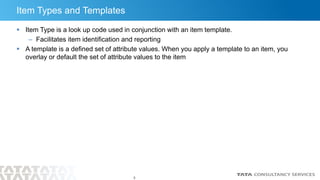
Item Types and Templates
 Item Type is a look up code used in conjunction with an item template.
– Facilitates item identification and reporting
 A template is a defined set of attribute values. When you apply a template to an item, you
overlay or default the set of attribute values to the item
6
Item Catalog and Item Category
Item Categories
 A category is a logical classification of
items that have similar characteristics
 Category and category sets are used
to group items for various reports and
programs
 Widely used for reporting as compared
to catalogs (across applications)
 Allows for searching on items
 Most standard reports have categories
as a parameter
Item Catalog
 Item catalog is used to add descriptive
‘elements’ information (physical attributes)
to items
 Partition Item Master into groups of items
that share common characteristics
 Provide standard language in referring to
items
 Use descriptive item “elements” as search
criteria for items
 Update Item Description with a
concatenated value of the item catalog
information
 Key in text vs. selecting LOV in category
7
Defining a new item – Assurant Device
 Samsung Galaxy S4, White
8
Serial Numbering, Lot and Grade attributes
 Serial Number
– At Receipt
o Assign serial numbers when you receive the item
– At Sales Order Issue
o Serial Numbers are required at Ship Confirm
– Predefined
o Assign predefined serial numbers when you define the item
 Lot Control
– A lot represents a quality of an item that shares the same specifications, one or more
receipts from the same vendor
– Assign a lot number when you receive items under lot control
 Grade Control
– Was part of Oracle Process Manufacturing
– From R12 Discrete and Process Inventory were merged
9
Item Relationships
 Enables cross selling and upselling on a sales order
 Other functionalities such as Service, Prerequisite, Collateral, Complimentary, Repair, etc…
 Search for item through relationships

Oracle item master crp-0 (2)

  • 1.
    1 Project ASPIRE CRP0 –Oracle Item Master June 29, 2015
  • 2.
    2 Agenda  Design Decisions Item Types and Templates  Item Catalog and Item Category  Defining a new item – Assurant Device  Serial Numbering, Lot Control and Grade attributes  Item Relationships  Customer Item Cross References
  • 3.
    3 Design Decisions  Dependenciessuch as Organization Structure  Auto number generation (14 digit) for items – Oracle Inventory extension / Oracle Product Hub  Manual entry / automated part creation  Do we need to capture Manufacturer part numbers  Part / Item number structure – Unrepaired item, repaired item, finished goods – Naming conventions (N, R, U)  Dependency of item attributes on respective tracks – If it is a buy item – can a WIP order be created ? – If an item is not lot controlled, can it be grade controlled ? – Test an item end to end for respective tracks – Reporting requirements  Item Type, Item Category and Item Catalog decisions  What can be used for Programs – Item Type, Item Templates, Catalogs, Categories ?  Changing item grade during operations  Inventory sorting or storage decisions for these items  Processing a sales order for a graded item
  • 4.
    5 Item Types andTemplates  Item Type is a look up code used in conjunction with an item template. – Facilitates item identification and reporting  A template is a defined set of attribute values. When you apply a template to an item, you overlay or default the set of attribute values to the item
  • 5.
    6 Item Catalog andItem Category Item Categories  A category is a logical classification of items that have similar characteristics  Category and category sets are used to group items for various reports and programs  Widely used for reporting as compared to catalogs (across applications)  Allows for searching on items  Most standard reports have categories as a parameter Item Catalog  Item catalog is used to add descriptive ‘elements’ information (physical attributes) to items  Partition Item Master into groups of items that share common characteristics  Provide standard language in referring to items  Use descriptive item “elements” as search criteria for items  Update Item Description with a concatenated value of the item catalog information  Key in text vs. selecting LOV in category
  • 6.
    7 Defining a newitem – Assurant Device  Samsung Galaxy S4, White
  • 7.
    8 Serial Numbering, Lotand Grade attributes  Serial Number – At Receipt o Assign serial numbers when you receive the item – At Sales Order Issue o Serial Numbers are required at Ship Confirm – Predefined o Assign predefined serial numbers when you define the item  Lot Control – A lot represents a quality of an item that shares the same specifications, one or more receipts from the same vendor – Assign a lot number when you receive items under lot control  Grade Control – Was part of Oracle Process Manufacturing – From R12 Discrete and Process Inventory were merged
  • 8.
    9 Item Relationships  Enablescross selling and upselling on a sales order  Other functionalities such as Service, Prerequisite, Collateral, Complimentary, Repair, etc…  Search for item through relationships