Proprietary and confidential. | 2016 AXIA Consulting™ | All rights reserved.
Oracle Applications – Upgrade Strategies
AXIA Consulting
About AXIA Consulting
At AXIA Consulting, we understand the importance of
choosing a trustworthy partner who takes the time to
understand your business and we have the proven
ability to deliver meaningful results.
With a team of industry experts who average 20 years of
experience in the field, AXIA’s accessible business and
technology leaders hardness their expertise to solve our
clients’ most complex problems.
Founded in 2005, AXIA is 100% employee-owned and
employs approximately 100 Senior Consultants. We are
a global company, delivering results for clients in more
than 54 countries over six continents.
www.axiaconsulting.net
Committed To Excellence
AXIA is driven by values and our commitment
to excellence, resulting in trusted
partnerships and lasting client relationships
AXIA Credentials
• Founded on Oracle EBS - AXIA Consulting was founded in 2005 by
experienced Oracle ERP professionals who created, grew, and managed
Oracle ERP practice areas at larger, global consulting firms.
• Most AXIA company leaders started with Oracle Applications in 1993
working on version 9.4.2. A majority of our Oracle consultants have over 20
years of Oracle experience.
• AXIA Consulting is committed to the ongoing professional development of
its consultants and to supporting regional and national user groups:
• Oracle Gold Partner
• Oracle Applications User Group (OAUG) member and frequent presenter
• Oracle Open World regular conference attendee, frequent presenter
• Ohio Valley OAUG, President, Past-president and Co-Founder
• National OAUG Geo/SIG Committee
Upgrade Questions
AXIA has expertise with helping clients navigate through the
following trends in the Oracle Applications area:
• Upgrades of EBS from 11i (e.g., 11.5.10) to R12
• Oracle’s constant revisions to the published support lifecycles for
Applications products
• Applications customers wondering what the future holds for R12.2 and
Fusion
This presentation will review some strategies to consider for
your organization’s journey to the latest Oracle Applications
releases (EBS & Fusion)
Many slides will contain content from Oracle presentations and this
will be used as a reference to drive the direction of this discussion.
Upgrade Questions cont.
Depending on your current ERP operating environment
and version, you may be asking questions such as:
“Should I upgrade to EBS Release 12.1 or 12.2? What will R12.2 do for
me?”
“What is going on with Oracle’s Fusion Applications? Should I consider
an upgrade to Fusion? Will there be an EBS version beyond 12.2?”
“Can we use parts of Fusion at some point, or must we migrate entirely
off EBS?”
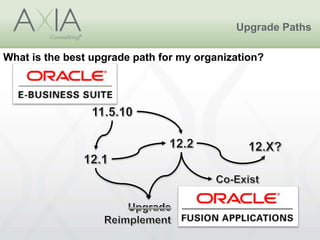
Upgrade Paths
What is the best upgrade path for my organization?
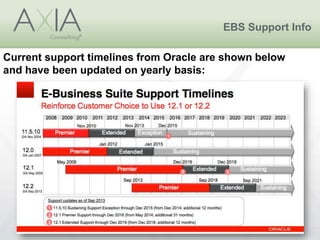
EBS Support Info
Current support timelines from Oracle are shown below
and have been updated on yearly basis:
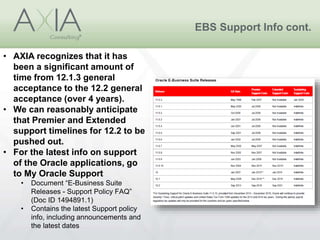
EBS Support Info cont.
• AXIA recognizes that it has
been a significant amount of
time from 12.1.3 general
acceptance to the 12.2 general
acceptance (over 4 years).
• We can reasonably anticipate
that Premier and Extended
support timelines for 12.2 to be
pushed out.
• For the latest info on support
of the Oracle applications, go
to My Oracle Support
• Document “E-Business Suite
Releases - Support Policy FAQ”
(Doc ID 1494891.1)
• Contains the latest Support policy
info, including announcements and
the latest dates
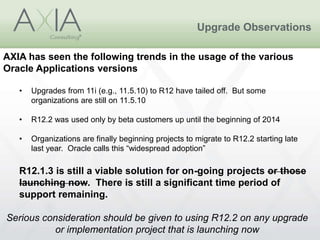
Upgrade Observations
AXIA has seen the following trends in the usage of the various
Oracle Applications versions
• Upgrades from 11i (e.g., 11.5.10) to R12 have tailed off. But some
organizations are still on 11.5.10
• R12.2 was used only by beta customers up until the beginning of 2014
• Organizations are finally beginning projects to migrate to R12.2 starting late
last year. Oracle calls this “widespread adoption”
R12.1.3 is still a viable solution for on-going projects or those
launching now. There is still a significant time period of
support remaining.
Serious consideration should be given to using R12.2 on any upgrade
or implementation project that is launching now
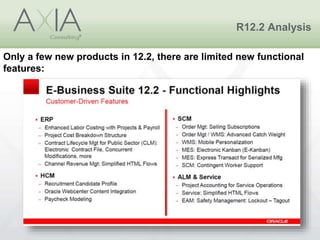
R12.2 Analysis
Only a few new products in 12.2, there are limited new functional
features:
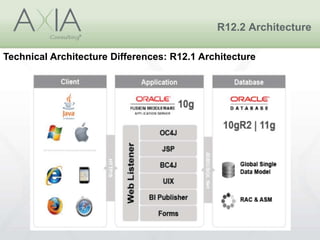
R12.2 Architecture
Technical Architecture Differences: R12.1 Architecture
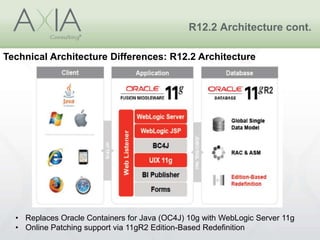
R12.2 Architecture cont.
Technical Architecture Differences: R12.2 Architecture
• Replaces Oracle Containers for Java (OC4J) 10g with WebLogic Server 11g
• Online Patching support via 11gR2 Edition-Based Redefinition
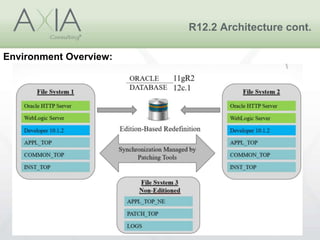
R12.2 Architecture cont.
Environment Overview:
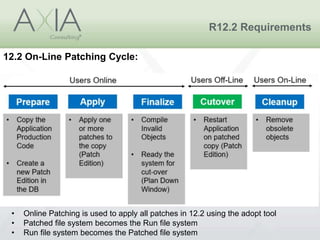
R12.2 Requirements
12.2 On-Line Patching Cycle:
• Online Patching is used to apply all patches in 12.2 using the adopt tool
• Patched file system becomes the Run file system
• Run file system becomes the Patched file system
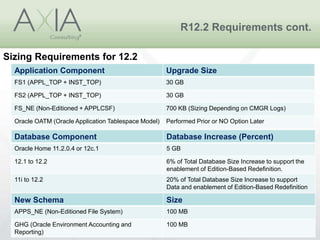
R12.2 Requirements cont.
Sizing Requirements for 12.2
Application Component Upgrade Size
FS1 (APPL_TOP + INST_TOP) 30 GB
FS2 (APPL_TOP + INST_TOP) 30 GB
FS_NE (Non-Editioned + APPLCSF) 700 KB (Sizing Depending on CMGR Logs)
Oracle OATM (Oracle Application Tablespace Model) Performed Prior or NO Option Later
Database Component Database Increase (Percent)
Oracle Home 11.2.0.4 or 12c.1 5 GB
12.1 to 12.2 6% of Total Database Size Increase to support the
enablement of Edition-Based Redefinition.
11i to 12.2 20% of Total Database Size Increase to support
Data and enablement of Edition-Based Redefinition
New Schema Size
APPS_NE (Non-Editioned File System) 100 MB
GHG (Oracle Environment Accounting and
Reporting)
100 MB
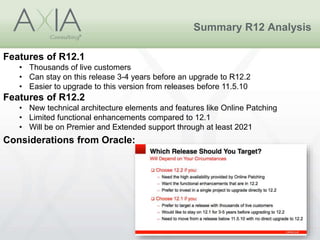
Summary R12 Analysis
Features of R12.1
• Thousands of live customers
• Can stay on this release 3-4 years before an upgrade to R12.2
• Easier to upgrade to this version from releases before 11.5.10
Features of R12.2
• New technical architecture elements and features like Online Patching
• Limited functional enhancements compared to 12.1
• Will be on Premier and Extended support through at least 2021
Considerations from Oracle:
12.1.3 to 12.2
On 12.1.3?
• Limited functional enhancements compared to 12.2
• 12.2 will be on Premier and Extended support through at
least 2021
• Online Patching
• iStore, Service
• 24x7 shop
• World-wide operations
• Specific functional enhancements
• WMS Personalization
• Subscriptions
Fusion Introduction
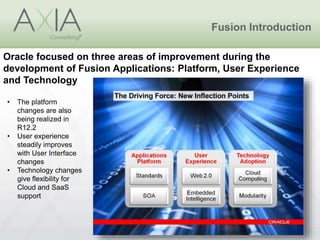
Oracle focused on three areas of improvement during the
development of Fusion Applications: Platform, User Experience
and Technology
• The platform
changes are also
being realized in
R12.2
• User experience
steadily improves
with User Interface
changes
• Technology changes
give flexibility for
Cloud and SaaS
support
Fusion Options
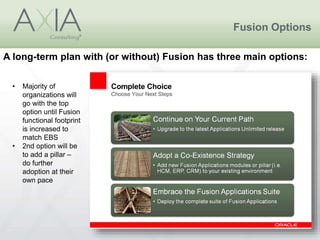
A long-term plan with (or without) Fusion has three main options:
• Majority of
organizations will
go with the top
option until Fusion
functional footprint
is increased to
match EBS
• 2nd option will be
to add a pillar –
do further
adoption at their
own pace
Expected Upgrade Benefits
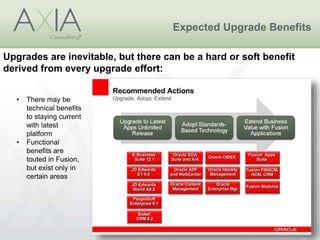
Upgrades are inevitable, but there can be a hard or soft benefit
derived from every upgrade effort:
• There may be
technical benefits
to staying current
with latest
platform
• Functional
benefits are
touted in Fusion,
but exist only in
certain areas
Co-Existence Options
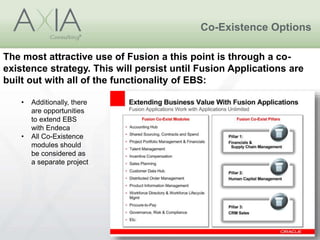
The most attractive use of Fusion a this point is through a co-
existence strategy. This will persist until Fusion Applications are
built out with all of the functionality of EBS:
• Additionally, there
are opportunities
to extend EBS
with Endeca
• All Co-Existence
modules should
be considered as
a separate project
Thoughts on Fusion
Choosing to go with a Co-existence scenario will present its
own set of challenges in the long term:
• May complicate future upgrades of the EBS “Applications
Unlimited” products.
• At some point, an organization may choose to complete migrate
to Fusion Applications. The process of data synchronization
used in a Co-existence model will have to be rationalized with
the upgrade onto a complete Fusion platform.
• We are trusting that Oracle will develop some really good scripts
to deal with this action!!
Factors to Consider
While considering your existing Oracle solutions and the
new releases of Oracle Applications available, customers
should keep the following potential business objectives in
mind:
• Getting and protecting the most value from their existing investment
• Getting the key benefits of new application features and functionality
offered by Oracle
• Mitigating the risks associated with upgrading, reimplementation, or
coexistence with multiple instances
• Minimizing risks of disruptions to daily operations
• Looking for productivity enhancements, while keeping employees
motivated and challenged
• Exploring benefits of On-Premise vs. SaaS models
Next Steps
• Whenever an organization must decide on the future direction of their
applications environment, it is vital to perform a detailed business
and technical assessment of the organization’s requirements and
existing solutions
• Typically, this would result in an applications roadmap tailored to the
organization’s unique requirements and current application footprint
• The roadmap is based on an assessment of the customer’s existing
Oracle Applications and any proposed target Oracle Applications
solution, and includes a proposed high-level plan and an
identification of any risks
• Assessments should also take into account the organization’s
technical environment, custom development inventory, and existing
issues in order to fully leverage Oracle Applications
Reference Materials
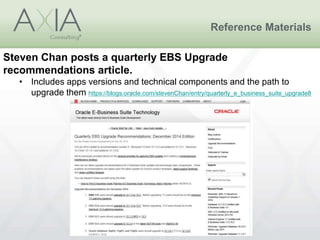
Steven Chan posts a quarterly EBS Upgrade
recommendations article.
• Includes apps versions and technical components and the path to
upgrade them https://blogs.oracle.com/stevenChan/entry/quarterly_e_business_suite_upgrade8
Reference Materials cont.
See 12.2 Technical Planning Guide, Doc 1585857.1
“One of the most significant new features of Oracle E-Business Suite Release 12.2 is Online
Patching, which greatly reduces the periods of downtime needed when applying patches. Such a
significant transition does, however, require an understanding of the new patching model, including
the new terminology and tools that underpin online patching operation, as well as the database and
file system features and organization.
This Technical Planning Guide is designed to help you identify what you need to think about as you
prepare to install (or upgrade to) Oracle E-Business Suite Release 12.2 and its online patching
environment.”
Oracle® E-‐Business Suite -‐Upgrade Guide Release 11i to
12.2
• Part No. E48834-‐08-‐March 2014
Reference Materials cont.
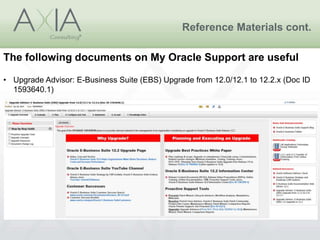
The following documents on My Oracle Support are useful
• Upgrade Advisor: E-Business Suite (EBS) Upgrade from 12.0/12.1 to 12.2.x (Doc ID
1593640.1)
Reference Materials cont.
• EBS Data Model Comparison Report (1290886.1)
• Lists database object definition changes between 11i (and
beyond) and 12.x releases
• Helps you identify and plan for upgrade impacts on custom code
• Switch custom reports from distribution lines in separate apps to new
Subledger Accounting (XLA) tables
• Update custom Oracle Discoverer Business Areas
• Video on the contents and usage
• EBS File System Comparison Report (1446430.1)
• Lists additions, removals, and modifications of EBS files
between 11i (and beyond) and 12.x releases
• Helps you analyze and plan for upgrade impacts on:
• Customizations and personalizations
• Functional flow tests
Reference Materials cont.
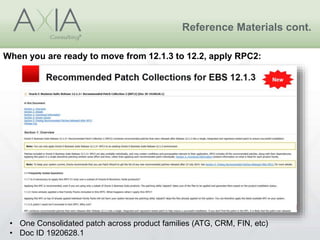
When you are ready to move from 12.1.3 to 12.2, apply RPC2:
• One Consolidated patch across product families (ATG, CRM, FIN, etc)
• Doc ID 1920628.1
Reference Materials cont.
When you are ready to move from 12.1.3 to 12.2:
New Development Standards
Some Examples:
• Review the New Coding Standards:
• Cross Edition Triggers replace data upgrade scripts
• Table names must be less than 29 characters
• Non-Editioned objects can't reference Editioned objects
• Do not reference the database object directly from their home schema
• Never query standard tables directly, instead use the synonym
• All custom schemas/applications must be registered
• Review the New Deployment Standards:
• Custom files must be applied to the Patch file system
• Custom files must be registered with the custom driver
Reference Materials cont.
Technical Challenges for 12.2 – Impact on your Customizations
• Note 1577661.1 describes the process of setting up the application and
database tiers to support custom objects in the new On-Line patching
architecture
• An Oracle E-Business Suite Release 12.2 installation now includes two editions
(versions) of the application code and seed data, the “Run” edition and the
“Patch” edition
• Online Patching Readiness Report MOS DOC ID #1531121.1
• The Global Standards Compliance Checker (GSCC)
• New development standards for R12.2 are discussed to ensure compatibility with
On-Line Patching
• Online Patching Analysis Report (Patch #16236081)
• Report all violations of “Non-Editioned Objects can’t reference Editioned Objects
• Custom application is created with the adsplice utility, to ensure that the proper
“editioning” of the custom code will take place
• This is described in further detail in note 1577707.1
Conclusion
• Stay Alert! Take a Yearly Check-Up!
• “Favorite” the important notes in My Oracle Support
• Talk to other organizations to find out what they are doing
• Support your local/national OAUG and attend events
• Consider a formal roadmap exercise every 3-5 years
Contacts
For more information, visit
http://www.axiaconsulting.net/
or give us a call at 866.937.5550
AXIA Consulting is a global provider of business and technology solutions
focused on maximizing investments and delivering results. With experience
across multiple industries and more than 54 countries, AXIA’s senior team
helps organizations tackle tough challenges, from large-scale ERP
implementations and post-merger integrations, to organizational change
and more.

Oracle Applications Upgrade Strategies

  • 1.
    Proprietary and confidential.| 2016 AXIA Consulting™ | All rights reserved. Oracle Applications – Upgrade Strategies
  • 2.
    AXIA Consulting About AXIAConsulting At AXIA Consulting, we understand the importance of choosing a trustworthy partner who takes the time to understand your business and we have the proven ability to deliver meaningful results. With a team of industry experts who average 20 years of experience in the field, AXIA’s accessible business and technology leaders hardness their expertise to solve our clients’ most complex problems. Founded in 2005, AXIA is 100% employee-owned and employs approximately 100 Senior Consultants. We are a global company, delivering results for clients in more than 54 countries over six continents. www.axiaconsulting.net Committed To Excellence AXIA is driven by values and our commitment to excellence, resulting in trusted partnerships and lasting client relationships
  • 3.
    AXIA Credentials • Foundedon Oracle EBS - AXIA Consulting was founded in 2005 by experienced Oracle ERP professionals who created, grew, and managed Oracle ERP practice areas at larger, global consulting firms. • Most AXIA company leaders started with Oracle Applications in 1993 working on version 9.4.2. A majority of our Oracle consultants have over 20 years of Oracle experience. • AXIA Consulting is committed to the ongoing professional development of its consultants and to supporting regional and national user groups: • Oracle Gold Partner • Oracle Applications User Group (OAUG) member and frequent presenter • Oracle Open World regular conference attendee, frequent presenter • Ohio Valley OAUG, President, Past-president and Co-Founder • National OAUG Geo/SIG Committee
  • 4.
    Upgrade Questions AXIA hasexpertise with helping clients navigate through the following trends in the Oracle Applications area: • Upgrades of EBS from 11i (e.g., 11.5.10) to R12 • Oracle’s constant revisions to the published support lifecycles for Applications products • Applications customers wondering what the future holds for R12.2 and Fusion This presentation will review some strategies to consider for your organization’s journey to the latest Oracle Applications releases (EBS & Fusion) Many slides will contain content from Oracle presentations and this will be used as a reference to drive the direction of this discussion.
  • 5.
    Upgrade Questions cont. Dependingon your current ERP operating environment and version, you may be asking questions such as: “Should I upgrade to EBS Release 12.1 or 12.2? What will R12.2 do for me?” “What is going on with Oracle’s Fusion Applications? Should I consider an upgrade to Fusion? Will there be an EBS version beyond 12.2?” “Can we use parts of Fusion at some point, or must we migrate entirely off EBS?”
  • 6.
    Upgrade Paths What isthe best upgrade path for my organization?
  • 7.
    EBS Support Info Currentsupport timelines from Oracle are shown below and have been updated on yearly basis:
  • 8.
    EBS Support Infocont. • AXIA recognizes that it has been a significant amount of time from 12.1.3 general acceptance to the 12.2 general acceptance (over 4 years). • We can reasonably anticipate that Premier and Extended support timelines for 12.2 to be pushed out. • For the latest info on support of the Oracle applications, go to My Oracle Support • Document “E-Business Suite Releases - Support Policy FAQ” (Doc ID 1494891.1) • Contains the latest Support policy info, including announcements and the latest dates
  • 9.
    Upgrade Observations AXIA hasseen the following trends in the usage of the various Oracle Applications versions • Upgrades from 11i (e.g., 11.5.10) to R12 have tailed off. But some organizations are still on 11.5.10 • R12.2 was used only by beta customers up until the beginning of 2014 • Organizations are finally beginning projects to migrate to R12.2 starting late last year. Oracle calls this “widespread adoption” R12.1.3 is still a viable solution for on-going projects or those launching now. There is still a significant time period of support remaining. Serious consideration should be given to using R12.2 on any upgrade or implementation project that is launching now
  • 10.
    R12.2 Analysis Only afew new products in 12.2, there are limited new functional features:
  • 11.
    R12.2 Architecture Technical ArchitectureDifferences: R12.1 Architecture
  • 12.
    R12.2 Architecture cont. TechnicalArchitecture Differences: R12.2 Architecture • Replaces Oracle Containers for Java (OC4J) 10g with WebLogic Server 11g • Online Patching support via 11gR2 Edition-Based Redefinition
  • 13.
  • 14.
    R12.2 Requirements 12.2 On-LinePatching Cycle: • Online Patching is used to apply all patches in 12.2 using the adopt tool • Patched file system becomes the Run file system • Run file system becomes the Patched file system
  • 15.
    R12.2 Requirements cont. SizingRequirements for 12.2 Application Component Upgrade Size FS1 (APPL_TOP + INST_TOP) 30 GB FS2 (APPL_TOP + INST_TOP) 30 GB FS_NE (Non-Editioned + APPLCSF) 700 KB (Sizing Depending on CMGR Logs) Oracle OATM (Oracle Application Tablespace Model) Performed Prior or NO Option Later Database Component Database Increase (Percent) Oracle Home 11.2.0.4 or 12c.1 5 GB 12.1 to 12.2 6% of Total Database Size Increase to support the enablement of Edition-Based Redefinition. 11i to 12.2 20% of Total Database Size Increase to support Data and enablement of Edition-Based Redefinition New Schema Size APPS_NE (Non-Editioned File System) 100 MB GHG (Oracle Environment Accounting and Reporting) 100 MB
  • 16.
    Summary R12 Analysis Featuresof R12.1 • Thousands of live customers • Can stay on this release 3-4 years before an upgrade to R12.2 • Easier to upgrade to this version from releases before 11.5.10 Features of R12.2 • New technical architecture elements and features like Online Patching • Limited functional enhancements compared to 12.1 • Will be on Premier and Extended support through at least 2021 Considerations from Oracle:
  • 17.
    12.1.3 to 12.2 On12.1.3? • Limited functional enhancements compared to 12.2 • 12.2 will be on Premier and Extended support through at least 2021 • Online Patching • iStore, Service • 24x7 shop • World-wide operations • Specific functional enhancements • WMS Personalization • Subscriptions
  • 18.
    Fusion Introduction Oracle focusedon three areas of improvement during the development of Fusion Applications: Platform, User Experience and Technology • The platform changes are also being realized in R12.2 • User experience steadily improves with User Interface changes • Technology changes give flexibility for Cloud and SaaS support
  • 19.
    Fusion Options A long-termplan with (or without) Fusion has three main options: • Majority of organizations will go with the top option until Fusion functional footprint is increased to match EBS • 2nd option will be to add a pillar – do further adoption at their own pace
  • 20.
    Expected Upgrade Benefits Upgradesare inevitable, but there can be a hard or soft benefit derived from every upgrade effort: • There may be technical benefits to staying current with latest platform • Functional benefits are touted in Fusion, but exist only in certain areas
  • 21.
    Co-Existence Options The mostattractive use of Fusion a this point is through a co- existence strategy. This will persist until Fusion Applications are built out with all of the functionality of EBS: • Additionally, there are opportunities to extend EBS with Endeca • All Co-Existence modules should be considered as a separate project
  • 22.
    Thoughts on Fusion Choosingto go with a Co-existence scenario will present its own set of challenges in the long term: • May complicate future upgrades of the EBS “Applications Unlimited” products. • At some point, an organization may choose to complete migrate to Fusion Applications. The process of data synchronization used in a Co-existence model will have to be rationalized with the upgrade onto a complete Fusion platform. • We are trusting that Oracle will develop some really good scripts to deal with this action!!
  • 23.
    Factors to Consider Whileconsidering your existing Oracle solutions and the new releases of Oracle Applications available, customers should keep the following potential business objectives in mind: • Getting and protecting the most value from their existing investment • Getting the key benefits of new application features and functionality offered by Oracle • Mitigating the risks associated with upgrading, reimplementation, or coexistence with multiple instances • Minimizing risks of disruptions to daily operations • Looking for productivity enhancements, while keeping employees motivated and challenged • Exploring benefits of On-Premise vs. SaaS models
  • 24.
    Next Steps • Wheneveran organization must decide on the future direction of their applications environment, it is vital to perform a detailed business and technical assessment of the organization’s requirements and existing solutions • Typically, this would result in an applications roadmap tailored to the organization’s unique requirements and current application footprint • The roadmap is based on an assessment of the customer’s existing Oracle Applications and any proposed target Oracle Applications solution, and includes a proposed high-level plan and an identification of any risks • Assessments should also take into account the organization’s technical environment, custom development inventory, and existing issues in order to fully leverage Oracle Applications
  • 25.
    Reference Materials Steven Chanposts a quarterly EBS Upgrade recommendations article. • Includes apps versions and technical components and the path to upgrade them https://blogs.oracle.com/stevenChan/entry/quarterly_e_business_suite_upgrade8
  • 26.
    Reference Materials cont. See12.2 Technical Planning Guide, Doc 1585857.1 “One of the most significant new features of Oracle E-Business Suite Release 12.2 is Online Patching, which greatly reduces the periods of downtime needed when applying patches. Such a significant transition does, however, require an understanding of the new patching model, including the new terminology and tools that underpin online patching operation, as well as the database and file system features and organization. This Technical Planning Guide is designed to help you identify what you need to think about as you prepare to install (or upgrade to) Oracle E-Business Suite Release 12.2 and its online patching environment.” Oracle® E-‐Business Suite -‐Upgrade Guide Release 11i to 12.2 • Part No. E48834-‐08-‐March 2014
  • 27.
    Reference Materials cont. Thefollowing documents on My Oracle Support are useful • Upgrade Advisor: E-Business Suite (EBS) Upgrade from 12.0/12.1 to 12.2.x (Doc ID 1593640.1)
  • 28.
    Reference Materials cont. •EBS Data Model Comparison Report (1290886.1) • Lists database object definition changes between 11i (and beyond) and 12.x releases • Helps you identify and plan for upgrade impacts on custom code • Switch custom reports from distribution lines in separate apps to new Subledger Accounting (XLA) tables • Update custom Oracle Discoverer Business Areas • Video on the contents and usage • EBS File System Comparison Report (1446430.1) • Lists additions, removals, and modifications of EBS files between 11i (and beyond) and 12.x releases • Helps you analyze and plan for upgrade impacts on: • Customizations and personalizations • Functional flow tests
  • 29.
    Reference Materials cont. Whenyou are ready to move from 12.1.3 to 12.2, apply RPC2: • One Consolidated patch across product families (ATG, CRM, FIN, etc) • Doc ID 1920628.1
  • 30.
    Reference Materials cont. Whenyou are ready to move from 12.1.3 to 12.2: New Development Standards Some Examples: • Review the New Coding Standards: • Cross Edition Triggers replace data upgrade scripts • Table names must be less than 29 characters • Non-Editioned objects can't reference Editioned objects • Do not reference the database object directly from their home schema • Never query standard tables directly, instead use the synonym • All custom schemas/applications must be registered • Review the New Deployment Standards: • Custom files must be applied to the Patch file system • Custom files must be registered with the custom driver
  • 31.
    Reference Materials cont. TechnicalChallenges for 12.2 – Impact on your Customizations • Note 1577661.1 describes the process of setting up the application and database tiers to support custom objects in the new On-Line patching architecture • An Oracle E-Business Suite Release 12.2 installation now includes two editions (versions) of the application code and seed data, the “Run” edition and the “Patch” edition • Online Patching Readiness Report MOS DOC ID #1531121.1 • The Global Standards Compliance Checker (GSCC) • New development standards for R12.2 are discussed to ensure compatibility with On-Line Patching • Online Patching Analysis Report (Patch #16236081) • Report all violations of “Non-Editioned Objects can’t reference Editioned Objects • Custom application is created with the adsplice utility, to ensure that the proper “editioning” of the custom code will take place • This is described in further detail in note 1577707.1
  • 32.
    Conclusion • Stay Alert!Take a Yearly Check-Up! • “Favorite” the important notes in My Oracle Support • Talk to other organizations to find out what they are doing • Support your local/national OAUG and attend events • Consider a formal roadmap exercise every 3-5 years
  • 33.
    Contacts For more information,visit http://www.axiaconsulting.net/ or give us a call at 866.937.5550 AXIA Consulting is a global provider of business and technology solutions focused on maximizing investments and delivering results. With experience across multiple industries and more than 54 countries, AXIA’s senior team helps organizations tackle tough challenges, from large-scale ERP implementations and post-merger integrations, to organizational change and more.