

Copyright © 2006 Oracle Corporation
APPLICATION
DEVELOPMENT
FRAMEWORK
<Insert Picture Here>
Introduction Oracle ADF
FUSION MIDDLEWARE
APPLICATION DEVELOPENT
FRAMEWORK
Copyright © 2006 Oracle Corporation
Oracle Application Development Framework
 Increase productivity & ease-of-use
- Visual and declarative development
- Takes care of the “plumbing” code
- Implements best practices
 Promote service oriented development
- Re-usable business services
- Composite applications development
 Standards-based
- Java EE, SOA SDO/SCA
 End-to-end coverage
- MVC, security, customization
Copyright © 2006 Oracle Corporation
Oracle’s Strategic Framework
 ADF is used at Oracle for all “next generation” Web User interface
- Fusion Application (CRM, HCM etc.)
- Middleware components (Enterprise Manager, administration consoles
etc)
- Vertical applications (Insurance, telco, pharma…)
- WebCenter Spaces and Services
 Anyone can use this
- Available to customers and partners as part of the platform
Copyright © 2006 Oracle Corporation
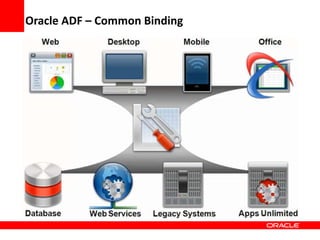
Oracle ADF – Common Binding
Copyright © 2006 Oracle Corporation
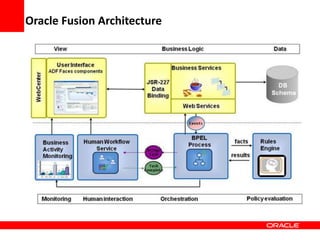
Oracle Fusion Architecture
Copyright © 2006 Oracle Corporation
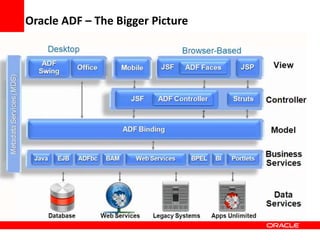
Oracle ADF – The Bigger Picture
Copyright © 2006 Oracle Corporation
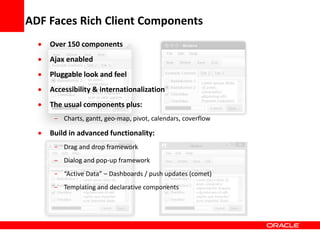
ADF Faces Rich Client Components
 Over 150 components
 Ajax enabled
 Pluggable look and feel
 Accessibility & internationalization
 The usual components plus:
- Charts, gantt, geo-map, pivot, calendars, coverflow
 Build in advanced functionality:
- Drag and drop framework
- Dialog and pop-up framework
- “Active Data” – Dashboards / push updates (comet)
- Templating and declarative components
Copyright © 2006 Oracle Corporation
ADF Business Components
A framework that simplifies developing Java EE Business services for
developers familiar with 4GL tools, declarative development, and
relational databases
 Simplify data access
 Simplify validation and business logic
 Uses SQL based data views
 Separate data view from business logic
 Implement best practices
 Easy customization
Copyright © 2006 Oracle Corporation
ADF Model – Data Binding
 ADF Model
- JSR-227 Data Controls
 Service Oriented Interface
- Abstract implementation from clients
- Loose coupling between services and application
 More Reusability
- Discover and share services
 More Productivity
- Drag and drop data binding
- Declarative validation
- Control hints
Copyright © 2006 Oracle Corporation
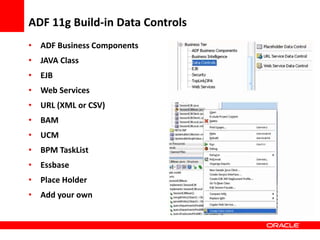
ADF 11g Build-in Data Controls
• ADF Business Components
• JAVA Class
• EJB
• Web Services
• URL (XML or CSV)
• BAM
• UCM
• BPM TaskList
• Essbase
• Place Holder
• Add your own
Copyright © 2006 Oracle Corporation
ADF Controller
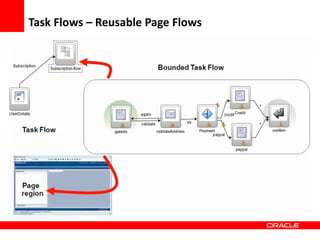
 An extension to the JSF page flow engine
 Define flows of pages and methods
 Diagram your process
 Build reusable task flows
- In other flows, inside other pages
 Advance functionality in a declarative way
- Transaction, initialization, Back button
Copyright © 2006 Oracle Corporation
Task Flows – Reusable Page Flows
Copyright © 2006 Oracle Corporation
Oracle ADF Mobile
 Two approaches:
- ADF Mobile Browser
- ADF Mobile Client
 Extend your existing application
 Reuse business services
 Same development concepts
Copyright © 2006 Oracle Corporation
 Excel Spreadsheets connected to Java
Business services through ADF binding
 Familiar working environment
 Connected or disconnected
 Leverage business service and security
from your application
Oracle Desktop Integration
Copyright © 2006 Oracle Corporation
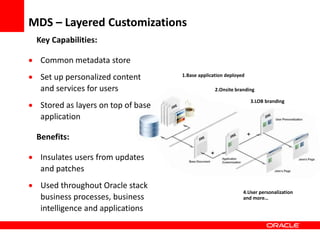
MDS – Layered Customizations
Key Capabilities:
 Common metadata store
 Set up personalized content
and services for users
 Stored as layers on top of base
application
Benefits:
 Insulates users from updates
and patches
 Used throughout Oracle stack
business processes, business
intelligence and applications
1.Base application deployed
2.Onsite branding
3.LOB branding
4.User personalization
and more…
Copyright © 2006 Oracle Corporation
 Authentication and authorization
 End to end security
- Business service operations
- Task flows
- UI components
 Externalized security administration
 Sits on top of Oracle Platform Security Services
- Pluggable providers
- Adaptive access management
ADF Security
Copyright © 2006 Oracle Corporation
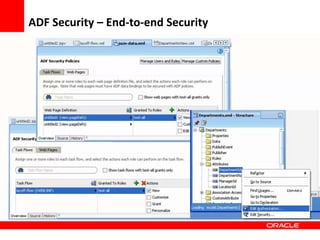
ADF Security – End-to-end Security
<Insert Picture Here>
FUSION MIDDLEWARE
APPLICATION DEVELOPENT
FRAMEWORK ADF Business Component
Copyright © 2006 Oracle Corporation
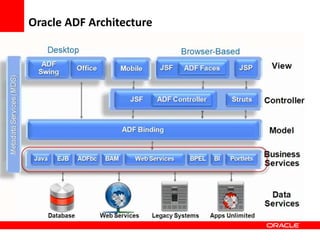
Oracle ADF Architecture
Copyright © 2006 Oracle Corporation
The Business Service Layer
 Manages Persistence
- O/R mapping
- Queries/DML
 Performs Validation
- Data validation
- Business logic
 Choices of implementation
- ADF Business Components, JPA Entities, Web
Services, Java classes
Copyright © 2006 Oracle Corporation
ADF Business Components
A framework that simplifies developing Java EE Business services for
developers familiar with 4GL tools, declarative development, and
relational databases
 Simplify data access
 Simplify validation and business logic
 Uses SQL based data views
 Separate data view from business logic
 Implement best practices
 Easy customization
Copyright © 2006 Oracle Corporation
ADF Business Components Characteristics
 Provides data interaction & business logic execution
 Maps to a data source
 Enable 4GL development
- Declarative and visual development
- Implemented in metadata
 Enables business logic development
- Declarative business rules
- Pre-defined Java methods for events
 Can expose application modules as services
 Based on Java and XML
Copyright © 2006 Oracle Corporation
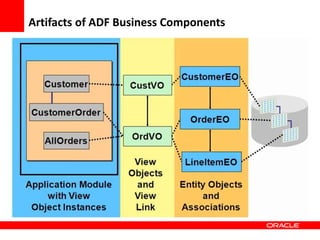
Artifacts of ADF Business Components
Copyright © 2006 Oracle Corporation
Entity Objects
• Maps to a row in a database table
• Handles insert, update, delete operation
• Define behaviors for attributes
• Can continue validation and business logic
Copyright © 2006 Oracle Corporation
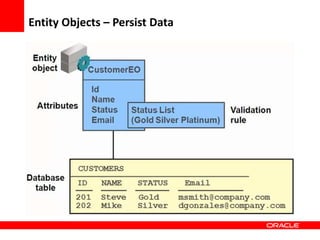
Entity Objects – Persist Data
Copyright © 2006 Oracle Corporation
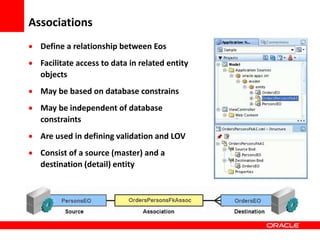
Associations
 Define a relationship between Eos
 Facilitate access to data in related entity
objects
 May be based on database constrains
 May be independent of database
constraints
 Are used in defining validation and LOV
 Consist of a source (master) and a
destination (detail) entity
Copyright © 2006 Oracle Corporation
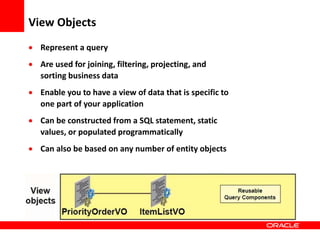
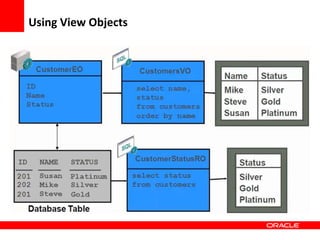
View Objects
 Represent a query
 Are used for joining, filtering, projecting, and
sorting business data
 Enable you to have a view of data that is specific to
one part of your application
 Can be constructed from a SQL statement, static
values, or populated programmatically
 Can also be based on any number of entity objects
Copyright © 2006 Oracle Corporation
Using View Objects
Copyright © 2006 Oracle Corporation
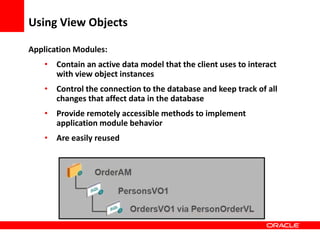
Using View Objects
Application Modules:
• Contain an active data model that the client uses to interact
with view object instances
• Control the connection to the database and keep track of all
changes that affect data in the database
• Provide remotely accessible methods to implement
application module behavior
• Are easily reused
Copyright © 2006 Oracle Corporation
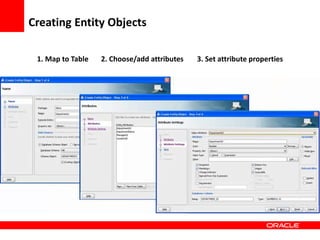
Creating Entity Objects
1. Map to Table 2. Choose/add attributes 3. Set attribute properties
Copyright © 2006 Oracle Corporation
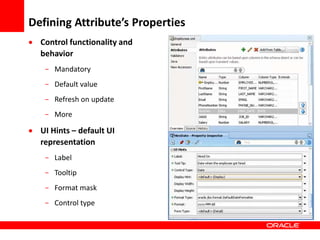
Defining Attribute’s Properties
 Control functionality and
behavior
- Mandatory
- Default value
- Refresh on update
- More
 UI Hints – default UI
representation
- Label
- Tooltip
- Format mask
- Control type
Copyright © 2006 Oracle Corporation
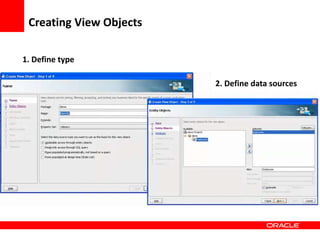
Creating View Objects
1. Define type
2. Define data sources
Copyright © 2006 Oracle Corporation
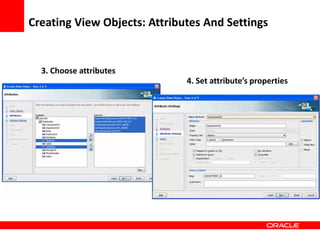
Creating View Objects: Attributes And Settings
3. Choose attributes
4. Set attribute’s properties
Copyright © 2006 Oracle Corporation
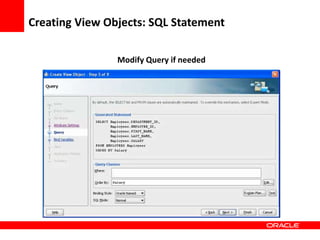
Creating View Objects: SQL Statement
Modify Query if needed
Copyright © 2006 Oracle Corporation
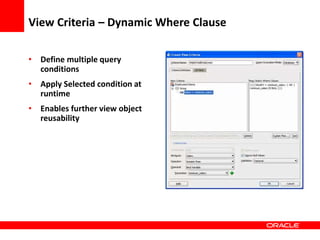
View Criteria – Dynamic Where Clause
• Define multiple query
conditions
• Apply Selected condition at
runtime
• Enables further view object
reusability
Copyright © 2006 Oracle Corporation
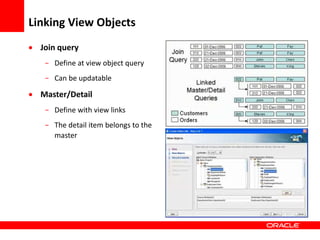
Linking View Objects
 Join query
- Define at view object query
- Can be updatable
 Master/Detail
- Define with view links
- The detail item belongs to the
master
Copyright © 2006 Oracle Corporation
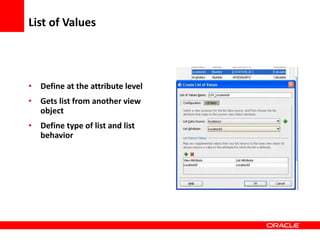
List of Values
• Define at the attribute level
• Gets list from another view
object
• Define type of list and list
behavior
Copyright © 2006 Oracle Corporation
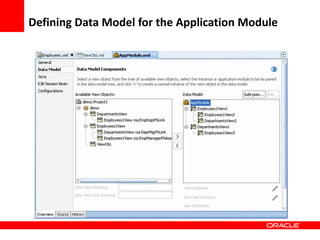
Defining Data Model for the Application Module
Copyright © 2006 Oracle Corporation
ADF Business Components – XML and Java
• ADF BC uses XML metadata to describe the objects
• By default there are no Java files created
• In many cases you don’t need java files
• However if you want more complex logic you’ll put that in a Java
file overriding default behavior
• You can create Java files for EO, VO and AM
Copyright © 2006 Oracle Corporation
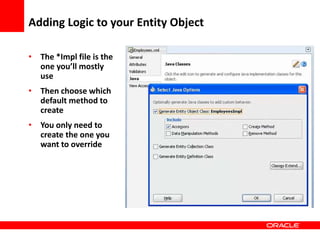
Adding Logic to your Entity Object
• The *Impl file is the
one you’ll mostly
use
• Then choose which
default method to
create
• You only need to
create the one you
want to override
Copyright © 2006 Oracle Corporation
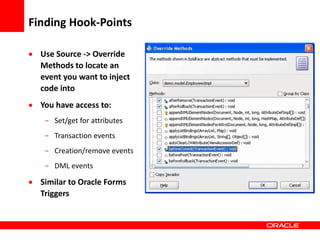
Finding Hook-Points
 Use Source -> Override
Methods to locate an
event you want to inject
code into
 You have access to:
- Set/get for attributes
- Transaction events
- Creation/remove events
- DML events
 Similar to Oracle Forms
Triggers
Copyright © 2006 Oracle Corporation
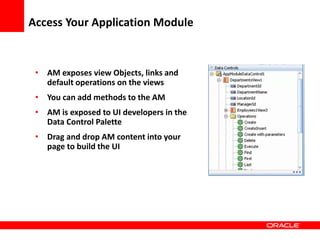
Access Your Application Module
• AM exposes view Objects, links and
default operations on the views
• You can add methods to the AM
• AM is exposed to UI developers in the
Data Control Palette
• Drag and drop AM content into your
page to build the UI
Copyright © 2006 Oracle Corporation
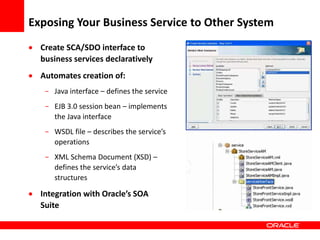
Exposing Your Business Service to Other System
 Create SCA/SDO interface to
business services declaratively
 Automates creation of:
- Java interface – defines the service
- EJB 3.0 session bean – implements
the Java interface
- WSDL file – describes the service’s
operations
- XML Schema Document (XSD) –
defines the service’s data
structures
 Integration with Oracle’s SOA
Suite
<Insert Picture Here>
FUSION MIDDLEWARE
APPLICATION DEVELOPENT
FRAMEWORK ADF Faces
Copyright © 2006 Oracle Corporation
Web User Interface in Oracle ADF
 MVC approach to web UI development
 Based on JSF – the Java EE Standard MVC framework
 Extended capabilities provided by Oracle ADF
- ADF Faces – richer set of JSF components
- ADF Controller – extended controller with reusable task flows
- ADF Binding – simpler binding of view and controller to business
services
Copyright © 2006 Oracle Corporation
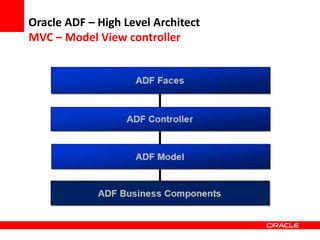
Oracle ADF – High Level Architect
MVC – Model View controller
Copyright © 2006 Oracle Corporation
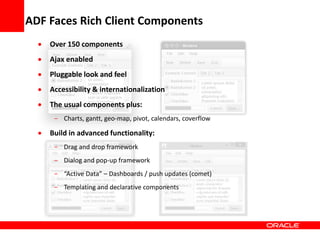
ADF Faces Rich Client Components
 Over 150 components
 Ajax enabled
 Pluggable look and feel
 Accessibility & internationalization
 The usual components plus:
- Charts, gantt, geo-map, pivot, calendars, coverflow
 Build in advanced functionality:
- Drag and drop framework
- Dialog and pop-up framework
- “Active Data” – Dashboards / push updates (comet)
- Templating and declarative components
Copyright © 2006 Oracle Corporation
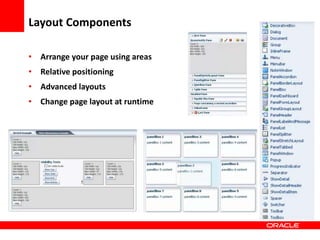
Layout Components
• Arrange your page using areas
• Relative positioning
• Advanced layouts
• Change page layout at runtime
Copyright © 2006 Oracle Corporation
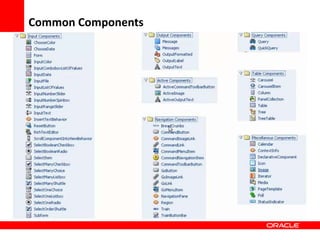
Common Components
Copyright © 2006 Oracle Corporation
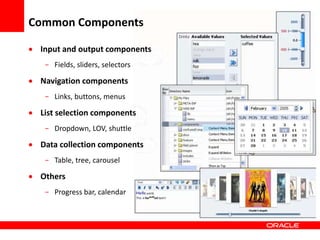
Common Components
 Input and output components
- Fields, sliders, selectors
 Navigation components
- Links, buttons, menus
 List selection components
- Dropdown, LOV, shuttle
 Data collection components
- Table, tree, carousel
 Others
- Progress bar, calendar
Copyright © 2006 Oracle Corporation
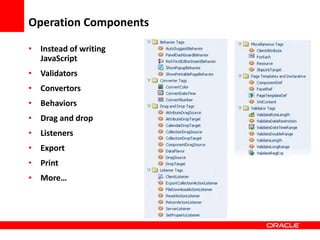
Operation Components
• Instead of writing
JavaScript
• Validators
• Convertors
• Behaviors
• Drag and drop
• Listeners
• Export
• Print
• More…
Copyright © 2006 Oracle Corporation
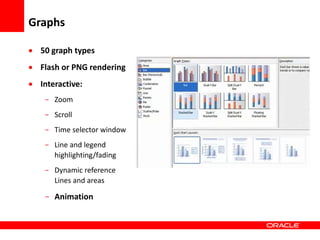
Graphs
 50 graph types
 Flash or PNG rendering
 Interactive:
- Zoom
- Scroll
- Time selector window
- Line and legend
highlighting/fading
- Dynamic reference
Lines and areas
- Animation
Copyright © 2006 Oracle Corporation
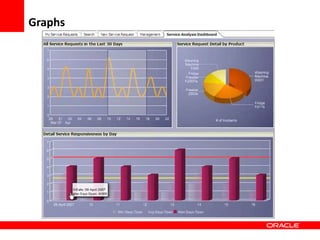
Graphs
Copyright © 2006 Oracle Corporation
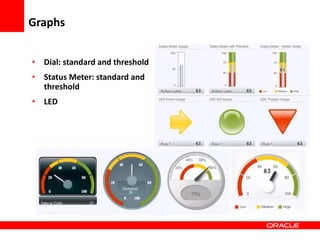
Graphs
• Dial: standard and threshold
• Status Meter: standard and
threshold
• LED
Copyright © 2006 Oracle Corporation
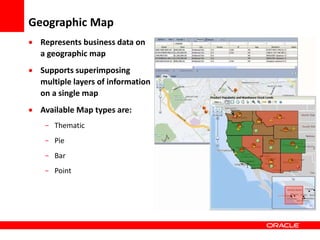
Geographic Map
 Represents business data on
a geographic map
 Supports superimposing
multiple layers of information
on a single map
 Available Map types are:
- Thematic
- Pie
- Bar
- Point
Copyright © 2006 Oracle Corporation
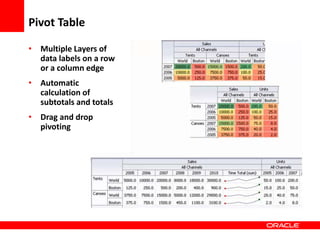
Pivot Table
• Multiple Layers of
data labels on a row
or a column edge
• Automatic
calculation of
subtotals and totals
• Drag and drop
pivoting
Copyright © 2006 Oracle Corporation
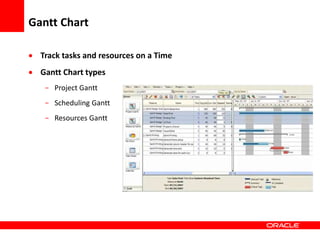
Gantt Chart
 Track tasks and resources on a Time
 Gantt Chart types
- Project Gantt
- Scheduling Gantt
- Resources Gantt
Copyright © 2006 Oracle Corporation
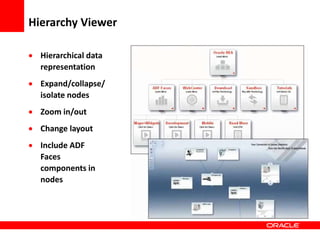
Hierarchy Viewer
 Hierarchical data
representation
 Expand/collapse/
isolate nodes
 Zoom in/out
 Change layout
 Include ADF
Faces
components in
nodes
Copyright © 2006 Oracle Corporation
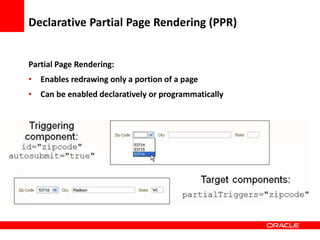
Declarative Partial Page Rendering (PPR)
Partial Page Rendering:
• Enables redrawing only a portion of a page
• Can be enabled declaratively or programmatically
Copyright © 2006 Oracle Corporation
JavaScript API
• Interact with ADF Faces components from client side
JavaScript
• Allows you to have a client representation of the component
• Catch events and react on the client side
• Invoke server side events from client side JavaScript code
• As a rule – try to minimize the usage of this feature
Copyright © 2006 Oracle Corporation
Templates
• Reusable ADF Faces page that contains place holder for custom
page content
• Templates are interpreted at runtime
• Authors can change the template for an existing application
without opening the application itself
• Templates can have their own ADF binding file
• Templates may accept parameters for passing information from
the inheriting page to the template
Copyright © 2006 Oracle Corporation
Declarative Components
• Construct composite components from other components
• Can customize behavior using attributes, methods, and facets
• Package components for reuse in other applications
Q U E S T I O N S
A N S W E R S
Oracel ADF Introduction

Oracel ADF Introduction

  • 2.
    Copyright © 2006Oracle Corporation APPLICATION DEVELOPMENT FRAMEWORK
  • 3.
    <Insert Picture Here> IntroductionOracle ADF FUSION MIDDLEWARE APPLICATION DEVELOPENT FRAMEWORK
  • 4.
    Copyright © 2006Oracle Corporation Oracle Application Development Framework  Increase productivity & ease-of-use - Visual and declarative development - Takes care of the “plumbing” code - Implements best practices  Promote service oriented development - Re-usable business services - Composite applications development  Standards-based - Java EE, SOA SDO/SCA  End-to-end coverage - MVC, security, customization
  • 5.
    Copyright © 2006Oracle Corporation Oracle’s Strategic Framework  ADF is used at Oracle for all “next generation” Web User interface - Fusion Application (CRM, HCM etc.) - Middleware components (Enterprise Manager, administration consoles etc) - Vertical applications (Insurance, telco, pharma…) - WebCenter Spaces and Services  Anyone can use this - Available to customers and partners as part of the platform
  • 6.
    Copyright © 2006Oracle Corporation Oracle ADF – Common Binding
  • 7.
    Copyright © 2006Oracle Corporation Oracle Fusion Architecture
  • 8.
    Copyright © 2006Oracle Corporation Oracle ADF – The Bigger Picture
  • 9.
    Copyright © 2006Oracle Corporation ADF Faces Rich Client Components  Over 150 components  Ajax enabled  Pluggable look and feel  Accessibility & internationalization  The usual components plus: - Charts, gantt, geo-map, pivot, calendars, coverflow  Build in advanced functionality: - Drag and drop framework - Dialog and pop-up framework - “Active Data” – Dashboards / push updates (comet) - Templating and declarative components
  • 10.
    Copyright © 2006Oracle Corporation ADF Business Components A framework that simplifies developing Java EE Business services for developers familiar with 4GL tools, declarative development, and relational databases  Simplify data access  Simplify validation and business logic  Uses SQL based data views  Separate data view from business logic  Implement best practices  Easy customization
  • 11.
    Copyright © 2006Oracle Corporation ADF Model – Data Binding  ADF Model - JSR-227 Data Controls  Service Oriented Interface - Abstract implementation from clients - Loose coupling between services and application  More Reusability - Discover and share services  More Productivity - Drag and drop data binding - Declarative validation - Control hints
  • 12.
    Copyright © 2006Oracle Corporation ADF 11g Build-in Data Controls • ADF Business Components • JAVA Class • EJB • Web Services • URL (XML or CSV) • BAM • UCM • BPM TaskList • Essbase • Place Holder • Add your own
  • 13.
    Copyright © 2006Oracle Corporation ADF Controller  An extension to the JSF page flow engine  Define flows of pages and methods  Diagram your process  Build reusable task flows - In other flows, inside other pages  Advance functionality in a declarative way - Transaction, initialization, Back button
  • 14.
    Copyright © 2006Oracle Corporation Task Flows – Reusable Page Flows
  • 15.
    Copyright © 2006Oracle Corporation Oracle ADF Mobile  Two approaches: - ADF Mobile Browser - ADF Mobile Client  Extend your existing application  Reuse business services  Same development concepts
  • 16.
    Copyright © 2006Oracle Corporation  Excel Spreadsheets connected to Java Business services through ADF binding  Familiar working environment  Connected or disconnected  Leverage business service and security from your application Oracle Desktop Integration
  • 17.
    Copyright © 2006Oracle Corporation MDS – Layered Customizations Key Capabilities:  Common metadata store  Set up personalized content and services for users  Stored as layers on top of base application Benefits:  Insulates users from updates and patches  Used throughout Oracle stack business processes, business intelligence and applications 1.Base application deployed 2.Onsite branding 3.LOB branding 4.User personalization and more…
  • 18.
    Copyright © 2006Oracle Corporation  Authentication and authorization  End to end security - Business service operations - Task flows - UI components  Externalized security administration  Sits on top of Oracle Platform Security Services - Pluggable providers - Adaptive access management ADF Security
  • 19.
    Copyright © 2006Oracle Corporation ADF Security – End-to-end Security
  • 20.
    <Insert Picture Here> FUSIONMIDDLEWARE APPLICATION DEVELOPENT FRAMEWORK ADF Business Component
  • 21.
    Copyright © 2006Oracle Corporation Oracle ADF Architecture
  • 22.
    Copyright © 2006Oracle Corporation The Business Service Layer  Manages Persistence - O/R mapping - Queries/DML  Performs Validation - Data validation - Business logic  Choices of implementation - ADF Business Components, JPA Entities, Web Services, Java classes
  • 23.
    Copyright © 2006Oracle Corporation ADF Business Components A framework that simplifies developing Java EE Business services for developers familiar with 4GL tools, declarative development, and relational databases  Simplify data access  Simplify validation and business logic  Uses SQL based data views  Separate data view from business logic  Implement best practices  Easy customization
  • 24.
    Copyright © 2006Oracle Corporation ADF Business Components Characteristics  Provides data interaction & business logic execution  Maps to a data source  Enable 4GL development - Declarative and visual development - Implemented in metadata  Enables business logic development - Declarative business rules - Pre-defined Java methods for events  Can expose application modules as services  Based on Java and XML
  • 25.
    Copyright © 2006Oracle Corporation Artifacts of ADF Business Components
  • 26.
    Copyright © 2006Oracle Corporation Entity Objects • Maps to a row in a database table • Handles insert, update, delete operation • Define behaviors for attributes • Can continue validation and business logic
  • 27.
    Copyright © 2006Oracle Corporation Entity Objects – Persist Data
  • 28.
    Copyright © 2006Oracle Corporation Associations  Define a relationship between Eos  Facilitate access to data in related entity objects  May be based on database constrains  May be independent of database constraints  Are used in defining validation and LOV  Consist of a source (master) and a destination (detail) entity
  • 29.
    Copyright © 2006Oracle Corporation View Objects  Represent a query  Are used for joining, filtering, projecting, and sorting business data  Enable you to have a view of data that is specific to one part of your application  Can be constructed from a SQL statement, static values, or populated programmatically  Can also be based on any number of entity objects
  • 30.
    Copyright © 2006Oracle Corporation Using View Objects
  • 31.
    Copyright © 2006Oracle Corporation Using View Objects Application Modules: • Contain an active data model that the client uses to interact with view object instances • Control the connection to the database and keep track of all changes that affect data in the database • Provide remotely accessible methods to implement application module behavior • Are easily reused
  • 32.
    Copyright © 2006Oracle Corporation Creating Entity Objects 1. Map to Table 2. Choose/add attributes 3. Set attribute properties
  • 33.
    Copyright © 2006Oracle Corporation Defining Attribute’s Properties  Control functionality and behavior - Mandatory - Default value - Refresh on update - More  UI Hints – default UI representation - Label - Tooltip - Format mask - Control type
  • 34.
    Copyright © 2006Oracle Corporation Creating View Objects 1. Define type 2. Define data sources
  • 35.
    Copyright © 2006Oracle Corporation Creating View Objects: Attributes And Settings 3. Choose attributes 4. Set attribute’s properties
  • 36.
    Copyright © 2006Oracle Corporation Creating View Objects: SQL Statement Modify Query if needed
  • 37.
    Copyright © 2006Oracle Corporation View Criteria – Dynamic Where Clause • Define multiple query conditions • Apply Selected condition at runtime • Enables further view object reusability
  • 38.
    Copyright © 2006Oracle Corporation Linking View Objects  Join query - Define at view object query - Can be updatable  Master/Detail - Define with view links - The detail item belongs to the master
  • 39.
    Copyright © 2006Oracle Corporation List of Values • Define at the attribute level • Gets list from another view object • Define type of list and list behavior
  • 40.
    Copyright © 2006Oracle Corporation Defining Data Model for the Application Module
  • 41.
    Copyright © 2006Oracle Corporation ADF Business Components – XML and Java • ADF BC uses XML metadata to describe the objects • By default there are no Java files created • In many cases you don’t need java files • However if you want more complex logic you’ll put that in a Java file overriding default behavior • You can create Java files for EO, VO and AM
  • 42.
    Copyright © 2006Oracle Corporation Adding Logic to your Entity Object • The *Impl file is the one you’ll mostly use • Then choose which default method to create • You only need to create the one you want to override
  • 43.
    Copyright © 2006Oracle Corporation Finding Hook-Points  Use Source -> Override Methods to locate an event you want to inject code into  You have access to: - Set/get for attributes - Transaction events - Creation/remove events - DML events  Similar to Oracle Forms Triggers
  • 44.
    Copyright © 2006Oracle Corporation Access Your Application Module • AM exposes view Objects, links and default operations on the views • You can add methods to the AM • AM is exposed to UI developers in the Data Control Palette • Drag and drop AM content into your page to build the UI
  • 45.
    Copyright © 2006Oracle Corporation Exposing Your Business Service to Other System  Create SCA/SDO interface to business services declaratively  Automates creation of: - Java interface – defines the service - EJB 3.0 session bean – implements the Java interface - WSDL file – describes the service’s operations - XML Schema Document (XSD) – defines the service’s data structures  Integration with Oracle’s SOA Suite
  • 46.
    <Insert Picture Here> FUSIONMIDDLEWARE APPLICATION DEVELOPENT FRAMEWORK ADF Faces
  • 47.
    Copyright © 2006Oracle Corporation Web User Interface in Oracle ADF  MVC approach to web UI development  Based on JSF – the Java EE Standard MVC framework  Extended capabilities provided by Oracle ADF - ADF Faces – richer set of JSF components - ADF Controller – extended controller with reusable task flows - ADF Binding – simpler binding of view and controller to business services
  • 48.
    Copyright © 2006Oracle Corporation Oracle ADF – High Level Architect MVC – Model View controller
  • 49.
    Copyright © 2006Oracle Corporation ADF Faces Rich Client Components  Over 150 components  Ajax enabled  Pluggable look and feel  Accessibility & internationalization  The usual components plus: - Charts, gantt, geo-map, pivot, calendars, coverflow  Build in advanced functionality: - Drag and drop framework - Dialog and pop-up framework - “Active Data” – Dashboards / push updates (comet) - Templating and declarative components
  • 50.
    Copyright © 2006Oracle Corporation Layout Components • Arrange your page using areas • Relative positioning • Advanced layouts • Change page layout at runtime
  • 51.
    Copyright © 2006Oracle Corporation Common Components
  • 52.
    Copyright © 2006Oracle Corporation Common Components  Input and output components - Fields, sliders, selectors  Navigation components - Links, buttons, menus  List selection components - Dropdown, LOV, shuttle  Data collection components - Table, tree, carousel  Others - Progress bar, calendar
  • 53.
    Copyright © 2006Oracle Corporation Operation Components • Instead of writing JavaScript • Validators • Convertors • Behaviors • Drag and drop • Listeners • Export • Print • More…
  • 54.
    Copyright © 2006Oracle Corporation Graphs  50 graph types  Flash or PNG rendering  Interactive: - Zoom - Scroll - Time selector window - Line and legend highlighting/fading - Dynamic reference Lines and areas - Animation
  • 55.
    Copyright © 2006Oracle Corporation Graphs
  • 56.
    Copyright © 2006Oracle Corporation Graphs • Dial: standard and threshold • Status Meter: standard and threshold • LED
  • 57.
    Copyright © 2006Oracle Corporation Geographic Map  Represents business data on a geographic map  Supports superimposing multiple layers of information on a single map  Available Map types are: - Thematic - Pie - Bar - Point
  • 58.
    Copyright © 2006Oracle Corporation Pivot Table • Multiple Layers of data labels on a row or a column edge • Automatic calculation of subtotals and totals • Drag and drop pivoting
  • 59.
    Copyright © 2006Oracle Corporation Gantt Chart  Track tasks and resources on a Time  Gantt Chart types - Project Gantt - Scheduling Gantt - Resources Gantt
  • 60.
    Copyright © 2006Oracle Corporation Hierarchy Viewer  Hierarchical data representation  Expand/collapse/ isolate nodes  Zoom in/out  Change layout  Include ADF Faces components in nodes
  • 61.
    Copyright © 2006Oracle Corporation Declarative Partial Page Rendering (PPR) Partial Page Rendering: • Enables redrawing only a portion of a page • Can be enabled declaratively or programmatically
  • 62.
    Copyright © 2006Oracle Corporation JavaScript API • Interact with ADF Faces components from client side JavaScript • Allows you to have a client representation of the component • Catch events and react on the client side • Invoke server side events from client side JavaScript code • As a rule – try to minimize the usage of this feature
  • 63.
    Copyright © 2006Oracle Corporation Templates • Reusable ADF Faces page that contains place holder for custom page content • Templates are interpreted at runtime • Authors can change the template for an existing application without opening the application itself • Templates can have their own ADF binding file • Templates may accept parameters for passing information from the inheriting page to the template
  • 64.
    Copyright © 2006Oracle Corporation Declarative Components • Construct composite components from other components • Can customize behavior using attributes, methods, and facets • Package components for reuse in other applications
  • 65.
    Q U ES T I O N S A N S W E R S