Madhuri Chopurala
    January 2013
   ABI Research 2011 – 7 trillion SMS Messages
   Projected $133 billion – 2014 mobile
    enterprise sector
    IDC – Mobile App revenues $15.9 billion in
    2012 projected to grow to $35 billion
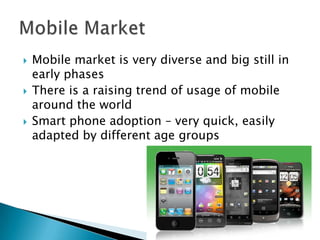
   Mobile market is very diverse and big still in
    early phases
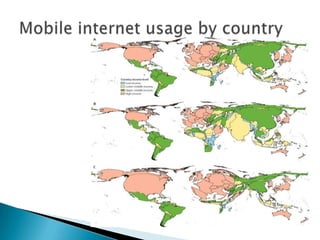
   There is a raising trend of usage of mobile
    around the world
   Smart phone adoption – very quick, easily
    adapted by different age groups
   Mobile user experience now matters more than ever before
    ◦ Define your audience , user statement
    ◦ Fast performing app – high user adoption rate
   Mobile apps – product designed with great functionality with
    great user experience succeeds through iteration
    ◦   Design objectives ,strategy
    ◦       Behavioral, Visceral, Reflective
    ◦   Design revision and recreation
    ◦   Content, User experience
    ◦   Efficient, fast performing, fully functional, flexible and simple
    ◦   Release to market
    ◦   Connection speed, speed and latency
    ◦   Screen sizes, cross platform, device independent pixels, optimized relative
        layouts and resolution independent
   Story telling Apps
    ◦ Share information
    ◦ Interesting , fun, entertaining
   Product Design
      Do you want to enhance usability of the app
      Best design decision
      Basics of usability


   Simplicity
   Fast loading
   Security
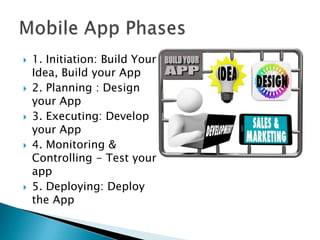
   1. Initiation: Build Your
    Idea, Build your App
   2. Planning : Design
    your App
   3. Executing: Develop
    your App
   4. Monitoring &
    Controlling - Test your
    app
   5. Deploying: Deploy
    the App
   Native Apps
    ◦ These are specific to a given mobile platform (iOS
      or Android)
      iOS platform - Xcode and Objective-C
       Android platform - Java and Eclipse
   HMTL5 Apps
    ◦ write-once-run-anywhere apps
   Hybrid Apps
    ◦ Embed HTML5 apps inside a thin native container
   Native Apps are specific to a given mobile
    platform (iOS or Android) using the
    development tools and language that the
    platform supports.
    iOS platform - Xcode and Objective-C
    Android platform - Java and Eclipse

    Advantages
    1. They perform the best as they are meant for
    the platform ex: gaming, fast graphics API
    2. Usability is best - look and feel ( multi touch
    double tap UI )
    3. Ease of use
   HTML 5 Apps are gaining lot of popularity -
    developed using standard web technologies using
    HTML5, Javascript and CSS. These apps are write-
    once-run-anywhere apps are created to support
    cross-platform mobile applications that work on
    multiple devices.

    Advantages
    1. HTML5 and Javascript can be used to create real
    good apps
    Limitations include session management, secure
    offline storage and access to native device
    functionality
    ex: Calendar, Camera, Address book, Geo Location,
    Video
   Apple iOS framework - xcode and Objective-c
    Touch Device technologies like jquery UI and touch devices like
    iPad, iPod Touch
    iUi: iPhone User Interface Framework - WebApp development on
    iPhone-class devices. iUi is a framework consisting of a
    JavaScript library, CSS, and images for developing advanced
    mobile WebApps for iPhone and comparable/compatible devices.
    jQTouch - jQuery plugin for mobile web development on the
    iPhone, iPod Touch, and other forward-thinking devices.
    Touch-scroll is a jQuery plugin that provides a way to have inline
    scrollable content. It mimics the behaviour of scrolling on iOS
    devices (iPhone, iPod touch and iPad) to solve the problem that
    "position: fixed;" does not work in mobile Safari.
   Google free Open source framework

    Source: http://source.android.com - android
    2.1 , android 1.5 updates in SDK
    SDK: http://developer.android.com
    Eclipse IDE - Runs in Eclipse
    Java version in Android VM - Java 1.6
            Your Apps
            System Apps (context, phone-dialer, email)
            Android framework( access to software, activity manager,
             location manager, content manager and notification manager)
            Native Libraries
            Linux platform
   Location based services based on context, personal
    preference, age, gender
   Social media - LinkedIn, FB, Gplus, Twitter
   Mobile search for page, address, price of product,
    buying ticket, call for reservation
   Mobile commerce
   Mobile payments
   Mobile context-aware services - persons interests
   Object recognition like camera, sensor sensitive
    devices,
   Mobile Messaging - instant messaging
   Mobile Email - mobile e-mail services
   Mobile Video - mobile video services
Optimized mobile apps

Optimized mobile apps

  • 1.
    Madhuri Chopurala January 2013
  • 2.
    ABI Research 2011 – 7 trillion SMS Messages  Projected $133 billion – 2014 mobile enterprise sector  IDC – Mobile App revenues $15.9 billion in 2012 projected to grow to $35 billion
  • 6.
    Mobile market is very diverse and big still in early phases  There is a raising trend of usage of mobile around the world  Smart phone adoption – very quick, easily adapted by different age groups
  • 7.
    Mobile user experience now matters more than ever before ◦ Define your audience , user statement ◦ Fast performing app – high user adoption rate  Mobile apps – product designed with great functionality with great user experience succeeds through iteration ◦ Design objectives ,strategy ◦ Behavioral, Visceral, Reflective ◦ Design revision and recreation ◦ Content, User experience ◦ Efficient, fast performing, fully functional, flexible and simple ◦ Release to market ◦ Connection speed, speed and latency ◦ Screen sizes, cross platform, device independent pixels, optimized relative layouts and resolution independent  Story telling Apps ◦ Share information ◦ Interesting , fun, entertaining
  • 8.
    Product Design  Do you want to enhance usability of the app  Best design decision  Basics of usability  Simplicity  Fast loading  Security
  • 9.
    1. Initiation: Build Your Idea, Build your App  2. Planning : Design your App  3. Executing: Develop your App  4. Monitoring & Controlling - Test your app  5. Deploying: Deploy the App
  • 10.
    Native Apps ◦ These are specific to a given mobile platform (iOS or Android)  iOS platform - Xcode and Objective-C Android platform - Java and Eclipse  HMTL5 Apps ◦ write-once-run-anywhere apps  Hybrid Apps ◦ Embed HTML5 apps inside a thin native container
  • 11.
    Native Apps are specific to a given mobile platform (iOS or Android) using the development tools and language that the platform supports. iOS platform - Xcode and Objective-C Android platform - Java and Eclipse Advantages 1. They perform the best as they are meant for the platform ex: gaming, fast graphics API 2. Usability is best - look and feel ( multi touch double tap UI ) 3. Ease of use
  • 12.
    HTML 5 Apps are gaining lot of popularity - developed using standard web technologies using HTML5, Javascript and CSS. These apps are write- once-run-anywhere apps are created to support cross-platform mobile applications that work on multiple devices.  Advantages 1. HTML5 and Javascript can be used to create real good apps Limitations include session management, secure offline storage and access to native device functionality ex: Calendar, Camera, Address book, Geo Location, Video
  • 13.
    Apple iOS framework - xcode and Objective-c Touch Device technologies like jquery UI and touch devices like iPad, iPod Touch iUi: iPhone User Interface Framework - WebApp development on iPhone-class devices. iUi is a framework consisting of a JavaScript library, CSS, and images for developing advanced mobile WebApps for iPhone and comparable/compatible devices. jQTouch - jQuery plugin for mobile web development on the iPhone, iPod Touch, and other forward-thinking devices. Touch-scroll is a jQuery plugin that provides a way to have inline scrollable content. It mimics the behaviour of scrolling on iOS devices (iPhone, iPod touch and iPad) to solve the problem that "position: fixed;" does not work in mobile Safari.
  • 14.
    Google free Open source framework Source: http://source.android.com - android 2.1 , android 1.5 updates in SDK SDK: http://developer.android.com Eclipse IDE - Runs in Eclipse Java version in Android VM - Java 1.6  Your Apps  System Apps (context, phone-dialer, email)  Android framework( access to software, activity manager, location manager, content manager and notification manager)  Native Libraries  Linux platform
  • 15.
    Location based services based on context, personal preference, age, gender  Social media - LinkedIn, FB, Gplus, Twitter  Mobile search for page, address, price of product, buying ticket, call for reservation  Mobile commerce  Mobile payments  Mobile context-aware services - persons interests  Object recognition like camera, sensor sensitive devices,  Mobile Messaging - instant messaging  Mobile Email - mobile e-mail services  Mobile Video - mobile video services