What is FiberMaterials ?
■ fiber materials refer to materials that are used in the construction of optical fibers.
■ They are thin, flexible, and transparent fibers that are used to transmit light between
two ends of the fiber.
■ These materials are crucial for the efficient and reliable transmission of light signals in
various optical applications, such as telecommunications, fiber optic sensors, and
medical imaging.
4.
Types
■ There aremany fiber materials such as
– Glass Fibers
– Plastic Fibers
– Silica (Silicon Dioxide)
■ The choice of fiber material depends on the specific requirements of the application,
such as the desired transmission characteristics, flexibility, cost, and environmental
conditions.
5.
Glass Fiber
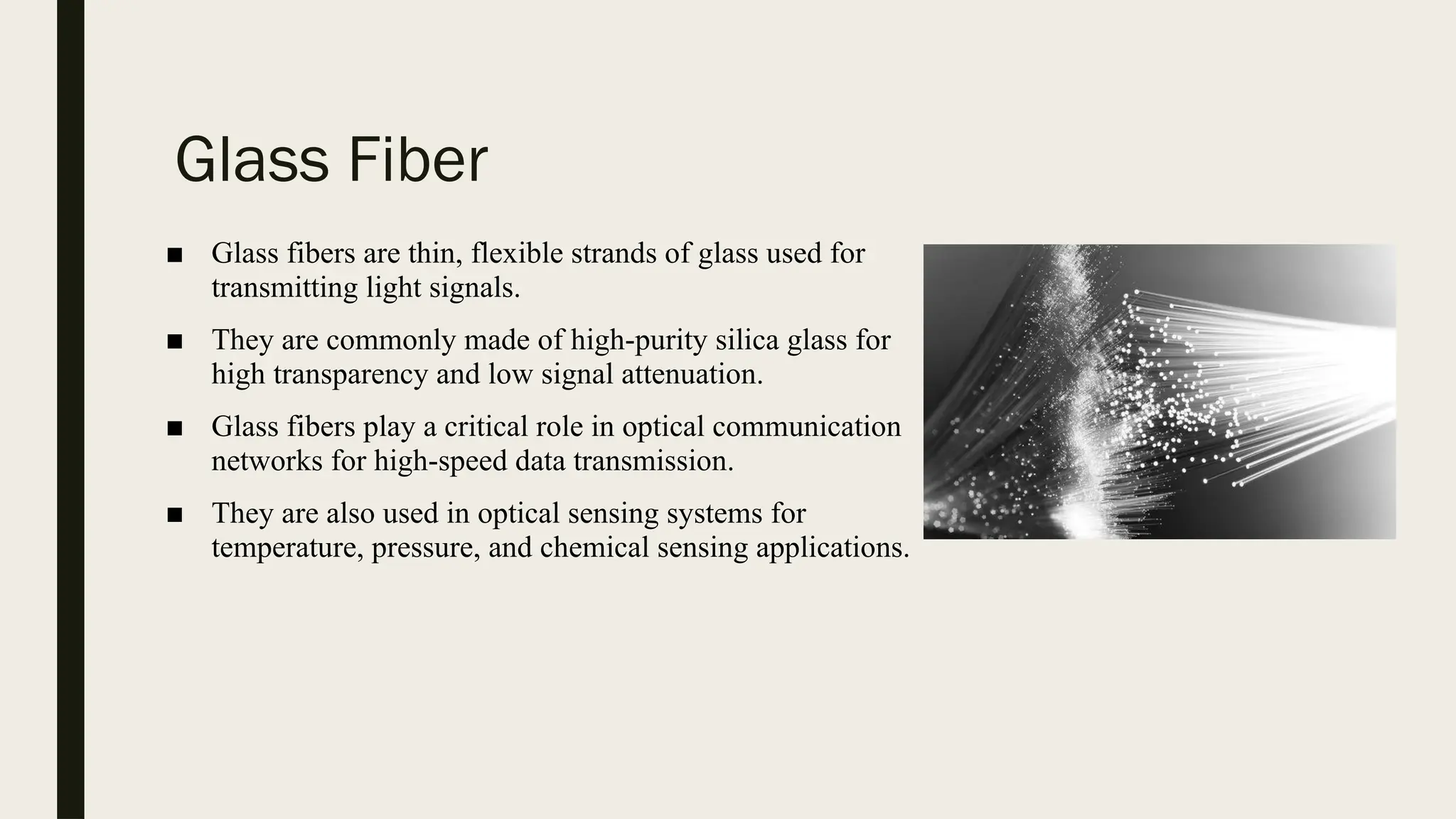
■ Glassfibers are thin, flexible strands of glass used for
transmitting light signals.
■ They are commonly made of high-purity silica glass for
high transparency and low signal attenuation.
■ Glass fibers play a critical role in optical communication
networks for high-speed data transmission.
■ They are also used in optical sensing systems for
temperature, pressure, and chemical sensing applications.
6.
Plastic Fibers
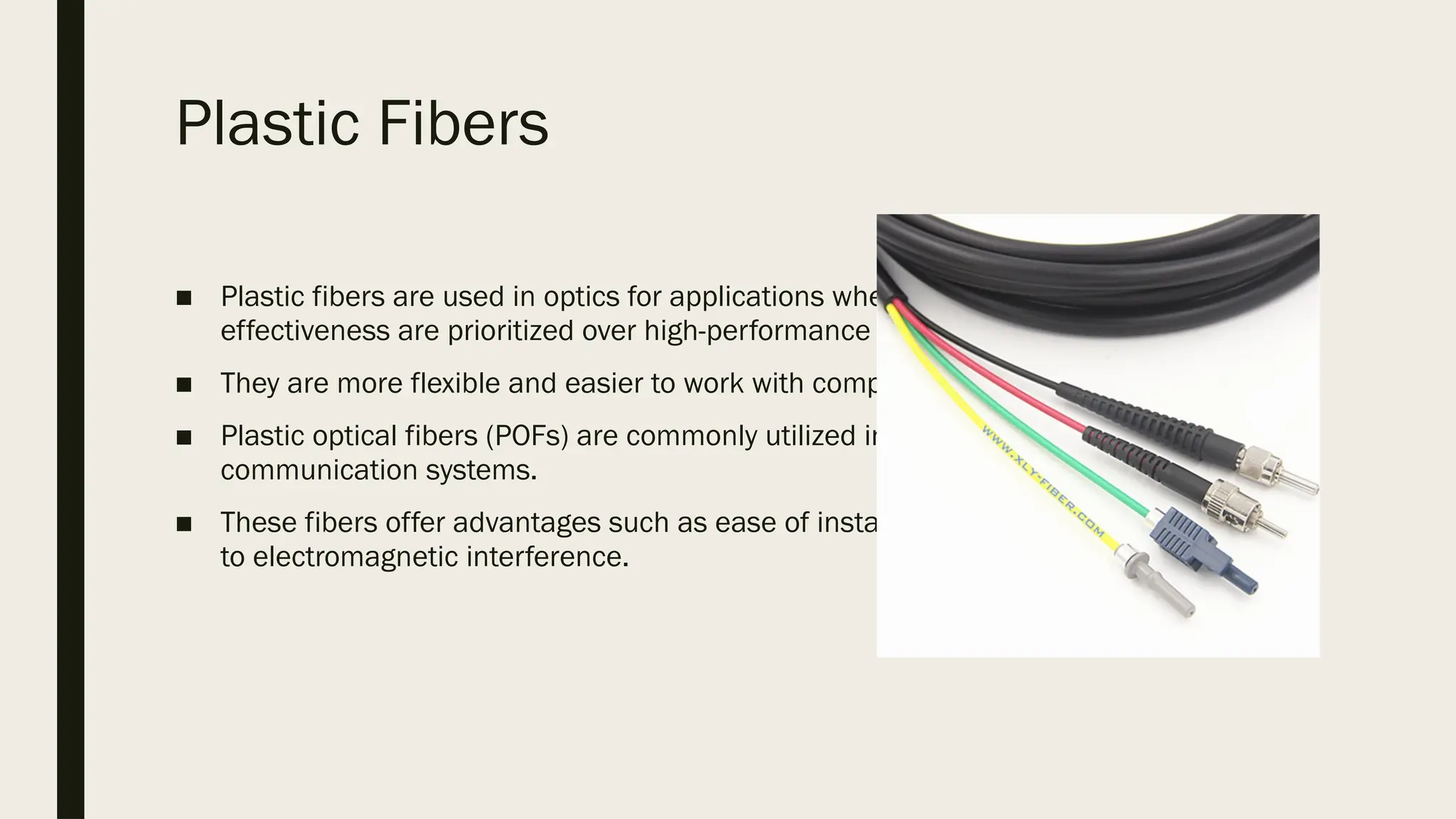
■ Plasticfibers are used in optics for applications where flexibility and cost-
effectiveness are prioritized over high-performance transmission characteristics.
■ They are more flexible and easier to work with compared to glass fibers.
■ Plastic optical fibers (POFs) are commonly utilized in short-distance, low-speed
communication systems.
■ These fibers offer advantages such as ease of installation, durability, and resistance
to electromagnetic interference.
7.
Difference between GlassAnd Plastic fiber
Glass Fiber
■ Made of silica glass, which offers
high transparency and low signal
attenuation.
■ Offers higher performance in terms
of signal loss, bandwidth, and
temperature resistance compared to
plastic fibers.
■ Primarily used in long-distance
telecommunications, high-speed data
transmission, and high-performance
optical applications.
Plastic fiber
■ Made of polymers or plastic materials,
providing flexibility and ease of handling.
■ Generally offer lower performance
compared to glass fibers, with higher
signal attenuation and lower temperature
resistance.
■ Used in short-distance, low-speed
communication systems, and applications
where flexibility and cost-effectiveness
are prioritized over high-performance
transmission characteristics.
8.
Light sources forfiber optics
■ Light sources for fiber optics are essential for providing the input optical signals that
propagate through the fiber and transmit data or information.
■ Various light sources can be used, depending on the specific application and the
requirements of the optical system. Such as:
– Light Emitting Diodes (LEDs)
– Laser Diodes
9.
Continued :
■ LightEmitting Diodes (LEDs): LEDs are commonly used as cost-effective light sources
for short-range communication systems and applications where moderate bandwidth is
sufficient.
■ Laser Diodes: Laser diodes are widely used in high-speed, long-distance
communication systems and applications that require high data transmission rates and
precise optical control.

![Introduction-to-Optical-Fiber[ PPT ].pptx](https://cdn.slidesharecdn.com/ss_thumbnails/introduction-to-optical-fiberautosaved-241102060447-c1f46fc0-thumbnail.jpg?width=640&height=640&fit=bounds)


![[DSC Europe 25] Nikolay Burlutskiy - Best Practices for Building Enterprise M...](https://cdn.slidesharecdn.com/ss_thumbnails/uirvaiuvq8y1w8hzd9tx-7-251212103249-2619edb4-thumbnail.jpg?width=640&height=640&fit=bounds)
![[DSC Europe 25] Katherine Forrest - AI NOW: Understanding the Velocity of Cha...](https://cdn.slidesharecdn.com/ss_thumbnails/wvvbruqfrci0sfq9xwgb-4-251212104007-e5ad1987-thumbnail.jpg?width=640&height=640&fit=bounds)


![[DSC Europe 25] Uros Pesic - The Reality of AI in Marketing.pdf](https://cdn.slidesharecdn.com/ss_thumbnails/rtkodnmtycovsllvzsyn-9-251215095918-b0c6bfe3-thumbnail.jpg?width=640&height=640&fit=bounds)

![[DSC Europe 25] Dunja Adzic Jovanovic - AI and Cybersecurity: Defending Data ...](https://cdn.slidesharecdn.com/ss_thumbnails/o1zylpbhrtwnixxq2xj8-7-251211083048-185086f6-thumbnail.jpg?width=640&height=640&fit=bounds)

![[DSC Europe 25] Branko Urosevic -Rethinking Financial Talent: Integrating Cod...](https://cdn.slidesharecdn.com/ss_thumbnails/8jjrus8ttko6qj64f58f-3-251212103250-642c6374-thumbnail.jpg?width=640&height=640&fit=bounds)


![[DSC Europe 25] Danica Soc - The Science Behind Marketing: Experimentation me...](https://cdn.slidesharecdn.com/ss_thumbnails/c0nofsggs9gw5ucmallr-3-251216103155-56bd64d1-thumbnail.jpg?width=640&height=640&fit=bounds)
![[DSC Europe 25] Miodrag Pesovic & Vladislav Radonjic - Federated Data Archite...](https://cdn.slidesharecdn.com/ss_thumbnails/gsbe3y5it5uhndi4e08e-1-251212103249-f1008e0c-thumbnail.jpg?width=640&height=640&fit=bounds)

![[DSC Europe 25] Branko Dzakula - From Defense to Attack: How AI Redefines Cyb...](https://cdn.slidesharecdn.com/ss_thumbnails/80bdzdxpr3ky2g0qvyk9-8-251211083048-ce5fc1ee-thumbnail.jpg?width=640&height=640&fit=bounds)

![[DSC Europe 25] Tatevik Maytesyan - How to actually use AI in marketing: gett...](https://cdn.slidesharecdn.com/ss_thumbnails/tjo626lsqdgfntbgl2mw-4-251216103155-e36cd239-thumbnail.jpg?width=640&height=640&fit=bounds)
![[DSC Europe 25] Ivan Peric - Intelligence Swarm Logic and Techno-Functional M...](https://cdn.slidesharecdn.com/ss_thumbnails/7my7c97fsduiccadgavw-2-251212103249-5a03f7c6-thumbnail.jpg?width=640&height=640&fit=bounds)
