z
Adaptability struggle of
mathematics teachers in
shifting from traditional
method to online
z
Need of the hour
 As schools across the globe temporarily shut doors due to the COVID-19
pandemic, teachers are left searching for effective and engaging ways to
continuously provide student learning outside the four walls of the
classroom.
 The situation has pushed many educators to turn to remote teaching,
which is rapidly becoming the “new normal” in the era of social-
distancing and community quarantine. But this sudden shift from
traditional classrooms to virtual learning has plunged many teachers into
uncharted waters.
z
Difference
between
traditional and
online teaching
z Traditional
method
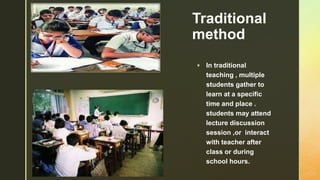
 In traditional
teaching , multiple
students gather to
learn at a specific
time and place .
students may attend
lecture discussion
session ,or interact
with teacher after
class or during
school hours.
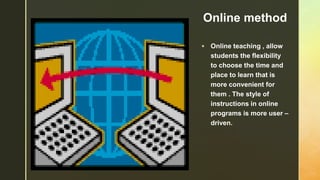
z Online method
 Online teaching , allow
students the flexibility
to choose the time and
place to learn that is
more convenient for
them . The style of
instructions in online
programs is more user –
driven.
z
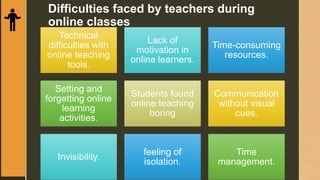
Difficulties faced by teachers during
online classes
Technical
difficulties with
online teaching
tools.
Lack of
motivation in
online learners.
Time-consuming
resources.
Setting and
forgetting online
learning
activities.
Students found
online teaching
boring
Communication
without visual
cues.
Invisibility.
feeling of
isolation.
Time
management.
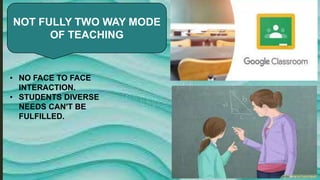
NOT FULLY TWO WAY MODE
OF TEACHING
• NO FACE TO FACE
INTERACTION.
• STUDENTS DIVERSE
NEEDS CAN'T BE
FULFILLED.
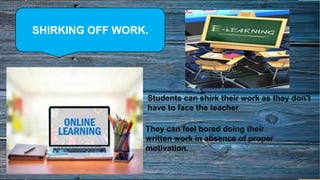
SHIRKING OFF WORK.
They can feel bored doing their
written work in absence of proper
motivation.
Students can shirk their work as they don't
have to face the teacher
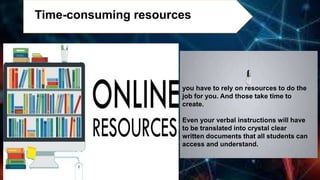
Time-consuming resources
you have to rely on resources to do the
job for you. And those take time to
create.
Even your verbal instructions will have
to be translated into crystal clear
written documents that all students can
access and understand.
Isolation
•Coordinate virtual group activities using
chats, discussion boards or cloud tools
for collaboration.
•Show your face and let students hear
your voice, using video or audio
recordings. Don’t let yourself become a
robot who only communicates via text.
•Schedule regular check ins with
students via email or chat, if you have
the capacity. Pay attention to those at
risk of disengagement in particular.
Factors that will help the teacher to
adapt
1.Create an effective
class opener
teachers would start by sharing the
agenda for the class period so that
students will know the expectations for
what will be occurring.
z
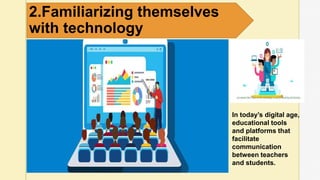
2.Familiarizing themselves
with technology
In today’s digital age,
educational tools
and platforms that
facilitate
communication
between teachers
and students.
Requirements
z
4.SETTING REALISTIC GOALS
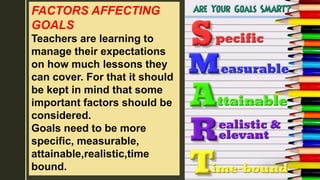
FACTORS AFFECTING
GOALS
Teachers are learning to
manage their expectations
on how much lessons they
can cover. For that it should
be kept in mind that some
important factors should be
considered.
Goals need to be more
specific, measurable,
attainable,realistic,time
bound.
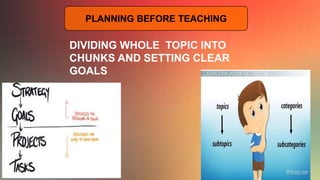
PLANNING BEFORE TEACHING
DIVIDING WHOLE TOPIC INTO
CHUNKS AND SETTING CLEAR
GOALS
5.Setting up adequate learning
environment
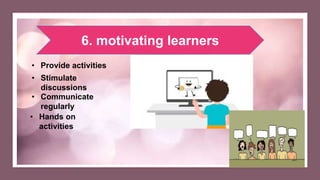
6. motivating learners
• Stimulate
discussions
• Communicate
regularly
• Provide activities
• Hands on
activities
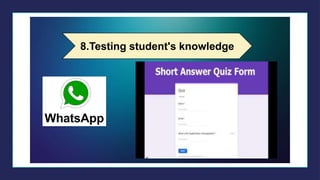
8.Testing student's knowledge
9.Finish class with a summary.
The lecture can
be recapitulated
for the better
understanding
and making the
concept repeat
will make the
concept concrete
THANKS!

adaptability to online teachingstruggles. ppt.pptx

  • 1.
    z Adaptability struggle of mathematicsteachers in shifting from traditional method to online
  • 3.
    z Need of thehour  As schools across the globe temporarily shut doors due to the COVID-19 pandemic, teachers are left searching for effective and engaging ways to continuously provide student learning outside the four walls of the classroom.  The situation has pushed many educators to turn to remote teaching, which is rapidly becoming the “new normal” in the era of social- distancing and community quarantine. But this sudden shift from traditional classrooms to virtual learning has plunged many teachers into uncharted waters.
  • 4.
  • 5.
    z Traditional method  Intraditional teaching , multiple students gather to learn at a specific time and place . students may attend lecture discussion session ,or interact with teacher after class or during school hours.
  • 6.
    z Online method Online teaching , allow students the flexibility to choose the time and place to learn that is more convenient for them . The style of instructions in online programs is more user – driven.
  • 7.
    z Difficulties faced byteachers during online classes Technical difficulties with online teaching tools. Lack of motivation in online learners. Time-consuming resources. Setting and forgetting online learning activities. Students found online teaching boring Communication without visual cues. Invisibility. feeling of isolation. Time management.
  • 8.
    NOT FULLY TWOWAY MODE OF TEACHING • NO FACE TO FACE INTERACTION. • STUDENTS DIVERSE NEEDS CAN'T BE FULFILLED.
  • 9.
    SHIRKING OFF WORK. Theycan feel bored doing their written work in absence of proper motivation. Students can shirk their work as they don't have to face the teacher
  • 10.
    Time-consuming resources you haveto rely on resources to do the job for you. And those take time to create. Even your verbal instructions will have to be translated into crystal clear written documents that all students can access and understand.
  • 11.
    Isolation •Coordinate virtual groupactivities using chats, discussion boards or cloud tools for collaboration. •Show your face and let students hear your voice, using video or audio recordings. Don’t let yourself become a robot who only communicates via text. •Schedule regular check ins with students via email or chat, if you have the capacity. Pay attention to those at risk of disengagement in particular.
  • 12.
    Factors that willhelp the teacher to adapt
  • 13.
    1.Create an effective classopener teachers would start by sharing the agenda for the class period so that students will know the expectations for what will be occurring.
  • 14.
    z 2.Familiarizing themselves with technology Intoday’s digital age, educational tools and platforms that facilitate communication between teachers and students.
  • 15.
  • 16.
  • 17.
    FACTORS AFFECTING GOALS Teachers arelearning to manage their expectations on how much lessons they can cover. For that it should be kept in mind that some important factors should be considered. Goals need to be more specific, measurable, attainable,realistic,time bound.
  • 18.
    PLANNING BEFORE TEACHING DIVIDINGWHOLE TOPIC INTO CHUNKS AND SETTING CLEAR GOALS
  • 19.
    5.Setting up adequatelearning environment
  • 20.
    6. motivating learners •Stimulate discussions • Communicate regularly • Provide activities • Hands on activities
  • 21.
  • 22.
    9.Finish class witha summary. The lecture can be recapitulated for the better understanding and making the concept repeat will make the concept concrete
  • 23.