Drugs acting in CNS
Opioid Analgesics & Antagonists
H151M2-01-0038/2021.
Introduction
• The opioids
– natural opiates and semi-synthetic alkaloids
derived from the opium poppy,
– pharmacologically similar synthetic surrogates,
– and endogenous peptides.
• Classified on the basis of their interaction with
opioid receptors;
• agonists,
• mixed agonist-antagonists
• antagonists
• Mechanism of action
– Pharmacologic actions of opiates and synthetic opioid
drugs are effected via their interactions with
endogenous opioid peptide receptors.
• The opioid analgesic effects occur through their interactions
with specific receptors for endogenous peptides in the CNS
and peripheral tissues.
• Three areas in which the analgesic effects of opioids
are mediated:
–Transmission: There are opioid receptors in
primary afferents and spinal cord pain neurons
with inhibitory effects on pain transmission .
–Modulation: Opioid receptors also located in
neurons in the midbrain and medulla that function
in pain modulation .
–Reactivity: Other opioid receptors that may be
involved in altering reactivity to pain are located on
neurons in the basal ganglia, the hypothalamus,
the limbic structures, and the cerebral cortex.
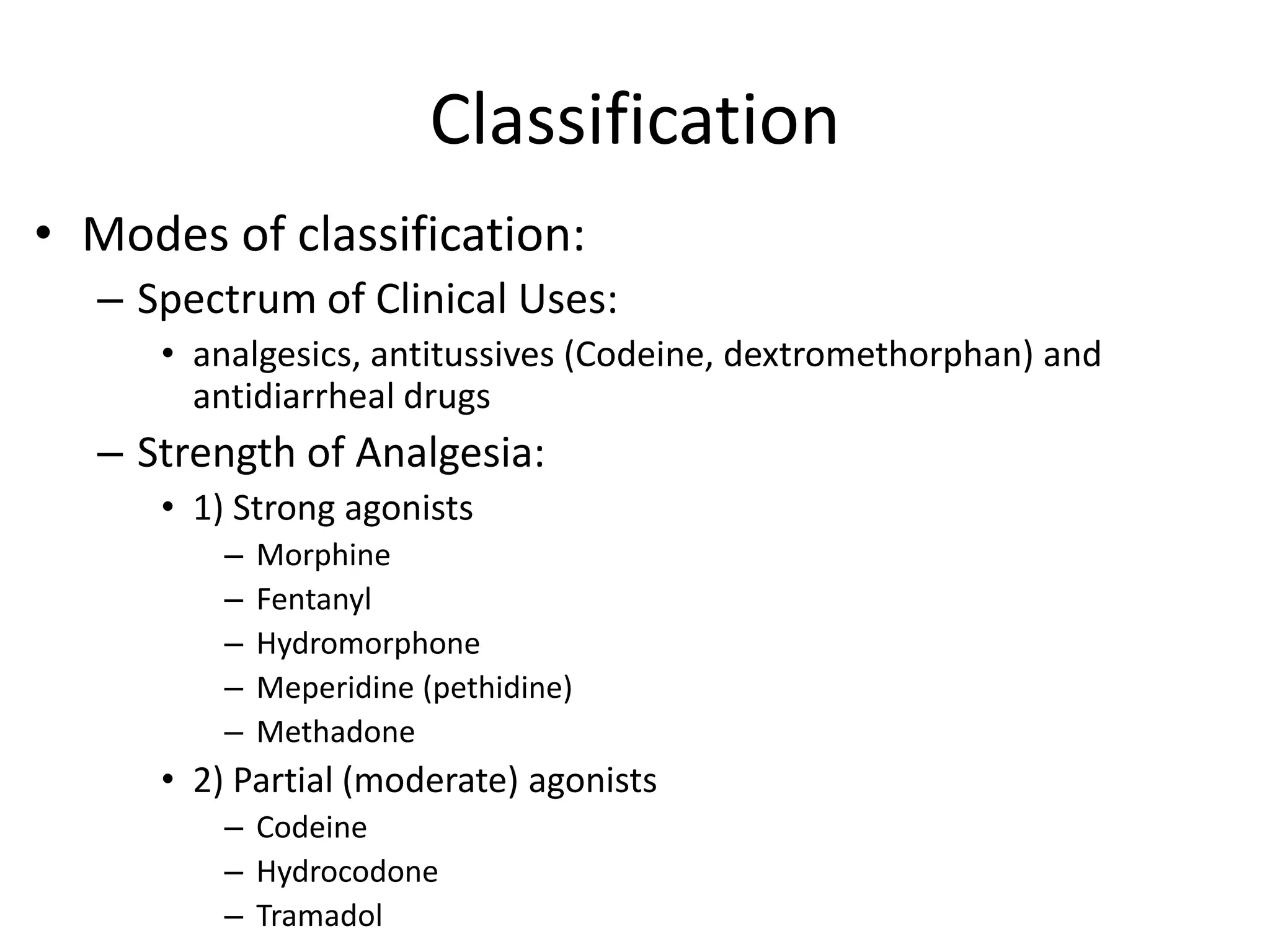
• Modes of classification:
– Spectrum of Clinical Uses:
• analgesics, antitussives (Codeine, dextromethorphan) and
antidiarrheal drugs
– Strength of Analgesia:
• 1) Strong agonists
– Morphine
– Fentanyl
– Hydromorphone
– Meperidine (pethidine)
– Methadone
• 2) Partial (moderate) agonists
– Codeine
– Hydrocodone
– Tramadol
Classification
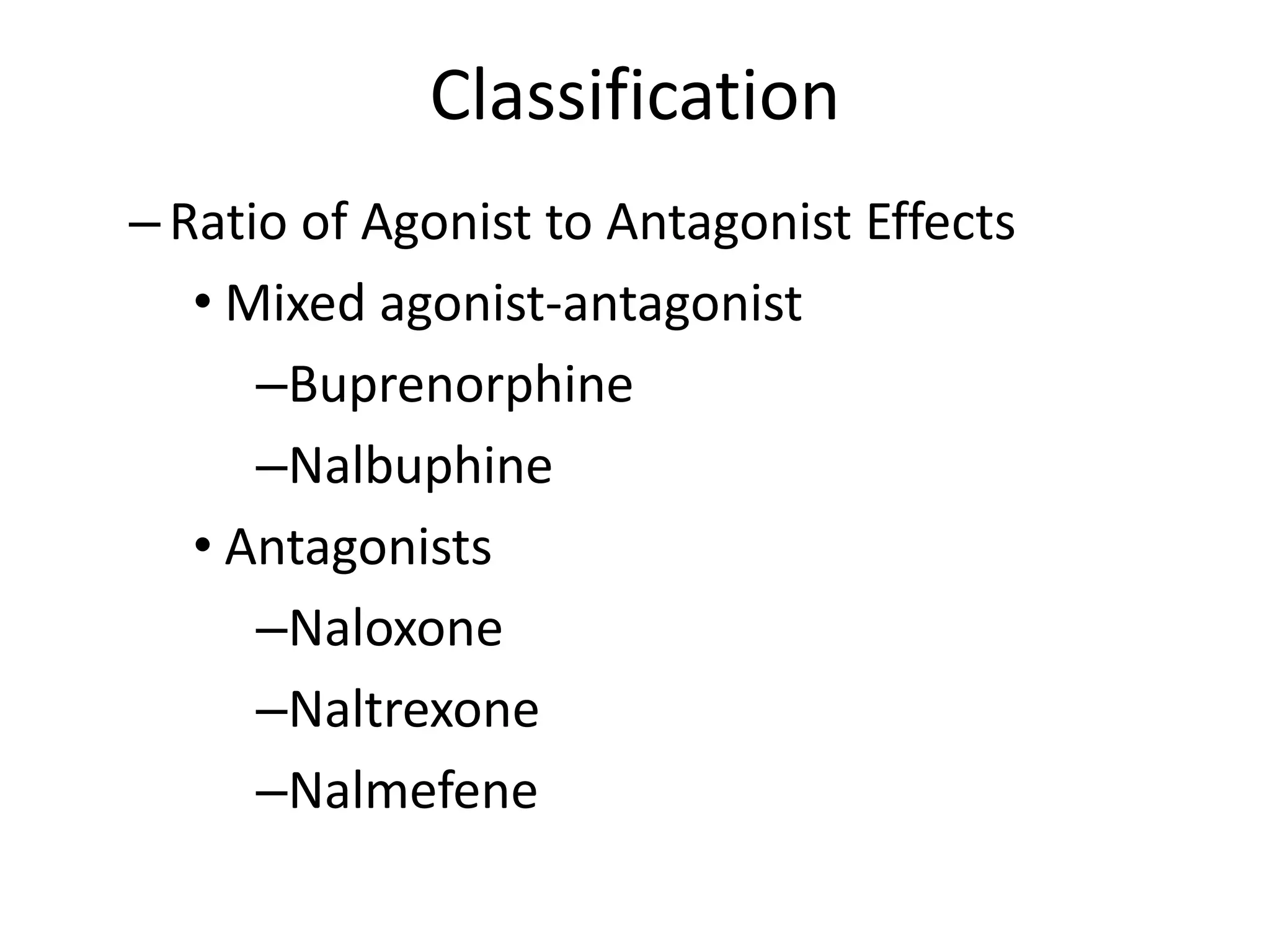
Classification
–Ratio of Agonist to Antagonist Effects
• Mixed agonist-antagonist
–Buprenorphine
–Nalbuphine
• Antagonists
–Naloxone
–Naltrexone
–Nalmefene
Pharmacologic Effects
Acute effects:
• Analgesia
– The opioids are the most powerful drugs available
for the relief of pain
• Sedation and Euphoria
– These effects may occur at doses lower than those
required for maximum analgesia
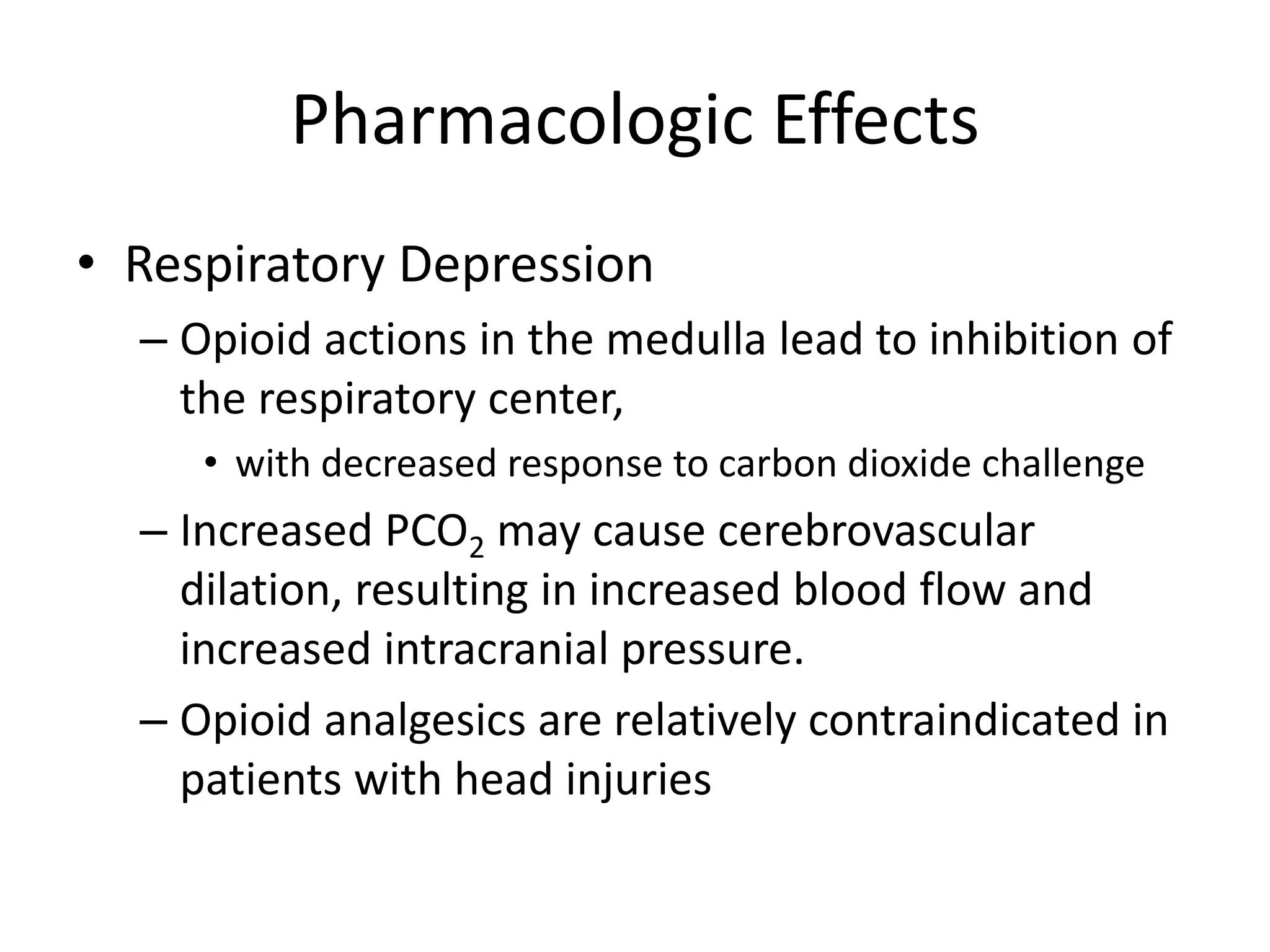
• Respiratory Depression
– Opioid actions in the medulla lead to inhibition of
the respiratory center,
• with decreased response to carbon dioxide challenge
– Increased PCO2 may cause cerebrovascular
dilation, resulting in increased blood flow and
increased intracranial pressure.
– Opioid analgesics are relatively contraindicated in
patients with head injuries
Pharmacologic Effects
• Antitussive Actions: Opioids cause suppression
of the cough reflex by unknown mechanisms
• Nausea and Vomiting
– caused by activation of the chemoreceptor trigger
zone and are increased by ambulation
• Gastrointestinal Effects
– Decrease peristalsis thus resulting to constipation
– This powerful action is the basis for the clinical use
of these drugs as antidiarrheal agents.
Pharmacologic Effects
• Smooth Muscle:
– Opioids (with the exception of meperidine/pethidine)
cause:
• contraction of biliary tract smooth muscle, which can result
in biliary colic or spasm,
• increased ureteral and bladder sphincter tone,
• and a reduction in uterine tone, which may contribute to
prolongation of labor
• Miosis:
– Pupillary constriction is a characteristic effect of all
opioids except meperidine/pethidine, which has a
muscarinic blocking action
Pharmacologic Effects
Chronic effects:
• Tolerance:
– decreased response to a drug, necessitating larger
doses to achieve the same effect
– Tolerance to opioids occurs to all the above
mentioned acute effects except miosis and
constipation
Pharmacologic Effects
• Dependence: physical or physiologic
dependence
– A state characterized by signs and symptoms,
frequently the opposite of those caused by a drug,
when it is withdrawn from chronic use or when the
dose is abruptly lowered;
• Abrupt discontinuance from chronic opioid therapy
results in abstinence syndrome, characterized by:
– rhinorrhea, lacrimation, chills, gooseflesh, muscle aches,
diarrhea, yawning, anxiety, and hostility.
Pharmacologic Effects
• A more intense state of precipitated withdrawal
results when an opioid antagonist is administered to a
physically dependent individual.
– For patients with physical dependence, instead of
administering an opioid antagonist,
• the drug Methadone, one of the longer acting opioids, is
used in the management of opioid withdrawal states and
in maintenance programs for addicts
Pharmacologic Effects
Clinical uses
• Analgesia
– Treatment of relatively constant moderate to severe
pain
– Prolonged pain reduction requires strong agonists
(fentanyl, morphine) administered epidurally
– Moderate pain: moderate agonists are given by the
oral route, sometimes in combinations with
acetaminophen or NSAIDs.
• Cough Suppression:
– Includes use of oral antitussive drugs: codeine and
dextromethorphan
• Treatment of Diarrhea:
– Includes use of selective antidiarrheal opioids:
diphenoxylate and loperamide
CONT…
• Management of Acute Pulmonary Edema:
– Morphine (parenteral) may be useful in acute
pulmonary edema because of its hemodynamic
actions;
• It decreases both cardiac preload (reduced venous tone)
and afterload (decreased peripheral resistance)
– The calming effects of the drug probably also
contributes to relief of the pulmonary symptoms
• Anesthesia
– Opioids are used as preoperative medications and
as intraoperative adjunctive agents in balanced
anesthesia protocols
• Opioid Dependence:
– Methadone (long acting) is used in the
management of opioid withdrawal states and in
maintenance programs for addicts
• It permits a slow tapering of opioid effect that
diminishes the intensity of abstinence symptoms
Toxicity/adverse effects
• The adverse effects of the opioid analgesics
extend from their pharmacologic effects:
– Nausea,
– Constipation,
– Respiratory depression.
– Dependence/Addiction
• Overdose:
– This is may be fatal if not attended to promptly. It is
characterized by a triad of:
• pupillary constriction,
• comatose state, and
• respiratory depression
– Diagnosis confirmed on improvement of symptoms
after administration of naloxone
– Treatment: opioid antagonists (naloxone) and other
therapeutic measures like ventilatory support
Interactions
• Opioid analgesics cause additive CNS depression
with
– ethanol,
– sedative-hypnotics,
– anesthetics,
– antipsychotic drugs,
– tricyclic antidepressants,
– and antihistamines.
• Concomitant use of certain opioids (eg,
meperidine) with monoamine oxidase inhibitors
increases the incidence of hyperpyrexic coma.
Bibliography
– Anthony J. Trevor, Bertram G. Katzung & Susan B.
Masters (2013) Pharmacology- Examination And
Board Review 10th ed., McGraw Hill, Lange
– Katzung B.G (2007) Basic & Clinical Pharmacology,
11th ed, McGraw Hill, Lange
THANK YOU !

Opioid Analgesics & Antagonists.ppt

  • 1.
    Drugs acting inCNS Opioid Analgesics & Antagonists H151M2-01-0038/2021.
  • 2.
    Introduction • The opioids –natural opiates and semi-synthetic alkaloids derived from the opium poppy, – pharmacologically similar synthetic surrogates, – and endogenous peptides. • Classified on the basis of their interaction with opioid receptors; • agonists, • mixed agonist-antagonists • antagonists
  • 3.
    • Mechanism ofaction – Pharmacologic actions of opiates and synthetic opioid drugs are effected via their interactions with endogenous opioid peptide receptors. • The opioid analgesic effects occur through their interactions with specific receptors for endogenous peptides in the CNS and peripheral tissues.
  • 4.
    • Three areasin which the analgesic effects of opioids are mediated: –Transmission: There are opioid receptors in primary afferents and spinal cord pain neurons with inhibitory effects on pain transmission . –Modulation: Opioid receptors also located in neurons in the midbrain and medulla that function in pain modulation . –Reactivity: Other opioid receptors that may be involved in altering reactivity to pain are located on neurons in the basal ganglia, the hypothalamus, the limbic structures, and the cerebral cortex.
  • 5.
    • Modes ofclassification: – Spectrum of Clinical Uses: • analgesics, antitussives (Codeine, dextromethorphan) and antidiarrheal drugs – Strength of Analgesia: • 1) Strong agonists – Morphine – Fentanyl – Hydromorphone – Meperidine (pethidine) – Methadone • 2) Partial (moderate) agonists – Codeine – Hydrocodone – Tramadol Classification
  • 6.
    Classification –Ratio of Agonistto Antagonist Effects • Mixed agonist-antagonist –Buprenorphine –Nalbuphine • Antagonists –Naloxone –Naltrexone –Nalmefene
  • 7.
    Pharmacologic Effects Acute effects: •Analgesia – The opioids are the most powerful drugs available for the relief of pain • Sedation and Euphoria – These effects may occur at doses lower than those required for maximum analgesia
  • 8.
    • Respiratory Depression –Opioid actions in the medulla lead to inhibition of the respiratory center, • with decreased response to carbon dioxide challenge – Increased PCO2 may cause cerebrovascular dilation, resulting in increased blood flow and increased intracranial pressure. – Opioid analgesics are relatively contraindicated in patients with head injuries Pharmacologic Effects
  • 9.
    • Antitussive Actions:Opioids cause suppression of the cough reflex by unknown mechanisms • Nausea and Vomiting – caused by activation of the chemoreceptor trigger zone and are increased by ambulation • Gastrointestinal Effects – Decrease peristalsis thus resulting to constipation – This powerful action is the basis for the clinical use of these drugs as antidiarrheal agents. Pharmacologic Effects
  • 10.
    • Smooth Muscle: –Opioids (with the exception of meperidine/pethidine) cause: • contraction of biliary tract smooth muscle, which can result in biliary colic or spasm, • increased ureteral and bladder sphincter tone, • and a reduction in uterine tone, which may contribute to prolongation of labor • Miosis: – Pupillary constriction is a characteristic effect of all opioids except meperidine/pethidine, which has a muscarinic blocking action Pharmacologic Effects
  • 11.
    Chronic effects: • Tolerance: –decreased response to a drug, necessitating larger doses to achieve the same effect – Tolerance to opioids occurs to all the above mentioned acute effects except miosis and constipation Pharmacologic Effects
  • 12.
    • Dependence: physicalor physiologic dependence – A state characterized by signs and symptoms, frequently the opposite of those caused by a drug, when it is withdrawn from chronic use or when the dose is abruptly lowered; • Abrupt discontinuance from chronic opioid therapy results in abstinence syndrome, characterized by: – rhinorrhea, lacrimation, chills, gooseflesh, muscle aches, diarrhea, yawning, anxiety, and hostility. Pharmacologic Effects
  • 13.
    • A moreintense state of precipitated withdrawal results when an opioid antagonist is administered to a physically dependent individual. – For patients with physical dependence, instead of administering an opioid antagonist, • the drug Methadone, one of the longer acting opioids, is used in the management of opioid withdrawal states and in maintenance programs for addicts Pharmacologic Effects
  • 14.
    Clinical uses • Analgesia –Treatment of relatively constant moderate to severe pain – Prolonged pain reduction requires strong agonists (fentanyl, morphine) administered epidurally – Moderate pain: moderate agonists are given by the oral route, sometimes in combinations with acetaminophen or NSAIDs. • Cough Suppression: – Includes use of oral antitussive drugs: codeine and dextromethorphan • Treatment of Diarrhea: – Includes use of selective antidiarrheal opioids: diphenoxylate and loperamide
  • 15.
    CONT… • Management ofAcute Pulmonary Edema: – Morphine (parenteral) may be useful in acute pulmonary edema because of its hemodynamic actions; • It decreases both cardiac preload (reduced venous tone) and afterload (decreased peripheral resistance) – The calming effects of the drug probably also contributes to relief of the pulmonary symptoms
  • 16.
    • Anesthesia – Opioidsare used as preoperative medications and as intraoperative adjunctive agents in balanced anesthesia protocols • Opioid Dependence: – Methadone (long acting) is used in the management of opioid withdrawal states and in maintenance programs for addicts • It permits a slow tapering of opioid effect that diminishes the intensity of abstinence symptoms
  • 17.
    Toxicity/adverse effects • Theadverse effects of the opioid analgesics extend from their pharmacologic effects: – Nausea, – Constipation, – Respiratory depression. – Dependence/Addiction
  • 18.
    • Overdose: – Thisis may be fatal if not attended to promptly. It is characterized by a triad of: • pupillary constriction, • comatose state, and • respiratory depression – Diagnosis confirmed on improvement of symptoms after administration of naloxone – Treatment: opioid antagonists (naloxone) and other therapeutic measures like ventilatory support
  • 19.
    Interactions • Opioid analgesicscause additive CNS depression with – ethanol, – sedative-hypnotics, – anesthetics, – antipsychotic drugs, – tricyclic antidepressants, – and antihistamines. • Concomitant use of certain opioids (eg, meperidine) with monoamine oxidase inhibitors increases the incidence of hyperpyrexic coma.
  • 20.
    Bibliography – Anthony J.Trevor, Bertram G. Katzung & Susan B. Masters (2013) Pharmacology- Examination And Board Review 10th ed., McGraw Hill, Lange – Katzung B.G (2007) Basic & Clinical Pharmacology, 11th ed, McGraw Hill, Lange THANK YOU !

Editor's Notes

  • #20 Hyperpyrexia is known to be neurodegenerative leading to brain damage. Some of the neurotoxic effects of hyperpyrexia on the brain include seizures, decreased cognitive speed, mental status changes, coma, and even death.