DÜSSELDORF WORKSHOP ON INTERDISCIPLINARY
                              APPROACHES TO TWITTER ANALYSIS


               HOW TO MEASURE OPINION LEADERSHIP ON
                            TWITTER?


                                   Katrin Jungnickel, TU Ilmenau

                                            14.09.2011


Katrin Jungnickel M.A.                       Folie 1
Agenda


   1. Original Concept: Opinion Leadership and the Two-Step Flow of Communication


   2. What is Different Online and on Twitter


   3. Implications for Measuring Opinion Leadership Online and on Twitter


Katrin Jungnickel M.A.                     Folie 2
WHAT ARE OPINION LEADERS?
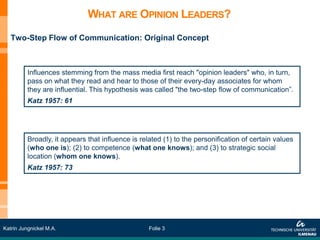
   Two-Step Flow of Communication: Original Concept


          Influences stemming from the mass media first reach "opinion leaders" who, in turn,
          pass on what they read and hear to those of their every-day associates for whom
          they are influential. This hypothesis was called "the two-step flow of communication”.
          Katz 1957: 61


          Broadly, it appears that influence is related (1) to the personification of certain values
          (who one is); (2) to competence (what one knows); and (3) to strategic social
          location (whom one knows).
          Katz 1957: 73


Katrin Jungnickel M.A.                             Folie 3
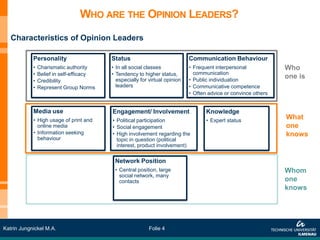
WHO ARE THE OPINION LEADERS?
   Characteristics of Opinion Leaders

            Personality                   Status                             Communication Behaviour
            •   Charismatic authority     • In all social classes            • Frequent interpersonal            Who
            •   Belief in self-efficacy   • Tendency to higher status,         communication
                                                                             • Public individuation
                                                                                                                 one is
            •   Credibility                 especially for virtual opinion
            •   Represent Group Norms       leaders                          • Communicative competence
                                                                             • Often advice or convince others


            Media use                     Engagement/ Involvement                   Knowledge
            • High usage of print and     • Political participation                 • Expert status
                                                                                                                 What
              online media                • Social engagement                                                    one
            • Information seeking         • High involvement regarding the                                       knows
              behaviour                     topic in question (political
                                            interest, product involvement)

                                           Network Position
                                           • Central position, large                                             Whom
                                             social network, many
                                             contacts                                                            one
                                                                                                                 knows


Katrin Jungnickel M.A.                                     Folie 4
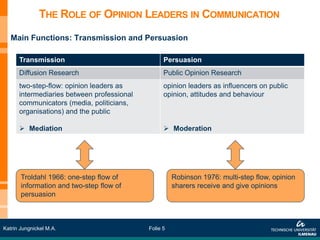
THE ROLE OF OPINION LEADERS IN COMMUNICATION
   Main Functions: Transmission and Persuasion

      Transmission                                Persuasion
      Diffusion Research                          Public Opinion Research
      two-step-flow: opinion leaders as           opinion leaders as influencers on public
      intermediaries between professional         opinion, attitudes and behaviour
      communicators (media, politicians,
      organisations) and the public

       Mediation                                  Moderation


       Troldahl 1966: one-step flow of                Robinson 1976: multi-step flow, opinion
       information and two-step flow of               sharers receive and give opinions
       persuasion


Katrin Jungnickel M.A.                      Folie 5
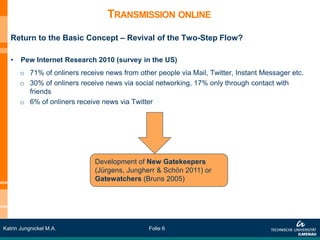
TRANSMISSION ONLINE
   Return to the Basic Concept – Revival of the Two-Step Flow?

   •   Pew Internet Research 2010 (survey in the US)
       o 71% of onliners receive news from other people via Mail, Twitter, Instant Messager etc.
       o 30% of onliners receive news via social networking, 17% only through contact with
         friends
       o 6% of onliners receive news via Twitter


                              Development of New Gatekeepers
                              (Jürgens, Jungherr & Schön 2011) or
                              Gatewatchers (Bruns 2005)


Katrin Jungnickel M.A.                         Folie 6
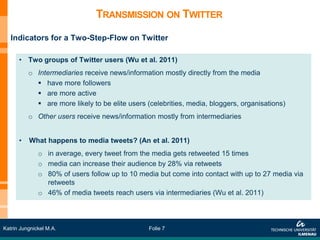
TRANSMISSION ON TWITTER
   Indicators for a Two-Step-Flow on Twitter

      • Two groups of Twitter users (Wu et al. 2011)
          o Intermediaries receive news/information mostly directly from the media
             have more followers
             are more active
             are more likely to be elite users (celebrities, media, bloggers, organisations)
          o Other users receive news/information mostly from intermediaries


      •   What happens to media tweets? (An et al. 2011)
              o in average, every tweet from the media gets retweeted 15 times
              o media can increase their audience by 28% via retweets
              o 80% of users follow up to 10 media but come into contact with up to 27 media via
                retweets
              o 46% of media tweets reach users via intermediaries (Wu et al. 2011)


Katrin Jungnickel M.A.                          Folie 7
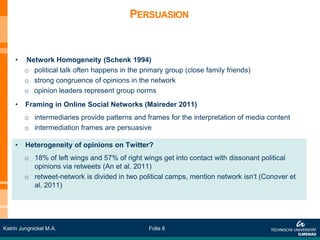
PERSUASION


     •   Network Homogeneity (Schenk 1994)
         o political talk often happens in the primary group (close family friends)
         o strong congruence of opinions in the network
         o opinion leaders represent group norms
     •   Framing in Online Social Networks (Maireder 2011)
         o intermediaries provide patterns and frames for the interpretation of media content
         o intermediation frames are persuasive

     •   Heterogeneity of opinions on Twitter?
         o 18% of left wings and 57% of right wings get into contact with dissonant political
           opinions via retweets (An et al. 2011)
         o retweet-network is divided in two political camps, mention network isn‘t (Conover et
           al. 2011)


Katrin Jungnickel M.A.                           Folie 8
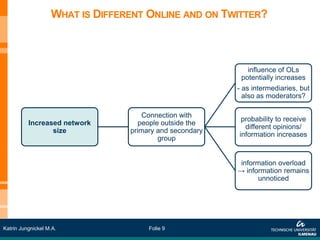
WHAT IS DIFFERENT ONLINE AND ON TWITTER?


                                                            influence of OLs
                                                          potentially increases
                                                         - as intermediaries, but
                                                           also as moderators?

                                     Connection with
                                                          probability to receive
          Increased network        people outside the
                                                           different opinions/
                 size            primary and secondary
                                                         information increases
                                         group


                                                          information overload
                                                         → information remains
                                                                unnoticed


Katrin Jungnickel M.A.                Folie 9
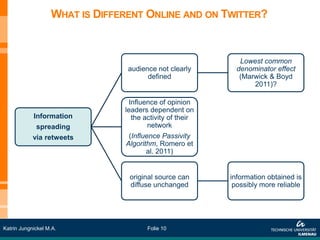
WHAT IS DIFFERENT ONLINE AND ON TWITTER?


                                                             Lowest common
                                 audience not clearly       denominator effect
                                       defined               (Marwick & Boyd
                                                                 2011)?

                                 Influence of opinion
                                leaders dependent on
            Information           the activity of their
             spreading                 network
            via retweets         (Influence Passivity
                                Algorithm, Romero et
                                       al. 2011)


                                 original source can      information obtained is
                                 diffuse unchanged         possibly more reliable


Katrin Jungnickel M.A.                 Folie 10
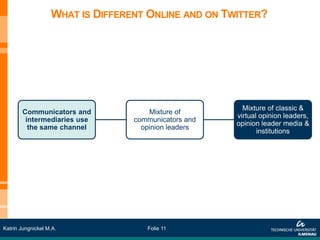
WHAT IS DIFFERENT ONLINE AND ON TWITTER?


                                                        Mixture of classic &
        Communicators and             Mixture of
                                                      virtual opinion leaders,
         intermediaries use       communicators and
                                                      opinion leader media &
          the same channel          opinion leaders
                                                             institutions


Katrin Jungnickel M.A.               Folie 11
VIRTUAL OPINION LEADERS
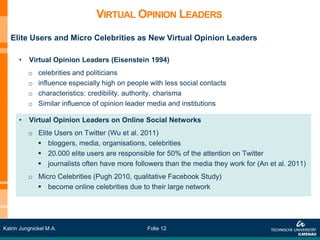
   Elite Users and Micro Celebrities as New Virtual Opinion Leaders

      •   Virtual Opinion Leaders (Eisenstein 1994)
          o   celebrities and politicians
          o   influence especially high on people with less social contacts
          o   characteristics: credibility, authority, charisma
          o   Similar influence of opinion leader media and institutions

      •   Virtual Opinion Leaders on Online Social Networks
          o Elite Users on Twitter (Wu et al. 2011)
             bloggers, media, organisations, celebrities
             20.000 elite users are responsible for 50% of the attention on Twitter
             journalists often have more followers than the media they work for (An et al. 2011)
          o Micro Celebrities (Pugh 2010, qualitative Facebook Study)
             become online celebrities due to their large network


Katrin Jungnickel M.A.                           Folie 12
MIXTURE OF COMMUNICATORS ONLINE
  Implications for the Opinion Leadership Concept

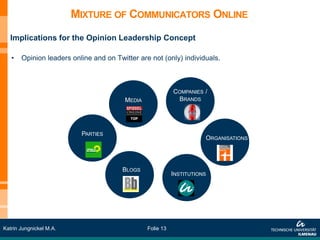
   •   Opinion leaders online and on Twitter are not (only) individuals.


                                                           COMPANIES /
                                        MEDIA               BRANDS


                          PARTIES
                                                                      ORGANISATIONS


                                        BLOGS
                                                           INSTITUTIONS


Katrin Jungnickel M.A.                          Folie 13
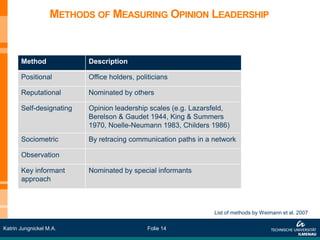
METHODS OF MEASURING OPINION LEADERSHIP


       Method             Description

       Positional         Office holders, politicians

       Reputational       Nominated by others

       Self-designating   Opinion leadership scales (e.g. Lazarsfeld,
                          Berelson & Gaudet 1944, King & Summers
                          1970, Noelle-Neumann 1983, Childers 1986)
       Sociometric        By retracing communication paths in a network

       Observation

       Key informant      Nominated by special informants
       approach


                                                                List of methods by Weimann et al. 2007

Katrin Jungnickel M.A.                        Folie 14
METHODS OF MEASURING OPINION LEADERSHIP
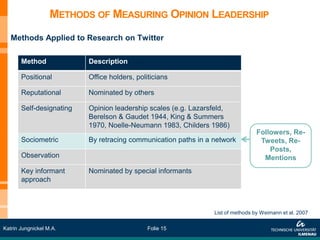
   Methods Applied to Research on Twitter

       Method             Description

       Positional         Office holders, politicians

       Reputational       Nominated by others

       Self-designating   Opinion leadership scales (e.g. Lazarsfeld,
                          Berelson & Gaudet 1944, King & Summers
                          1970, Noelle-Neumann 1983, Childers 1986)
                                                                                 Followers, Re-
       Sociometric        By retracing communication paths in a network           Tweets, Re-
                                                                                     Posts,
       Observation                                                                 Mentions
       Key informant      Nominated by special informants
       approach


                                                                List of methods by Weimann et al. 2007

Katrin Jungnickel M.A.                        Folie 15
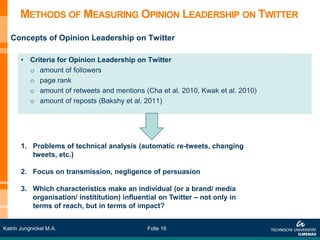
METHODS OF MEASURING OPINION LEADERSHIP ON TWITTER
   Concepts of Opinion Leadership on Twitter

       • Criteria for Opinion Leadership on Twitter
         o amount of followers
         o page rank
         o amount of retweets and mentions (Cha et al. 2010, Kwak et al. 2010)
         o amount of reposts (Bakshy et al. 2011)


       1. Problems of technical analysis (automatic re-tweets, changing
          tweets, etc.)

       2. Focus on transmission, negligence of persuasion

       3. Which characteristics make an individual (or a brand/ media
          organisation/ instititution) influential on Twitter – not only in
          terms of reach, but in terms of impact?


Katrin Jungnickel M.A.                         Folie 16
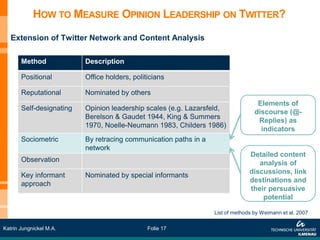
HOW TO MEASURE OPINION LEADERSHIP ON TWITTER?
   Extension of Twitter Network and Content Analysis

       Method             Description

       Positional         Office holders, politicians

       Reputational       Nominated by others
                                                                                   Elements of
       Self-designating   Opinion leadership scales (e.g. Lazarsfeld,
                                                                                  discourse (@-
                          Berelson & Gaudet 1944, King & Summers
                                                                                   Replies) as
                          1970, Noelle-Neumann 1983, Childers 1986)
                                                                                    indicators
       Sociometric        By retracing communication paths in a
                          network
                                                                                Detailed content
       Observation                                                                 analysis of
                                                                                discussions, link
       Key informant      Nominated by special informants
                                                                                destinations and
       approach
                                                                                their persuasive
                                                                                    potential

                                                                  List of methods by Weimann et al. 2007

Katrin Jungnickel M.A.                         Folie 17
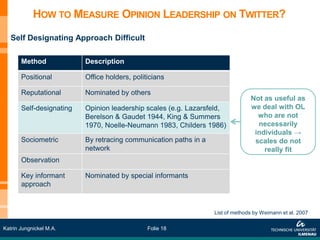
HOW TO MEASURE OPINION LEADERSHIP ON TWITTER?
   Self Designating Approach Difficult

       Method             Description

       Positional         Office holders, politicians

       Reputational       Nominated by others
                                                                                Not as useful as
       Self-designating   Opinion leadership scales (e.g. Lazarsfeld,           we deal with OL
                          Berelson & Gaudet 1944, King & Summers                  who are not
                          1970, Noelle-Neumann 1983, Childers 1986)               necessarily
                                                                                 individuals →
       Sociometric        By retracing communication paths in a                  scales do not
                          network                                                   really fit
       Observation

       Key informant      Nominated by special informants
       approach


                                                                  List of methods by Weimann et al. 2007

Katrin Jungnickel M.A.                         Folie 18
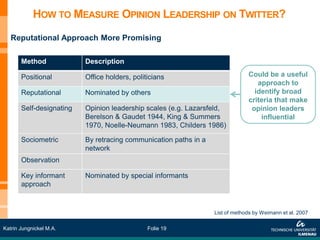
HOW TO MEASURE OPINION LEADERSHIP ON TWITTER?
   Reputational Approach More Promising

       Method             Description

       Positional         Office holders, politicians                          Could be a useful
                                                                                  approach to
       Reputational       Nominated by others                                    identify broad
                                                                               criteria that make
       Self-designating   Opinion leadership scales (e.g. Lazarsfeld,           opinion leaders
                          Berelson & Gaudet 1944, King & Summers                   influential
                          1970, Noelle-Neumann 1983, Childers 1986)

       Sociometric        By retracing communication paths in a
                          network
       Observation

       Key informant      Nominated by special informants
       approach


                                                                  List of methods by Weimann et al. 2007

Katrin Jungnickel M.A.                         Folie 19
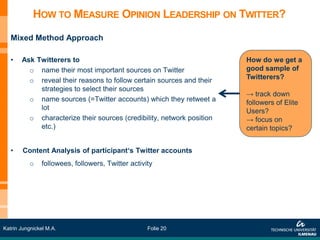
HOW TO MEASURE OPINION LEADERSHIP ON TWITTER?
   Mixed Method Approach

   •   Ask Twitterers to                                               How do we get a
         o name their most important sources on Twitter                good sample of
         o reveal their reasons to follow certain sources and their    Twitterers?
            strategies to select their sources
                                                                       → track down
         o name sources (=Twitter accounts) which they retweet a       followers of Elite
            lot                                                        Users?
         o characterize their sources (credibility, network position   → focus on
            etc.)                                                      certain topics?


   •    Content Analysis of participant‘s Twitter accounts
          o    followees, followers, Twitter activity


Katrin Jungnickel M.A.                             Folie 20
References
   An, J., Cha, M., Gummadi, K., & Crowcroft, J. (2011). Media landscape in Twitter: A world of new conventions and political diversity. Association for the Advancement of Artificial
   Intelligence. Retrieved from http://www.cl.cam.ac.uk/~jac22/out/twitter-diverse.pdf.
   Bakshy, E., Hofman, J. M., Mason, W. A., & Watts, D. J. (2011). Everyone’s an Influencer: Quantifying Influence on Twitter. WSDM '11, Hong Kong, China. Retrieved from
   http://research.yahoo.com/files/wsdm333w-bakshy.pdf.
   Bruns, A. (2005). Gatewatching: Collaborative Online News Production. New York: Peter Lang Publishing.
   Cha, M., Haddadi, H., Benevenuto, F., & Gummadi, K. P. (2010). Measuring User Influence in Twitter: The Million Follower Fallacy. Proc. International AAAI Conference on Weblogs and
   Social Media (ICWSM), May 2010. Retrieved from http://an.kaist.ac.kr/~mycha/docs/icwsm2010_cha.pdf.
   Childers, J. L. (1986). Assessment of the psychometric properties of an opinion leadership scale. Journal of Marketing Research, 184-188.
   Conover, M.D., Ratkiewicz, J., Francisco, M., Goncalves, B., Flammini, A., Menczer, F. (2011). Political Polarization on Twitter. Proceedings of the Fifth International AAAI Conference on
   Weblogs and Social Media. Retrieved from: http://www.aaai.org/ocs/index.php/ICWSM/ICWSM11/paper/view/ 2847/3275.
   Eisenstein, C. (1994). Meinungsbildung in der Mediengesellschaft: Eine Analyse zum Multi -Step Flow of Communication. Opladen: Westdeutscher Verlag.
   Jürgens, P., Jungherr, A. ,& Schön, H. (2011). Small Worlds with a Difference: New Gatekeepers and the Filtering of Political Information on Twitter. WebSci ’11, June 14-17, 2011,
   Koblenz, Germany. Retrieved from: http://www.websci11.org/fileadmin/websci/Papers/147_paper.pdf.
   Katz, E. (1957). The Two-Step Flow of Communication: An Up-To-Date Report on an Hypothesis. Public Opinion Quarterly, 21, 61-78.
   King, C., & Summers, J. (1970). Overlap of opinion leadership across consumer product categories. Journal of Marketing Research, 7, 43-51.
   Kwak, H., Lee, C., Park, H., & Moon, S. (2010). What is Twitter, a Social Network or a News Media? Proceedings of the 19th International World Wide Web (WWW) Conference, April 26-
   30, 2010, Raleigh NC (USA). Retrieved from http://an.kaist.ac.kr/~haewoon/papers/2010-www-twitter.pdf.
   Lazarsfeld, P., Berelson, B., & Gaudet, H. (1944). The People's Choice. How the Voter Makes up his Mind in a Presidential Campaign. New York: Columbia University Press.
   Maireder, A. (2011). Framing von Medieninhalten in Intermediationsprozessen über Social Media. Überarbeitetes extended Abstract zum Vortrag auf der Tagung der Fachgruppe
   Rezeptions- und Wirkungsforschung der DGPuK, Januar 2011. Retrieved from: http://www.slideshare.net/axelmaireder/framing-von-medieninhalten-im-social-web.
   Marwick, A.E. & Boyd, D. (2011). I tweet honestly, I tweet passionately: Twitter users, context collapse, and the imagined audience. New Media & Society, 13, 114-133.
   Noelle-Neumann, E. (1983). Persönlichkeitsstärke: ein neuer Maßstab zur Bestimmung von Zielgruppenpotentialen. Hamburg: Spiegel Verlag.
   Pew Research Center (2010). Understanding the participatory news consumer. How internet and cell phone users have turned news into a social experience. Retrieved from:
   http://infousa.state.gov/media/internet/docs/participatory-news-consumer.pdf.
   Pugh, J. (2010). A qualitative study of the Facebook Social Network: The desire to influence, associate and construct a representative and ideal identity. Retrieved from:
   http://www.csulb.edu/colleges/cba/honors/thesis/documents/JessicaPughThesis.pdf.
   Romero, D. M., Meeder, B., & Kleinberg, J. (2011). Differences in the Mechanics of Information Diffusion Across Topics: Idioms, Political Hashtags, and Complex Contagion on Twitter.
   Proc. 20th International World Wide Web Conference. Retrieved from http://www.cs.cornell.edu/home/kleinber/www11-hashtags.pdf.
   Robinson, J. P. (1976). Interpersonal influence in election campaigns: Two step-flow hypotheses. Public Opinion Quarterly, 40, 304-320.
   Schenk, M. (1994). Meinungsbildung im Alltag - Zum Einfluss von Meinungsführern und sozialen Netzwerken. In M. Jäckel & P. Winterhoff-Spurk (Hrsg.), Politik und Medien. Analysen zur
   Entwicklung der politischen Kommunikation. (S. 143-158). Berlin: Vistas.
   Troldahl, V. C. (1966). A field test of a modified two-step flow of communication model. Public Opinion Quarterly, 18, 609-623.
   Weimann, G., Tustin, D. H., van Vuuren, D., & Joubert, J. P. R. (2007). Looking for opinion leaders: Traditional vs. modern measures in traditional societies. International Journal of Public
   Opinion Research, 19(2), 173-190.
   Wu, S., Hofman, J. M., Mason, W. A., & Watts, D. J. (2011). Who Says What to Whom on Twitter. WWW '11, Hyderabad, India. Retrieved from http://research.yahoo.com/files/twitter-
   flow.pdf.


Katrin Jungnickel M.A.                                                                     Folie 21

Opinion leadership on twitter

  • 1.
    DÜSSELDORF WORKSHOP ONINTERDISCIPLINARY APPROACHES TO TWITTER ANALYSIS HOW TO MEASURE OPINION LEADERSHIP ON TWITTER? Katrin Jungnickel, TU Ilmenau 14.09.2011 Katrin Jungnickel M.A. Folie 1
  • 2.
    Agenda 1. Original Concept: Opinion Leadership and the Two-Step Flow of Communication 2. What is Different Online and on Twitter 3. Implications for Measuring Opinion Leadership Online and on Twitter Katrin Jungnickel M.A. Folie 2
  • 3.
    WHAT ARE OPINIONLEADERS? Two-Step Flow of Communication: Original Concept Influences stemming from the mass media first reach "opinion leaders" who, in turn, pass on what they read and hear to those of their every-day associates for whom they are influential. This hypothesis was called "the two-step flow of communication”. Katz 1957: 61 Broadly, it appears that influence is related (1) to the personification of certain values (who one is); (2) to competence (what one knows); and (3) to strategic social location (whom one knows). Katz 1957: 73 Katrin Jungnickel M.A. Folie 3
  • 4.
    WHO ARE THEOPINION LEADERS? Characteristics of Opinion Leaders Personality Status Communication Behaviour • Charismatic authority • In all social classes • Frequent interpersonal Who • Belief in self-efficacy • Tendency to higher status, communication • Public individuation one is • Credibility especially for virtual opinion • Represent Group Norms leaders • Communicative competence • Often advice or convince others Media use Engagement/ Involvement Knowledge • High usage of print and • Political participation • Expert status What online media • Social engagement one • Information seeking • High involvement regarding the knows behaviour topic in question (political interest, product involvement) Network Position • Central position, large Whom social network, many contacts one knows Katrin Jungnickel M.A. Folie 4
  • 5.
    THE ROLE OFOPINION LEADERS IN COMMUNICATION Main Functions: Transmission and Persuasion Transmission Persuasion Diffusion Research Public Opinion Research two-step-flow: opinion leaders as opinion leaders as influencers on public intermediaries between professional opinion, attitudes and behaviour communicators (media, politicians, organisations) and the public  Mediation  Moderation Troldahl 1966: one-step flow of Robinson 1976: multi-step flow, opinion information and two-step flow of sharers receive and give opinions persuasion Katrin Jungnickel M.A. Folie 5
  • 6.
    TRANSMISSION ONLINE Return to the Basic Concept – Revival of the Two-Step Flow? • Pew Internet Research 2010 (survey in the US) o 71% of onliners receive news from other people via Mail, Twitter, Instant Messager etc. o 30% of onliners receive news via social networking, 17% only through contact with friends o 6% of onliners receive news via Twitter Development of New Gatekeepers (Jürgens, Jungherr & Schön 2011) or Gatewatchers (Bruns 2005) Katrin Jungnickel M.A. Folie 6
  • 7.
    TRANSMISSION ON TWITTER Indicators for a Two-Step-Flow on Twitter • Two groups of Twitter users (Wu et al. 2011) o Intermediaries receive news/information mostly directly from the media  have more followers  are more active  are more likely to be elite users (celebrities, media, bloggers, organisations) o Other users receive news/information mostly from intermediaries • What happens to media tweets? (An et al. 2011) o in average, every tweet from the media gets retweeted 15 times o media can increase their audience by 28% via retweets o 80% of users follow up to 10 media but come into contact with up to 27 media via retweets o 46% of media tweets reach users via intermediaries (Wu et al. 2011) Katrin Jungnickel M.A. Folie 7
  • 8.
    PERSUASION • Network Homogeneity (Schenk 1994) o political talk often happens in the primary group (close family friends) o strong congruence of opinions in the network o opinion leaders represent group norms • Framing in Online Social Networks (Maireder 2011) o intermediaries provide patterns and frames for the interpretation of media content o intermediation frames are persuasive • Heterogeneity of opinions on Twitter? o 18% of left wings and 57% of right wings get into contact with dissonant political opinions via retweets (An et al. 2011) o retweet-network is divided in two political camps, mention network isn‘t (Conover et al. 2011) Katrin Jungnickel M.A. Folie 8
  • 9.
    WHAT IS DIFFERENTONLINE AND ON TWITTER? influence of OLs potentially increases - as intermediaries, but also as moderators? Connection with probability to receive Increased network people outside the different opinions/ size primary and secondary information increases group information overload → information remains unnoticed Katrin Jungnickel M.A. Folie 9
  • 10.
    WHAT IS DIFFERENTONLINE AND ON TWITTER? Lowest common audience not clearly denominator effect defined (Marwick & Boyd 2011)? Influence of opinion leaders dependent on Information the activity of their spreading network via retweets (Influence Passivity Algorithm, Romero et al. 2011) original source can information obtained is diffuse unchanged possibly more reliable Katrin Jungnickel M.A. Folie 10
  • 11.
    WHAT IS DIFFERENTONLINE AND ON TWITTER? Mixture of classic & Communicators and Mixture of virtual opinion leaders, intermediaries use communicators and opinion leader media & the same channel opinion leaders institutions Katrin Jungnickel M.A. Folie 11
  • 12.
    VIRTUAL OPINION LEADERS Elite Users and Micro Celebrities as New Virtual Opinion Leaders • Virtual Opinion Leaders (Eisenstein 1994) o celebrities and politicians o influence especially high on people with less social contacts o characteristics: credibility, authority, charisma o Similar influence of opinion leader media and institutions • Virtual Opinion Leaders on Online Social Networks o Elite Users on Twitter (Wu et al. 2011)  bloggers, media, organisations, celebrities  20.000 elite users are responsible for 50% of the attention on Twitter  journalists often have more followers than the media they work for (An et al. 2011) o Micro Celebrities (Pugh 2010, qualitative Facebook Study)  become online celebrities due to their large network Katrin Jungnickel M.A. Folie 12
  • 13.
    MIXTURE OF COMMUNICATORSONLINE Implications for the Opinion Leadership Concept • Opinion leaders online and on Twitter are not (only) individuals. COMPANIES / MEDIA BRANDS PARTIES ORGANISATIONS BLOGS INSTITUTIONS Katrin Jungnickel M.A. Folie 13
  • 14.
    METHODS OF MEASURINGOPINION LEADERSHIP Method Description Positional Office holders, politicians Reputational Nominated by others Self-designating Opinion leadership scales (e.g. Lazarsfeld, Berelson & Gaudet 1944, King & Summers 1970, Noelle-Neumann 1983, Childers 1986) Sociometric By retracing communication paths in a network Observation Key informant Nominated by special informants approach List of methods by Weimann et al. 2007 Katrin Jungnickel M.A. Folie 14
  • 15.
    METHODS OF MEASURINGOPINION LEADERSHIP Methods Applied to Research on Twitter Method Description Positional Office holders, politicians Reputational Nominated by others Self-designating Opinion leadership scales (e.g. Lazarsfeld, Berelson & Gaudet 1944, King & Summers 1970, Noelle-Neumann 1983, Childers 1986) Followers, Re- Sociometric By retracing communication paths in a network Tweets, Re- Posts, Observation Mentions Key informant Nominated by special informants approach List of methods by Weimann et al. 2007 Katrin Jungnickel M.A. Folie 15
  • 16.
    METHODS OF MEASURINGOPINION LEADERSHIP ON TWITTER Concepts of Opinion Leadership on Twitter • Criteria for Opinion Leadership on Twitter o amount of followers o page rank o amount of retweets and mentions (Cha et al. 2010, Kwak et al. 2010) o amount of reposts (Bakshy et al. 2011) 1. Problems of technical analysis (automatic re-tweets, changing tweets, etc.) 2. Focus on transmission, negligence of persuasion 3. Which characteristics make an individual (or a brand/ media organisation/ instititution) influential on Twitter – not only in terms of reach, but in terms of impact? Katrin Jungnickel M.A. Folie 16
  • 17.
    HOW TO MEASUREOPINION LEADERSHIP ON TWITTER? Extension of Twitter Network and Content Analysis Method Description Positional Office holders, politicians Reputational Nominated by others Elements of Self-designating Opinion leadership scales (e.g. Lazarsfeld, discourse (@- Berelson & Gaudet 1944, King & Summers Replies) as 1970, Noelle-Neumann 1983, Childers 1986) indicators Sociometric By retracing communication paths in a network Detailed content Observation analysis of discussions, link Key informant Nominated by special informants destinations and approach their persuasive potential List of methods by Weimann et al. 2007 Katrin Jungnickel M.A. Folie 17
  • 18.
    HOW TO MEASUREOPINION LEADERSHIP ON TWITTER? Self Designating Approach Difficult Method Description Positional Office holders, politicians Reputational Nominated by others Not as useful as Self-designating Opinion leadership scales (e.g. Lazarsfeld, we deal with OL Berelson & Gaudet 1944, King & Summers who are not 1970, Noelle-Neumann 1983, Childers 1986) necessarily individuals → Sociometric By retracing communication paths in a scales do not network really fit Observation Key informant Nominated by special informants approach List of methods by Weimann et al. 2007 Katrin Jungnickel M.A. Folie 18
  • 19.
    HOW TO MEASUREOPINION LEADERSHIP ON TWITTER? Reputational Approach More Promising Method Description Positional Office holders, politicians Could be a useful approach to Reputational Nominated by others identify broad criteria that make Self-designating Opinion leadership scales (e.g. Lazarsfeld, opinion leaders Berelson & Gaudet 1944, King & Summers influential 1970, Noelle-Neumann 1983, Childers 1986) Sociometric By retracing communication paths in a network Observation Key informant Nominated by special informants approach List of methods by Weimann et al. 2007 Katrin Jungnickel M.A. Folie 19
  • 20.
    HOW TO MEASUREOPINION LEADERSHIP ON TWITTER? Mixed Method Approach • Ask Twitterers to How do we get a o name their most important sources on Twitter good sample of o reveal their reasons to follow certain sources and their Twitterers? strategies to select their sources → track down o name sources (=Twitter accounts) which they retweet a followers of Elite lot Users? o characterize their sources (credibility, network position → focus on etc.) certain topics? • Content Analysis of participant‘s Twitter accounts o followees, followers, Twitter activity Katrin Jungnickel M.A. Folie 20
  • 21.
    References An, J., Cha, M., Gummadi, K., & Crowcroft, J. (2011). Media landscape in Twitter: A world of new conventions and political diversity. Association for the Advancement of Artificial Intelligence. Retrieved from http://www.cl.cam.ac.uk/~jac22/out/twitter-diverse.pdf. Bakshy, E., Hofman, J. M., Mason, W. A., & Watts, D. J. (2011). Everyone’s an Influencer: Quantifying Influence on Twitter. WSDM '11, Hong Kong, China. Retrieved from http://research.yahoo.com/files/wsdm333w-bakshy.pdf. Bruns, A. (2005). Gatewatching: Collaborative Online News Production. New York: Peter Lang Publishing. Cha, M., Haddadi, H., Benevenuto, F., & Gummadi, K. P. (2010). Measuring User Influence in Twitter: The Million Follower Fallacy. Proc. International AAAI Conference on Weblogs and Social Media (ICWSM), May 2010. Retrieved from http://an.kaist.ac.kr/~mycha/docs/icwsm2010_cha.pdf. Childers, J. L. (1986). Assessment of the psychometric properties of an opinion leadership scale. Journal of Marketing Research, 184-188. Conover, M.D., Ratkiewicz, J., Francisco, M., Goncalves, B., Flammini, A., Menczer, F. (2011). Political Polarization on Twitter. Proceedings of the Fifth International AAAI Conference on Weblogs and Social Media. Retrieved from: http://www.aaai.org/ocs/index.php/ICWSM/ICWSM11/paper/view/ 2847/3275. Eisenstein, C. (1994). Meinungsbildung in der Mediengesellschaft: Eine Analyse zum Multi -Step Flow of Communication. Opladen: Westdeutscher Verlag. Jürgens, P., Jungherr, A. ,& Schön, H. (2011). Small Worlds with a Difference: New Gatekeepers and the Filtering of Political Information on Twitter. WebSci ’11, June 14-17, 2011, Koblenz, Germany. Retrieved from: http://www.websci11.org/fileadmin/websci/Papers/147_paper.pdf. Katz, E. (1957). The Two-Step Flow of Communication: An Up-To-Date Report on an Hypothesis. Public Opinion Quarterly, 21, 61-78. King, C., & Summers, J. (1970). Overlap of opinion leadership across consumer product categories. Journal of Marketing Research, 7, 43-51. Kwak, H., Lee, C., Park, H., & Moon, S. (2010). What is Twitter, a Social Network or a News Media? Proceedings of the 19th International World Wide Web (WWW) Conference, April 26- 30, 2010, Raleigh NC (USA). Retrieved from http://an.kaist.ac.kr/~haewoon/papers/2010-www-twitter.pdf. Lazarsfeld, P., Berelson, B., & Gaudet, H. (1944). The People's Choice. How the Voter Makes up his Mind in a Presidential Campaign. New York: Columbia University Press. Maireder, A. (2011). Framing von Medieninhalten in Intermediationsprozessen über Social Media. Überarbeitetes extended Abstract zum Vortrag auf der Tagung der Fachgruppe Rezeptions- und Wirkungsforschung der DGPuK, Januar 2011. Retrieved from: http://www.slideshare.net/axelmaireder/framing-von-medieninhalten-im-social-web. Marwick, A.E. & Boyd, D. (2011). I tweet honestly, I tweet passionately: Twitter users, context collapse, and the imagined audience. New Media & Society, 13, 114-133. Noelle-Neumann, E. (1983). Persönlichkeitsstärke: ein neuer Maßstab zur Bestimmung von Zielgruppenpotentialen. Hamburg: Spiegel Verlag. Pew Research Center (2010). Understanding the participatory news consumer. How internet and cell phone users have turned news into a social experience. Retrieved from: http://infousa.state.gov/media/internet/docs/participatory-news-consumer.pdf. Pugh, J. (2010). A qualitative study of the Facebook Social Network: The desire to influence, associate and construct a representative and ideal identity. Retrieved from: http://www.csulb.edu/colleges/cba/honors/thesis/documents/JessicaPughThesis.pdf. Romero, D. M., Meeder, B., & Kleinberg, J. (2011). Differences in the Mechanics of Information Diffusion Across Topics: Idioms, Political Hashtags, and Complex Contagion on Twitter. Proc. 20th International World Wide Web Conference. Retrieved from http://www.cs.cornell.edu/home/kleinber/www11-hashtags.pdf. Robinson, J. P. (1976). Interpersonal influence in election campaigns: Two step-flow hypotheses. Public Opinion Quarterly, 40, 304-320. Schenk, M. (1994). Meinungsbildung im Alltag - Zum Einfluss von Meinungsführern und sozialen Netzwerken. In M. Jäckel & P. Winterhoff-Spurk (Hrsg.), Politik und Medien. Analysen zur Entwicklung der politischen Kommunikation. (S. 143-158). Berlin: Vistas. Troldahl, V. C. (1966). A field test of a modified two-step flow of communication model. Public Opinion Quarterly, 18, 609-623. Weimann, G., Tustin, D. H., van Vuuren, D., & Joubert, J. P. R. (2007). Looking for opinion leaders: Traditional vs. modern measures in traditional societies. International Journal of Public Opinion Research, 19(2), 173-190. Wu, S., Hofman, J. M., Mason, W. A., & Watts, D. J. (2011). Who Says What to Whom on Twitter. WWW '11, Hyderabad, India. Retrieved from http://research.yahoo.com/files/twitter- flow.pdf. Katrin Jungnickel M.A. Folie 21