Operations Management
T.Rama Krishna Reddy
161452
Operations Management
Definition
Operations management is defined as the
design, operation, and improvement of the
systems that create and deliver the firm’s
primary products and services.
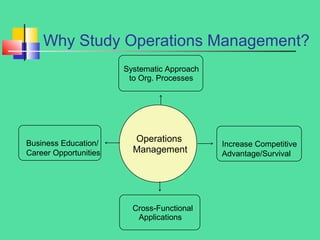
Why Study Operations Management?
Operations
Management
Business Education/
Career Opportunities
Systematic Approach
to Org. Processes
Increase Competitive
Advantage/Survival
Cross-Functional
Applications
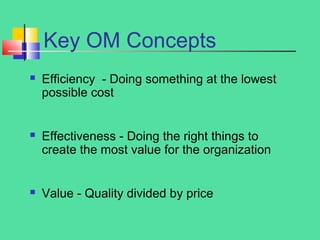
Key OM Concepts
 Efficiency - Doing something at the lowest
possible cost
 Effectiveness - Doing the right things to
create the most value for the organization
 Value - Quality divided by price
Transformations
 Physical--manufacturing
 Locational--transportation
 Exchange--retailing
 Storage--warehousing
 Physicological--health care
 Informational--telecommunications
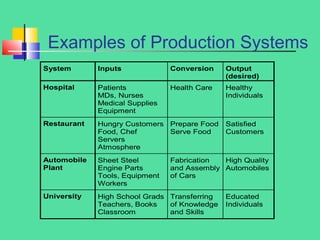
Examples of Production Systems
System Inputs Conversion Output
(desired)
Hospital Patients
MDs, Nurses
Medical Supplies
Equipment
Health Care Healthy
Individuals
Restaurant Hungry Customers
Food, Chef
Servers
Atmosphere
Prepare Food
Serve Food
Satisfied
Customers
Automobile
Plant
Sheet Steel
Engine Parts
Tools, Equipment
Workers
Fabrication
and Assembly
of Cars
High Quality
Automobiles
University High School Grads
Teachers, Books
Classroom
Transferring
of Knowledge
and Skills
Educated
Individuals
Front and Back Office
Front Office
Customer
Service Provider
Back Office
Core “Factory Services”
Core Services are basic things that
customers want from products that they
purchase.

Quality

Flexibility

Speed

Price (or production cost)
Competitive Dimensions
 Cost
 Quality and Reliability
 Delivery
 Flexibility
 Speed
 Reliability
 Coping with Changes in Demand
 New Product Introduction
 Speed
 Flexibility
Balanced Scorecard
1. Financial perspective
2. Internal perspective
3. Customer perspective
4. Innovation and learning perspective
Thank You

Operations management

  • 1.
  • 2.
    Operations Management Definition Operations managementis defined as the design, operation, and improvement of the systems that create and deliver the firm’s primary products and services.
  • 3.
    Why Study OperationsManagement? Operations Management Business Education/ Career Opportunities Systematic Approach to Org. Processes Increase Competitive Advantage/Survival Cross-Functional Applications
  • 4.
    Key OM Concepts Efficiency - Doing something at the lowest possible cost  Effectiveness - Doing the right things to create the most value for the organization  Value - Quality divided by price
  • 5.
    Transformations  Physical--manufacturing  Locational--transportation Exchange--retailing  Storage--warehousing  Physicological--health care  Informational--telecommunications
  • 6.
    Examples of ProductionSystems System Inputs Conversion Output (desired) Hospital Patients MDs, Nurses Medical Supplies Equipment Health Care Healthy Individuals Restaurant Hungry Customers Food, Chef Servers Atmosphere Prepare Food Serve Food Satisfied Customers Automobile Plant Sheet Steel Engine Parts Tools, Equipment Workers Fabrication and Assembly of Cars High Quality Automobiles University High School Grads Teachers, Books Classroom Transferring of Knowledge and Skills Educated Individuals
  • 7.
    Front and BackOffice Front Office Customer Service Provider Back Office
  • 8.
    Core “Factory Services” CoreServices are basic things that customers want from products that they purchase.  Quality  Flexibility  Speed  Price (or production cost)
  • 9.
    Competitive Dimensions  Cost Quality and Reliability  Delivery  Flexibility  Speed  Reliability  Coping with Changes in Demand  New Product Introduction  Speed  Flexibility
  • 10.
    Balanced Scorecard 1. Financialperspective 2. Internal perspective 3. Customer perspective 4. Innovation and learning perspective
  • 11.

Editor's Notes

  • #3 Operations Management --> OM, POM, OPS NOT OR/MS or IE OM uses their tools to manage production. OM is the management of a company’s production system. Marketing Sells Finance keeps track of the money OPS produces
  • #4 Systematic approach to Org. Processes: An Organized way of Looking at work. Career Opportunities: Direct – Plant Manager, Production Supervisor Indirect – Material Manager, Consulting Cross-Functional Applications: Everyone needs to plan & control their work. Business Education: New ideas such as SCM, ERP, Reengineering, and six sigma
  • #6 Physical: Saturn Locational: FedEx Exchange: Target Storage: Self or Cold Storage Physiological: Hospitals, clinics Informational: Transfer of information, Information networks
  • #7 Production as a system Whole is worth more than the sum of its parts.
  • #10 In Order of Time Cost for type of market& type of product Involves tradeoffs
  • #11 Financial perspective – ultimate benefit to shareholder Internal perspective – key internal processes To the future Leading measures – are descriptive of what has happened Lagging measures – predictive Such as: retention versus customer satisfaction rejects versus absenteeism