Monolithic vs Microservice Architecture
Whiledesigning a new product, the first thing that comes tomindis how tostructure the code.As youmay be
aware,the monolithicvs. microservice debate is stillraging.Microservicesare believedtobe the
comparatively best technique of developing a software system,despite the factthat monolithicappshave
beenpresentfor a long time.
According to O’Reily, 61% of companies have implemented microservices over the past five years,
with a 55% “complete success” rate. Also, data from Dzone shows that 73% of companies believe
that microservices will become indispensable for building next-gen software applications.
What is monolithic architecture?
Itis a traditional methodtosoftware developmentinwhichthe total system functionis basedonasingle
applicationas a single,autonomous unit. A huge block of stone canbe usedas ananalogy here (a.k.a
monolith). This single blockwouldrepresenta single platforminsoftware development.
Allfunctions are controlledandservedinone place ina monolithicapp. Of course,anapphas aninternal
structure thatincludes a database,a client-side interface,andbusiness logic,butitis still a hiddenunit. Its
components cancommunicate withoutusing anAPI.
 Advantages of monolithic applications
 Disadvantages of monolithic architecture
What ismicroservice software architecture?
Business logicis splitdownintolightweight,single-purpose self-containedservices ina microservice
architecture.As a result, the infrastructure resembles collectionmodules. Eachservice in this style of
architectureis in charge of achieving a specificbusiness goal.As a result,the microservicearchitecture
resembles a Legostructure thatcanbe brokendownintomultiple components.APIs guarantee that the
system's components communicate withone another.
 Advantages of microservices architecture
 Disadvantages of microservices architecture
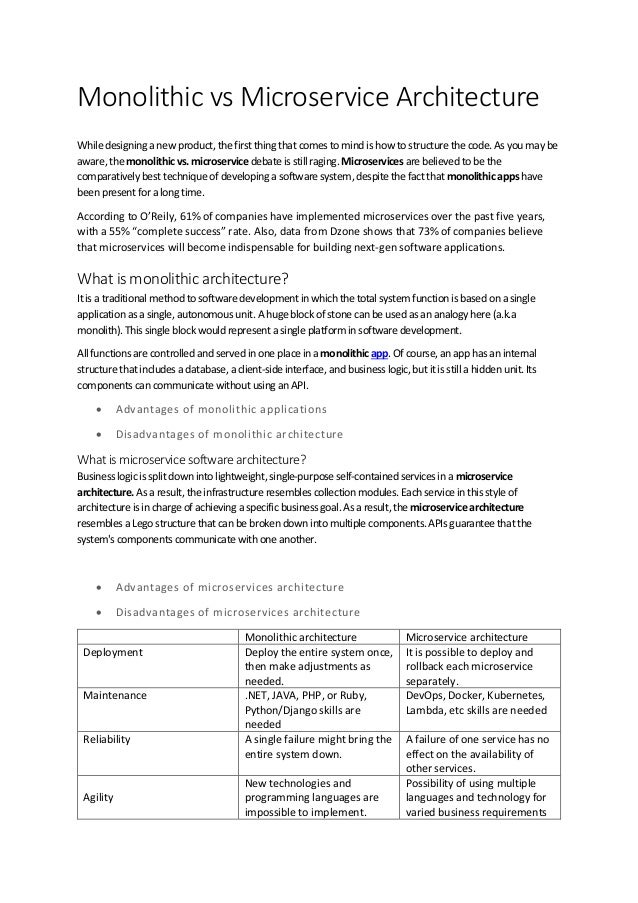
Monolithic architecture Microservice architecture
Deployment Deploy the entire system once,
then make adjustments as
needed.
It is possible to deploy and
rollback each microservice
separately.
Maintenance .NET, JAVA, PHP, or Ruby,
Python/Django skills are
needed
DevOps, Docker, Kubernetes,
Lambda, etc skills are needed
Reliability A single failure might bring the
entire system down.
A failure of one service has no
effect on the availability of
other services.
Agility
New technologies and
programming languages are
impossible to implement.
Possibility of using multiple
languages and technology for
varied business requirements
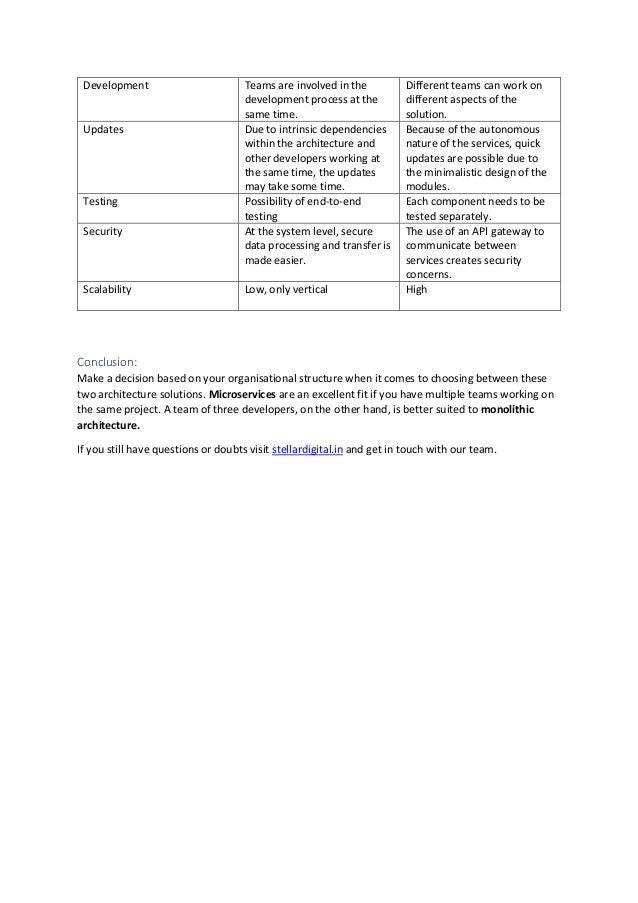
Development Teams are involved in the
development process at the
same time.
Different teams can work on
different aspects of the
solution.
Updates Due to intrinsic dependencies
within the architecture and
other developers working at
the same time, the updates
may take some time.
Because of the autonomous
nature of the services, quick
updates are possible due to
the minimalistic design of the
modules.
Testing Possibility of end-to-end
testing
Each component needs to be
tested separately.
Security At the system level, secure
data processing and transfer is
made easier.
The use of an API gateway to
communicate between
services creates security
concerns.
Scalability Low, only vertical High
Conclusion:
Make a decision based on your organisational structure when it comes to choosing between these
two architecture solutions. Microservices are an excellent fit if you have multiple teams working on
the same project. A team of three developers, on the other hand, is better suited to monolithic
architecture.
If you still have questions or doubts visit stellardigital.in and get in touch with our team.

Monolithic vs microservice architecture Which is best suited for your business.pdf

  • 1.
    Monolithic vs MicroserviceArchitecture Whiledesigning a new product, the first thing that comes tomindis how tostructure the code.As youmay be aware,the monolithicvs. microservice debate is stillraging.Microservicesare believedtobe the comparatively best technique of developing a software system,despite the factthat monolithicappshave beenpresentfor a long time. According to O’Reily, 61% of companies have implemented microservices over the past five years, with a 55% “complete success” rate. Also, data from Dzone shows that 73% of companies believe that microservices will become indispensable for building next-gen software applications. What is monolithic architecture? Itis a traditional methodtosoftware developmentinwhichthe total system functionis basedonasingle applicationas a single,autonomous unit. A huge block of stone canbe usedas ananalogy here (a.k.a monolith). This single blockwouldrepresenta single platforminsoftware development. Allfunctions are controlledandservedinone place ina monolithicapp. Of course,anapphas aninternal structure thatincludes a database,a client-side interface,andbusiness logic,butitis still a hiddenunit. Its components cancommunicate withoutusing anAPI.  Advantages of monolithic applications  Disadvantages of monolithic architecture What ismicroservice software architecture? Business logicis splitdownintolightweight,single-purpose self-containedservices ina microservice architecture.As a result, the infrastructure resembles collectionmodules. Eachservice in this style of architectureis in charge of achieving a specificbusiness goal.As a result,the microservicearchitecture resembles a Legostructure thatcanbe brokendownintomultiple components.APIs guarantee that the system's components communicate withone another.  Advantages of microservices architecture  Disadvantages of microservices architecture Monolithic architecture Microservice architecture Deployment Deploy the entire system once, then make adjustments as needed. It is possible to deploy and rollback each microservice separately. Maintenance .NET, JAVA, PHP, or Ruby, Python/Django skills are needed DevOps, Docker, Kubernetes, Lambda, etc skills are needed Reliability A single failure might bring the entire system down. A failure of one service has no effect on the availability of other services. Agility New technologies and programming languages are impossible to implement. Possibility of using multiple languages and technology for varied business requirements
  • 2.
    Development Teams areinvolved in the development process at the same time. Different teams can work on different aspects of the solution. Updates Due to intrinsic dependencies within the architecture and other developers working at the same time, the updates may take some time. Because of the autonomous nature of the services, quick updates are possible due to the minimalistic design of the modules. Testing Possibility of end-to-end testing Each component needs to be tested separately. Security At the system level, secure data processing and transfer is made easier. The use of an API gateway to communicate between services creates security concerns. Scalability Low, only vertical High Conclusion: Make a decision based on your organisational structure when it comes to choosing between these two architecture solutions. Microservices are an excellent fit if you have multiple teams working on the same project. A team of three developers, on the other hand, is better suited to monolithic architecture. If you still have questions or doubts visit stellardigital.in and get in touch with our team.