What Is Microservices Architecture
and How Does It Benefit App
Development?
Follow My Blog & Please Visit My Website
Keywords
#Microservices, #CloudNative, #SoftwareDev, #DevOps,
#Scalability, #AppArch, #Docker, #Kubernetes, #AgileDev,
#EventDriven
Table of Contents
1. Introduction to Microservices Architecture
2. History and Evolution of Microservices
3. Why Choose Microservices Over Monolithic Architecture?
4. Key Concepts of Microservices Architecture
5. How Microservices Work in App Development
6. Understanding Service Decomposition in Microservices
7. Real-Life Examples of Microservices in Action (Netflix,
Amazon, etc.)
8. Advantages of Microservices Architecture
9. Challenges of Implementing Microservices
10. Comparison: Microservices vs. Monolithic Architecture
11. Microservices vs. Service-Oriented Architecture (SOA)
12. Microservices in Mobile App Development
13. Best Practices for Designing Microservices
14. Containerization and Orchestration Tools (Docker,
Kubernetes)
15. API Gateways and Service Communication
16. Implementing Security in Microservices
17. Monitoring and Logging in Microservices
18. How to Transition from Monolithic to Microservices
19. Avoiding Accidental Monoliths When Refactoring
20. The Role of Continuous Integration and Continuous
Deployment (CI/CD)
21. Tools and Technologies for Microservices Development
22. Microservices in Cloud-Native Applications
23, Case Studies of Successful Microservices
Implementations
24. Future Trends in Microservices Architecture
25, Conclusion and Call to Action: Should You Adopt
Microservices?
26. FAQs
1. Introduction to Microservices
Architecture
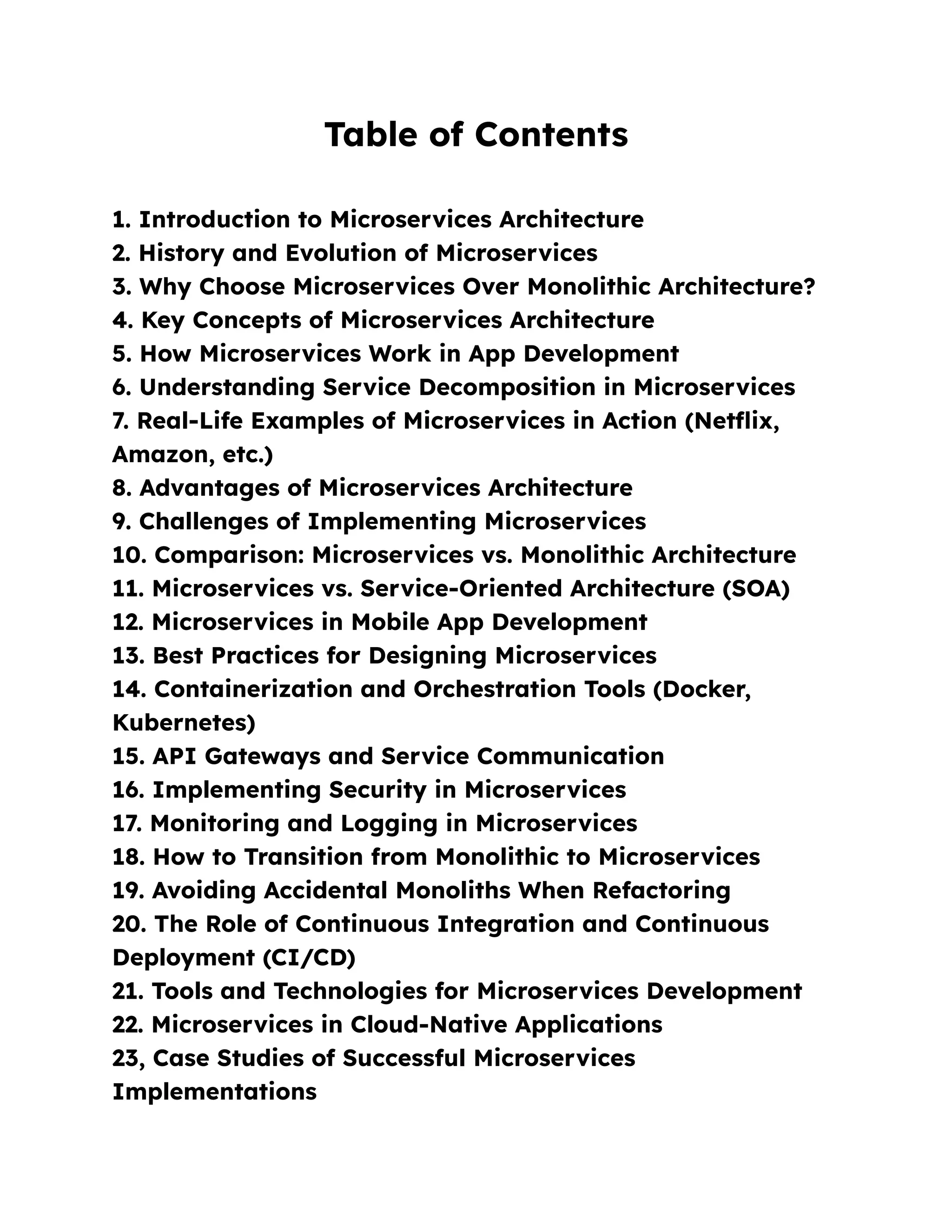
Microservices. Sounds cool, right? But what exactly does it
mean, and why should you care? Imagine trying to build a
Lego set. You could either make it one big block (not very
fun), or you could build it piece by piece—each Lego brick
doing its part to form the final, awesome product. That’s the
essence of microservices architecture. Instead of creating
one giant piece of software where everything is tightly
wound together, microservices architecture breaks the
application down into small, independent services. Each
service has a specific task or responsibility and can be
developed, deployed, and scaled separately.
Microservices architecture has taken the software
development world by storm, becoming the preferred choice
for many modern apps. But why? Well, it’s all about
flexibility and adaptability. With technology advancing at a
breakneck pace, businesses need to react quickly to changes
in user demands and market conditions. Having an app
that’s one giant, tangled codebase doesn’t allow for much
flexibility. You change one thing, and boom—something else
breaks! It’s like a house of cards. With microservices,
however, you can make updates to one service without
worrying about bringing the whole app down.
Let’s break it down a bit more. Each microservice in this
architecture performs a specific function, like user
authentication, payment processing, or sending
notifications. These services communicate with each other,
usually through APIs (Application Programming Interfaces),
to achieve the bigger picture: running the entire app.
Imagine each service as an independent worker in a
factory, each responsible for one part of the process, but all
working together to make a shiny, final product.
Why is this so important today? Well, businesses now deal
with a lot more complexity than they did ten years ago.
There are more users, more data, and more features to
handle. Microservices help to manage this complexity by
making the system more modular. If your app starts
growing and you suddenly have thousands of users logging
in every minute, you can scale just the login service, rather
than scaling the entire application. It’s a bit like turning up
the heat on just one burner when you’ve got a lot of food to
cook.
Microservices architecture also gives developers more
freedom when it comes to choosing tools and technologies.
Unlike monolithic architectures, which often force you to
stick with one programming language or tech stack,
microservices let you use different tools for different
services. For example, one service might be written in
Python, another in Java, and yet another in
Node.js—whatever works best for the task at hand. This can
lead to better performance and quicker development times
since each service can be optimized for its specific function.
In short, microservices architecture is about making large,
complex applications more manageable, scalable, and
resilient. Each microservice acts as a small, independent
puzzle piece, and when you put them together, they create
the full picture. This is why companies like Netflix, Amazon,
and Uber have embraced this architecture—it allows them to
move fast, stay flexible, and keep their apps running
smoothly even as they grow.
2. History and Evolution of
Microservices
Before microservices became the hottest thing in software
architecture, most applications were built using a monolithic
architecture. Picture an old desktop computer from the
1990s. Everything was in one box—the monitor, the CPU, the
speakers. It worked fine for a while, but as technology
advanced, this setup became a bottleneck. If one part
failed, the whole thing came crashing down. That’s what it
was like with monolithic software architectures. All the
components of the application were bundled together into
one large, complex system.
In the early days of computing, monolithic applications
made sense. Software systems were smaller, user demands
were simpler, and the pace of technological change was
much slower. But as the internet exploded in the early 2000s,
applications started getting bigger and more complicated.
Companies like Amazon and Netflix were among the first to
realize that monolithic architectures couldn’t keep up with
the scale and speed they needed.
So, what happened? Well, these companies started
experimenting with breaking their applications down into
smaller, more manageable pieces. This was the early
evolution of microservices, although they weren’t called that
yet. Instead of one big app, they created multiple, smaller
services that could be developed and maintained
independently. Each service was responsible for a specific
function, such as handling user authentication, managing
the shopping cart, or recommending products to customers.
It wasn’t until 2011 that the term microservices was
formalized by James Lewis and Martin Fowler, two
renowned software architects. They observed that many
large-scale web companies were moving towards this model
of development. These companies needed to be agile and
able to update parts of their systems without disrupting the
entire application. Monolithic architectures were like trying
to change a tire while driving 60 miles per hour—it just
wasn’t sustainable.
The rise of cloud computing in the late 2000s also played a
huge role in the evolution of microservices. Cloud platforms
like Amazon Web Services (AWS) and Microsoft Azure made
it easier to deploy and manage multiple services, further
encouraging the adoption of microservices architecture.
Before the cloud, managing infrastructure was a
headache—companies had to buy servers, maintain data
centers, and manually manage everything. The cloud
eliminated much of this overhead, making it much simpler to
deploy and scale individual services.
Another significant milestone in the evolution of
microservices was the development of tools like Docker and
Kubernetes. Docker made it easy to package microservices
into lightweight, portable containers, while Kubernetes
provided a way to orchestrate and manage these containers
across a cluster of servers. These tools made it much easier
to adopt microservices, even for smaller companies without
massive IT budgets.
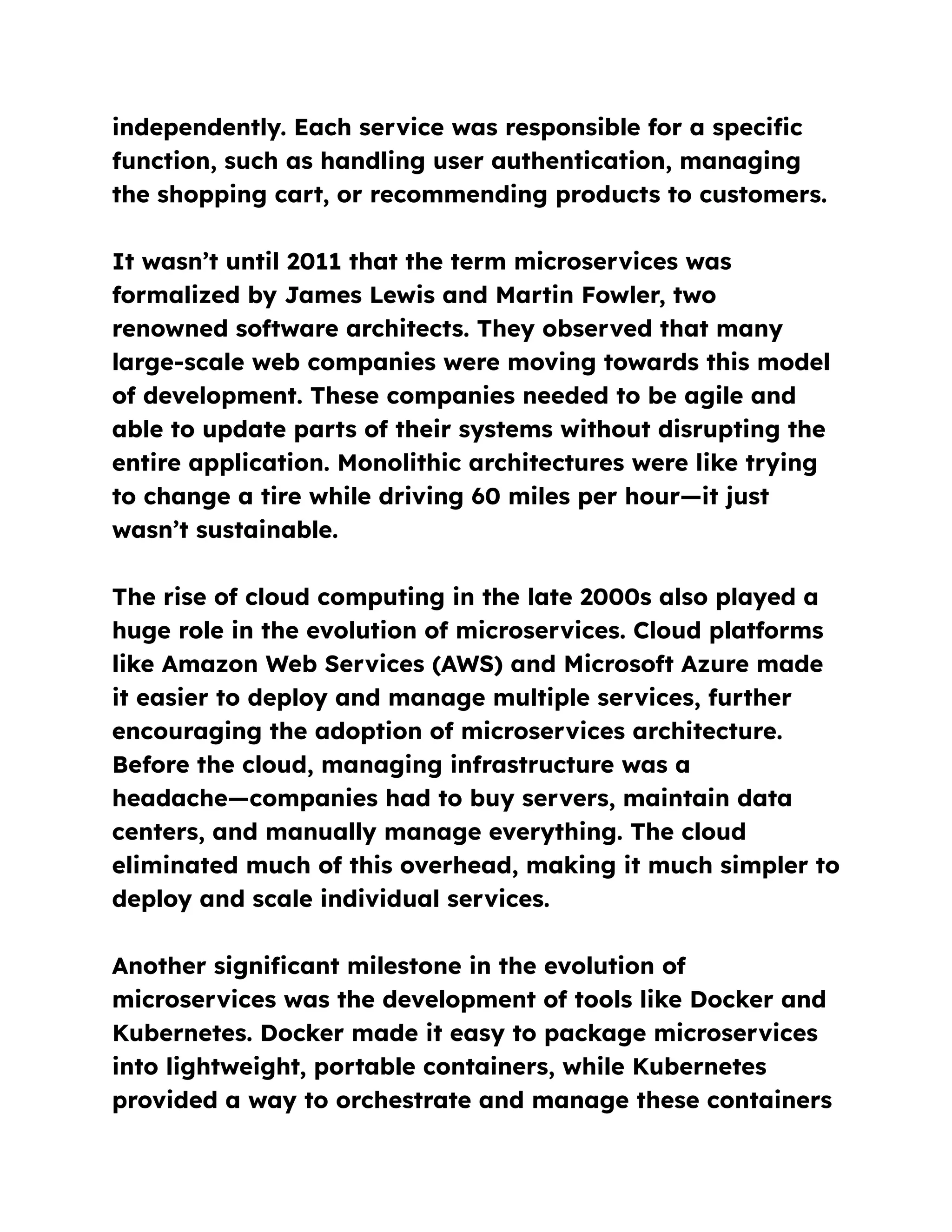
As microservices architecture continued to evolve, it became
clear that this wasn’t just a trend—it was the future of
software development. Today, microservices are widely used
across industries, from finance to healthcare to
entertainment. They’ve proven to be a game-changer in
terms of scalability, flexibility, and resilience.
3. Why Choose Microservices Over
Monolithic Architecture?
Let’s say you’re building a house. Would you rather have one
big, blocky room where everything’s jammed together, or a
series of well-organized rooms, each serving a specific
purpose? This is essentially the choice between monolithic
architecture and microservices architecture. Monolithic
architecture is like that one big room—everything’s in there,
and it works, but it’s not very efficient. Microservices, on the
other hand, break everything down into smaller, specialized
rooms, making the whole system more organized and easier
to maintain.
So, why should you choose microservices over monolithic
architecture? There are several key reasons:
Scalability : One of the biggest advantages of
microservices is that they allow you to scale specific parts of
your application independently. In a monolithic system, if
one part of your app starts experiencing high traffic—say,
the login page—you’d have to scale the entire application,
even if the other parts aren’t experiencing any issues. This is
not only inefficient but also expensive. With microservices,
you can scale just the parts that need it. If your login
service is getting hammered by traffic, you can add more
instances of just that service without touching the rest of the
app.
Agility: Monolithic architectures tend to slow down
development because all the code is tangled together. If you
want to update one part of the app, you have to make sure
it won’t break anything else, which can take a lot of time
and testing. Microservices, on the other hand, allow for
much faster development. Each team can work on their
service independently without worrying about the rest of the
app. This means you can roll out updates and new features
much more quickly.
Resilience: In a monolithic app, if one part crashes, the
whole system can go down. It’s like a row of
dominoes—once one falls, the others follow. Microservices
are more resilient because they’re independent of each
other. If one service crashes, the others keep running. For
example, if your payment service goes down, your users can
still browse products and add them to their cart, even if they
can’t complete the purchase right away.
Flexibility: Monolithic architectures often lock you into
using a specific tech stack, which can limit your ability to
innovate. With microservices, you can use different tools and
technologies for different services. For example, you might
use Python for your machine learning services, Java for
your backend services, and JavaScript for your frontend.
This flexibility allows you to choose the best tool for each
job, leading to better performance and faster development.
Maintainability: Over time, monolithic applications tend
to become big, tangled messes of code. Adding new features
becomes increasingly difficult, and debugging issues can
feel like finding a needle in a haystack. Microservices, by
contrast, are much easier to maintain. Each service has its
own codebase, making it simpler to troubleshoot and update
without affecting the rest of the application.
Continuous Deployment: In a monolithic system,
deploying updates can be risky because even a small
change can potentially break the entire app. This leads to
infrequent updates and a lot of downtime. Microservices
make it easier to adopt Continuous Integration/Continuous
Deployment (CI/CD) practices, where updates are rolled out
frequently and with minimal disruption. Since each
microservice can be deployed independently, you can
release updates more often and with less risk.
In conclusion, while monolithic architecture might be
simpler to implement for small apps, it quickly becomes a
burden as the app grows. Microservices offer a more
scalable, flexible, and resilient solution, making them the
better choice for modern app development.
4. Key Concepts of Microservices
Architecture
When you hear the term "microservices architecture," it
might sound a bit complex, but it’s actually built on a
handful of straightforward key concepts that work together
to form a robust and flexible system. Think of it like building
with Legos—each piece is simple, but together they create
something incredible. Let's break down the key concepts
that make microservices architecture tick.
1. Service Independence
The heart of microservices lies in the idea that each service
is independent. Imagine each microservice as a
self-sufficient unit with its own tasks, responsibilities, and
resources. For example, one microservice could be
responsible for handling user logins, another for processing
payments, and yet another for managing product
recommendations. These services don't need to know the
inner workings of each other—they just need to
communicate through well-defined APIs. This independence
means you can develop, test, deploy, and scale each
microservice on its own, without worrying about how it will
affect other parts of the application.
Why is this a game-changer? Well, in a traditional
monolithic architecture, all parts of the system are tightly
coupled. If you want to make a change or update one
feature, you risk breaking something else. In microservices,
since each service is independent, changes to one service
don’t typically affect the others. This makes updates faster,
safer, and less prone to error.
2. API-Driven Communication
One of the most important concepts in microservices is how
these independent services communicate with each other.
They do this through APIs (Application Programming
Interfaces). Think of APIs as the language that
microservices use to talk to each other. APIs allow
microservices to request and send information in a
structured way. For example, when a user logs in, the login
service might need to verify their credentials with a
database service. The login service sends a request via an
API, and the database service responds with the necessary
information.
APIs are crucial because they ensure that microservices can
remain decoupled. They don’t need to know about the
internal logic of other services; they just need to know how
to make and respond to API requests. This not only makes
the system more modular but also allows different teams to
work on different services independently.
3. Data Decentralization
In a traditional monolithic application, there is usually one
central database that all components rely on. However, in
microservices architecture, data is often decentralized,
meaning each microservice can have its own database or
datastore. This decentralization allows each microservice to
manage its own data without needing to coordinate with
other services constantly. It’s like giving each department in
a company its own filing cabinet, rather than making
everyone share one big cabinet.
Decentralized data improves performance and scalability.
Services can operate faster because they don’t have to wait
on a central database. It also reduces bottlenecks because
no single database is overwhelmed with requests. However,
it also introduces new challenges, like ensuring data
consistency across services.
4. Continuous Deployment and DevOps
Integration
Another key concept in microservices architecture is the
ability to continuously deploy and integrate new features or
updates. Since microservices are smaller and independent,
you can update or redeploy them without affecting the
entire application. This ties into the practice of Continuous
Integration and Continuous Deployment (CI/CD), where
code is frequently integrated, tested, and deployed in short
cycles.
CI/CD allows developers to push changes faster and more
efficiently. Because each microservice is separate, you can
roll out updates to just one service without disrupting
others. This is great for large teams working on different
parts of an application since it minimizes downtime and
speeds up development cycles. DevOps practices—such as
automating testing and deployment—play a huge role in
making this process smooth and error-free.
5. Fault Tolerance and Resilience
Microservices architecture is designed to be fault-tolerant,
which means the failure of one service doesn’t bring the
whole system down. If one service fails—say, the payment
gateway—the other services, like browsing products or
adding them to a cart, continue to function normally. This
resilience is crucial for large, complex applications that need
to maintain uptime and performance, even when individual
services experience issues.
In monolithic architectures, a single bug or issue in one part
of the code can crash the entire application. In contrast,
microservices are isolated from each other, which limits the
impact of a single failure. Of course, building fault tolerance
into a microservices system takes careful planning. You’ll
need to implement strategies like retries, circuit breakers,
and failover mechanisms to ensure services can recover
from failures smoothly.
6. Scalability
One of the greatest advantages of microservices
architecture is scalability. Because each service is
independent, you can scale individual services based on
their specific needs. For example, if your login service is
experiencing heavy traffic, you can add more instances of
just that service to handle the load, without having to scale
your entire application. This is much more efficient and
cost-effective than scaling a monolithic application, where
you have to add resources to the whole system, even if only
one part is experiencing high demand.
Microservices can also scale across different regions and
data centers, making them ideal for global applications with
users around the world. The ability to scale specific services
also improves performance since you can allocate resources
where they’re needed most.
7. Polyglot Programming
In microservices architecture, you're not tied to one
programming language or tech stack. This concept is called
polyglot programming. You can use the best tool or
language for the job at hand. For example, one microservice
might be written in Python, another in Java, and yet
another in Go. Each team can choose the language and tools
that best suit their service’s specific needs.
Polyglot programming allows for greater flexibility and
innovation. Developers can experiment with different
technologies without disrupting the entire system. It also
means you can bring in specialized talent to work on
specific services without needing to standardize across the
entire codebase.
8. Monitoring and Logging
With so many services running independently, it's essential
to have robust monitoring and logging systems in place.
These systems help you keep track of the health and
performance of each microservice. If one service starts to
lag or fails, monitoring tools can alert your team before the
issue spirals into a bigger problem.
Logging is equally important because it provides a detailed
record of what’s happening inside each service. When
something goes wrong, logs help developers trace the
problem back to its source. Together, monitoring and
logging ensure that your microservices system stays healthy
and performs at its best.
5. How Microservices Work in App
Development
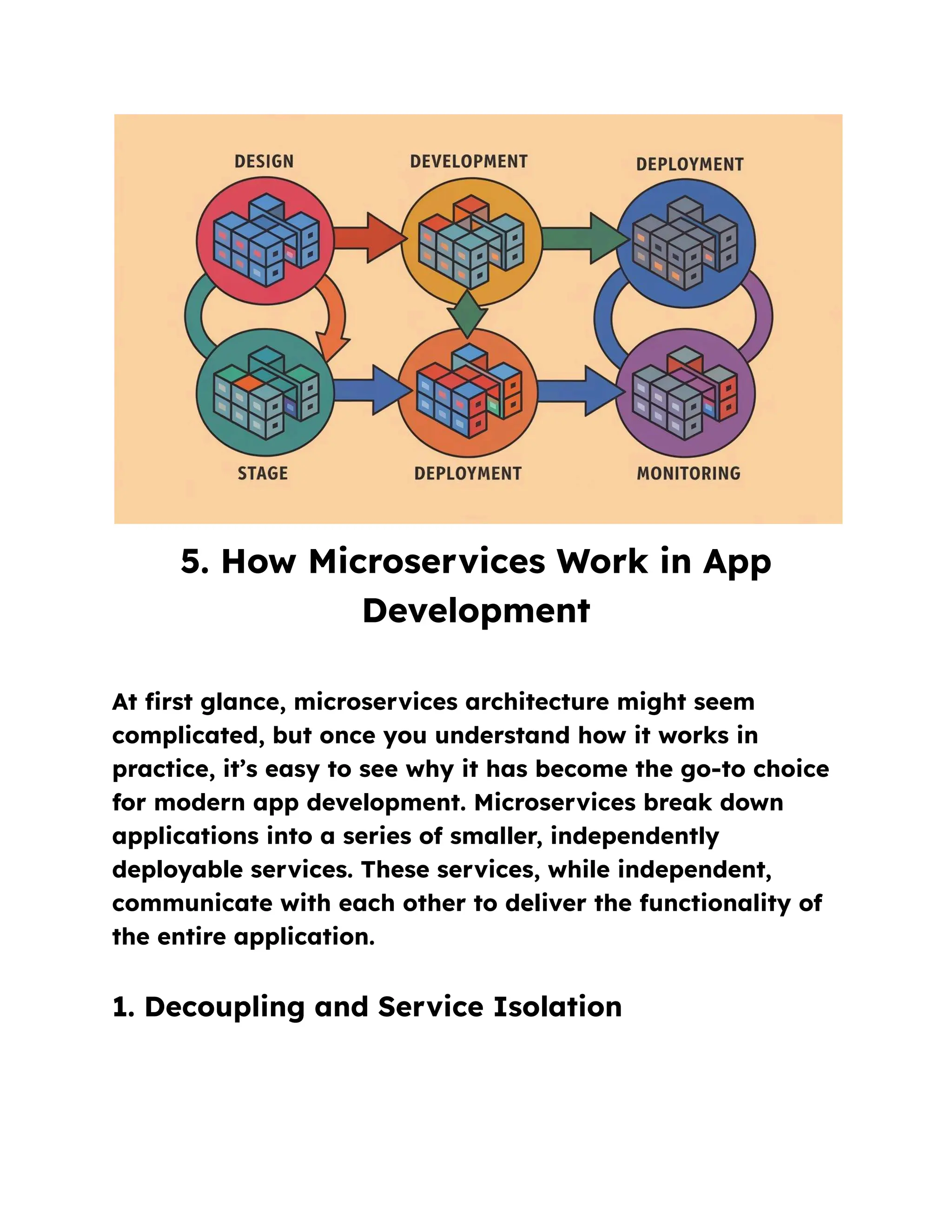
At first glance, microservices architecture might seem
complicated, but once you understand how it works in
practice, it’s easy to see why it has become the go-to choice
for modern app development. Microservices break down
applications into a series of smaller, independently
deployable services. These services, while independent,
communicate with each other to deliver the functionality of
the entire application.
1. Decoupling and Service Isolation
In a microservices-based app, each microservice is isolated
from the others. This is crucial for maintaining a scalable
and flexible system. When developers build an app using a
monolithic architecture, all the functionality lives in a single
codebase, and changes to one feature can ripple through
the entire application. In microservices architecture,
developers isolate each feature or functionality into its own
service, which can be updated, deployed, and scaled
independently.
For example, let’s say you’re developing an e-commerce
platform. In a monolithic app, features like user
authentication, payment processing, and product
recommendations would all be tied together in the same
application. If you needed to scale up the payment
processing system to handle a surge in traffic, you’d have to
scale the entire app, which could be costly and inefficient. In
contrast, in a microservices architecture, each of these
features would be separated into its own microservice,
allowing you to scale just the payment service without
affecting the others.
2. Communication Between Services
While microservices are decoupled, they still need to
communicate with each other to deliver the complete
functionality of an app. This is typically done through APIs
or message brokers. For example, if a user logs into your
app, the login service will need to communicate with the
user database service to verify credentials. This
communication is usually done over HTTP or through
message queues like RabbitMQ or Apache Kafka, depending
on the complexity and requirements of the application.
Because microservices communicate through APIs, they can
remain language-agnostic. This means you can have one
service written in Python, another in JavaScript, and yet
another in Java, and as long as they all follow the same API
protocols, they can communicate seamlessly. This allows for
great flexibility in choosing the right tools for each part of
your application.
3. Service Discovery
In a large system with dozens or even hundreds of
microservices, managing communication between services
can become challenging. This is where service discovery
comes into play. Service discovery is the process of
automatically finding the location of services so they can
communicate with each other without hardcoding their
addresses. Tools like Consul, Eureka, or Kubernetes come in
handy for this, allowing services to register themselves and
look up other services dynamically.
Without service discovery, managing the endpoints for each
microservice would be a logistical nightmare, especially in
cloud environments where services can move around or
scale up and down dynamically. By automating this process,
service discovery ensures that communication between
microservices remains smooth and efficient.
4. Handling Data in a Microservices Architecture
When building an app with microservices, handling data can
get a little tricky. In a monolithic architecture, there’s
usually a single database that all components of the app
interact with. In microservices architecture, each service
typically manages its own database or datastore. This
ensures that services remain decoupled, but it also
introduces the challenge of data consistency.
For instance, let’s say you have a microservice that handles
product inventory and another that processes customer
orders. When a customer places an order, the order service
needs to update the inventory in the inventory service. Since
each service has its own database, ensuring that these
updates happen consistently requires careful planning,
typically using techniques like event-driven architecture or
sagas to manage distributed transactions.
5. Scalability and Performance
One of the biggest advantages of microservices in app
development is the ability to scale individual services based
on demand. In a traditional monolithic app, if you
experience high traffic to one feature—say, the product
search functionality—you’d have to scale the entire app to
handle the load. This is not only inefficient but can also lead
to bottlenecks in other parts of the app.
With microservices, you can scale just the services that need
it. So if your product search is getting a lot of traffic, you
can spin up more instances of the search service without
affecting the rest of your app. This makes microservices
architecture much more resource-efficient and allows for
better performance under heavy loads.
6. Understanding Service Decomposition
in Microservices
Service decomposition is the art of breaking down an
application into smaller, independently deployable services,
which is the essence of microservices architecture. Imagine
trying to organize a gigantic library—you wouldn't want all
the books in one pile! Instead, you'd break it down into
sections: fiction, non-fiction, science, history, etc. This is
what service decomposition does for your application. It
takes a large, monolithic application and splits it into
manageable pieces, making the system more maintainable,
scalable, and adaptable.
1. Why Service Decomposition Matters
When you're building an application, it's easy to fall into the
trap of creating one big, interconnected system where every
part relies on every other part. This is called a monolithic
architecture, and it works fine when your app is small.
However, as your app grows, so does its complexity. A
monolith can become unwieldy and hard to maintain. You
change one part of the system, and suddenly everything
breaks. That’s where service decomposition comes in—it
allows you to split your app into smaller, more focused
services that can be developed, maintained, and scaled
independently.
In microservices architecture, each service is responsible for
a specific functionality or feature. For example, in an
e-commerce app, you might have one service for user
accounts, another for managing products, and another for
processing orders. Each of these services can be developed
and updated independently, which speeds up development
and reduces the risk of introducing bugs across the entire
system.
2. Approaches to Service Decomposition
Breaking down a monolithic application into microservices
isn’t something you should do haphazardly. There are a few
common approaches to service decomposition that
developers use to ensure the architecture remains clean,
efficient, and maintainable.
Decomposition by Business Capabilities: One of the most
popular approaches to service decomposition is by business
capability. Think of each service as a separate department
in a company. Just like how the HR department handles
employee records and payroll, a business capability-based
microservice might handle a specific function like user
authentication, product inventory, or payment processing.
The idea is to decompose the application based on the
specific tasks or processes that make up the business.
Decomposition by Subdomains: Another approach is to
decompose services by subdomains of the application. For
example, using Domain-Driven Design (DDD) principles, you
can split the application into subdomains that each focus on
a specific area of functionality. Subdomains might include
core features, such as product catalogs, and support
features, such as notifications or email services. The
advantage of this method is that it ensures each
microservice is focused on a specific domain of
responsibility.
Decomposition by User Journey: This approach considers
how users interact with your app. For instance, in an
e-commerce app, a user journey might involve browsing
products, adding items to the cart, and checking out. Each
step of this journey can be its own microservice. This
approach aligns the microservices with the customer
experience, making it easier to manage updates or
improvements based on how users engage with the app.
3. Best Practices for Service Decomposition
Service decomposition is more than just splitting things up;
it requires careful planning and foresight. Here are some
best practices to follow when breaking down an application
into microservices:
Keep Services Small, But Not Too Small: It’s important to
strike a balance between small, manageable services and
ones that are too small to function independently. Each
service should be focused on doing one thing well but should
also be able to handle its own data and logic without relying
too much on other services. If your microservices are too
small, you may end up with a fragmented system that's hard
to manage.
Focus on Autonomy: Microservices should be as independent
as possible. This means they should have their own data
storage, their own codebase, and their own deployment
process. If your microservices are constantly
communicating with each other, you risk introducing tight
coupling, which can negate the benefits of service
decomposition.
Think About Data Ownership: When decomposing services,
it’s crucial to ensure that each service owns its own data.
Sharing data between services can create dependencies and
complicate your system. Instead, each service should be
responsible for its own database or data storage, ensuring
that data is consistent and reliable.
Minimize Communication Overhead: While microservices
need to communicate, over-relying on communication can
slow down your system and introduce points of failure. It’s
best to limit the amount of communication between services.
When communication is necessary, it should be done
through well-defined APIs or asynchronous messaging
systems to avoid bottlenecks.
4. Challenges of Service Decomposition
While service decomposition brings many benefits, it also
introduces new challenges that developers must be aware of:
Increased Complexity: While microservices reduce the
complexity of individual services, they increase the
complexity of the overall system. Managing dozens (or even
hundreds) of microservices can be difficult, especially when
it comes to communication, deployment, and monitoring.
Data Consistency Issues: When services are decomposed,
ensuring data consistency across them becomes more
difficult. In a monolithic application, you might rely on a
single database, but in a microservices architecture, each
service often has its own database. This can lead to issues
with keeping data consistent between services, especially in
distributed systems.
Deployment and DevOps Challenges: With multiple
microservices, your deployment process becomes more
complex. Instead of deploying a single application, you now
need to deploy and manage multiple services. This requires
careful orchestration, often involving tools like Kubernetes
or Docker to handle containerization and service
deployment.
5. Examples of Effective Service Decomposition
Many large companies have successfully adopted service
decomposition in their microservices architectures. Take
Netflix, for example. Netflix has broken down its application
into hundreds of microservices, each handling a different
aspect of the service, such as user recommendations, video
encoding, and payment processing. This decomposition
allows Netflix to scale its services independently and deliver
updates more quickly without interrupting users.
Amazon also employs service decomposition. Amazon’s
e-commerce platform is built on a vast microservices
architecture, where services like product catalog
management, order fulfillment, and customer reviews are
handled by separate teams. This allows Amazon to innovate
rapidly and roll out updates without affecting the entire
platform.
7. Real-Life Examples of Microservices in
Action (Netflix, Amazon, etc.)
Microservices architecture is not just a theoretical
concept—it has been implemented by some of the biggest
and most successful companies in the world. These real-life
examples show how microservices can improve scalability,
flexibility, and performance, helping businesses stay ahead
of the curve in today’s fast-paced tech landscape.
1. Netflix
When you think of Netflix, you probably think of endless
hours of streaming entertainment. But behind the scenes,
Netflix has one of the most advanced microservices
architectures in the world. Netflix started as a DVD rental
service and later transitioned to online streaming. Initially,
Netflix used a monolithic architecture, but as their user base
exploded, so did the complexity of their system. They
realized that the monolithic approach couldn’t keep up with
the scale and speed they needed.
Netflix transitioned to microservices architecture, breaking
their monolithic system into hundreds of microservices. Each
service handles a specific function, such as user
authentication, content recommendation, or video encoding.
This decomposition has allowed Netflix to scale its services
independently. For example, during peak viewing times (like
when a new season of a popular show drops), Netflix can
scale up its video encoding service without affecting other
services.
Netflix’s microservices architecture also improves fault
tolerance. If one service fails—say, the recommendation
engine—it won’t crash the entire system. Other services, like
content streaming, can continue to run smoothly. This
resilience is critical for a platform like Netflix, where users
expect continuous, uninterrupted service.
Netflix also makes use of DevOps and Continuous
Deployment to roll out new features quickly. With
microservices, they can update one part of their system
without having to redeploy the entire application, leading to
faster iteration and innovation.
2. Amazon
Amazon, one of the world’s largest e-commerce platforms,
also shifted from a monolithic architecture to microservices.
In the early 2000s, Amazon’s system became a massive
monolith that was difficult to manage and scale. Developers
faced long delays in rolling out new features, and the system
struggled to handle the company’s rapid growth.
To address these issues, Amazon adopted microservices
architecture, breaking their monolith into smaller, more
manageable services. Each microservice is responsible for a
specific function, such as handling product
recommendations, managing inventory, or processing
payments. This decomposition has allowed Amazon to
innovate rapidly and scale individual services to meet
demand.
For instance, during high-traffic events like Black Friday,
Amazon can scale its order fulfillment and payment
processing services independently to handle the surge in
traffic. Other services, such as product recommendations,
don’t need to be scaled as aggressively, saving resources.
Amazon’s microservices architecture also allows for faster
development cycles. Each service is developed and
maintained by a separate team, allowing for greater
specialization and efficiency. This has enabled Amazon to
roll out new features faster and stay competitive in the
e-commerce space.
3. Uber
Uber is another great example of microservices in action.
When Uber started, it was a small app serving a single city,
and a monolithic architecture made sense. However, as Uber
expanded globally, the monolithic system couldn’t keep up.
Uber needed a system that could scale quickly and handle
the complex logistics of matching riders with drivers in
real-time.
Uber transitioned to microservices, allowing them to break
their application into various services, such as rider
management, driver management, payment processing, and
route optimization. This architecture enables Uber to scale
each service independently. For example, during peak hours,
Uber can quickly scale its driver management service to
ensure that enough drivers are available to meet demand.
Moreover, Uber’s microservices architecture enhances its
ability to innovate. Different teams can work on separate
services simultaneously without stepping on each other’s
toes. This leads to faster development cycles and more rapid
deployment of new features.
4. Spotify
Spotify, the popular music streaming service, also employs
microservices architecture to manage its vast library of
songs and user preferences. With millions of users streaming
music every day, Spotify needed a robust system that could
handle significant load while providing personalized
recommendations.
Spotify’s architecture consists of multiple microservices that
manage different functionalities, such as user profiles,
playlist management, and song recommendations. Each
microservice is developed and maintained independently,
allowing Spotify to roll out new features quickly. For
instance, when a user saves a song to a playlist, the playlist
service can update that data in real-time without affecting
the rest of the system.
Spotify’s microservices architecture also supports their goal
of providing personalized experiences. The recommendation
engine can analyze user behavior and preferences through
independent services, ensuring users get tailored music
suggestions based on their listening habits.
8. Advantages of Microservices
Architecture
Microservices architecture offers several benefits that make
it an appealing choice for many organizations looking to
improve their software development process. Let’s explore
some of the key advantages of adopting a microservices
approach.
1. Scalability
One of the standout features of microservices is their
inherent scalability. In a traditional monolithic architecture,
scaling requires duplicating the entire application, which
can be inefficient and resource-intensive. However, with
microservices, you can scale individual services based on
demand.
Imagine a social media application that experiences a
sudden surge in activity during a trending event. With
microservices, the application can quickly scale its user
management and messaging services to accommodate the
increased traffic, all while leaving other services unaffected.
This granular approach to scaling ensures that resources are
allocated efficiently and helps maintain optimal
performance.
2. Flexibility and Technology Diversity
Microservices architecture promotes flexibility in terms of
technology choices. Each service can be built using the most
suitable programming language, framework, or database
for its specific requirements. This means that teams can
choose the right tools for their services without being
constrained by a single tech stack.
For example, a data-intensive service might be built using
Python with a PostgreSQL database, while a real-time
communication service might leverage Node.js with a
NoSQL database like MongoDB. This technology diversity
allows organizations to leverage the best tools for each
service, resulting in improved performance and
maintainability.
3. Faster Time to Market
Microservices architecture enables teams to work more
independently and collaboratively. Each microservice can be
developed, tested, and deployed independently, reducing the
time it takes to bring new features or updates to market.
This agile development approach is particularly beneficial in
today’s fast-paced business environment.
Imagine you’re working on an e-commerce application.
Instead of waiting for the entire application to be
redeployed for a small change in the payment processing
service, your team can deploy updates to that specific
service quickly. This faster time to market allows
organizations to respond to user feedback, market changes,
and competitive pressures more effectively.
4. Improved Fault Isolation
In a microservices architecture, if one service fails, it
doesn’t necessarily bring down the entire application. This
improved fault isolation enhances the overall resilience of
the system. If a service encounters an error, the rest of the
services can continue to operate normally, ensuring that
users experience minimal disruptions.
For instance, if a payment processing service experiences
downtime, users can still browse products and add items to
their carts. They might receive an error message when
trying to check out, but they won’t be completely locked out
of the application. This level of fault tolerance is crucial for
providing a seamless user experience.
5. Easier Maintenance and Updates
Maintaining a monolithic application can be challenging due
to its interconnected nature. A small change in one area can
have unintended consequences in others. Microservices, on
the other hand, allow for more straightforward maintenance.
Each service is responsible for its own codebase, making it
easier to identify and fix issues without affecting the entire
system.
Additionally, updating individual microservices becomes less
risky. If a new version of a service is deployed and
introduces a bug, it can be rolled back without impacting
other services. This agility in maintenance and updates
leads to reduced downtime and a more stable application.
6. Enhanced Team Collaboration
Microservices architecture fosters better collaboration
among development teams. With each team responsible for
a specific service, they can work independently and take
ownership of their respective areas. This autonomy
encourages innovation and enables teams to experiment
with new technologies and approaches.
Moreover, because teams are working on smaller, focused
services, communication becomes more manageable.
Developers can easily collaborate within their teams without
getting bogged down by the complexities of a monolithic
codebase. This enhanced collaboration leads to increased
productivity and better outcomes.
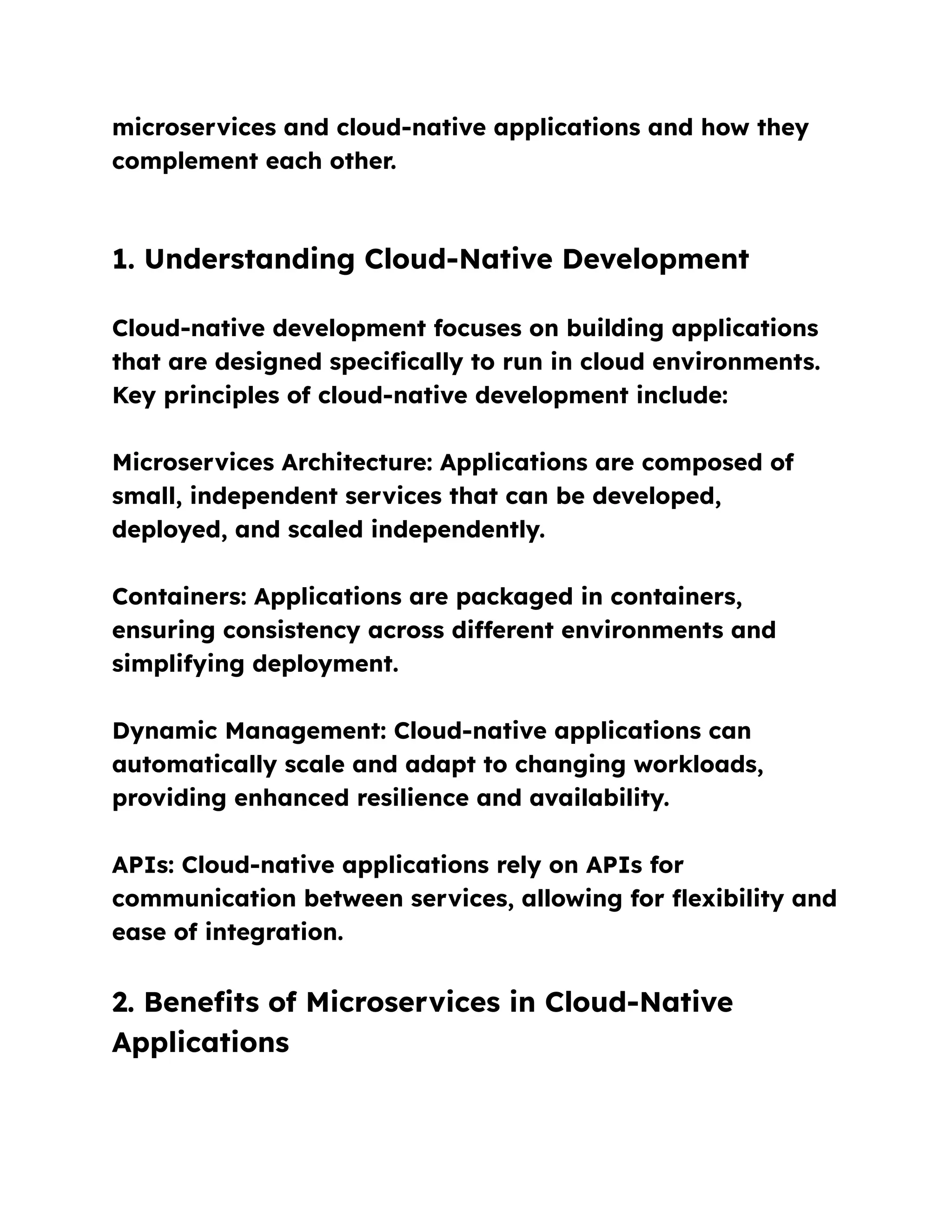
9. Challenges of Implementing
Microservices
While microservices architecture offers many benefits, it
also comes with its own set of challenges. Understanding
these challenges is essential for organizations considering a
shift to microservices. Let’s delve into some of the key
hurdles that developers and teams may face when
implementing microservices.
1. Increased Complexity
One of the most significant challenges of adopting
microservices is the increased complexity of managing
multiple services. Unlike a monolithic application where
everything is in one place, microservices involve numerous
independent services that need to communicate with each
other. This adds complexity to deployment, monitoring, and
management.
As the number of microservices grows, tracking
dependencies and interactions becomes more challenging.
Organizations must invest in robust orchestration tools and
monitoring solutions to ensure that services are functioning
correctly and communicating effectively.
2. Data Management Challenges
In a microservices architecture, each service often has its
own database. This can lead to challenges in data
consistency and management. Ensuring that data remains
synchronized across services while maintaining
independence can be tricky.
For example, if one service updates user information, how
do you ensure that other services reflect those changes?
Organizations may need to implement event-driven
architecture or eventual consistency models to manage data
across distributed systems. This requires careful planning
and consideration to avoid data discrepancies.
3. Deployment Overhead
With multiple microservices comes the need for more
sophisticated deployment strategies. Each service needs to
be deployed, monitored, and maintained independently,
which can create overhead in terms of deployment processes
and infrastructure.
Organizations may need to invest in tools and technologies
for containerization (like Docker) and orchestration (like
Kubernetes) to manage the deployment and scaling of
microservices effectively. This adds another layer of
complexity to the development process.
4. Inter-Service Communication
Microservices rely on communication between services to
function correctly. However, this communication can
introduce latency and potential points of failure. Ensuring
smooth and reliable communication between services is
critical for the overall performance of the application.
Organizations must choose appropriate communication
protocols (like REST or gRPC) and consider factors like
network latency, security, and service discovery. Designing
robust APIs and implementing error handling mechanisms
become essential to mitigate communication challenges.
5. Testing Challenges
Testing microservices can be more complex than testing a
monolithic application. Each service needs to be tested
independently, and end-to-end testing must ensure that the
entire system works together as expected. This requires a
shift in testing strategies and may necessitate the use of
tools for automated testing and continuous integration.
Organizations should invest in comprehensive testing
frameworks to ensure that services are thoroughly tested
both in isolation and in conjunction with one another. This
helps identify issues early in the development process and
ensures a stable application.
6. Cultural Shift
Adopting microservices often requires a cultural shift within
an organization. Teams need to embrace agile
methodologies, DevOps practices, and cross-functional
collaboration to succeed with microservices. This can be a
challenge, especially for organizations accustomed to
traditional development approaches.
Fostering a culture of collaboration and continuous
improvement is essential for successfully implementing
microservices. Organizations may need to invest in training
and resources to help teams adapt to the new way of
working.
10. Comparison: Microservices vs.
Monolithic Architecture
When it comes to software architecture, two popular
approaches are microservices and monolithic architecture.
Both have their strengths and weaknesses, and
understanding these differences is crucial for developers,
businesses, and tech enthusiasts. Let’s break it down in a
fun, engaging way!
What is Monolithic Architecture?
Imagine you’re building a giant LEGO castle. You use one
large base to connect all the individual blocks—walls,
towers, and gates. This is akin to a monolithic architecture,
where all components of an application are tightly
integrated into a single codebase. In a monolithic
application, everything from the user interface to the
backend is bundled together, which can make it easy to
manage initially.
However, as the application grows, this approach can
become cumbersome. Want to add a new feature? You might
need to dig through a ton of code, risking a domino effect
where one small change could lead to bigger issues. This
leads to longer development cycles and more bugs—yikes!
What are Microservices?
Now, let’s take a look at microservices. Picture instead that
you’re building a LEGO city, where each building (service)
stands alone but communicates with others. Each service
can be developed, deployed, and scaled independently. This
is the essence of microservices architecture.
With microservices, teams can work on different
components simultaneously without stepping on each
other's toes. For instance, if the payment service needs an
upgrade, it can be modified without impacting the user
interface or other parts of the application. This independent
approach enhances flexibility and agility.
Comparison: The Good, The Bad, and The Ugly
1. Scalability:
Monolithic: Scaling a monolithic application can be like
trying to move a large boulder. You often have to replicate
the entire application, which can lead to inefficient resource
use.
Microservices: Scaling is much more straightforward! You
can scale individual services based on demand. For
example, if your chat service is buzzing, you can spin up
more instances of just that service.
2. Development Speed:
Monolithic: Changes can take a long time to implement, as
everything is interconnected. This leads to longer
development cycles.
Microservices: Teams can work concurrently on different
services, leading to faster development cycles and quicker
time to market.
3. Fault Tolerance:
Monolithic: If one part fails, it can bring down the entire
application. Picture your LEGO castle losing a key block—it
all falls apart!
Microservices: If one service fails, it doesn’t necessarily
crash the whole application. This design improves overall
reliability.
4. Complexity:
Monolithic: While simple to understand initially, as the
application grows, managing the complexity becomes
challenging.
Microservices: Though it offers flexibility, microservices can
introduce their own complexity in terms of service
management, inter-service communication, and data
consistency.
5. Deployment:
Monolithic: Every time there’s an update, the entire
application needs to be redeployed, which can lead to
downtime.
Microservices: Updates can be made to individual services,
allowing for smoother, less disruptive deployments.
Conclusion
In conclusion, the choice between microservices and
monolithic architecture largely depends on the specific
needs and goals of your project. Monolithic architecture may
be suitable for smaller applications or startups, while
microservices can provide the scalability and flexibility
needed for larger, more complex systems.
As the tech world continues to evolve, understanding these
architectural choices will help teams make informed
decisions that align with their growth strategies and
development methodologies.
11. Microservices vs. Service-Oriented
Architecture (SOA)
In the ever-evolving world of software development, terms
like microservices and service-oriented architecture (SOA)
are often thrown around. While they might sound similar,
they have distinct characteristics and use cases. Let’s dive
into this comparison with a bit of flair!
What is Service-Oriented Architecture (SOA)?
Think of SOA as a community where everyone helps each
other. In this architecture, applications are designed as a
collection of loosely coupled services. Each service is a
distinct unit that can communicate with others over a
network. SOA emphasizes reusability and interoperability,
allowing different applications to share services seamlessly.
SOA often involves a central service bus that facilitates
communication among services, promoting integration
across different platforms. For instance, in a banking
application, the payment service and account management
service might communicate through the service bus.
Microservices Unleashed!
Now, let’s shift gears to microservices. Microservices
architecture takes the concept of SOA and shrinks it down to
size. While SOA focuses on larger services that can perform
multiple functions, microservices prioritize small,
single-purpose services. Each microservice does one thing
and does it well—kind of like a specialized superhero.
This granular approach means that microservices can be
deployed, scaled, and updated independently. If you need to
update the authentication service in your application, you
can do so without affecting the user profile service. This
flexibility is a game-changer!
Key Differences Between Microservices and SOA
1. Size and Scope:
SOA: Services are larger and can encompass multiple
functionalities. Think of a Swiss army knife—many tools in
one.
Microservices: Each service is small and focuses on a single
task. Imagine a toolbox with specialized tools for each job.
2. Communication:
SOA: Communication often happens through a central
service bus, which can introduce bottlenecks.
Microservices: Each service communicates directly with
others using lightweight protocols, promoting faster
interactions and reducing latency.
3. Technology Stack:
SOA: Services are typically built using the same technology
stack to facilitate integration.
Microservices: Teams can choose different technologies for
different services, leading to greater innovation and
flexibility.
4. Data Management:
SOA: Services often share a common database, which can
lead to tight coupling and data consistency challenges.
Microservices: Each microservice can manage its own data,
leading to more autonomy and better fault isolation.
5. Development Approach:
SOA: Generally involves a more centralized approach to
governance and management, which can slow down
decision-making.
Microservices: Encourages decentralized decision-making
and promotes agile methodologies, allowing teams to move
quickly and adapt.
Conclusion
In the battle between microservices and SOA, the victor
depends on your project’s goals and structure. If you need a
flexible, agile environment that supports continuous
integration and deployment, microservices might be the way
to go. On the other hand, if you’re looking for robust
integration across diverse systems, SOA could be your best
bet.
Ultimately, both approaches offer unique benefits that cater
to different needs in software development. As technology
continues to advance, staying informed about these
architectural styles will help you navigate the complexities
of building modern applications.
12. Microservices in Mobile App
Development
Mobile applications have become an integral part of our
daily lives, from social media to e-commerce. But have you
ever wondered how these apps are built? Enter
microservices architecture—a game-changer in the mobile
app development landscape. Let’s explore how microservices
are shaping the future of mobile applications!
Why Microservices for Mobile Apps?
When developing a mobile app, speed, scalability, and user
experience are paramount. Microservices architecture aligns
perfectly with these goals by allowing developers to create
modular components that can be updated independently.
For example, imagine you’re building a shopping app.
Instead of having a single, monolithic codebase, you can
have separate microservices for user authentication,
product catalog, payment processing, and user reviews. This
means that if you want to introduce a new payment method,
you can do so without impacting the entire app—how cool is
that?
Benefits of Using Microservices in Mobile App
Development
1. Scalability: With microservices, you can scale specific
components based on user demand. If your app experiences
a sudden spike in users trying to make purchases, you can
scale the payment processing service without affecting the
rest of the app.
2. Faster Development Cycles: Since teams can work on
different services simultaneously, you can roll out new
features and updates much faster. This agility is crucial in
the fast-paced world of mobile apps, where user preferences
can change overnight.
3. Improved User Experience: By utilizing microservices,
developers can create a more responsive and interactive
user experience. Services can be updated independently,
ensuring that users always have access to the latest features
without facing downtime.
4. Better Fault Isolation: If one service encounters an issue,
it won’t bring down the entire app. This fault isolation leads
to a more reliable user experience. For instance, if the user
review service fails, users can still browse products and
make purchases.
Real-World Examples of Microservices in Mobile Apps
Many popular mobile applications leverage microservices
architecture to enhance their functionality:
Netflix: The streaming giant uses microservices to manage
everything from user accounts to content delivery. This
allows them to deliver a seamless viewing experience across
devices.
Uber: The ride-hailing app relies on microservices to handle
various functionalities, such as user management, trip
requests, and payment processing, ensuring efficient
operations.
Spotify: The music streaming service employs microservices
to manage playlists, recommendations, and user
interactions, allowing for real-time updates and a
personalized experience.
Challenges in Implementing Microservices for Mobile Apps
While microservices offer numerous benefits, they also come
with challenges that developers must navigate:
1. Complexity: Managing multiple services can increase the
complexity of development and deployment. Ensuring
seamless communication between services requires careful
planning and execution.
2. Data Management: Data consistency can be a challenge
when using microservices. Each service may have its own
database, which can lead to discrepancies if not managed
properly.
3. Network Latency: Microservices communicate over the
network, which can introduce latency. Developers must
optimize service interactions to ensure a smooth user
experience.
Conclusion
In conclusion, microservices architecture is revolutionizing
mobile app development by providing the scalability,
flexibility, and resilience needed in today’s fast-paced
digital landscape. By breaking down applications into
smaller, independent services, developers can enhance user
experiences and streamline development processes.
As mobile applications continue to evolve, understanding
how microservices can be leveraged will empower
developers to create innovative and efficient solutions that
meet the ever-changing needs of users.
Follow My Blog & Please Visit My Website
13. Best Practices for Designing
Microservices
Designing microservices can be both exciting and
challenging. With great power comes great responsibility! To
ensure your microservices architecture is robust, scalable,
and maintainable, let's explore some best practices that can
guide you through the process.
1. Define Clear Service Boundaries
One of the most critical aspects of microservices design is


defining clear boundaries for each service. Each
microservice should be responsible for a specific business
capability. This ensures that the service remains focused
and can be developed, deployed, and scaled independently.
For instance, in an e-commerce application, you might have
separate services for user management, product catalog,
order processing, and payment. By keeping these services
distinct, you minimize dependencies and complexity.
2. Embrace API-First Design
In the world of microservices, APIs are your best friends!
Adopting an API-first design means that you define your
service interfaces before diving into the implementation.
This approach not only streamlines development but also
promotes clear communication between teams.
When you create an API specification, you can share it with
other developers, ensuring everyone is on the same page.
This collaboration helps avoid misunderstandings and
reduces the likelihood of integration issues down the road.
3. Choose the Right Data Management Strategy
Data management is a crucial consideration in
microservices design. Each service can have its own
database, allowing for autonomy and better fault isolation.
However, this approach can also lead to challenges in
maintaining data consistency across services.
Consider adopting eventual consistency and implementing
patterns like event sourcing or CQRS (Command Query
Responsibility Segregation) to manage data effectively. This
way, you can ensure that services remain decoupled while
still maintaining data integrity.
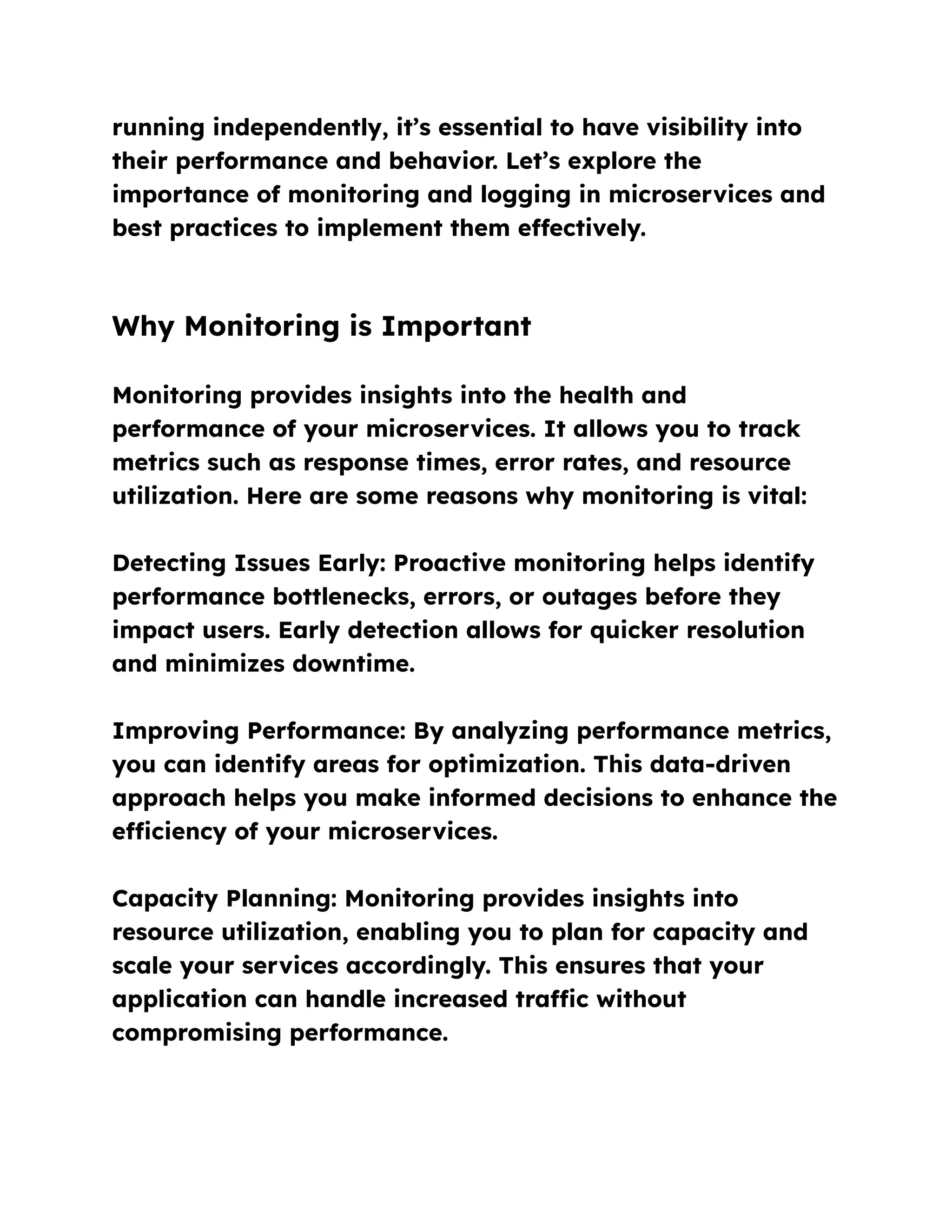
4. Implement Robust Monitoring and Logging
Monitoring and logging are vital components of
microservices architecture. With multiple services running
independently, it's essential to have a centralized
monitoring solution to track performance and detect issues.
Use tools like Prometheus, Grafana, or ELK Stack
(Elasticsearch, Logstash, and Kibana) to aggregate logs and
metrics from different services. This visibility enables you to
quickly identify bottlenecks, troubleshoot errors, and
optimize performance.
5. Prioritize Security from the Start
Security should never be an afterthought, especially in
microservices architecture. Each service should implement
its own security measures, such as authentication and
authorization.
Consider using OAuth or JWT (JSON Web Tokens) for secure
communication between services. By adopting a
security-first mindset, you can protect sensitive data and
reduce vulnerabilities across your application.
6. Automate Deployment with CI/CD
Continuous Integration and Continuous Deployment (CI/CD)
are essential practices for microservices development.
Automating the deployment process allows teams to release
updates more frequently and reliably.
Set up CI/CD pipelines to automate testing, building, and
deploying your microservices. This not only speeds up the
development process but also ensures that your services are
always in a releasable state.
7. Plan for Failure
In a microservices architecture, failures are inevitable.
Instead of fearing failure, plan for it! Implement patterns
like circuit breakers, retries, and fallbacks to enhance the
resilience of your services.
By anticipating and managing failures, you can create a
more robust application that continues to function even
under adverse conditions.
Conclusion
Designing microservices requires careful planning and
consideration. By following these best practices—defining
clear boundaries, embracing API-first design, choosing the
right data management strategy, implementing robust
monitoring and logging, prioritizing security, automating
deployment, and planning for failure—you can create a
microservices architecture that is scalable, maintainable,
and resilient.
As you embark on your microservices journey, remember
that the key to success lies in collaboration, communication,
and continuous improvement. Happy coding!
14. Containerization and Orchestration
Tools (Docker, Kubernetes)
In the world of microservices, containerization and
orchestration are two powerful concepts that go hand in
hand. Let’s dive into what these terms mean and how they
play a crucial role in deploying and managing microservices
effectively.
What is Containerization?
Think of containerization as a magic box that packages
everything an application needs to run—code, libraries,
dependencies—into a neat little container. This container is
lightweight, portable, and ensures that the application runs
consistently across different environments.
Docker is the most popular tool for containerization. With
Docker, developers can create, deploy, and manage
containers effortlessly. The beauty of containers is that they
isolate applications from their surroundings, meaning you
don’t have to worry about “it works on my machine” issues.
Your microservice will run the same way on your local
machine, in testing, and in production.
Benefits of Containerization for Microservices
Isolation: Each microservice runs in its own container, which
means they don’t interfere with each other. If one service
crashes, it won’t take down the entire application.
Portability: Containers can run anywhere—from a
developer's laptop to a cloud server. This portability makes
it easy to move services between different environments.
Scalability: Containers are lightweight and can be spun up
or down quickly. This flexibility allows you to scale
microservices based on demand without incurring
significant overhead.
Consistent Environments: With containers, you can ensure
that all microservices have the same environment,
eliminating issues related to configuration differences.
What is Orchestration?
Now that we have containers, we need a way to manage
them. This is where orchestration comes into play.
Orchestration tools automate the deployment, scaling, and
management of containerized applications.
Kubernetes is the reigning champion in the orchestration
world. It provides a framework for running distributed
systems reliably and efficiently. Kubernetes handles the
complexities of scaling and managing containers, allowing
developers to focus on writing code rather than managing
infrastructure.
How Kubernetes Works
Kubernetes organizes containers into pods, which are the
smallest deployable units. Each pod can contain one or more
containers that share storage and network resources.
Kubernetes also provides features like load balancing,
self-healing, and rolling updates to ensure your services are
always running smoothly.
Here are some key concepts in Kubernetes:
Nodes: These are the machines (physical or virtual) that run
your containers. Each node can host multiple pods.
Services: Services provide a stable endpoint for accessing
your microservices, allowing you to manage load balancing
and service discovery easily.
Deployments: Deployments manage the lifecycle of your
applications, ensuring the desired number of replicas are
running at all times.
Volumes: Volumes provide persistent storage for your
containers, allowing data to persist even if a container is
restarted.
Why Use Containerization and Orchestration Together?
Containerization and orchestration complement each other
perfectly. While containerization focuses on packaging
applications, orchestration focuses on managing those
packages. Together, they provide a powerful framework for
deploying and managing microservices in a scalable and
efficient manner.
1. Enhanced Efficiency: By combining containerization and
orchestration, you can automate the deployment of
microservices, reducing manual intervention and errors.
2. Simplified Management: Kubernetes simplifies the
management of containerized applications, allowing you to
focus on building features rather than handling
infrastructure concerns.
3. Scalability and Flexibility: With orchestration tools, you
can easily scale your microservices based on traffic
demands, ensuring optimal performance.
Conclusion
In the world of microservices, containerization and
orchestration tools like Docker and Kubernetes are essential
for building scalable, resilient applications. By leveraging
these technologies, developers can package their
microservices into portable containers and manage them
efficiently in production environments.
As you explore the benefits of containerization and
orchestration, keep in mind that these tools are designed to
make your life easier. Embrace them, and watch your
microservices architecture flourish!
15. API Gateways and Service
Communication
In the realm of microservices, effective communication
between services is paramount. One of the key components
that facilitate this communication is the API gateway. Let’s
explore what API gateways are, their role in microservices,
and how they enhance service communication.
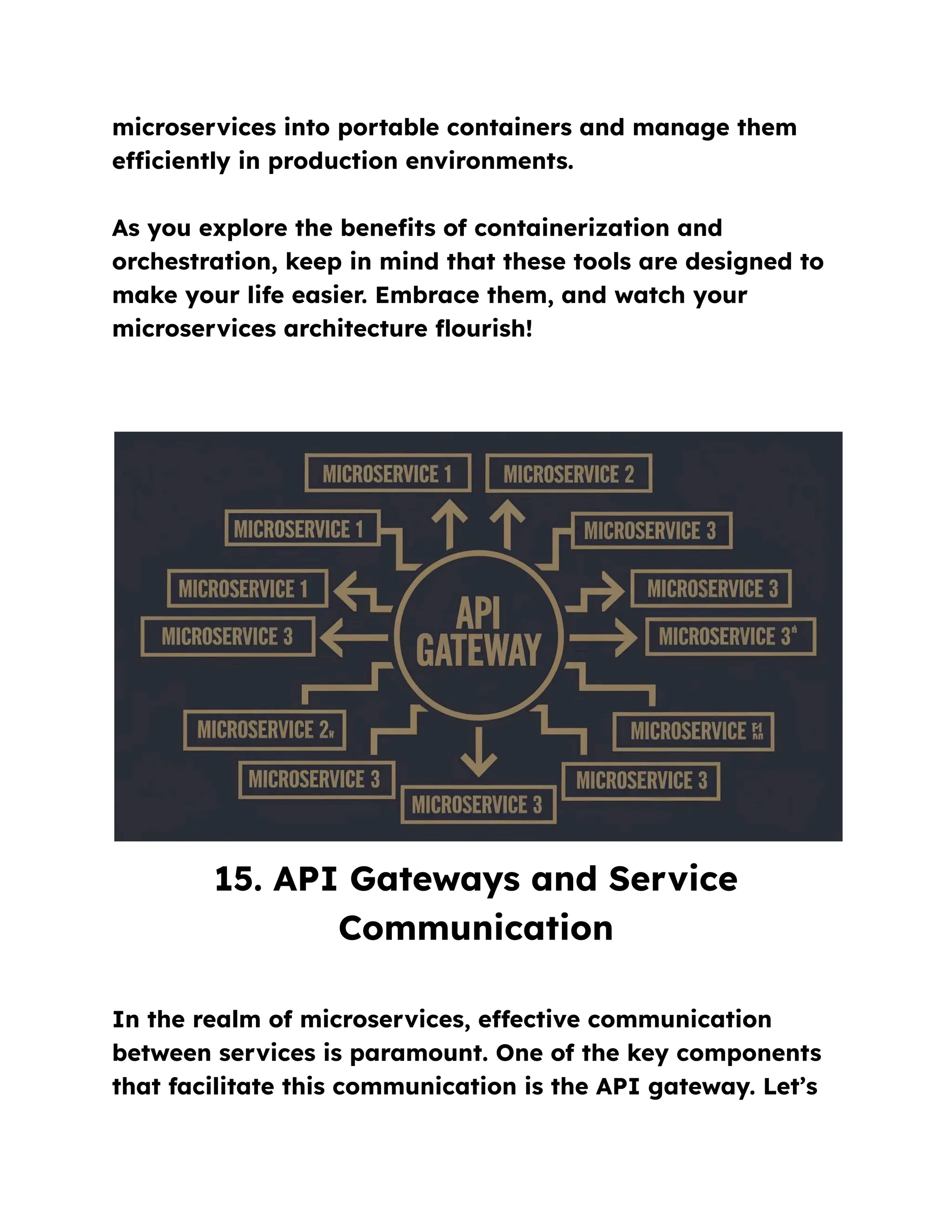
What is an API Gateway?
An API gateway acts as a single entry point for all client
requests to your microservices. Imagine it as the
receptionist of a busy office building—directing traffic,
managing requests, and ensuring everyone gets to where
they need to go. The API gateway handles incoming
requests, routes them to the appropriate microservice, and
returns the response to the client.
By centralizing API management, an API gateway simplifies
the client-side experience and provides several key benefits.
Benefits of Using an API Gateway
Unified Entry Point: Instead of having clients communicate
with multiple services directly, the API gateway provides a
single entry point. This reduces complexity on the client side
and makes integration easier.
Load Balancing: The API gateway can distribute incoming
requests across multiple instances of a microservice,
ensuring that no single instance becomes overwhelmed.
Security: API gateways can enforce security policies, such as
authentication and authorization, before allowing access to
microservices. This adds an additional layer of protection
for your application.
Monitoring and Analytics: API gateways provide insights
into traffic patterns, performance metrics, and error rates,
enabling teams to monitor and analyze their microservices
effectively.
Rate Limiting and Throttling: By implementing rate limiting,
the API gateway can control how many requests are allowed
from a client, preventing abuse and ensuring fair usage of
resources.
Service Communication Patterns
In addition to serving as a gateway, API gateways also
facilitate various communication patterns between
microservices. Let’s look at some common patterns:
Synchronous Communication: In this pattern, microservices
communicate with each other in real-time, often using HTTP
REST APIs or gRPC. While this approach is straightforward,
it can lead to increased latency if services are
interdependent.
Asynchronous Communication: This pattern uses message
brokers or event streams to enable microservices to
communicate without blocking each other. Services can send
messages or events to a queue, allowing them to process
requests independently. This approach enhances resilience
and scalability.
Service Discovery: In a dynamic microservices environment,
services may come and go. API gateways can facilitate
service discovery by dynamically routing requests to
available instances, ensuring that clients always connect to
the right service.
API Composition: Sometimes, a client may need data from
multiple microservices. The API gateway can handle this by
composing responses from different services into a single
response, reducing the number of round trips needed by the
client.
Conclusion
API gateways are essential components of microservices
architecture, providing a unified entry point for clients and
facilitating seamless communication between services. By
implementing an API gateway, you can enhance security,
improve performance, and simplify the management of your
microservices.
As you continue your journey into the world of
microservices, remember that effective communication is
key to building robust and scalable applications. Embrace
the power of API gateways, and watch your microservices
thrive!
16. Implementing Security in
Microservices
Security is a crucial aspect of any application, and in a
microservices architecture, it becomes even more complex
due to the decentralized nature of services. Let’s explore the
best practices for implementing security in microservices
and ensuring your application remains safe from threats.
1. Secure Service-to-Service Communication
Microservices often need to communicate with each other,
and securing this communication is vital. Here are some
strategies to achieve this:
Use HTTPS: Always encrypt data in transit by using HTTPS
for all service-to-service communication. This prevents
eavesdropping and man-in-the-middle attacks.
Mutual TLS (mTLS): Implement mutual TLS to ensure that
both the client and server authenticate each other during
communication. This adds an extra layer of trust and
security.
2. Implement Authentication and Authorization
Authentication verifies the identity of users or services,
while authorization determines what they are allowed to do.
Implementing robust authentication and authorization
mechanisms is essential in microservices.
API Gateway Security: Utilize the API gateway to handle
authentication and authorization before forwarding
requests to backend services. This centralizes security
management and reduces duplication.
OAuth 2.0 and OpenID Connect: These protocols are widely
used for secure authentication and authorization. They allow
users to grant limited access to their resources without
sharing their credentials.
3. Use Secure APIs
When designing your microservices, ensure that APIs are
secure by following these practices:
Input Validation: Always validate incoming data to prevent
injection attacks and other vulnerabilities. Sanitize user
inputs and enforce strict data types.
Rate Limiting: Implement rate limiting on your APIs to
prevent abuse and denial-of-service attacks. This restricts
the number of requests a client can make within a specific
timeframe.
4. Monitor and Log Security Events
Monitoring and logging are essential for detecting and
responding to security incidents. Implement centralized
logging solutions to collect logs from all microservices.
Security Information and Event Management (SIEM): Utilize
SIEM tools to analyze security events, detect anomalies, and
respond to incidents in real-time.
Audit Trails: Maintain audit trails for all security-related
events, such as logins, failed authentication attempts, and
access to sensitive resources. This helps in forensic
investigations if a security breach occurs.
5. Secure Data at Rest
In addition to securing data in transit, it’s crucial to protect
sensitive data at rest. Here are some strategies:
Encryption: Use encryption to protect sensitive data stored
in databases or file systems. This ensures that even if
attackers gain access to the data, they cannot read it
without the encryption key.
Access Controls: Implement strict access controls to ensure
that only authorized services and users can access sensitive
data. Use role-based access control (RBAC) to manage
permissions effectively.
6. Regular Security Audits and Penetration Testing
Conduct regular security audits and penetration testing to
identify vulnerabilities in your microservices architecture.
This proactive approach helps you stay ahead of potential
threats.
Automated Security Scans: Use automated tools to scan
your codebase and infrastructure for common security
vulnerabilities.
Red Team Exercises: Engage in red team exercises, where
ethical hackers simulate attacks on your system to identify
weaknesses and improve your security posture.
Conclusion
Implementing security in microservices is a continuous
process that requires diligence and proactive measures. By
securing service-to-service communication, implementing
authentication and authorization, using secure APIs,
monitoring and logging security events, securing data at
rest, and conducting regular audits, you can build a resilient
microservices architecture.
As you navigate the complexities of microservices,
remember that security should be ingrained in your
development process. By prioritizing security from the
outset, you can protect your application and ensure a safe
environment for your users.
17. Monitoring and Logging in
Microservices
Monitoring and logging are crucial components of a
successful microservices architecture. With multiple services
running independently, it’s essential to have visibility into
their performance and behavior. Let’s explore the
importance of monitoring and logging in microservices and
best practices to implement them effectively.
Why Monitoring is Important
Monitoring provides insights into the health and
performance of your microservices. It allows you to track
metrics such as response times, error rates, and resource
utilization. Here are some reasons why monitoring is vital:
Detecting Issues Early: Proactive monitoring helps identify
performance bottlenecks, errors, or outages before they
impact users. Early detection allows for quicker resolution
and minimizes downtime.
Improving Performance: By analyzing performance metrics,
you can identify areas for optimization. This data-driven
approach helps you make informed decisions to enhance the
efficiency of your microservices.
Capacity Planning: Monitoring provides insights into
resource utilization, enabling you to plan for capacity and
scale your services accordingly. This ensures that your
application can handle increased traffic without
compromising performance.
Key Metrics to Monitor
When monitoring microservices, focus on the following key
metrics:
Response Time: Measure the time taken for a service to
respond to requests. High response times may indicate
performance issues or increased load.
Error Rates: Monitor the rate of errors returned by your
microservices. A sudden spike in errors can signal
underlying issues that need immediate attention.
Resource Utilization: Keep an eye on CPU and memory
usage for each service. High resource utilization can lead to
performance degradation or service outages.
Traffic Patterns: Analyze traffic patterns to understand user
behavior and identify trends. This data helps in making
informed decisions about scaling and resource allocation.
Why Logging is Important
Logging captures detailed information about the behavior
and interactions of your microservices. It provides a
historical record of events, making it easier to troubleshoot
issues and analyze performance. Here’s why logging is
crucial:
Debugging and Troubleshooting: Detailed logs help
developers identify the root cause of issues when things go
wrong. This is especially important in a distributed
architecture where tracing requests across services can be
challenging.
Auditing and Compliance: Logging provides an audit trail of
user actions and system events, which is essential for
compliance with regulations and security standards.
Performance Analysis: Logs can reveal insights into
performance bottlenecks, allowing you to optimize your
microservices based on real user behavior.
Best Practices for Monitoring and Logging
Centralized Logging: Use a centralized logging solution (e.g.,
ELK Stack or Graylog) to aggregate logs from all
microservices. This simplifies log management and makes it
easier to search and analyze logs.
Structured Logging: Implement structured logging to ensure
that logs are consistent and easy to parse. Use formats like
JSON to capture relevant information such as timestamps,
service names, and error details.
Log Levels: Use different log levels (e.g., DEBUG, INFO,
WARN, ERROR) to categorize log messages. This helps in
filtering logs based on severity and focus on critical issues.
Distributed Tracing: Implement distributed tracing tools
(e.g., OpenTracing, Jaeger) to track requests as they flow
through different microservices. This provides visibility into
how services interact and helps identify performance
bottlenecks.
Alerts and Notifications: Set up alerts based on monitoring
metrics to notify your team of potential issues. For example,
you can configure alerts for high error rates or increased
response times.
Regular Review: Regularly review logs and monitoring data
to identify trends, anomalies, and areas for improvement.
This proactive approach ensures that your microservices
remain healthy and performant.
Conclusion
Monitoring and logging are essential practices in
microservices architecture. By implementing robust
monitoring solutions and logging strategies, you can gain
visibility into your services, detect issues early, and optimize
performance.
As you continue to develop and scale your microservices,
prioritize monitoring and logging to ensure a reliable and
efficient application. With the right tools and practices in
place, you can confidently navigate the complexities of
microservices and deliver a seamless experience to your
users.
18. How to Transition from Monolithic to
Microservices
Transitioning from a monolithic architecture to
microservices can feel like climbing a mountain. But fear
not! With careful planning and the right approach, you can
make the journey smoother and more successful. Let’s
explore the steps to effectively transition from a monolithic
application to a microservices architecture.
1. Assess Your Current Application
Before diving into microservices, take a step back and
assess your existing monolithic application. Understand its
architecture, dependencies, and bottlenecks. Here are some
questions to consider:
What are the core functionalities of your application?
Are there any components that are tightly coupled and
difficult to change?
What are the pain points or limitations of your current
architecture?
This assessment will help you identify which parts of your
application can be extracted into microservices.
2. Define Your Microservices Boundaries
Once you have a clear understanding of your monolithic
application, the next step is to define the boundaries of your
microservices. This involves identifying distinct
functionalities that can be developed and deployed
independently. Consider the following approaches:
Business Capabilities: Break down your application based on
business functions. Each microservice should represent a
specific business capability, such as user management,
payment processing, or inventory management.
Domain-Driven Design (DDD): Use DDD principles to identify
bounded contexts within your application. Each bounded
context can become a separate microservice with its own
data model.
3. Start Small: Build a Pilot Microservice
Instead of attempting to migrate the entire application at
once, start with a small pilot project. Choose a less critical
component of your application to convert into a
microservice. This allows you to test the waters and learn
from the experience without risking your entire application.
Migrate Incrementally: Gradually migrate components from
your monolith to microservices. This incremental approach
reduces risk and allows for easier management.
Focus on Success: Choose a component that has clear
boundaries and limited dependencies. This increases the
chances of a successful migration.
4. Establish DevOps Practices
Embracing DevOps practices is crucial for the successful
transition to microservices. DevOps fosters collaboration
between development and operations teams, enabling faster
and more efficient deployments. Here’s how to get started:
Continuous Integration/Continuous Deployment (CI/CD):
Implement CI/CD pipelines to automate the build, test, and
deployment processes for your microservices. This ensures
that new features and bug fixes can be delivered quickly
and reliably.
Infrastructure as Code (IaC): Use IaC tools (e.g., Terraform,
Ansible) to manage your infrastructure. This allows you to
define and provision your environment consistently and
reproducibly.
5. Implement Service Communication and APIs
As you transition to microservices, it’s essential to establish
clear communication protocols between services. Define
APIs that microservices will use to interact with each other.
Choose Communication Patterns: Decide whether to use
synchronous (e.g., REST, gRPC) or asynchronous (e.g.,
message queues, event streams) communication patterns.
Each approach has its pros and cons, so choose the one that
fits your use case best.
API Documentation: Document your APIs thoroughly to
ensure that all team members understand how to interact
with the microservices.
6. Monitor and Optimize Performance
As you start deploying microservices, implement monitoring
and logging practices to gain insights into their
performance. Monitor key metrics and set up alerts for
potential issues.
Performance Tuning: Continuously optimize the performance
of your microservices based on monitoring data. This may
involve fine-tuning resource allocations or refactoring code
to improve efficiency.
Feedback Loop: Encourage feedback from your team and
users to identify areas for improvement. Iterative
development is key to refining your microservices
architecture.
7. Foster a Microservices Culture
Transitioning to microservices isn’t just about technology;
it’s also about fostering a culture that embraces change and
collaboration. Encourage your team to adopt a
microservices mindset by promoting the following values:
Autonomy: Allow teams to take ownership of their
microservices and make decisions about design and
deployment.
Collaboration: Encourage collaboration between teams to
ensure that microservices integrate seamlessly and function
cohesively.
Conclusion
Transitioning from a monolithic architecture to
microservices is a journey that requires careful planning,
incremental migration, and a commitment to DevOps
practices. By assessing your current application, defining
microservices boundaries, starting small, and fostering a
culture of collaboration, you can successfully navigate this
transformation.
Embrace the flexibility and scalability that microservices
offer, and enjoy the benefits of a more agile and resilient
application architecture!
19. Avoiding Accidental Monoliths When
Refactoring
When transitioning to microservices, one of the biggest
challenges is avoiding the trap of creating accidental
monoliths. An accidental monolith occurs when
microservices end up being tightly coupled or
interdependent, negating the benefits of a microservices
architecture. Let’s explore how to avoid this pitfall and
maintain the true spirit of microservices.
1. Define Clear Service Boundaries
The first step in avoiding accidental monoliths is to define
clear boundaries for each microservice. Each service should
represent a specific business capability or bounded context,
ensuring that it can operate independently.
Business Capability Focus: Identify distinct business
functions that can be encapsulated within individual
microservices. This helps ensure that services are cohesive
and focused on specific tasks.
Domain-Driven Design (DDD): Leverage DDD principles to
establish boundaries based on domain contexts. Each
service should have its own domain model and
responsibility.
2. Embrace Loose Coupling
Loose coupling is essential for maintaining the
independence of microservices. Strive to minimize
dependencies between services, allowing them to evolve and
deploy independently.
API-First Approach: Design APIs for microservices that are
stable and well-defined. Avoid exposing internal
implementation details that could lead to tight coupling.
Event-Driven Architecture: Consider adopting an
event-driven architecture where services communicate
through events rather than direct API calls. This reduces
dependencies and allows for asynchronous communication.
3. Avoid Shared Databases
Using a shared database across multiple microservices can
lead to tight coupling and hinder independent development.
Each microservice should manage its own data store to
maintain autonomy.
Database per Service: Encourage a “database per service”
pattern, where each microservice has its own database
schema. This allows services to evolve independently
without affecting others.
Data Replication: If necessary, implement data replication
mechanisms to share data between services while
maintaining independent databases.
4. Implement Service Discovery
Service discovery is crucial for managing microservices in a
dynamic environment. It enables services to locate and
communicate with each other without hard-coded
dependencies.
Service Registry: Use a service registry (e.g., Consul, Eureka)
to maintain a list of available services and their endpoints.
This allows microservices to discover each other
dynamically.
Load Balancing: Implement load balancing to distribute
traffic across service instances, reducing the risk of
bottlenecks and single points of failure.
5. Establish Clear Communication Patterns
Define clear communication patterns for how microservices
interact. This helps ensure that services remain decoupled
and can evolve independently.
Synchronous vs. Asynchronous: Decide on communication
patterns based on the use case. For example, use
synchronous communication for real-time interactions and
asynchronous communication for event-driven scenarios.
API Contracts: Clearly define API contracts to establish
expectations for data formats and interaction protocols.
This helps prevent misunderstandings between services.
6. Monitor and Optimize Dependencies
As you develop and deploy microservices, continuously
monitor and analyze service dependencies. This will help
you identify potential coupling issues early.
Dependency Analysis Tools: Use tools to visualize service
dependencies and monitor interactions. This can help you
identify tightly coupled services and take corrective action.
Regular Refactoring: Encourage a culture of regular
refactoring to address coupling issues as they arise. This
proactive approach ensures that your microservices
architecture remains healthy.
7. Foster a Culture of Independence
Encourage a culture that values independence and
autonomy among teams working on microservices. This
mindset fosters innovation and prevents the emergence of
accidental monoliths.
Team Ownership: Assign ownership of individual
microservices to specific teams, empowering them to make
decisions about design and implementation.
Cross-Functional Collaboration: Promote collaboration
between teams to share best practices and address
inter-service communication challenges without creating
dependencies.
Conclusion
Avoiding accidental monoliths is crucial for realizing the full
benefits of microservices architecture. By defining clear
service boundaries, embracing loose coupling, avoiding
shared databases, implementing service discovery,
establishing communication patterns, and fostering a
culture of independence, you can maintain a true
microservices environment.
Embrace the flexibility and agility of microservices, and
ensure that your architecture remains modular and resilient
as your application evolves!
20. The Role of Continuous Integration
and Continuous Deployment (CI/CD)
Continuous Integration (CI) and Continuous Deployment
(CD) are vital practices for successful microservices
development. They enable teams to automate the process of
building, testing, and deploying microservices, ensuring
faster releases and higher quality. Let’s explore the role of
CI/CD in microservices and how to implement it effectively.
1. Understanding CI/CD
Before diving into implementation, let’s clarify what CI/CD
means:
Continuous Integration (CI): CI is the practice of
automatically integrating code changes from multiple
contributors into a shared repository. Developers frequently
commit code, triggering automated builds and tests to
identify integration issues early.
Continuous Deployment (CD): CD takes CI a step further by
automating the deployment of code changes to production
environments. With CD, every change that passes tests is
automatically deployed, ensuring that new features and
fixes reach users quickly.
2. Benefits of CI/CD in Microservices
Implementing CI/CD in a microservices architecture offers
several advantages:
Faster Release Cycles: CI/CD accelerates the development
process by allowing teams to release new features and bug
fixes quickly. This agility is crucial for staying competitive in
today’s fast-paced market.
Improved Code Quality: Automated testing during the CI
process helps catch bugs and integration issues early. This
leads to higher code quality and reduces the risk of
deploying faulty code.
Reduced Manual Effort: Automating the build and
deployment processes minimizes manual intervention,
reducing the chances of human error and freeing up
developers to focus on more strategic tasks.
Easier Rollbacks: In the event of a deployment issue, CI/CD
allows for quick rollbacks to previous versions, minimizing
downtime and disruption.
3. Setting Up CI/CD for Microservices
To implement CI/CD effectively in a microservices
environment, follow these steps:
Choose CI/CD Tools: Select tools that fit your team’s
workflow and technology stack. Popular options include
Jenkins, GitLab CI, CircleCI, and Travis CI for CI, while tools
like Spinnaker and Argo CD are commonly used for CD.
Define Build Pipelines: Create build pipelines for each
microservice. Each pipeline should include steps for building
the service, running tests, and deploying to the appropriate
environment.
Automate Testing: Implement automated tests for your
microservices, including unit tests, integration tests, and
end-to-end tests. This ensures that code changes are
thoroughly validated before deployment.
Containerization: Use containerization (e.g., Docker) to
package your microservices. This ensures that each service
runs consistently across different environments and
simplifies deployment.
Use Infrastructure as Code (IaC): Manage your
infrastructure using IaC tools (e.g., Terraform, Ansible) to
define and provision resources consistently. This aligns with
CI/CD practices and enhances reproducibility.
4. CI/CD Workflow for Microservices
A typical CI/CD workflow for microservices may look like
this:
Code Commit: Developers commit code changes to a version
control system (e.g., Git).
Automated Build: A CI server automatically triggers a build
process, compiling the code and running tests.
Test Execution: Automated tests are executed, validating the
functionality and integration of the microservice.
Artifact Creation: Upon successful testing, build artifacts
(e.g., Docker images) are created and stored in an artifact
repository.
Deployment to Staging: The microservice is deployed to a
staging environment for further testing and validation.
Production Deployment: Once approved, the microservice is
automatically deployed to the production environment.
Monitoring: Continuous monitoring is implemented to track
the performance and health of the deployed microservice.
5. Best Practices for CI/CD in Microservices
To maximize the effectiveness of CI/CD in microservices,
consider the following best practices:
Service Independence: Ensure that each microservice has its
own CI/CD pipeline. This promotes independence and allows
teams to release services at their own pace.
Versioning: Implement versioning for your microservices
and their APIs. This helps manage changes and ensures
backward compatibility.
Rollback Strategy: Define a clear rollback strategy for
deployments. Ensure that teams can quickly revert to
previous versions in case of issues.
Monitoring and Logging: Set up monitoring and logging for
your CI/CD pipelines. This provides visibility into the build
and deployment processes and helps identify bottlenecks or
failures.
Conclusion
Continuous Integration and Continuous Deployment are
essential practices for maximizing the benefits of
microservices architecture. By automating the build, testing,
and deployment processes, teams can achieve faster release
cycles, improved code quality, and reduced manual effort.
Investing in CI/CD practices will not only streamline your
microservices development but also empower your teams to
deliver value to users more efficiently. Embrace the power of
automation, and let CI/CD propel your microservices
journey!
21. Tools and Technologies for
Microservices Development
When embarking on a microservices development journey,
it’s essential to equip yourself with the right tools and
technologies. The microservices landscape is rich with
options that cater to various aspects of development,
deployment, monitoring, and orchestration. Let’s explore
some key tools and technologies that can enhance your
microservices architecture.
1. Containerization Technologies
Containerization is a cornerstone of microservices
development, enabling developers to package applications
and their dependencies into isolated environments.
Docker: Docker is the most popular containerization
platform, allowing you to create, deploy, and manage
containers efficiently. It simplifies the process of building
and shipping microservices across different environments.
Podman: An alternative to Docker, Podman offers similar
containerization capabilities with a focus on security and
compatibility with Docker images. Podman is daemonless,
making it a great choice for certain environments.
2. Orchestration Tools
As the number of microservices grows, managing them
becomes increasingly complex. Orchestration tools help
automate deployment, scaling, and management of
containers.
Kubernetes: Kubernetes is the leading container
orchestration platform, providing powerful features for
managing containerized applications at scale. It automates
deployment, scaling, and monitoring, making it a popular
choice for microservices architectures.
Docker Swarm: Docker Swarm is a simpler orchestration
solution integrated with Docker. It’s suitable for smaller
deployments and provides basic container orchestration
features.
3. API Management Tools
APIs are the backbone of microservices communication. API
management tools help design, document, and secure APIs.
Swagger/OpenAPI: Swagger (now known as OpenAPI) is a
widely used specification for documenting RESTful APIs. It
allows developers to define APIs in a standardized format,
making it easier to communicate and collaborate.
API Gateway: An API Gateway acts as a single entry point
for all microservices, handling requests and routing them to
the appropriate services. Popular options include Kong,
Apigee, and AWS API Gateway.
4. Monitoring and Logging Tools
Monitoring and logging are crucial for maintaining the
health and performance of microservices.
Prometheus: Prometheus is a powerful monitoring tool
designed for cloud-native applications. It collects metrics
from services and provides alerting capabilities based on
defined thresholds.
Grafana: Grafana is a visualization tool that works well with
Prometheus. It allows you to create interactive dashboards
to monitor service performance and health.
ELK Stack (Elasticsearch, Logstash, Kibana): The ELK Stack
is a popular solution for centralized logging. It allows you to
collect, analyze, and visualize logs from multiple
microservices in one place.
5. Service Mesh Technologies
Service meshes provide advanced traffic management,
security, and observability for microservices.
Istio: Istio is a leading service mesh that provides features
such as traffic routing, load balancing, and security for
microservices. It helps manage communication between
services and provides insights into their behavior.
Linkerd: Linkerd is a lightweight service mesh that focuses
on simplicity and performance. It provides essential features
for managing microservices traffic and monitoring.
6. Development Frameworks
Choosing the right development framework can streamline
the process of building microservices.
Spring Boot: Spring Boot is a popular Java framework for
building microservices. It provides tools and conventions to
simplify the development of production-ready applications.
Node.js: Node.js is a JavaScript runtime that’s ideal for
building lightweight and scalable microservices. It’s
commonly used for building RESTful APIs.
Go: Go is known for its performance and efficiency, making
it a great choice for building microservices. Its built-in
concurrency support helps handle multiple requests
seamlessly.
7. CI/CD Tools
Continuous Integration and Continuous Deployment tools
automate the development process and streamline
deployments.
Jenkins: Jenkins is an open-source automation server that
supports building, testing, and deploying applications. It
has a vast library of plugins for integrating with various
tools.
GitLab CI/CD: GitLab offers integrated CI/CD capabilities
within its platform, allowing teams to manage code
repositories and pipelines seamlessly.
CircleCI: CircleCI is a cloud-based CI/CD tool that provides
fast and scalable pipelines for deploying microservices.
Conclusion
Equipping yourself with the right tools and technologies is
essential for successful microservices development. From
containerization and orchestration to API management and
monitoring, the microservices ecosystem offers a variety of
solutions to enhance your architecture.
By leveraging these tools, you can streamline development
processes, improve collaboration, and ensure the scalability
and reliability of your microservices. Embrace the power of
technology and embark on your microservices journey with
confidence!
22. Microservices in Cloud-Native
Applications
Cloud-native applications leverage cloud computing to
enhance scalability, resilience, and flexibility. Microservices
architecture aligns perfectly with the principles of
cloud-native development, enabling organizations to build
and deploy applications that can thrive in dynamic cloud
environments. Let’s explore the relationship between
microservices and cloud-native applications and how they
complement each other.
1. Understanding Cloud-Native Development
Cloud-native development focuses on building applications
that are designed specifically to run in cloud environments.
Key principles of cloud-native development include:
Microservices Architecture: Applications are composed of
small, independent services that can be developed,
deployed, and scaled independently.
Containers: Applications are packaged in containers,
ensuring consistency across different environments and
simplifying deployment.
Dynamic Management: Cloud-native applications can
automatically scale and adapt to changing workloads,
providing enhanced resilience and availability.
APIs: Cloud-native applications rely on APIs for
communication between services, allowing for flexibility and
ease of integration.
2. Benefits of Microservices in Cloud-Native
Applications
Integrating microservices architecture into cloud-native
applications offers several advantages:
Scalability: Microservices can be scaled independently,
allowing organizations to allocate resources based on
demand. This means that if one service experiences high
traffic, it can be scaled without affecting the entire
application.
Resilience: With microservices, if one service fails, it does
not bring down the entire application. This fault isolation
enhances the overall resilience of cloud-native applications.
Faster Development Cycles: Microservices enable teams to
work on different services concurrently, speeding up the
development process. This agility is crucial for meeting the
demands of today’s fast-paced business environment.
Technology Diversity: Microservices allow teams to choose
the best technologies for each service, promoting innovation
and enabling the use of different programming languages
and frameworks.
3. Deploying Microservices in the Cloud
Deploying microservices in a cloud environment involves
leveraging various cloud services and platforms. Here’s how
you can get started:
Choose a Cloud Provider: Select a cloud provider that meets
your needs, such as Amazon Web Services (AWS), Microsoft
Azure, or Google Cloud Platform (GCP).
Use Container Services: Utilize container orchestration
services like Amazon ECS, Azure Kubernetes Service (AKS),
or Google Kubernetes Engine (GKE) to manage your
microservices effectively.
Leverage Serverless Computing: Consider using serverless
architectures for certain microservices. Serverless
computing abstracts infrastructure management, allowing
developers to focus on code while automatically scaling
resources.
Implement API Gateway: Use an API gateway service to
manage traffic between clients and microservices. This
service handles request routing, load balancing, and
security.
Monitor and Optimize: Utilize cloud-native monitoring tools
to gain insights into the performance and health of your
microservices. This information helps optimize resource
allocation and improve application performance.
4. Challenges of Microservices in Cloud-Native
Applications
While microservices offer significant benefits, there are
challenges to consider:
Complexity: Managing multiple microservices introduces
complexity in terms of deployment, communication, and
monitoring. Effective orchestration and service discovery
are crucial.
Data Management: Each microservice may require its own
database, leading to challenges in data consistency and
management. Implementing event-driven architectures can
help address this issue.
Security: Ensuring the security of microservices and data
transmission between them requires careful planning and
implementation of security best practices.
5. Conclusion
Microservices architecture and cloud-native applications are
a powerful combination that can drive innovation and
agility in software development. By embracing
microservices in cloud-native environments, organizations
can build resilient, scalable, and flexible applications that
meet the demands of modern users.
As you explore the world of microservices and cloud-native
development, remember to leverage the right tools and
practices to maximize the benefits of this architectural
approach. Embrace the cloud, embrace microservices, and
unlock the potential of your applications!
23. Case Studies of Successful
Microservices Implementations
Learning from real-world examples is an invaluable way to
understand the practical application of microservices
architecture. Many organizations have successfully
transitioned to microservices, experiencing improved
scalability, faster deployment cycles, and enhanced agility.
Let’s explore a few notable case studies of successful
microservices implementations.
1. Netflix
Overview: Netflix is a pioneer in adopting microservices
architecture to support its massive streaming platform.
Originally built as a monolithic application, Netflix faced
challenges in scaling its services to accommodate growing
user demand.
Implementation:
Decoupling Services: Netflix migrated to a microservices
architecture by decoupling its application into smaller,
independent services. Each service handles a specific
function, such as user authentication, content delivery, or
recommendation algorithms.
Automated Deployments: Netflix implemented automated
CI/CD pipelines, allowing teams to deploy changes to
individual services independently. This led to faster release
cycles and improved responsiveness to user feedback.
Resilience and Scalability: By leveraging cloud infrastructure
and containerization, Netflix achieved significant scalability.
The architecture allows services to scale independently
based on user demand.
Outcome: Netflix successfully improved its scalability and
resilience, enabling millions of users to stream content
simultaneously. The move to microservices has been a key
driver of its continued growth and innovation in the
streaming industry.
2. Amazon
Overview: Amazon, one of the largest e-commerce platforms
in the world, adopted microservices to enhance its
application architecture and improve operational efficiency.
Implementation:
Service-Based Approach: Amazon decomposed its
monolithic application into microservices, each responsible
for specific business functionalities. For example, separate
services handle payment processing, inventory
management, and order fulfillment.
Scalable Infrastructure: Amazon Web Services (AWS)
provides the infrastructure for deploying and managing
microservices. The use of AWS enables on-demand scaling
and flexibility.
DevOps Culture: Amazon fostered a DevOps culture,
empowering development teams to take ownership of their
services. This cultural shift promoted accountability and
faster delivery of features.
Outcome: Amazon’s transition to microservices has resulted
in increased operational efficiency, faster feature delivery,
and improved customer experience. The architecture
supports the rapid growth of its e-commerce platform while
maintaining reliability.
3. Spotify
Overview: Spotify, a leading music streaming platform,
adopted microservices to enhance its ability to deliver
features rapidly and improve user experience.
Implementation:
Independent Teams: Spotify organized its engineering
teams into small, autonomous squads, each responsible for
specific features. These squads work independently to
develop, test, and deploy their microservices.
Continuous Delivery: Spotify implemented CI/CD practices
to automate the deployment process. This allows squads to
release updates frequently and respond quickly to user
feedback.
Service Discovery: To manage communication between
microservices, Spotify employs a service discovery
mechanism. This helps services find and communicate with
each other seamlessly.
Outcome: Spotify’s adoption of microservices has led to a
more agile development process, enabling rapid feature
delivery and continuous improvement. The architecture has
allowed Spotify to maintain a competitive edge in the music
streaming industry.
4. Uber
Overview: Uber, the ride-hailing and transportation
platform, transitioned to microservices to address scalability
challenges and improve system reliability.
Implementation:
Service Decomposition: Uber decomposed its monolithic
application into numerous microservices, each handling
specific functionalities like ride requests, payments, and
driver management.
Real-Time Processing: The microservices architecture
supports real-time processing of ride requests and
notifications, enhancing the overall user experience.
Data Management: Uber uses event sourcing and CQRS
(Command Query Responsibility Segregation) patterns to
manage data across microservices effectively.
Outcome: Uber’s transition to microservices has resulted in
improved scalability, allowing the platform to handle
millions of ride requests simultaneously. The architecture
has enabled Uber to innovate quickly and enhance its
service offerings.
Conclusion
These case studies illustrate the transformative power of
microservices architecture in real-world applications. By
adopting microservices, organizations can achieve greater
scalability, agility, and resilience, enabling them to respond
effectively to changing market demands.
As you consider implementing microservices in your own
projects, draw inspiration from these success stories and
tailor your approach to align with your organization’s goals
and challenges. Embrace the microservices journey, and
unlock the potential of your applications!
24. Future Trends in Microservices
Architecture
As technology continues to evolve, so does the landscape of
microservices architecture. Keeping an eye on emerging
trends is essential for organizations looking to leverage
microservices effectively. Let’s explore some future trends
that are shaping the microservices ecosystem.
1. Increased Adoption of Service Mesh
Service mesh technologies are gaining traction as
organizations seek to manage the complexities of
microservices communication. A service mesh provides
features like traffic management, observability, and
security, simplifying the interactions between microservices.
Traffic Management: Service meshes allow for advanced
traffic routing, enabling features like canary deployments
and A/B testing, which enhance release strategies.
Observability: With built-in observability tools, service
meshes provide insights into the behavior of microservices,
making it easier to monitor performance and troubleshoot
issues.
2. Enhanced Security Practices
As microservices architecture becomes more prevalent,
security remains a top priority. Organizations are adopting
practices to secure their microservices and protect sensitive
data.
Zero Trust Security: The adoption of a zero trust security
model ensures that each service is authenticated and
authorized before communication occurs. This reduces the
risk of unauthorized access.
API Security: Organizations are investing in API security
solutions to protect their microservices endpoints from
potential threats. Implementing security best practices is
crucial for maintaining data integrity.
3. Serverless Architectures
Serverless computing is gaining popularity as a
complementary approach to microservices. By abstracting
infrastructure management, serverless architectures allow
developers to focus on writing code without worrying about
scaling.
Cost Efficiency: Serverless architectures can lead to cost
savings as resources are allocated based on actual usage,
making it an attractive option for microservices.
Event-Driven Development: Serverless computing aligns well
with event-driven architectures, allowing microservices to
respond to events and triggers seamlessly.
4. Focus on DevSecOps
The integration of security practices into the DevOps
pipeline is becoming essential. DevSecOps emphasizes the
importance of incorporating security at every stage of the
development lifecycle.
Automated Security Testing: Organizations are
implementing automated security testing within their CI/CD
pipelines to identify vulnerabilities early in the development
process.
Collaboration Between Teams: DevSecOps fosters
collaboration between development, operations, and
security teams, ensuring that security considerations are an
integral part of the development workflow.
5. Improved Tooling and Ecosystem
The microservices ecosystem is continuously evolving, with
new tools and frameworks emerging to simplify
development and management.
GraphQL: GraphQL is gaining popularity as an alternative to
REST APIs for microservices communication. It allows
clients to request only the data they need, reducing
over-fetching and improving performance.
AI and Machine Learning: Organizations are exploring the
integration of AI and machine learning into microservices
for improved automation, predictive analytics, and
enhanced decision-making.
6. Growing Importance of Observability
As microservices environments become more complex,
observability is crucial for monitoring performance and
understanding system behavior.
Distributed Tracing: Distributed tracing tools provide
visibility into the flow of requests across microservices,
helping developers identify bottlenecks and performance
issues.
Real-Time Monitoring: Real-time monitoring solutions allow
organizations to track metrics and logs, ensuring proactive
management of microservices.
Conclusion
The future of microservices architecture is promising, with
trends that focus on security, automation, and improved
tooling. By staying informed about these trends,
organizations can adapt their strategies to leverage
microservices effectively.
Embracing these future trends will empower teams to build
resilient and scalable applications that meet the demands of
a rapidly changing technology landscape. As you navigate
the microservices journey, keep an eye on these emerging
trends to stay ahead in the game!
Follow My Blog & Please Visit My Website
25. Conclusion and Call to Action: Should
You Adopt Microservices?
Microservices architecture offers a powerful approach to
building modern applications, enabling organizations to
achieve scalability, agility, and resilience. Throughout this
blog, we’ve explored the key concepts of microservices, their
advantages, and real-world implementations. As you
consider whether to adopt microservices for your
organization, here are a few key takeaways:
Benefits of Microservices Architecture
Scalability: Microservices allow you to scale individual
components of your application independently, ensuring
optimal performance under varying loads.
Agility: The ability to develop, deploy, and update
microservices independently accelerates the development
process and enhances responsiveness to changing business
needs.
Resilience: Microservices enhance fault tolerance, as the
failure of one service does not affect the entire application,
improving overall reliability.
Technology Flexibility: Organizations can choose the best
technologies for each microservice, allowing for innovation
and experimentation.
Considerations Before Adopting Microservices
Complexity Management: Be prepared to manage the
complexity of deploying, monitoring, and maintaining
multiple microservices.
Team Structure: Ensure that your teams are organized
effectively to support a microservices approach, promoting
autonomy and collaboration.
Cultural Shift: Embrace a cultural shift towards DevOps and
continuous delivery, empowering teams to take ownership of
their services.
Call to Action
If you're considering adopting microservices or are already
on the journey, share your thoughts and experiences in the
comments below! We’d love to hear about your challenges
and successes. Additionally, feel free to share this blog with
your colleagues and friends who might benefit from
understanding microservices architecture.
Ready to dive deeper? Explore our other articles on software
development, cloud technologies, and best practices for
building resilient applications. The future is bright for
microservices, and we’re excited to see where it takes you! If
you enjoyed this blog, please share it with your friends and
family! And visit knowledgenprofit.blogspot. Leave your
thoughts in the comments below.
26. FAQ Section
1. What are microservices?
Microservices are a software architecture style that
structures an application as a collection of loosely coupled
services, each responsible for specific functionalities.
2. How do microservices differ from monolithic architecture?
In monolithic architecture, applications are built as a single
unit, while microservices decompose applications into
smaller, independent services that can be developed and
deployed separately.
3. What are the advantages of microservices?
Advantages include improved scalability, faster deployment
cycles, technology flexibility, and enhanced fault tolerance.
4. What challenges are associated with microservices?
Challenges include increased complexity, data management
issues, and the need for effective monitoring and security
practices.
5. How can I implement microservices in my application?
Start by identifying components of your application that
can be decoupled into services, use containerization tools,
and establish CI/CD pipelines for deployment.
6. What role does cloud computing play in microservices?
Cloud computing provides the infrastructure and tools
necessary to deploy, manage, and scale microservices
efficiently.
7. How do microservices support agile development?
Microservices allow teams to work on individual components
independently, enabling faster iterations and responsiveness
to changing requirements.
8. What tools can help manage microservices?
Tools like Kubernetes, Docker, service meshes, and
monitoring solutions enhance the management and
orchestration of microservices.
9. Can microservices be used in mobile app development?
Yes, microservices can enhance mobile app development by
enabling faster updates, scalability, and improved user
experiences.
10. What is the future of microservices architecture?
The future of microservices includes trends like serverless
computing, improved security practices, and enhanced
observability, driving innovation and efficiency.

What Is Microservices Architecture and How Does It Benefit App Development.pdf

  • 1.
    What Is MicroservicesArchitecture and How Does It Benefit App Development? Follow My Blog & Please Visit My Website Keywords #Microservices, #CloudNative, #SoftwareDev, #DevOps, #Scalability, #AppArch, #Docker, #Kubernetes, #AgileDev, #EventDriven
  • 2.
    Table of Contents 1.Introduction to Microservices Architecture 2. History and Evolution of Microservices 3. Why Choose Microservices Over Monolithic Architecture? 4. Key Concepts of Microservices Architecture 5. How Microservices Work in App Development 6. Understanding Service Decomposition in Microservices 7. Real-Life Examples of Microservices in Action (Netflix, Amazon, etc.) 8. Advantages of Microservices Architecture 9. Challenges of Implementing Microservices 10. Comparison: Microservices vs. Monolithic Architecture 11. Microservices vs. Service-Oriented Architecture (SOA) 12. Microservices in Mobile App Development 13. Best Practices for Designing Microservices 14. Containerization and Orchestration Tools (Docker, Kubernetes) 15. API Gateways and Service Communication 16. Implementing Security in Microservices 17. Monitoring and Logging in Microservices 18. How to Transition from Monolithic to Microservices 19. Avoiding Accidental Monoliths When Refactoring 20. The Role of Continuous Integration and Continuous Deployment (CI/CD) 21. Tools and Technologies for Microservices Development 22. Microservices in Cloud-Native Applications 23, Case Studies of Successful Microservices Implementations
  • 3.
    24. Future Trendsin Microservices Architecture 25, Conclusion and Call to Action: Should You Adopt Microservices? 26. FAQs 1. Introduction to Microservices Architecture Microservices. Sounds cool, right? But what exactly does it mean, and why should you care? Imagine trying to build a Lego set. You could either make it one big block (not very fun), or you could build it piece by piece—each Lego brick doing its part to form the final, awesome product. That’s the essence of microservices architecture. Instead of creating
  • 4.
    one giant pieceof software where everything is tightly wound together, microservices architecture breaks the application down into small, independent services. Each service has a specific task or responsibility and can be developed, deployed, and scaled separately. Microservices architecture has taken the software development world by storm, becoming the preferred choice for many modern apps. But why? Well, it’s all about flexibility and adaptability. With technology advancing at a breakneck pace, businesses need to react quickly to changes in user demands and market conditions. Having an app that’s one giant, tangled codebase doesn’t allow for much flexibility. You change one thing, and boom—something else breaks! It’s like a house of cards. With microservices, however, you can make updates to one service without worrying about bringing the whole app down. Let’s break it down a bit more. Each microservice in this architecture performs a specific function, like user authentication, payment processing, or sending notifications. These services communicate with each other, usually through APIs (Application Programming Interfaces), to achieve the bigger picture: running the entire app. Imagine each service as an independent worker in a factory, each responsible for one part of the process, but all working together to make a shiny, final product. Why is this so important today? Well, businesses now deal with a lot more complexity than they did ten years ago.
  • 5.
    There are moreusers, more data, and more features to handle. Microservices help to manage this complexity by making the system more modular. If your app starts growing and you suddenly have thousands of users logging in every minute, you can scale just the login service, rather than scaling the entire application. It’s a bit like turning up the heat on just one burner when you’ve got a lot of food to cook. Microservices architecture also gives developers more freedom when it comes to choosing tools and technologies. Unlike monolithic architectures, which often force you to stick with one programming language or tech stack, microservices let you use different tools for different services. For example, one service might be written in Python, another in Java, and yet another in Node.js—whatever works best for the task at hand. This can lead to better performance and quicker development times since each service can be optimized for its specific function. In short, microservices architecture is about making large, complex applications more manageable, scalable, and resilient. Each microservice acts as a small, independent puzzle piece, and when you put them together, they create the full picture. This is why companies like Netflix, Amazon, and Uber have embraced this architecture—it allows them to move fast, stay flexible, and keep their apps running smoothly even as they grow.
  • 6.
    2. History andEvolution of Microservices Before microservices became the hottest thing in software architecture, most applications were built using a monolithic architecture. Picture an old desktop computer from the 1990s. Everything was in one box—the monitor, the CPU, the speakers. It worked fine for a while, but as technology advanced, this setup became a bottleneck. If one part failed, the whole thing came crashing down. That’s what it was like with monolithic software architectures. All the components of the application were bundled together into one large, complex system. In the early days of computing, monolithic applications made sense. Software systems were smaller, user demands were simpler, and the pace of technological change was much slower. But as the internet exploded in the early 2000s, applications started getting bigger and more complicated. Companies like Amazon and Netflix were among the first to realize that monolithic architectures couldn’t keep up with the scale and speed they needed. So, what happened? Well, these companies started experimenting with breaking their applications down into smaller, more manageable pieces. This was the early evolution of microservices, although they weren’t called that yet. Instead of one big app, they created multiple, smaller services that could be developed and maintained
  • 7.
    independently. Each servicewas responsible for a specific function, such as handling user authentication, managing the shopping cart, or recommending products to customers. It wasn’t until 2011 that the term microservices was formalized by James Lewis and Martin Fowler, two renowned software architects. They observed that many large-scale web companies were moving towards this model of development. These companies needed to be agile and able to update parts of their systems without disrupting the entire application. Monolithic architectures were like trying to change a tire while driving 60 miles per hour—it just wasn’t sustainable. The rise of cloud computing in the late 2000s also played a huge role in the evolution of microservices. Cloud platforms like Amazon Web Services (AWS) and Microsoft Azure made it easier to deploy and manage multiple services, further encouraging the adoption of microservices architecture. Before the cloud, managing infrastructure was a headache—companies had to buy servers, maintain data centers, and manually manage everything. The cloud eliminated much of this overhead, making it much simpler to deploy and scale individual services. Another significant milestone in the evolution of microservices was the development of tools like Docker and Kubernetes. Docker made it easy to package microservices into lightweight, portable containers, while Kubernetes provided a way to orchestrate and manage these containers
  • 8.
    across a clusterof servers. These tools made it much easier to adopt microservices, even for smaller companies without massive IT budgets. As microservices architecture continued to evolve, it became clear that this wasn’t just a trend—it was the future of software development. Today, microservices are widely used across industries, from finance to healthcare to entertainment. They’ve proven to be a game-changer in terms of scalability, flexibility, and resilience. 3. Why Choose Microservices Over Monolithic Architecture?
  • 9.
    Let’s say you’rebuilding a house. Would you rather have one big, blocky room where everything’s jammed together, or a series of well-organized rooms, each serving a specific purpose? This is essentially the choice between monolithic architecture and microservices architecture. Monolithic architecture is like that one big room—everything’s in there, and it works, but it’s not very efficient. Microservices, on the other hand, break everything down into smaller, specialized rooms, making the whole system more organized and easier to maintain. So, why should you choose microservices over monolithic architecture? There are several key reasons: Scalability : One of the biggest advantages of microservices is that they allow you to scale specific parts of your application independently. In a monolithic system, if one part of your app starts experiencing high traffic—say, the login page—you’d have to scale the entire application, even if the other parts aren’t experiencing any issues. This is not only inefficient but also expensive. With microservices, you can scale just the parts that need it. If your login service is getting hammered by traffic, you can add more instances of just that service without touching the rest of the app. Agility: Monolithic architectures tend to slow down development because all the code is tangled together. If you want to update one part of the app, you have to make sure
  • 10.
    it won’t breakanything else, which can take a lot of time and testing. Microservices, on the other hand, allow for much faster development. Each team can work on their service independently without worrying about the rest of the app. This means you can roll out updates and new features much more quickly. Resilience: In a monolithic app, if one part crashes, the whole system can go down. It’s like a row of dominoes—once one falls, the others follow. Microservices are more resilient because they’re independent of each other. If one service crashes, the others keep running. For example, if your payment service goes down, your users can still browse products and add them to their cart, even if they can’t complete the purchase right away. Flexibility: Monolithic architectures often lock you into using a specific tech stack, which can limit your ability to innovate. With microservices, you can use different tools and technologies for different services. For example, you might use Python for your machine learning services, Java for your backend services, and JavaScript for your frontend. This flexibility allows you to choose the best tool for each job, leading to better performance and faster development. Maintainability: Over time, monolithic applications tend to become big, tangled messes of code. Adding new features becomes increasingly difficult, and debugging issues can feel like finding a needle in a haystack. Microservices, by
  • 11.
    contrast, are mucheasier to maintain. Each service has its own codebase, making it simpler to troubleshoot and update without affecting the rest of the application. Continuous Deployment: In a monolithic system, deploying updates can be risky because even a small change can potentially break the entire app. This leads to infrequent updates and a lot of downtime. Microservices make it easier to adopt Continuous Integration/Continuous Deployment (CI/CD) practices, where updates are rolled out frequently and with minimal disruption. Since each microservice can be deployed independently, you can release updates more often and with less risk. In conclusion, while monolithic architecture might be simpler to implement for small apps, it quickly becomes a burden as the app grows. Microservices offer a more scalable, flexible, and resilient solution, making them the better choice for modern app development. 4. Key Concepts of Microservices Architecture When you hear the term "microservices architecture," it might sound a bit complex, but it’s actually built on a handful of straightforward key concepts that work together to form a robust and flexible system. Think of it like building with Legos—each piece is simple, but together they create
  • 12.
    something incredible. Let'sbreak down the key concepts that make microservices architecture tick. 1. Service Independence The heart of microservices lies in the idea that each service is independent. Imagine each microservice as a self-sufficient unit with its own tasks, responsibilities, and resources. For example, one microservice could be responsible for handling user logins, another for processing payments, and yet another for managing product recommendations. These services don't need to know the inner workings of each other—they just need to communicate through well-defined APIs. This independence means you can develop, test, deploy, and scale each microservice on its own, without worrying about how it will affect other parts of the application. Why is this a game-changer? Well, in a traditional monolithic architecture, all parts of the system are tightly coupled. If you want to make a change or update one feature, you risk breaking something else. In microservices, since each service is independent, changes to one service don’t typically affect the others. This makes updates faster, safer, and less prone to error. 2. API-Driven Communication
  • 13.
    One of themost important concepts in microservices is how these independent services communicate with each other. They do this through APIs (Application Programming Interfaces). Think of APIs as the language that microservices use to talk to each other. APIs allow microservices to request and send information in a structured way. For example, when a user logs in, the login service might need to verify their credentials with a database service. The login service sends a request via an API, and the database service responds with the necessary information. APIs are crucial because they ensure that microservices can remain decoupled. They don’t need to know about the internal logic of other services; they just need to know how to make and respond to API requests. This not only makes the system more modular but also allows different teams to work on different services independently. 3. Data Decentralization In a traditional monolithic application, there is usually one central database that all components rely on. However, in microservices architecture, data is often decentralized, meaning each microservice can have its own database or datastore. This decentralization allows each microservice to manage its own data without needing to coordinate with other services constantly. It’s like giving each department in
  • 14.
    a company itsown filing cabinet, rather than making everyone share one big cabinet. Decentralized data improves performance and scalability. Services can operate faster because they don’t have to wait on a central database. It also reduces bottlenecks because no single database is overwhelmed with requests. However, it also introduces new challenges, like ensuring data consistency across services. 4. Continuous Deployment and DevOps Integration Another key concept in microservices architecture is the ability to continuously deploy and integrate new features or updates. Since microservices are smaller and independent, you can update or redeploy them without affecting the entire application. This ties into the practice of Continuous Integration and Continuous Deployment (CI/CD), where code is frequently integrated, tested, and deployed in short cycles. CI/CD allows developers to push changes faster and more efficiently. Because each microservice is separate, you can roll out updates to just one service without disrupting others. This is great for large teams working on different parts of an application since it minimizes downtime and speeds up development cycles. DevOps practices—such as
  • 15.
    automating testing anddeployment—play a huge role in making this process smooth and error-free. 5. Fault Tolerance and Resilience Microservices architecture is designed to be fault-tolerant, which means the failure of one service doesn’t bring the whole system down. If one service fails—say, the payment gateway—the other services, like browsing products or adding them to a cart, continue to function normally. This resilience is crucial for large, complex applications that need to maintain uptime and performance, even when individual services experience issues. In monolithic architectures, a single bug or issue in one part of the code can crash the entire application. In contrast, microservices are isolated from each other, which limits the impact of a single failure. Of course, building fault tolerance into a microservices system takes careful planning. You’ll need to implement strategies like retries, circuit breakers, and failover mechanisms to ensure services can recover from failures smoothly. 6. Scalability One of the greatest advantages of microservices architecture is scalability. Because each service is independent, you can scale individual services based on their specific needs. For example, if your login service is
  • 16.
    experiencing heavy traffic,you can add more instances of just that service to handle the load, without having to scale your entire application. This is much more efficient and cost-effective than scaling a monolithic application, where you have to add resources to the whole system, even if only one part is experiencing high demand. Microservices can also scale across different regions and data centers, making them ideal for global applications with users around the world. The ability to scale specific services also improves performance since you can allocate resources where they’re needed most. 7. Polyglot Programming In microservices architecture, you're not tied to one programming language or tech stack. This concept is called polyglot programming. You can use the best tool or language for the job at hand. For example, one microservice might be written in Python, another in Java, and yet another in Go. Each team can choose the language and tools that best suit their service’s specific needs. Polyglot programming allows for greater flexibility and innovation. Developers can experiment with different technologies without disrupting the entire system. It also means you can bring in specialized talent to work on
  • 17.
    specific services withoutneeding to standardize across the entire codebase. 8. Monitoring and Logging With so many services running independently, it's essential to have robust monitoring and logging systems in place. These systems help you keep track of the health and performance of each microservice. If one service starts to lag or fails, monitoring tools can alert your team before the issue spirals into a bigger problem. Logging is equally important because it provides a detailed record of what’s happening inside each service. When something goes wrong, logs help developers trace the problem back to its source. Together, monitoring and logging ensure that your microservices system stays healthy and performs at its best.
  • 18.
    5. How MicroservicesWork in App Development At first glance, microservices architecture might seem complicated, but once you understand how it works in practice, it’s easy to see why it has become the go-to choice for modern app development. Microservices break down applications into a series of smaller, independently deployable services. These services, while independent, communicate with each other to deliver the functionality of the entire application. 1. Decoupling and Service Isolation
  • 19.
    In a microservices-basedapp, each microservice is isolated from the others. This is crucial for maintaining a scalable and flexible system. When developers build an app using a monolithic architecture, all the functionality lives in a single codebase, and changes to one feature can ripple through the entire application. In microservices architecture, developers isolate each feature or functionality into its own service, which can be updated, deployed, and scaled independently. For example, let’s say you’re developing an e-commerce platform. In a monolithic app, features like user authentication, payment processing, and product recommendations would all be tied together in the same application. If you needed to scale up the payment processing system to handle a surge in traffic, you’d have to scale the entire app, which could be costly and inefficient. In contrast, in a microservices architecture, each of these features would be separated into its own microservice, allowing you to scale just the payment service without affecting the others. 2. Communication Between Services While microservices are decoupled, they still need to communicate with each other to deliver the complete functionality of an app. This is typically done through APIs or message brokers. For example, if a user logs into your app, the login service will need to communicate with the
  • 20.
    user database serviceto verify credentials. This communication is usually done over HTTP or through message queues like RabbitMQ or Apache Kafka, depending on the complexity and requirements of the application. Because microservices communicate through APIs, they can remain language-agnostic. This means you can have one service written in Python, another in JavaScript, and yet another in Java, and as long as they all follow the same API protocols, they can communicate seamlessly. This allows for great flexibility in choosing the right tools for each part of your application. 3. Service Discovery In a large system with dozens or even hundreds of microservices, managing communication between services can become challenging. This is where service discovery comes into play. Service discovery is the process of automatically finding the location of services so they can communicate with each other without hardcoding their addresses. Tools like Consul, Eureka, or Kubernetes come in handy for this, allowing services to register themselves and look up other services dynamically. Without service discovery, managing the endpoints for each microservice would be a logistical nightmare, especially in cloud environments where services can move around or scale up and down dynamically. By automating this process,
  • 21.
    service discovery ensuresthat communication between microservices remains smooth and efficient. 4. Handling Data in a Microservices Architecture When building an app with microservices, handling data can get a little tricky. In a monolithic architecture, there’s usually a single database that all components of the app interact with. In microservices architecture, each service typically manages its own database or datastore. This ensures that services remain decoupled, but it also introduces the challenge of data consistency. For instance, let’s say you have a microservice that handles product inventory and another that processes customer orders. When a customer places an order, the order service needs to update the inventory in the inventory service. Since each service has its own database, ensuring that these updates happen consistently requires careful planning, typically using techniques like event-driven architecture or sagas to manage distributed transactions. 5. Scalability and Performance One of the biggest advantages of microservices in app development is the ability to scale individual services based on demand. In a traditional monolithic app, if you experience high traffic to one feature—say, the product search functionality—you’d have to scale the entire app to
  • 22.
    handle the load.This is not only inefficient but can also lead to bottlenecks in other parts of the app. With microservices, you can scale just the services that need it. So if your product search is getting a lot of traffic, you can spin up more instances of the search service without affecting the rest of your app. This makes microservices architecture much more resource-efficient and allows for better performance under heavy loads. 6. Understanding Service Decomposition in Microservices Service decomposition is the art of breaking down an application into smaller, independently deployable services, which is the essence of microservices architecture. Imagine trying to organize a gigantic library—you wouldn't want all the books in one pile! Instead, you'd break it down into sections: fiction, non-fiction, science, history, etc. This is what service decomposition does for your application. It takes a large, monolithic application and splits it into manageable pieces, making the system more maintainable, scalable, and adaptable. 1. Why Service Decomposition Matters When you're building an application, it's easy to fall into the trap of creating one big, interconnected system where every
  • 23.
    part relies onevery other part. This is called a monolithic architecture, and it works fine when your app is small. However, as your app grows, so does its complexity. A monolith can become unwieldy and hard to maintain. You change one part of the system, and suddenly everything breaks. That’s where service decomposition comes in—it allows you to split your app into smaller, more focused services that can be developed, maintained, and scaled independently. In microservices architecture, each service is responsible for a specific functionality or feature. For example, in an e-commerce app, you might have one service for user accounts, another for managing products, and another for processing orders. Each of these services can be developed and updated independently, which speeds up development and reduces the risk of introducing bugs across the entire system. 2. Approaches to Service Decomposition Breaking down a monolithic application into microservices isn’t something you should do haphazardly. There are a few common approaches to service decomposition that developers use to ensure the architecture remains clean, efficient, and maintainable. Decomposition by Business Capabilities: One of the most popular approaches to service decomposition is by business
  • 24.
    capability. Think ofeach service as a separate department in a company. Just like how the HR department handles employee records and payroll, a business capability-based microservice might handle a specific function like user authentication, product inventory, or payment processing. The idea is to decompose the application based on the specific tasks or processes that make up the business. Decomposition by Subdomains: Another approach is to decompose services by subdomains of the application. For example, using Domain-Driven Design (DDD) principles, you can split the application into subdomains that each focus on a specific area of functionality. Subdomains might include core features, such as product catalogs, and support features, such as notifications or email services. The advantage of this method is that it ensures each microservice is focused on a specific domain of responsibility. Decomposition by User Journey: This approach considers how users interact with your app. For instance, in an e-commerce app, a user journey might involve browsing products, adding items to the cart, and checking out. Each step of this journey can be its own microservice. This approach aligns the microservices with the customer experience, making it easier to manage updates or improvements based on how users engage with the app. 3. Best Practices for Service Decomposition
  • 25.
    Service decomposition ismore than just splitting things up; it requires careful planning and foresight. Here are some best practices to follow when breaking down an application into microservices: Keep Services Small, But Not Too Small: It’s important to strike a balance between small, manageable services and ones that are too small to function independently. Each service should be focused on doing one thing well but should also be able to handle its own data and logic without relying too much on other services. If your microservices are too small, you may end up with a fragmented system that's hard to manage. Focus on Autonomy: Microservices should be as independent as possible. This means they should have their own data storage, their own codebase, and their own deployment process. If your microservices are constantly communicating with each other, you risk introducing tight coupling, which can negate the benefits of service decomposition. Think About Data Ownership: When decomposing services, it’s crucial to ensure that each service owns its own data. Sharing data between services can create dependencies and complicate your system. Instead, each service should be responsible for its own database or data storage, ensuring that data is consistent and reliable.
  • 26.
    Minimize Communication Overhead:While microservices need to communicate, over-relying on communication can slow down your system and introduce points of failure. It’s best to limit the amount of communication between services. When communication is necessary, it should be done through well-defined APIs or asynchronous messaging systems to avoid bottlenecks. 4. Challenges of Service Decomposition While service decomposition brings many benefits, it also introduces new challenges that developers must be aware of: Increased Complexity: While microservices reduce the complexity of individual services, they increase the complexity of the overall system. Managing dozens (or even hundreds) of microservices can be difficult, especially when it comes to communication, deployment, and monitoring. Data Consistency Issues: When services are decomposed, ensuring data consistency across them becomes more difficult. In a monolithic application, you might rely on a single database, but in a microservices architecture, each service often has its own database. This can lead to issues with keeping data consistent between services, especially in distributed systems.
  • 27.
    Deployment and DevOpsChallenges: With multiple microservices, your deployment process becomes more complex. Instead of deploying a single application, you now need to deploy and manage multiple services. This requires careful orchestration, often involving tools like Kubernetes or Docker to handle containerization and service deployment. 5. Examples of Effective Service Decomposition Many large companies have successfully adopted service decomposition in their microservices architectures. Take Netflix, for example. Netflix has broken down its application into hundreds of microservices, each handling a different aspect of the service, such as user recommendations, video encoding, and payment processing. This decomposition allows Netflix to scale its services independently and deliver updates more quickly without interrupting users. Amazon also employs service decomposition. Amazon’s e-commerce platform is built on a vast microservices architecture, where services like product catalog management, order fulfillment, and customer reviews are handled by separate teams. This allows Amazon to innovate rapidly and roll out updates without affecting the entire platform.
  • 28.
    7. Real-Life Examplesof Microservices in Action (Netflix, Amazon, etc.) Microservices architecture is not just a theoretical concept—it has been implemented by some of the biggest and most successful companies in the world. These real-life examples show how microservices can improve scalability, flexibility, and performance, helping businesses stay ahead of the curve in today’s fast-paced tech landscape. 1. Netflix When you think of Netflix, you probably think of endless hours of streaming entertainment. But behind the scenes, Netflix has one of the most advanced microservices
  • 29.
    architectures in theworld. Netflix started as a DVD rental service and later transitioned to online streaming. Initially, Netflix used a monolithic architecture, but as their user base exploded, so did the complexity of their system. They realized that the monolithic approach couldn’t keep up with the scale and speed they needed. Netflix transitioned to microservices architecture, breaking their monolithic system into hundreds of microservices. Each service handles a specific function, such as user authentication, content recommendation, or video encoding. This decomposition has allowed Netflix to scale its services independently. For example, during peak viewing times (like when a new season of a popular show drops), Netflix can scale up its video encoding service without affecting other services. Netflix’s microservices architecture also improves fault tolerance. If one service fails—say, the recommendation engine—it won’t crash the entire system. Other services, like content streaming, can continue to run smoothly. This resilience is critical for a platform like Netflix, where users expect continuous, uninterrupted service. Netflix also makes use of DevOps and Continuous Deployment to roll out new features quickly. With microservices, they can update one part of their system without having to redeploy the entire application, leading to faster iteration and innovation.
  • 30.
    2. Amazon Amazon, oneof the world’s largest e-commerce platforms, also shifted from a monolithic architecture to microservices. In the early 2000s, Amazon’s system became a massive monolith that was difficult to manage and scale. Developers faced long delays in rolling out new features, and the system struggled to handle the company’s rapid growth. To address these issues, Amazon adopted microservices architecture, breaking their monolith into smaller, more manageable services. Each microservice is responsible for a specific function, such as handling product recommendations, managing inventory, or processing payments. This decomposition has allowed Amazon to innovate rapidly and scale individual services to meet demand. For instance, during high-traffic events like Black Friday, Amazon can scale its order fulfillment and payment processing services independently to handle the surge in traffic. Other services, such as product recommendations, don’t need to be scaled as aggressively, saving resources. Amazon’s microservices architecture also allows for faster development cycles. Each service is developed and maintained by a separate team, allowing for greater specialization and efficiency. This has enabled Amazon to
  • 31.
    roll out newfeatures faster and stay competitive in the e-commerce space. 3. Uber Uber is another great example of microservices in action. When Uber started, it was a small app serving a single city, and a monolithic architecture made sense. However, as Uber expanded globally, the monolithic system couldn’t keep up. Uber needed a system that could scale quickly and handle the complex logistics of matching riders with drivers in real-time. Uber transitioned to microservices, allowing them to break their application into various services, such as rider management, driver management, payment processing, and route optimization. This architecture enables Uber to scale each service independently. For example, during peak hours, Uber can quickly scale its driver management service to ensure that enough drivers are available to meet demand. Moreover, Uber’s microservices architecture enhances its ability to innovate. Different teams can work on separate services simultaneously without stepping on each other’s toes. This leads to faster development cycles and more rapid deployment of new features. 4. Spotify
  • 32.
    Spotify, the popularmusic streaming service, also employs microservices architecture to manage its vast library of songs and user preferences. With millions of users streaming music every day, Spotify needed a robust system that could handle significant load while providing personalized recommendations. Spotify’s architecture consists of multiple microservices that manage different functionalities, such as user profiles, playlist management, and song recommendations. Each microservice is developed and maintained independently, allowing Spotify to roll out new features quickly. For instance, when a user saves a song to a playlist, the playlist service can update that data in real-time without affecting the rest of the system. Spotify’s microservices architecture also supports their goal of providing personalized experiences. The recommendation engine can analyze user behavior and preferences through independent services, ensuring users get tailored music suggestions based on their listening habits. 8. Advantages of Microservices Architecture Microservices architecture offers several benefits that make it an appealing choice for many organizations looking to improve their software development process. Let’s explore
  • 33.
    some of thekey advantages of adopting a microservices approach. 1. Scalability One of the standout features of microservices is their inherent scalability. In a traditional monolithic architecture, scaling requires duplicating the entire application, which can be inefficient and resource-intensive. However, with microservices, you can scale individual services based on demand. Imagine a social media application that experiences a sudden surge in activity during a trending event. With microservices, the application can quickly scale its user management and messaging services to accommodate the increased traffic, all while leaving other services unaffected. This granular approach to scaling ensures that resources are allocated efficiently and helps maintain optimal performance. 2. Flexibility and Technology Diversity Microservices architecture promotes flexibility in terms of technology choices. Each service can be built using the most suitable programming language, framework, or database for its specific requirements. This means that teams can choose the right tools for their services without being constrained by a single tech stack.
  • 34.
    For example, adata-intensive service might be built using Python with a PostgreSQL database, while a real-time communication service might leverage Node.js with a NoSQL database like MongoDB. This technology diversity allows organizations to leverage the best tools for each service, resulting in improved performance and maintainability. 3. Faster Time to Market Microservices architecture enables teams to work more independently and collaboratively. Each microservice can be developed, tested, and deployed independently, reducing the time it takes to bring new features or updates to market. This agile development approach is particularly beneficial in today’s fast-paced business environment. Imagine you’re working on an e-commerce application. Instead of waiting for the entire application to be redeployed for a small change in the payment processing service, your team can deploy updates to that specific service quickly. This faster time to market allows organizations to respond to user feedback, market changes, and competitive pressures more effectively. 4. Improved Fault Isolation
  • 35.
    In a microservicesarchitecture, if one service fails, it doesn’t necessarily bring down the entire application. This improved fault isolation enhances the overall resilience of the system. If a service encounters an error, the rest of the services can continue to operate normally, ensuring that users experience minimal disruptions. For instance, if a payment processing service experiences downtime, users can still browse products and add items to their carts. They might receive an error message when trying to check out, but they won’t be completely locked out of the application. This level of fault tolerance is crucial for providing a seamless user experience. 5. Easier Maintenance and Updates Maintaining a monolithic application can be challenging due to its interconnected nature. A small change in one area can have unintended consequences in others. Microservices, on the other hand, allow for more straightforward maintenance. Each service is responsible for its own codebase, making it easier to identify and fix issues without affecting the entire system. Additionally, updating individual microservices becomes less risky. If a new version of a service is deployed and introduces a bug, it can be rolled back without impacting other services. This agility in maintenance and updates leads to reduced downtime and a more stable application.
  • 36.
    6. Enhanced TeamCollaboration Microservices architecture fosters better collaboration among development teams. With each team responsible for a specific service, they can work independently and take ownership of their respective areas. This autonomy encourages innovation and enables teams to experiment with new technologies and approaches. Moreover, because teams are working on smaller, focused services, communication becomes more manageable. Developers can easily collaborate within their teams without getting bogged down by the complexities of a monolithic codebase. This enhanced collaboration leads to increased productivity and better outcomes.
  • 37.
    9. Challenges ofImplementing Microservices While microservices architecture offers many benefits, it also comes with its own set of challenges. Understanding these challenges is essential for organizations considering a shift to microservices. Let’s delve into some of the key hurdles that developers and teams may face when implementing microservices. 1. Increased Complexity One of the most significant challenges of adopting microservices is the increased complexity of managing multiple services. Unlike a monolithic application where
  • 38.
    everything is inone place, microservices involve numerous independent services that need to communicate with each other. This adds complexity to deployment, monitoring, and management. As the number of microservices grows, tracking dependencies and interactions becomes more challenging. Organizations must invest in robust orchestration tools and monitoring solutions to ensure that services are functioning correctly and communicating effectively. 2. Data Management Challenges In a microservices architecture, each service often has its own database. This can lead to challenges in data consistency and management. Ensuring that data remains synchronized across services while maintaining independence can be tricky. For example, if one service updates user information, how do you ensure that other services reflect those changes? Organizations may need to implement event-driven architecture or eventual consistency models to manage data across distributed systems. This requires careful planning and consideration to avoid data discrepancies. 3. Deployment Overhead
  • 39.
    With multiple microservicescomes the need for more sophisticated deployment strategies. Each service needs to be deployed, monitored, and maintained independently, which can create overhead in terms of deployment processes and infrastructure. Organizations may need to invest in tools and technologies for containerization (like Docker) and orchestration (like Kubernetes) to manage the deployment and scaling of microservices effectively. This adds another layer of complexity to the development process. 4. Inter-Service Communication Microservices rely on communication between services to function correctly. However, this communication can introduce latency and potential points of failure. Ensuring smooth and reliable communication between services is critical for the overall performance of the application. Organizations must choose appropriate communication protocols (like REST or gRPC) and consider factors like network latency, security, and service discovery. Designing robust APIs and implementing error handling mechanisms become essential to mitigate communication challenges. 5. Testing Challenges
  • 40.
    Testing microservices canbe more complex than testing a monolithic application. Each service needs to be tested independently, and end-to-end testing must ensure that the entire system works together as expected. This requires a shift in testing strategies and may necessitate the use of tools for automated testing and continuous integration. Organizations should invest in comprehensive testing frameworks to ensure that services are thoroughly tested both in isolation and in conjunction with one another. This helps identify issues early in the development process and ensures a stable application. 6. Cultural Shift Adopting microservices often requires a cultural shift within an organization. Teams need to embrace agile methodologies, DevOps practices, and cross-functional collaboration to succeed with microservices. This can be a challenge, especially for organizations accustomed to traditional development approaches. Fostering a culture of collaboration and continuous improvement is essential for successfully implementing microservices. Organizations may need to invest in training and resources to help teams adapt to the new way of working.
  • 41.
    10. Comparison: Microservicesvs. Monolithic Architecture When it comes to software architecture, two popular approaches are microservices and monolithic architecture. Both have their strengths and weaknesses, and understanding these differences is crucial for developers, businesses, and tech enthusiasts. Let’s break it down in a fun, engaging way! What is Monolithic Architecture? Imagine you’re building a giant LEGO castle. You use one large base to connect all the individual blocks—walls, towers, and gates. This is akin to a monolithic architecture, where all components of an application are tightly integrated into a single codebase. In a monolithic application, everything from the user interface to the backend is bundled together, which can make it easy to manage initially. However, as the application grows, this approach can become cumbersome. Want to add a new feature? You might need to dig through a ton of code, risking a domino effect where one small change could lead to bigger issues. This leads to longer development cycles and more bugs—yikes! What are Microservices?
  • 42.
    Now, let’s takea look at microservices. Picture instead that you’re building a LEGO city, where each building (service) stands alone but communicates with others. Each service can be developed, deployed, and scaled independently. This is the essence of microservices architecture. With microservices, teams can work on different components simultaneously without stepping on each other's toes. For instance, if the payment service needs an upgrade, it can be modified without impacting the user interface or other parts of the application. This independent approach enhances flexibility and agility. Comparison: The Good, The Bad, and The Ugly 1. Scalability: Monolithic: Scaling a monolithic application can be like trying to move a large boulder. You often have to replicate the entire application, which can lead to inefficient resource use. Microservices: Scaling is much more straightforward! You can scale individual services based on demand. For example, if your chat service is buzzing, you can spin up more instances of just that service. 2. Development Speed:
  • 43.
    Monolithic: Changes cantake a long time to implement, as everything is interconnected. This leads to longer development cycles. Microservices: Teams can work concurrently on different services, leading to faster development cycles and quicker time to market. 3. Fault Tolerance: Monolithic: If one part fails, it can bring down the entire application. Picture your LEGO castle losing a key block—it all falls apart! Microservices: If one service fails, it doesn’t necessarily crash the whole application. This design improves overall reliability. 4. Complexity: Monolithic: While simple to understand initially, as the application grows, managing the complexity becomes challenging. Microservices: Though it offers flexibility, microservices can introduce their own complexity in terms of service management, inter-service communication, and data consistency. 5. Deployment:
  • 44.
    Monolithic: Every timethere’s an update, the entire application needs to be redeployed, which can lead to downtime. Microservices: Updates can be made to individual services, allowing for smoother, less disruptive deployments. Conclusion In conclusion, the choice between microservices and monolithic architecture largely depends on the specific needs and goals of your project. Monolithic architecture may be suitable for smaller applications or startups, while microservices can provide the scalability and flexibility needed for larger, more complex systems. As the tech world continues to evolve, understanding these architectural choices will help teams make informed decisions that align with their growth strategies and development methodologies.
  • 45.
    11. Microservices vs.Service-Oriented Architecture (SOA) In the ever-evolving world of software development, terms like microservices and service-oriented architecture (SOA) are often thrown around. While they might sound similar, they have distinct characteristics and use cases. Let’s dive into this comparison with a bit of flair! What is Service-Oriented Architecture (SOA)? Think of SOA as a community where everyone helps each other. In this architecture, applications are designed as a collection of loosely coupled services. Each service is a distinct unit that can communicate with others over a
  • 46.
    network. SOA emphasizesreusability and interoperability, allowing different applications to share services seamlessly. SOA often involves a central service bus that facilitates communication among services, promoting integration across different platforms. For instance, in a banking application, the payment service and account management service might communicate through the service bus. Microservices Unleashed! Now, let’s shift gears to microservices. Microservices architecture takes the concept of SOA and shrinks it down to size. While SOA focuses on larger services that can perform multiple functions, microservices prioritize small, single-purpose services. Each microservice does one thing and does it well—kind of like a specialized superhero. This granular approach means that microservices can be deployed, scaled, and updated independently. If you need to update the authentication service in your application, you can do so without affecting the user profile service. This flexibility is a game-changer! Key Differences Between Microservices and SOA 1. Size and Scope:
  • 47.
    SOA: Services arelarger and can encompass multiple functionalities. Think of a Swiss army knife—many tools in one. Microservices: Each service is small and focuses on a single task. Imagine a toolbox with specialized tools for each job. 2. Communication: SOA: Communication often happens through a central service bus, which can introduce bottlenecks. Microservices: Each service communicates directly with others using lightweight protocols, promoting faster interactions and reducing latency. 3. Technology Stack: SOA: Services are typically built using the same technology stack to facilitate integration. Microservices: Teams can choose different technologies for different services, leading to greater innovation and flexibility. 4. Data Management: SOA: Services often share a common database, which can lead to tight coupling and data consistency challenges. Microservices: Each microservice can manage its own data, leading to more autonomy and better fault isolation.
  • 48.
    5. Development Approach: SOA:Generally involves a more centralized approach to governance and management, which can slow down decision-making. Microservices: Encourages decentralized decision-making and promotes agile methodologies, allowing teams to move quickly and adapt. Conclusion In the battle between microservices and SOA, the victor depends on your project’s goals and structure. If you need a flexible, agile environment that supports continuous integration and deployment, microservices might be the way to go. On the other hand, if you’re looking for robust integration across diverse systems, SOA could be your best bet. Ultimately, both approaches offer unique benefits that cater to different needs in software development. As technology continues to advance, staying informed about these architectural styles will help you navigate the complexities of building modern applications. 12. Microservices in Mobile App Development Mobile applications have become an integral part of our daily lives, from social media to e-commerce. But have you
  • 49.
    ever wondered howthese apps are built? Enter microservices architecture—a game-changer in the mobile app development landscape. Let’s explore how microservices are shaping the future of mobile applications! Why Microservices for Mobile Apps? When developing a mobile app, speed, scalability, and user experience are paramount. Microservices architecture aligns perfectly with these goals by allowing developers to create modular components that can be updated independently. For example, imagine you’re building a shopping app. Instead of having a single, monolithic codebase, you can have separate microservices for user authentication, product catalog, payment processing, and user reviews. This means that if you want to introduce a new payment method, you can do so without impacting the entire app—how cool is that? Benefits of Using Microservices in Mobile App Development 1. Scalability: With microservices, you can scale specific components based on user demand. If your app experiences a sudden spike in users trying to make purchases, you can scale the payment processing service without affecting the rest of the app.
  • 50.
    2. Faster DevelopmentCycles: Since teams can work on different services simultaneously, you can roll out new features and updates much faster. This agility is crucial in the fast-paced world of mobile apps, where user preferences can change overnight. 3. Improved User Experience: By utilizing microservices, developers can create a more responsive and interactive user experience. Services can be updated independently, ensuring that users always have access to the latest features without facing downtime. 4. Better Fault Isolation: If one service encounters an issue, it won’t bring down the entire app. This fault isolation leads to a more reliable user experience. For instance, if the user review service fails, users can still browse products and make purchases. Real-World Examples of Microservices in Mobile Apps Many popular mobile applications leverage microservices architecture to enhance their functionality: Netflix: The streaming giant uses microservices to manage everything from user accounts to content delivery. This allows them to deliver a seamless viewing experience across devices. Uber: The ride-hailing app relies on microservices to handle various functionalities, such as user management, trip
  • 51.
    requests, and paymentprocessing, ensuring efficient operations. Spotify: The music streaming service employs microservices to manage playlists, recommendations, and user interactions, allowing for real-time updates and a personalized experience. Challenges in Implementing Microservices for Mobile Apps While microservices offer numerous benefits, they also come with challenges that developers must navigate: 1. Complexity: Managing multiple services can increase the complexity of development and deployment. Ensuring seamless communication between services requires careful planning and execution. 2. Data Management: Data consistency can be a challenge when using microservices. Each service may have its own database, which can lead to discrepancies if not managed properly. 3. Network Latency: Microservices communicate over the network, which can introduce latency. Developers must optimize service interactions to ensure a smooth user experience. Conclusion
  • 52.
    In conclusion, microservicesarchitecture is revolutionizing mobile app development by providing the scalability, flexibility, and resilience needed in today’s fast-paced digital landscape. By breaking down applications into smaller, independent services, developers can enhance user experiences and streamline development processes. As mobile applications continue to evolve, understanding how microservices can be leveraged will empower developers to create innovative and efficient solutions that meet the ever-changing needs of users. Follow My Blog & Please Visit My Website 13. Best Practices for Designing Microservices
  • 53.
    Designing microservices canbe both exciting and challenging. With great power comes great responsibility! To ensure your microservices architecture is robust, scalable, and maintainable, let's explore some best practices that can guide you through the process. 1. Define Clear Service Boundaries One of the most critical aspects of microservices design is defining clear boundaries for each service. Each microservice should be responsible for a specific business capability. This ensures that the service remains focused and can be developed, deployed, and scaled independently. For instance, in an e-commerce application, you might have separate services for user management, product catalog, order processing, and payment. By keeping these services distinct, you minimize dependencies and complexity. 2. Embrace API-First Design In the world of microservices, APIs are your best friends! Adopting an API-first design means that you define your service interfaces before diving into the implementation. This approach not only streamlines development but also promotes clear communication between teams.
  • 54.
    When you createan API specification, you can share it with other developers, ensuring everyone is on the same page. This collaboration helps avoid misunderstandings and reduces the likelihood of integration issues down the road. 3. Choose the Right Data Management Strategy Data management is a crucial consideration in microservices design. Each service can have its own database, allowing for autonomy and better fault isolation. However, this approach can also lead to challenges in maintaining data consistency across services. Consider adopting eventual consistency and implementing patterns like event sourcing or CQRS (Command Query Responsibility Segregation) to manage data effectively. This way, you can ensure that services remain decoupled while still maintaining data integrity. 4. Implement Robust Monitoring and Logging Monitoring and logging are vital components of microservices architecture. With multiple services running independently, it's essential to have a centralized monitoring solution to track performance and detect issues.
  • 55.
    Use tools likePrometheus, Grafana, or ELK Stack (Elasticsearch, Logstash, and Kibana) to aggregate logs and metrics from different services. This visibility enables you to quickly identify bottlenecks, troubleshoot errors, and optimize performance. 5. Prioritize Security from the Start Security should never be an afterthought, especially in microservices architecture. Each service should implement its own security measures, such as authentication and authorization. Consider using OAuth or JWT (JSON Web Tokens) for secure communication between services. By adopting a security-first mindset, you can protect sensitive data and reduce vulnerabilities across your application. 6. Automate Deployment with CI/CD Continuous Integration and Continuous Deployment (CI/CD) are essential practices for microservices development. Automating the deployment process allows teams to release updates more frequently and reliably. Set up CI/CD pipelines to automate testing, building, and deploying your microservices. This not only speeds up the
  • 56.
    development process butalso ensures that your services are always in a releasable state. 7. Plan for Failure In a microservices architecture, failures are inevitable. Instead of fearing failure, plan for it! Implement patterns like circuit breakers, retries, and fallbacks to enhance the resilience of your services. By anticipating and managing failures, you can create a more robust application that continues to function even under adverse conditions. Conclusion Designing microservices requires careful planning and consideration. By following these best practices—defining clear boundaries, embracing API-first design, choosing the right data management strategy, implementing robust monitoring and logging, prioritizing security, automating deployment, and planning for failure—you can create a microservices architecture that is scalable, maintainable, and resilient. As you embark on your microservices journey, remember that the key to success lies in collaboration, communication, and continuous improvement. Happy coding!
  • 57.
    14. Containerization andOrchestration Tools (Docker, Kubernetes) In the world of microservices, containerization and orchestration are two powerful concepts that go hand in hand. Let’s dive into what these terms mean and how they play a crucial role in deploying and managing microservices effectively. What is Containerization? Think of containerization as a magic box that packages everything an application needs to run—code, libraries, dependencies—into a neat little container. This container is lightweight, portable, and ensures that the application runs consistently across different environments. Docker is the most popular tool for containerization. With Docker, developers can create, deploy, and manage containers effortlessly. The beauty of containers is that they isolate applications from their surroundings, meaning you don’t have to worry about “it works on my machine” issues. Your microservice will run the same way on your local machine, in testing, and in production.
  • 58.
    Benefits of Containerizationfor Microservices Isolation: Each microservice runs in its own container, which means they don’t interfere with each other. If one service crashes, it won’t take down the entire application. Portability: Containers can run anywhere—from a developer's laptop to a cloud server. This portability makes it easy to move services between different environments. Scalability: Containers are lightweight and can be spun up or down quickly. This flexibility allows you to scale microservices based on demand without incurring significant overhead. Consistent Environments: With containers, you can ensure that all microservices have the same environment, eliminating issues related to configuration differences. What is Orchestration? Now that we have containers, we need a way to manage them. This is where orchestration comes into play. Orchestration tools automate the deployment, scaling, and management of containerized applications. Kubernetes is the reigning champion in the orchestration world. It provides a framework for running distributed systems reliably and efficiently. Kubernetes handles the
  • 59.
    complexities of scalingand managing containers, allowing developers to focus on writing code rather than managing infrastructure. How Kubernetes Works Kubernetes organizes containers into pods, which are the smallest deployable units. Each pod can contain one or more containers that share storage and network resources. Kubernetes also provides features like load balancing, self-healing, and rolling updates to ensure your services are always running smoothly. Here are some key concepts in Kubernetes: Nodes: These are the machines (physical or virtual) that run your containers. Each node can host multiple pods. Services: Services provide a stable endpoint for accessing your microservices, allowing you to manage load balancing and service discovery easily. Deployments: Deployments manage the lifecycle of your applications, ensuring the desired number of replicas are running at all times. Volumes: Volumes provide persistent storage for your containers, allowing data to persist even if a container is restarted.
  • 60.
    Why Use Containerizationand Orchestration Together? Containerization and orchestration complement each other perfectly. While containerization focuses on packaging applications, orchestration focuses on managing those packages. Together, they provide a powerful framework for deploying and managing microservices in a scalable and efficient manner. 1. Enhanced Efficiency: By combining containerization and orchestration, you can automate the deployment of microservices, reducing manual intervention and errors. 2. Simplified Management: Kubernetes simplifies the management of containerized applications, allowing you to focus on building features rather than handling infrastructure concerns. 3. Scalability and Flexibility: With orchestration tools, you can easily scale your microservices based on traffic demands, ensuring optimal performance. Conclusion In the world of microservices, containerization and orchestration tools like Docker and Kubernetes are essential for building scalable, resilient applications. By leveraging these technologies, developers can package their
  • 61.
    microservices into portablecontainers and manage them efficiently in production environments. As you explore the benefits of containerization and orchestration, keep in mind that these tools are designed to make your life easier. Embrace them, and watch your microservices architecture flourish! 15. API Gateways and Service Communication In the realm of microservices, effective communication between services is paramount. One of the key components that facilitate this communication is the API gateway. Let’s
  • 62.
    explore what APIgateways are, their role in microservices, and how they enhance service communication. What is an API Gateway? An API gateway acts as a single entry point for all client requests to your microservices. Imagine it as the receptionist of a busy office building—directing traffic, managing requests, and ensuring everyone gets to where they need to go. The API gateway handles incoming requests, routes them to the appropriate microservice, and returns the response to the client. By centralizing API management, an API gateway simplifies the client-side experience and provides several key benefits. Benefits of Using an API Gateway Unified Entry Point: Instead of having clients communicate with multiple services directly, the API gateway provides a single entry point. This reduces complexity on the client side and makes integration easier. Load Balancing: The API gateway can distribute incoming requests across multiple instances of a microservice, ensuring that no single instance becomes overwhelmed.
  • 63.
    Security: API gatewayscan enforce security policies, such as authentication and authorization, before allowing access to microservices. This adds an additional layer of protection for your application. Monitoring and Analytics: API gateways provide insights into traffic patterns, performance metrics, and error rates, enabling teams to monitor and analyze their microservices effectively. Rate Limiting and Throttling: By implementing rate limiting, the API gateway can control how many requests are allowed from a client, preventing abuse and ensuring fair usage of resources. Service Communication Patterns In addition to serving as a gateway, API gateways also facilitate various communication patterns between microservices. Let’s look at some common patterns: Synchronous Communication: In this pattern, microservices communicate with each other in real-time, often using HTTP REST APIs or gRPC. While this approach is straightforward, it can lead to increased latency if services are interdependent. Asynchronous Communication: This pattern uses message brokers or event streams to enable microservices to
  • 64.
    communicate without blockingeach other. Services can send messages or events to a queue, allowing them to process requests independently. This approach enhances resilience and scalability. Service Discovery: In a dynamic microservices environment, services may come and go. API gateways can facilitate service discovery by dynamically routing requests to available instances, ensuring that clients always connect to the right service. API Composition: Sometimes, a client may need data from multiple microservices. The API gateway can handle this by composing responses from different services into a single response, reducing the number of round trips needed by the client. Conclusion API gateways are essential components of microservices architecture, providing a unified entry point for clients and facilitating seamless communication between services. By implementing an API gateway, you can enhance security, improve performance, and simplify the management of your microservices. As you continue your journey into the world of microservices, remember that effective communication is key to building robust and scalable applications. Embrace
  • 65.
    the power ofAPI gateways, and watch your microservices thrive! 16. Implementing Security in Microservices Security is a crucial aspect of any application, and in a microservices architecture, it becomes even more complex due to the decentralized nature of services. Let’s explore the best practices for implementing security in microservices and ensuring your application remains safe from threats. 1. Secure Service-to-Service Communication Microservices often need to communicate with each other, and securing this communication is vital. Here are some strategies to achieve this: Use HTTPS: Always encrypt data in transit by using HTTPS for all service-to-service communication. This prevents eavesdropping and man-in-the-middle attacks. Mutual TLS (mTLS): Implement mutual TLS to ensure that both the client and server authenticate each other during communication. This adds an extra layer of trust and security.
  • 66.
    2. Implement Authenticationand Authorization Authentication verifies the identity of users or services, while authorization determines what they are allowed to do. Implementing robust authentication and authorization mechanisms is essential in microservices. API Gateway Security: Utilize the API gateway to handle authentication and authorization before forwarding requests to backend services. This centralizes security management and reduces duplication. OAuth 2.0 and OpenID Connect: These protocols are widely used for secure authentication and authorization. They allow users to grant limited access to their resources without sharing their credentials. 3. Use Secure APIs When designing your microservices, ensure that APIs are secure by following these practices: Input Validation: Always validate incoming data to prevent injection attacks and other vulnerabilities. Sanitize user inputs and enforce strict data types. Rate Limiting: Implement rate limiting on your APIs to prevent abuse and denial-of-service attacks. This restricts
  • 67.
    the number ofrequests a client can make within a specific timeframe. 4. Monitor and Log Security Events Monitoring and logging are essential for detecting and responding to security incidents. Implement centralized logging solutions to collect logs from all microservices. Security Information and Event Management (SIEM): Utilize SIEM tools to analyze security events, detect anomalies, and respond to incidents in real-time. Audit Trails: Maintain audit trails for all security-related events, such as logins, failed authentication attempts, and access to sensitive resources. This helps in forensic investigations if a security breach occurs. 5. Secure Data at Rest In addition to securing data in transit, it’s crucial to protect sensitive data at rest. Here are some strategies: Encryption: Use encryption to protect sensitive data stored in databases or file systems. This ensures that even if attackers gain access to the data, they cannot read it without the encryption key.
  • 68.
    Access Controls: Implementstrict access controls to ensure that only authorized services and users can access sensitive data. Use role-based access control (RBAC) to manage permissions effectively. 6. Regular Security Audits and Penetration Testing Conduct regular security audits and penetration testing to identify vulnerabilities in your microservices architecture. This proactive approach helps you stay ahead of potential threats. Automated Security Scans: Use automated tools to scan your codebase and infrastructure for common security vulnerabilities. Red Team Exercises: Engage in red team exercises, where ethical hackers simulate attacks on your system to identify weaknesses and improve your security posture. Conclusion Implementing security in microservices is a continuous process that requires diligence and proactive measures. By securing service-to-service communication, implementing authentication and authorization, using secure APIs, monitoring and logging security events, securing data at
  • 69.
    rest, and conductingregular audits, you can build a resilient microservices architecture. As you navigate the complexities of microservices, remember that security should be ingrained in your development process. By prioritizing security from the outset, you can protect your application and ensure a safe environment for your users. 17. Monitoring and Logging in Microservices Monitoring and logging are crucial components of a successful microservices architecture. With multiple services
  • 70.
    running independently, it’sessential to have visibility into their performance and behavior. Let’s explore the importance of monitoring and logging in microservices and best practices to implement them effectively. Why Monitoring is Important Monitoring provides insights into the health and performance of your microservices. It allows you to track metrics such as response times, error rates, and resource utilization. Here are some reasons why monitoring is vital: Detecting Issues Early: Proactive monitoring helps identify performance bottlenecks, errors, or outages before they impact users. Early detection allows for quicker resolution and minimizes downtime. Improving Performance: By analyzing performance metrics, you can identify areas for optimization. This data-driven approach helps you make informed decisions to enhance the efficiency of your microservices. Capacity Planning: Monitoring provides insights into resource utilization, enabling you to plan for capacity and scale your services accordingly. This ensures that your application can handle increased traffic without compromising performance.
  • 71.
    Key Metrics toMonitor When monitoring microservices, focus on the following key metrics: Response Time: Measure the time taken for a service to respond to requests. High response times may indicate performance issues or increased load. Error Rates: Monitor the rate of errors returned by your microservices. A sudden spike in errors can signal underlying issues that need immediate attention. Resource Utilization: Keep an eye on CPU and memory usage for each service. High resource utilization can lead to performance degradation or service outages. Traffic Patterns: Analyze traffic patterns to understand user behavior and identify trends. This data helps in making informed decisions about scaling and resource allocation. Why Logging is Important Logging captures detailed information about the behavior and interactions of your microservices. It provides a historical record of events, making it easier to troubleshoot issues and analyze performance. Here’s why logging is crucial:
  • 72.
    Debugging and Troubleshooting:Detailed logs help developers identify the root cause of issues when things go wrong. This is especially important in a distributed architecture where tracing requests across services can be challenging. Auditing and Compliance: Logging provides an audit trail of user actions and system events, which is essential for compliance with regulations and security standards. Performance Analysis: Logs can reveal insights into performance bottlenecks, allowing you to optimize your microservices based on real user behavior. Best Practices for Monitoring and Logging Centralized Logging: Use a centralized logging solution (e.g., ELK Stack or Graylog) to aggregate logs from all microservices. This simplifies log management and makes it easier to search and analyze logs. Structured Logging: Implement structured logging to ensure that logs are consistent and easy to parse. Use formats like JSON to capture relevant information such as timestamps, service names, and error details. Log Levels: Use different log levels (e.g., DEBUG, INFO, WARN, ERROR) to categorize log messages. This helps in filtering logs based on severity and focus on critical issues.
  • 73.
    Distributed Tracing: Implementdistributed tracing tools (e.g., OpenTracing, Jaeger) to track requests as they flow through different microservices. This provides visibility into how services interact and helps identify performance bottlenecks. Alerts and Notifications: Set up alerts based on monitoring metrics to notify your team of potential issues. For example, you can configure alerts for high error rates or increased response times. Regular Review: Regularly review logs and monitoring data to identify trends, anomalies, and areas for improvement. This proactive approach ensures that your microservices remain healthy and performant. Conclusion Monitoring and logging are essential practices in microservices architecture. By implementing robust monitoring solutions and logging strategies, you can gain visibility into your services, detect issues early, and optimize performance. As you continue to develop and scale your microservices, prioritize monitoring and logging to ensure a reliable and efficient application. With the right tools and practices in place, you can confidently navigate the complexities of
  • 74.
    microservices and delivera seamless experience to your users. 18. How to Transition from Monolithic to Microservices Transitioning from a monolithic architecture to microservices can feel like climbing a mountain. But fear not! With careful planning and the right approach, you can make the journey smoother and more successful. Let’s explore the steps to effectively transition from a monolithic application to a microservices architecture. 1. Assess Your Current Application Before diving into microservices, take a step back and assess your existing monolithic application. Understand its architecture, dependencies, and bottlenecks. Here are some questions to consider: What are the core functionalities of your application? Are there any components that are tightly coupled and difficult to change? What are the pain points or limitations of your current architecture? This assessment will help you identify which parts of your application can be extracted into microservices.
  • 75.
    2. Define YourMicroservices Boundaries Once you have a clear understanding of your monolithic application, the next step is to define the boundaries of your microservices. This involves identifying distinct functionalities that can be developed and deployed independently. Consider the following approaches: Business Capabilities: Break down your application based on business functions. Each microservice should represent a specific business capability, such as user management, payment processing, or inventory management. Domain-Driven Design (DDD): Use DDD principles to identify bounded contexts within your application. Each bounded context can become a separate microservice with its own data model. 3. Start Small: Build a Pilot Microservice Instead of attempting to migrate the entire application at once, start with a small pilot project. Choose a less critical component of your application to convert into a microservice. This allows you to test the waters and learn from the experience without risking your entire application.
  • 76.
    Migrate Incrementally: Graduallymigrate components from your monolith to microservices. This incremental approach reduces risk and allows for easier management. Focus on Success: Choose a component that has clear boundaries and limited dependencies. This increases the chances of a successful migration. 4. Establish DevOps Practices Embracing DevOps practices is crucial for the successful transition to microservices. DevOps fosters collaboration between development and operations teams, enabling faster and more efficient deployments. Here’s how to get started: Continuous Integration/Continuous Deployment (CI/CD): Implement CI/CD pipelines to automate the build, test, and deployment processes for your microservices. This ensures that new features and bug fixes can be delivered quickly and reliably. Infrastructure as Code (IaC): Use IaC tools (e.g., Terraform, Ansible) to manage your infrastructure. This allows you to define and provision your environment consistently and reproducibly. 5. Implement Service Communication and APIs
  • 77.
    As you transitionto microservices, it’s essential to establish clear communication protocols between services. Define APIs that microservices will use to interact with each other. Choose Communication Patterns: Decide whether to use synchronous (e.g., REST, gRPC) or asynchronous (e.g., message queues, event streams) communication patterns. Each approach has its pros and cons, so choose the one that fits your use case best. API Documentation: Document your APIs thoroughly to ensure that all team members understand how to interact with the microservices. 6. Monitor and Optimize Performance As you start deploying microservices, implement monitoring and logging practices to gain insights into their performance. Monitor key metrics and set up alerts for potential issues. Performance Tuning: Continuously optimize the performance of your microservices based on monitoring data. This may involve fine-tuning resource allocations or refactoring code to improve efficiency. Feedback Loop: Encourage feedback from your team and users to identify areas for improvement. Iterative
  • 78.
    development is keyto refining your microservices architecture. 7. Foster a Microservices Culture Transitioning to microservices isn’t just about technology; it’s also about fostering a culture that embraces change and collaboration. Encourage your team to adopt a microservices mindset by promoting the following values: Autonomy: Allow teams to take ownership of their microservices and make decisions about design and deployment. Collaboration: Encourage collaboration between teams to ensure that microservices integrate seamlessly and function cohesively. Conclusion Transitioning from a monolithic architecture to microservices is a journey that requires careful planning, incremental migration, and a commitment to DevOps practices. By assessing your current application, defining microservices boundaries, starting small, and fostering a culture of collaboration, you can successfully navigate this transformation.
  • 79.
    Embrace the flexibilityand scalability that microservices offer, and enjoy the benefits of a more agile and resilient application architecture! 19. Avoiding Accidental Monoliths When Refactoring When transitioning to microservices, one of the biggest challenges is avoiding the trap of creating accidental monoliths. An accidental monolith occurs when microservices end up being tightly coupled or interdependent, negating the benefits of a microservices architecture. Let’s explore how to avoid this pitfall and maintain the true spirit of microservices.
  • 80.
    1. Define ClearService Boundaries The first step in avoiding accidental monoliths is to define clear boundaries for each microservice. Each service should represent a specific business capability or bounded context, ensuring that it can operate independently. Business Capability Focus: Identify distinct business functions that can be encapsulated within individual microservices. This helps ensure that services are cohesive and focused on specific tasks. Domain-Driven Design (DDD): Leverage DDD principles to establish boundaries based on domain contexts. Each service should have its own domain model and responsibility. 2. Embrace Loose Coupling Loose coupling is essential for maintaining the independence of microservices. Strive to minimize dependencies between services, allowing them to evolve and deploy independently. API-First Approach: Design APIs for microservices that are stable and well-defined. Avoid exposing internal implementation details that could lead to tight coupling.
  • 81.
    Event-Driven Architecture: Consideradopting an event-driven architecture where services communicate through events rather than direct API calls. This reduces dependencies and allows for asynchronous communication. 3. Avoid Shared Databases Using a shared database across multiple microservices can lead to tight coupling and hinder independent development. Each microservice should manage its own data store to maintain autonomy. Database per Service: Encourage a “database per service” pattern, where each microservice has its own database schema. This allows services to evolve independently without affecting others. Data Replication: If necessary, implement data replication mechanisms to share data between services while maintaining independent databases. 4. Implement Service Discovery Service discovery is crucial for managing microservices in a dynamic environment. It enables services to locate and communicate with each other without hard-coded dependencies.
  • 82.
    Service Registry: Usea service registry (e.g., Consul, Eureka) to maintain a list of available services and their endpoints. This allows microservices to discover each other dynamically. Load Balancing: Implement load balancing to distribute traffic across service instances, reducing the risk of bottlenecks and single points of failure. 5. Establish Clear Communication Patterns Define clear communication patterns for how microservices interact. This helps ensure that services remain decoupled and can evolve independently. Synchronous vs. Asynchronous: Decide on communication patterns based on the use case. For example, use synchronous communication for real-time interactions and asynchronous communication for event-driven scenarios. API Contracts: Clearly define API contracts to establish expectations for data formats and interaction protocols. This helps prevent misunderstandings between services. 6. Monitor and Optimize Dependencies
  • 83.
    As you developand deploy microservices, continuously monitor and analyze service dependencies. This will help you identify potential coupling issues early. Dependency Analysis Tools: Use tools to visualize service dependencies and monitor interactions. This can help you identify tightly coupled services and take corrective action. Regular Refactoring: Encourage a culture of regular refactoring to address coupling issues as they arise. This proactive approach ensures that your microservices architecture remains healthy. 7. Foster a Culture of Independence Encourage a culture that values independence and autonomy among teams working on microservices. This mindset fosters innovation and prevents the emergence of accidental monoliths. Team Ownership: Assign ownership of individual microservices to specific teams, empowering them to make decisions about design and implementation. Cross-Functional Collaboration: Promote collaboration between teams to share best practices and address inter-service communication challenges without creating dependencies.
  • 84.
    Conclusion Avoiding accidental monolithsis crucial for realizing the full benefits of microservices architecture. By defining clear service boundaries, embracing loose coupling, avoiding shared databases, implementing service discovery, establishing communication patterns, and fostering a culture of independence, you can maintain a true microservices environment. Embrace the flexibility and agility of microservices, and ensure that your architecture remains modular and resilient as your application evolves! 20. The Role of Continuous Integration and Continuous Deployment (CI/CD) Continuous Integration (CI) and Continuous Deployment (CD) are vital practices for successful microservices development. They enable teams to automate the process of building, testing, and deploying microservices, ensuring faster releases and higher quality. Let’s explore the role of CI/CD in microservices and how to implement it effectively. 1. Understanding CI/CD
  • 85.
    Before diving intoimplementation, let’s clarify what CI/CD means: Continuous Integration (CI): CI is the practice of automatically integrating code changes from multiple contributors into a shared repository. Developers frequently commit code, triggering automated builds and tests to identify integration issues early. Continuous Deployment (CD): CD takes CI a step further by automating the deployment of code changes to production environments. With CD, every change that passes tests is automatically deployed, ensuring that new features and fixes reach users quickly. 2. Benefits of CI/CD in Microservices Implementing CI/CD in a microservices architecture offers several advantages: Faster Release Cycles: CI/CD accelerates the development process by allowing teams to release new features and bug fixes quickly. This agility is crucial for staying competitive in today’s fast-paced market. Improved Code Quality: Automated testing during the CI process helps catch bugs and integration issues early. This leads to higher code quality and reduces the risk of deploying faulty code.
  • 86.
    Reduced Manual Effort:Automating the build and deployment processes minimizes manual intervention, reducing the chances of human error and freeing up developers to focus on more strategic tasks. Easier Rollbacks: In the event of a deployment issue, CI/CD allows for quick rollbacks to previous versions, minimizing downtime and disruption. 3. Setting Up CI/CD for Microservices To implement CI/CD effectively in a microservices environment, follow these steps: Choose CI/CD Tools: Select tools that fit your team’s workflow and technology stack. Popular options include Jenkins, GitLab CI, CircleCI, and Travis CI for CI, while tools like Spinnaker and Argo CD are commonly used for CD. Define Build Pipelines: Create build pipelines for each microservice. Each pipeline should include steps for building the service, running tests, and deploying to the appropriate environment. Automate Testing: Implement automated tests for your microservices, including unit tests, integration tests, and end-to-end tests. This ensures that code changes are thoroughly validated before deployment.
  • 87.
    Containerization: Use containerization(e.g., Docker) to package your microservices. This ensures that each service runs consistently across different environments and simplifies deployment. Use Infrastructure as Code (IaC): Manage your infrastructure using IaC tools (e.g., Terraform, Ansible) to define and provision resources consistently. This aligns with CI/CD practices and enhances reproducibility. 4. CI/CD Workflow for Microservices A typical CI/CD workflow for microservices may look like this: Code Commit: Developers commit code changes to a version control system (e.g., Git). Automated Build: A CI server automatically triggers a build process, compiling the code and running tests. Test Execution: Automated tests are executed, validating the functionality and integration of the microservice. Artifact Creation: Upon successful testing, build artifacts (e.g., Docker images) are created and stored in an artifact repository.
  • 88.
    Deployment to Staging:The microservice is deployed to a staging environment for further testing and validation. Production Deployment: Once approved, the microservice is automatically deployed to the production environment. Monitoring: Continuous monitoring is implemented to track the performance and health of the deployed microservice. 5. Best Practices for CI/CD in Microservices To maximize the effectiveness of CI/CD in microservices, consider the following best practices: Service Independence: Ensure that each microservice has its own CI/CD pipeline. This promotes independence and allows teams to release services at their own pace. Versioning: Implement versioning for your microservices and their APIs. This helps manage changes and ensures backward compatibility. Rollback Strategy: Define a clear rollback strategy for deployments. Ensure that teams can quickly revert to previous versions in case of issues. Monitoring and Logging: Set up monitoring and logging for your CI/CD pipelines. This provides visibility into the build
  • 89.
    and deployment processesand helps identify bottlenecks or failures. Conclusion Continuous Integration and Continuous Deployment are essential practices for maximizing the benefits of microservices architecture. By automating the build, testing, and deployment processes, teams can achieve faster release cycles, improved code quality, and reduced manual effort. Investing in CI/CD practices will not only streamline your microservices development but also empower your teams to deliver value to users more efficiently. Embrace the power of automation, and let CI/CD propel your microservices journey!
  • 90.
    21. Tools andTechnologies for Microservices Development When embarking on a microservices development journey, it’s essential to equip yourself with the right tools and technologies. The microservices landscape is rich with options that cater to various aspects of development, deployment, monitoring, and orchestration. Let’s explore some key tools and technologies that can enhance your microservices architecture. 1. Containerization Technologies
  • 91.
    Containerization is acornerstone of microservices development, enabling developers to package applications and their dependencies into isolated environments. Docker: Docker is the most popular containerization platform, allowing you to create, deploy, and manage containers efficiently. It simplifies the process of building and shipping microservices across different environments. Podman: An alternative to Docker, Podman offers similar containerization capabilities with a focus on security and compatibility with Docker images. Podman is daemonless, making it a great choice for certain environments. 2. Orchestration Tools As the number of microservices grows, managing them becomes increasingly complex. Orchestration tools help automate deployment, scaling, and management of containers. Kubernetes: Kubernetes is the leading container orchestration platform, providing powerful features for managing containerized applications at scale. It automates deployment, scaling, and monitoring, making it a popular choice for microservices architectures. Docker Swarm: Docker Swarm is a simpler orchestration solution integrated with Docker. It’s suitable for smaller
  • 92.
    deployments and providesbasic container orchestration features. 3. API Management Tools APIs are the backbone of microservices communication. API management tools help design, document, and secure APIs. Swagger/OpenAPI: Swagger (now known as OpenAPI) is a widely used specification for documenting RESTful APIs. It allows developers to define APIs in a standardized format, making it easier to communicate and collaborate. API Gateway: An API Gateway acts as a single entry point for all microservices, handling requests and routing them to the appropriate services. Popular options include Kong, Apigee, and AWS API Gateway. 4. Monitoring and Logging Tools Monitoring and logging are crucial for maintaining the health and performance of microservices. Prometheus: Prometheus is a powerful monitoring tool designed for cloud-native applications. It collects metrics from services and provides alerting capabilities based on defined thresholds.
  • 93.
    Grafana: Grafana isa visualization tool that works well with Prometheus. It allows you to create interactive dashboards to monitor service performance and health. ELK Stack (Elasticsearch, Logstash, Kibana): The ELK Stack is a popular solution for centralized logging. It allows you to collect, analyze, and visualize logs from multiple microservices in one place. 5. Service Mesh Technologies Service meshes provide advanced traffic management, security, and observability for microservices. Istio: Istio is a leading service mesh that provides features such as traffic routing, load balancing, and security for microservices. It helps manage communication between services and provides insights into their behavior. Linkerd: Linkerd is a lightweight service mesh that focuses on simplicity and performance. It provides essential features for managing microservices traffic and monitoring. 6. Development Frameworks Choosing the right development framework can streamline the process of building microservices.
  • 94.
    Spring Boot: SpringBoot is a popular Java framework for building microservices. It provides tools and conventions to simplify the development of production-ready applications. Node.js: Node.js is a JavaScript runtime that’s ideal for building lightweight and scalable microservices. It’s commonly used for building RESTful APIs. Go: Go is known for its performance and efficiency, making it a great choice for building microservices. Its built-in concurrency support helps handle multiple requests seamlessly. 7. CI/CD Tools Continuous Integration and Continuous Deployment tools automate the development process and streamline deployments. Jenkins: Jenkins is an open-source automation server that supports building, testing, and deploying applications. It has a vast library of plugins for integrating with various tools. GitLab CI/CD: GitLab offers integrated CI/CD capabilities within its platform, allowing teams to manage code repositories and pipelines seamlessly.
  • 95.
    CircleCI: CircleCI isa cloud-based CI/CD tool that provides fast and scalable pipelines for deploying microservices. Conclusion Equipping yourself with the right tools and technologies is essential for successful microservices development. From containerization and orchestration to API management and monitoring, the microservices ecosystem offers a variety of solutions to enhance your architecture. By leveraging these tools, you can streamline development processes, improve collaboration, and ensure the scalability and reliability of your microservices. Embrace the power of technology and embark on your microservices journey with confidence! 22. Microservices in Cloud-Native Applications Cloud-native applications leverage cloud computing to enhance scalability, resilience, and flexibility. Microservices architecture aligns perfectly with the principles of cloud-native development, enabling organizations to build and deploy applications that can thrive in dynamic cloud environments. Let’s explore the relationship between
  • 96.
    microservices and cloud-nativeapplications and how they complement each other. 1. Understanding Cloud-Native Development Cloud-native development focuses on building applications that are designed specifically to run in cloud environments. Key principles of cloud-native development include: Microservices Architecture: Applications are composed of small, independent services that can be developed, deployed, and scaled independently. Containers: Applications are packaged in containers, ensuring consistency across different environments and simplifying deployment. Dynamic Management: Cloud-native applications can automatically scale and adapt to changing workloads, providing enhanced resilience and availability. APIs: Cloud-native applications rely on APIs for communication between services, allowing for flexibility and ease of integration. 2. Benefits of Microservices in Cloud-Native Applications
  • 97.
    Integrating microservices architectureinto cloud-native applications offers several advantages: Scalability: Microservices can be scaled independently, allowing organizations to allocate resources based on demand. This means that if one service experiences high traffic, it can be scaled without affecting the entire application. Resilience: With microservices, if one service fails, it does not bring down the entire application. This fault isolation enhances the overall resilience of cloud-native applications. Faster Development Cycles: Microservices enable teams to work on different services concurrently, speeding up the development process. This agility is crucial for meeting the demands of today’s fast-paced business environment. Technology Diversity: Microservices allow teams to choose the best technologies for each service, promoting innovation and enabling the use of different programming languages and frameworks. 3. Deploying Microservices in the Cloud Deploying microservices in a cloud environment involves leveraging various cloud services and platforms. Here’s how you can get started:
  • 98.
    Choose a CloudProvider: Select a cloud provider that meets your needs, such as Amazon Web Services (AWS), Microsoft Azure, or Google Cloud Platform (GCP). Use Container Services: Utilize container orchestration services like Amazon ECS, Azure Kubernetes Service (AKS), or Google Kubernetes Engine (GKE) to manage your microservices effectively. Leverage Serverless Computing: Consider using serverless architectures for certain microservices. Serverless computing abstracts infrastructure management, allowing developers to focus on code while automatically scaling resources. Implement API Gateway: Use an API gateway service to manage traffic between clients and microservices. This service handles request routing, load balancing, and security. Monitor and Optimize: Utilize cloud-native monitoring tools to gain insights into the performance and health of your microservices. This information helps optimize resource allocation and improve application performance. 4. Challenges of Microservices in Cloud-Native Applications
  • 99.
    While microservices offersignificant benefits, there are challenges to consider: Complexity: Managing multiple microservices introduces complexity in terms of deployment, communication, and monitoring. Effective orchestration and service discovery are crucial. Data Management: Each microservice may require its own database, leading to challenges in data consistency and management. Implementing event-driven architectures can help address this issue. Security: Ensuring the security of microservices and data transmission between them requires careful planning and implementation of security best practices. 5. Conclusion Microservices architecture and cloud-native applications are a powerful combination that can drive innovation and agility in software development. By embracing microservices in cloud-native environments, organizations can build resilient, scalable, and flexible applications that meet the demands of modern users. As you explore the world of microservices and cloud-native development, remember to leverage the right tools and practices to maximize the benefits of this architectural
  • 100.
    approach. Embrace thecloud, embrace microservices, and unlock the potential of your applications! 23. Case Studies of Successful Microservices Implementations Learning from real-world examples is an invaluable way to understand the practical application of microservices architecture. Many organizations have successfully transitioned to microservices, experiencing improved scalability, faster deployment cycles, and enhanced agility. Let’s explore a few notable case studies of successful microservices implementations.
  • 101.
    1. Netflix Overview: Netflixis a pioneer in adopting microservices architecture to support its massive streaming platform. Originally built as a monolithic application, Netflix faced challenges in scaling its services to accommodate growing user demand. Implementation: Decoupling Services: Netflix migrated to a microservices architecture by decoupling its application into smaller, independent services. Each service handles a specific function, such as user authentication, content delivery, or recommendation algorithms. Automated Deployments: Netflix implemented automated CI/CD pipelines, allowing teams to deploy changes to individual services independently. This led to faster release cycles and improved responsiveness to user feedback. Resilience and Scalability: By leveraging cloud infrastructure and containerization, Netflix achieved significant scalability. The architecture allows services to scale independently based on user demand. Outcome: Netflix successfully improved its scalability and resilience, enabling millions of users to stream content simultaneously. The move to microservices has been a key
  • 102.
    driver of itscontinued growth and innovation in the streaming industry. 2. Amazon Overview: Amazon, one of the largest e-commerce platforms in the world, adopted microservices to enhance its application architecture and improve operational efficiency. Implementation: Service-Based Approach: Amazon decomposed its monolithic application into microservices, each responsible for specific business functionalities. For example, separate services handle payment processing, inventory management, and order fulfillment. Scalable Infrastructure: Amazon Web Services (AWS) provides the infrastructure for deploying and managing microservices. The use of AWS enables on-demand scaling and flexibility. DevOps Culture: Amazon fostered a DevOps culture, empowering development teams to take ownership of their services. This cultural shift promoted accountability and faster delivery of features. Outcome: Amazon’s transition to microservices has resulted in increased operational efficiency, faster feature delivery,
  • 103.
    and improved customerexperience. The architecture supports the rapid growth of its e-commerce platform while maintaining reliability. 3. Spotify Overview: Spotify, a leading music streaming platform, adopted microservices to enhance its ability to deliver features rapidly and improve user experience. Implementation: Independent Teams: Spotify organized its engineering teams into small, autonomous squads, each responsible for specific features. These squads work independently to develop, test, and deploy their microservices. Continuous Delivery: Spotify implemented CI/CD practices to automate the deployment process. This allows squads to release updates frequently and respond quickly to user feedback. Service Discovery: To manage communication between microservices, Spotify employs a service discovery mechanism. This helps services find and communicate with each other seamlessly.
  • 104.
    Outcome: Spotify’s adoptionof microservices has led to a more agile development process, enabling rapid feature delivery and continuous improvement. The architecture has allowed Spotify to maintain a competitive edge in the music streaming industry. 4. Uber Overview: Uber, the ride-hailing and transportation platform, transitioned to microservices to address scalability challenges and improve system reliability. Implementation: Service Decomposition: Uber decomposed its monolithic application into numerous microservices, each handling specific functionalities like ride requests, payments, and driver management. Real-Time Processing: The microservices architecture supports real-time processing of ride requests and notifications, enhancing the overall user experience. Data Management: Uber uses event sourcing and CQRS (Command Query Responsibility Segregation) patterns to manage data across microservices effectively.
  • 105.
    Outcome: Uber’s transitionto microservices has resulted in improved scalability, allowing the platform to handle millions of ride requests simultaneously. The architecture has enabled Uber to innovate quickly and enhance its service offerings. Conclusion These case studies illustrate the transformative power of microservices architecture in real-world applications. By adopting microservices, organizations can achieve greater scalability, agility, and resilience, enabling them to respond effectively to changing market demands. As you consider implementing microservices in your own projects, draw inspiration from these success stories and tailor your approach to align with your organization’s goals and challenges. Embrace the microservices journey, and unlock the potential of your applications! 24. Future Trends in Microservices Architecture As technology continues to evolve, so does the landscape of microservices architecture. Keeping an eye on emerging trends is essential for organizations looking to leverage
  • 106.
    microservices effectively. Let’sexplore some future trends that are shaping the microservices ecosystem. 1. Increased Adoption of Service Mesh Service mesh technologies are gaining traction as organizations seek to manage the complexities of microservices communication. A service mesh provides features like traffic management, observability, and security, simplifying the interactions between microservices. Traffic Management: Service meshes allow for advanced traffic routing, enabling features like canary deployments and A/B testing, which enhance release strategies. Observability: With built-in observability tools, service meshes provide insights into the behavior of microservices, making it easier to monitor performance and troubleshoot issues. 2. Enhanced Security Practices As microservices architecture becomes more prevalent, security remains a top priority. Organizations are adopting practices to secure their microservices and protect sensitive data.
  • 107.
    Zero Trust Security:The adoption of a zero trust security model ensures that each service is authenticated and authorized before communication occurs. This reduces the risk of unauthorized access. API Security: Organizations are investing in API security solutions to protect their microservices endpoints from potential threats. Implementing security best practices is crucial for maintaining data integrity. 3. Serverless Architectures Serverless computing is gaining popularity as a complementary approach to microservices. By abstracting infrastructure management, serverless architectures allow developers to focus on writing code without worrying about scaling. Cost Efficiency: Serverless architectures can lead to cost savings as resources are allocated based on actual usage, making it an attractive option for microservices. Event-Driven Development: Serverless computing aligns well with event-driven architectures, allowing microservices to respond to events and triggers seamlessly. 4. Focus on DevSecOps
  • 108.
    The integration ofsecurity practices into the DevOps pipeline is becoming essential. DevSecOps emphasizes the importance of incorporating security at every stage of the development lifecycle. Automated Security Testing: Organizations are implementing automated security testing within their CI/CD pipelines to identify vulnerabilities early in the development process. Collaboration Between Teams: DevSecOps fosters collaboration between development, operations, and security teams, ensuring that security considerations are an integral part of the development workflow. 5. Improved Tooling and Ecosystem The microservices ecosystem is continuously evolving, with new tools and frameworks emerging to simplify development and management. GraphQL: GraphQL is gaining popularity as an alternative to REST APIs for microservices communication. It allows clients to request only the data they need, reducing over-fetching and improving performance. AI and Machine Learning: Organizations are exploring the integration of AI and machine learning into microservices
  • 109.
    for improved automation,predictive analytics, and enhanced decision-making. 6. Growing Importance of Observability As microservices environments become more complex, observability is crucial for monitoring performance and understanding system behavior. Distributed Tracing: Distributed tracing tools provide visibility into the flow of requests across microservices, helping developers identify bottlenecks and performance issues. Real-Time Monitoring: Real-time monitoring solutions allow organizations to track metrics and logs, ensuring proactive management of microservices. Conclusion The future of microservices architecture is promising, with trends that focus on security, automation, and improved tooling. By staying informed about these trends, organizations can adapt their strategies to leverage microservices effectively. Embracing these future trends will empower teams to build resilient and scalable applications that meet the demands of
  • 110.
    a rapidly changingtechnology landscape. As you navigate the microservices journey, keep an eye on these emerging trends to stay ahead in the game! Follow My Blog & Please Visit My Website 25. Conclusion and Call to Action: Should You Adopt Microservices? Microservices architecture offers a powerful approach to building modern applications, enabling organizations to achieve scalability, agility, and resilience. Throughout this blog, we’ve explored the key concepts of microservices, their advantages, and real-world implementations. As you
  • 111.
    consider whether toadopt microservices for your organization, here are a few key takeaways: Benefits of Microservices Architecture Scalability: Microservices allow you to scale individual components of your application independently, ensuring optimal performance under varying loads. Agility: The ability to develop, deploy, and update microservices independently accelerates the development process and enhances responsiveness to changing business needs. Resilience: Microservices enhance fault tolerance, as the failure of one service does not affect the entire application, improving overall reliability. Technology Flexibility: Organizations can choose the best technologies for each microservice, allowing for innovation and experimentation. Considerations Before Adopting Microservices Complexity Management: Be prepared to manage the complexity of deploying, monitoring, and maintaining multiple microservices.
  • 112.
    Team Structure: Ensurethat your teams are organized effectively to support a microservices approach, promoting autonomy and collaboration. Cultural Shift: Embrace a cultural shift towards DevOps and continuous delivery, empowering teams to take ownership of their services. Call to Action If you're considering adopting microservices or are already on the journey, share your thoughts and experiences in the comments below! We’d love to hear about your challenges and successes. Additionally, feel free to share this blog with your colleagues and friends who might benefit from understanding microservices architecture. Ready to dive deeper? Explore our other articles on software development, cloud technologies, and best practices for building resilient applications. The future is bright for microservices, and we’re excited to see where it takes you! If you enjoyed this blog, please share it with your friends and family! And visit knowledgenprofit.blogspot. Leave your thoughts in the comments below. 26. FAQ Section 1. What are microservices?
  • 113.
    Microservices are asoftware architecture style that structures an application as a collection of loosely coupled services, each responsible for specific functionalities. 2. How do microservices differ from monolithic architecture? In monolithic architecture, applications are built as a single unit, while microservices decompose applications into smaller, independent services that can be developed and deployed separately. 3. What are the advantages of microservices? Advantages include improved scalability, faster deployment cycles, technology flexibility, and enhanced fault tolerance. 4. What challenges are associated with microservices? Challenges include increased complexity, data management issues, and the need for effective monitoring and security practices. 5. How can I implement microservices in my application? Start by identifying components of your application that can be decoupled into services, use containerization tools, and establish CI/CD pipelines for deployment. 6. What role does cloud computing play in microservices?
  • 114.
    Cloud computing providesthe infrastructure and tools necessary to deploy, manage, and scale microservices efficiently. 7. How do microservices support agile development? Microservices allow teams to work on individual components independently, enabling faster iterations and responsiveness to changing requirements. 8. What tools can help manage microservices? Tools like Kubernetes, Docker, service meshes, and monitoring solutions enhance the management and orchestration of microservices. 9. Can microservices be used in mobile app development? Yes, microservices can enhance mobile app development by enabling faster updates, scalability, and improved user experiences. 10. What is the future of microservices architecture? The future of microservices includes trends like serverless computing, improved security practices, and enhanced observability, driving innovation and efficiency.