Learn the difference between Smoke testing vs Sanity testing, including what is sanity testing. Compare their advantages and disadvantages to choose the right testing approach for your software projects.
What is SmokeTesting in Software?
Key Characteristics of Smoke Testing
When to Perform Smoke Testing?
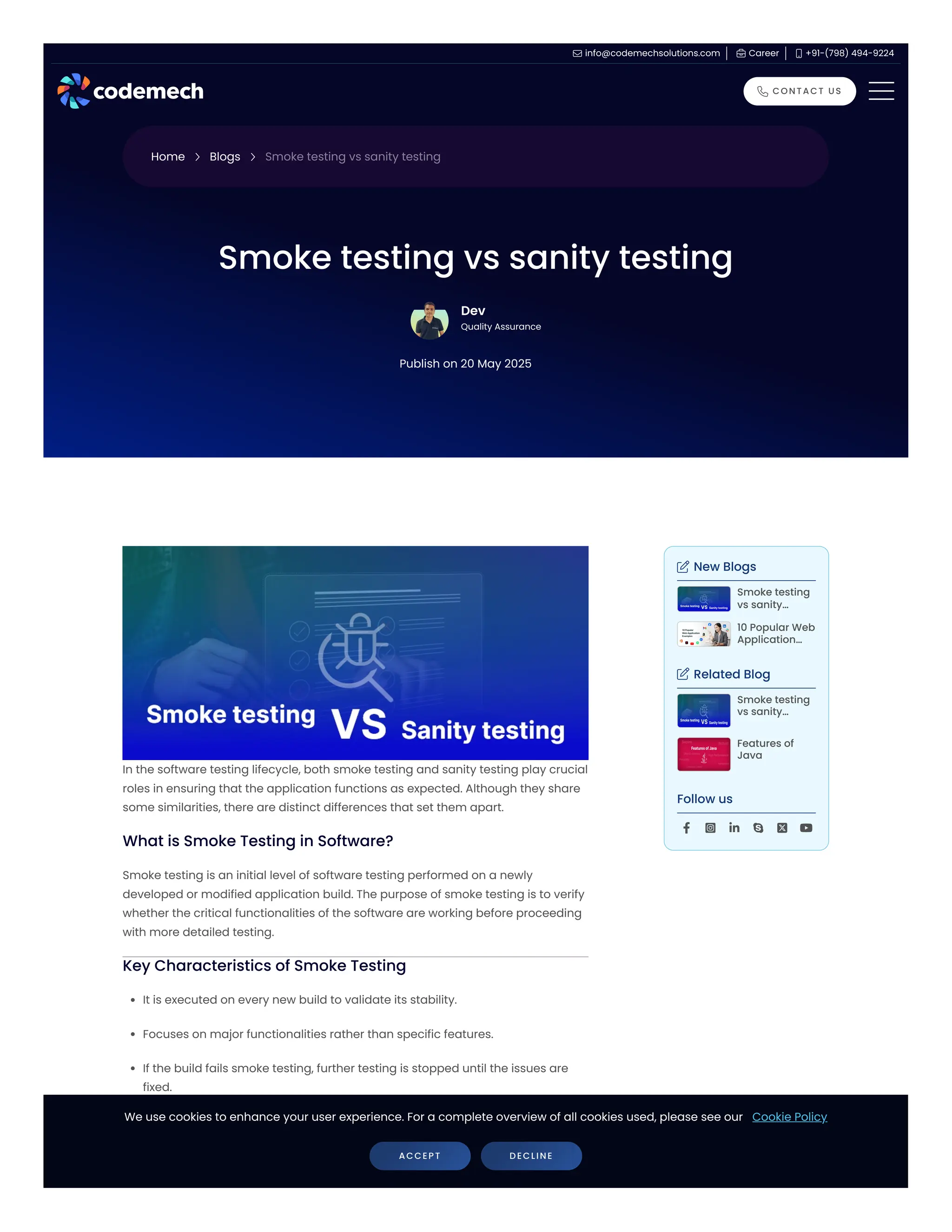
In the software testing lifecycle, both smoke testing and sanity testing play crucial
roles in ensuring that the application functions as expected. Although they share
some similarities, there are distinct differences that set them apart.
Smoke testing is an initial level of software testing performed on a newly
developed or modified application build. The purpose of smoke testing is to verify
whether the critical functionalities of the software are working before proceeding
with more detailed testing.
It is executed on every new build to validate its stability.
Focuses on major functionalities rather than specific features.
If the build fails smoke testing, further testing is stopped until the issues are
fixed.
It is scripted and automated in most cases.
Smoke testing vs sanity testing
Dev
Quality Assurance
Publish on 20 May 2025
New Blogs
Related Blog
Follow us
Smoke testing
vs sanity…
10 Popular Web
Application…
Smoke testing
vs sanity…
Features of
Java
Home Blogs Smoke testing vs sanity testing
info@codemechsolutions.com Career +91-(798) 494-9224
CONTACT US
We use cookies to enhance your user experience. For a complete overview of all cookies used, please see our Cookie Policy
ACCEPT DECLINE
2.
Advantages of SmokeTesting
Disadvantages of Smoke Testing
What is Sanity Testing?
Key Characteristics of Sanity Testing
When to Perform Sanity Testing?
Advantages of Sanity Testing
Disadvantages of Sanity Testing
Before conducting regression testing.
When a new software build is released.
Before delivering the application to QA teams.
After integration testing to check system stability.
Detects major bugs at an early stage.
Ensures that the build is stable for further testing.
Reduces testing effort by identifying unstable builds quickly.
Can be automated, saving time and resources.
Does not cover all application features.
May not catch deeper functionality defects.
Requires an initial setup for automation in some cases.
Sanity testing is a type of software testing performed after receiving a new build
to check if specific functionalities or bug fixes work as expected. It is a narrow and
focused testing process that ensures that the minor changes in the code have
not affected the core functionalities of the application.
It is performed after receiving a new build with minor code changes or bug
fixes.
Focuses on specific functionalities rather than the entire system.
Ensures that previously reported bugs are fixed without introducing new
issues.
It is unscripted and quick, allowing testers to proceed with further testing if the
application is stable.
When developers fix a critical bug in the software.
Before moving to regression testing to validate small fixes.
After minor code changes to ensure stability before deeper testing.
When an application is migrated to a different environment.
Saves time by focusing only on specific features.
Helps identify major issues quickly.
Ensures bug fixes do not cause new defects.
Avoids redundant testing efforts.
3.
Smoke Testing vsSanity Testing
Key Differences Between Smoke Testing and Sanity Testing
When Should You Choose Smoke Testing vs. Sanity Testing?
Does not cover the entire application.
May miss issues outside the tested functionalities.
Mostly manual, which can be time-consuming.
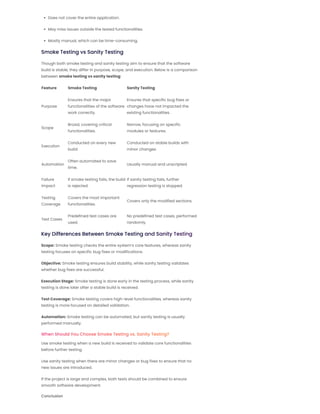
Though both smoke testing and sanity testing aim to ensure that the software
build is stable, they differ in purpose, scope, and execution. Below is a comparison
between smoke testing vs sanity testing:
Feature Smoke Testing Sanity Testing
Purpose
Ensures that the major
functionalities of the software
work correctly.
Ensures that specific bug fixes or
changes have not impacted the
existing functionalities.
Scope
Broad, covering critical
functionalities.
Narrow, focusing on specific
modules or features.
Execution
Conducted on every new
build.
Conducted on stable builds with
minor changes.
Automation
Often automated to save
time.
Usually manual and unscripted.
Failure
Impact
If smoke testing fails, the build
is rejected.
If sanity testing fails, further
regression testing is stopped.
Testing
Coverage
Covers the most important
functionalities.
Covers only the modified sections.
Test Cases
Predefined test cases are
used.
No predefined test cases, performed
randomly.
Scope: Smoke testing checks the entire system’s core features, whereas sanity
testing focuses on specific bug fixes or modifications.
Objective: Smoke testing ensures build stability, while sanity testing validates
whether bug fixes are successful.
Execution Stage: Smoke testing is done early in the testing process, while sanity
testing is done later after a stable build is received.
Test Coverage: Smoke testing covers high-level functionalities, whereas sanity
testing is more focused on detailed validation.
Automation: Smoke testing can be automated, but sanity testing is usually
performed manually.
Use smoke testing when a new build is received to validate core functionalities
before further testing.
Use sanity testing when there are minor changes or bug fixes to ensure that no
new issues are introduced.
If the project is large and complex, both tests should be combined to ensure
smooth software development.
Conclusion
4.
Both smoke testingand sanity testing are essential in software testing to ensure
the reliability and stability of an application. Smoke testing focuses on verifying
the core functionalities of a new build, while sanity testing ensures that recent
changes or bug fixes do not introduce new issues. Understanding the differences
between smoke testing vs sanity testing helps QA teams decide when and how to
apply them in the software development process.
By implementing both smoke testing and sanity testing effectively, software
teams can reduce defects, save time, and improve overall software quality.
Always ensure that these testing techniques are part of your software testing
strategy for a smoother development cycle.
We provide hassle-free service and solutions for web and mobile applications.
Support
(Mon-Fri)
10:00am - 7:00pm(IST)
info@codemechsolutions.com
(Sales) + 91 798 494-9224
(HR) + 91 635 104-3147
Resources
About
Portfolio
Career
Recent Solutions
Case study
Blogs
Sitemap
Services
Java Development
Angular Development
iPhone Development
Android Development
Hybrid Development
Aws Cloud Services
Integration
Services
Docker/Kubernetes
Container Services
CI/CD Deployment
ERP/E-commerce
Development
Hire Developers
Locations
Our Highly skilled IT Service team is ready to support you within a very short
period and also it will be available on-demand.
Codemech's Value
Customers
Support & Services
CONTACT US
5.
India
403, Swasthi BusinessCenter, SP Ring Rd. Nikol Ahmedabad
GJ 382350
Ireland
11, Derravaragh Abbey Multyfarnham, Co. Westmeath,
Ireland N91N7F8.
Copyright @ 2024 Codemech Solutions Terms and Conditions



![The Most Comprehensive and Friendly Guide On Smoke Testing [with Examples].pdf](https://cdn.slidesharecdn.com/ss_thumbnails/themostcomprehensiveandfriendlyguideonsmoketestingwithexamples-241001124614-eebebae4-thumbnail.jpg?width=640&height=640&fit=bounds)


