Meaning
Objectives Of Operating System
Functions Of Operating System
Measuring System Performance
An operating system is a software,
consisting of an integrated set of programs
that controls computer resources(CPU,
memory, I/O devices etc.)and provides
common services for efficient execution of
various application software. In short,
operating system is an interface between the
hardware and user.
 Making a computer system user-friendly
 Managing the resources of a computer
system
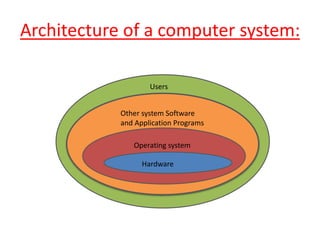
Architecture of a computer system:
Users
Other system Software
and Application Programs
Operating system
Hardware
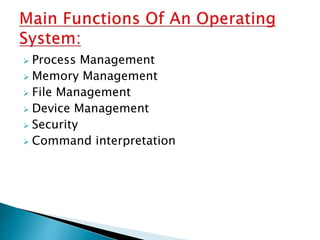
 Process Management
 Memory Management
 File Management
 Device Management
 Security
 Command interpretation
A process is a program in execution. The
operating system manages many kinds of
activities from user programs to system
programs. A process includes the complete
execution context(code,data,PC,registers,OS
resources in use etc.)
 Creation and deletion of user and system
process
 Suspension and resumption of processes
 A mechanism for process synchronization
 A mechanism for process communication
 A mechanism for deadlock handling
The memory management module of an
operating system takes care of the allocation
and de-allocation of memory space to the
various programs in need of this resource.
Main-memory provides storage that can be
directly accessed by the CPU. For a program
to be executed, it must be in the main
memory.
 To keep track of which part of memory are
currently being used and by whom
 To decide which process is loaded into
memory when memory space becomes
available; and to allocate and de-allocate
memory space, as needed.
A file is a collection of related
information defined by its creator. Computer
can store files on the disk(secondary storage),
which provide long term storage. Some
examples of storage media are magnetic
tape, magnetic disk and optical disk. Each of
these media has its own properties like
speed, capacity, data transfer rate and access
methods.
 The creation and deletion of files
 The creation and deletion of directions
 The support of primitives for manipulating
files and directions
 The mapping of files into secondary storage
 The back up files on stable storage media
A computer system normally consists of
several I/O devices such as terminal, printer,
disk and tape. The device management
module of an operating system takes care of
controlling all the computer’s I/O devices. It
keeps track of I/O requests from processes,
issues commands to the I/O devices, and
ensures correct data transmission to/from an
I/O device.
Computer systems often store large
amounts of information, some of which is
highly sensitive and valuable to their users.
Users can trust the system and rely on it only
if the various resources and information of a
computer system are protected against
destruction and authorized access.
A command interpreter is an interface of
the operating system with the user. The main
function of a command interpreter is to get
and execute next user specified command.
The efficiency of an operating system and
the overall performance of a computer
system are usually measured in the following
terms:
 Throughput
 Turnaround Time
 Response Time
It is the amount of work that the system
is able to do per unit of time. If n processes
are completed in an interval of t seconds, the
throughput is taken as n/t processes per
second during that interval.
It is the interval from the time of
submission of a job to the system for
processing to the time of completion of the
job.
It is the interval from the time of
submission of a job to the system for
processing to the time the first response for
the job is produced by the system.
Operating system

Operating system

  • 2.
    Meaning Objectives Of OperatingSystem Functions Of Operating System Measuring System Performance
  • 3.
    An operating systemis a software, consisting of an integrated set of programs that controls computer resources(CPU, memory, I/O devices etc.)and provides common services for efficient execution of various application software. In short, operating system is an interface between the hardware and user.
  • 4.
     Making acomputer system user-friendly  Managing the resources of a computer system
  • 5.
    Architecture of acomputer system: Users Other system Software and Application Programs Operating system Hardware
  • 6.
     Process Management Memory Management  File Management  Device Management  Security  Command interpretation
  • 7.
    A process isa program in execution. The operating system manages many kinds of activities from user programs to system programs. A process includes the complete execution context(code,data,PC,registers,OS resources in use etc.)
  • 8.
     Creation anddeletion of user and system process  Suspension and resumption of processes  A mechanism for process synchronization  A mechanism for process communication  A mechanism for deadlock handling
  • 9.
    The memory managementmodule of an operating system takes care of the allocation and de-allocation of memory space to the various programs in need of this resource. Main-memory provides storage that can be directly accessed by the CPU. For a program to be executed, it must be in the main memory.
  • 10.
     To keeptrack of which part of memory are currently being used and by whom  To decide which process is loaded into memory when memory space becomes available; and to allocate and de-allocate memory space, as needed.
  • 11.
    A file isa collection of related information defined by its creator. Computer can store files on the disk(secondary storage), which provide long term storage. Some examples of storage media are magnetic tape, magnetic disk and optical disk. Each of these media has its own properties like speed, capacity, data transfer rate and access methods.
  • 12.
     The creationand deletion of files  The creation and deletion of directions  The support of primitives for manipulating files and directions  The mapping of files into secondary storage  The back up files on stable storage media
  • 13.
    A computer systemnormally consists of several I/O devices such as terminal, printer, disk and tape. The device management module of an operating system takes care of controlling all the computer’s I/O devices. It keeps track of I/O requests from processes, issues commands to the I/O devices, and ensures correct data transmission to/from an I/O device.
  • 14.
    Computer systems oftenstore large amounts of information, some of which is highly sensitive and valuable to their users. Users can trust the system and rely on it only if the various resources and information of a computer system are protected against destruction and authorized access.
  • 15.
    A command interpreteris an interface of the operating system with the user. The main function of a command interpreter is to get and execute next user specified command.
  • 16.
    The efficiency ofan operating system and the overall performance of a computer system are usually measured in the following terms:  Throughput  Turnaround Time  Response Time
  • 17.
    It is theamount of work that the system is able to do per unit of time. If n processes are completed in an interval of t seconds, the throughput is taken as n/t processes per second during that interval.
  • 18.
    It is theinterval from the time of submission of a job to the system for processing to the time of completion of the job.
  • 19.
    It is theinterval from the time of submission of a job to the system for processing to the time the first response for the job is produced by the system.