OPERANT CONDITIONING
PRESENTED BY: AGUSTIN KIM ILEX
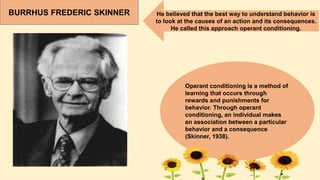
BURRHUS FREDERIC SKINNER He believed that the best way to understand behavior is
to look at the causes of an action and its consequences.
He called this approach operant conditioning.
Operant conditioning is a method of
learning that occurs through
rewards and punishments for
behavior. Through operant
conditioning, an individual makes
an association between a particular
behavior and a consequence
(Skinner, 1938).
History
Skinner is regarded as the father of
Operant Conditioning, but his work was
based on Thorndike’s (1898) law of effect.
According to this principle, behavior that
is followed by pleasant consequences
is likely to be repeated, and behavior
followed by unpleasant consequences
is less likely to be repeated.
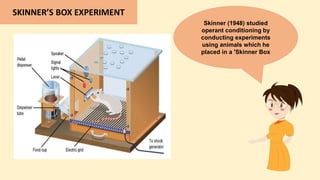
Skinner (1948) studied
operant conditioning by
conducting experiments
using animals which he
placed in a 'Skinner Box
SKINNER’S BOX EXPERIMENT
POSITIVE REINFORCEMENT
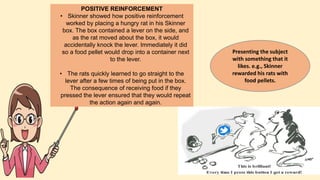
• Skinner showed how positive reinforcement
worked by placing a hungry rat in his Skinner
box. The box contained a lever on the side, and
as the rat moved about the box, it would
accidentally knock the lever. Immediately it did
so a food pellet would drop into a container next
to the lever.
• The rats quickly learned to go straight to the
lever after a few times of being put in the box.
The consequence of receiving food if they
pressed the lever ensured that they would repeat
the action again and again.
Presenting the subject
with something that it
likes. e.g., Skinner
rewarded his rats with
food pellets.
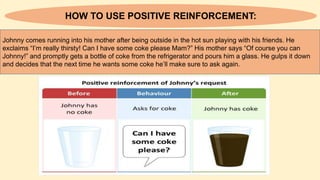
HOW TO USE POSITIVE REINFORCEMENT:
Johnny comes running into his mother after being outside in the hot sun playing with his friends. He
exclaims “I’m really thirsty! Can I have some coke please Mam?” His mother says “Of course you can
Johnny!” and promptly gets a bottle of coke from the refrigerator and pours him a glass. He gulps it down
and decides that the next time he wants some coke he’ll make sure to ask again.
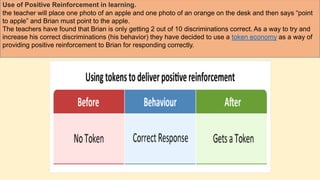
Use of Positive Reinforcement in learning.
the teacher will place one photo of an apple and one photo of an orange on the desk and then says “point
to apple” and Brian must point to the apple.
The teachers have found that Brian is only getting 2 out of 10 discriminations correct. As a way to try and
increase his correct discriminations (his behavior) they have decided to use a token economy as a way of
providing positive reinforcement to Brian for responding correctly.
NEGATIVE REINFORCEMENT
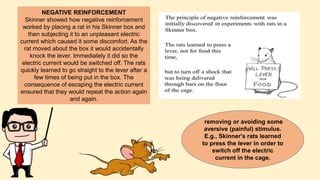
Skinner showed how negative reinforcement
worked by placing a rat in his Skinner box and
then subjecting it to an unpleasant electric
current which caused it some discomfort. As the
rat moved about the box it would accidentally
knock the lever. Immediately it did so the
electric current would be switched off. The rats
quickly learned to go straight to the lever after a
few times of being put in the box. The
consequence of escaping the electric current
ensured that they would repeat the action again
and again.
removing or avoiding some
aversive (painful) stimulus.
E.g., Skinner's rats learned
to press the lever in order to
switch off the electric
current in the cage.
USE OF NEGATIVE REINFORCEMENT:
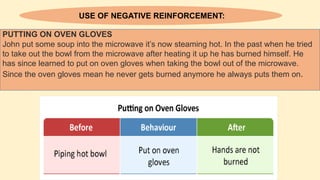
PUTTING ON OVEN GLOVES
John put some soup into the microwave it’s now steaming hot. In the past when he tried
to take out the bowl from the microwave after heating it up he has burned himself. He
has since learned to put on oven gloves when taking the bowl out of the microwave.
Since the oven gloves mean he never gets burned anymore he always puts them on.
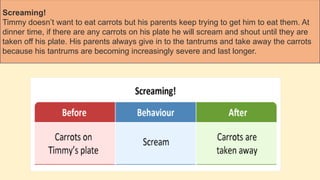
Screaming!
Timmy doesn’t want to eat carrots but his parents keep trying to get him to eat them. At
dinner time, if there are any carrots on his plate he will scream and shout until they are
taken off his plate. His parents always give in to the tantrums and take away the carrots
because his tantrums are becoming increasingly severe and last longer.
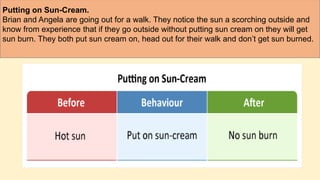
Putting on Sun-Cream.
Brian and Angela are going out for a walk. They notice the sun a scorching outside and
know from experience that if they go outside without putting sun cream on they will get
sun burn. They both put sun cream on, head out for their walk and don’t get sun burned.
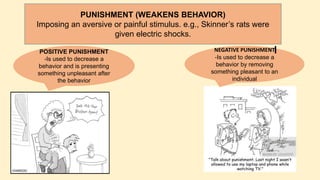
PUNISHMENT (WEAKENS BEHAVIOR)
Imposing an aversive or painful stimulus. e.g., Skinner’s rats were
given electric shocks.
NEGATIVE PUNISHMENT
-Is used to decrease a
behavior by removing
something pleasant to an
individual
POSITIVE PUNISHMENT
-Is used to decrease a
behavior and is presenting
something unpleasant after
the behavior
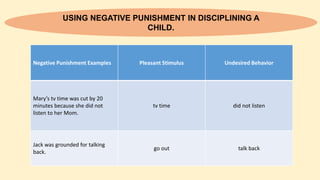
USING NEGATIVE PUNISHMENT IN DISCIPLINING A
CHILD.
Negative Punishment Examples Pleasant Stimulus Undesired Behavior
Mary’s tv time was cut by 20
minutes because she did not
listen to her Mom.
tv time did not listen
Jack was grounded for talking
back.
go out talk back
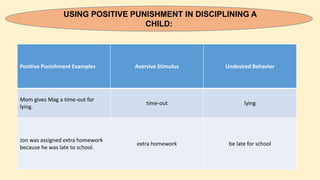
USING POSITIVE PUNISHMENT IN DISCIPLINING A
CHILD:
Positive Punishment Examples Aversive Stimulus Undesired Behavior
Mom gives Mag a time-out for
lying.
time-out lying
Jon was assigned extra homework
because he was late to school.
extra homework be late for school
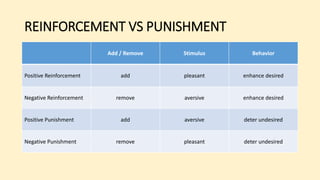
REINFORCEMENT VS PUNISHMENT
Add / Remove Stimulus Behavior
Positive Reinforcement add pleasant enhance desired
Negative Reinforcement remove aversive enhance desired
Positive Punishment add aversive deter undesired
Negative Punishment remove pleasant deter undesired
Operant Conditioning

Operant Conditioning

  • 1.
  • 2.
    BURRHUS FREDERIC SKINNERHe believed that the best way to understand behavior is to look at the causes of an action and its consequences. He called this approach operant conditioning. Operant conditioning is a method of learning that occurs through rewards and punishments for behavior. Through operant conditioning, an individual makes an association between a particular behavior and a consequence (Skinner, 1938).
  • 3.
    History Skinner is regardedas the father of Operant Conditioning, but his work was based on Thorndike’s (1898) law of effect. According to this principle, behavior that is followed by pleasant consequences is likely to be repeated, and behavior followed by unpleasant consequences is less likely to be repeated.
  • 4.
    Skinner (1948) studied operantconditioning by conducting experiments using animals which he placed in a 'Skinner Box SKINNER’S BOX EXPERIMENT
  • 5.
    POSITIVE REINFORCEMENT • Skinnershowed how positive reinforcement worked by placing a hungry rat in his Skinner box. The box contained a lever on the side, and as the rat moved about the box, it would accidentally knock the lever. Immediately it did so a food pellet would drop into a container next to the lever. • The rats quickly learned to go straight to the lever after a few times of being put in the box. The consequence of receiving food if they pressed the lever ensured that they would repeat the action again and again. Presenting the subject with something that it likes. e.g., Skinner rewarded his rats with food pellets.
  • 6.
    HOW TO USEPOSITIVE REINFORCEMENT: Johnny comes running into his mother after being outside in the hot sun playing with his friends. He exclaims “I’m really thirsty! Can I have some coke please Mam?” His mother says “Of course you can Johnny!” and promptly gets a bottle of coke from the refrigerator and pours him a glass. He gulps it down and decides that the next time he wants some coke he’ll make sure to ask again.
  • 7.
    Use of PositiveReinforcement in learning. the teacher will place one photo of an apple and one photo of an orange on the desk and then says “point to apple” and Brian must point to the apple. The teachers have found that Brian is only getting 2 out of 10 discriminations correct. As a way to try and increase his correct discriminations (his behavior) they have decided to use a token economy as a way of providing positive reinforcement to Brian for responding correctly.
  • 8.
    NEGATIVE REINFORCEMENT Skinner showedhow negative reinforcement worked by placing a rat in his Skinner box and then subjecting it to an unpleasant electric current which caused it some discomfort. As the rat moved about the box it would accidentally knock the lever. Immediately it did so the electric current would be switched off. The rats quickly learned to go straight to the lever after a few times of being put in the box. The consequence of escaping the electric current ensured that they would repeat the action again and again. removing or avoiding some aversive (painful) stimulus. E.g., Skinner's rats learned to press the lever in order to switch off the electric current in the cage.
  • 9.
    USE OF NEGATIVEREINFORCEMENT: PUTTING ON OVEN GLOVES John put some soup into the microwave it’s now steaming hot. In the past when he tried to take out the bowl from the microwave after heating it up he has burned himself. He has since learned to put on oven gloves when taking the bowl out of the microwave. Since the oven gloves mean he never gets burned anymore he always puts them on.
  • 10.
    Screaming! Timmy doesn’t wantto eat carrots but his parents keep trying to get him to eat them. At dinner time, if there are any carrots on his plate he will scream and shout until they are taken off his plate. His parents always give in to the tantrums and take away the carrots because his tantrums are becoming increasingly severe and last longer.
  • 11.
    Putting on Sun-Cream. Brianand Angela are going out for a walk. They notice the sun a scorching outside and know from experience that if they go outside without putting sun cream on they will get sun burn. They both put sun cream on, head out for their walk and don’t get sun burned.
  • 12.
    PUNISHMENT (WEAKENS BEHAVIOR) Imposingan aversive or painful stimulus. e.g., Skinner’s rats were given electric shocks. NEGATIVE PUNISHMENT -Is used to decrease a behavior by removing something pleasant to an individual POSITIVE PUNISHMENT -Is used to decrease a behavior and is presenting something unpleasant after the behavior
  • 13.
    USING NEGATIVE PUNISHMENTIN DISCIPLINING A CHILD. Negative Punishment Examples Pleasant Stimulus Undesired Behavior Mary’s tv time was cut by 20 minutes because she did not listen to her Mom. tv time did not listen Jack was grounded for talking back. go out talk back
  • 14.
    USING POSITIVE PUNISHMENTIN DISCIPLINING A CHILD: Positive Punishment Examples Aversive Stimulus Undesired Behavior Mom gives Mag a time-out for lying. time-out lying Jon was assigned extra homework because he was late to school. extra homework be late for school
  • 15.
    REINFORCEMENT VS PUNISHMENT Add/ Remove Stimulus Behavior Positive Reinforcement add pleasant enhance desired Negative Reinforcement remove aversive enhance desired Positive Punishment add aversive deter undesired Negative Punishment remove pleasant deter undesired