Openly Secure   

Staying secure by using Open Source 
      Mohamed Hussein Sayed 
     mechanic@unixgarage.com 
    h;p://www.unixgarage.com/
          openlysecure.pdf 
Using OSS where security ma;ers 
•  Some corporaAons and government agencies 
   forbid it. 
•  The source is available!: Easier for bad guys to 
   find holes. 
•  The source is available!: Good guys can find 
   holes and fix them. 
•  The source is available! You can fix it yourself 
   or pay someone to fix it. 
The OS: Choosing a secure foundaAon 
•  The OS controls everything; if it is 
   compromised the game is over. 
•  Linux kernel size and pace makes it harder to 
   audit. 
•  SELinux was developed to cover the gaps and 
   provide a more secure linux plaNorm. 
•  SELinux main features: Mandatory access 
   controls, Security policies, implemented as 
   LSM. 
The OS: Choosing a secure foundaAon 
•  SELinux is now enabled in many mainstream 
   distribuAons. 
•  SELinux core idea is to protect the system in 
   case of a parAal compromise. 
•  Many sysadmins are frustrated by the 
   configuraAon and turn it off. 
The OS: Choosing a secure foundaAon. 
            OpenSolaris 
•  Made serious efforts towards improving security 
   infrastructure at the OS level. 
•  Common Criteria cerAfied EAL4+. 
•  Role based access control. 
•  Supports many popular firewalls.(PF, IPFilter). 
•  Policy management and roles definiAon requires 
   some pracAce. 
•  Supports Pluggable AuthenAcaAon Modules , 
   Kerberos, LDAP. 
The OS: Choosing a secure foundaAon 
             OpenBSD 
•  Designed from the ground up with security in 
   mind. 
•  Best security track record among OS OS’s. 
•  Gave birth to OpenSSH, the defacto secure 
   shell. 
•  Gave birth to PF, solid and robust firewall 
   engine. 
•  Great IPv6 and IPSec support. 
The OS: Choosing a secure foundaAon. 
             OpenBSD 
•  May be late to implement features, especially 
   if it affects security. 
•  May not support the latest and greatest 
   hardware. 
•  Excellent choice for network services type 
   work including Firewalls, VPNs, DNS , FTP, Mail 
   and Web servers. 
The applicaAons: Email 
•  Crucial service in today’s world. 
•  Insecure email servers have been notoriously 
   targeted in the past. 
•  Must be closely monitored. 
•  The grandfather of email servers had several 
   major security issues. 
•  Newer alternaAves like sendmail had security 
   as a core requirement.  
The applicaAon: FTP servers 
•  Older dp servers were commonly targeted. 
•  VulnerabiliAes usually required only a normal 
   user which may be easily sniffed or socially 
   engineered. 
•  Newer dp servers implement chroots, allow 
   for stricter policies. 
•  VSFTPD puts a great effort into providing the 
   service securely 
The applicaAon: Web Servers 
•  Crucial service for modern business. 
•  Industry standard has been apache. 
•  Apache has a great track record, but as the 
   project adds features this record may come to 
   test. 
•  Apache has support for various authenAcaAon 
   backends. 
•  AlternaAves with less features are available 
   and may be easily audited. 
Loose the fat: Less is be;er 
•  Many main stream distribuAons turn on 
   services by default. 
•  It is important to disable any addiAonal 
   services you may not use. 
•  Linux distribuAons can have a laxed service 
   startup policy. 
•  OpenBSD service management is easy via /
   etc/rc.conf 
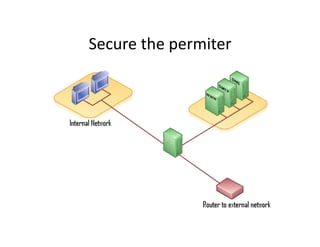
Secure the permiter 
Secure the perimeter: Firewalls 
•  OS firewall engines are plenty and excellent in 
   features. 
•  IPTables has very large feature set, excellent 
   modules repository and great library for 
   developers. 
•  PF has a very clean syntax, excellent feature 
   set. Excellent performance and have been 
   ported to many OS’s 
Secure the perimeter: Firewalls 
       Successful implementaAon 
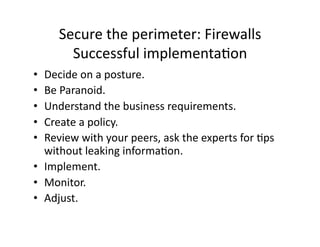
•  Decide on a posture. 
•  Be Paranoid. 
•  Understand the business requirements. 
•  Create a policy. 
•  Review with your peers, ask the experts for Aps 
   without leaking informaAon. 
•  Implement. 
•  Monitor. 
•  Adjust. 
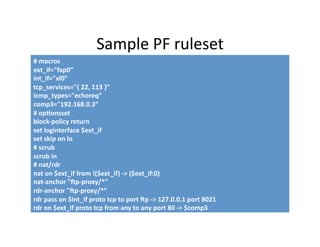
Sample PF ruleset 
# macros 
ext_if="fxp0” 
int_if="xl0” 
tcp_services="{ 22, 113 }” 
icmp_types="echoreq” 
comp3="192.168.0.3” 
# opDonsset 
block‐policy return 
set loginterface $ext_if 
set skip on lo 
# scrub 
scrub in 
# nat/rdr 
nat on $ext_if from !($ext_if) ‐> ($ext_if:0) 
nat‐anchor "Rp‐proxy/*” 
rdr‐anchor "Rp‐proxy/*” 
rdr pass on $int_if proto tcp to port Rp ‐> 127.0.0.1 port 8021 
rdr on $ext_if proto tcp from any to any port 80 ‐> $comp3 
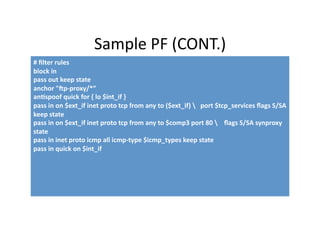
Sample PF (CONT.) 
# filter rules 
block in 
pass out keep state 
anchor "Rp‐proxy/*” 
anDspoof quick for { lo $int_if } 
pass in on $ext_if inet proto tcp from any to ($ext_if)    port $tcp_services flags S/SA 
keep state 
pass in on $ext_if inet proto tcp from any to $comp3 port 80     flags S/SA synproxy 
state 
pass in inet proto icmp all icmp‐type $icmp_types keep state 
pass in quick on $int_if 
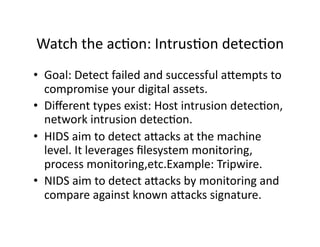
Watch the acAon: IntrusAon detecAon 
•  Goal: Detect failed and successful a;empts to 
   compromise your digital assets. 
•  Different types exist: Host intrusion detecAon, 
   network intrusion detecAon. 
•  HIDS aim to detect a;acks at the machine 
   level. It leverages filesystem monitoring, 
   process monitoring,etc.Example: Tripwire. 
•  NIDS aim to detect a;acks by monitoring and 
   compare against known a;acks signature. 
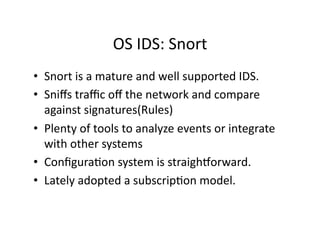
OS IDS: Snort 
•  Snort is a mature and well supported IDS. 
•  Sniffs traffic off the network and compare 
   against signatures(Rules) 
•  Plenty of tools to analyze events or integrate 
   with other systems 
•  ConfiguraAon system is straighNorward. 
•  Lately adopted a subscripAon model. 
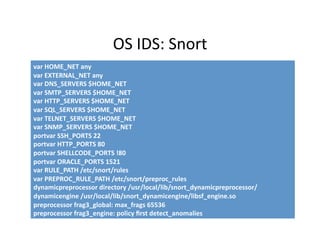
OS IDS: Snort 
var HOME_NET any 
var EXTERNAL_NET any 
var DNS_SERVERS $HOME_NET 
var SMTP_SERVERS $HOME_NET 
var HTTP_SERVERS $HOME_NET 
var SQL_SERVERS $HOME_NET 
var TELNET_SERVERS $HOME_NET 
var SNMP_SERVERS $HOME_NET 
portvar SSH_PORTS 22 
portvar HTTP_PORTS 80 
portvar SHELLCODE_PORTS !80 
portvar ORACLE_PORTS 1521 
var RULE_PATH /etc/snort/rules 
var PREPROC_RULE_PATH /etc/snort/preproc_rules 
dynamicpreprocessor directory /usr/local/lib/snort_dynamicpreprocessor/
dynamicengine /usr/local/lib/snort_dynamicengine/libsf_engine.so 
preprocessor frag3_global: max_frags 65536 
preprocessor frag3_engine: policy first detect_anomalies 
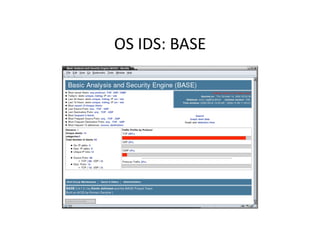
OS IDS: BASE 
Analyze the logs 
•  Unexamined data is worthless. 
•  Tune your environment to record what you 
   care about. 
•  Centralize your logs. 
•  Make it a habit to surf your logs. 
•  Create reports and graphs. A picture is worth a 
   1000 words. 
References 
•    www.openbsd.org/security.html 
•    opensolaris.org/os/community/security/ 
•    www.nsa.gov/research/selinux/ 
•    www.snort.org 
•    www.tripwire.org 
•    www.wireshark.org 
•    en.wikipedia.org/wiki/Syslog‐ng 
•    www.apache.org 
•    www.packetstormsecurity.org 
•    www.cert.org 
•    www.sans.org 

Openly Secure