Opening Up of Access
to Publicly Funded Research in
India: Status and Way Forward
@SridharGutam
Open Access?
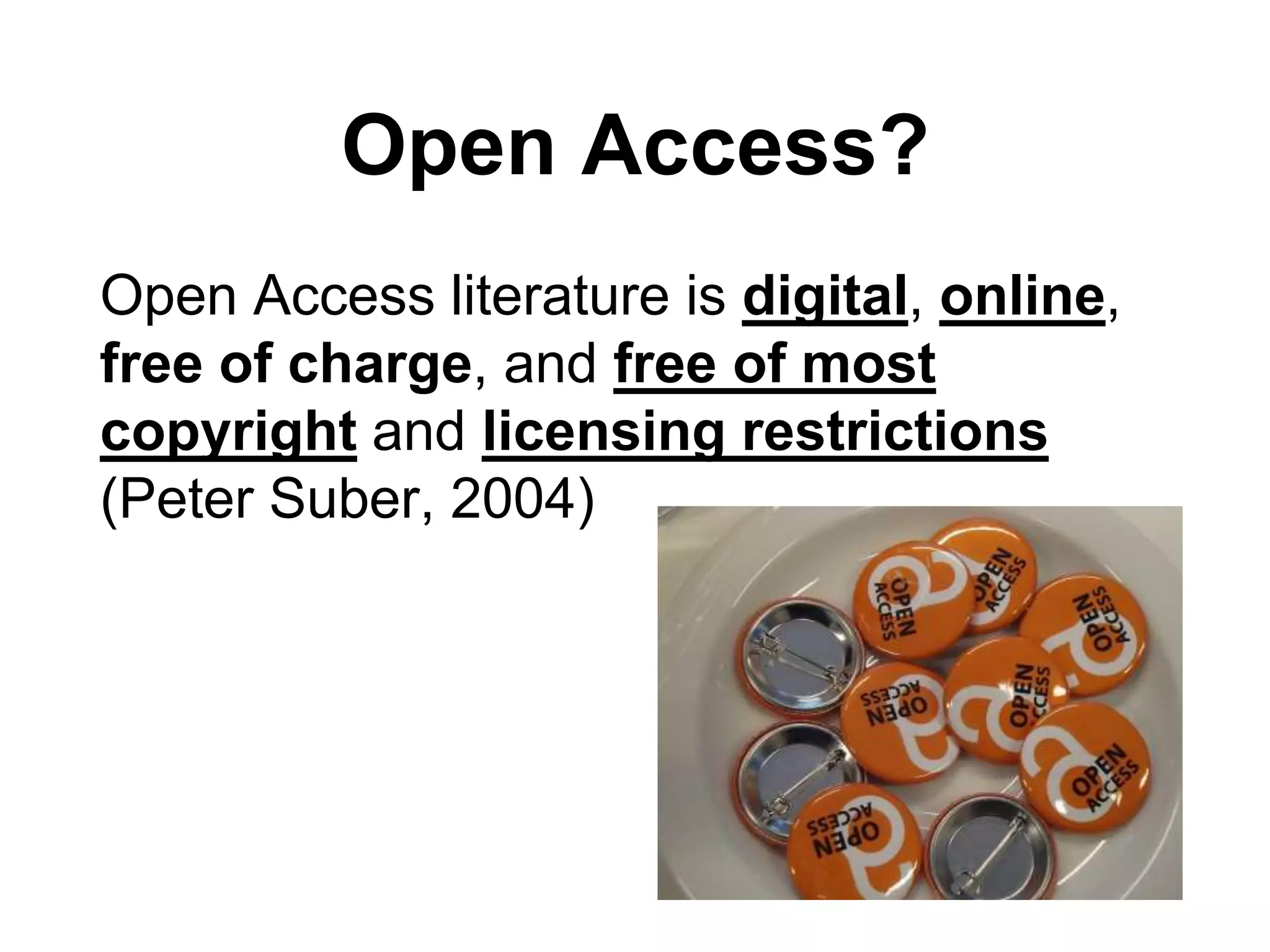
Open Access literature is digital, online,
free of charge, and free of most
copyright and licensing restrictions
(Peter Suber, 2004)
Budapest Open Access Initiative
• Conference convened in Budapest by
the Open Society Institute on December
1–2, 2001 to promote open access
(Free Online Scholarship).
• On the occasion of the 10th anniversary
of the initiative (2012), recommended
"the new goal that within the next ten
years, OA will become the default
method for distributing new peer-
reviewed research in every field and
country”.
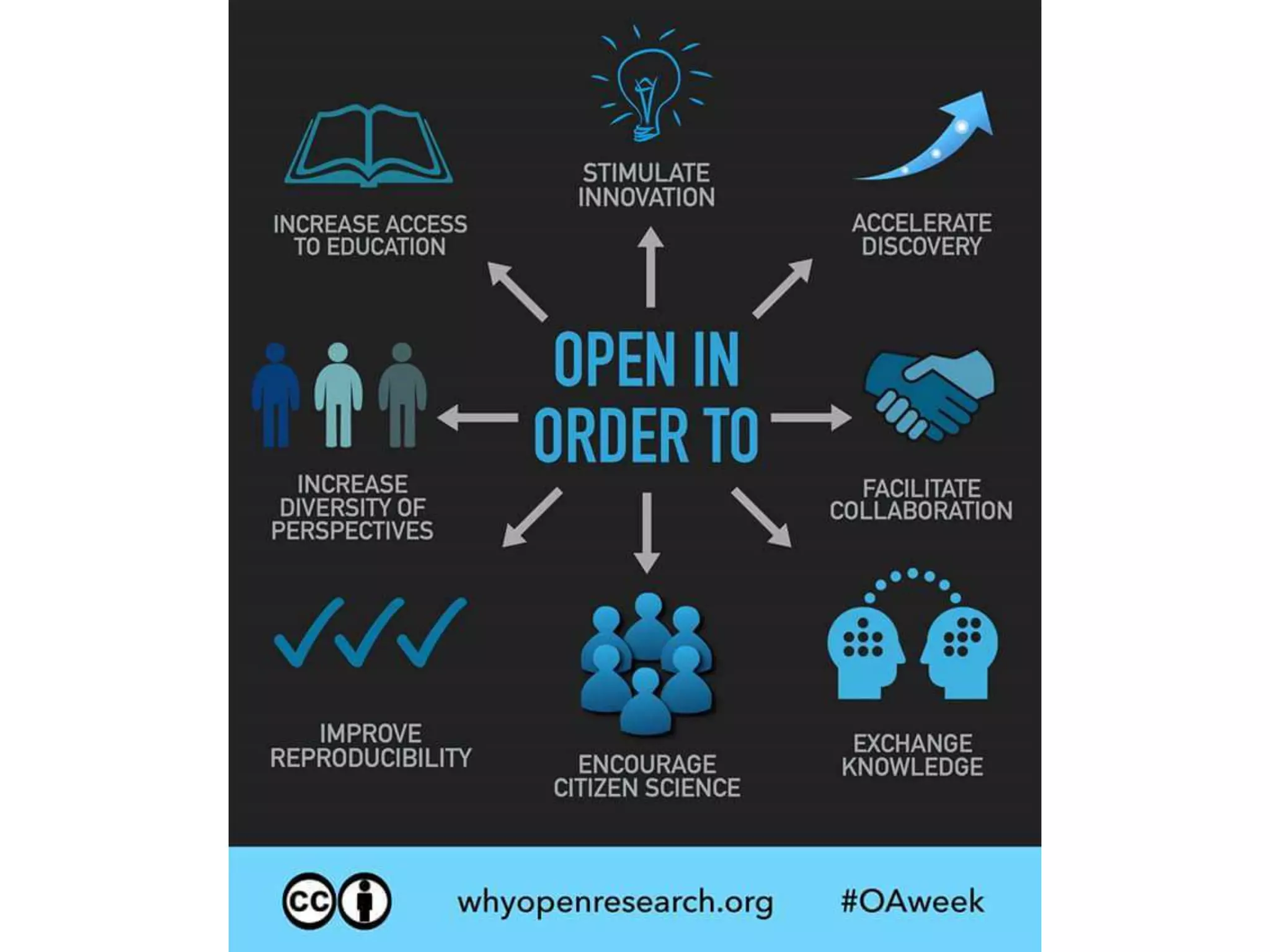
Why Open Access?
Open Access seeks to return scholarly
publishing to its original purpose: to
spread knowledge and allow that
knowledge to be built upon
(righttoresearch.org).
It ensures that the community has free
and immediate access to the literature
before and after it has been reviewed and
published (jneurosci.org).
Source: http://mofapp.nic.in:8080/economicsurvey/pdf/119-130_Chapter_08_ENGLISH_Vol_01_2017-18.pdf
"…national laboratories and other publicly funded
R&D institutions need to make much stronger efforts
to engage with the public and not make their
research centers quintessential ivory towers.” –
Economic Survey 2018
Source: http://mofapp.nic.in:8080/economicsurvey/pdf/119-130_Chapter_08_ENGLISH_Vol_01_2017-18.pdf
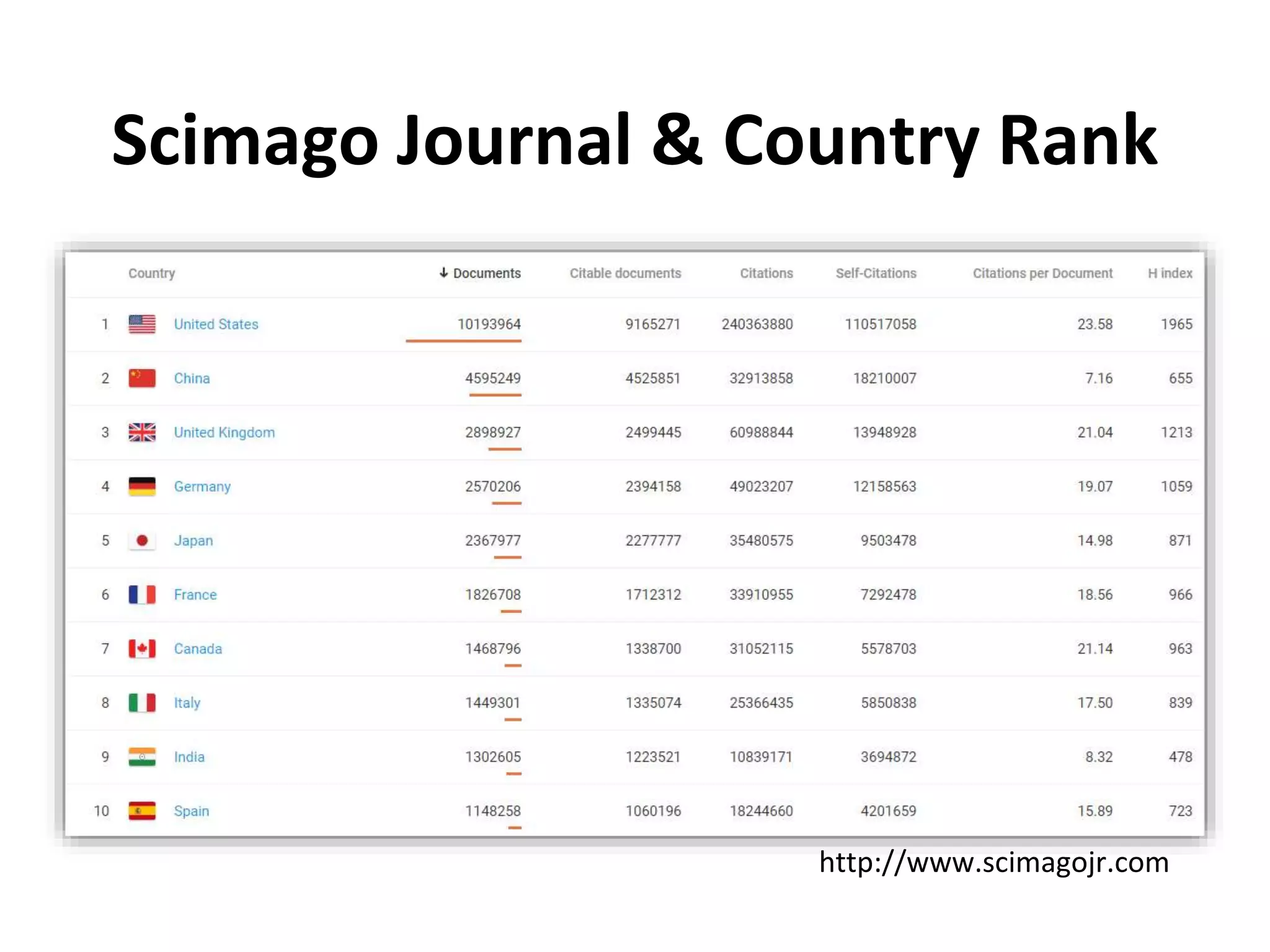
Scimago Journal & Country Rank
http://www.scimagojr.com
India’s Open Access Output (SJR)
http://www.scimagojr.com
• DOAJ - Directory of Open Access Journals
• Journals 200
• DOAJ Seal
• International Journal of Physiotherapy (Print 2349-5987; Online
2348-8336
• Article processing charges
• No (129)
• Yes (70)
• No Information (1)
• ISSN - Indian Journals
• Assigned during 1986 – 2015 : 18,702
• During 2015 : 2,462
• During 2016 : 855
Availability and Accessibility of Research
Outputs in NARS: A case study with IARI
(2002)
• “While publications from IARI are available to subscribers of the
Consortium for e-Resources in Agriculture (CeRA), public availability to
IARI publications is very meagre”
• Availability and accessibility of IARI publications were examined for
2008–2010, of the 221 indexed journals, only 19 (9%) were open access
journals indexed in DOAJ.
• Additionally, 14% of the published articles could be found on
Eprints@IARI (now Krishikosh). Thus, up to 23% of the published
literature is available and accessible to the public.
• The percentage of articles available in CeRA was 69%. This shows that a
little more than 30% of the articles published were not available to the
researchers in CeRA, a closed consortium model that makes articles
available through subscription to NARS constituents.
Source: Tandon et. al. 2012 (src-online.ca/index.php/src/article/view/86/232)
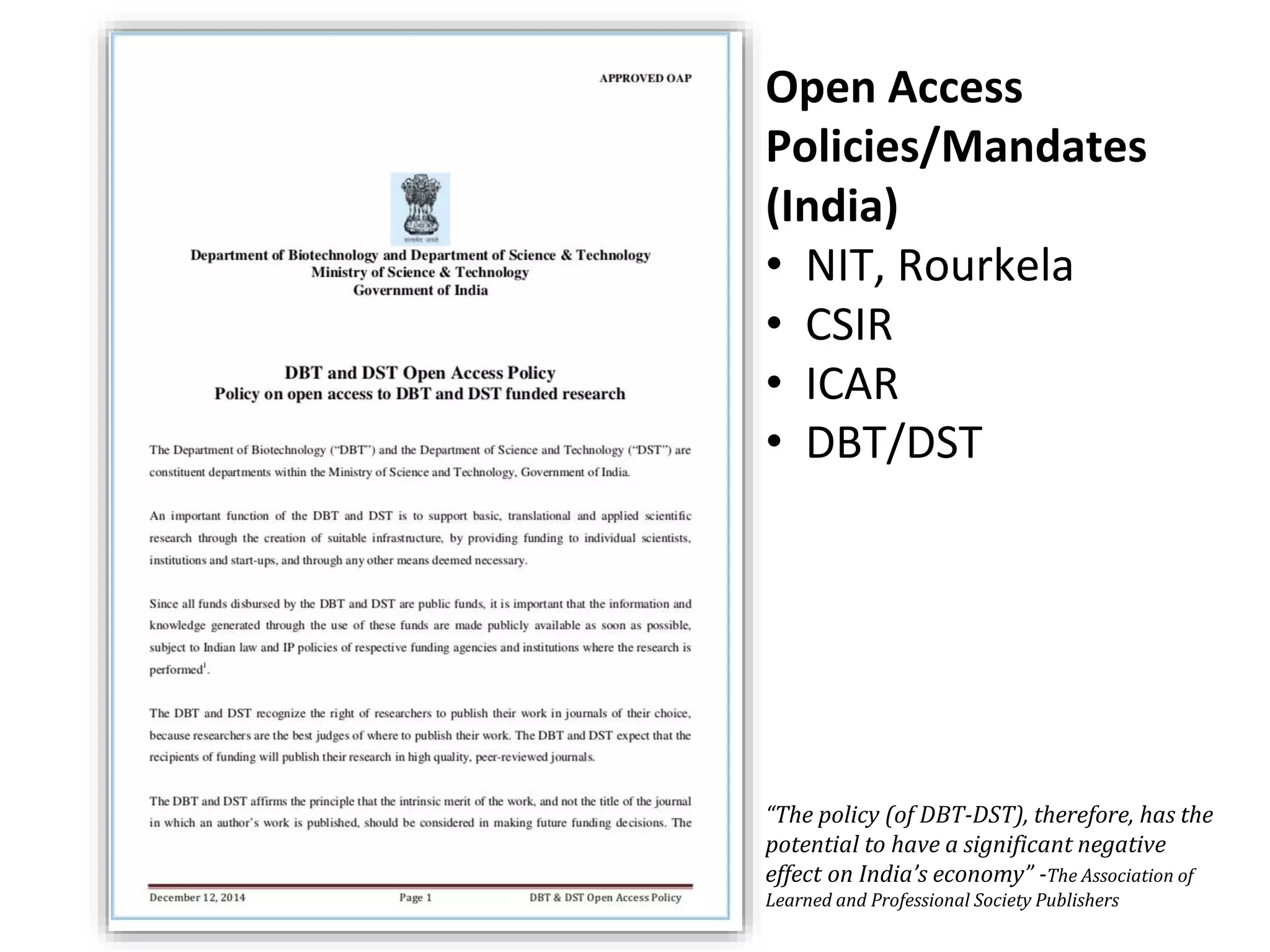
“The policy (of DBT-DST), therefore, has the
potential to have a significant negative
effect on India’s economy” -The Association of
Learned and Professional Society Publishers
Open Access
Policies/Mandates
(India)
• NIT, Rourkela
• CSIR
• ICAR
• DBT/DST
Registry of Open Access Repository
Mandates and Policies (World)
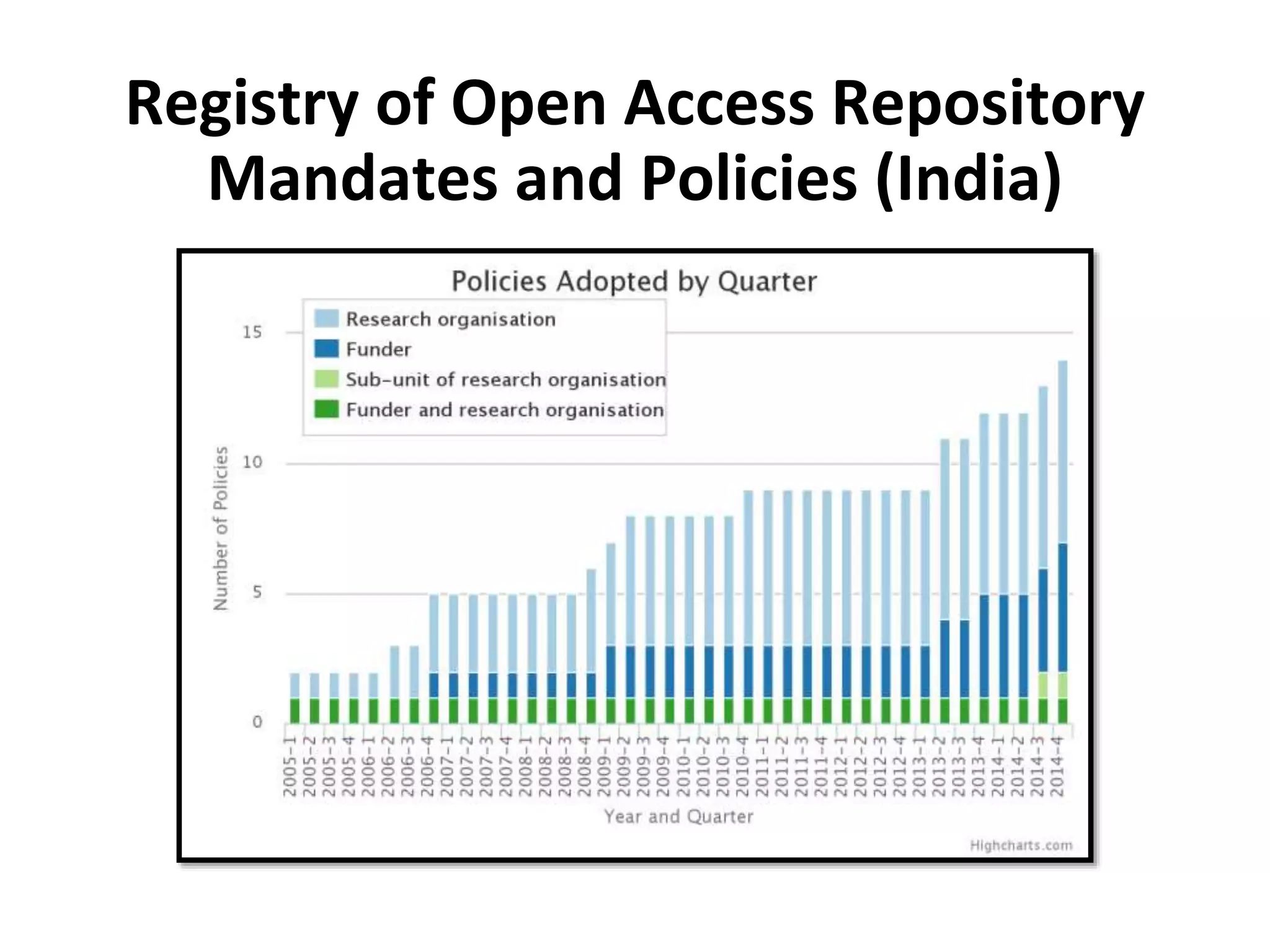
Registry of Open Access Repository
Mandates and Policies (India)
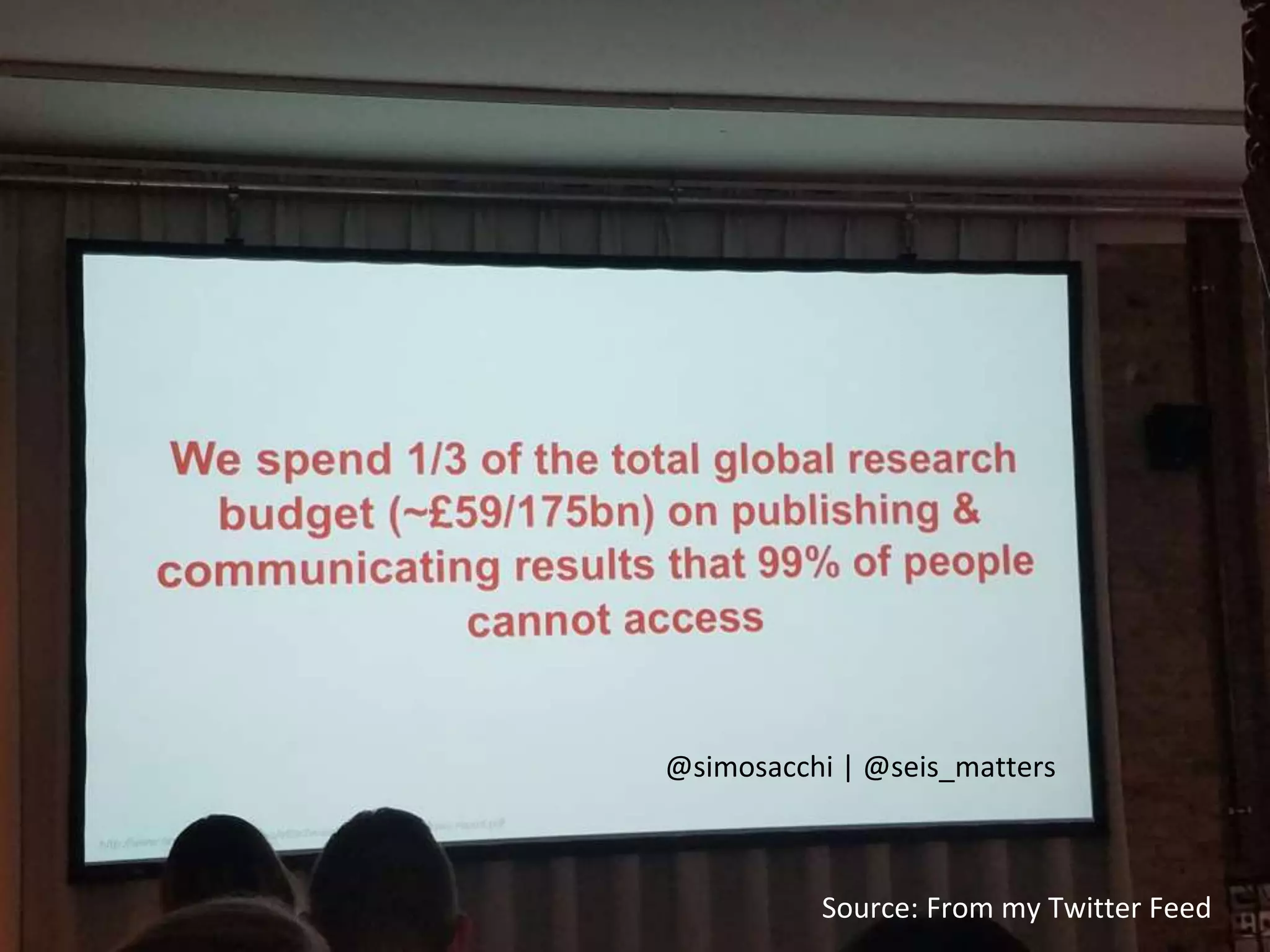
@simosacchi | @seis_matters
Source: From my Twitter Feed
“We estimate that India is potentially spending about US$ 2.4
million annually on APCs paid to OA journals and the amount would
be much more if we add APCs paid to make papers published in
hybrid journals open access “ - Muthu et al. 2017
http://www.currentscience.ac.in/Volumes/112/04/0703.pdf
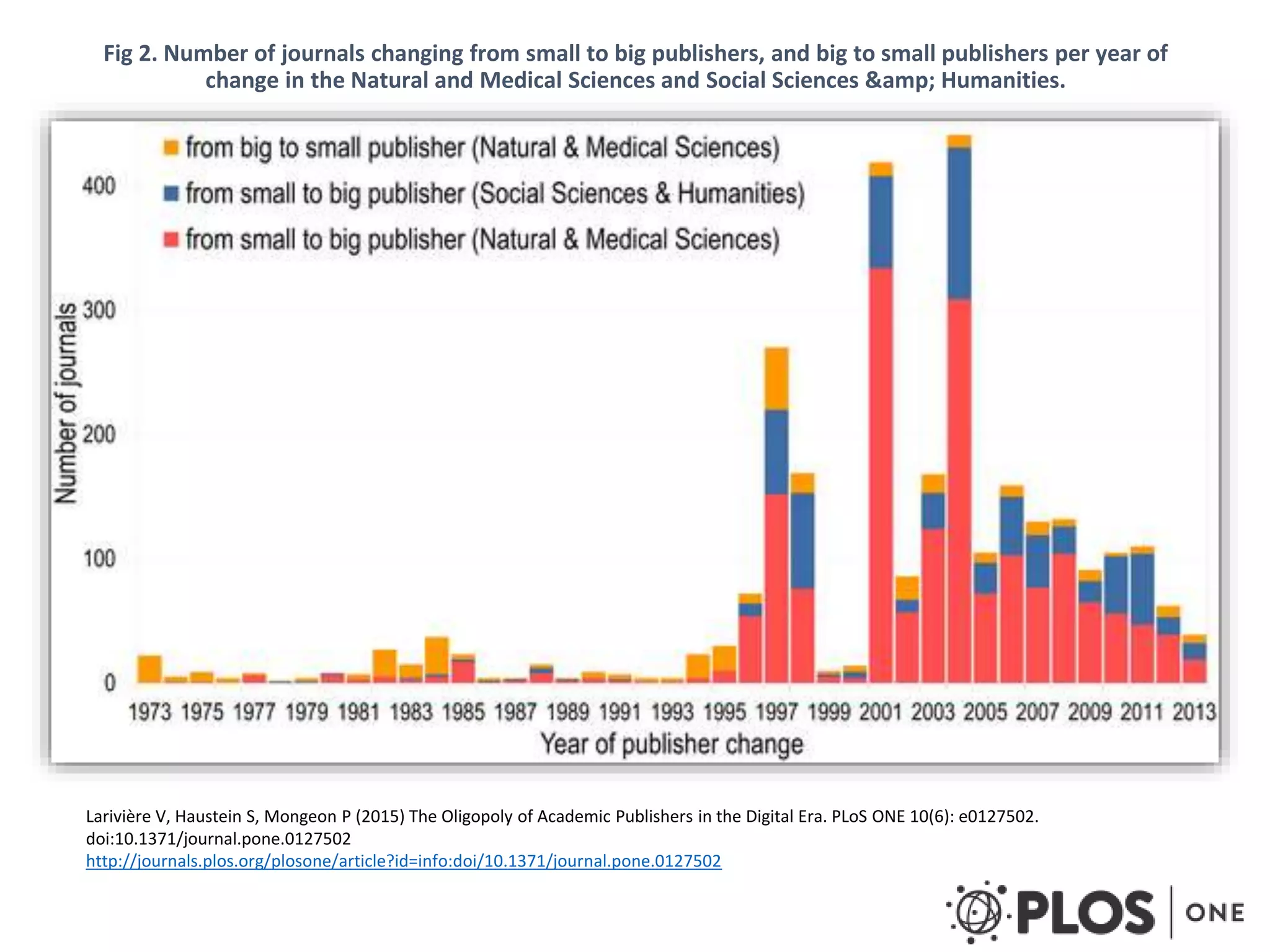
Fig 2. Number of journals changing from small to big publishers, and big to small publishers per year of
change in the Natural and Medical Sciences and Social Sciences & Humanities.
Larivière V, Haustein S, Mongeon P (2015) The Oligopoly of Academic Publishers in the Digital Era. PLoS ONE 10(6): e0127502.
doi:10.1371/journal.pone.0127502
http://journals.plos.org/plosone/article?id=info:doi/10.1371/journal.pone.0127502
Publishing Companies
• Social Science Research Network (SSRN) was
acquired by Elsevier $2 billion publishing company.
• Study published in PLoS, revealed that Reed-
Elsevier, Springer, Wiley-Blackwell, Taylor & Francis
and Sage published more than 50% of all research
articles in 2013.
• Its time for authors to move away from these for-
profit publishing corporations?
Institutional Repositories
● “Institutional repositories increase visibility and
opportunities for researchers” -Sarah
Tanksalvala
● “Institute’s research reputation increases when
all the scholarly outputs are showcased (abilities
and expertise)”.
● ROAR - Registry of Open Access Repositories
● India – 123
● Eprints – 64
● Dspace – 38
http://www.thehindu.com/sci-tech/science/Open-access-The-sorry-state-of-Indian-repositories/article17108642.ece
Status of Open Access
Repositories
Kumar and Mahesh, 2017. http://www.currentscience.ac.in/Volumes/112/02/0210.pdf
Dr. G. Mahesh, NISCAIR, New
Delhi
• “Ideally, pre-prints of papers should be deposited
in a repository. A large majority of publishers of
subscription journals have no problem in
researchers depositing preprints in a repository.”
• “Researchers get greater visibility when they
deposit their pre-prints in a repository as anyone
can read them. The institutions too gain. So it
difficult to say why researchers don’t do it,”
http://www.thehindu.com/sci-tech/science/Open-access-The-sorry-state-of-Indian-repositories/article17108642.ece
SHERPA/RoMEO
Publisher copyright policies & self-archiving
Source: http://www.sherpa.ac.uk/
120 publishers from India (52 Green)
Pre-Prints and Post-Prints
• Pre-Prints
• First draft of the article - before peer-
review, even before any contact with
a publisher
• Post-Prints
• Version of the paper after peer-
review, with revisions having been
made.
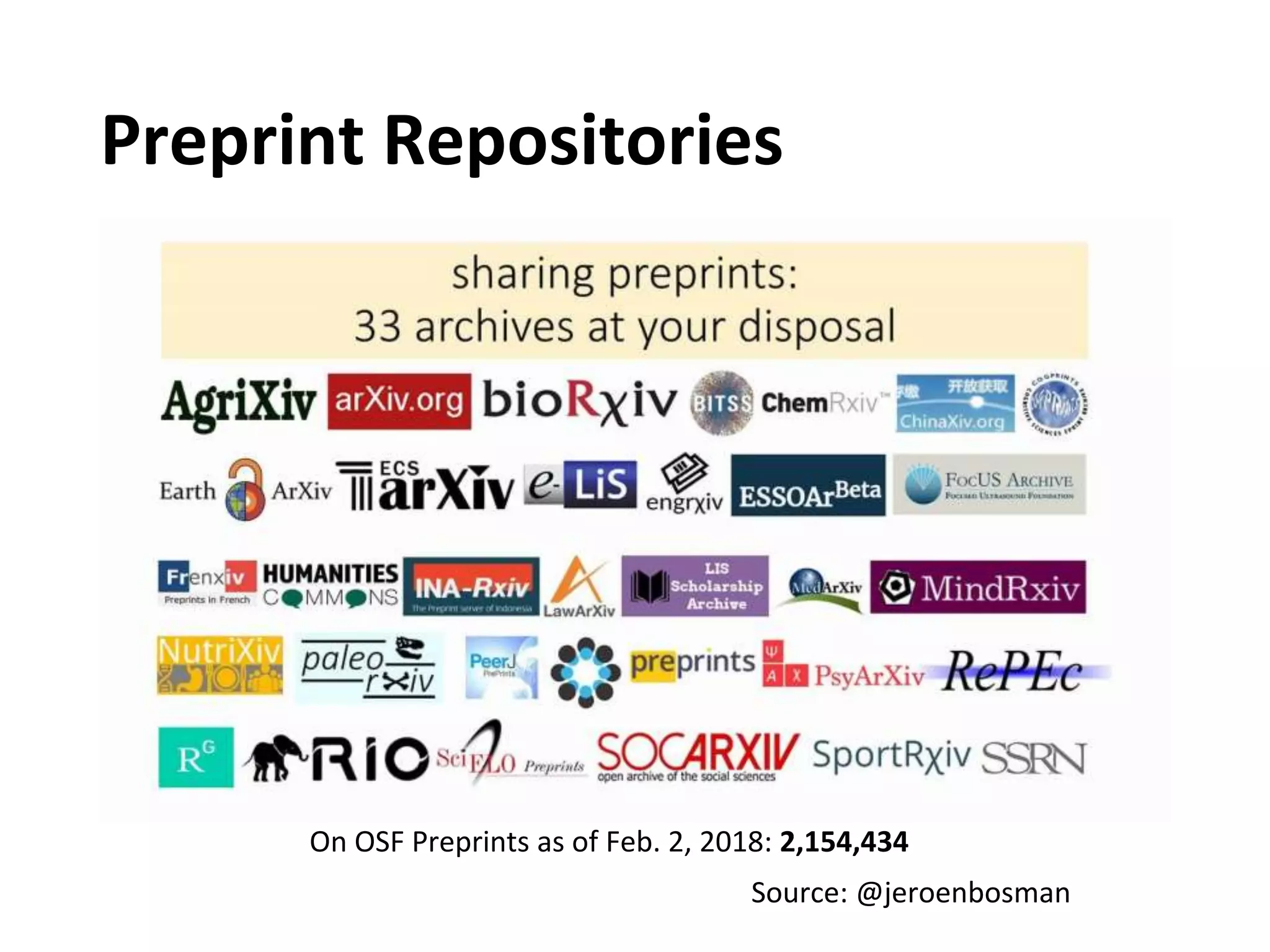
Preprint Repositories
Source: @jeroenbosman
On OSF Preprints as of Feb. 2, 2018: 2,154,434
“everything else can wait, but not agriculture.” -Jawaharlal Nehru.
Preprints for Agriculture
https://osf.io/preprints/agrixiv
/
Open Access India
• Advocating Open
Access, Open Data and
Open Education
• Launched as online
advocacy facebook
group on July 8th, 2011
• Facebook group
membership: 10864
• Grown into community
of practice
Memberships & Partnerships
• GODAN - Global Open Data for Agriculture and
Nutrition
• ICORE – The International Community for Open
Research and Education
• OA2020 – initiative for large-scale transition for
open access
• Open Policy Network
• CLACSO Working Group - Bienes Comunes y
Acceso Abierto (Common Goods and Open Access)
for the period 2016 – 2019
Works & Initiatives
• Actively participated in discussions/deliberations for ICAR
Open Access Policy
• Developing Indian Journals' copyright policies to be
integrated with the databases like Sherpa/RoMEO.
• Working with DOAJ in building whitelist of Indian Journals
• National Open Access Policy of India (Draft) Ver. 3
• A draft ‘National Open Access Policy’ for India was
prepared and submitted to: Ministries - Human
Resource Development and Science & Technology,
Government of India on 14th February, 2017, the 15th
anniversary of the BOAI (Budapest open access
Initiative). <https://zenodo.org/record/1002618>
OA Communities in South Asia
Forum for
Open
Access in
SAARC
http://thinkchecksubmit.org/
https://zenodo.org/
Thank you for your kind attention
licensed under a Creative Commons Attribution 4.0 International License.

Opening Up of Access to Publicly Funded Research

  • 1.
    Opening Up ofAccess to Publicly Funded Research in India: Status and Way Forward @SridharGutam
  • 2.
    Open Access? Open Accessliterature is digital, online, free of charge, and free of most copyright and licensing restrictions (Peter Suber, 2004)
  • 3.
    Budapest Open AccessInitiative • Conference convened in Budapest by the Open Society Institute on December 1–2, 2001 to promote open access (Free Online Scholarship). • On the occasion of the 10th anniversary of the initiative (2012), recommended "the new goal that within the next ten years, OA will become the default method for distributing new peer- reviewed research in every field and country”.
  • 4.
    Why Open Access? OpenAccess seeks to return scholarly publishing to its original purpose: to spread knowledge and allow that knowledge to be built upon (righttoresearch.org). It ensures that the community has free and immediate access to the literature before and after it has been reviewed and published (jneurosci.org).
  • 6.
  • 7.
    "…national laboratories andother publicly funded R&D institutions need to make much stronger efforts to engage with the public and not make their research centers quintessential ivory towers.” – Economic Survey 2018 Source: http://mofapp.nic.in:8080/economicsurvey/pdf/119-130_Chapter_08_ENGLISH_Vol_01_2017-18.pdf
  • 8.
    Scimago Journal &Country Rank http://www.scimagojr.com
  • 9.
    India’s Open AccessOutput (SJR) http://www.scimagojr.com
  • 10.
    • DOAJ -Directory of Open Access Journals • Journals 200 • DOAJ Seal • International Journal of Physiotherapy (Print 2349-5987; Online 2348-8336 • Article processing charges • No (129) • Yes (70) • No Information (1) • ISSN - Indian Journals • Assigned during 1986 – 2015 : 18,702 • During 2015 : 2,462 • During 2016 : 855
  • 11.
    Availability and Accessibilityof Research Outputs in NARS: A case study with IARI (2002) • “While publications from IARI are available to subscribers of the Consortium for e-Resources in Agriculture (CeRA), public availability to IARI publications is very meagre” • Availability and accessibility of IARI publications were examined for 2008–2010, of the 221 indexed journals, only 19 (9%) were open access journals indexed in DOAJ. • Additionally, 14% of the published articles could be found on Eprints@IARI (now Krishikosh). Thus, up to 23% of the published literature is available and accessible to the public. • The percentage of articles available in CeRA was 69%. This shows that a little more than 30% of the articles published were not available to the researchers in CeRA, a closed consortium model that makes articles available through subscription to NARS constituents. Source: Tandon et. al. 2012 (src-online.ca/index.php/src/article/view/86/232)
  • 12.
    “The policy (ofDBT-DST), therefore, has the potential to have a significant negative effect on India’s economy” -The Association of Learned and Professional Society Publishers Open Access Policies/Mandates (India) • NIT, Rourkela • CSIR • ICAR • DBT/DST
  • 13.
    Registry of OpenAccess Repository Mandates and Policies (World)
  • 14.
    Registry of OpenAccess Repository Mandates and Policies (India)
  • 15.
  • 16.
    “We estimate thatIndia is potentially spending about US$ 2.4 million annually on APCs paid to OA journals and the amount would be much more if we add APCs paid to make papers published in hybrid journals open access “ - Muthu et al. 2017 http://www.currentscience.ac.in/Volumes/112/04/0703.pdf
  • 17.
    Fig 2. Numberof journals changing from small to big publishers, and big to small publishers per year of change in the Natural and Medical Sciences and Social Sciences &amp; Humanities. Larivière V, Haustein S, Mongeon P (2015) The Oligopoly of Academic Publishers in the Digital Era. PLoS ONE 10(6): e0127502. doi:10.1371/journal.pone.0127502 http://journals.plos.org/plosone/article?id=info:doi/10.1371/journal.pone.0127502
  • 18.
    Publishing Companies • SocialScience Research Network (SSRN) was acquired by Elsevier $2 billion publishing company. • Study published in PLoS, revealed that Reed- Elsevier, Springer, Wiley-Blackwell, Taylor & Francis and Sage published more than 50% of all research articles in 2013. • Its time for authors to move away from these for- profit publishing corporations?
  • 19.
    Institutional Repositories ● “Institutionalrepositories increase visibility and opportunities for researchers” -Sarah Tanksalvala ● “Institute’s research reputation increases when all the scholarly outputs are showcased (abilities and expertise)”. ● ROAR - Registry of Open Access Repositories ● India – 123 ● Eprints – 64 ● Dspace – 38
  • 20.
  • 21.
    Status of OpenAccess Repositories Kumar and Mahesh, 2017. http://www.currentscience.ac.in/Volumes/112/02/0210.pdf
  • 22.
    Dr. G. Mahesh,NISCAIR, New Delhi • “Ideally, pre-prints of papers should be deposited in a repository. A large majority of publishers of subscription journals have no problem in researchers depositing preprints in a repository.” • “Researchers get greater visibility when they deposit their pre-prints in a repository as anyone can read them. The institutions too gain. So it difficult to say why researchers don’t do it,” http://www.thehindu.com/sci-tech/science/Open-access-The-sorry-state-of-Indian-repositories/article17108642.ece
  • 23.
    SHERPA/RoMEO Publisher copyright policies& self-archiving Source: http://www.sherpa.ac.uk/ 120 publishers from India (52 Green)
  • 24.
    Pre-Prints and Post-Prints •Pre-Prints • First draft of the article - before peer- review, even before any contact with a publisher • Post-Prints • Version of the paper after peer- review, with revisions having been made.
  • 25.
    Preprint Repositories Source: @jeroenbosman OnOSF Preprints as of Feb. 2, 2018: 2,154,434
  • 26.
    “everything else canwait, but not agriculture.” -Jawaharlal Nehru. Preprints for Agriculture
  • 27.
  • 28.
    Open Access India •Advocating Open Access, Open Data and Open Education • Launched as online advocacy facebook group on July 8th, 2011 • Facebook group membership: 10864 • Grown into community of practice
  • 29.
    Memberships & Partnerships •GODAN - Global Open Data for Agriculture and Nutrition • ICORE – The International Community for Open Research and Education • OA2020 – initiative for large-scale transition for open access • Open Policy Network • CLACSO Working Group - Bienes Comunes y Acceso Abierto (Common Goods and Open Access) for the period 2016 – 2019
  • 30.
    Works & Initiatives •Actively participated in discussions/deliberations for ICAR Open Access Policy • Developing Indian Journals' copyright policies to be integrated with the databases like Sherpa/RoMEO. • Working with DOAJ in building whitelist of Indian Journals • National Open Access Policy of India (Draft) Ver. 3 • A draft ‘National Open Access Policy’ for India was prepared and submitted to: Ministries - Human Resource Development and Science & Technology, Government of India on 14th February, 2017, the 15th anniversary of the BOAI (Budapest open access Initiative). <https://zenodo.org/record/1002618>
  • 31.
  • 32.
  • 33.
  • 34.
  • 35.
    Thank you foryour kind attention licensed under a Creative Commons Attribution 4.0 International License.